


Introduction
The geographical distribution of copper deposits in Western Europe and the Mediterranean that could have been exploited in prehistory is limited (Figure 1). After the Chalcolithic (3000/2800–2300/2100 BC; chronology relates only to Western Europe), a decline in mining activity is noted in Iberia, southern France and southern Ireland (O’Brien Reference O’Brien2015; Williams Reference Williams2023: 46), while new mining sites emerged in Wales and the Austrian Alps in the Early Bronze Age (2300/2100–1800/1600 BC) (Höppner et al. Reference Höppner2005; Pernicka et al. Reference Pernicka2016; Williams Reference Williams2023: 46–48). Copper from Alpine mines and the Slovak Ore Mountains reached regions beyond Central Europe, such as northern Germany and Scandinavia (Bunnefeld Reference Bunnefeld2016; Ling et al. Reference Ling2019; Nørgaard et al. Reference Nørgaard, Nørgaard and Reiter2025). In the Middle Bronze Age (1800/1600–1300/1100 BC), the Austrian Alps, specifically the Mitterberg district, became the main supplier of copper for Central Europe; other sources, such as Great Orme in Wales and the Italian Alps, seemed to replace the Austrian Alps as the principal supplier to the North Atlantic and Scandinavian regions (Pernicka et al. Reference Pernicka2016; Ling et al. Reference Ling2019; Artioli et al. Reference Artioli2020; Williams Reference Williams2023: 46; Nørgaard et al. Reference Nørgaard, Nørgaard and Reiter2025). During that phase, other copper-producing regions also emerged across Europe, including Cyprus and Sardinia (Lo Schiavo et al. Reference Lo Schiavo2005; Kassianidou Reference Kassianidou2013). Welsh copper production declined around 1400 BC (Williams Reference Williams2023), while the Italian Alps continued as a major inter-regional provider during the Late Bronze Age (1300/1100–900/700 BC) (Artioli et al. Reference Artioli2020; Williams Reference Williams2023: 48; Nørgaard et al. Reference Nørgaard, Nørgaard and Reiter2025). Recent direct (Hunt-Ortiz et al. Reference Hunt-Ortiz and Koch2025) and indirect (Berger et al. Reference Berger2022, Reference Berger2025; Nørgaard et al. Reference Nørgaard, Nørgaard and Reiter2025; Stos-Gale & Ling Reference Stos-Gale and Ling2025) evidence suggests Iberia also played a significant role as an inter-regional copper-producing area during the Late Bronze Age. This article aims to contextualise this role by providing evidence of mining activity in southern Iberia.
Available evidence for copper mining in Western Europe during the Chalcolithic–Bronze Age. The exploitation intervals shown are based on available radiocarbon dates and archaeological evidence, their accuracy varies between sites due to differing research intensity and preservation conditions. As such, depicted ranges should be viewed as estimates not absolute dates (data available in OSM6, based on Tomczyk et al. Reference Tomczyk and Peake2020, Reference Tomczyk and Meunier2023; for reference see also Williams Reference Williams2023: 48; * for Sardinia, please consult Sabatini Reference Sabatiniin press) (figure by J. Latorre-Ruiz).

The prehistoric mining evidence in southern Iberia
Iberia contains one of the largest concentrations of copper-mineral deposits in Europe. The Iberian Pyrite Belt alone is estimated to hold around 400 million tonnes of sulphide polymetallic ores, while the Ossa-Morena and Central Iberian domains host hundreds of vein-type copper deposits (Hunt-Ortiz Reference Hunt-Ortiz2003). Despite this geological richness, the systematic study of Iberian mining history began only in the 1970s. Chinflón, located in what is now south-west Spain, was the first prehistoric mine investigated in Iberia. Although initially considered a Chalcolithic mine (Rothenberg & Blanco Reference Rothenberg, Blanco and Craddock1980: 60), ceramic typology and radiocarbon dating subsequently suggested a Late Bronze Age chronology (Hunt-Ortiz Reference Hunt-Ortiz2003). More than 100 potential prehistoric mines have been identified in southern Iberia (Domergue Reference Domergue1987), though few have been systematically investigated. The Huelva Archaeo-metallurgical Project identified 40 sites with surface indications of prehistoric mining (i.e. stone hammers, Bronze Age-type pottery and slags and mining structures) in south-west Iberia alone (Rothenberg & Blanco Reference Rothenberg and Blanco1981); a more recent survey increased this number to 84 (Hunt-Ortiz Reference Hunt-Ortiz2003). While survey evidence cannot, on its own, reveal the relative importance of prehistoric copper mining, it highlights the area’s potential significance.
The significance of copper mining in Iberia during the Chalcolithic and Early Bronze Age is widely accepted (Tomczyk et al. Reference Tomczyk and Meunier2023). Evidence for mining is currently concentrated in the north-west (Blas Cortina & Suárez Reference Blas Cortina and Suárez2022), south-west (Soares et al. Reference Soares2020; Goldenberg & Hanning Reference Goldenberg, Hanning and Kunst2022; Valério et al. Reference Valério2023) and south-east (Arboledas Martínez et al. Reference Arboledas Martínez and Bartelheim2022; Murillo-Barroso et al. Reference Murillo-Barroso2024), with growing research in the north-east (Rafel i Fontanals et al. Reference Rafel i Fontanals2018) and the Balearic Islands (Llull Estarellas et al. Reference Llull Estarellas2021). Lead isotope analysis also offers indirect evidence for copper mining in south-western Iberia and points to Iberia as a key source of copper in Late Bronze Age Europe more widely. Iberian copper has been identified in some Late Bronze Age artefacts from Poland (Nowak et al. Reference Nowak2023), Scandinavia (Ling et al. Reference Ling2014, Reference Ling2019; Melheim et al. Reference Melheim2018: 34; Nørgaard et al. Reference Nørgaard, Nørgaard and Reiter2025; Stos-Gale & Ling Reference Stos-Gale and Ling2025) and Ireland (O’Brien Reference O’Brien2022: 172–73), in ingots from southern England (Berger et al. Reference Berger2022) and Sardinian bronze figurines (Berger et al. Reference Berger2025).
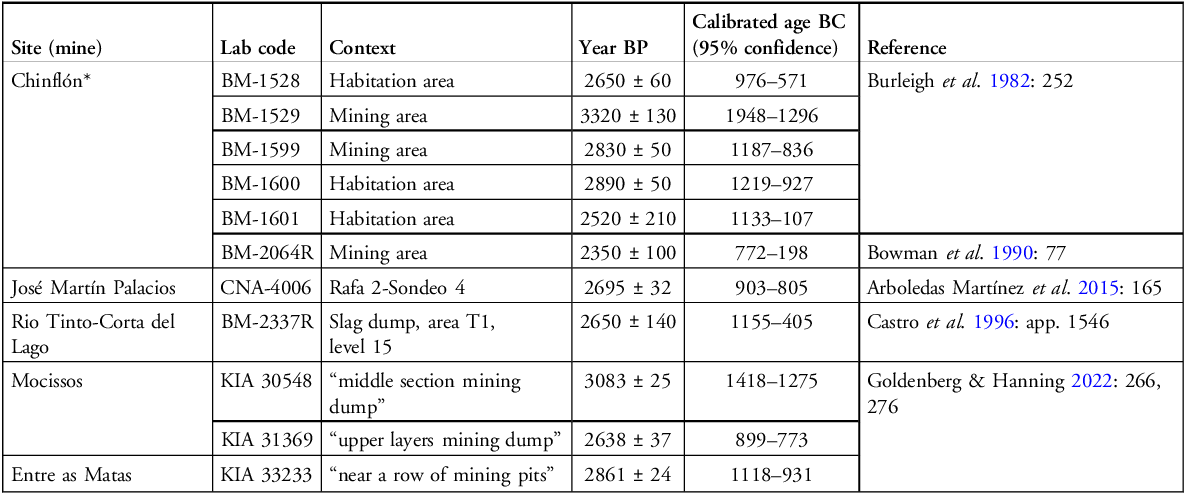
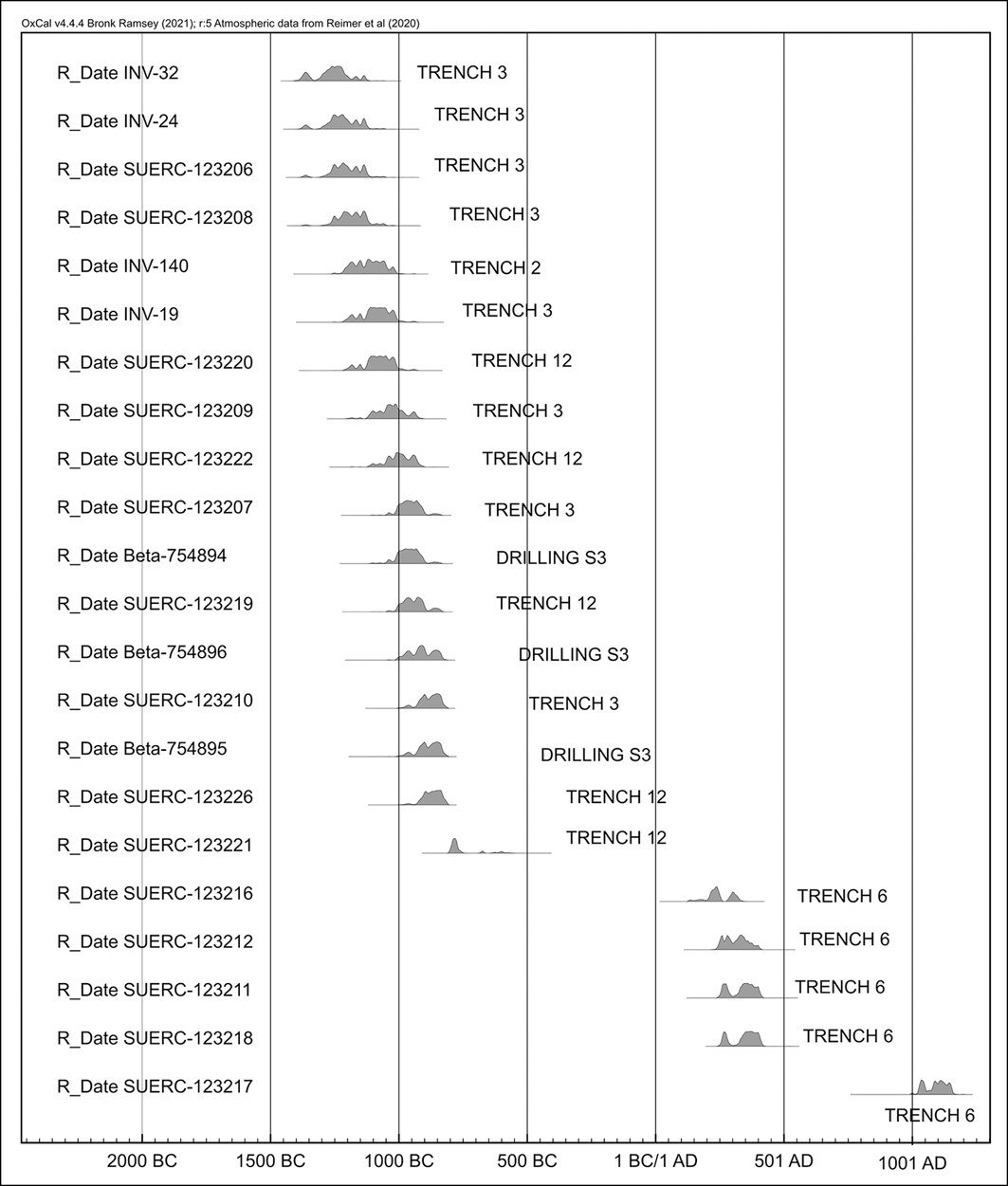
Nevertheless, direct research on Iberian Late Bronze Age copper mining has been limited, with few excavations providing absolute dates. Until recently, only 11 dates from five sites supported Late Bronze Age mining (Table 1). The extensive fieldwork conducted since 2020 at Las Minillas copper mine in Granja de Torrehermosa (Badajoz, Extremadura, south-west Spain) has yielded 17 absolute Late Bronze Age radiocarbon dates (Table 2, Figure 2).
Late Bronze Age radiocarbon dates from copper mines in Iberia (excluding Las Minillas).

Table 1 Long description
The table presents radiocarbon dates from different copper mines in Iberia, excluding Las Minillas. It includes seven rows and six columns. The columns are labeled Site (mine), Lab code, Context, Year BP, Calibrated age BC (95% confidence), and Reference. Each row lists data for a specific site, including the mine name, lab code, context, year before present (BP), calibrated age range in BC, and reference. The sites listed are Chinflón, José Martín Palacios, Rio Tinto-Corta del Lago, Mocissos, and Entre as Matas. Each site has multiple entries with different lab codes, contexts, and corresponding dates.
* Indicate old, poor-quality dates with large uncertainties.
Unpublished radiocarbon dates from Las Minillas.

Table 2 Long description
A table with 21 rows and 5 columns. The columns are labeled Lab. code, Sample (species), Context, Year BP, and Cal. age (95% confidence). The table lists radiocarbon dates from various samples of charcoal and charred material. Each row provides details on the laboratory code, sample species, context, year before present (BP), and calibrated age range with 95% confidence. The samples are from different contexts such as trenches and drilling depths, with species including Arbutus unedo, Quercus sp., Pistacia lentiscus, and others. The calibrated age ranges span from 1384–1156 BC to AD 1023–1158.
Probability distributions of the radiocarbon measurements mentioned in the text (generated with OxCal v.4.4.4) (figure by J. Latorre-Ruiz).

Las Minillas copper mine
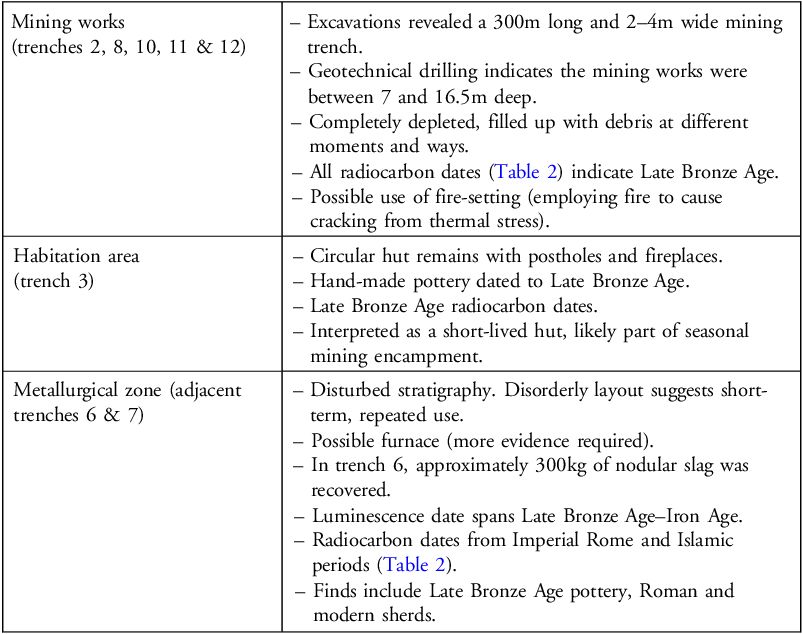
Las Minillas is a 300m-long outcrop of copper ore with quartz and calcite gangue (non-ore minerals associated with the ore), oriented 15 degrees east of north and located south of the municipality of Granja de Torrehermosa (Figure 3) (Hunt-Ortiz et al. Reference Hunt-Ortiz and Koch2025: 169). Prehistoric mining at the site was first noted by Claude Domergue (Reference Domergue1987: 38), followed by small-scale studies (Domínguez-Bella et al. Reference Domínguez-Bella and Rábano2000, Reference Domínguez-Bella and Gómez2001) and a surface survey (Hunt-Ortiz et al. Reference Hunt-Ortiz, Maria Mata-Perelló and Hunt Ortiz2017). Systematic investigation began in 2020 as a precursor to the Maritime Encounters Project, with major field campaigns carried out in 2020, 2021 and 2023. Although some Roman domestic and decorative artefacts (e.g. an Aucissa fibula) were recovered, these are unrelated to the mining, and more substantial modern underground works do not appear to have disturbed most of the prehistoric remains (Hunt-Ortiz et al. Reference Hunt-Ortiz and Koch2025). Table 3 summarises the results (see also Hunt Ortiz et al. Reference Hunt-Ortiz and Koch2025) and detailed discussion is in the online supplementary material (OSM5).
Aerial view of Las Minillas and the excavated trenches. The inset lidar image shows the surface area mined for copper (figure by J. Latorre-Ruiz; inset image by K. Sánchez with modifications).

Main results of the excavations by sector and trench (see also OSM5).

Table 3 Long description
A table summarizing excavation results by sector and trench. The table has three rows and three columns. Column headers are Mining works, Habitation area, and Metallurgical zone. Row 1: Mining works includes excavations revealing a 300m long and 2-4m wide mining trench, geotechnical drilling indicating depths between 7 and 16.5m, completely depleted trenches filled with debris, radiocarbon dates indicating Late Bronze Age, and possible use of fire-setting. Row 2: Habitation area includes circular hut remains with postholes and fireplaces, hand-made pottery dated to Late Bronze Age, Late Bronze Age radiocarbon dates, and interpretation as a short-lived hut likely part of a seasonal mining encampment. Row 3: Metallurgical zone includes disturbed stratigraphy with a disorderly layout suggesting short-term, repeated use, possible furnace, approximately 300kg of nodular slag recovered, luminescence date spanning Late Bronze Age to Iron Age, radiocarbon dates from Imperial Rome and Islamic periods, and finds including Late Bronze Age pottery, Roman and modern sherds.
Intensive surface and magnetometer surveys, conducted as part of the 2020 campaign, identified functional areas across the site. Investigated in 2021 and 2023, 11 trenches yielded mining, habitation and metallurgical zones (Figure 3, Table 3). The Late Bronze Age mining at Las Minillas focused on trench-type workings dug along the ore vein, now filled with debris. Excavation, ground-penetrating radar surveys and geotechnical drilling (using a Rolatec RL-36-L rotary rig) revealed that these trenches reached depths of 8.2m and widths of 2–4m. Drilling S3 (near trench 8) yielded charcoal samples at a depth of 8.2m (Figure 4), while charcoal concentrations at the base of trench 12 suggest the use of fire-setting to fracture the ore. Radiocarbon determinations based on samples from across the site indicate Late Bronze Age activity (Table 2).
Geotechnical drilling at Las Minillas (photograph courtesy of Las Minillas Archaeological Team).

In total, 892 lithic tools were documented, including 735 grooved stone hammers that parallel those from Chinflón and other Bronze Age mines (Pellicer & Hurtado Reference Pellicer and Hurtado1980; O’Brien Reference O’Brien2022: 69) (Figure 5). Identification of copper droplets, nodular slags and a pyrotechnological structure, possibly a furnace (trenches 6 & 7; Table 3, Figure 6), indicates that smelting took place. The scale of the mining works, the numerous Late Bronze Age radiocarbon dates (Figure 3) and the abundance of mining tools identify Las Minillas as the largest securely dated Late Bronze Age copper mine excavated in Iberia to date. By contrast, other mines with Late Bronze Age dates, such as Chinflón (Hunt-Ortiz Reference Hunt-Ortiz2003: 70), Entre as Matas (Goldenberg & Hanning Reference Goldenberg, Hanning and Kunst2022: 276) and José Martín Palacios (Arboledas Martínez et al. Reference Arboledas Martínez2015: 160), are considerably smaller. The ore vein at Mocissos in Portugal is longer (approximately 800m), but its exploitation appears to have spanned from the fourth millennium BC to the Iron Age, rather than being concentrated in the Late Bronze Age (Goldenberg & Hanning Reference Goldenberg, Hanning and Kunst2022: 266; Goldenberg et al. Reference Goldenberg, Hanning and Kunst2022: 184).
Grooved stone mining hammers (above) and Late Bronze Age pottery (below) recovered from Las Minillas (photographs by M. Díaz-Guardamino and Las Minillas Archaeological Team).

Excavations in trench 6, showing a partially preserved, circular pyrotechnological structure (photograph courtesy of Las Minillas Archaeological Team).

The chronology of Las Minillas
Radiocarbon dates from anthracologically identified charcoal samples offer chronological insights into three functional areas of Las Minillas—the mining trench, the habitation zone and the metallurgical area (Table 3). Nine samples obtained from the mining trench (trenches 2 & 12), including from drillings to its base (drilling S3), and eight from the habitation zone (trench 3) provide radiocarbon dates that span approximately 1350–750 BC, corresponding to the Late Bronze Age (Table 2, Figure 2). These dates are supported by the recovery of a few sherds of hand-made burnished pottery from the habitation zone (Figure 5) and correlate with the extraordinary number of stone tools identified on the surface and in the excavated trenches.
Five charcoal samples from the metallurgical area (trenches 6 & 7) provide much later dates. This area was characterised by the presence of nodular (not tapped) slags on the surface. During the excavation of trench 6 in 2022, all the slag was collected and processed, weighing a total of 300kg. The stratigraphy in this area is greatly affected by rodent burrowing, the removal of mining debris for ballast use and ploughing. The presence of characteristic, hand-made Late Bronze Age pottery and the initial attribution of the pyrotechnological structure (Figure 6) to the Late Bronze Age are called into question by the radiocarbon results and by the dating of a reddened clay fragment, possibly a piece of ‘furnace wall’, to 2.72±0.27 ky (between 2450 and 2990 ky before 2023) using optically stimulated luminescence (see OSM8). All five radiocarbon dates indicate more recent activity: four date to the Roman period (second–fourth centuries AD) and one to the Islamic period (Fabaceae, SUERC-123217 AD 1023–1158) (Table 2). These determinations include a charcoal sample (Quercus) obtained by flotation of crushed nodular slags (SUERC-123211, AD 250–412).
Lead isotope and chemical analyses
Lead isotope analysis has been used for approximately four decades to investigate Bronze Age metal provenance and, when combined with the chemical analyses of ores and ancient metals, can provide a good indication of the geographical origin of copper (Gale & Stos-Gale Reference Gale, Stos-Gale, Ciliberto and Spoto2000; Artioli et al. Reference Artioli2020). Ores, slags and copper metal droplets were collected during the excavations at Las Minillas and some were submitted for lead isotope and chemical composition analyses (see OSM4). The results of these analyses suggest that the copper minerals smelted at Las Minillas were formed during different mineral-forming events, which occurred at different times and involved ore-forming fluids of heterogeneous chemistry (Figure 7A, see also OSM7). Comparison with the lead isotope data for ores from other mines in the southern Iberian administrative provinces of Córdoba, Badajoz, Jaén and Huelva indicate that copper ores have similarly varied geochronology over this area (Figure 7A). The lead isotope ratios of the slags and copper droplets from Las Minillas fall between the values obtained from analysing modern ore samples from south-west Spain, indicating that copper ores from geochronologically different ore-forming events were used for smelting (Figure 7A). The complex geology of Las Minillas is being studied and will be reported in future publications.
A) Lead isotope ratios of copper ores from south-west Spain from IBERLID compared with data from Las Minillas show that ores in this region were formed in different events. The lines drawn through Las Minillas ore data points indicate approximate geochronology of separate ore-forming events. The ores from the mines in the Italian Alps (Artioli et al. Reference Artioli2020) have lead isotope ratios that differ from Las Minillas. B) Lead isotope ratios from Las Minillas have distinctive lead isotope ratios that are also found in some Sardinian copper ores (OXALID). Plots A and B show the lead isotope ratios of bronzes from Scandinavia that are isotopically consistent with copper smelted at Las Minillas (see OSM 7 & 9) (figure by Z. Stos-Gale).

The chemical analysis of the copper droplets, slags and ores from Las Minillas (OSM7) reveals characteristic fractionation. During smelting, trace elements from the copper ores partition between the slag and the metallic copper in varying amounts, with the retention of silver and antimony within the metal phase (Pernicka Reference Pernicka and Young1999). This partitioning is seen in the metallurgical samples from Las Minillas.
The lead isotope ratios of the samples from Las Minillas fall outside of the known ‘overlap’ between ores from mines in Spain and the Italian mines of Trentino Alto Adige (Figure 7A; Berger et al. Reference Berger2022; Stos-Gale & Ling Reference Stos-Gale and Ling2025). The Las Minillas ores are also distinct from copper ores found on Sardinia (Figure 7B). However, when compared with data on more than 300 Late Bronze Age bronze objects from sites across Scandinavia (Ling et al. Reference Ling2014, Reference Ling2019, Reference Ling2024; Melheim et al. Reference Melheim2018), 11 artefacts of various types emerge as isotopically and chemically consistent with the ores, slags and metal droplets from Las Minillas (Figure 7A & B; OSM9). Comparison of these 11 Scandinavian bronzes and the metal smelted in Las Minillas shows a similar, large range of contents of antimony and silver, indicating that some of the copper minerals smelted at Las Minillas in the Late Bronze Age contained quite high concentrations of silver and antimony (Figure 8A & B). On average, the amount of nickel in the Scandinavian bronzes is lower than in the samples from Las Minillas, but still within the range for some of the ores and metal droplets (Figure 8C). Two of the Scandinavian bronzes are dated to the Nordic Bronze Age Period VI (700–500 BC) and so post-date the final phase of exploitation at Las Minillas, but seven are assigned to Period V (900–700 BC), which closely corresponds with the latest documented phase of exploitation (Figure 9).
A & B) Samples from Las Minillas have a wide range of antimony (Sb) and silver (Ag) contents, and the Scandinavian artefacts dated to 1300–700 BC with lead isotope ratios consistent with Las Minillas also show a similar range of Sb and Ag contents; C) the range of nickel (Ni) content in samples from Las Minillas is larger than in the Scandinavian bronzes (figure by Z. Stos-Gale).

Map of find locations for Scandinavian bronzes with lead isotope ratios consistent with copper smelted at Las Minillas (figure by authors).

Preliminary comparisons with Late Bronze Age bronzes from Britain (Berger et al. Reference Berger2022; Stos-Gale & Ling Reference Stos-Gale and Ling2025), Poland (Nowak et al. Reference Nowak2023) and several regions of Spain and Portugal (Goldenberg & Hanning Reference Goldenberg, Hanning and Kunst2022; Montero-Ruiz Reference Montero-Ruiz, de la Torre Echávarri and Arias-Sánchez2023) indicate that some of these artefacts are also consistent with the lead isotope characteristics of copper smelted in Las Minillas. Further interrogation of these findings will be published with the site report.
The ‘Southern Iberian Copper Mining Complex’
Evidence from the excavations at Las Minillas indicates that copper production was active at the site between c. 1300 and 800/700 BC (Table 2, Figure 2). The site formed part of a broader network of prehistoric mining areas across southern Iberia, extending from southern Portugal to south-eastern Spain (Figure 10). In southern Portugal, copper deposits were exploited from the Chalcolithic through to the Late Bronze Age (Goldenberg & Hanning Reference Goldenberg, Hanning and Kunst2022; Valério et al. Reference Valério2023). In south-eastern Spain, recent studies have identified copper outcrops likely exploited during both the Chalcolithic and the Bronze Age (Arboledas Martínez et al. Reference Arboledas Martínez and Bartelheim2022; Murillo-Barroso et al. Reference Murillo-Barroso2019, Reference Murillo-Barroso2024). A total of 84 mining sites characterised by morphological features and surface finds (stone hammers) comparable to Late Bronze Age mines such as Las Minillas have been documented in south-west Iberia (Hunt-Ortiz Reference Hunt-Ortiz2003); however, it remains uncertain how many of these sites were actually exploited during the Late Bronze Age. More recent fieldwork has confirmed and expanded the evidence for Late Bronze Age mining activities in southern Portugal and south-western Iberia (Goldenberg & Hanning Reference Goldenberg, Hanning and Kunst2022; Hunt-Ortiz et al. Reference Hunt-Ortiz and Koch2025) and, at present, six mining sites can be securely attributed to the Late Bronze Age, including Las Minillas (Tables 1 & 2, Figure 10).
Distribution of mines with evidence of late prehistoric exploitation and of stelae in southern Iberia. Mines with Late Bronze Age radiocarbon dates: 1) Las Minillas; 2) José Martín Palacios; 3) Rio Tinto/Corta Lago; 4) Chinflón; 5) Mocissos; 6) Entre as Matas (map by M. Díaz-Guardamino, data from Domergue Reference Domergue1987; Hunt-Ortiz Reference Hunt-Ortiz2003; Hurtado Reference Hurtado2006–2009; Gauβ Reference Gauß2016; Soares et al. Reference Soares2020).

Estimates for the copper output of Las Minillas range from an optimistic 738 tonnes to a cautious 197 tonnes, with a minimum of 49 tonnes (Hunt-Ortiz et al. Reference Hunt-Ortiz and Koch2025: 182). By comparison, Great Orme—the largest prehistoric copper mine in Wales—is estimated to have produced between 202 and 756 tonnes during 1600–1400 BC (Williams & Le Carlier de Veslud Reference Williams and Le Carlier de Veslud2019: 1189), while the Mitterberg district had a far greater total output of approximately 23 000 tonnes between c. 1700 and 1300/1200 BC (Pernicka et al. Reference Pernicka2016; Williams Reference Williams2023).
Although Las Minillas yielded less copper than the Mitterberg or Great Orme, it formed part of a landscape of more than 100 prehistoric mines in southern Iberia that may have been exploited during the Late Bronze Age (Figure 10). If active contemporaneously, their combined output may have rivalled that of other major European mining districts. This is particularly significant given the decline of mining activity in the Mitterberg and Great Orme around 1300/1200 BC (Pernicka et al. Reference Pernicka2016; Williams Reference Williams2023), while Italian Alpine mining districts continued to supply copper during the Late Bronze Age (Artioli et al. Reference Artioli2020).
We refer to the potential collective Late Bronze Age mining activity (Figure 10) as the Southern Iberian Copper Mining Complex (SICMC). Although further dating and chemical analyses are needed, current evidence indicates that southern Iberia was a key node in Late Bronze Age copper circulation, raising two questions: why did mining in this region expand, and how is this linked to declining production in the Mitterberg and at Great Orme?
The SICMC in the context of Late Bronze Age connectivity
Iberia occupies a strategic position between Atlantic Europe and the Mediterranean, both regions with strong Late Bronze Age copper demand. Links between Atlantic Iberia and Atlantic Europe weakened during the Middle Bronze Age (Latorre-Ruiz Reference Latorre-Ruiz2024; Ling et al. Reference Ling2024: 25) but strengthened again in the Late Bronze Age (Burgess & O’Connor Reference Burgess, O’Connor and Celestino Pérez2008). The SICMC may have supplied copper to Atlantic, Nordic Atlantic and western Mediterranean regions, providing a maritime alternative to Central European routes (Vandkilde et al. Reference Vandkilde2024; Williams et al. Reference Williams2025).
The possibility of southern Iberian copper reaching distant European regions needs to be seen in the context of the southern Iberian Late Bronze Age mining boom (Montero-Ruiz Reference Montero-Ruiz, de la Torre Echávarri and Arias-Sánchez2023; Tomczyk et al. Reference Tomczyk and Meunier2023; Hunt-Ortiz et al. Reference Hunt-Ortiz and Koch2025), the re-emergence of maritime exchange networks that connected Iberia with the wider European Atlantic façade (Cunliffe Reference Cunliffe2001; Burgess & O’Connor Reference Burgess, O’Connor and Celestino Pérez2008) and renewed contacts with communities in Sardinia and Nordic Europe (Harrison Reference Harrison2004; Ling et al. Reference Ling2024; Berger et al. Reference Berger2025). Local mainland Iberian mining groups actively participated in these wider exchange networks. Sites such as Setefilla in the Guadalquivir Valley blended western Mediterranean, Atlantic and Nordic symbolism with local sculptural traditions, producing hybrid ‘warrior’ stelae (Díaz-Guardamino et al. Reference Díaz-Guardamino2019, Reference Díaz-Guardamino2022) (Figure 10). Their distribution across southern and western Iberia reveals routes linking tin-rich north-western areas with copper-rich southern zones and connecting metal-bearing interior regions with key coastal landing sites (Rodríguez-Corral & Rodríguez-Rellán Reference Rodríguez-Corral and Rodríguez-Rellán2023; Ling et al. Reference Ling2024: 25–38).
By 1400 BC, the output at Great Orme declined (Williams Reference Williams2023), followed by the Mitterberg around 1300/1200 BC (Pernicka et al. Reference Pernicka2016; Williams Reference Williams2023: 46). These regions, together with the Italian Alps, had previously supplied copper to much of western and northern Europe (Williams & Le Carlier de Veslud Reference Williams and Le Carlier de Veslud2019; Nørgaard et al. Reference Nørgaard, Nørgaard and Reiter2025; Stos-Gale & Ling Reference Stos-Gale and Ling2025). After their decline, the Italian Alps became the primary source, with Iberia contributing modestly. Only from around c. 1300/1200 BC do lead isotope and chemical signatures from bronze artefacts in western/northern Europe consistently match southern Iberian deposits (Berger et al. Reference Berger2022; O’Brien Reference O’Brien2022; Nowak et al. Reference Nowak2023; Nørgaard et al. Reference Nørgaard, Nørgaard and Reiter2025). This is the time of the Atlantic Late Bronze Age when Iberia rejoined maritime networks linking the Irish Sea, English Channel, North Sea and Baltic (Cunliffe Reference Cunliffe2001; Ling et al. Reference Ling2024), and participated in shared traditions of metalwork (Burgess & O’Connor Reference Burgess, O’Connor and Celestino Pérez2008) and convergent warrior and nautical iconography (Ling et al. Reference Ling2024; Díaz-Guardamino et al. Reference Díaz-Guardamino2026).
This article advances a hypothetical model in which Late Bronze Age Iberia complemented copper sources in the Alps, Wales and Sardinia within a polycentric metal-exchange system, supplying local, Atlantic–Nordic and western Mediterranean communities primarily via maritime routes. Assessing the SICMC’s significance relative to Alpine production remains difficult as Alpine mines supplied Europe both before and after the decline of Great Orme, while Iberia hosts numerous mines with currently poorly defined chronologies (Figure 10). Limited lead isotope and chemical data hinder provenance studies, but the number of Late Bronze Age radiocarbon dates for southern Iberian copper mines is rapidly increasing (Tables 1 & 2).
Conclusion
Understanding the flow of copper during the European Bronze Age is a complex field of research (e.g. Radivojević et al. Reference Radivojević2018). The importance of southern Iberia in the supply of copper during the Late Bronze Age has long been suspected but difficult to prove due to a chronic lack of research. The results of fieldwork at the copper mine of Las Minillas, providing radiometric dates and clarifying lead isotope signatures, highlight the potential importance of this site in long-distance provisioning and of this region more broadly as a copper-mining centre that may have rivalled the Italian Alps. This paves the way for re-evaluating the extensive evidence of copper mining in southern Iberia (Figure 10) (Hunt-Ortiz Reference Hunt-Ortiz2003; Murillo-Barroso et al. Reference Murillo-Barroso2019; Arboledas et al. Reference Arboledas Martínez and Bartelheim2022; Goldenberg et al. Reference Goldenberg, Hanning and Kunst2022; Valério et al. Reference Valério2023). The story of southern Iberia as a Late Bronze Age copper-production centre has only just begun to be uncovered; further investigation of other sites within the SICMC will, in time, add greater nuance.
Acknowledgements
The authors are grateful for the technical and human support provided by the Geochronology and Isotope Geochemistry-SGIker facility of Universidad del País Vasco/ Euskal Herriko Unibertsitatea.
Funding statement
This work was supported by the Riksbankens Jubileumsfond (grant M21-0018) and European funding (ERDF and ESF).
Online supplementary material (OSM)
To view supplementary material for this article, please visit https://doi.org/10.15184/aqy.2026.10438 and select the supplementary materials tab.





 Open access

