Introduction
Patients with thoracic trauma are a priority and special patient group for emergency physicians as they require rapid decision making and early intervention, and the increasing number of patients with thoracic trauma in natural disasters seriously affects the health care system. In the chaotic environment that occurs in emergency departments (EDs) after major natural disasters, blunt thoracic traumas may be overlooked. The decision-making process for hospitalization versus discharge is often complicated during disasters by the influx of patients and potential disruptions in health care services. Reference Ozel, Tatliparmak and Cetinkaya1,Reference Sato, Kobayashi and Ishibashi2
Although trauma severity scores are available to identify critically ill patients, their application may be hindered in chaotic and resource-limited environments during disasters. Reference Elgin, Appel and Grisham3,Reference Martínez Casas, Amador Marchante and Paduraru4 Additionally, various circumstances can influence physicians’ decisions regarding patient hospitalization and discharge in specific situations. Thoracic trauma, especially in the aftermath of a large-scale earthquake, presents unique challenges that can overwhelm health care systems, making it crucial to optimize management strategies. Identifying the characteristics of hospitalized and discharged patients with earthquake-related thoracic trauma may help improve triage protocols, optimize resource allocation, and enhance patient outcomes in future disaster scenarios.
This study investigated the characteristics of patients with earthquake-related thoracic trauma to determine factors influencing hospitalization decisions in a disaster context. The aim was to contribute to disaster preparedness, especially for centers in disaster areas.
Methods
This retrospective, cross-sectional study was conducted in a university hospital’s ED located in the earthquake area. All patients over 18 years of age who had earthquake-related thoracic trauma and presented to the adult ED from February 6, 2023 through February 21, 2023 were included. In addition to the demographic data such as age and gender, the data of initial clinical presentation, mechanism of injury, associated injuries, laboratory result, and the treatments provided from the hospital records were collected.
Patients were divided into two groups: the discharged group and the hospitalized group. Hospitalization or discharge decisions were based on the evaluation of the ED and consultant physicians. Patients with unstable vital signs, patients with life-threatening injuries on imaging results, patients with abnormal laboratory findings such as elevated creatinine, creatinine kinase (CK), or patients requiring follow-up for crush syndrome (with nephrology and orthopedics consultation), patients with severe symptoms such as dyspnea and loss of consciousness, patients at risk of complications due to comorbidities or injuries, and patients undergoing emergency surgical procedures were hospitalized and treated.
The study was approved by the Çukurova University’s, School of Medicine Ethics Committee (Adana, Türkiye; meeting #135 on July 14, 2023).
Statistical Analysis
The Jamovi 2.3.28.0 package program (Jamovi project; Sydney, Australia) was used to analyze the study data. Continuous variables were evaluated using the Shapiro-Wilks test, histogram, and q-q plots to determine whether they conformed to normal distribution. Continuous variables conforming to normal distribution were reported as mean and standard deviation (SD); those not conforming to normal distribution were reported as median and interquartile range (IQR 25%-75%). Categorical variables were defined by number and frequency. The Chi-square and Fischer exact tests were used to compare categorical variables. In the comparison of numerical values, the Mann Whitney U test was used for variables that did not confirm the normal distribution, Student’s t test and Welch’s test were used for variables that confirmed the normal distribution. Statistical significance level of .05 was accepted for all tests.
Results
The rate of thoracic trauma among all trauma-related ED presentations was 24.8% and 179 of these patients were included in the study (Figure 1). Ninety-two of the patients (51.4%) were female. The median age of all patients was 45 years (IQR 25%-75% = 33-61). The majority of the study population (n = 161; 89.9%) were the patients who came from Hatay province.
Patient Flow Diagram.

One hundred and forty-four (80.4%) patients were trapped under earthquake debris and 43.8% (n = 63) of them were rescued on the first day of the earthquake. There was no difference in hospitalization rate between genders. Hospitalization rate was higher in patients who were trapped under debris. In the subgroup analyses, it was determined that patients who were rescued on the second, third, or subsequent days were hospitalized more than those who were rescued on the first day (Table 1).
Characteristics of Patients

Note: *In familywise analyses, Bonferroni correction was made by dividing the P value by the number of hypothesis (3) and <.016 was considered statistically significant. Accordingly, it was determined that patients who were rescued on 2nd day and 3rd+ day were hospitalized more frequently than patients who were rescued on 1st day (P < .001 and P = .006, respectively), and there was no difference between those who were rescued on 2nd day and 3rd+ day (P = .819).
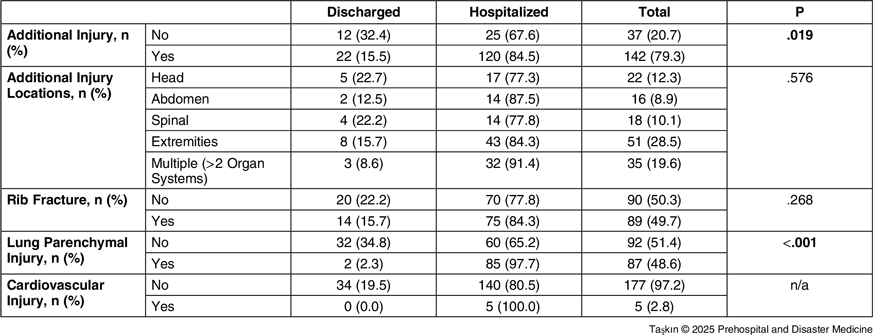
One hundred and forty-nine patients had 15 points from the Glasgow Coma Scale (GCS). There were 18 patients with GCS scores of three points, two with 14 points, four with 13 points, and two with seven points. There was one patient each with 12, 11, eight, and six points. When the types of traumas were analyzed, 171 patients (95.5%) had blunt trauma. One patient (0.6%) had blunt trauma and aspiration. Seven patients (7.0%) had burns in the chest area. Patients with injuries in addition to thoracic trauma had higher hospitalization rates; however, there was no difference in terms of affected organ systems between patients with additional injuries. Patients with lung parenchymal injury had higher hospitalizations rates (Table 2).
Additional Injuries to the Chest Injury and Injury Types of Patients

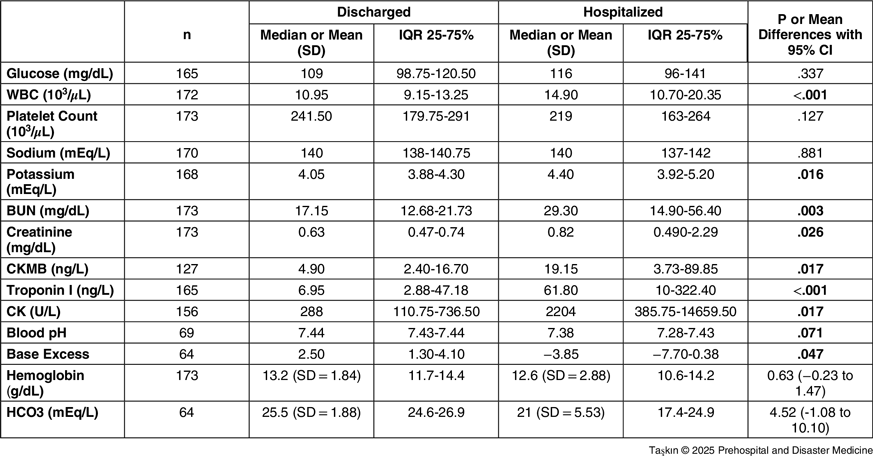
Hospitalized patients had higher white blood count (WBC), potassium, blood urea nitrogen (BUN), creatinine, CK, creatine kinase-myocardial band (CKMB), and troponin I levels than discharged patients. Base excess levels were decreased in hospitalized patients. Table 3 outlines the laboratory results for each patient.
Laboratory Results of Patients

Abbreviations: WBC, white blood count; CK, creatine kinase; CKMB, creatine kinase-myocardial band; BUN, blood urea nitrogen; HCO3, bicarbonate.
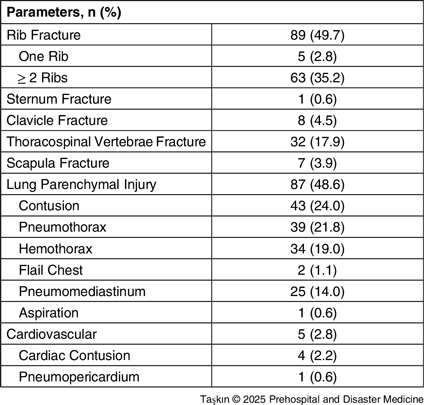
One hundred and three patients (57.5%) underwent Extended Focused Assessment with Sonography in Trauma (E-FAST) in the ED, 152 patients (84.9%) underwent x-ray, and 129 patients (72.1%) underwent computed tomography (CT). As a result of these examinations, rib fracture was detected in 89 patients (49.7%), lung parenchymal injury in 87 patients (48.6%), and cardiovascular injury in five patients (2.8%); Table 4.
Results of Imaging Studies

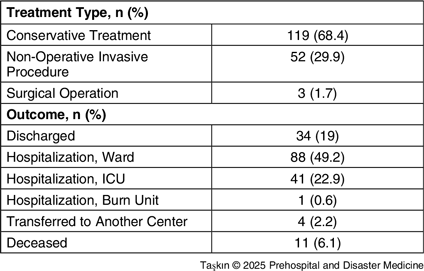
Three patients (1.7%) underwent surgical procedures and 52 (29.9%) patients had non-operative invasive procedures such as tube thoracostomy. Thirty-one (17.3%) patients were discharged from the ED, 130 (72.7%) were hospitalized in the center, and 11 (6.1%) patients lost their lives in the center (Table 5).
Types of Treatment Applied and Outcomes of Patients

Abbreviation: ICU, intensive care unit.
The median length of stay for the 179 patients in the ED was 360 minutes (IQR 25%-75% = 180-399).
Discussion
The February earthquakes affected 11 provinces in Türkiye and northern Syria, where approximately 15 million people reside. In addition to apartment buildings that collapsed, many public buildings such as hospitals and police stations were destroyed or heavily damaged. Significant transportation disruptions also occurred due to damage to highways. To manage the numerous on-going crises caused by the extensive damage in the region, a “state of emergency” was declared two days after the earthquake. This allowed for the administration of severely affected areas such as Hatay, Adıyaman, and Malatya to be overseen by neighboring provinces that were less impacted by the earthquake. While only 11 buildings collapsed and 418 people lost their lives in the province where the study hospital is located, the nearby province of Hatay experienced extensive destruction and loss of life. 5,6 The majority of this study’s population (89.9%) comprised patients from Hatay province. The high percentage of patients coming from Hatay likely reflects the severe damage in that region, leading to increased displacement and a greater need for accessible medical facilities outside the province. Damaged infrastructure, including roads and local hospitals, may have further contributed to patients seeking care in neighboring areas, creating an increased reliance on hospitals in nearby provinces. Additionally, patients coming from more heavily impacted areas such as Hatay may have presented with more severe injuries due to delayed access to medical assistance compared to those from less affected regions. This pattern of patient movement underscores the importance of flexible health care infrastructure that can accommodate a sudden influx of patients from disaster-affected areas, as well as the necessity of enhancing the resilience of local facilities in highly vulnerable regions.
In a study by Sarı, et al, which analyzed the first week following the earthquake, it was noted that the incidence of thoracic trauma was higher in patients trapped under collapsed structures compared to those injured during escape attempts. Reference Sarı, Özel and Akkoç7 Similarly, Ciflik, et al, in their examination of patients with thoracic trauma referred to their hospital from the earthquake-stricken region, found that 85.4% of the patients were trapped under debris. Reference Ciflik, Beyoglu and Sahin8 While various mechanisms such as falling, impact, or crushing could result in injury during an earthquake, the occurrence of the earthquake in the early morning hours (at 04:17am) and the fact that it took place during the winter season likely contributed to a higher number of individuals being trapped under rubble, especially as many were asleep in their homes at the time. People who spend long periods under rubble are more likely to develop post-traumatic complications. Prolonged exposure to pressure besides the thoracic injury can lead to serious issues such as crush syndrome and consequent kidney failure. Furthermore, delayed intervention increases the risk of infection and complicates patient recovery.
Despite the increase in diagnostic methods used in emergency medicine and modern treatment methods, thoracic trauma remains an important cause of mortality. The incidence of thoracic trauma in earthquake-related trauma patients can reach 16%. Reference Ozel, Tatliparmak and Cetinkaya1 In the present study, thoracic trauma was observed in 24.8% of patients. Sato, et al, which examined patients admitted after the Japan earthquake in 2011, reported a rate of chest trauma at 1.1%. It is noteworthy that this rate is considerably lower than the present study. This earthquake in Japan was larger than the February earthquake in Türkiye and was followed by a tsunami. However, in terms of the results, the number of dead and injured was 10% of that in Türkiye. Reference Sato, Kobayashi and Ishibashi2 In the 2008 Wen-Chuan earthquake, thoracic trauma was observed at a rate of 10.1%. Reference Hu, Guo and Zhang9 The socioeconomic and development levels of countries and related factors such as people’s lifestyles and building quality can be considered to change the damage caused by earthquakes in macro and micro dimensions.
In a study conducted after the Wen-Chuan earthquake involving 1,522 patients with thoracic trauma, it was observed that 43.9% of patients also sustained extremity injuries alongside thoracic injuries. Reference Hu, Guo and Zhang9 Similarly, in a study analyzing the aftermath of the Marmara earthquake on August 17, 1999, considered one of Türkiye’s largest natural disasters, Bulut, et al reported that extremities were the most frequently injured body region. Reference Bulut, Fedakar and Akkose10 The finding that extremity injury was the most common additional injury in the present study aligns with existing literature.
Blunt thoracic trauma represents a significant patient demographic in EDs, primarily due to the necessity of imaging for assessing its severity. In the current study, blunt thoracic trauma was observed in 95.5% of the patients. Given the potentially fatal nature of open thoracic injuries, earthquake victims may succumb to such injuries may have deceased under the debris without rescue. For evaluating patient injuries in the present study, x-rays were performed in 84.9% of cases, CT scans in 72.1%, and 57.5% were assessed using E-FAST in the ED. Akoğlu, et al suggested that E-FAST, conducted by emergency physicians, proves highly beneficial for patients with thoracic trauma. Reference Akoglu, Celik and Celik11 Additionally, thoracic ultrasound (US) administered by paramedics in prehospital settings is effective. Reference Kowalczyk, Turkowiak and Piotrowski12,Reference Khalil, Merelman and Riccio13 Due to its fast results and mobility, US holds critical importance in natural disaster scenarios. Increased utilization of US in disaster area centers and among experienced field teams could facilitate early and accurate patient diagnosis, thereby reducing the ED’s workload by averting unnecessary examinations. The portable nature of US enables rapid on-site assessments, which can be particularly valuable when transport to a hospital is delayed or when field triage is necessary to prioritize patients based on injury severity. Furthermore, by enabling faster triage and targeted assessment, US can help optimize the allocation of medical resources in disaster settings, where demand on health care facilities is often overwhelming. Training both emergency physicians and paramedics in advanced US applications can maximize its impact in disaster responses, ensuring that more personnel are prepared to effectively use this tool in critical situations. As expected after the earthquake, the ED was very busy, and the fact that the rate of E-FAST performed on patients was less than the rate of x-ray and CT scans may have prolonged the time patients spent in the ED.
Surgery was required 31.6% of this study’s patients, with 29.9% undergoing non-operative invasive procedures and 1.7% undergoing surgical operations. Nevertheless, the majority of patients were hospitalized, and unfortunately, 11 patients (6.1%) deceased due to their injuries. Pneumomediastinum, which is less common than hemothorax and pneumothorax in patients with chest trauma in the ED, was detected in 25 patients. Aspirations during the collapse, compression of the chest area, and hypoxia may have increased this condition which may be secondary to blunt trauma.
Crush syndrome and associated metabolic issues pose significant challenges in earthquake scenarios. In a study by Dişel, et al, numerous laboratory parameters were found to be elevated in patients who did not survive earthquakes compared to those who did. Reference Disel, Taskin and Daglioglu14 In the current study, the hospitalized patients exhibited higher levels of WBC, potassium, BUN, creatinine, CK, CKMB, and troponin I compared to discharged patients. Additionally, base excess levels were decreased in hospitalized patients. These findings align with elevated WBC levels, which typically signify inflammation or infection. Elevated levels of potassium, BUN, and creatinine suggest renal dysfunction or significant muscular injuries like crush syndrome, necessitating intensive treatment and monitoring. Elevated CKMB and troponin I levels indicate myocardial damage or cardiac stress due to ischemia, highlighting the need for cardiac monitoring and intervention. Decreased base excess levels signify metabolic acidosis and are associated with severe tissue damage and hypoperfusion. These laboratory results suggest that hospitalized patients generally present with more complex and severe clinical conditions, warranting advanced medical care and treatment. Therefore, patients should be closely monitored for these subsequent issues alongside their initial traumas. The implementation of standardized protocols for managing crush syndrome in earthquake-affected areas, including early and adequate fluid administration, could improve patient outcomes. Additionally, setting up specialized facilities with the capacity for renal replacement therapy and monitoring of electrolytes in disaster zones may be essential to manage the anticipated surge in crush syndrome cases effectively.
Limitations
The single-center and retrospective nature of this study limits its generalizability despite being one of the largest centers in the region. The chaotic environment and high influx of patients, especially in EDs after the earthquake, may have led to variability in assessment and treatment practices, potentially affecting the consistency of the collected data. None of the discharged patients ever returned to the study’s hospital. Due to limited access to the national medical record system, it was not possible to follow up on the subsequent health status of these patients.
Conclusion
This study provides insight into the prevalence of blunt thoracic trauma among patients presenting to the ED in the aftermath of the February 2023 earthquakes in Türkiye. The study findings emphasize the wide-spread use of imaging modalities for assessing thoracic injuries, with particular emphasis on the effectiveness of E-FAST and mobile US in rapidly and accurately diagnosing conditions in the context of natural disasters. The increased adoption of these diagnostic tools has the potential to alleviate the strain on EDs and enhance patient care in similar disaster scenarios.
Additionally, the need for surgical intervention was relatively low among these patients, yet a substantial proportion required hospitalization due to the severity of their injuries and elevated laboratory parameters. These findings underscore the importance of vigilant monitoring for complications such as rhabdomyolysis, crush syndrome, and infection, which are common among patients trapped under debris for extended periods. The elevated laboratory values observed in hospitalized patients highlight the complex clinical challenges they face and the necessity for specialized management protocols.
In large-scale natural disasters, a flexible health care system that can quickly handle patient surges is essential. This involves strengthening local facilities and ensuring that emergency teams are trained and equipped to manage serious earthquake-related injuries. This study also highlights the importance of rapid and accurate diagnosis to improve outcomes for disaster victims. A well-prepared response system can make a critical difference in saving lives.
Conflicts of interest
The author(s) declare none.