Introduction
It is accepted that in the bilingual mind both languages are co-active (e.g., Costa & Caramazza, Reference Costa and Caramazza1999; Kroll & Stewart, Reference Kroll and Stewart1994; Morford, Wilkinson, Villwock, Piñar & Kroll, Reference Morford, Wilkinson, Villwock, Piñar and Kroll2011; Meuter & Allport, Reference Meuter and Allport1999; Thierry & Wu, Reference Thierry and Wu2007). Theoretical models that account for language processing offer support for this concept (de Groot, Reference de Groot1992; Dijkstra & van Heuven, Reference Dijkstra and van Heuven2002; Kroll & Stewart, Reference Kroll and Stewart1994). Additionally, theoretical models that more directly account for language control also show support for the simultaneous activation of languages (Costa & Santesteban, Reference Costa and Santesteban2004; Costa, Santesteban & Ivanova, Reference Costa, Santesteban and Ivanova2006; Green, Reference Green1998). For instance, the inhibitory control (IC) model (Green, Reference Green1998) proposes that because both languages are active in parallel, lexical items from the non-target language must be inhibited in order for the target language lexical items to be activated and selected. One assumption of this model is that proficiency influences the amount of inhibition that lexical items receive. Another assumption is that inhibitory control mechanisms required for language control are domain-general, i.e., linguistic and non-linguistic control tasks tap an overlapping inhibitory control network.
In this study we aim to explore the relationship between linguistic control and non-linguistic control in bilingual adults with aphasia (BAA). In this population, the delicate balance between the languages, i.e., language control, can be disrupted, thus offering a unique opportunity to explore the relationship between linguistic and non-linguistic control mechanisms. The IC model is integral to our analyses because it offers an explanation for language control as a function of inhibitory control processes which are a type of cognitive control and fundamental to control in non-linguistic contexts. A logical place to begin this exploration is to discuss cognitive control and to review a model that identifies types of cognitive control that can be examined.
Cognitive control is used to regulate a wide variety of processes that include but are not limited to attention, mental flexibility, problem solving, reasoning, goal formation, planning, and execution (Jurado & Rosselli, Reference Jurado and Rosselli2007). It is often associated with the functions observed in the prefrontal cortex (Aron, Reference Aron2007; Miller & Cohen, Reference Miller and Cohen2001). Pertinent to the present study, one component of cognitive control is inhibition. Therefore, we briefly discuss the Friedman and Miyake (Reference Friedman and Miyake2004) study that accounts for three types of interference and explores inhibitory control in both the linguistic and non-linguistic domains by framing various experimental tasks within the different types of inhibition: 1) prepotent response inhibition which is the ability to suppress a response that was trained to be automatic; 2) resistance to distractor interference which is the ability to ignore distracting, non-target stimuli, and 3) resistance to proactive interference, which is the ability to resist distracting, non-target stimuli which was previously response stimuli. Ultimately, by making clear distinctions between types of inhibition, the intrinsic quality of Friedman and Miyake's (Reference Friedman and Miyake2004) study is that it allows for investigations that tease apart the fine differences between types of inhibition and how they present in particular domains, i.e., linguistic and non-linguistic.
Recently, studies have begun to examine and compare the performances of healthy bilingual groups on linguistic control tasks and non-linguistic control tasks. The findings have produced conflicting results that provide evidence for 1) an association between the mechanisms that underlie the two systems which is indicative of domain general cognitive control (Festman & Münte, Reference Festman and Münte2012; Festman, Rodriguez-Fornells & Münte, Reference Festman, Rodriguez-Fornells and Münte2010; Prior & Gollan, Reference Prior and Gollan2011; Soveri, Rodriguez-Fornels & Laine, Reference Soveri, Rodriguez-Fornells and Laine2011), and 2) a dissociation between the mechanisms that underlie the two systems which is indicative of domain specific cognitive control (Calabria, Branzi, Marne, Hernández & Costa, Reference Calabria, Branzi, Marne, Hernández and Costa2015; Calabria, Hernández, Branzi & Costa, Reference Calabria, Hernández, Branzi and Costa2012; Weissberger, Wierenga, Bondi & Gollan, Reference Weissberger, Wierenga, Bondi and Gollan2012).
For instance, Prior and Gollan (Reference Prior and Gollan2011) examined the performance of a group of bilinguals who habitually switched languages, a group of bilinguals who did not habitually switch languages, and a group of monolinguals on a linguistic and a non-linguistic task switching paradigm designed to tap resistance to proactive interference. On the non-linguistic task, results revealed no difference between the non-habitual language switchers and the monolingual group, whereas the habitual language switchers outperformed the monolinguals and non-habitual language switchers. On the linguistic task, results revealed that the habitual language switchers outperformed the non-habitual language switchers. These findings suggest that, within bilingual groups, control mechanisms can be influenced to various degrees and effects are observed in the linguistic and non-linguistic domain. In a set of studies, Festman et al. (Reference Festman, Rodriguez-Fornells and Münte2010; Reference Festman and Münte2012) examined bilingual groups who were categorized as intentional language switchers and non-intentional language switchers. Tasks included a go-No-go task designed to tap prepotent response inhibition, the Flanker task, designed to test resistance to distractor interference, and the Wisconsin Card Sorting Task, designed to tap resistance to proactive interference. Similar to Prior and Gollan (Reference Prior and Gollan2011), the intentional language switchers outperformed the non-intentional language switchers, indicating that skill in the linguistic domain can transfer to the non-linguistic domain. In sum, these findings suggest a link between mechanisms of linguistic control and non-linguistic control, which is indicative of domain general cognitive control.
In contrast, other studies have revealed a dissociation between linguistic control and non-linguistic control mechanisms (Calabria et al. Reference Calabria, Hernández, Branzi and Costa2012; Reference Calabria, Branzi, Marne, Hernández and Costa2015; Weissberger et al., Reference Weissberger, Wierenga, Bondi and Gollan2012). In two studies, Calabria et al. (Reference Calabria, Hernández, Branzi and Costa2012; Reference Calabria, Branzi, Marne, Hernández and Costa2015) asked bilinguals to complete two tasks that targeted resistance to proactive interference: a non-linguistic, cued color-shape sorting task and a linguistic, cued picture naming task. In the 2012 study, young adult participants showed symmetrical switch costs for the linguistic task but asymmetrical switch costs for the non-linguistic task, indicative of domain specific cognitive control. In the 2015 study, participants included highly proficient Catalan–Spanish bilinguals who were categorized as young, middle, and old aged adults. Findings revealed age related change only on the non-linguistic task, offering more evidence in support of a dissociation between linguistic control and non-linguistic control, suggestive of domain specific cognitive control.
Up to this point, we have reviewed studies that examine control mechanisms in healthy bilinguals. A complementary approach to examine these mechanisms and their relationship across domains is to look through the lens of bilingual aphasia. Individuals with bilingual aphasia may present with deficits in lexical access and language control. These two processes are distinct, but also intertwined, such that language control deficits in bilingual aphasia can give rise to a variety of language impairment issues, e.g., impairment and recovery patterns and/or non-target language intrusion errors. Therefore, this population allows for a unique method to further explore control mechanisms in the brain and how they relate to linguistic and non-linguistic domains.
Few studies have investigated control mechanisms in bilingual adults with aphasia (BAA; Dash & Kar, Reference Dash and Kar2014; Gray & Kiran, Reference Gray and Kiran2016; Green, Grogan, Crinion, Ali, Sutton & Price, Reference Green, Grogan, Crinion, Ali, Sutton and Price2010; Verreyt, De Letter, Hemelsoet, DSantens & Duyck, Reference Verreyt, De Letter, Hemelsoet, Santens and Duyck2013). For instance, Green et al. (Reference Green, Grogan, Crinion, Ali, Sutton and Price2010) asked two non-native English BAA (French–English and Spanish–English) to perform three tasks that required control in linguistic and non-linguistic contexts. The non-linguistic control task tapped resistance to distractor interference, whereas the first linguistic task tapped prepotent response inhibition and the second linguistic task best related to resistance to distractor interference. Findings were two fold: results from one patient offered support of domain general cognitive control, whereas results from the second patient offered support of domain specific cognitive control. This is a compelling outcome because it presents differential findings and warrants further investigations.
More recently, Dash and Kar (Reference Dash and Kar2014) investigated the mechanisms of linguistic and non-linguistic control by examining conflict resolution. Specifically, they examined proactive control (i.e., anticipatory decision making, preparing for an upcoming event) and reactive control (i.e., the ability to resolve interference after it occurs) in linguistic and non-linguistic contexts. Four bilingual patients with aphasia were asked to complete three tasks that tapped resistance to distractor interference. The findings point towards a dissociation between language control and cognitive control as evidenced by the variation of engaged control processes across tasks.
Finally, Gray and Kiran (Reference Gray and Kiran2016) employed a group design to investigate cognitive control in ten BAA. Participants were asked to complete one linguistic task and one non-linguistic task that each tapped resistance to distractor interference. Results revealed that BAA exhibited normal effects of control on the non-linguistic task and impaired effects of control on the linguistic task, indicative of domain specific cognitive control.
The results from these studies on control mechanisms in bilingual aphasia illustrate the dynamic relationship between linguistic and non-linguistic control in this population. Because the findings appear to support opposing viewpoints, these data are provocative and emphasize the need for more research to explore this topic. To target control mechanisms, the studies employ tasks that tap the three types of inhibition (Friedman & Miyake, Reference Friedman and Miyake2004). Because of this, it is challenging to make meaningful comparisons across studies. It could be that type of inhibition may play an informative role in domain general vs domain specific cognitive control processing. It is apparent that in addition to task type (i.e., linguistic and non-linguistic), inhibition type across tasks is an important variable that must be controlled. Thus, accounting for inhibition type will contribute to a study with a clear focus to examine the effects of control in two domains and how they interact.
To extend the results from Gray and Kiran (Reference Gray and Kiran2016) that examined resistance to distractor interference, the tasks for the current study were specifically chosen to tap the same type of inhibition across domains to account for two key variables: 1) the congruency effect and 2) task complexity. First, each task includes congruent and incongruent conditions, and we will examine the data for the congruency effect, i.e., greater accuracy or shorter response times on congruent conditions relative to incongruent conditions. Based on experimental paradigms that require cognitive control, neurologically healthy individuals have been observed to exhibit the congruency effect; therefore, this behavioral presentation is indicative of unimpaired linguistic or non-linguistic control. In contrast, a deviation from the congruency effect, i.e., a lack of the congruency effect, shows that the individual may not be appropriately managing target and non-target stimuli.
Second, the tasks are designed to examine the role of complexity on cognitive control. The two low-level complexity tasks consist of a non-linguistic Flanker task (NL-Flanker) and a linguistic Flanker task (L-Flanker) in which non-target stimuli must be inhibited in order to identify the target stimuli characteristic, i.e., the directionality of arrows or language identification. The two high-level complexity tasks consist of a non-linguistic triad task (NL-Triad) and a linguistic triad task (L-Triad) in which non-target stimuli that vary by two dimensions must be suppressed in order to identify targets with their matches, i.e., managing colors and shapes or within- and between-language word-pairs. To summarize, on the high-level tasks more information must be managed and processed compared to the low-level tasks, and this complexity hierarchy will allow us to account for how mechanisms of control may function differently when processing tasks of low-complexity vs. tasks of high-complexity.
The NL-Flanker task has been shown to evoke congruency effects in neurologically healthy bilingual adults (NHBA) (Gray & Kiran, Reference Gray and Kiran2016; Green et al., Reference Green, Grogan, Crinion, Ali, Sutton and Price2010; Gollan et al., Reference Prior and Gollan2011), whereas these findings are inconclusive in BAA (Dash & Kar, Reference Dash and Kar2014; Gray & Kiran, Reference Gray and Kiran2016; Green et al., Reference Green, Grogan, Crinion, Ali, Sutton and Price2010; Verreyt et al., Reference Verreyt, De Letter, Hemelsoet, Santens and Duyck2013). The NL-Triad task has not yet been studied in healthy adults or patient populations; however, because it requires inhibition and uses congruent and incongruent constructs similar to the NL-Flanker task, we expect that it will evoke the congruency effect in healthy adults and patients. The two linguistic control tasks have not been previously investigated, but because the experimental designs systematically control for the increased demands of language control (i.e., incongruent conditions require more language control effort relative to congruent conditions) and because previous studies that have explored language control have revealed that NHBA exhibit the congruency effect in linguistic contexts (Gray & Kiran, Reference Gray and Kiran2016; Green et al., Reference Green, Grogan, Crinion, Ali, Sutton and Price2010; Bialystok, Craik & Luk, Reference Bialystok, Craik and Luk2008), we expect to find congruency effects in NHBA. In contrast, BAA performance on linguistic control tasks is conflicting (Gray & Kiran, Reference Gray and Kiran2016; Green et al., Reference Green, Grogan, Crinion, Ali, Sutton and Price2010) and based on previous research, we expect that BAA will be more vulnerable to incongruent conditions in which case they may not show congruency effects. The following are our specific research questions.
Research Questions
Research question 1: What is the evidence for domain general cognitive control or domain specific cognitive control processing as reflected by congruency effects on linguistic and non-linguistic tasks that are presented in terms of low and high complexity for NHBA and BAA?
If NHBA or BAA show congruency effects or no congruency effects on both the non-linguistic and linguistic tasks, this provides evidence for domain general cognitive control. In contrast, if NHBA or BAA exhibit congruency effects in one domain (e.g., non-linguistic) and no congruency effects in the other domain (e.g., linguistic) or vice versa, this provides evidence of domain specific cognitive control. Finally, to address the effect of task complexity, if NHBA show congruency effects on both linguistic and non-linguistic low complexity tasks or on both linguistic and non-linguistic tasks high complexity tasks, this will be indicative of domain general cognitive control because it identifies a distinct pattern that is systematically grouped across complexity. These results will also reveal differential effects of task complexity.
Research question 2: What is the relationship between the magnitude of conflict across linguistic and non-linguistic tasks that are presented in terms of low- and high-complexity in NHBA and BAA?
To examine the magnitude of conflict, we use the conflict ratio proposed by Green et al. (Reference Green, Grogan, Crinion, Ali, Sutton and Price2010): (incongruent – congruent)/congruent. Based on the literature (Gray & Kiran, Reference Gray and Kiran2016; Green et al., Reference Green, Grogan, Crinion, Ali, Sutton and Price2010), we hypothesize that NHBA will show an association between linguistic and non-linguistic conflict ratios for each level of complexity, suggesting that the ability to inhibit incongruent conditions on the linguistic task is related to the ability to inhibit incongruent conditions on the non-linguistic task, further providing evidence for domain general cognitive control. We expect that BAA conflict ratios will also show an association between linguistic and non-linguistic tasks. However, because BAA present with deficits in lexical access and are vulnerable to language control deficits (Gray & Kiran, Reference Gray and Kiran2016; Green et al., Reference Green, Grogan, Crinion, Ali, Sutton and Price2010), we may see a dissociation between linguistic and non-linguistic conflict ratios. In other words, there would be no correlation between the conflict ratios of linguistic and non-linguistic tasks characterized by larger conflict ratios on the linguistic tasks compared to the non-linguistic tasks. This would indicate that it takes BAA longer to resolve the incongruent trials on linguistic tasks compared to non-linguistic tasks.
Research question 3: What is the relationship between brain damage and the ability to process information presented in linguistic and non-linguistic contexts?
Based on previous findings (Hunting-Pompon, Kendall & Moore, Reference Hunting-Pompon, Kendall and Moore2011; Murray, Reference Murray2012; Robin & Rizzo, Reference Robin and Rizzo1989), we hypothesize that BAA who exhibit slower response times on linguistic and non-linguistic tasks will also present with greater language impairment (as evidenced by lower diagnostic scores) because we expect that brain damage affects the ability to successfully manage linguistic and non-linguistic information.
Methods
Participants
Twenty Spanish–English bilingual NHBA (6 males) ranging in age from 30–75 (M = 48, SD = 13) and thirteen Spanish–English bilingual BAA (7 males) ranging in age from 31–65 (M = 49, SD = 12) participated in this study. Eighteen NHBA and ten BAA were recruited from the Boston, MA area, 2 NHBA were recruited from the San Francisco, CA area, and the remaining 3 BAA were recruited from the Austin, TX area. NHBA and BAA were matched on age (t(31) = .25, p = .81) and education (t(31) = −.12, p = .91). NHBA did not exhibit neurological, cognitive and/or psychological impairment. All BAA were at least 12 months post onset from a cerebrovascular accident, except two who had gunshot wounds. All participants were right handed, and according to the Boston University Human Subjects Protocol gave informed consent prior to participation in the study.
NHBA and BAA filled out a participant or patient history form and completed the Language Use Questionnaire (LUQ: Kiran, Peña, Bedore & Sheng, Reference Kiran, Peña, Bedore and Sheng2010) with a licensed speech language pathologist or trained student clinician. The LUQ asks specific questions about: (a) age of acquisition for first language (L1) and second language (L2); (b) number of years of lifetime exposure for hearing, speaking, and reading L1 and L2; (c) confidence for hearing, speaking, and reading L1 and L2; (d) current exposure that includes an hour by hour account of language(s) spoken and heard by participant during his/her daily routine (weekday/weekend) (for BAA this includes a separate rating for pre- and post-stroke language exposure); (e) language proficiency of first degree family members; (f) language of education history, specifically, languages spoken and preferred by participant and other students in elementary school, high school, and college environments; and (g) language ability rating (LAR) for L1 and L2 including overall ability, speaking in casual conversations, listening in casual conversations, speaking in formal situations, listening in formal situations, and reading and writing using a 5 point scale where 1 represents non-fluent skills (e.g., speaking at the single word level) and 5 represents native or near native-fluency (for BAA, LAR data was collected for pre- and post-stroke language skill). LAR values for English and Spanish are calculated by taking an average from all LAR categories. In our previous work (Gray & Kiran, Reference Gray and Kiran2013; Reference Gray and Kiran2016; Kiran, Balachandran & Lucas, Reference Kiran, Balachandran and Lucas2014) we found LAR to be a reliable indicator of an individual's language proficiency. It provides a quantitative value so that it can be employed as a covariate that captures proficiency in the linguistic statistical models.
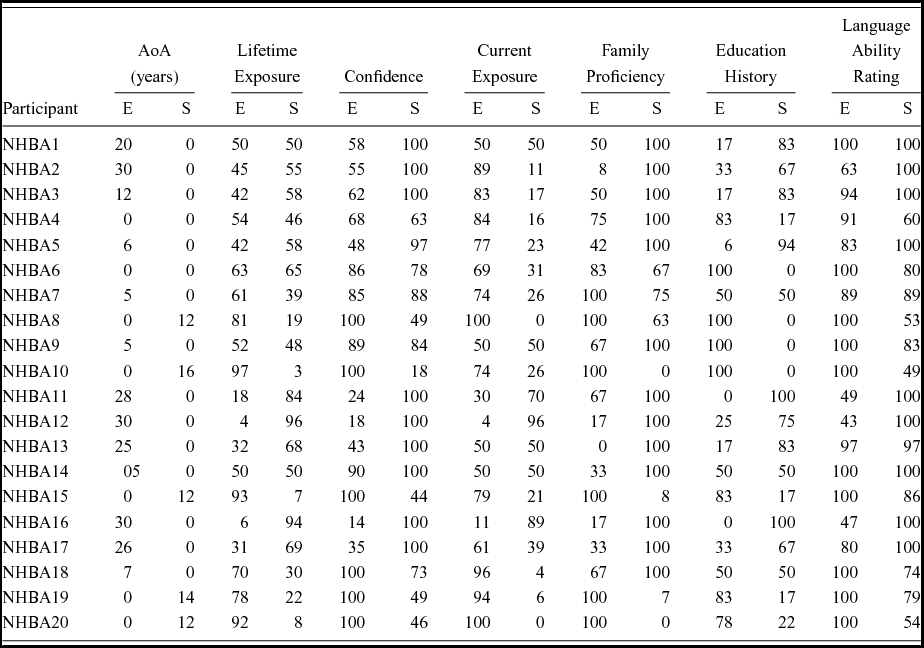
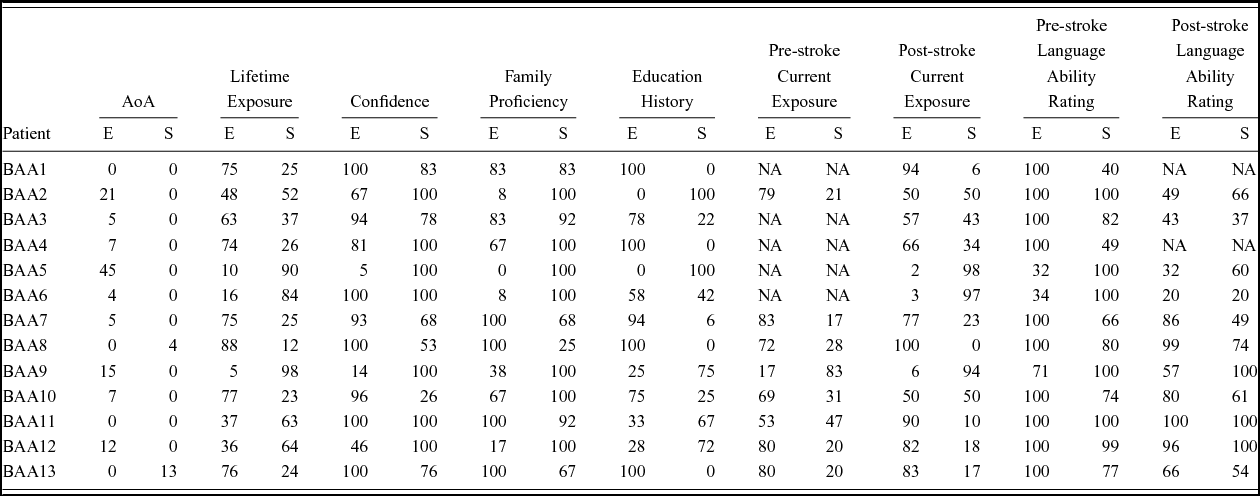
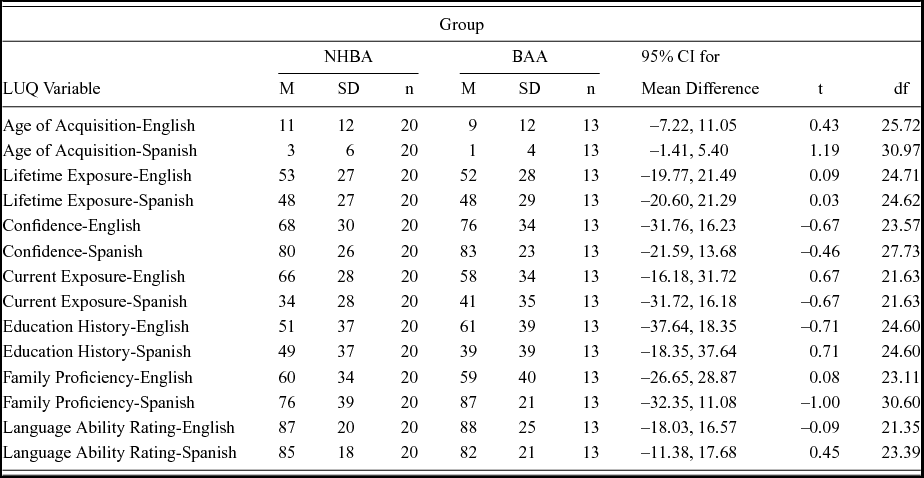
According to LAR, 9 NHBA were English dominant, 7 NHBA were Spanish dominant and 4 NHBA were balanced and this aligns with BAA language dominance profiles. According to pre- and post-LAR, 7 BAA were English Dominant, 2 BAA were Spanish Dominant, 2 BAA were balanced, 1 BAA was balanced before his stroke and Spanish dominant after his stroke and 1 BAA was Spanish dominant before his stroke and was balanced after his stroke. Generally, a third of each participant group had more lifetime exposure, greater confidence and greater language ability rating in English, another third of each group followed the same trends favoring Spanish, and a final third of each group considered themselves as having balanced exposure, confidence, and self-rating. See Table 1 and Table 2 for NHBA and BAA LUQ profiles. NHBA and BAA were matched on all LUQ variables. For results of t-test and descriptive statistics for LUQ variables for both groups, see Table 3.
NHBA Language Use Questionnaire variables (percents).

Note: NHBA = neurologically healthy bilingual adult, AoA: age of acquisition, E = English, S = Spanish.
BAA Language Use Questionnaire variables (percents).

Note: BAA = bilingual adults with aphasia, AoA = age of acquisition, NA = not applicable, E = English, S = Spanish.
Results of t-test and descriptive statistics for Language Use Questionnaire variables.

Note. Satterthwaite approximation employed due to unequal group variances. All p > .05.
Additionally, BAA completed the following standardized tests: the Boston Naming Test (BNT) (Kaplan, Goodglass & Weintraub, Reference Kaplan, Goodglass and Weinraub2001) in Spanish and English to identify confrontation naming ability in each language; the Pyramids and Palm Trees Test (PPT) – Picture Version (Howard & Patterson, Reference Howard and Patterson1992) to identify the integrity of the semantic system; the Symbol Cancellation, Symbol Trails, and Design Generation subtests from the Cognitive Linguistic Quick Test (CLQT) (Helm-Estabrooks, Reference Helm-Estabrooks2001) to identify deficits of general cognitive processing; the Bilingual Aphasia Test (BAT) (Paradis, Reference Paradis1989) in English and Spanish and the BAT Part C to identify overall receptive, expressive and translation deficits in each language; the Imageability and Frequency Visual Lexical Decision (#25) subtest from the Psycholinguistic Assessments of Language Processing in Aphasia (PALPA) (Kay, Coltheart & Lesser, Reference Kay, Coltheart and Lesser2001) and the Spanish translation (Decisión lexica visual: imaginabilidad y frecuencia [#26]; la Evaluación del Procesamiento Lingüístico en la Afasia; Coltheart, Kay & Lesser, Reference Coltheart, Kay and Lesser1995). An accuracy score of at least 65% or higher on the written word judgement task in English or Spanish was established in order to ensure the ability to perform the experimental tasks.
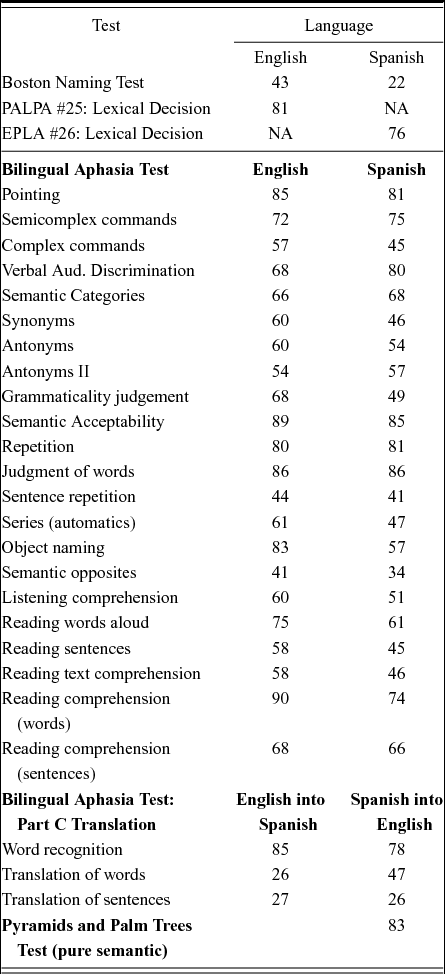
Approximately half of the BAA showed mild to moderate lexical access and language control impairments, and the remaining BAA demonstrated more severe language deficits. Naming skills were generally less impaired for English compared to Spanish. This trend was also observed for lexical decision tasks. Patients demonstrated a more than adequate performance on semantic judgement tasks. Non-linguistic test results followed language testing trends: approximately half of the BAA showed mild to moderate non-linguistic impairment and the remaining BAA demonstrated more severe impaired skill. For a complete summary of test results, see Table 4. See Supplemental Table 1ab and Table 2ab (Supplementary Materials) for diagnostic test scores for each patient.
Boston Naming Test, PALPA, EPLA, Bilingual Aphasia Test + Part C Translation, Pyramids and Palm Trees Test (patient averages).

Tasks
All participants completed four experimental tasks that included congruent and incongruent conditions and were presented using E-Prime (Psychology Software Tools, Inc., 2012). Participants were seated a comfortable distance from the computer, instructed to use a left hand, keyboard button press and to respond as quickly as possible. Specific instructions for each task are detailed below. Linguistic tasks were presented before the non-linguistic tasks; however, the order of each task type was counterbalanced.
Non-linguistic Flanker task
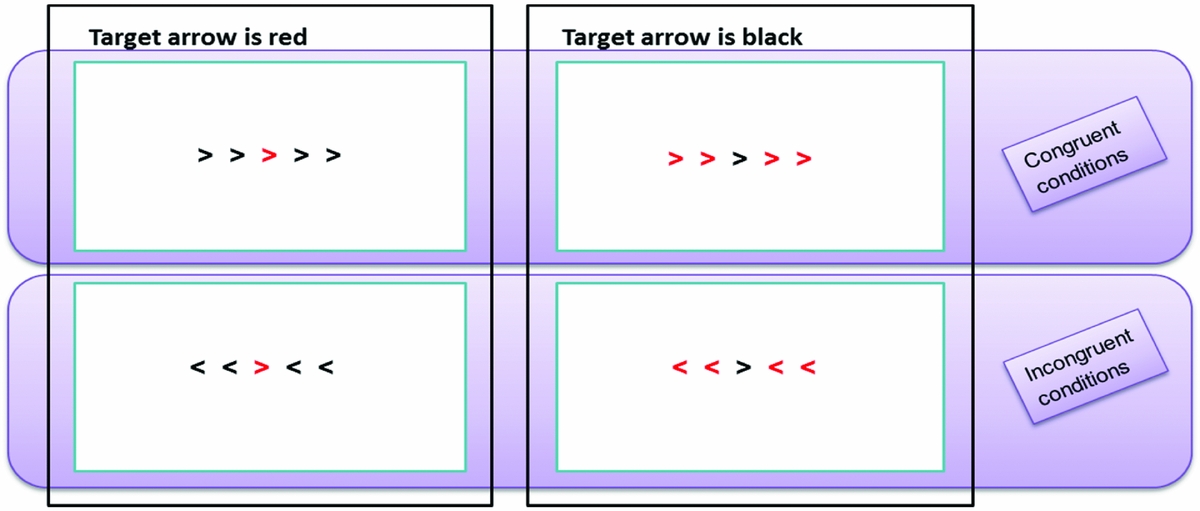
On each trial, participants were presented with a row of 5 arrows. In half of the trials, the target arrow was red and the flanking, non-target arrows were black. In the other half of the trials the target arrow was black and the flanking, non-target arrows were red. The target arrow was pseudorandomized to alternate position (e.g., center, left and right sides), and participants were instructed to indicate the directionality of the target arrow with a button press. See Figure 1 for sample stimuli. A total of 160 trials were presented in two runs, each consisting of two blocks. Each block included 20 congruent (10 red arrows and 10 black arrows) and 20 incongruent (10 red arrows and 10 black arrows) trials that were pseudorandomized by target arrow color (red and black) and condition (congruent and incongruent). A fixation cross was presented for 500ms, and the stimuli were presented for 2000 ms.
Non-linguistic Flanker task stimuli sample.

Linguistic Flanker task
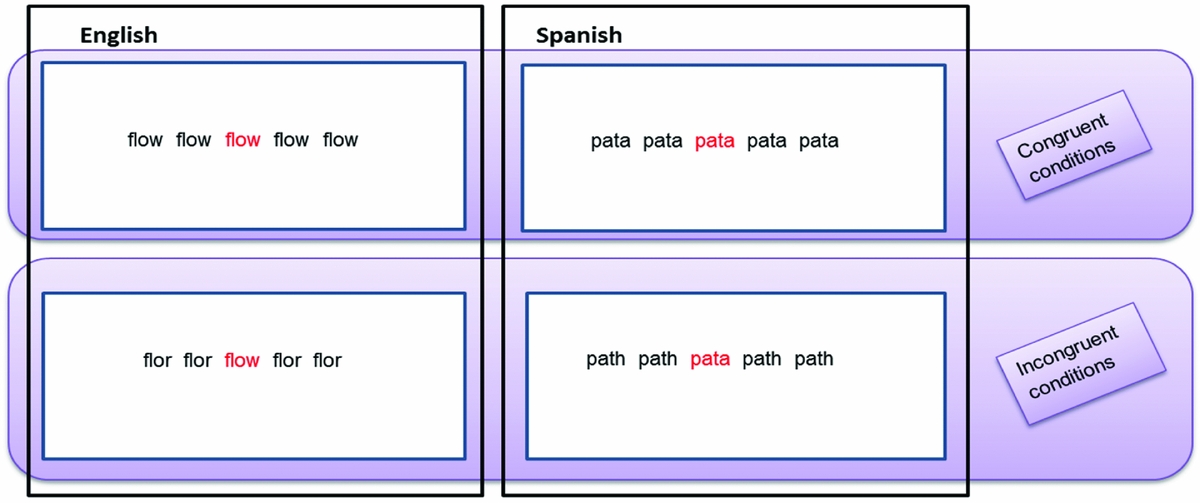
On each trial, participants were presented with a row of 5 words. In half of the trials the target word was Spanish and in the other half the target word was English. The target word was always red and the flanking, non-target words were always black. Participants were instructed to use a button press to identify the target word as English or Spanish. In the congruent condition, the flanking, distractor words were a repetition of the target word in that trial. In the incongruent condition, the flanking, distractor words differed from the target word by 1) language and 2) one phoneme. The target word was pseudorandomized to alternate position (e.g., center, left and right sides). See Figure 2 for sample stimuli. A total of 160 trials were presented in two runs, each consisting of two blocks. Each block included 20 congruent (10 Spanish targets and 10 English targets) and 20 incongruent (10 Spanish targets and 10 English targets) trials that were pseudorandomized by target language (Spanish and English) and condition (congruent and incongruent). Because the basic structure of this task is very similar to the NL-Flanker, the stimulus presentations were matched where each condition was preceded by a fixation cross presented for 500ms and the stimuli were presented for 2000 ms.
Linguistic Flanker task stimuli sample.

Non-linguistic triad task
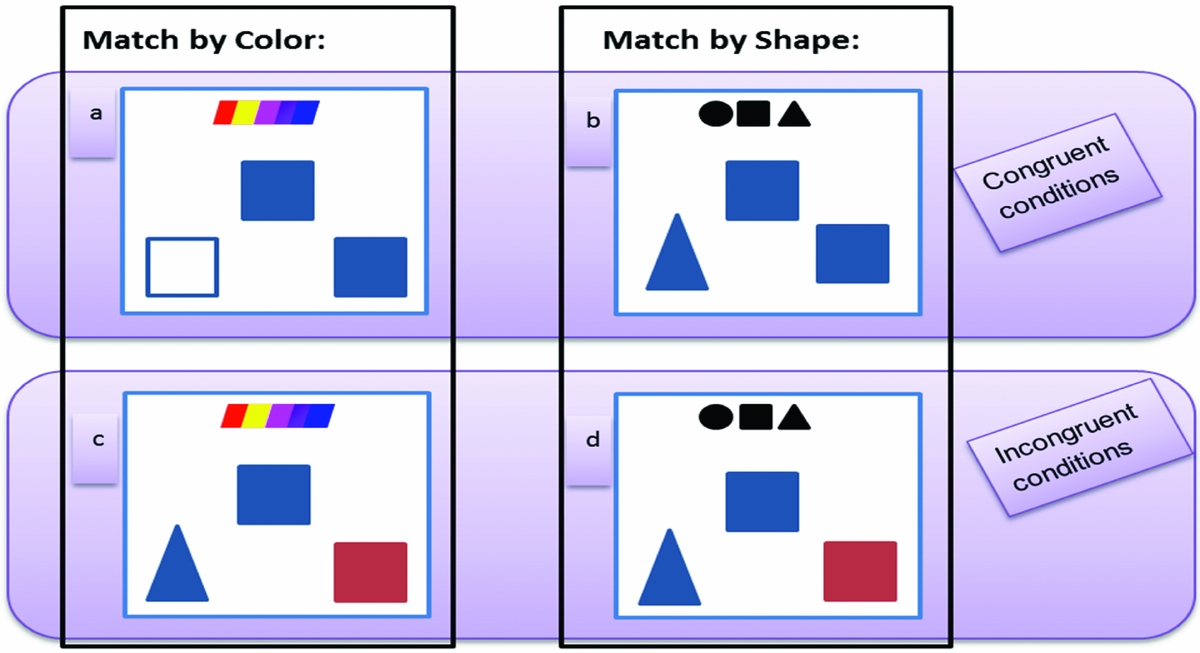
This task was adapted from Calabria et al. (Reference Calabria, Hernández, Branzi and Costa2012; Reference Calabria, Branzi, Marne, Hernández and Costa2015). On each trial, participants were presented with a cue located at the top, center portion of the screen and a triad of shapes (circles, squares and triangles that were red, blue, or green). One shape was located below the cue (the given item) and two shapes (the target and distractor) were located on the lower half of the screen (one in the left corner and one in the right corner). Each trial began with a cue, indicating to match by shape (cue: a series of black shapes) or color (cue: a rainbow patch) and participants were instructed to use a button press to identify the target that was appropriately categorized with the given item. The positions of the targets and distractors were pseudorandomized. On color matching congruent trials (see Figure 3a), all items (i.e., the given item, target and distractor) were the same shape and only the given item and target matched on color. On shape matching congruent trials (see Figure 3b), all items were the same color and only the target matched the shape of the given item. On color and shape matching incongruent trials (see Figure 3c and 3d), the target and distractor were different shapes and colors and the target matched the given item by color or shape. A total of 160 trials were presented in two runs, each consisting of two blocks. Each block included 20 congruent (10 shape targets and 10 color targets) and 20 incongruent (10 shape targets and 10 color targets) trials that were pseudorandomized by target (color and shape) and condition (congruent and incongruent). Each trial began with a fixation cross of 500 ms. Then a cue preceded the stimuli by 1000ms and remained on the screen when the array of stimuli appeared for 3000 ms.
Non-linguistic Triad task stimuli sample.

Linguistic triad task
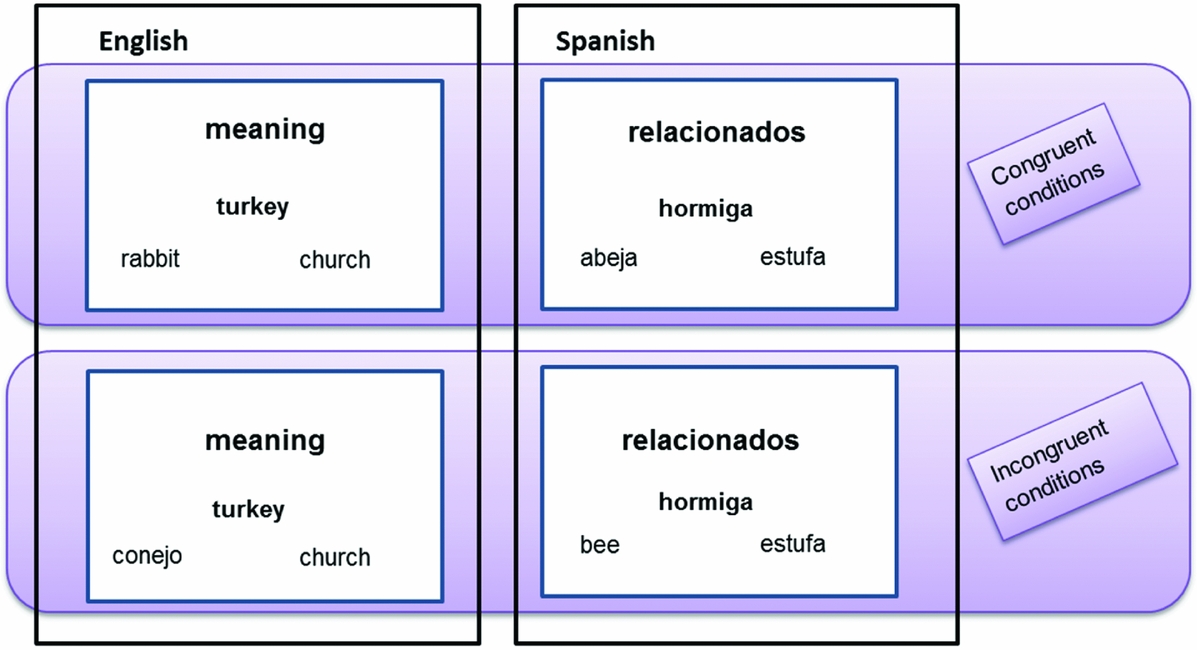
On each trial, the participant was presented with a cue located at the top, center of the screen and a triad of words. One word was located below the cue (the given item) and two words (the target and distractor) were located on the lower half of the screen (one in the left corner and one in the right corner). The target and distractor locations were pseudorandomized. Participants were instructed to use a button press to choose the word that was semantically related to the given item, i.e. identify a word-pair match. Given items were in English or Spanish and each word-pair had two conditions that systematically altered the language of the word-pair and target-distractor relationship. Specifically, the trial was considered congruent when all words on the screen were in Spanish or English. The trial was considered incongruent when the given item and target were between-language and the given item and distractor were within-language. When the given item was English, the cue read “related” and when the given item was in Spanish, the cue was “relacionado”, the Spanish translation of “related.” See Figure 4 for sample stimuli. A total of 160 items were presented in two runs, each consisting of two blocks. Each block included 20 congruent (10 Spanish given items and 10 English given items) and 20 incongruent (10 Spanish given items and 10 English given items) trials that were pseudorandomized by given item language (Spanish and English) and condition (congruent and incongruent). Based on previous research (Kiran, Gray, Kapse & Raney, Reference Kiran, Gray, Kapse and Raney2013), each trial was preceded by a fixation cross (500ms) and the stimulus array appeared for 4000 ms.
Linguistic Triad task stimuli sample.

Cognates were omitted from the linguistic stimuli, and word frequencies were calculated based on the Cross-Linguistic Easy-Access Resource for Phonological and Orthographic Neighborhood Densities database (Clearpond; Marian, Bartolotti, Chabal & Shook, Reference Marian, Bartolotti, Chabal and Shook2012). All stimuli were matched on frequency for within- and between-languages for the L-Flanker and L-Triad tasks.
Results
For all tasks, percent accuracy and response time (RT) data were collected for NHBA and BAA. An alpha level of p < .05 was used for all statistical models, and only accurate responses were included in the RT analyses. Responses that were below 200 ms or above 2.5 SDs from the mean were removed from the data.
Non-linguistic tasks
For each group (NHBA and BAA), we conducted two repeated measures ANOVAs (R-ANOVAs) for each task (NL-Flanker and NL-Triad) that examined the effect of congruency (congruent and incongruent) and target type (NL-Flanker: red and black; NL-Triad: color and shape) as the independent measures for percent accuracy and RT. Similar to previous studies (Green et al., Reference Green, Grogan, Crinion, Ali, Sutton and Price2010; Verreyt et al., Reference Verreyt, De Letter, Hemelsoet, Santens and Duyck2013), as long as the congruency effect was observed in accuracy or RT, that was considered to be indicative of unimpaired control mechanisms of the domain being tested.
NL-Flanker
Accuracy
NHBA
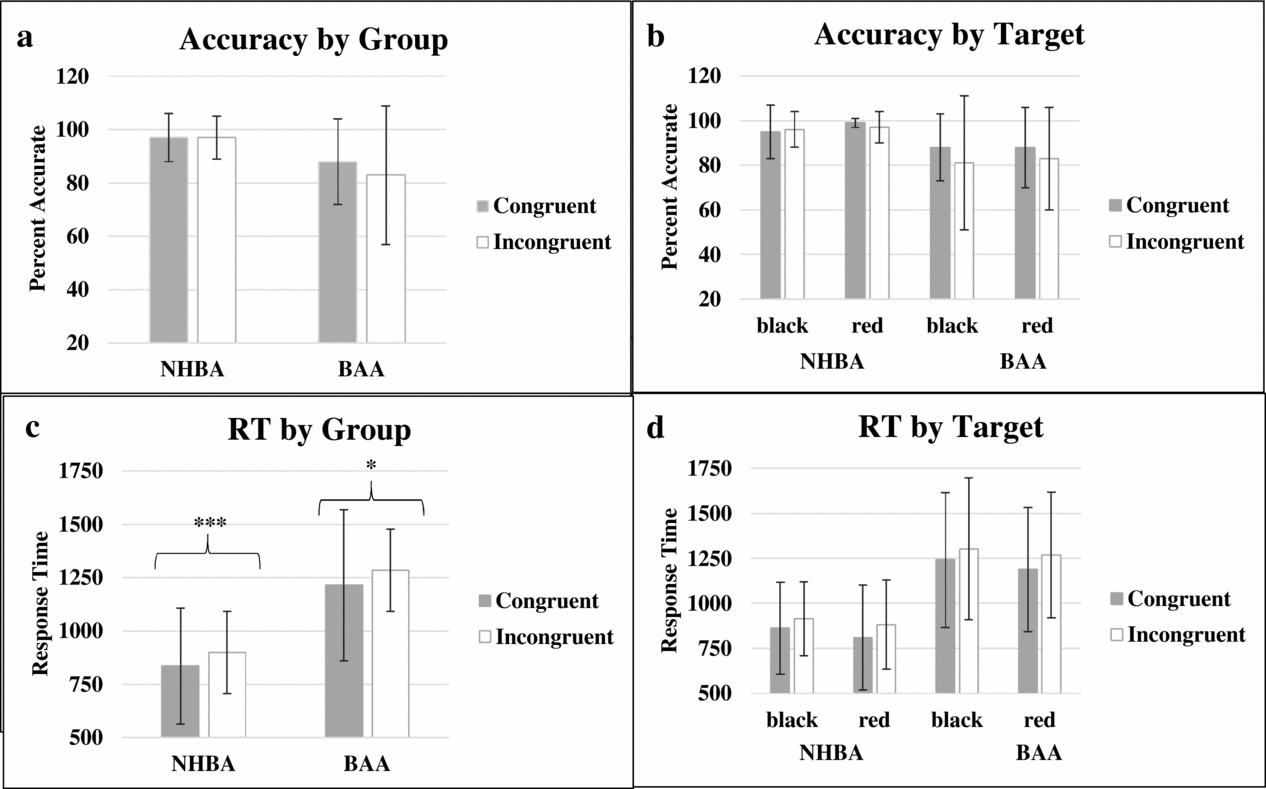
Within-subjects analyses revealed no significant effect of congruency (F(1, 19) = .02, p = .89, ηp² = .001) or target (F(1, 19) = 2.26, p = .15, ηp² = .11) and no significant congruency by target interaction (F(1, 19) = 1.03, p = .32, ηp² = .05). These results indicate that NHBA accuracy is similar for congruent and incongruent conditions.
BAA
Similar to NHBA results, within-subjects analyses revealed no significant effect of congruency (F(1, 12) = 2.61, p = .13, ηp² = .18) or target (F(1, 12) = .21, p = .66, ηp² = .01) and no significant congruency by target interaction (F(1, 12) = .13, p = .73, ηp² = .01). See Figure 5a and 5b for NHBA and BAA NL-Flanker accuracy results.
Non-linguistic Flanker task: accuracy by group (a), accuracy by target (b), RT by group (c), RT by target (d). Standard error bars indicate standard deviations.

Response time
NHBA
Within-subjects analyses revealed a significant effect of congruency (F(1, 19) = 17.36, p < .001, ηp² = .47). There was also a significant effect of target (F(1, 19) = 4.52, p < .05, ηp² = .19). There was no significant congruency by target interaction (F(1, 19) = 1.06, p = .31, ηp² = .05).
BAA
In line with NHBA results, within-subjects analyses revealed a significant effect of congruency (F(1, 12) = 4.70, p = .05, ηp² = .28). The effect of target was trending towards significance (F(1, 12) = 3.82, p = .07, ηp² = .24). In line with NHBA, there was no significant congruency by target interaction (F(1, 12) = .21, p = .65, ηp² = .01). In sum, on the NL-Flanker task, NHBA and BAA exhibited the congruency effect only for RT. See Figure 5c and 5d for NHBA and BAA NL-Flanker RT results.
NL-Triad
Accuracy
NHBA
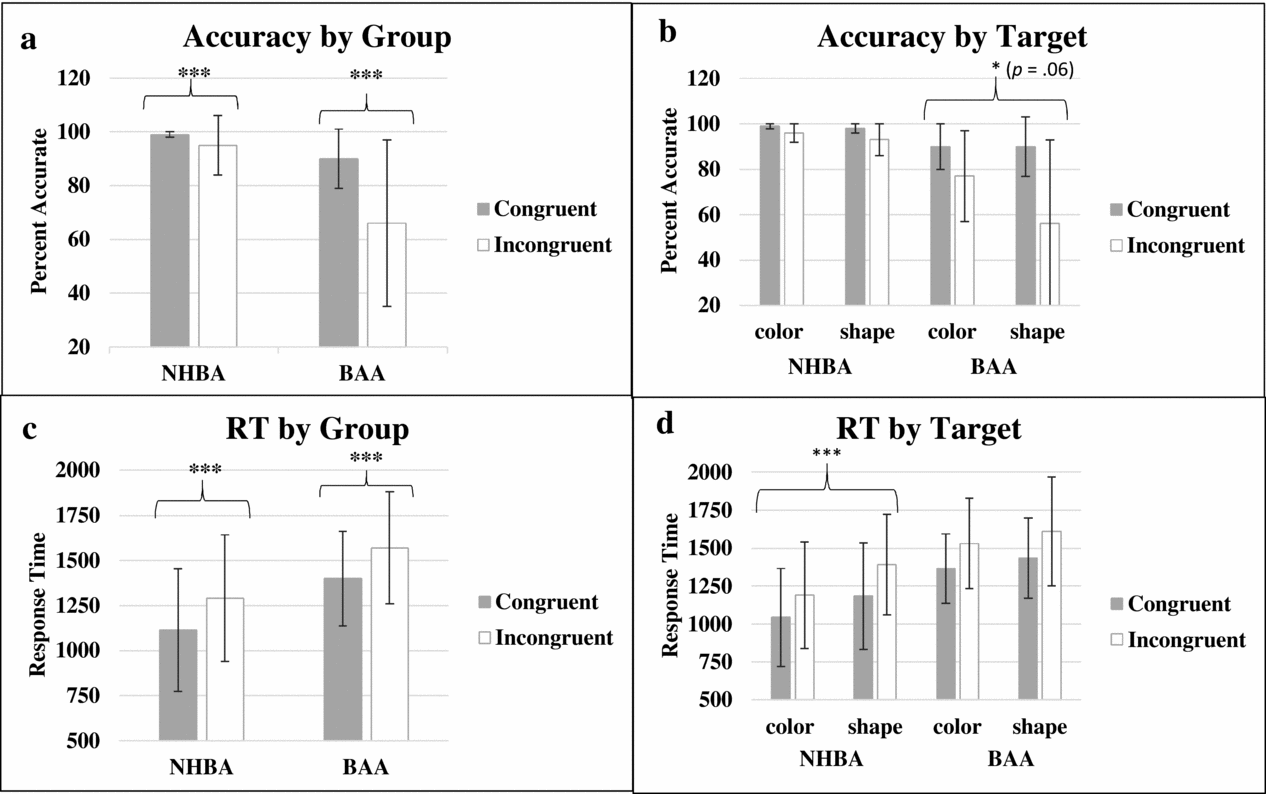
Within-subjects analyses revealed a significant effect of congruency (F(1, 19) = 26.79, p < .001, ηp² = .58) and target (F(1, 19) = 6.24, p < .05, ηp² = .24). There was no significant congruency by target interaction (F(1, 19) = 3.52, p = .08, ηp² = .15).
BAA
Similar to NHBA results, within-subjects analyses revealed a significant effect of congruency (F(1, 12) = 23.01, p < .001, ηp² = .65). The effect of target was trending towards significance (F(1, 12) = 4.39, p = .06, ηp² = .26). In contrast to NHBA, the congruency by target interaction was trending towards significance (F(1, 12) = 4.50, p = .06, ηp² = .27). See Figure 6a and 6b for NHBA and BAA NL-Triad accuracy results.
Non-linguistic Triad task: accuracy by group (a), accuracy by target (b), RT by group (c), RT by target (d). Standard error bars indicate standard deviations.

Response time
NHBA
Within-subjects analyses revealed a significant main effect of congruency (F(1, 19) = 68.89, p < .001, ηp² = .78). There was a significant main effect of target (F(1, 19) = 51.76, p < .001, ηp² = .73). The congruency by target interaction was also significant F(1, 19) = 7.23, p < .05, ηp² = .27). For color and shape targets, NHBA were faster (p < .001) on the congruent condition compared to the incongruent condition, indicating that NHBA exhibited the congruency effect on both target types for RT.
BAA
In line with NHBA results, within-subjects analyses revealed a significant effect of congruency (F(1, 12) = 21.82, p < .001, ηp² = .64). Unlike NHBA there was no significant effect of target (F(1, 12) = .2.37, p = .15, ηp² = .17) and no significant congruency by target interaction (F(1, 12) = .01, p = .92, ηp² = .001). In sum, on the NL-Triad task, NHBA and BAA exhibited the congruency effect for accuracy and RT. See Figure 6c and 6d for NHBA and BAA NL-Triad RT results.
Linguistic tasks
For each group (NHBA and BAA) and task (L-Flanker and L-Triad), two R-ANCOVAs examining the effect of congruency (congruent and incongruent) and target language (English and Spanish) as the independent measures for percent accuracy and on RT were performed. To distinguish between the effects of proficiency and the effects of congruency on the linguistic tasks, Language Ability Rating (English and Spanish) from the Language Use Questionnaire (Kiran et al., Reference Kiran, Peña, Bedore and Sheng2010) was used as the covariate.
L-Flanker
Accuracy
NHBA
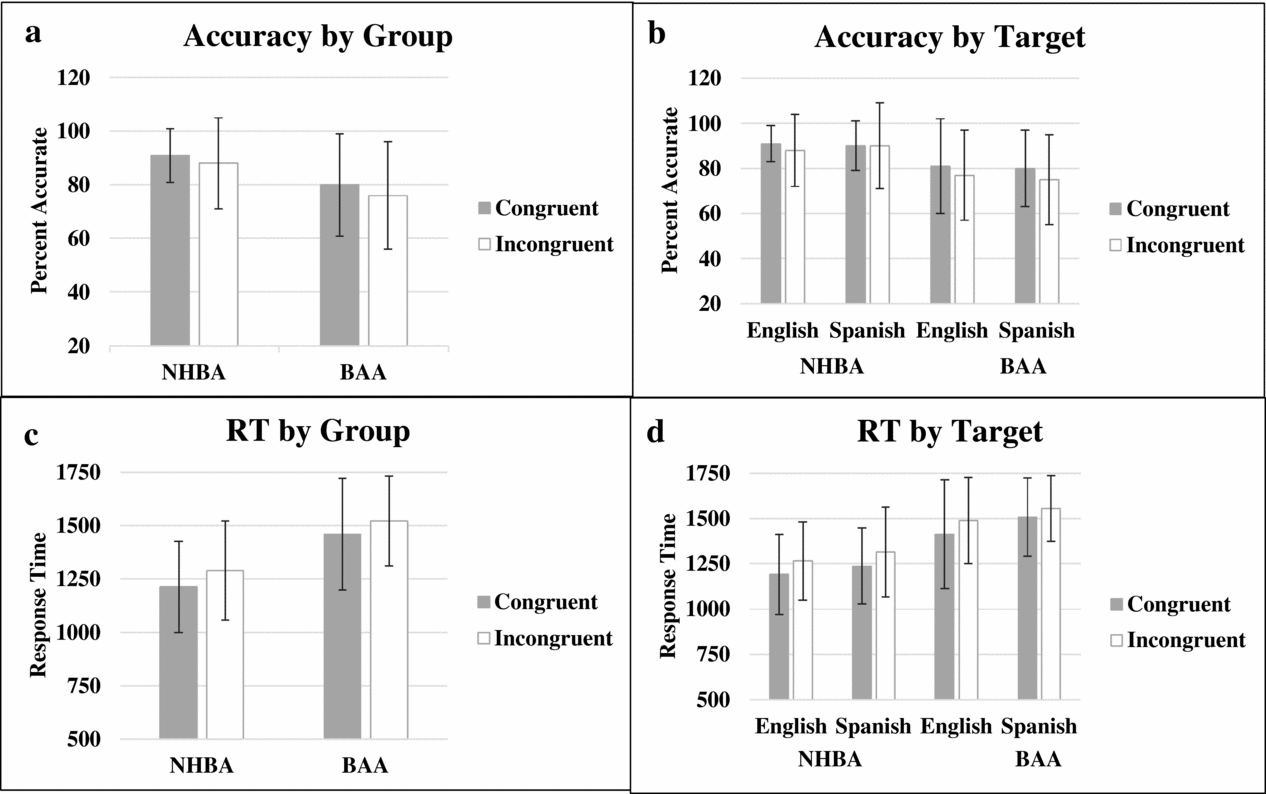
Within-subjects analyses revealed no significant effect of congruency (F(1, 17) = 1.37, p = .25, ηp² = .07), indicating that when language proficiency was taken into account, NHBA did not exhibit the congruency effect for accuracy. There was a significant effect of target (F(1, 17) = 13.33, p < .01, ηp² = .44). There was a significant effect of English covariate (F(1, 17) = 11.23, p < .01, ηp² = .39) but not for Spanish covariate (F(1, 17) = 0, p = .98, ηp² = 0). The other comparisons and higher order interactions were not significant.
BAA
Similar to NHBA results, within-subjects analyses revealed no significant effect of congruency (F(1, 10) = .97, p = .34, ηp² = .08), indicating that when language proficiency was taken into account, BAA did not exhibit the congruency effect for accuracy. In line with the NHBA the other comparisons and higher order interactions were not significant.
See Figure 7a and 7b for NHBA and BAA L-Flanker accuracy results.
Linguistic Flanker task: accuracy by group (a), accuracy by target (b), RT by group (c), RT by target (d). Standard error bars indicate standard deviations.

Response time
NHBA
Within-subjects analyses revealed no significant effect of congruency (F(1, 17) = 1.10, p = .31, ηp² = .06), indicating that when language proficiency was taken into account, NHBA did not exhibit the congruency effect for RT. The other comparisons and higher order interactions were not significant.
BAA
Similar to NHBA, within-subjects analyses revealed no significant effect of congruency (F(1, 10) = .13, p = .72, ηp² = .01), indicating that when language proficiency was taken into account, BAA did not exhibit the congruency effect for RT. In line with the NHBA, the other comparisons and higher order interactions were not significant. In sum, after accounting for language proficiency, NHBA and BAA did not show the congruency effect on the L-Flanker task for accuracy or RT. See Figure 7c and 7d for NHBA and BAA L-Flanker RT results.
L-Triad
Accuracy
NHBA
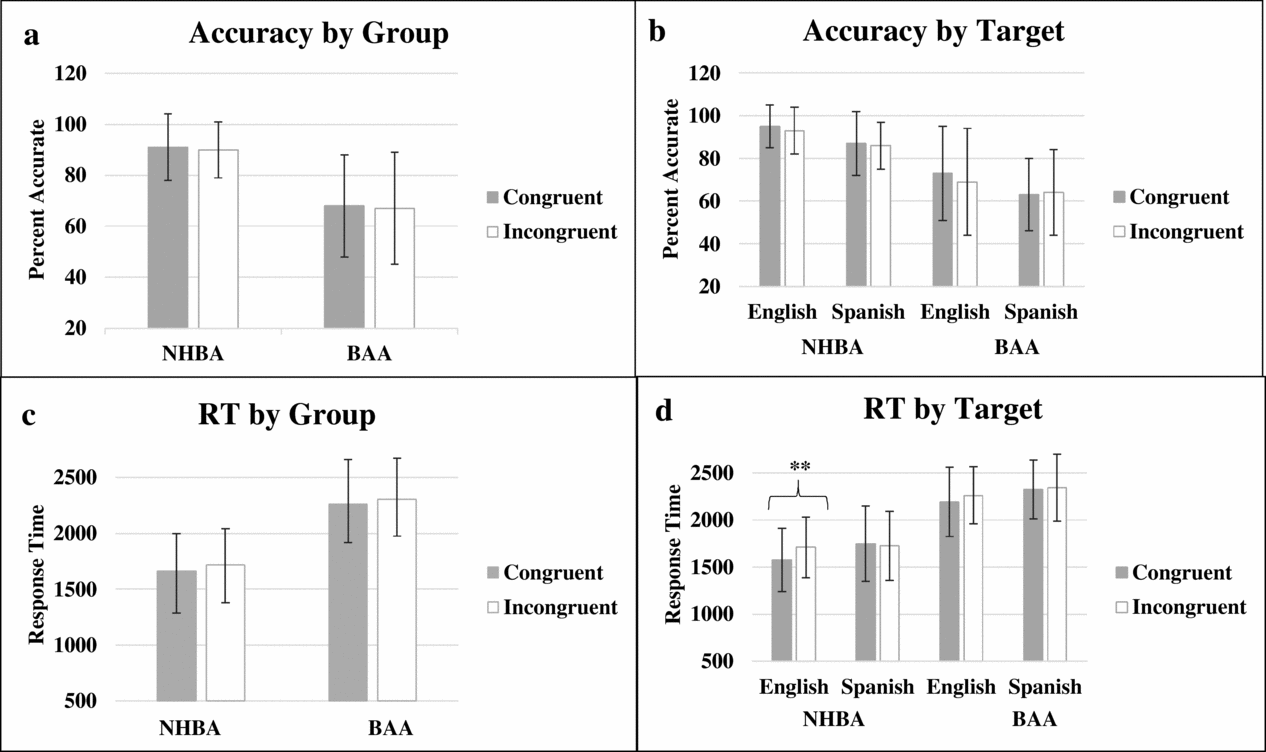
Within-subjects analyses revealed no significant effect of congruency (F(1, 17) = .16, p = .68, ηp² = .01), indicating that when language proficiency was taken into account, NHBA did not exhibit the congruency effect for accuracy. There was a significant effect of target (F(1, 17) = 10.25, p < .01, ηp² = .37), a significant effect of English covariate (F(1, 17) = 6.51, p < .05, ηp² = .27), and a significant effect of Spanish covariate (F(1, 17) = 6.25, p < .05, ηp² = .26). The other comparisons and higher order interactions were not significant.
BAA
In line with NHBA, within-subjects analyses revealed no significant effect of congruency (F(1, 10) = .01, p = .92, ηp² = .001), indicating that when language proficiency was taken into account, BAA did not exhibit the congruency effect for accuracy. The other comparisons and higher order interactions were not significant.
See Figure 8a and 8b for NHBA and BAA L-Triad accuracy results.
Linguistic Triad task: accuracy by group (a), accuracy by target (b), RT by group (c), RT by target (d). Standard error bars indicate standard deviations.

Response time
NHBA
Within-subjects analyses revealed no significant effect of congruency (F(1, 17) = 1.40, p = .25, ηp² = .07), indicating that when language proficiency was taken into account, NHBA did not exhibit the congruency effect for RT. There was a significant effect of target (F(1, 17) = 5.49, p < .05, ηp² = .24), a significant effect of English covariate (F(1, 17) = 11.31, p < .01, ηp² = .40), and a significant effect of Spanish covariate (F(1, 17) = 6.36, p < .05, ηp² = .27). There was a significant congruency by target interaction (F(1, 17) = 4.76, p < .05, ηp² = .22). Post hoc LSD pairwise comparisons revealed that, for English targets, NHBA were faster (p < .01) on the congruent condition compared to the incongruent condition; however, for the Spanish targets, there was no significant difference between the congruent condition and the incongruent condition (p = .26), indicating that when language proficiency was accounted for, NHBA exhibited the congruency effect for speed on English targets only. The other comparisons were not significant.
BAA
Similar to NHBA, within-subjects analyses revealed no significant effect of congruency (F(1, 10) = .29, p = 1.24, ηp² = .11), indicating that when language proficiency was taken into account, BAA did not exhibit the congruency effect for RT. There was a significant effect of English covariate (F(1, 10) = 4.70, p = .05, ηp² = .40); however, other comparisons and higher order interactions were not significant. In sum, on the L-Triad task, NHBA exhibited the congruency effect only on RT and BAA did not exhibit the congruency effect on accuracy or RT. See Figure 8c and 8d for NHBA and BAA L-Triad RT results.
To summarize the findings reported above, on the low complexity tasks, NHBA and BAA exhibited the congruency effect only on the NL-Flanker. On the high complexity tasks, NHBA exhibited the congruency effect on the linguistic and non-linguistic tasks, whereas BAA exhibited the congruency effect only on the non-linguistic task.
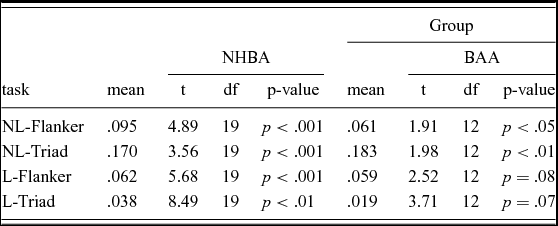
In the next analysis we examined conflict ratios for RT. Conflict ratios capture the magnitude of conflict experienced when performing a task. One-sample t-tests were conducted to examine whether conflict ratios were significantly different from zero which would be an indication of amount of control required to perform the task. Results revealed that NHBA conflict ratios for linguistic and non-linguistic tasks were significantly above zero, indicating that NHBA demonstrated conflict in order to complete linguistic and non-linguistic tasks. In contrast, BAA results revealed significant conflict ratios only on the non-linguistic tasks, indicating that BAA demonstrated a dissociation between processing control in the linguistic domain compared to the non-linguistic domain. It is noted that the BAA linguistic tasks may be trending towards a significant result. See Table 5 for conflict ratio one-sample t-test results.
Conflict ratio one-sample t-test results.

As a follow up to the conflict ratios, three more analyses were conducted. First, we conducted two sets of correlations (Pearson for NHBA data and Spearman for BAA data) to evaluate the relationship between RT conflict ratio on 1) linguistic and non-linguistic Flanker tasks and 2) linguistic and non-linguistic Triad tasks. Results revealed that for NHBA, the linguistic and non-linguistic triad tasks were significantly correlated (rs = .45, p < .05), whereas the linguistic and non-linguistic Flanker tasks were not correlated (rs = −.27, p = .24), and none of the BAA correlations were significant (Flanker: rs = .25, p = .42; Triad: rs = −.41, p = .16).
Second, Spearman correlations were performed on BAA data to evaluate the relationship between RT conflict ratio for each task and language impairment. For a measure of language impairment, nine BAT semantic subtests were averaged (Pointing, Semantic Categories, Synonyms, Antonyms, Antonyms II, Semantic Acceptability, Semantic Opposites, Reading Comprehension, and Word Recognition), thus developing a BAT-semantic score. Results revealed significant correlations between BAT-semantic and L-Flanker (rs = .44, p < .05) and a correlation that is trending on significance for the BAT-semantic and L-Triad (rs = .36, p =.06), indicating that higher diagnostic scores (i.e., more mildly impaired language profiles) were correlated with greater conflict ratio. The non-linguistic task correlations were not significant: NL-Flanker (rs = .12, p = .54), NL-Triad (rs = −.01, p = .93).
Third, and finally, in order to better understand the relationship between brain damage and linguistic and non-linguistic processing, Spearman correlations were performed to evaluate the relationship between language impairment (i.e., the BAT-semantic score) and congruent RTs for each task. Results revealed significant correlations between BAT-semantic and L-Flanker (rs −.49, p < .01), L-Triad (rs = −.43, p < .05), and NL-Flanker (rs = −.47, p < .01), indicating that brain damage (i.e., lower diagnostic scores) was correlated with how linguistic and non-linguistic information is processed (i.e., slower congruent RTs). However, BAT-semantic and NL-Triad were not significantly correlated (rs = −.28, p = .16).
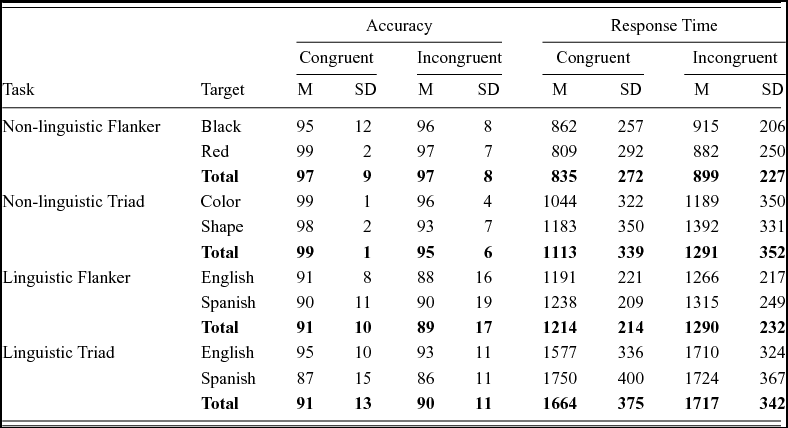
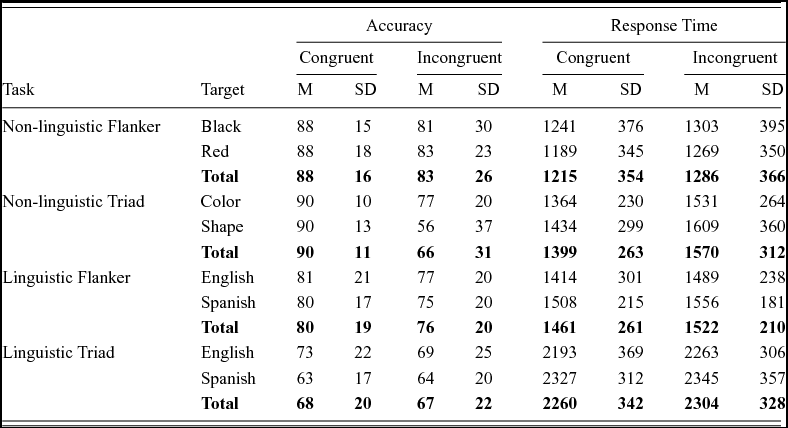
For a summary of NHBA and BAA accuracy and RT averages on all tasks, see Table 6.
Mean percent accuracies, standard deviations, and reaction time values for NHBA.

Mean percent accuracies, standard deviations, and reaction time values for BAA.

Discussion
The goal of this study was to investigate inhibitory control mechanisms in linguistic and non-linguistic contexts in bilingual aphasia. We examined evidence in support of domain general vs. domain specific cognitive control, inspected the magnitude of conflict required to complete control tasks across domains, and investigated the relationship between brain damage and linguistic and non-linguistic processing. All participants completed two linguistic tasks and two non-linguistic tasks that were matched on low and high levels of complexity and required a specific type of control, resistance to distractor interference (Friedman & Miyake, Reference Friedman and Miyake2004). The NL-Flanker task requires the participant to identify the direction of a target arrow flanked by congruent or incongruent distractors, whereas the more complex NL-Triad requires the participant to match colors and shapes in univalent (i.e., congruent) or bivalent (i.e., incongruent) conditions. The L-Flanker task requires the participant to identify the language of a word while it is flanked by congruent or incongruent distractors, whereas the L-Triad task requires the participant to semantically process word meanings and identify associated word-pairs in within-language (i.e., congruent) or between-language (i.e., congruent) conditions. Compared to the L-Triad, the L-Flanker is a surface level task and considered low-complex. To identify positive effects of control in non-linguistic or linguistic contexts, we expected to observe the congruency effect: higher accuracy and/or faster RTs on the congruent condition compared to the incongruent condition.
For our main findings, results revealed that on the low complexity tasks, NHBA and BAA exhibited the congruency effect on the NL-Flanker. In contrast, NHBA and BAA did not exhibit the congruency effect on the L-Flanker, indicating no difference in interference from distractors on the incongruent condition relative to the congruent condition. For the NHBA group, these findings were unexpected; however, the analyses took into account individual language proficiency. When language proficiency was not factored into the analyses, NHBA did show the congruency effect on the L-Flanker. These follow up analyses illustrates that the L-Flanker effects are linked to the automaticity of reading which are also influenced by proficiency.
NHBA and BAA group differences emerged on the high complexity tasks. NHBA showed the congruency effect on the NL-Triad and on the L-Task, providing evidence for domain general cognitive control on the high complexity tasks. This result is in line with studies that show an association between linguistic and non-linguistic control (e.g., Festman et al., Reference Festman, Rodriguez-Fornells and Münte2010; Green et al., Reference Green, Grogan, Crinion, Ali, Sutton and Price2010; Soveri et al., Reference Soveri, Rodriguez-Fornells and Laine2011; Verreyt et al., Reference Verreyt, De Letter, Hemelsoet, Santens and Duyck2013; Zhang, Kang, Wu, Ma & Guo, Reference Zhang, Kang, Wu, Ma and Guo2015). In contrast, a different pattern emerged from BAA performance that showed the congruency effect on the NL-Triad but not on the L-Triad. Therefore, control mechanisms are different when BAA engage mechanisms of linguistic and non-linguistic control in high complexity contexts, providing evidence in support of domain specific cognitive control. These divergent findings between NHBA and BAA suggest that healthy brains show domain general cognitive control on the high complexity tasks, and brain damage highlights the opposite effect. In sum, these results reveal how inhibitory control mechanisms function in the brain when managing linguistic and non-linguistic information and underscore the importance of examining control systems in people with brain damage because outcomes differ from their healthy counterparts.
In the current study we also examined the amount of control each task elicits, captured by conflict ratios. In these ratios, the slower RT for the incongruent condition relative to the congruent condition results in a larger conflict ratio, thus providing an opportunity to examine patterns of conflict resolution across tasks for each group. NHBA presented with significant conflict ratios on all tasks, indicating that across linguistic and non-linguistic domains and levels of complexity, NHBA were resolving conflict comparably. In contrast, BAA only exhibited significant conflict ratios on the non-linguistic tasks. This finding was unexpected. We hypothesized that larger conflict ratios on linguistic tasks would be observed because that would indicate more difficulty resolving conflict on incongruent trials. However, it appears that because BAA present with language deficits, they are slow to resolve both congruent and incongruent trials which results in smaller conflict ratios. In other words, smaller conflict ratios, at least in BAA, may not necessarily reflect more efficient processing, but rather an overall slowness to respond to stimuli. Therefore, it may not be appropriate to compare conflict ratios across patient and healthy control groups. We encourage future studies to carefully interpret what the conflict ratio represents.
Our primary findings showed that on low complexity tasks NHBA and BAA performance revealed the congruency effect only on the non-linguistic task, whereas on high complexity tasks NHBA present with domain general cognitive control and BAA present with domain specific cognitive control for BAA. The correlations that examined the magnitude of conflict between linguistic and non-linguistic tasks provide additional support for these main findings The correlation results revealed an association only for the NL-Triad and L-Triad for the NHBA group which suggests a) an association between linguistic and non-linguistic control mechanisms on high complexity tasks but not on the low complexity tasks for NHBA, and b) no association between linguistic and non-linguistic control mechanisms for high or low complexity tasks for BAA.
To examine the latter observation further, we investigated the relationship between BAA linguistic and non-linguistic conflict ratios and language impairment. Consistent with the findings from the primary conflict ratio analysis, results showed that for the linguistic tasks, smaller conflict ratios were correlated with more impaired language ability. In other words, BAA who scored worse on language testing exhibited smaller magnitudes of conflict, and BAA who scored higher on language testing exhibited greater magnitudes of conflict. These data add to the literature that suggests a relationship between language control and language impairment (Green et al., Reference Green, Grogan, Crinion, Ali, Sutton and Price2010; Gray & Kiran, Reference Gray and Kiran2016; Dash & Kar, Reference Dash and Kar2014). Although language control (i.e., the ability to manage two languages) and language impairment (i.e., aphasia) are distinct processes, they are clearly related, and further research that explores this connection is warranted.
In our final analysis, we investigated the relationship between response times on congruent conditions for all tasks and language impairment to determine whether brain damage is associated with language processing and non-linguistic processing. Significant correlations were identified for L-Flanker, L-Triad and NL-Flanker, indicating that brain damage not only affects language processing but also non-linguistic processing. From this finding, a few concepts emerge. First, our results offer support for the growing body of evidence suggesting the presence of cognitive impairment in persons with aphasia (Helm-Estabrooks, Reference Helm-Estabrooks2001; Hula & McNeil, Reference Hula and McNeil2008; Hunting-Pompon, Kendall & Moore, Reference Hunting-Pompon, Kendall and Moore2011; Hunting-Pompon, McNeil, Spencer & Kendall, Reference Hunting-Pompon, McNeil, Spencer and Kendall2015; Murray, Reference Murray2012; Robin & Rizzo, Reference Robin and Rizzo1989; Villard & Kiran, 2015, for a review see Villard & Kiran, 2016). Together these studies strongly suggest that future research that examines aphasia should consider the issue of cognitive deficits in this population. Second, consistent with the observation about conflict ratios, it may be that slowed lexical activation and inhibition may overshadow effects of potential interference in the incongruent condition (especially in the L-Triad task). According to Ridderinkhof, van den Wildenberg and Wylie (Reference Ridderinkhof, van den Wildenberg, Wylie and Posner2011), inhibition builds up over time; therefore, slow responses may not show the congruency effect. To that end, the lack of congruency effect and lack of significant result for conflict ratios may not be due to lack of inhibitory control but due to speed of responses. This is an important point and should be taken into consideration by future studies that investigate inhibitory control in patient populations.
In this study we examine domain general vs domain specific cognitive control as a function of congruent and incongruent metrics, focusing on one type of inhibition, resistance to distractor interference. It is worth noting that there is a body of research that employs task switching paradigms to examine linguistic and non-linguistic control mechanisms (e.g., Branzi, Calabria, Boscarino & Costa, Reference Branzi, Calabria, Boscarino and Costa2016; Prior & MacWhinney, Reference Prior and MacWhinney2010). For instance, Branzi et al. (Reference Branzi, Calabria, Boscarino and Costa2016) examined and compared switch costs and repetition costs in linguistic and non-linguistic control tasks performed by healthy, highly proficient bilinguals. Findings revealed that the two costs were correlated across domains, suggesting that inhibitory control is required to complete the linguistic and non-linguistic tasks. However, there was a dissociation of how each type of inhibition, as measured by the switch cost vs repetition cost, was employed in the linguistic and non-linguistic tasks, suggesting that bilingual language control and cognitive control do not share the same inhibitory mechanisms. Thus, to move forward with this work that investigates control mechanisms across domains, it is important that the variability of control mechanisms as they are examined in different methodologies is appreciated.
In conclusion, the goal of this study was to investigate inhibitory control mechanisms in bilingual aphasia. Previous studies that examine these processes in this population have not systematically accounted for inhibition type and receptive language presentation. Therefore, the experimental paradigms of the present study were developed within the parameters of these constraints. This is the first study of its kind that incorporates linguistic and non-linguistic tasks designed to account for task complexity. Additionally, our findings extend previous work of Green et al. (Reference Green, Grogan, Crinion, Ali, Sutton and Price2010), Verreyt et al. (Reference Verreyt, De Letter, Hemelsoet, Santens and Duyck2013) and Gray and Kiran (Reference Gray and Kiran2016) with a larger group of patients. In sum, the findings are compelling because they 1) reveal that effects of task complexity, as well as healthy brains vs. brain damage, play a role in how we identify domain general vs domain specific mechanisms of control, 2) reveal a dissociation between how patients resolve conflict across linguistic and non-linguistic contexts, 3) highlight the relationship between language control and language impairment in bilingual aphasia and 4) provide evidence in support of the relationship between brain damage and linguistic and non-linguistic processing.
Supplementary material
To view supplementary material for this article, please visit https://doi.org/10.1017/S1366728917000712