1. Introduction
The Karoo-aged rift basins across southern and eastern Africa act as important time-capsules of depositional and evolutionary history, tracking long-term climatic and evolutionary change (Cooper, Reference Cooper1982; Banks et al. Reference Banks, Bardwell, Musiwa and Lambiase1995; Catuneanu et al. Reference Catuneanu, Wopfner, Eriksson, Cairncross, Rubidge, Smith and Hancox2005; Rubidge, Reference Rubidge2005; Roopnarine et al. Reference Roopnarine, Angielczyk, Olroyd, Nesbitt, Botha-Brink, Peecook, Day and Smith2018). However, inter- and intra-basinal correlations are difficult as relatively little work has been conducted to constrain the depositional ages of Karoo-aged sequences outside the main Karoo Basin (MKB), despite their rich palaeontological records (Cooper, Reference Cooper1982; Banks et al. Reference Banks, Bardwell, Musiwa and Lambiase1995; Catuneanu et al. Reference Catuneanu, Wopfner, Eriksson, Cairncross, Rubidge, Smith and Hancox2005; Rubidge, Reference Rubidge2005; Roopnarine et al. Reference Roopnarine, Angielczyk, Olroyd, Nesbitt, Botha-Brink, Peecook, Day and Smith2018). One such basin in northern Zimbabwe and southern Zambia, the Mid-Zambezi Basin (MZB), contains Karoo-aged sediments of late Carboniferous – Middle Jurassic age that have been little studied since the 1970s (Oesterlen, Reference Oesterlen2003; Barber, Reference Barber2018).
The MZB preserves sedimentary deposits belonging to the Lower and Upper Karoo groups that are capped by the Batoka Basalt (Smith et al. Reference Smith, Eriksson and Botha1993; Johnson et al. Reference Johnson, Van Vuuren, Hegenberger, Key and Shoko1996; Oesterlen, Reference Oesterlen2003; Zerfass et al. Reference Zerfass, Chemale, Schultz and Lavina2004; Catuneanu et al. Reference Catuneanu, Wopfner, Eriksson, Cairncross, Rubidge, Smith and Hancox2005). The Upper Karoo Group is considered the equivalent of the MKB’s Stormberg and Drakensberg groups (Catuneanu et al. Reference Catuneanu, Wopfner, Eriksson, Cairncross, Rubidge, Smith and Hancox2005). While the presence of shared taxa with the MKB has been confirmed in the Lower Karoo Group sequences (Lepper, Reference Lepper1992; Lepper et al. Reference Lepper, Raath and Rubidge2000; Sidor et al. Reference Sidor, Angielczyk, Smith, Goulding, Nesbitt, Peecook, Steyer and Tolan2014), the growing importance of the Upper Karoo Group strata from the MZB of Zimbabwe stems from the presence of fossil vertebrate groups that are currently unknown in other potentially contemporaneous southern African basins (see Raath et al. Reference Raath1972 a, b, Reference Raath, Oesterlen and Kitching1992; Bond & Falcon, Reference Bond and Falcon1973; Cooper, Reference Cooper1984; Viglietti et al. Reference Viglietti, Barrett, Broderick, Munyikwa, MacNiven, Broderick, Chapelle, Glynn, Edwards, Zondo, Broderick and Choiniere2018; Barrett et al. Reference Barrett, Sciscio, Viglietti, Broderick, Suarez, Sharman, Jones, Munyikwa, Edwards, Chapelle, Dollman, Zondo and Choiniere2020). The presence of this material highlights the need to further explore and re-evaluate the palaeontology and stratigraphy of the Zimbabwean MZB, as well as correlating it with neighbouring southern African basins, such as the Cabora Bassa (CBB), Mana Pools and Luangwa basins.
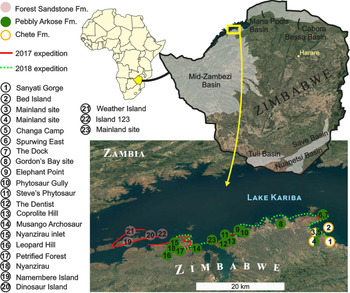
Our team, comprising members from the University of the Witwatersrand (South Africa), National Museums and Monuments (Zimbabwe), the Natural History Museum (United Kingdom) and the University of Johannesburg (South Africa) as well as other local experts, recently conducted fieldwork over two field seasons (2017–2018) within Matusadona National Park and on several islands along the southern shoreline of Lake Kariba (Zimbabwe; Fig. 1). Many of the new fossil vertebrate localities mentioned here were originally identified by SFE during exploratory sorties in the area.
Mid-Zambezi Basin field sites along the southern shoreline of Lake Kariba, Zimbabwe. Sites are numbered and the stratigraphic position for each site is indicated. See online Supplementary Table S1 for detailed site location information. Map data: Google, CNES/Airbus and Maxar Technologies 2020.

Here, we provide a historical review of the work conducted on the Upper Karoo Group in the MZB of Zimbabwe, describe new field sites (Fig. 1) and document the taxa they have yielded, many of which were previously unknown (or rare) in southern Africa.
2. Historical review
Foundational palaeontological work was conducted in the MZB of Zimbabwe by Geoffrey Bond and colleagues (e.g. Bond, Reference Bond1955, Reference Bond1972; Raath, Reference Raath1967; Bond et al. Reference Bond, Wilson and Raath1970; B Wahl, unpub. thesis, University of Rhodesia, 1971; Bond & Falcon, Reference Bond and Falcon1973). The last fossil collections to focus on the Upper Karoo Group strata around Lake Kariba were mainly concerned with ‘Dinosaur Island’ (Island 126/127) where one of the earliest sauropods, Vulcanodon karibaensis, was discovered (Bond et al. Reference Bond, Wilson and Raath1970; Raath, Reference Raath1972 b; Cooper, Reference Cooper1984; Viglietti et al. Reference Viglietti, Barrett, Broderick, Munyikwa, MacNiven, Broderick, Chapelle, Glynn, Edwards, Zondo, Broderick and Choiniere2018).
From a sedimentological perspective, previous workers have been interested primarily in the mineral resources of the Upper Karoo Group and, given the diversity of researchers, a varied nomenclature has been used to describe and correlate local or regional Zimbabwean Upper Karoo stratigraphy (e.g. Macgregor, Reference Macgregor1941; Gair, Reference Gair1959; Bond, Reference Bond1967, Reference Bond1972; Bond & Falcon, Reference Bond and Falcon1973; Marsh & Jackson, Reference Marsh and Jackson1974; Stowe, Reference Stowe1974; Stagman, Reference Stagman1978; BC Hosking, unpub. M.Sc. thesis, University of Zimbabwe, 1981; Oesterlen & Millsteed, Reference Oesterlen and Millsteed1994; Hiller & Shoko, Reference Hiller and Shoko1995; Oesterlen, Reference Oesterlen1999, Reference Oesterlen2003; Catuneanu et al. Reference Catuneanu, Wopfner, Eriksson, Cairncross, Rubidge, Smith and Hancox2005; Ait-Kaci Ahmed, Reference Ait-Kaci Ahmed2018; Barber, Reference Barber2018). In most cases, no defined type localities or specific reference sections were proposed to either standardize lithostratigraphic descriptions or aid comparisons between the various units in the sub-basins. Correlations between areas and basins have therefore relied heavily on lithological characters and stratigraphic relationships.
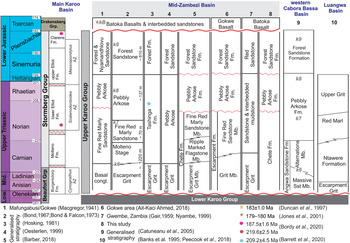
Macgregor (Reference Macgregor1941; refined by Sutton, Reference Sutton1979 and consolidated by Bond, Reference Bond1967) was the first to propose divisions within the Upper Karoo Group of the Matabola sub-basin (MZB), Zimbabwe. He denoted several unique lithofacies on which the current terminology is mostly based (Fig. 2) and subdivided the sequence into a tripartite sedimentary system: (i) Basal Conglomerate (Escarpment Grit); (ii) Fine Red Marly Sandstone Unit/Pebbly Arkose Unit; and (iii) Forest Sandstone Unit.
Summary of the Upper Karoo Group lithostratigraphic nomenclature from the Mid-Zambezi, Cabora Bassa and Luangwa basins. Wavy red lines represent unconformities. Bond’s (Reference Bond1967) lithostratigraphic symbols ‘k6 – k9, kB’ are shown. Small stars = 40Ar-39Ar ages from the Drakensberg Group and Batoka flood basalts; larger stars = U-Pb detrital zircon ages. Abbreviations: Fm. = Formation; Mb. = Member.
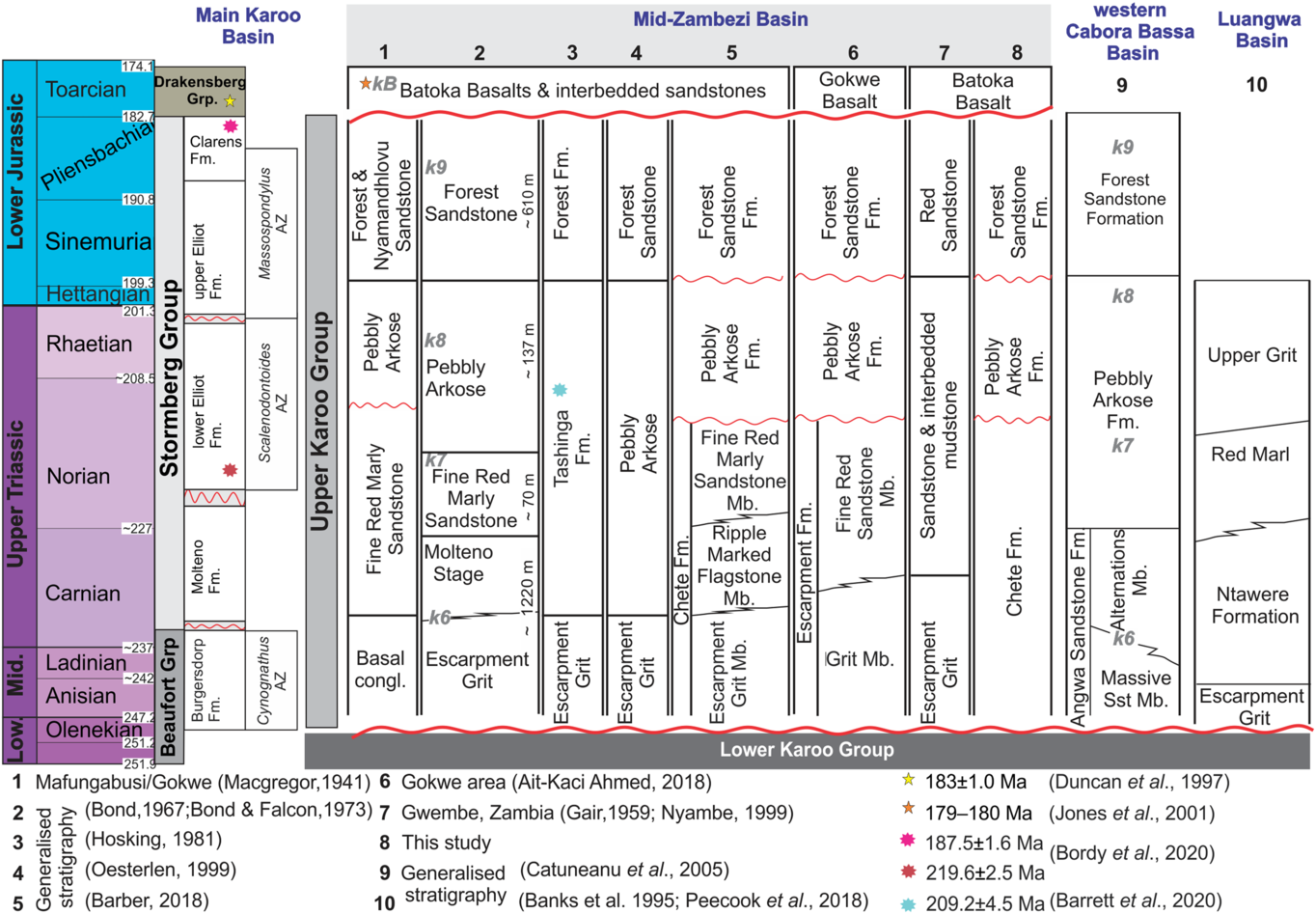
Bond (Reference Bond1967) and Bond & Falcon (Reference Bond and Falcon1973) recorded two fining-upwards tectonosedimentary cycles within the Upper Karoo Group: cycle 1 is represented by the Escarpment Grit, overlain by the Ripple Marked Flagstone unit (not identified by Macgregor, Reference Macgregor1941) and the Fine Red Marly Sandstone; and cycle 2 is represented by the Pebbly Arkose to Forest Sandstone transition, with both related to distinct tectonic pulses. Tavener-Smith (Reference Tavener-Smith1962), Drysdall & Kitching (Reference Drysdall and Kitching1962) and Rust (Reference Rust and Campbell1973) considered these pulses to be visible in other basins and correlatable (e.g. with the Cabora Bassa and Luangwa basins; see Fig. 2) and related to major phases of rifting initiated during Early Triassic time.
More recently, there have been several proposals to reorganize Upper Karoo lithostratigraphy within the MZB. BC Hosking (unpub. M.Sc. thesis, University of Zimbabwe, 1981) suggested the consolidation of the Ripple Marked Flagstone, Fine Red Marly Sandstone and Pebbly Arkose units into the informal Tashinga Formation (Fig. 2). We believe this formation to be named after Tashinga Camp (in Matusadona National Park), although not all of the relevant lithologies are exposed there. The use of the Tashinga Formation was recently applied to outcrops along the shoreline of Lake Kariba by Barrett et al. (Reference Barrett, Sciscio, Viglietti, Broderick, Suarez, Sharman, Jones, Munyikwa, Edwards, Chapelle, Dollman, Zondo and Choiniere2020). In contrast, Ait-Kaci Ahmed (Reference Ait-Kaci Ahmed2018) suggested that the Upper Karoo Group could be divided into the Escarpment (composed of the Escarpment Grit and Fine Red Sandstone members), Pebbly Arkose and Forest Sandstone formations (Fig. 2). However, Barber’s (Reference Barber2018) MZB lithostratigraphy proposes the Chete, Pebbly Arkose and Forest Sandstone formations and downgrades the Escarpment Grit, Ripple Marked Flagstone and Fine Red Marly Sandstone units to members within the Chete Formation. These he interprets as diachronous, gradational, fining-upwards sequences and coeval facies equivalents initiated by the first phase of rifting. The naming of the Chete Formation is based on the exposures of these members in the Chete Safari Area (Zimbabwe) and on Chete Island (Zambia). Below we provide additional detail on these Upper Karoo Group lithostratigraphic units.
2.a. Escarpment Grit Member, Chete Formation
The oldest lithostratigraphic unit of the Upper Karoo Group has been referred to as either the basal conglomerate, Escarpment Grit (Macgregor, Reference Macgregor1941), Escarpment Formation (BC Hosking, unpub. M.Sc. thesis, University of Zimbabwe, 1981), Grit Member (Escarpment Formation; Ait-Kaci Ahmed, Reference Ait-Kaci Ahmed2018) or Escarpment Grit Member (Chete Formation; Barber, Reference Barber2018; Fig. 2). It is regarded as a persistent arenaceous unit occurring throughout the rift valleys of Zimbabwe and Zambia (Drysdall & Kitching, Reference Drysdall and Kitching1962; Oesterlen & Millsteed, Reference Oesterlen and Millsteed1994; Oesterlen, Reference Oesterlen1998). Within the MZB, an erosional unconformity divides it from either the underlying Lower Karoo Group’s Madumabisa Mudstone Formation or older basement rocks (Bond, Reference Bond1952; Lepper, Reference Lepper1992).
The Escarpment Grit Member and its lithological correlatives in other basins have often been considered to be palaeontologically barren (Bond & Falcon, Reference Bond and Falcon1973), but fossilized wood has been noted in the Zambian portion of the MZB (Gwembe area; Gair, Reference Gair1959; Tavener-Smith, Reference Tavener-Smith1960; Barbolini et al. Reference Barbolini, Bamford and Tolan2016). In terms of its relative age, Cox (Reference Cox1969) correlated the Escarpment Grit in the Luangwa Basin of Zambia with the Cynognathus zone of the Upper Beaufort Group in the MKB, which was then considered to be upper Scythian (= upper Early Triassic) in age, and the overlying Molteno Beds as likely Ladinian–Anisian in age. Others also considered the Escarpment Grit Member to be contemporaneous with the Upper Beaufort Group, although opinions on the relative age of this unit have differed (Drysdall & Kitching, Reference Drysdall and Kitching1963; Anderson & Anderson, Reference Anderson and Anderson1970; Johnson et al. Reference Johnson, Van Vuuren, Hegenberger, Key and Shoko1996). By contrast, Watkeys (Reference Watkeys1979), Nyambe & Utting (Reference Nyambe and Utting1997), Nyambe (Reference Nyambe1999) and Catuneanu et al. (Reference Catuneanu, Wopfner, Eriksson, Cairncross, Rubidge, Smith and Hancox2005) considered the Escarpment Grit Member, as well as the Massive Sandstone Member (lower Angwa Sandstone Formation) from the CBB (Oesterlen & Millsteed, Reference Oesterlen and Millsteed1994; d’Engelbronner, Reference d’Engelbronner1996), as stratigraphic equivalents of the Molteno Formation, but of upper Scythian (= Olenekian) rather than Middle Triassic age.
In the Luangwa Basin of Zambia, a Cynognathus Assemblage Zone-type fauna (Upper Beaufort Group equivalent, MKB) has been identified in the Ntawere Formation that overlies the Escarpment Grit in this basin (Sidor, Reference Sidor2011; Peecook et al. Reference Peecook, Steyer, Tabor and Smith2018; Roopnarine et al. Reference Roopnarine, Angielczyk, Olroyd, Nesbitt, Botha-Brink, Peecook, Day and Smith2018; Smith et al. Reference Smith, Sidor, Angielczyk, Nesbitt and Tabor2018; Wynd et al. Reference Wynd, Sidor, Whitney and Peecook2018). Recently, Peecook et al. (Reference Peecook, Steyer, Tabor and Smith2018) identified two distinct faunal assemblages in the lower and upper Ntawere Formation that they correlated with the MKB’s Cynognathus B and C subzones (Trirachodon-Kannemeyeria and Cricodon-Ufudocyclops subzones; Hancox et al. Reference Hancox, Neveling and Rubidge2020), respectively. On the basis of current age assessments for the Cynognathus Assemblage Zone in the MKB, this would give a relative age for the Ntawere Formation of Middle Triassic (Anisian–Ladinian), but with a potential uppermost age as young as Carnian (Peecook et al. Reference Peecook, Steyer, Tabor and Smith2018; Sidor & Hopson, Reference Sidor and Hopson2018; Wynd et al. Reference Wynd, Sidor, Whitney and Peecook2018; Hancox et al. Reference Hancox, Neveling and Rubidge2020). A similar age has been suggested for the fossiliferous Lifua Member (Manda Formation) of the Ruhuhu Basin of Tanzania (Smith et al. Reference Smith, Sidor, Angielczyk, Nesbitt and Tabor2018). These assertions indicate that the Escarpment Grit in Zambia must be either equivalent in age or, more likely, older than the Cynognathus Assemblage Zone, that is, similar in age to the Katberg or lower Burgersdorp formations (Early Triassic) of the MKB, as has been suggested for the Kingori Member (Manda Formation, Tanzania; Smith et al. Reference Smith, Sidor, Angielczyk, Nesbitt and Tabor2018). We therefore tentatively consider the oldest potential age for Escarpment Grit sedimentation as Early–Middle Triassic in the Karoo-aged basins. However, it must be stressed that the correlation of Escarpment Grit units in these basins has been purely on lithology and stratigraphic position, with no other data to support the temporal equivalency of these units.
2.b. Ripple Marked Flagstone Member or Molteno Stage, Chete Formation
Conformably overlying the Escarpment Grit Member in the MZB is a unit that has been termed either the Ripple Marked Flags (k7; Fig. 2; Bond, Reference Bond1967), Ripple Marked Flagstones or the Ripple Marked Flagstone Member of the Chete Formation (Barber, Reference Barber2018; Fig. 2). The Ripple Marked Flagstone Member was described and informally named by Watson (Reference Watson1960) based on observations made in the Hwange area and Binga District (Milibizi Sub-basin, MZB) of Zimbabwe and does not appear to have a uniform distribution throughout the MZB. It is a cyclic unit of conglomerates and alternating fine-grained sandstones, siltstones and mudstones (orange-purple to grey in colouration), and is known for its Dicroidium-bearing floral assemblages (Lacey, Reference Lacey1961; Bond & Falcon, Reference Bond and Falcon1973; Stowe, Reference Stowe1974).
Pioneering work to describe the MZB’s Dicroidium-bearing flora was conducted by Lacey (Reference Lacey1970, Reference Lacey1976) with revisions by Anderson & Anderson (Reference Anderson and Anderson1983). Other Dicroidium-bearing assemblages are known from near Somabuhla, on the Binga Road, west of the Ruzuruhuru (Luizikukulu) River, the Sengwa estuary, and near the old confluence of the Sengwa and Zambezi rivers (Bond & Falcon, Reference Bond and Falcon1973), as well as from the Alternations Member of the Angwa Sandstone Formation (western CBB: Broderick, Reference Broderick1984; Barale et al. Reference Barale, Bamford, Gomez, Broderick, Raath and Cadman2006).
The presence of Dicroidium-bearing floral assemblages has led some researchers to correlate the Ripple Marked Flagstone Member with the MKB’s Molteno Formation. However, other workers have alternatively considered the Escarpment Grit, Ripple Marked Flagstone and Fine Red Marly Sandstone units as potential Molteno equivalents (Raath et al. Reference Raath, Oesterlen and Kitching1992). Bond & Falcon (Reference Bond and Falcon1973) designated the Ripple Marked Flagstone Member, together with the underlying Escarpment Grit Member, as a single megacycle and a potential MZB Molteno Stage. However, they hypothesized that it represented the northern and presumed older equivalent of the MKB’s Molteno Formation (the latter is considered to be Carnian in age; Anderson & Anderson, Reference Anderson and Anderson1984).
Correlation of the Escarpment Grit, Ripple Marked Flagstone and Fine Red Marly Sandstone members of the MZB to the neighbouring CBB’s Alternations Member, upper Angwa Sandstone Formation (Broderick, Reference Broderick1990), was discussed by Oesterlen & Millsteed (Reference Oesterlen and Millsteed1994) and Barber (Reference Barber2018). Fossils within the Alternations Member range from Dicroidium-bearing floral assemblages (i.e. Manyima site; Barale et al. Reference Barale, Bamford, Gomez, Broderick, Raath and Cadman2006) to freshwater bivalves (‘Unio’ karrooensis Cox, Reference Cox1932) and various invertebrate trace fossils. Barale et al. (Reference Barale, Bamford, Gomez, Broderick, Raath and Cadman2006) proposed a Late Triassic (Carnian) age for the Alternations Member in the western CBB and this is constrained by the occurrence of rhynchosaurs within the lower horizons of the overlying unit (Raath et al. Reference Raath, Oesterlen and Kitching1992). The Zambian MZB’s Sandstone and Interbedded Mudstone Formation (thought to be lateral equivalents of the Ripple Marked Flagstone/Fine Red Marly Sandstone members) contains palynomorph taxa interpreted by Nyambe & Utting (Reference Nyambe and Utting1997) as representing the presence of Molteno Formation-type equivalent floras. In the Matabolo/Sengwa Sub-basin (Zimbabwe), Dicroidium-bearing floras are reported from the Grit Member (Ait-Kaci Ahmed, Reference Ait-Kaci Ahmed2018).
2.c. Fine Red Marly Sandstone Member, Chete Formation
Overlying the Ripple Marked Flagstone Member is a series of red beds known as Fine Red Marly Sandstone (Fig. 2; Bond, Reference Bond1972; Bond & Falcon, Reference Bond and Falcon1973). More recently, this unit has either been subsumed into the Tashinga Formation (Fig. 3; BC Hosking, unpub. M.Sc. thesis, University of Zimbabwe, 1981) or downgraded to a member of the Escarpment Formation (Fine Red Sandstone Member; sensu Ait-Kaci Ahmed, Reference Ait-Kaci Ahmed2018) or the Chete Formation (Fine Red Marly Sandstone Member; Barber, Reference Barber2018). Barber (Reference Barber2018) considered the Fine Red Marly Sandstone Member to be laterally gradational with the Ripple Marked Flagstone Member, whereas Ait-Kaci Ahmed (Reference Ait-Kaci Ahmed2018) considered it gradational with the underlying Grit Member. Barber (Reference Barber2018) noted a type area for the Fine Red Marly Sandstone Member within the Matabola Sub-basin (= Upper Sengwa Sub-basin of Lepper, Reference Lepper1992) of the MZB near Gokwe.
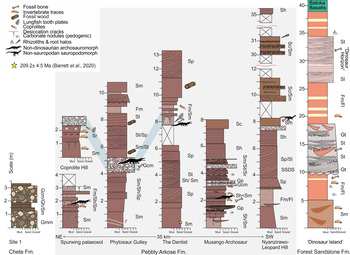
Measured sections of the Chete, Pebbly Arkose and Forest Sandstone formations (Upper Karoo Group) in the Mid-Zambezi Basin. Occurrences of phytosaur, lungfish and unidentified fossil bone material are indicated. Lithofacies codes are provided and discussed in the text and Table 1. Abbreviation: Fm. = Formation.

The Fine Red Marly Sandstone Member is reported as c. 70 m thick and as a local marker horizon by Bond (Reference Bond1967) and Bond & Falcon (Reference Bond and Falcon1973), although the distinct characters for its identification were not elaborated. The Fine Red Marly Sandstone Member has been described as a cyclic succession of mottled cream to red/maroon mudstones, siltstones (argillaceous beds) and sandstones (calcareous arenites, grits and arkosic arenites) with the presence of calcareous and ferric nodules, and is not considered fossiliferous (Bond, Reference Bond1972; FG Böhmke & RG Duncan, unpub. technical report, 1974; Stagman, Reference Stagman1978; Barber, Reference Barber2018). In the MZB, Grant (Reference Grant1970) and Marsh & Jackson (Reference Marsh and Jackson1974) reported the only mapped occurrence of the Fine Red Marly Sandstone Member SW of Bumi Hills (close to some sites of our recent fieldwork).
Macgregor (Reference Macgregor1941) and later authors (Bond, Reference Bond1967; Bond & Falcon, Reference Bond and Falcon1973) recorded a minor unconformity between the Fine Red Marly Sandstone and the overlying Pebbly Arkose, although it was not described. Stagman (Reference Stagman1978, p. 90) noted an ‘eroded surface at the base of the Pebbly Arkose’ that is locally designated by a thin bed of ‘hardened fragments of underlying sandstone’, whereas Ait-Kaci Ahmed (Reference Ait-Kaci Ahmed2018) identified an erosional disconformity at this boundary. These are likely related to the tectonic pulses outlined by Tavener-Smith (Reference Tavener-Smith1958, Reference Tavener-Smith1960), Bond (Reference Bond1955) and Bond & Falcon (Reference Bond and Falcon1973).
Bond (Reference Bond1972) noted similarities in lithology between the Fine Red Marly Sandstone and the Elliot Formation of the MKB, despite the apparent lack of fossils in the former. However, he also proposed that the Fine Red Marly Sandstone might be temporally correlated with the Molteno Formation, with similar lithofacies developing earlier in Zimbabwe because of plate tectonics (see also Visser, Reference Visser1984). Catuneanu et al. (Reference Catuneanu, Wopfner, Eriksson, Cairncross, Rubidge, Smith and Hancox2005) proposed that the Ripple Marked Flagstone, Fine Red Marly Sandstone and Pebbly Arkose units are likely all Elliot Formation equivalents, based on lithology and stratigraphic relationships, but older in age than those in the MKB and ranging from Scythian (= Olenekian) to Anisian.
2.d. Pebbly Arkose Formation
In the MZB, the Pebbly Arkose Formation is a thin unit with a thickness of c. 79–137 m (Bond, Reference Bond1967; Bond & Falcon, Reference Bond and Falcon1973; Fig. 2) and was either incorporated into BC Hosking’s (unpub. M.Sc. thesis, University of Zimbabwe, 1981) informal Tashinga Formation or described as the separate Pebbly Arkose Formation (Bond & Falcon, Reference Bond and Falcon1973; Ait-Kaci Ahmed, Reference Ait-Kaci Ahmed2018; Barber, Reference Barber2018). Barber (Reference Barber2018) describes it as composed of thickly bedded, medium- to coarse-grained pebbly arenites to arkoses. In the MZB, it has been considered to have both a conformable and unconformable boundary with the under- and overlying units (Bond & Falcon, Reference Bond and Falcon1973; Ait-Kaci Ahmed, Reference Ait-Kaci Ahmed2018; Barber, Reference Barber2018).
The Pebbly Arkose Formation is well known in the CBB, where it can reach thicknesses of c. 850 m in the eastern part of the basin and c. 1500–2000 m in the SW (Oesterlen & Millsteed, Reference Oesterlen and Millsteed1994; Barber, Reference Barber2018). There it comprises two facies: (i) a lower ‘coarse-grained facies’, composed predominantly of very coarse- to coarse-grained, pebbly, massive, arkosic sandstone that dominates at the base of the succession, and (ii) an uppermost ‘finer-grained facies’ that consists of fining-upwards cycles of medium- to coarse-grained, moderate- to poorly sorted, graded sandstones that transition into purple, micaceous (and pebbly) siltstones and mudstones (Oesterlen & Millsteed, Reference Oesterlen and Millsteed1994).
The Pebbly Arkose Formation, in both the MZB and CBB, is known for its large silicified tree trunks (Rhexoxylon, Dadoxylon, Mesembrioxylon; e.g. Deteema Fossil Forest in Hwange National Park) that occur at several stratigraphic levels within the unit (Bond & Falcon, Reference Bond and Falcon1973; Bond, Reference Bond1974; Stagman, Reference Stagman1978; Oesterlen & Millsteed, Reference Oesterlen and Millsteed1994). The coarse-grained sandstones and minor mudstones of the Upper Grit from Zambia’s Luangwa Basin are also known for their fossil tree trunks (Drysdall & Kitching, Reference Drysdall and Kitching1962) and, given tentative correlations by Tavener-Smith (Reference Tavener-Smith1960) and Rust (Reference Rust and Campbell1973), we suggest that the Upper Grit may be partly correlated with the Pebbly Arkose Formation in the MZB and CBB (see Fig. 2). An unconformity is also registered between the Luangwa Basin’s Red Marl and Upper Grit (as per Dixey, Reference Dixey1937).
In 1974, the first fossil vertebrate material, consisting of large lungfish tooth plates, was found in the Pebbly Arkose Formation within the MZB. These were discovered on an island in the Bumi River estuary (c. 16° 51′ S; 28° 28′ E) and reported by Bond (Reference Bond1974; Raath et al. Reference Raath, Oesterlen and Kitching1992). Recently, Barrett et al. (Reference Barrett, Sciscio, Viglietti, Broderick, Suarez, Sharman, Jones, Munyikwa, Edwards, Chapelle, Dollman, Zondo and Choiniere2020) documented the first fossil assemblage from the upper part of the ‘Tashinga Formation’ (dominated by phytosaurs, lungfish and metoposaurid amphibians) and provided a maximum depositional age of 209 ± 4.5 Ma (LA-ICPMS; see Barrett et al. Reference Barrett, Sciscio, Viglietti, Broderick, Suarez, Sharman, Jones, Munyikwa, Edwards, Chapelle, Dollman, Zondo and Choiniere2020; see also online Supplementary Table S1, available at http://journals.cambridge.org/geo) for these assemblages along the southern shoreline of Lake Kariba. Rhynchosaurs, cynodonts and basal sauropodomorph dinosaurs were also reported from the Pebbly Arkose Formation in the western CBB near the Angwa River in the Dande West area (Raath et al. Reference Raath, Oesterlen and Kitching1992; C. Griffin, pers. comm., 2020).
Bond (Reference Bond1972) considered the Pebbly Arkose Formation in the MZB to represent equivalents of the upper parts of the Red Beds Stage within the MKB (= Elliot Formation) based on fossil occurrences within the Pebbly Arkose Formation (fossil wood) and overlying Forest Sandstone (i.e. shared presence of the sauropodomorph dinosaur Massospondylus). Catuneanu et al. (Reference Catuneanu, Wopfner, Eriksson, Cairncross, Rubidge, Smith and Hancox2005) described the Elliot Formation equivalents from the MZB and CBB (Upper Angwa Sandstone Formation and Pebbly Arkose Formation) as Olenekian–Norian in age, that is, older than the Elliot Formation in the MKB (which is considered to be Norian–Sinemurian; Bordy et al. Reference Bordy, Abrahams, Sharman, Viglietti, Benson, Mcphee, Barrett, Sciscio, Condon, Mundil, Rademan, Jinnah, Clark, Suarez, Chapelle and Choiniere2020; Viglietti et al. Reference Viglietti, McPhee, Bordy, Sciscio, Barrett, Benson, Wills, Chapelle, Dollman, Mdekazi and Choiniere2020 a, b). However, the co-occurrence of rhynchosaurs, cynodonts and early sauropodomorph dinosaurs within the Pebbly Arkose Formation in the western CBB convincingly suggest a Late Triassic age, which is congruent with recent work by Barrett et al. (Reference Barrett, Sciscio, Viglietti, Broderick, Suarez, Sharman, Jones, Munyikwa, Edwards, Chapelle, Dollman, Zondo and Choiniere2020).
2.e. Forest Sandstone Formation
The uppermost Upper Karoo Group unit, the Forest Sandstone or Forest Sandstone Formation, is described as a series of pinkish-white to pale-brown, fine- to medium-grained, well-sorted sandstones, which can be subdivided into a calcareous lower unit showing evidence for subaqueous deposition and an aeolian upper unit with large-scale cross-bedding (Thompson, Reference Thompson1975; Stagman, Reference Stagman1978; Watkeys, Reference Watkeys1979; Cooper, Reference Cooper1981). Marsh & Jackson (Reference Marsh and Jackson1974) described a series of facies in the Forest Sandstone Formation near Bumi Hills and these are named, from stratigraphic lowest to highest: the Coarse White Sandstone, Calcareous Nodule Sandstone, the Red Beds and the Dinosaur Horizon. The latter overlies the Red Beds on Dinosaur Island, and is where Vulcanodon was retrieved by Bond et al. (Reference Bond, Wilson and Raath1970; see Viglietti et al. Reference Viglietti, Barrett, Broderick, Munyikwa, MacNiven, Broderick, Chapelle, Glynn, Edwards, Zondo, Broderick and Choiniere2018). Barber (Reference Barber2018) considers the Forest Sandstone Formation to uncomformably overlie the Pebbly Arkose Formation in the MZB, and this contact is denoted by a basal conglomerate interpreted as fossil regolith.
The Forest Sandstone Formation can be traced across several of the Karoo-aged basins in Zimbabwe and southern Africa (Johnson et al. Reference Johnson, Van Vuuren, Hegenberger, Key and Shoko1996; Catuneanu et al. Reference Catuneanu, Wopfner, Eriksson, Cairncross, Rubidge, Smith and Hancox2005). Lithological similarities to the aeolian-lacustrine Clarens Formation in the MKB have been observed, and these units have been correlated as time-equivalents by some authors (Johnson et al. Reference Johnson, Van Vuuren, Hegenberger, Key and Shoko1996; Bordy & Catuneanu, Reference Bordy and Catuneanu2002 a, b). Alternatively, others have suggested that the Forest Sandstone Formation is time-equivalent to the upper Elliot and lower Clarens formations (Bond & Falcon, Reference Bond and Falcon1973; Raath, Reference Raath1981). Drysdall & Kitching (Reference Drysdall and Kitching1962) noted that Dixey (Reference Dixey1937) suggested portions of the Upper Grit in the Luangwa Basin could be correlated to this Forest Sandstone Formation, although this has never been verified.
In addition to Vulcanodon, the Forest Sandstone Formation has yielded coelophysoid bonebeds, sauropodomorphs (notably specimens referred to Massospondylus), a ‘protosuchid’ crocodylomorph (cf. Notochampsa sp.), sphenodontid rhynchocephalians and tridactyl dinosaur trackways (Raath, Reference Raath1969, Reference Raath1981; Gow & Raath, Reference Gow and Raath1977; Raath et al. Reference Raath, Oesterlen and Kitching1992). Bone material was often noted to be coated in black manganese oxides (Bond, Reference Bond1974; Raath, Reference Raath1981). Importantly, Massospondylus is an index taxon for the Massospondylus Assemblage Zone in the MKB (Viglietti et al. Reference Viglietti, McPhee, Bordy, Sciscio, Barrett, Benson, Wills, Chapelle, Dollman, Mdekazi and Choiniere2020 a) and has been used as an index taxon for the Forest Sandstone Formation (e.g. sites at Chitake in Mana Pools National Park and at the Mana-Angwa gorge in Chewore Safari Area, Raath et al. Reference Raath, Smith and Bond1970; and at Chelmer Spruit near Nyamandhlovu, Attridge, Reference Attridge1963). However, referrals of the MZB material to Massospondylus carinatus require confirmation in light of recent taxonomic work (see Barrett et al. Reference Barrett, Chapelle, Staunton, Botha and Choiniere2019; Bordy et al. Reference Bordy, Abrahams, Sharman, Viglietti, Benson, Mcphee, Barrett, Sciscio, Condon, Mundil, Rademan, Jinnah, Clark, Suarez, Chapelle and Choiniere2020).
2.f. Summary of historical work
In summary, the Upper Karoo Group sedimentary successions preserved in these adjacent, but geographically separate, depositional basins and sub-basins show similar lithological characteristics and are believed to correlate with similar Triassic–Jurassic sequences in the MKB (Catuneanu et al. Reference Catuneanu, Wopfner, Eriksson, Cairncross, Rubidge, Smith and Hancox2005). Although this review attempts to make some tentative interbasinal correlations, it also highlights the many caveats required when attempting to link these geographically adjacent, but potentially spatially and temporally distinct, stratigraphic assemblages. A key limitation is the scarcity of shared index fossils (see Wynd et al. Reference Wynd, Sidor, Whitney and Peecook2018; Barrett et al. Reference Barrett, Sciscio, Viglietti, Broderick, Suarez, Sharman, Jones, Munyikwa, Edwards, Chapelle, Dollman, Zondo and Choiniere2020; Bordy et al. Reference Bordy, Abrahams, Sharman, Viglietti, Benson, Mcphee, Barrett, Sciscio, Condon, Mundil, Rademan, Jinnah, Clark, Suarez, Chapelle and Choiniere2020; Viglietti et al. Reference Viglietti, McPhee, Bordy, Sciscio, Barrett, Benson, Wills, Chapelle, Dollman, Mdekazi and Choiniere2020 a, b). Moreover, Late Triassic – Early Jurassic continental rocks in southern Gondwana appear to be poor in primary volcaniclastic deposits (see Bordy et al. Reference Bordy, Abrahams, Sharman, Viglietti, Benson, Mcphee, Barrett, Sciscio, Condon, Mundil, Rademan, Jinnah, Clark, Suarez, Chapelle and Choiniere2020), making independent age-dating difficult, although some success has been seen with detrital zircon geochronology in the MZB (Barrett et al. Reference Barrett, Sciscio, Viglietti, Broderick, Suarez, Sharman, Jones, Munyikwa, Edwards, Chapelle, Dollman, Zondo and Choiniere2020). Because of these ambiguities, this review is important to the growing debate on the age and correlation of Gondwana’s Triassic record.
3. Materials and methods
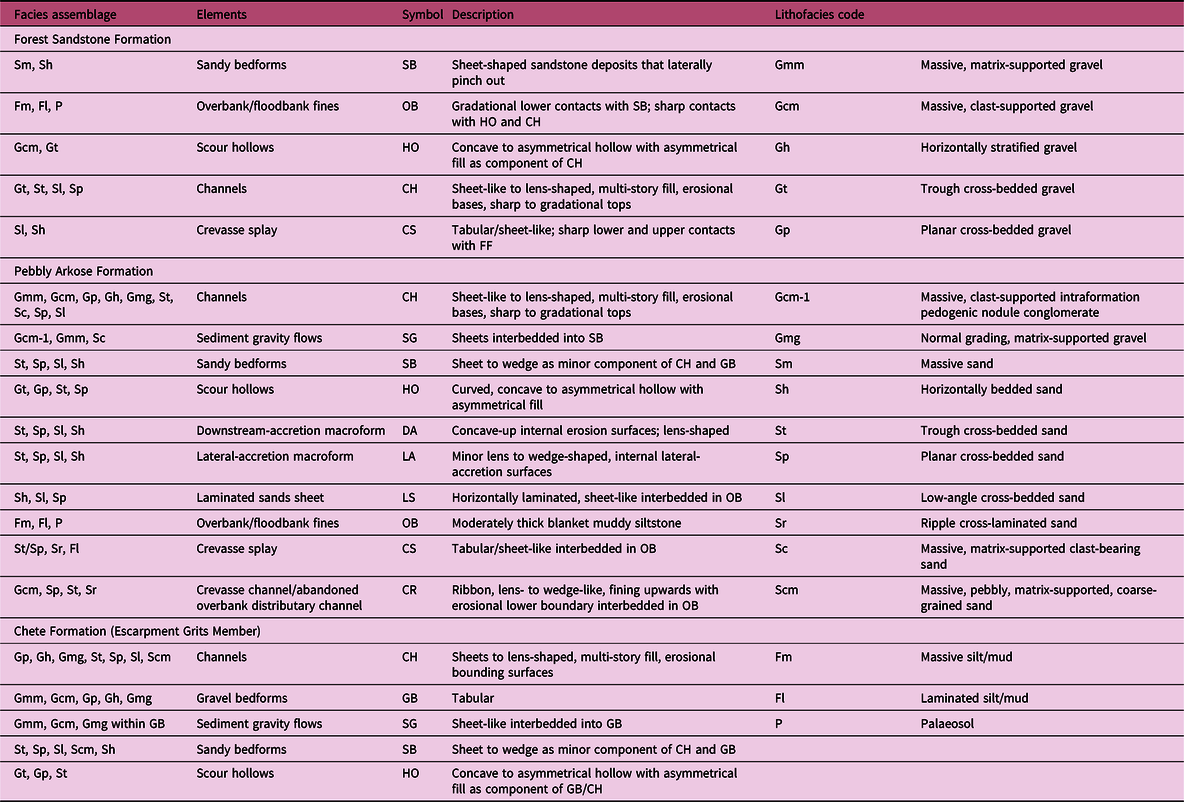
A total of 23 new georeferenced sites of sedimentological and palaeontological interest were identified along the southern shoreline of Lake Kariba in the MZB of northern Zimbabwe (Fig. 1; online Supplementary Tables S1–S3, available at http://journals.cambridge.org/geo). Standard field techniques were used to measure, document and record macroscopic observations of the host sedimentary rocks and to construct stratigraphical sections (Fig. 3) at several sites (Miall, Reference Miall1996, Reference Miall2014). For all lithofacies descriptions and codes, see Table 1. We documented the stratigraphical positions and facies associations of the fossil material identified from these sites. Structural observations and faulting were also taken into account (online Supplementary Material, available at http://journals.cambridge.org/geo). All collected fossil material is now deposited at the Natural History Museum of Zimbabwe (Bulawayo, NHMZ); a full list with justifications for taxonomic identifications can be found in online Supplementary Table S2 (see also Barrett et al. Reference Barrett, Sciscio, Viglietti, Broderick, Suarez, Sharman, Jones, Munyikwa, Edwards, Chapelle, Dollman, Zondo and Choiniere2020).
Lithofacies, facies assemblages and architectural elements noted in the Upper Karoo Group exposures, Mid-Zambezi Basin, Zimbabwe (following Miall, Reference Miall1996, Reference Miall2006)

4. Results
Sedimentological data collected here delineate several sites (Figs 1, 3; online Supplementary Table S1, available at http://journals.cambridge.org/geo) with facies and facies associations that we define as either distinctive or shared features of the Upper Karoo Group units mentioned in this study. Although recently adopted by Barrett et al. (Reference Barrett, Sciscio, Viglietti, Broderick, Suarez, Sharman, Jones, Munyikwa, Edwards, Chapelle, Dollman, Zondo and Choiniere2020), we have chosen to discontinue the use of the informal ‘Tashinga Formation’ given our new field observations and in light of recent geological reports on the MZB sub-basins (Ait-Kaci Ahmed, Reference Ait-Kaci Ahmed2018; Barber, Reference Barber2018). Here, we have adopted the use of the Chete, Pebbly Arkose and Forest Sandstone formations for the Lower Sengwa/Gwembe Sub-basin of the MZB, as described by Barber (Reference Barber2018). Following Barber (Reference Barber2018), we regard the Escarpment Grit, Ripple Marked Flagstone and the Fine Red Marly Sandstone as members of the Chete Formation in the Lower Sengwa (Lepper, Reference Lepper1992) or Gwembe (Barber, Reference Barber2018) Sub-basin of the MZB. We support the distinction of the Pebbly Arkose Formation proposed by both Ait-Kaci Ahmed (Reference Ait-Kaci Ahmed2018) and Barber (Reference Barber2018) for both the Gwembe (Lower Sengwa) and Matabolo (Upper Sengwa) sub-basins of the MZB. We confirm the distinction of the Forest Sandstone Formation and discuss each unit separately in the following. Finally, we present the new palaeontological information collected at each of these sites (Fig. 3).
4.a. Sedimentological results and interpretation
4.a.1. Chete Formation
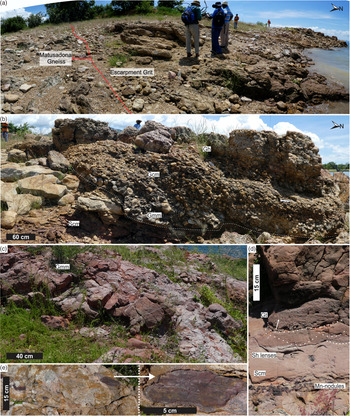
Outcrops of the Escarpment Grit Member were studied on the mainland near Sanyati Gorge (Site 1; Figs 3, 4; online Supplementary Table S1) where they had been mapped previously (see Brassey, Reference Brassey1951). Here the Escarpment Grit Member rests unconformably on the Palaeoproterozoic chevron-folded muscovite schist, biotite gneiss and associated amphibolite of the Matusadona Range (Fig. 4a). At Site 1, the Escarpment Grit Member consists of brown to russet, massive, graded and bedded gravelly facies that dip shallowly (< 5°) towards the north (Fig. 4b). It is characterized by clast-supported, very fine gravel (granules) to cobble conglomerates (Gcm) with lesser matrix-supported conglomerates (Gmm) that are sheet-like and have erosional bases (dashed line in Fig. 4b). These are both typically poorly to moderately sorted, with sub-rounded clasts and polymodal grain size distributions, and do show weakly developed normal and inverse grading. Clasts have an average size range of 0.4–12 cm with occasional boulders of c. 20–40 cm diameter. Clasts are generally rounded and discoidal in shape, and tend to exhibit crude imbrication that is directed northwards.
(a) Unconformable contact exposed near Sanyati Gorge, Zimbabwe between the Chete Formation (Upper Karoo Group) and older pre-Karoo, chevron-folded muscovite schist of the Matusadona Gneiss Formation. (b) Escarpment Grit Member gravelly facies on the mainland near Sanyati Gorge: massive to crudely bedded granule to cobble, polymictic conglomerates that are largely poorly to moderately sorted, clast- and matrix-supported and interbedded with very-coarse-grained sandstones. (c) Coarse-grained sandstones and conglomerate exposure on Bed Island. (d) Normal-graded and massive conglomerates and very-coarse-grained to coarse-grained sandstones from Bed Island. Note secondary manganese nodule growth and staining. (e) Impressions of fossil wood clasts within a micaceous coarse-grained sandstone. See Table 1 for acronyms and facies codes.

This gravelly facies is either massive (Gcm) or shows crude to horizontal bedding (Gh; Fig. 4b) defined by the alignment of clasts and their vertical decrease in grain size. Upwards fining is also noted (Gmg, normal grading) and inverse grading is present (Fig. 4). Interbedded within the gravelly facies are ≤ 60–120 cm lenses or thin ribbons of massive- to horizontally bedded, coarse- to medium-grained sandstone (often containing sporadically dispersed granules and pebbles).
Further away from the fault scarp and towards Bed Island (Fig. 4c–e; online Supplementary Table S1), this gravelly facies becomes finer-grained, better-sorted and bedded (c. 20–50 cm thick, localized trough-cross beds; St, Fig. 4c, d), and increases in the proportion of coarse- to medium-grained sandstone content. The presence of horizontally bedded, thin (< 45 cm) gravel–sand couplets with erosive or scour surfaces are common. Impressions of wood clasts (≤ 8 cm in length; Fig. 4e) within a matrix composed of micaceous, very coarse- and medium-grained sandstone are present and show secondary growth of Fe/Mn nodules. Bed Island, although finer-grained, preserves thick, massive to thin, graded trough cross-bedded and horizontally bedded coarse- to medium-grained sand bodies with basal conglomerate lags (Fig. 4c, d).
In attempting to define and map the upper contact of the Chete Formation with the overlying Pebbly Arkose Formation, we noted several sites (i.e. mainland Sites 2 and 3, and near the Changa Camp; online Supplementary Table S1), where there is a decrease in average grain size and an interfingering relationship of coarser- and finer-grained facies corresponding to a colour change. Here red siltstones (occasionally showing palaeopedogenesis) and mauve-reddish, normal-graded, massive- to trough cross-bedded, coarse-grained and pebbly sandstone become dominant (Fig. 5a, c, f). However, due to similarities in lithologies, the exact placement of an upper contact was hard to define and further hindered by the lack of lateral and vertical outcrop along our field transects. This contact has been reported as unconformable (Ait-Kaci Ahmed, Reference Ait-Kaci Ahmed2018; Barber, Reference Barber2018) and here we have represented it with the increasing occurrence of carbonate (as caliche and nodules) and the development of palaeosols (which are potentially convenient for field mapping, but this observation requires verification).
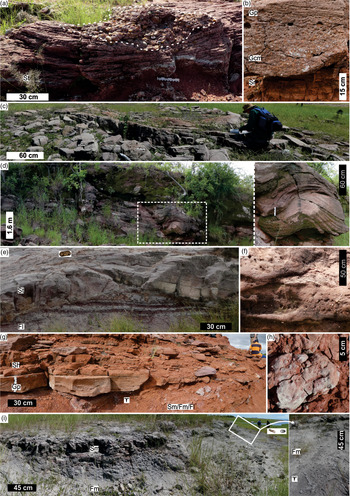
Exposures of the Pebbly Arkose Formation. (a) Typical trough cross-bedded, pebbly, very-coarse-grained sandstone near Sanyati River. (b) Pedogenic nodule and mudchip conglomerate with waning-energy sedimentary structures (massive–planar cross-bedded–horizontal lamination). (c) Abandoned, fining-upwards, pebbly trough cross-bedded sandstone channel in overbank fines on the mainland near site 2. (d) Multi-storey, low-angle and planar cross-bedding showing (inset) upwards directed soft sediment deformation structure (small-scale fold, likely related to a seismic tremor) (Leopard Hill geotraverse). (e) Laminated lacustrine (Fl) deposit down-cut by trough cross-bedded sandstone containing fossil logs ≤ 1.2 m in length. (f) Pebbly Arkose: very-coarse- to coarse-grained, maroon sandstone, generally massive (Sm) with pebble stringers (Scm). (g) Pedogenically altered muddy-siltstone overbank facies (Fm/Fl) with sandstone-filled desiccation cracks and in situ vertebrate material interbedded with lenticular, fining-upwards planar cross-bedded conglomerate (Gp) and sandstones. (h) Carbonate-rich bioturbated siltstone. (i) Palaeopedogenic alteration overbank Fm units capped by sheet-like fine- to medium-grained sandstones (Sm). See Table 1 for acronyms and Figure 3 for symbols.

4.a.2. Pebbly Arkose Formation
The Pebbly Arkose Formation, around the southern shoreline of Lake Kariba, can be subdivided into sandstone and fine-grained facies associations. The sandstone facies assemblage is dominated by fine- to very coarse-grained and pebbly, sandstones (Sm, St, Sp, Sl, Sc, Sr; Table 1) with minor intraformational conglomerates (lags; Gcm, Gh, Gp; Table 1). The sandstones are micaceous, maroon to reddish-brown and grey-cream, thinly to thickly (c. 0.3–1.2 m) bedded, tabular and lenticular in geometry (Fig. 5). All lithofacies may display granule- to pebble-sized stringers that can define a bedding plane, or be randomly dispersed throughout the sandstone matrix.
Stacked sandstone units exhibit a poorly developed fining-upwards trend defined by undulating erosional bases with/without channel lag conglomerate (Fig. 5a, c), and are capped by massive mudstones and siltstones (Fm units; Table 1) or erosively down-cut by overlying sandstone beds. These stacked sandstones can form multi-storied units (≤ 4 m thick as exposed) that extend laterally over > 200 m where outcrop is available. Trough (St) and planar-cross bedding (Sp) are the dominant sedimentary structures with lesser massive sandstone units (Sm; Fig. 5a, c, d). Medium- to fine-grained sandstones that display horizontal (Sh) and ripple cross-lamination (Sr) are less common and, when present, form the uppermost sedimentary structures in a weakly fining-upwards sandstone unit.
At the field sites visited, a single trough (scour structure) to grouped trough cross-bedding co-sets of c. 0.5–1.5 m thick occur (Fig. 5). Co-set thickness decreases upwards in a stacked package that was not measured as more than 4 m. Bedding planes may have mud drapes (millimetre thick) that can be bioturbated by simple, non-branched, non-ornamented, horizontal traces in epirelief (cf. Planolites isp.). These sandstone units are interbedded with or grade laterally into less thick muddy-siltstone units (c. 1.5–2 m thick) (i.e. Leopard Hill geotraverse).
Very coarse- to coarse-grained sandstones with pebble laminae are thickly bedded (≥ 1.5 m) with thin (< 5–10 cm; Fig. 5f) bands of conglomerate or pebble lags and laminae. The alternation of coarse-grained sandstone and bands of conglomerate, or pebble lags and laminae, suggest punctuated, fluctuating flow speeds.
Convolute bedding and soft-sediment deformation structures on both a small (< 15 cm; single bed) and large (> 60 cm) scale were documented (Fig. 5d). We also recorded wood fragments (< 2–50 cm) and larger fossil logs (> 1.5 m length) within massive and trough-cross bedded, coarse- to medium-grained sandstone successions, respectively (e.g. the Petrified Forest site, ex situ fossil wood).
The Pebbly Arkose Formation’s fine-grained facies assemblage is composed of maroon-red to pale cream, micaceous, thinly bedded (< 2 m), and often variegated (mottled), siltstones and mudstones (Fm, Fl; Fig. 5e, g, i; overbank deposits; Table 1). These pedogenically modified floodplain deposits are associated with lesser sandstones (Sp, Sm, Sh, Sl, Sr) and intraformational conglomerate (Gcm, Gcm-1, Gmm, Gh, Gp; Table 1; Figs 3, 5). Many of the fossiliferous sites listed here are within these finer-grained deposits, for example, the Spurwing East Palaeosol, The Dentist, Coprolite Hill, Steve’s Phytosaur and the Musango Archosaur sites (Fig. 5e, g, i).
Conglomerate lenses and fine-grained sandstones are also present as thin (< 35 cm; Fig. 5g) laterally discontinuous sheets, and these may be massive (Sm), horizontally laminated (Sh) and/or preserve climbing ripple cross-lamination (Sr). Minor sheet, asymmetrical to lenticular, trough (St), planar (Sp) to low-angle (Sl) cross-stratified sandstone units (average c. 1–2 m thick) are present within the overbank deposits (Fig. 5g). These are either isolated within the finer-grained facies or (may) show lateral accretion (e.g. Phytosaur Gulley, Musango Archosaur), and have either undulating lower boundary surfaces showing scouring ≥ 1 m deep (e.g. Phytosaur Gulley) or sharp bases. Single, lenticular St channel units may scour into floodplain fine-grained sediments (e.g. Musango Archosaur).
Thin (< 40–50 cm thick) sandstone sheets, occasionally coarsening upwards, occurring within the finer-grained facies are interpreted as overbank flooding (Miall, Reference Miall2006, Reference Miall2014). Ichnofossils (back-filled burrows, vertical and horizontal burrows; Fig. 5h) are common on mud-lined, upper bedding planes in isolated channel sandstones.
Pedogenically modified overbank deposits (palaeosols) in the Pebbly Arkose Formation can be recognized by their mottled red-grey colouration and the presence of pedogenic nodules, coprolites, occasional calcareous fossil rootlets (rhizoliths and rhizohalos; Fig. 5g, i), bioturbation (horizontal and vertical invertebrate burrows; Fig. 5h, i) and sandstone-filled desiccation cracks (< 40 cm long: Fig. 5i; The Dentist). Pedogenic carbonate nodules are present within the fine-grained facies and occur as either c. 10–20 mm or c. 40–60 mm largely unfused glaebules. Bioturbation is extremely common in both the sandstones and muddy siltstone of this facies (Fig. 5h, i). Bioturbation measured in the various sections and outcrop varies from grade 1–3 (moderate) to grade 5 (intense), with complete bioturbation (grade 6–100%) rare but present, using the bioturbation index (BI) of Taylor & Goldring (Reference Taylor and Goldring1993).
Throughout the Pebbly Arkose Formation, conglomerates are a minor component and appear as basal lags (i.e. mud-chip to pebble conglomerate channel lags), as thin (< 50 cm) massive sheets composed of granules to medium-sized pebbles and/or intraformational mud-chips or as reworked, localized, pedogenic nodule conglomerates (Gcm-1; Fig. 5a, b). These are all generally massive (Gmm, Gcm), but may also show planar cross-bedding (Gp) and/or horizontal bedding (Gh) and erosional bases (Fig. 5a).
Reworked, pedogenic nodule conglomerates (Gcm-1; Fig. 5b) are a distinct lithofacies (Gcm-1), characteristic of the strata found along the southern Kariba shoreline. They are clast-supported, moderately to poorly sorted, and consist of rounded to sub-angular clasts of quartz, mudstone, sandstone, pedogenic carbonate nodules and (often) fragmentary fossil bone. For instance, the fragmentary phytosaur material at Phytosaur Gulley (Fig. 3) was contained within this intraformational conglomerate. A distinctive carbonate matrix predominately fuses the clasts in these conglomerates. Clast size, sorting and rounding is variable between our studied sites, as are the fossil occurrences. Facies Gcm-1 forms tabular sheets with sharp lower boundaries (e.g. Phytosaur Gulley, Leopard Hill geotraverse), and the thickness of these units varies over the range c. 25–75 cm and with a lateral extent of ≤ 100 m.
4.a.3. Forest Sandstone Formation
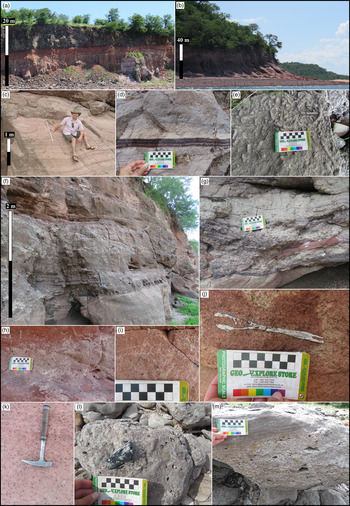
Viglietti et al. (Reference Viglietti, Barrett, Broderick, Munyikwa, MacNiven, Broderick, Chapelle, Glynn, Edwards, Zondo, Broderick and Choiniere2018) documented a total of 43 m of vertical strata exposed on Island 126/127 (Dinosaur Island; Figs 3, 6; online Supplementary Table S1). Within this interval, four sedimentary facies associations (lettered A to D) were recognized that we believe correspond to Marsh & Jackson’s (Reference Marsh and Jackson1974) Forest Sandstone Formation facies descriptions. Facies A is the lowermost facies located in this study area, and is represented by a red-brown, fine-grained sandstone c. 5 m in thickness (Fig. 6j). The sandstone is normally structureless, except for laterally discontinuous lenses of bioturbated, poorly sorted sandstone that show some horizontal lamination. Facies B represents a silty sandstone with mottled bioturbated horizons that are common (Fig. 6h). Carbonate nodules, plant fossil fragments with black mineralization and rhizoliths are also encountered, along with rare, isolated, but identifiable, vertebrate material (Fig. 6h, i). Facies C is a light-grey, coarse-grained, trough cross-bedded sandstone that contains multiple erosional boundaries and intraformational lags (Fig. 6e, f). These lags sometimes contain fragmentary and undiagnostic bone material, as observed on Namembere Island (Fig. 6k, l). Facies D is a medium- to coarse-grained (but well-sorted) sandstone containing large (>1 m) cross-beds that sometimes contain black heavy mineral preservation concentrated on foreset boundaries, has a distinctive, loosely compacted texture, and forms steep unstable cliffs in outcrop, which matches historic accounts of Marsh and Jackson’s (Reference Marsh and Jackson1974) Dinosaur Horizon (Fig. 6c, d).
Exposures of the upper Forest Sandstone Formation on ‘Dinosaur’ (a–j) and Namembere Islands (k, l). (a) Contact between the Forest Formation and Batoka Basalt. (b) Exposure on the northern portion of ‘Dinosaur Island’ where Vulcanodon karibaensis was recovered from a sandstone horizon immediately below a basalt layer. (c) Facies D from Viglietti et al. (Reference Viglietti, Barrett, Broderick, Munyikwa, MacNiven, Broderick, Chapelle, Glynn, Edwards, Zondo, Broderick and Choiniere2018), also known as the Dinosaur Horizon of Marsh & Jackson (Reference Marsh and Jackson1974). Note the presence of slightly undulating bedding and soft sediment deformation. (d) Common heavy mineral horizons in Facies D. (e) Calcified trace fossils on upper bedding places of Facies C (Viglietti et al. Reference Viglietti, Barrett, Broderick, Munyikwa, MacNiven, Broderick, Chapelle, Glynn, Edwards, Zondo, Broderick and Choiniere2018). (f) Typical outcrop of Facies C on Dinosaur Island. Note the multiple erosion boundaries (with basal lags on foresets) and presence of planar and trough-cross-bedding. (g) Facies C erosional scour showing large mudstone rip-up clasts. (h) Palaeosol horizon in Facies B showing bioturbation horizon in red siltstone. (i) Fossil rootlet halos in Facies B. (j) Isolated cervical neural arch of a sauropodomorph dinosaur found in Facies B. (k) Massive and heavily bioturbated horizon in Facies A (Viglietti et al. Reference Viglietti, Barrett, Broderick, Munyikwa, MacNiven, Broderick, Chapelle, Glynn, Edwards, Zondo, Broderick and Choiniere2018). (l) Examples of fossil bone fragments in a basal lag deposit on Namembere Island, west of Dinosaur Island. This site is attributed to the Facies C horizon on Dinosaur Island. (m) Basal lag deposit comprising mud chips and carbonate nodules. Fragmentary fossil bone is present but rare.

4.b. Palaeontology
4.b.1. Spurwing Island
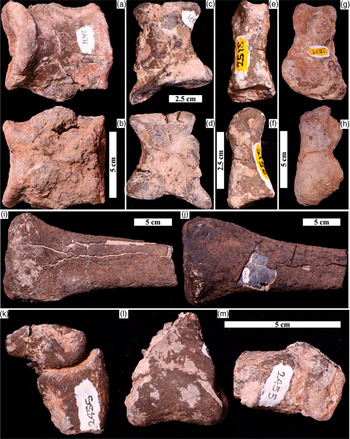
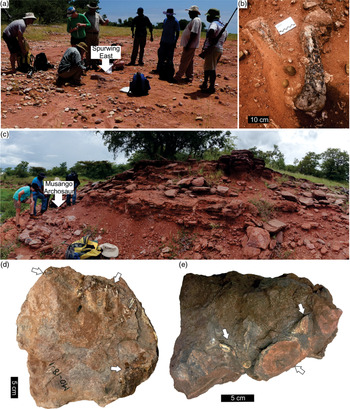
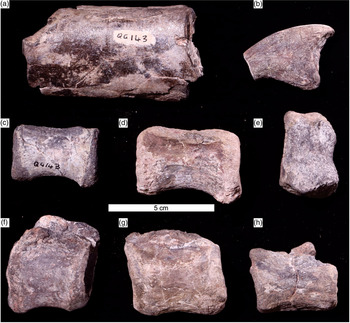
Spurwing Island hosts several fossil-bearing sites (e.g. The Dock, Spurwing East Palaeosol; Figs 7, 8a; online Supplementary Tables S1, S2) in addition to being the source of historically collected but undescribed vertebrate material (Fig. 9; PMB and JNC, pers. obs., NHMZ collections; M. A. Raath, pers. comm., 2019). These occur above trough cross-bedded, medium-grained, mauve sandstones and within a finer-grained facies composed of very fine-grained, silty sandstone and siltstones that often display palaeopedogenic alteration features such as mottling, bioturbation, desiccation cracks and pedogenic nodules. At The Dock site (Fig. 7), postcranial elements of taxonomically indeterminate non-sauropod sauropodomorph dinosaurs, including vertebrae, a proximal tibia, an astragalus, phalanges and other fragmentary limb bones, were recovered as well as a possible theropod dinosaur phalanx (Fig. 7e) and other indeterminate bone fragments. At the East Palaeosol site, an articulated hindlimb of a non-dinosaurian archosauromorph was discovered (Fig. 8a, b).
Fossils collected from surface exposures of the Pebbly Arkose Formation at Spurwing, The Dock locality. Two sacral vertebrae of an indeterminate reptile (NHMZ 2471) in (a) ventral, (b) dorsal, (c) ventral and (d) dorsal views. Manual phalanx of a ?theropod dinosaur (NHMZ 2518) in (e) extensor and (f) medial views. Astragalus of a sauropodomorph dinosaur in (g) proximal and (h) anterior views (NHMZ 2519). Proximal left tibia of a ?sauropodomorph dinosaur (NHMZ 2456) in (i) lateral and (j) medial views. Manual bones of a ?sauropodomorph dinosaur (NHMZ 2455) (k) distal end of penultimate phalanx and proximal end of ungual in medial or lateral view, (l) articulated partial phalanges and (m) articulated partial phalanges in medial or lateral view.

(a) Exposures looking north at the Spurwing East Palaeosol locality (Pebbly Arkose Formation). (b) In situ femur, tibia and fibula of an indeterminate archosaur at the Spurwing East Palaeosol locality (field number SW-18-4). (c) Exposures at the Musango Archosaur locality looking ENE (Pebbly Arkose Formation). Arrow indicates the position of a non-dinosaurian avemetatarsalian skeleton. (d) Block of fossiliferous sediment from the Musango Archosaur locality; arrows indicate fossilized bone (field number MO-18-1). (e) Block of fossiliferous sediment from the Musango Archosaur locality, arrows indicate fossilized bone (field number MO-18-1).

Historically collected isolated vertebrate (?dinosaur) bones from Spurwing Island (NHMZ QG 143/NHMZ 11634). (a) Diaphysis of an indeterminate limb bone, (b) partial manual ungual, (c) centrum of caudal vertebra, (d) centrum of caudal vertebra, (e) manual phalanx, (f) centrum of indeterminate vertebra, (g) centrum of indeterminate vertebra and (h) indeterminate bone fragment.

4.b.2. Phytosaur Gulley
The sedimentology of the Phytosaur Gulley site is described in Barrett et al. (Reference Barrett, Sciscio, Viglietti, Broderick, Suarez, Sharman, Jones, Munyikwa, Edwards, Chapelle, Dollman, Zondo and Choiniere2020; online Supplementary Table S2). The units above the waterline consist of several stacked sandstone units (Sm, Sl, Sp) that are sheet-like to tabular in geometry and moderately bedded (< 1–1.5 m thick) with minor interbedded overbank fines (Fm). Interbedded within this sandstone package is a c. 1-m thick, sheet-like pedogenic nodule conglomerate (Gcm-1) that has an erosive basal contact with the underlying Sm. The reworked, pedogenic nodule conglomerate horizon contains relatively abundant phytosaur remains including jaw fragments and teeth (Barrett et al. Reference Barrett, Sciscio, Viglietti, Broderick, Suarez, Sharman, Jones, Munyikwa, Edwards, Chapelle, Dollman, Zondo and Choiniere2020). Dermal bones attributed to metoposaur temnospondyls were also identified (Barrett et al. Reference Barrett, Sciscio, Viglietti, Broderick, Suarez, Sharman, Jones, Munyikwa, Edwards, Chapelle, Dollman, Zondo and Choiniere2020). Fossil bone material was recovered from this lithofacies only. Fossil wood was recovered from the trough cross-bedded medium- to coarse-grained sandstones overlying Gcm-1. Barrett et al. (Reference Barrett, Sciscio, Viglietti, Broderick, Suarez, Sharman, Jones, Munyikwa, Edwards, Chapelle, Dollman, Zondo and Choiniere2020) placed these sites in the upper ‘Tashinga Formation’, but they should be regarded as within the Pebbly Arkose Formation as described here.
4.b.3. Musango Archosaur site
The Musango Archosaur site is located c. 1 km SW of Musango Safari Camp. The logged section is c. 9 m thick (Figs 3, 8c) and consists of alternating massive muddy siltstone, thinly bedded, muddy, very-fine grained sandstones to fine- to medium-grained sandstone and subordinate conglomerate (clast- and matrix-supported) beds. The finer-grained deposits are interbedded with minor sheet-like and isolated, asymmetrical channel-like sandstone bodies (Sm, Sh and Sp, Sr; Fig. 5g, i). The latter is fine- to medium-grained, thin (≤40–50 cm thick) and laterally restricted (<1.2 m in length). Several of the channel sandstones have erosional and gullied bases that are draped by a matrix-supported intraformational conglomerate and show lateral accretion. Cross-bedding planes (Sp) are denoted by granular lags in these lowermost channel sandstones. Within the siltstone units, weakly developed palaeosols are noted by the presence of rare pedogenic nodules and sandstone-filled desiccation cracks (c. < 40 cm long; Fig. 5i). Many laterally restricted (< 5 m) sheet-like sandstone units coarsen upwards and show bioturbated mud-draped upper bedding plane surfaces.
Fossil vertebrate material was found within a pedogenically altered and heavily bioturbated (BI = 6; Taylor & Goldring, Reference Taylor and Goldring1993) muddy siltstone, which is interbedded between two thin (<30 cm), laterally continuous, fine-grained sandstone beds. The material collected from this site is still being prepared for study but appears to represent an associated, but partial, non-dinosaurian avemetatarsalian skeleton based on the morphology of the astragalus (Fig. 8c–e; online Supplementary Tables S1, S2).
4.b.4. The Dentist and Coprolite Hill
The Dentist and Coprolite Hill site complex was discussed in Barrett et al. (Reference Barrett, Sciscio, Viglietti, Broderick, Suarez, Sharman, Jones, Munyikwa, Edwards, Chapelle, Dollman, Zondo and Choiniere2020; online Supplementary Table S2). Here, lungfish, metoposaurid and phytosaur remains, as well as coprolites, were recovered from a variegated red-grey silty-mudstone that represents an overbank area and palaeosol deposit. These sites were considered to represent the upper ‘Tashinga Formation’ in Barrett et al. (Reference Barrett, Sciscio, Viglietti, Broderick, Suarez, Sharman, Jones, Munyikwa, Edwards, Chapelle, Dollman, Zondo and Choiniere2020), but now fall within the Pebbly Arkose Formation as described here.
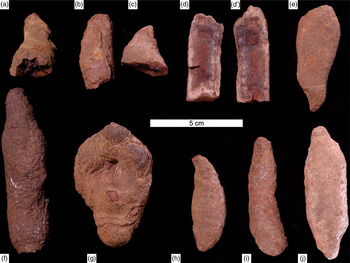
The Dentist and Coprolite Hill sites represent an almost purely aquatic vertebrate fauna, and they have yielded no material of sauropodomorph dinosaurs to date. Notable finds include partial mandibles, numerous teeth and osteoderms of phytosaurs (Barrett et al. Reference Barrett, Sciscio, Viglietti, Broderick, Suarez, Sharman, Jones, Munyikwa, Edwards, Chapelle, Dollman, Zondo and Choiniere2020). These fragments were unassociated and numerous individuals are likely to be represented; the mandibular fragments alone indicate the presence of at least three differently sized individuals. These phytosaur remains represent the first known occurrence of the clade in sub-Saharan mainland Africa (Barrett et al. Reference Barrett, Sciscio, Viglietti, Broderick, Suarez, Sharman, Jones, Munyikwa, Edwards, Chapelle, Dollman, Zondo and Choiniere2020), but more material will be required to determine its taxonomic affinities. Several taxonomically indeterminate ziphodont archosaur teeth were also recovered from this locality and may represent either those of dinosaurs (theropods or herrerasaurids) and/or another carnivorous archosaur clade (e.g. a non-crocodylomorph pseudosuchian). Lungfish tooth plates are very common and might represent a new taxon (T. Challands, pers. comm., 2017; Barrett et al. Reference Barrett, Sciscio, Viglietti, Broderick, Suarez, Sharman, Jones, Munyikwa, Edwards, Chapelle, Dollman, Zondo and Choiniere2020). Vertebrate coprolites are locally common at this site (Fig. 10).
(a–j) Selection of hematite-coated coprolites (field number MS-18-2) from the Pebbly Arkose Formation of the Coprolite Hill locality. (d, d’) Part and counterpart of a single coprolite showing internal structure.

4.b.5. Petrified Forest
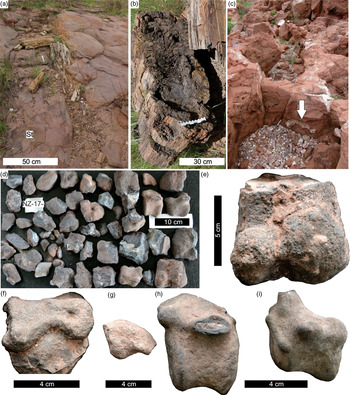
The Petrified Forest site occurs in a c. 5-m thick, medium-grained, light red-brown, trough and planar cross-bedded sandstone unit, with many internal erosional boundaries and intraformational lags. It includes a large number of fossilized logs preserved over an area of c. 50 m2 in the Pebbly Arkose Formation. The tree trunks (Fig. 11a, b) are ex situ and are often located at the bases of thick sandstone channels or between troughs. Tree trunks can reach up to c. 1 m in diameter and c. 1.5–5 m in length (Fig. 11b). While none of these tree trunks has been formally identified, previous work by Marsh & Jackson (Reference Marsh and Jackson1974) identified them as Rexoxylon (Corystospermales, or tree-fern-like) or Dadoxylon/Ausraloxylon (Cordaitales, or conifer-like) (Bamford, Reference Bamford2004; online Supplementary Tables S1–S3).
Fossil wood within the Pebbly Arkose and Forest Sandstone formations. (a) c. 1.2 m long log, with long axis roughly parallel to flow, between two trough cross-bedded sandstones (Pebbly Arkose Formation). (b) Cross-section of fossil wood at the Petrified Forest Site (Pebbly Arkose Formation). (c) Namembere Island tree trunk casts and associated silicified rhizoliths (arrowed; Forest Sandstone Formation). (d) Nyanzirau site fossil material (sample number NZ-17-1) collected within the Pebbly Arkose Formation. All material was ex situ but associated, and represents postcranial elements of a medium-sized sauropodomorph dinosaur. Note manganese encrustation. (e) Distal femur in ventral view. (f) Manual phalanx I-1 in ?lateral view. (g) Manual ungual in ?lateral view. (h) Proximal caudal vertebrae in right lateral view. (i) Distal caudal vertebra in lateral view.

4.b.6. Nyanzirau dinosaur site
The Nyanzirau site occurs along the Leopard Hill geotraverse (Fig. 3) and is associated with a medium-grained, massive sandstone that overlies a pedogenic nodule conglomerate (with intraformational mud chips and occasional fossil vertebrate material) of the Pebbly Arkose Formation. The Nyanzirau fossil material (Fig. 11d–i) consists of ex situ but associated elements of a medium-sized sauropodomorph dinosaur, including several teeth, dorsal vertebrae, caudal vertebrae, ilia, manual phalanx I-1, a manual ungual, a partial femur and fragmentary long bones (Fig. 11d–i; online Supplementary Tables S1, S2). All of this material is heavily encrusted in a black, manganese-rich coating, which can vary from 2 to 20 mm in thickness. The bone is black in colour and bone surfaces beneath the manganese crust are very well-preserved.
4.b.7. Gordon’s Bay
Around Gordon’s Bay (Fig. 1) there are several outcrops of medium-grained, trough cross-bedded red to cream sandstones of the Pebbly Arkose Formation, from which weathered bone material, phytosaur teeth and fragmentary fossil wood (Fig. 12a–c) were obtained (field number GB-18-3; online Supplementary Table S1). These are isolated ex situ occurrences of heavily weathered material, but they can be used to infer potential for future exploration (Fig. 12a–c).
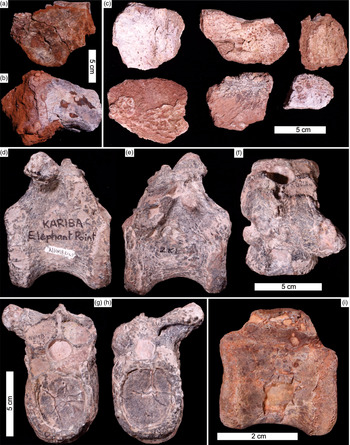
Gordon’s Bay site material (field number GB-18-1) showing (a, b) indeterminate ?dinosaur limb bone and (c) fragments of sculptured ?phytosaur cranial bone (field number GB-18-3). Elephant Point site in the Pebbly Arkose Formation showing anterior dorsal vertebra of saurischian dinosaur in (d) right lateral, (e) left lateral and (f) dorsal views. Posterior dorsal vertebra of saurischian dinosaur in (g) posterior and (h) anterior views (NHMZ 2145). (i) Centrum and partial neural arch of caudal vertebra of indeterminate tetrapod in lateral view, collected in 2018 (field number EP-18-1).

4.b.8. Elephant Point
A historically collected vertebra (NHMZ QG 2145; Fig. 10d–h; online Supplementary Tables S2, S3) and fossil wood were collected in 1986 by M.A. Raath (TJB, pers. obs.; Fig. 12a–e) from this locality. It was previously considered to have been recovered from Forest Sandstone Formation exposures, and no other site information is attached to this specimen. In our revisiting of Elephant Point and adjacent areas, the sedimentology of these sites places them within the Pebbly Arkose Formation. Unfortunately, this site has currently only yielded weathered and fragmentary material (Fig. 12i), and much of Elephant Point is underwater during times of high lake levels, which prevented us from revisiting the locality in 2018.
4.b.9. Namembere Island
Namembere Island is located to the west of Island 126/127 (Fig. 1; online Supplementary Tables S1, S2) within the Forest Sandstone Formation. Exposed sections usually comprise coarse-grained, light greenish-grey, cross-bedded sandstone with calcareous horizons, giving these layers a pustular texture. Intraformational conglomerates are common although they are not laterally continuous. These units contain rounded, dark greenish-brown mudstone clasts, many bone fragments, and isolated fossil vertebrate elements with a distinctive black and blue preservation (Fig. 6; Facies C sensu Viglietti et al. Reference Viglietti, Barrett, Broderick, Munyikwa, MacNiven, Broderick, Chapelle, Glynn, Edwards, Zondo, Broderick and Choiniere2018). Underlying this sandstone is a reddish-brown sandstone with bioturbated horizons (Facies B sensu Viglietti et al. Reference Viglietti, Barrett, Broderick, Munyikwa, MacNiven, Broderick, Chapelle, Glynn, Edwards, Zondo, Broderick and Choiniere2018). This site is placed within the Forest Sandstone Formation based on its sedimentology, which is very similar to that described on Island 126/127 (Viglietti et al. Reference Viglietti, Barrett, Broderick, Munyikwa, MacNiven, Broderick, Chapelle, Glynn, Edwards, Zondo, Broderick and Choiniere2018).
Fossil material from Namembere Island site consisted of mostly unidentifiable bone fragments, but a proximal humerus, partial fibula, caudal vertebrae and a distal tibia were identified from the intraformational conglomerates (Fig. 13). Given their morphology and medium to large size, this material likely pertains to sauropodomorph dinosaurs; however, given the fragmentary nature of the material, none was collected. Additionally, Namembere Island hosts a palaeosol horizon in which in situ tree stumps have been eroded (Fig. 11c), leaving voids where the silicified and calcareous rhizoliths remain.
Namembere Island site material (NHMZ 2470) within the Forest Sandstone Formation. (a, b) ?Sacral centrum and (c) partial ?femur of an indeterminate dinosaur.

4.b.10. Island 126/127 (Dinosaur Island)
This site is discussed extensively in Viglietti et al. (Reference Viglietti, Barrett, Broderick, Munyikwa, MacNiven, Broderick, Chapelle, Glynn, Edwards, Zondo, Broderick and Choiniere2018) with a stratigraphic revision indicating that strata exposed on Island 126/127 are of the Forest Sandstone Formation and overlying Batoka Basalt (Fig. 3). Surveys of Island 126/127 did not yield any noteworthy new material, making the Vulcanodon quarry a singular find. Most of the bone fragments identified during this investigation were located within the coarse-grained trough cross-bedded sandstone facies of the Forest Sandstone Formation (Facies C sensu Viglietti et al. Reference Viglietti, Barrett, Broderick, Munyikwa, MacNiven, Broderick, Chapelle, Glynn, Edwards, Zondo, Broderick and Choiniere2018). An isolated neural arch referable to a massospondylid sauropodomorph was identified in a siltstone referred to as Facies B (sensu Viglietti et al. Reference Viglietti, Barrett, Broderick, Munyikwa, MacNiven, Broderick, Chapelle, Glynn, Edwards, Zondo, Broderick and Choiniere2018), but was not collected. Bone at this locality is white in colour and well-preserved.
5. Discussion
This investigation has highlighted a series of sedimentologically and palaeontologically important sites with potential to provide critical information on the faunal, palaeoenvironmental and temporal framework for the Triassic–Jurassic terrestrial ecosystems of southern Gondwana.
Our preliminary sedimentological work (Viglietti et al. Reference Viglietti, Barrett, Broderick, Munyikwa, MacNiven, Broderick, Chapelle, Glynn, Edwards, Zondo, Broderick and Choiniere2018; Barrett et al. Reference Barrett, Sciscio, Viglietti, Broderick, Suarez, Sharman, Jones, Munyikwa, Edwards, Chapelle, Dollman, Zondo and Choiniere2020) used a revised Upper Karoo Group stratigraphy and the informal ‘Tashinga Formation’ (BC Hosking, unpub. M.Sc. thesis, University of Zimbabwe, 1981) for exposures around the southern shoreline of Lake Kariba. However, we now regard use of the ‘Tashinga Formation’ as untenable, as we can confirm a subdivision of lithofacies around Lake Kariba that corresponds to the previously described Escarpment Grit, Ripple Marked Flagstone, Fine Red Marly Sandstone and Pebbly Arkose (see Section 2). As such, we have abandoned the use of the ‘Tashinga Formation’ in the MZB for units across Matusadona National Park and have adopted the use of the Chete, Pebbly Arkose and Forest Sandstone formations for the Lower Sengwa/Gwembe Sub-basin of the MZB (Barber, Reference Barber2018).
Due to limited exposures, we were not able to further characterize the upper, lower and lateral boundaries of the Chete Formation members or strongly define their relationship with the overlying Pebbly Arkose Formation. These boundaries need to be better defined by future work. Nevertheless, for our fieldwork, demarcating the occurrence of fossil finds and for regional correlations, distinguishing the Chete and Pebbly Arkose formations is useful. Moreover, delineating type sections from the various sub-basins would assist in consolidating lithostratigraphic descriptions (Ait-Kaci Ahmed, Reference Ait-Kaci Ahmed2018; Barber, Reference Barber2018). Lastly, additional means of validating lithological correlations (i.e. bio- and magnetostratigraphy and geochronology) are necessary to provide robust constraints on their temporal correlatives. Moreover, given the uncertainty of the ages of Upper Karoo Group equivalents in the various Karoo-aged basins (see historical review in Section 2), radiometric dating and further refinement of the lithostratigraphy is critical.
5.a. Reconstructing the palaeoenvironments of the fossiliferous sites
Sedimentological work within the Upper Karoo Group of the MZB has established a progressive shift in depositional environments through time from alluvial fan and braidplain deposits, through the fluvio-lacustrine and sheet-flood systems to fluvio-aeolian deposits. In combination with the biostratigraphical record, the Upper Karoo Group of the MZB exhibits the same long-term climatic trends as the Stormberg Group of the MKB (Smith & Kitching, Reference Smith and Kitching1997; Bordy et al. Reference Bordy, Hancox and Rubidge2004; Sciscio & Bordy, Reference Sciscio and Bordy2016) and the Triassic globally (Lucas, Reference Lucas and Tanner2018), with temperate, humid regimes succeeded by increasingly arid climates.
The Chete Formation is considered to be the result of uplift and erosion along the rift basin margins that resulted in the development of several wedge-like alluvial fans and braided river systems (Barber, Reference Barber2018). In our study, Chete Formation exposures describe a gravelly facies association (Gmm, Gcm, Gh and imbrication) supporting high-energy debris- to stream-flow processes that wane (as shown by a decrease in clast size within a bed and between sites) (Miall, Reference Miall1977, Reference Miall2006; Ridgway & Decelles, Reference Ridgway and Decelles1993), and suggest upper braided fluvial plain deposition.
The overlying fossiliferous and palaeopedogenically altered sites of the Pebbly Arkose Formation, in contrast, are epitomized by the lithofacies Fm that represents sediments that have settled from suspension on the floodplain or in an overbank pond (Fl), and have subsequently undergone exposure, desiccation and palaeopedogenesis (e.g. Fig. 5g, i). The thinly laminated (millimetre-scale) Fl facies, although a minor component and of limited lateral extent (< 4 m), likely denotes localized permanent lacustrine conditions (e.g. Fig. 5e). Much of the fossil material reported here (Fig. 3; online Supplementary Tables S1, S2), found within pedogenically altered floodplain intervals, had either been transported and deposited there during flooding events or died in situ (e.g. the partially articulated material at the Spurwing East Palaeosol and Musango Archosaur sites) (Fig. 9).
In general, palaeosol development, as illustrated by colour mottling, sandstone-filled desiccation cracks, rhizoliths, rhizocretions, pedogenic nodules, bioturbation and the occurrence of coprolites (Figs 5g–i, 10; e.g. Coprolite Hill, Steve’s Phytosaur Site), is common. The caliche and fused or dispersed pedogenic carbonate nodules (Fig. 5h, i) denote the local palaeohydrological conditions, indicating active movement of the water table (Kraus, Reference Kraus1999; Retallack, Reference Retallack2001), and overall are indicative of subtropical to semi-arid palaeoenvironments (Khadkikar et al. Reference Khadkikar, Merh, Malik and Chamyal1998; Tanner et al. Reference Tanner, Lucas and Alonso-Zarza2006) within perennial fluvial systems. Bioturbation is common in both overbank units, especially around in situ fossil material (e.g. Musango Archosaur) and on the mud-draped bedding planes of sandstones (Fig. 5g, h). These invertebrate ichnites (horizontal and vertical burrows of 4–20 mm diameter, which are occasionally back-filled) indicate periodically water-saturated and nutrient-laden sediments. Lastly, the sandstone-filled desiccation cracks in several Fm profiles illustrate wet–dry conditions, and those that are deep (> 25 cm) and infilled by laminated sediments indicate long periods of drying and passive infill (present at Spurwing East Palaeosol, The Dentist; Figs 5i, 9).
Interbedded within overbank units are tabular to lenticular, planar to low-angle cross-stratified sandstone (and mud chip/nodule conglomerate) channel units showing lateral accretion (e.g. Phytosaur Gulley, Musango Archosaur; Fig. 5g) and with undulating lower boundary surfaces (showing scouring ≤ 1 m deep; e.g. at Phytosaur Gulley). These indicate high-sinuosity fluvial channels and laterally migrating distributary channels scouring the floodplain. Associated with these overbank deposits are lithofacies Gcm-1, representing a reworked pedogenic nodule conglomerate that can be fossiliferous and indicates localized floodplain scouring (Fig. 5b).
Complementing the palaeopedogenically altered sites, the Pebbly Arkose Formation’s sandy facies represent sand-dominated, mixed-load fluvial systems. These fluvial channel fills are characterized by erosive bases (with minor conglomerate/mud chip lags) and concurrent weakly developed, fining-upwards sequences of both grain size (pebbly, coarse- to fine-grained sand) and waning energy sedimentary structures (St, Sp, Sm, lesser Sr) (Fig. 5; Miall, Reference Miall2014). Multi-story, stacked sandstone units likely denote compound bar deposits. Lateral accretion surfaces were not readily observed indicating, again, a dominance of vertical aggradation. The number of trough cross-bedded sets in a single exposure likely indicates constant discharge of a perennial fluvial channel (Miall, Reference Miall1996, Reference Miall2014).
Overall, the contrasting high- and low-energy sedimentary structures in the Pebbly Arkose Formation represent the effects of fluctuating climate or strong seasonality in conjunction with tectonism. Strongly differentiated seasonal variations were proposed by Bond (Reference Bond1967, p. 189) in an analysis of well-defined growth rings in the fossil wood found ‘either at the top of the Molteno Stage or the bottom of the Red Beds’ (Fine Red Marly Sandstone Member). Fossilized wood in the Pebbly Arkose Formation needs to be studied to see if it records the same conditions; nevertheless, well-preserved silicified fossil wood (Fig. 11a, b; both fragments < 2–50 cm in length and logs > 1–2 m in length) indicates the proximity of local woodland areas (hinterland areas, abandoned channels or channel margins) and suggests their stripping during seasonal flood discharge and burial between migrating channel bars (Fielding & Alexander, Reference Fielding and Alexander2001). To date, all of the fossil wood noted within the Pebbly Arkose Formation is allochthonous and has been found within channel sandstones with their long axis parallel to flow (Fig. 11a).
Finally, the Pebbly Arkose Formation is notable for the occurrence of soft-sediment deformation structures recorded in sandstones (St-Sp sets), which range from convolute bedding to small-scale folds (Fig. 5d and inset). These may be produced by either rapid burial of water-saturated sediment leading to an increase in pore pressure, causing fluid escape and/or a seismic tremor. Given the Upper Karoo Group tectonic setting, it is likely they represent small seismic events.
5.b. Palaeontological diversity and proposed age relationships
The emerging diversity of the vertebrate fauna from the Upper Karoo Group includes taxonomic and palaeoecological components that were previously unknown from southwestern Gondwana, and suggests similarities to better-known palaeoecosystems from northern Pangaea (e.g. Upper Triassic Chinle Formation of the USA; Irmis, Reference Irmis2005; Martz et al. Reference Martz, Irmis and Milner2014; Barrett et al. Reference Barrett, Sciscio, Viglietti, Broderick, Suarez, Sharman, Jones, Munyikwa, Edwards, Chapelle, Dollman, Zondo and Choiniere2020). As this material is prepared and more fieldwork conducted, these MZB sites may reveal more detailed biostratigraphic correlations with neighbouring basins.
Although biostratigraphy has been the primary means of dating and correlating the Upper Karoo Group in the Mid-Zambezi, Mana Pools and Cabora Bassa basins, a single 40Ar/39Ar radiometric date of c. 179–180 Ma (Toarcian; Jones et al. Reference Jones, Duncan, Briden, Randall and Macniocaill2001; volcanic phase P3; Moulin et al. Reference Moulin, Fluteau, Courtillot, Marsh, Delpech, Quidelleur and Gérard2017) has been obtained from the Batoka Basalt. The Batoka Basalt caps the sedimentary sequence in northwestern Zimbabwe and gives an older Pliensbachian 40Ar/39Ar plateau age of 186.3 ± 1.2 Ma (Rogers et al. Reference Rogers, Rogers, Munyikwa, Terry and Singer2004; Tuli Basalt) in southwestern Zimbabwe. These basalts are considered to be the northern extension of the Karoo Large Igneous Province (KLIP) and are correlated with the upper Sabie River basalts (central Lebombo) based on geochemical and palaeomagnetic evidence (Jones et al. Reference Jones, Duncan, Briden, Randall and Macniocaill2001; Moulin et al. Reference Moulin, Fluteau, Courtillot, Marsh, Delpech, Quidelleur and Gérard2017). Importantly, the age of the MZB Batoka Basalt denotes that they were emplaced in a separate episode after – or towards the end of – the main magmatic pulse (P2) in the MKB (volcanic phase P2; 180–183 Ma; Drakensberg Group; Duncan et al. Reference Duncan, Hooper, Rehacek, Marsh and Duncan1997; Jourdan et al. Reference Jourdan, Féraud, Bertrand, Watkeys and Renne2007; Moulin et al. Reference Moulin, Fluteau, Courtillot, Marsh, Delpech, Quidelleur and Gérard2017), while the Tuli Basalt age is coeval with the earliest onset of volcanism in the MKB (c. 189 Ma; Moulin et al. Reference Moulin, Fluteau, Courtillot, Marsh, Delpech, Quidelleur and Gérard2017).
The relative ages of the basalts across Zimbabwe have to be considered when using them as minimum ages for the underlying sedimentary sequences. The age of the Forest Sandstone Formation is based on the conformably upper boundary with the overlying basalts, in addition to biostratigraphical correlations with the upper Elliot and Clarens formations of the MKB (Hettangian–Pliensbachian; Early Jurassic; Fig. 2; Knoll, Reference Knoll2005; Bordy et al. Reference Bordy, Abrahams, Sharman, Viglietti, Benson, Mcphee, Barrett, Sciscio, Condon, Mundil, Rademan, Jinnah, Clark, Suarez, Chapelle and Choiniere2020). These correlations draw upon the co-occurrence of Megapnosaurus rhodesiensis and Massospondylus in the Mana Pools, Tuli and Mid-Zambezi basins (Bond et al. Reference Bond, Wilson and Raath1970; Raath, Reference Raath1972 a, b; Cooper, Reference Cooper1981) as well as a ‘protosuchid’ crocodylomorph (cf. Notochampsa sp.; Raath, Reference Raath1981) in the CBB.
Currently, this spread of fauna from the Forest Sandstone Formation suggests a range between Rhaetian/Hettangian and Sinemurian/early Pliensbachian when compared to the MKB (Bordy et al. Reference Bordy, Abrahams, Sharman, Viglietti, Benson, Mcphee, Barrett, Sciscio, Condon, Mundil, Rademan, Jinnah, Clark, Suarez, Chapelle and Choiniere2020). However, based on the spread of ages for the overlying basalts, the uppermost age of the Forest Sandstone Formation in the northern MZB may be younger and/or reflect the longer duration of sedimentation than the same formation in the south (i.e. the Samkoto Formation, previously Forest Sandstone, in the Zimbabwean Tuli Basin; Rogers et al. Reference Rogers, Rogers, Munyikwa, Terry and Singer2004) and relative to the MKB (uppermost Clarens Formation maximum depositional age of 187.5 ± 1.6 Ma; Bordy et al. Reference Bordy, Abrahams, Sharman, Viglietti, Benson, Mcphee, Barrett, Sciscio, Condon, Mundil, Rademan, Jinnah, Clark, Suarez, Chapelle and Choiniere2020). As such, Zimbabwean Tuli Basin Clarens-type sedimentation is likely temporally more closely associated with that in the MKB, given the overlying Tuli Basalt age, than with the northernmost Forest Sandstone Formation within the MZB (Gwembe Sub-basin), but this needs further testing. Given the likely > 180 Ma age of the Vulcanodon site (Island 126/127), its proximity to the overlying Batoka Basalt and interbasinal faunal correlations, a Pliensbachian age is more plausible (the uppermost age estimate proposed by Viglietti et al. Reference Viglietti, Barrett, Broderick, Munyikwa, MacNiven, Broderick, Chapelle, Glynn, Edwards, Zondo, Broderick and Choiniere2018). It is possible this site could be coeval with the acme of volcanism within the MKB (181–183 Ma; Duncan et al. Reference Duncan, Hooper, Rehacek, Marsh and Duncan1997; Moulin et al. Reference Moulin, Fluteau, Courtillot, Marsh, Delpech, Quidelleur and Gérard2017) given the younging of Karoo volcanism across southern Africa. In any case, this older than previously considered age enabled recalibration of several nodes within sauropod phylogeny, and indicated an extended period of time where true sauropods and sauropodomorphs overlapped (Viglietti et al. Reference Viglietti, Barrett, Broderick, Munyikwa, MacNiven, Broderick, Chapelle, Glynn, Edwards, Zondo, Broderick and Choiniere2018). A deeper inquiry is clearly needed regarding the likely diachronous nature of Forest Sandstone Formation deposition across the Karoo-aged basins in Zimbabwe, as related to regional changes in depositional conditions (Visser, Reference Visser1984).
Determining the ages of the Upper Karoo Group units underlying the Forest Sandstone Formation across Zimbabwean Karoo-aged basins has been inhibited by the lack of shared fauna. Until recently, the conformably underlying Pebbly Arkose Formation in the MZB has yielded only fossil wood (Rhexoxylon, Dadoxylon, Mesembrioxylon) and a lungfish toothplate. The new maximum depositional age of 209.2 ± 4.5 Ma (late Norian or early Rhaetian) from the Pebbly Arkose Formation (previously upper ‘Tashinga Formation’; Barrett et al. Reference Barrett, Sciscio, Viglietti, Broderick, Suarez, Sharman, Jones, Munyikwa, Edwards, Chapelle, Dollman, Zondo and Choiniere2020) is the first independent date for these units. It is further supported by the presence of phytosaurs (and other aquatic vertebrates; Barrett et al. Reference Barrett, Sciscio, Viglietti, Broderick, Suarez, Sharman, Jones, Munyikwa, Edwards, Chapelle, Dollman, Zondo and Choiniere2020), which have a stratigraphically restricted distribution, occurring most frequently in deposits of Norian–Rhaetian age. These are considered to have gone extinct by either the end of the Triassic (Parker & Irmis, Reference Parker and Irmis2005; Rayfield et al. Reference Rayfield, Barrett and Milner2009; Stocker & Butler, Reference Stocker, Butler, Nesbitt, Desojo and Irmis2013) or during the earliest Jurassic (Lucas & Tanner, Reference Lucas, Tanner and Tanner2018).
The phytosaur-bearing interval is, therefore, most likely an equivalent of the lower Elliot Formation (Scalenodontoides Assemblage Zone, MKB; Kitching & Raath, Reference Kitching and Raath1984; Knoll, Reference Knoll2004; Bordy et al. Reference Bordy, Abrahams, Sharman, Viglietti, Benson, Mcphee, Barrett, Sciscio, Condon, Mundil, Rademan, Jinnah, Clark, Suarez, Chapelle and Choiniere2020; Viglietti et al. Reference Viglietti, McPhee, Bordy, Sciscio, Barrett, Benson, Wills, Tolchard and Choiniere2020 b) based on the MKB upper Stormberg Group geochronology and despite the current absence of shared taxa. Other localities in the Pebbly Arkose Formation, while yielding only fragmentary specimens so far, have revealed the potential for associated archosaur and dinosaur remains (e.g. Musango Archosaur, The Dock, Spurwing East Palaeosol) representing previously undocumented vertebrate taxa. Their discovery provides a clearer understanding of how the MZB correlates biostratigraphically with other extra-African basins (e.g. Rewa Gondwana Basin, India, Datta et al. Reference Datta, Ray and Bandyopadhyay2019; Colorado Plateau, Basin and Range, USA; Martz et al. Reference Martz, Kirkland, Milner, Parker and Santucci2017) and with those in southern and eastern Africa. Unfortunately, given that we have yet to map the lower and upper boundaries of the Chete and Pebbly Arkose formations accurately, we cannot place these localities into a more detailed intraformational stratigraphic context. Similarly, this makes it problematic to define the upper and lower age limits of the Pebbly Arkose Formation.
The presence of reworked, bone-bearing, pedogenic nodule conglomerates, palaeosols and scour-and-fill features suggest periodic erosion and non-deposition, and the presence of cryptic unconformities during Pebbly Arkose Formation time. Moreover, the rift basin itself controls shifts in subsidence rates, and evidence for tectonic activity (e.g. small-scale folding; Fig. 5d) in close association with debris-flow processes indicates periodic higher sediment accumulation as, most likely, a result of renewed faulting. Lastly, differential subsidence within a basin can also affect basinal facies thickness patterns (Alexander & Leeder, Reference Alexander, Leeder, Ethridge, Flores and Harvey1987; Einsele, Reference Einsele2000), which can make intrabasinal correlation equivocal. Differential subsidence might also explain the exceptional thickness discrepancies between lithostratigraphically correlated units such as the Pebbly Arkose Formation in the CBB and the MZB.
In comparison to other Karoo-aged basins, the MZB’s Pebbly Arkose Formation can be correlated lithostratigraphically with the Pebbly Arkose Formation in the Cabora Bassa and Mana Pools basins and, at least, part of the Sandstone and Interbedded Mudstone Formation from the Gwembe Sub-basin in Zambia and the Upper Grit of the Luangwa Basin (Fig. 2). Stratigraphically, the Pebbly Arkose Formation may be correlated to the Upper Unit and Red Beds/Mpandi Formation (Tuli Basin in South Africa and Zimbabwe, respectively; Bordy & Catuneanu, Reference Bordy and Catuneanu2001; Rogers et al. Reference Rogers, Rogers, Munyikwa, Terry and Singer2004), which have been correlated to the upper Elliot Formation (MKB; Rhaetian–Pliensbachian; Bordy et al. Reference Bordy, Abrahams, Sharman, Viglietti, Benson, Mcphee, Barrett, Sciscio, Condon, Mundil, Rademan, Jinnah, Clark, Suarez, Chapelle and Choiniere2020).
Biostratigraphically, Pebbly Arkose Formation units in each of these basins do not share any diagnostic fauna. Palynological work from the Mana Pools Basin suggests that the Pebbly Arkose Formation there is Carnian–Rhaetian in age (d’Engelbronner, Reference d’Engelbronner1996; Nyambe & Utting, Reference Nyambe and Utting1997). In the CBB, the lower Pebbly Arkose Formation contains faunal components, such as hyperodapedontine rhynchosaurs, a gomphodontosuchine cynodont and undescribed early-branching sauropodomorph dinosaur material (Raath et al. Reference Raath, Oesterlen and Kitching1992; C. Griffin, pers. comm., 2020), that are suggestive of a Carnian age, particularly when considering the close geographic and stratigraphic association of the Dicroidium-flora from the underlying unit (Alternations Member; Raath et al. Reference Raath, Oesterlen and Kitching1992). The faunal associations from the lower Pebbly Arkose Formation in the CBB therefore must be older (c. Carnian) than the current associations in the MZB’s Pebbly Arkose Formation (c. Norian), and cannot be directly correlated.
Together, these data suggest that the MZB’s Pebbly Arkose Formation and CBB’s Pebbly Arkose Formation represent diachronous deposition of similar lithofacies across the basins that were not time-equivalent. However, other factors such as lack of age constraints between the basins, erosional loss or non-deposition, or the prevalence of different palaeoenvironments, might also affect faunal composition between the different rift basins. It is also important to acknowledge the function of palaeotopographic barriers, such as the Chizarira Block/Matusadona Block, which may restrict dispersal of flora, fauna and even sediment accumulation in these respective basins and sub-basins. This has implications for lithological correlatives in neighbouring Karoo-aged Basins.
The uppermost age considered for the Chete Formation (i.e. the Fine Red Marly Sandstone Member) underlying the Pebbly Arkose Formation is Carnian–Norian. Currently, the Fine Red Marly Sandstone Member has no age-diagnostic fossils, but it is unconformably overlain by the Pebbly Arkose Formation and has a lower gradational boundary with the Dicroidium-bearing Ripple Marked Flagstone Member. The former indicates an approximate Norian age and the latter a Carnian age. However, it is important to note that ages of Dicroidium-bearing floral assemblages have not been assessed using independent dating methods (such as radiometric dating of detrital or primary zircons). Furthermore, Bond & Falcon (Reference Bond and Falcon1973) suggested that a simple correlation of the MKB’s Molteno Formation to the Ripple Marked Flagstone Member may be misleading, and proposed that this flora might have been established in northern Zimbabwe earlier than in the MKB. They suggested that this was plausible based on the assumption that the MZB’s lower palaeolatitudal position relative to the MKB might have favoured the earlier establishment of this flora (Bond & Falcon, Reference Bond and Falcon1973).
Globally, the oldest reported Dicroidium is potentially Olenekian in age (Sydney Basin; Retallack, Reference Retallack1977); in southern Africa, the oldest report of Dicroidium (D. hughesii) is from the Cynognathus B-subzone (Trirachodon-Kannemeyeria Subzone) of the Burgersdorp Formation, which is considered Middle Triassic (Anisian) in age (upper Beaufort Group; Anderson & Anderson, Reference Anderson and Anderson1984; Anderson et al. Reference Anderson, Barbacka, Bamford, Holmes and Anderson2020; Hancox et al. Reference Hancox, Neveling and Rubidge2020). In recent years, the true age of South Africa’s Early–Middle Triassic record, which plays a central role in global tetrapod biostratigraphy (Lucas, Reference Lucas1998), has been called into question by SHRIMP isotope dilution – thermal ionization mass spectrometry (ID-TIMS) dates retrieved from the Gondwanan record in Argentina (Ottone et al. Reference Ottone, Monti, Marsicano, Marcelo, Naipauer, Armstrong and Mancuso2014). However, these ages are disputed (see Lucas, Reference Lucas and Tanner2018).
In the Karoo-aged basins of Zambia and Tanzania, units that can be correlated to the Chete Formation of the MZB were recently reviewed. Peecook et al. (Reference Peecook, Steyer, Tabor and Smith2018) and Wynd et al. (Reference Wynd, Sidor, Whitney and Peecook2018) challenged the Anisian age that had previously been proposed for the upper Ntawere Formation (Luangwa Basin, Zambia) and the lower Lifua Member of the Manda Beds (Ruhuhu Basin, Tanzania; Catuneanu et al. Reference Catuneanu, Wopfner, Eriksson, Cairncross, Rubidge, Smith and Hancox2005; Nesbitt et al. Reference Nesbitt, Butler, Ezcurra, Barrett, Stocker, Angielczyk, Smith, Sidor, Niedźwiedzki, Sennikov and Charig2017) because their vertebrate assemblages show more similarities to the Ladinian and Carnian faunas of South America (Ezcurra et al. Reference Ezcurra, Trotteyn, Fiorelli, Von Baczko, Taborda, Iberlucea and Desojo2014; Ottone et al. Reference Ottone, Monti, Marsicano, Marcelo, Naipauer, Armstrong and Mancuso2014; Martinelli et al. Reference Martinelli, Eltink, Da Rosa and Langer2017; Mancuso et al. Reference Mancuso, Benavente, Previtera, Arcucci and Irmis2018). Indeed, a Dicroidium-flora assemblage was previously reported for the upper Ntawere Formation and has been correlated with the Carnian Molteno Formation floras (Lacey & Smith Reference Lacey and Smith1972; Lacey Reference Lacey1974). In the same vein, the Middle Triassic age of the MKB Cynognathus C-subzone (Cricodon-Ufudocyclops Subzone; Hancox et al. Reference Hancox, Neveling and Rubidge2020) was questioned by Ottone et al. (Reference Ottone, Monti, Marsicano, Marcelo, Naipauer, Armstrong and Mancuso2014), who obtained SHRIMP U–Pb zircon dates indicating that the Puesto Viejo Group (which contains the Cynognathus/Diademodon-bearing Río Seco de la Quebrada Formation, Argentina) is Carnian in age. This would make the upper Burgersdorp Formation and the upper Cricodon–Ufudocyclops Subzone (Beaufort Group, MKB) more likely to be coeval with Carnian deposits in southern Gondwana (Hancox et al. Reference Hancox, Neveling and Rubidge2020). The upper Burgersdorp Formation’s Dicroidium flora could assist with this assessment, although they may be longer ranging than previously considered in the MKB (extending into the early Anisian; upper part of the Trirachodon–Kannemeyeria Subzone; Hancox et al. Reference Hancox, Neveling and Rubidge2020). Conversely, this may also indicate that its vertebrate assemblage represents a longer period of time. Altogether, the lower Upper Karoo Group units from the MZB and CBB point to a Late Triassic age for these units that may have a lowermost age range (i.e. Escarpment Grit/Ripple Marked Flagstone members and Alternations Member, respectively) that overlaps with the older units in the Luangwa and Ruhuhu basins. A Middle Triassic – Carnian age for the MZB’s Chete Formation is therefore plausible, and a Late Triassic – Early Jurassic age for the Pebbly Arkose and Forest Sandstone formations is reinforced by recent palaeontological finds.
6. Conclusion
The Pebbly Arkose Formation contains a diverse assemblage of aquatic and terrestrial fauna that are not currently known from other Karoo-aged basins but have global significance. Palaeoenvironmentally, the Pebbly Arkose Formation and its associated fauna and flora indicate a climate that experienced seasonality with wet-warm conditions succeeded by periodic (short-term) drying. Our review of the Upper Karoo Group provides a conservative age range of ?Carnian–Toarcian (i.e. Chete Formation–Batoka Basalt) for the exposures along the southern shoreline of Lake Kariba. However, an older Middle Triassic age cannot be ruled out for the Chete Formation. Finally, we caution against using uncritical comparisons of lithological similarities and stratigraphic position as a means of correlation between Karoo-aged basins, as it is likely that many lithologically similar units are diachronous (e.g. MZB Pebbly Arkose Formation versus CBB Pebbly Arkose Formation). This has major implications for correlations between neighbouring Karoo-aged Basins (i.e. Cabora Bassa, Luangwa and Ruhuhu basins of Zimbabwe, Zambia and Tanzania, respectively) where lithostratigraphy has been the primary means of correlation because of their dissimilar fossil-bearing assemblages and the current lack of radiometric dates.
Acknowledgements
This research was made possible by the continued support of the Claude Leon Postdoctoral Research Fellowship (to LS), Earth Sciences Departmental Investment Fund (NHM, London to PMB), Palaeontological Scientific Trust (to JNC, MZ and KEJC), National Research Foundation of South Africa (NRF) African Origins Platform (grant nos 98800 and 118794 to JNC) and Department of Science and Innovation – NRF Centre of Excellence in Palaeosciences (to JNC, PAV, KND and KEJC). Our research would not have been successful without the generous time and support given by numerous Zimbabwean supporters and colleagues. In particular, we are indebted to David and Julie Glynn for their amazing logistical prowess, as well as the assistance given by Lucy and Patricia Broderick, Wendy Edwards, Edward Mbambo, Rowan MacNiven and Steve Tolan. We also thank the crew of ‘Musankwa’ (Coster Katupu, Godfrey Swalika, Simbarashe Mangoroma and Never Mapira) for keeping us safe and on track. Mike Raath provided advice and insights into the foundational research that generated this paper. We also wish to thank Spencer G. Lucas, Chris Griffin and an anonymous reviewer for their comments and suggestions that improved this manuscript.
Supplementary material
To view supplementary material for this article, please visit https://doi.org/10.1017/S0016756820001089