Introduction
The introduction of agriculture is one of the defining characteristics of the Neolithic in Europe. Ireland, located at Europe's north-western margin, experienced this transition during the fourth millennium cal BC. The main crops in Neolithic Ireland (4000–2500 cal BC) were wheat (Triticum spp.) and barley (Hordeum spp.), but until recently we knew little about their relative importance, the intensity of agricultural activity or how their distribution varied across space and time. International narratives on prehistoric agriculture rarely mention the Irish evidence, except as an adjunct to British research, despite indications of divergence between the two regions (Cooney Reference Cooney2000; Bradley Reference Bradley2007). It is not clear if early agriculture in Ireland reflects primarily special or symbolic consumption in ‘ritual’ contexts (Edmonds 1999; Thomas Reference Thomas2003, Reference Thomas and Pollard2008), or if crops provided a major component of daily subsistence, as has been proposed for parts of central Europe (Monk Reference Monk, Desmond, Johnson, McCarthy, Sheehan and Twohig2000; Jones & Rowley-Conwy Reference Jones, Rowley-Conwy, Colledge and Conolly2007). New findings from a major study of plant macro-remains from Neolithic Ireland provide insight into the variety of crops recorded at different times and locations, broadening our knowledge of Neolithic society.
Arable agriculture in Neolithic Ireland: the story so far
Recent perspectives on the arrival of agriculture into Ireland were based upon a limited published archaeobotanical dataset, consisting of 10 sites at most (Monk Reference Monk, Desmond, Johnson, McCarthy, Sheehan and Twohig2000; Colledge et al. Reference Colledge, Conolly and Shennan2005; Jones & Rowley-Conwy Reference Jones, Rowley-Conwy, Colledge and Conolly2007; Stevens & Fuller Reference Stevens and Fuller2012). New archaeobotanical data have recently become available as a result of the many excavations associated with large-scale infrastructural developments over the past two decades (Grogan Reference Grogan2002; Smyth Reference Smyth2014; McClatchie in press). The excavation reports are, in most cases, completed but unpublished: the so-called ‘grey literature’. A major research project, “Cultivating Societies: Assessing the Evidence for Agriculture in Neolithic Ireland”, was established to re-evaluate the nature, timing and extent of agricultural activity (Whitehouse et al. Reference Whitehouse, McClatchie, Barratt, Schulting, McLaughlin and Bogaard2010, Reference Whitehouse, Schulting, McClatchie, Barratt, McLaughlin, Bogaard, Colledge, Marchant, Gaffrey, Reimer and Bunting2014). This paper presents the results of an analysis of the plant macro-remains, exploring changes between the earlier and later Neolithic. Further results are provided elsewhere, including comparison of data from Ireland and Europe, and analysis of the management of cultivation plots (McClatchie et al. Reference McClatchie, Bogaard, Colledge, Whitehouse, Schulting, Barratt and McLaughlin2014).
Methods of analysis
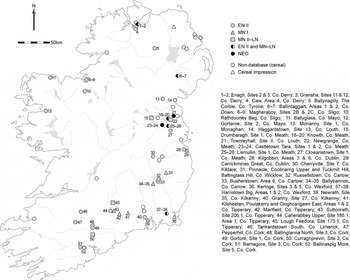
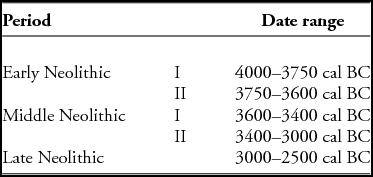
Archaeobotanical data were collated from 52 excavated sites (Figure 1), around two-thirds of which were unpublished at the time of collation. Cereals were recorded at a further 17 Neolithic sites (Figure 1), but excluded from analysis because final excavation reports were incomplete. As well as collating available radiocarbon dates, the ‘Cultivating Societies’ project undertook an extensive, targeted AMS 14C dating programme, which provided 187 additional dates to refine site chronologies further (Whitehouse et al. Reference Whitehouse, Schulting, McClatchie, Barratt, McLaughlin, Bogaard, Colledge, Marchant, Gaffrey, Reimer and Bunting2014). The dates were obtained from short-lived species (mainly cereal grains and hazelnut shell, Corylus avellana L.). They were calibrated and modelled in OxCal (Bronk Ramsey Reference Bronk Ramsey2008), using Bayesian statistics to improve precision. Based on these results and associated archaeological evidence, five chronological phases were defined: Early Neolithic (I & II), Middle Neolithic (I & II) and Late Neolithic (Table 1; Whitehouse et al. Reference Whitehouse, Schulting, McClatchie, Barratt, McLaughlin, Bogaard, Colledge, Marchant, Gaffrey, Reimer and Bunting2014). For the purposes of the present analysis, the Middle Neolithic II and Late Neolithic sites were combined due to the small number of sites available (five Middle Neolithic II, four Late Neolithic and two Middle Neolithic II/Late Neolithic). Where calibrated date ranges spanned different periods, sites were assigned to a broader Neolithic category (NEO). Analyses explored the frequency of different categories of plants across time and space, including the use of cumulative and summed radiocarbon calibrations (cf. Rick Reference Rick1987) to investigate dated plant remains. For the purposes of quantification, three cereal grain fragments were counted as one whole grain. Assessment of grains per litre of soil could not be undertaken because very few reports recorded the volume of soil from each individual sample.
Map of Ireland showing locations of sites with plant remains.

Chronology of the Neolithic in Ireland.

Category and chronology of sites
Data from plant macro-remains were available from a total of 437 samples from 390 contexts at 52 sites (Table 2; Online supplementary material Table S1). The 52 sites were recorded over the course of 47 excavations, most of which yielded material from a single chronological phase; two excavations produced evidence for multi-phase activity (Knowth and Lismullin), with each phase treated separately (see Table S1). The new 14C dating programme revealed that several sites contained later material that had become incorporated into Neolithic deposits (Table S1; Whitehouse et al. Reference Whitehouse, Schulting, McClatchie, Barratt, McLaughlin, Bogaard, Colledge, Marchant, Gaffrey, Reimer and Bunting2014). For example, plant remains dating to the early medieval and later periods were recorded within Neolithic deposits at Castletown Tara, Knowth, Tankardstown South, Kilgobbin and Lismullin. Additionally, Mesolithic deposits at Clowanstown contained plant remains dating to the Neolithic period. The presence of intrusive material underlines the importance of obtaining multiple 14C determinations when attempting to understand the chronology of Neolithic sites.
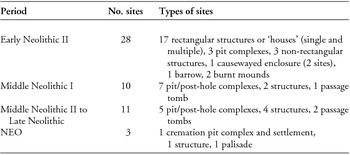
Types of site where archaeobotanical remains were recorded.

Archaeobotanical data were not obtainable from any Early Neolithic I sites, which reflects the paucity of sites dating to this period (Whitehouse et al. Reference Whitehouse, Schulting, McClatchie, Barratt, McLaughlin, Bogaard, Colledge, Marchant, Gaffrey, Reimer and Bunting2014). Archaeobotanical data from a total of 28 Early Neolithic II sites were examined (Table 2), the majority of which were rectangular structures/houses. Pit and post-hole complexes, some of which probably represent the fragmentary remains of structures, dominated the 10 Middle Neolithic I sites examined (Table 2). Eleven sites were dated from the Middle Neolithic II to the Late Neolithic period (Table 2), including pit/post-hole complexes, structures and passage tombs. Three sites were assigned to the NEO period, as they could not be dated to any specific sub-period (Table 2).
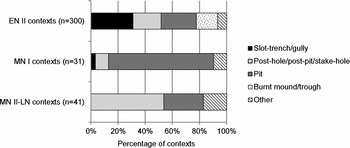
Plant remains were present in a wide variety of contexts (Figure 2). At the Early Neolithic II sites, they were mainly recorded in structural features, such as slot-trenches and post-holes. Plant remains were also recorded in pits, ditches, hearths and burnt mounds/troughs. At the Middle Neolithic I sites, most plant remains were recorded in pits and occasionally in structural features. Most plant remains at the Middle Neolithic II to Late Neolithic sites were found in structural features and pits, as well as in hearths, and turf layers and mound deposits associated with tombs. The vast majority of plant remains were preserved by charring. Waterlogged remains were recorded at just three sites: Clowanstown burnt mounds, turf layers at Newgrange passage tomb and ditch fills at Rathdooney Beg barrow.
Relative occurrence of contexts containing plant remains at Early Neolithic II, Middle Neolithic I and Middle Neolithic II to Late Neolithic sites (contexts n = 372; sites n = 49).

Plant categories recorded
Several plant categories were recorded at the 52 examined sites. Hazelnut-shell remains were most common, being present at 87% of sites (45/52), closely followed by cereal remains, which were recorded at 77% of sites (40/52). Fruit remains were present at approximately one-fifth of sites (19%; 10/52), dominated by crab-apple (Malus sylvestris L.) and bramble (Rubus spp.), with occasional evidence for elder (Sambucus nigra L.). Other wild plant remains were found at almost half of the examined sites (46%; 24/52); many appear to represent inadvertent harvesting of arable weeds growing alongside the cereals. Flax (Linum usitatissimum L.) remains were relatively rare, being recorded at only 4% of sites (2/52; including 14C-dated flax). Fabaceae seeds (pea family) were present at 2% of sites (1/52), but it is probable that these represent wild plants rather than cultivated legumes. Although pea (Pisum sativum L.) remains were found in a Neolithic deposit at Castletown Tara, 14C dating revealed that they were medieval (UBA-14682: 374±28 BP, cal AD 1447–1631).
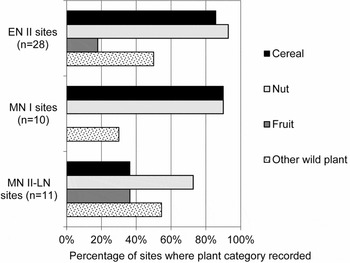
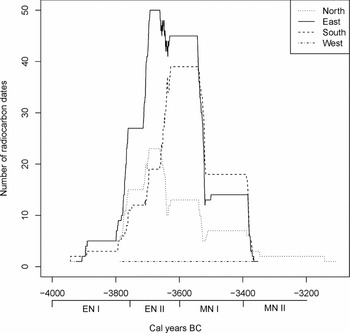
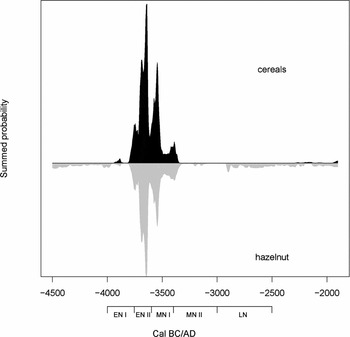
Analysis of the types of plants recorded during different time periods revealed interesting patterns (Figure 3). Cereals were present at 86% (24/28) and 90% (9/10) of the Early Neolithic II and Middle Neolithic I sites, respectively. This contrasts sharply with evidence from the Middle Neolithic II to Late Neolithic sites, where cereals were recorded at only 36% of sites (4/11; two Middle Neolithic II sites and two Late Neolithic sites). Furthermore, none of the Middle Neolithic II to Late Neolithic cereals have been directly dated, and it is possible that at least some may reflect later activity at Neolithic sites. While the difference between earlier and later periods seems striking, formal statistical testing is not straightforward, because insufficient information is available on the number and volume of deposits sampled at each site, and it is possible that the pattern is influenced by differences in sampling strategies (discussed in greater detail below). Cumulative radiocarbon calibrations of directly dated cereal remains (Figures 4 & S2) indicate that agriculture appeared simultaneously in all areas of Ireland during the Early Neolithic II period. Very few radiocarbon dates are available from either cereals or hazelnut shell during the later Neolithic (Figure 5).
Relative occurrence of plant categories at Early Neolithic II, Middle Neolithic I and Middle Neolithic II to Late Neolithic sites (sites n = 49).

Cumulative 14C dates from cereal grains at Irish Neolithic sites (dates n = 158; east sites n = 75; north sites n = 30; south sites n = 51; west sites n = 2).

Summed probabilities of 14C dates from cereal grains and hazelnut shell at Irish Neolithic sites (cereal dates n = 158, hazelnut shell dates n = 154).

Hazelnut shell remains were commonly present at both the Early Neolithic II and Middle Neolithic I sites (93% or 26/28 Early Neolithic II sites; 90% or 9/10 Middle Neolithic I sites). During the Middle Neolithic II to Late Neolithic period, there was a decrease in the number of sites where nutshell remains were recorded (73% or 8/11 sites), although not as marked as that seen with cereals. Fruit remains were recorded at just under one-fifth of Early Neolithic II sites (5/28), absent from the Middle Neolithic I sites and present at just over one-third of the Middle Neolithic II to Late Neolithic sites (4/11). Remains of other wild plants were found at around half of all the Early Neolithic II and Middle Neolithic II to Late Neolithic sites (14/28, 6/11), but at just under one-third of the Middle Neolithic I sites (3/10). Flax was present at a small number of the Early Neolithic II sites (2/28) but absent from later deposits. A further discovery of flax, directly 14C-dated to the Middle Neolithic I, was reported at Tullahedy in County Tipperary, after the collation of data was completed (McClatchie Reference McClatchie, Cleary and Kelleher2011).
Many of the cereal remains from the Early Neolithic II sites were associated with rectangular structures. Cereals were most often found in the slot-trenches, but were also present in associated post-holes, post-pits, stake-holes and pits. Almost all of the Middle Neolithic I sites contained cereal remains, most often recovered from pit/post-hole complexes. In contrast, most of the Middle Neolithic II to Late Neolithic sites did not contain cereal remains. Where cereals were recorded, they were associated only with structures/possible structures. Cereals were absent from the Middle Neolithic II to Late Neolithic burial sites and pit/post-hole complexes.
Where data were available, the number of cereal grains at each site was assessed (30 of the 40 sites where cereals were recorded). Most sites contained between 1 and 25 grains. Large cereal assemblages (more than 100 grains) were recorded at five sites, of which four were dated to Early Neolithic II (>400 grains from possible structure at Caherabbey Upper; >700 grains from rectangular house at Caw; >150 grains from burnt mounds at Clowanstown; >2100 grains from rectangular houses at Tankardstown South), with the fifth being a NEO site (>250 grains from cremation pit complex and other activity at Castletown Tara). The exact quantities were not reported for 10 sites where cereals were present, but re-analysis of the plant remains from Middle Neolithic I Baltinglass passage tomb has revealed another large cereal assemblage (>150 grains).
Cereal types present
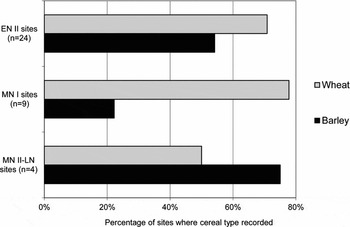
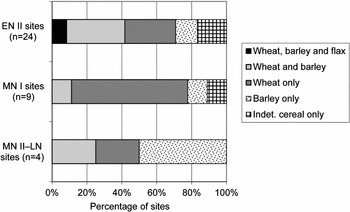
The cereal remains consisted of wheat and barley (Figure 6). Wheat dominated at the Early Neolithic II sites, but barley was also recorded at just over half of these. Wheat again dominated at the Middle Neolithic I sites, with barley recorded at less than one-quarter of sites. Barley was found at slightly more of the Middle Neolithic II to Late Neolithic sites than wheat, but this is based on a very small number of sites (four), and may not be representative of cereal preferences during this later period. No geographic or environmental patterning is apparent in the occurrence of wheat and barley, but the lack of sites in western areas limits the reliability of this observation.
Relative occurrence of wheat and barley at Early Neolithic II, Middle Neolithic I and Middle Neolithic II to Late Neolithic sites where cereals present (sites n = 37).

Although oat was present at eight sites, 14C dating of the oat grains at two of these sites (Monanny and Lismullin) revealed that the grains were later intrusions rather than Neolithic. Oat remains have, however, been directly radiocarbon dated to the Early Neolithic at Balbridie in Scotland (Fairweather & Ralston Reference Fairweather and Ralston1993). Oat is unlikely to have been cultivated during the Neolithic period, instead reflecting wild oat as a weed of wheat and barley crops (Zohary et al. Reference Zohary, Hopf and Weiss2012).
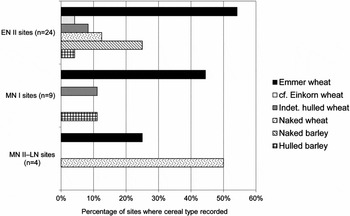
Where identifiable beyond indeterminate wheat or barley, a variety of wheat and barley types were recorded, including emmer wheat (Triticum dicoccum Schübl.), possible einkorn wheat (T. monococcum L.), naked wheat (T. aestivum/durum/turgidum L.), hulled barley (Hordeum vulgare L.) and naked barley (H. vulgare L. var. nudum) (Figure 7). Emmer wheat was the dominant cereal type during the Early Neolithic II and Middle Neolithic I periods. There are also a small number of records of naked wheat and possible einkorn wheat. It should be noted, however, that only grains from naked wheat and possible einkorn wheat were present; chaff rather than grain is a more reliable indicator of wheat species (Hillman et al. Reference Hillman, Mason, De Moulins and Nesbitt1996). Naked barley was more commonly recorded than hulled barley during the Early Neolithic II period.
Relative occurrence of cereal types at Early Neolithic II, Middle Neolithic I and Middle Neolithic II to Late Neolithic sites where cereals present (sites n = 37).

Turning to the Middle Neolithic II to Late Neolithic sites, although emmer wheat and naked wheat were both present, the small number of sites precludes determination of which wheat type was more important. In the case of naked wheat, chaff was again absent. Barley was present but not identified to type.
Variety of crops present
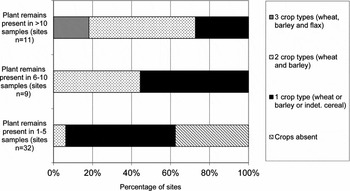
While cereals were recorded at the majority of examined sites, most individual sites contained evidence for only one crop type (wheat or barley; Figure 8). This trend was most noticeable at the Middle Neolithic I sites, where only 11% (1/9) of sites containing crops revealed evidence for more than one type. By contrast, more than one crop type was recorded at over 40% of the Early Neolithic II sites (10/24). It is notable that where barley was present, it was often a component of a mixed assemblage. Flax was similarly only recorded at sites where a variety of crops was present.
Relative occurrence of crops at Early Neolithic II, Middle Neolithic I and Middle Neolithic II to Late Neolithic sites where cereals present; sites n = 37).

It is probable that the number of bulk soil samples analysed from each site has influenced the variety of crops recovered. Most sites do not have a record of the total number of samples analysed (i.e. the number of samples where plant remains were present and absent), but an assessment could be undertaken of the number of samples where plant remains were recorded. At sites where cereals were absent (Figure 9), only five or fewer samples at each site contained any type of non-wood plant macro-remains. This was particularly apparent at the Middle Neolithic II to Late Neolithic sites; cereals were absent from many of these, but wild plants were also relatively rare, being present in very few deposits. This suggests that either plant-related activities were not significant at these sites or, more probably, that too few samples were taken to reflect plant use properly. Conversely, a wider variety of crops was more often found at sites where plant remains were present in a larger number of samples.
Relative occurrence of crops examined by number of soil samples from an individual site (sites n = 52).

Discussion
The inclusion of unpublished sources along with published literature reveals a much larger quantity and variety of evidence than acknowledged in previous studies. Cereals, hazelnut shells and fruits have, in fact, been found at many sites. Emmer wheat was the most important cereal, while barley (naked and hulled) and flax were also recorded. The earliest evidence for cereals was mainly associated with the Early Neolithic II rectangular houses. Although these rectangular houses were relatively short-lived, having been built and occupied for not more than a century (McSparron Reference McSparron2008; Whitehouse et al. Reference Whitehouse, Schulting, McClatchie, Barratt, McLaughlin, Bogaard, Colledge, Marchant, Gaffrey, Reimer and Bunting2014), agriculture persisted, continuing into the Middle Neolithic I period. There does appear to have been a significant shift in behaviour, however, from the Middle Neolithic II period, when both cereals and ‘domestic’ structures become rarer in the archaeological record. Interpreting this change is made difficult by the fact that rectangular houses are the most intensively sampled sites, and their disappearance provides us with far fewer well-sampled sites.
Although radiocarbon dates indicate that cereals were present across Ireland in the Early Neolithic II period, 3750–3600 cal BC (Figure 4), the geographic distribution of Irish sites containing cereals suggests an eastern and southern bias (Figures 1 & 4). It would be unwise to infer that this indicates early agriculture was focused on the eastern and southern seaboards, as this distribution is strongly influenced by the locations of recent infrastructural developments that involved large numbers of archaeological excavations. Fewer large-scale infrastructural projects have been carried out in western and northern areas of Ireland, which may explain why fewer Neolithic excavations have been undertaken there. Interestingly, the Irish pollen record reveals strong evidence for early agriculture around the north and west coasts of Ireland (Whitehouse et al. Reference Whitehouse, Schulting, McClatchie, Barratt, McLaughlin, Bogaard, Colledge, Marchant, Gaffrey, Reimer and Bunting2014). When combined, the plant macro-remains and palynological evidence indicate that farming activities were probably carried out in all coastal areas of the island. In contrast, sites in the Irish midlands often show rather muted or unclear anthropogenic signals in their pollen records (Selby et al. Reference Selby, O'Brien, Brown and Stuijts2005), suggesting limited landscape use by farming communities. This corresponds with archaeological evidence, as there are relatively few Early Neolithic II sites in the midlands, despite the completion of many modern infrastructural projects in the region (Whitehouse et al. Reference Whitehouse, Schulting, McClatchie, Barratt, McLaughlin, Bogaard, Colledge, Marchant, Gaffrey, Reimer and Bunting2014).
The earliest cereal macro-remains in Ireland date to the Early Neolithic II period, suggesting that arable farming was not firmly established until c. 3750 cal BC, although there are occasional examples where the date ranges extend earlier (Figures 4 & S2). The absence, thus far, of cereal remains from the Early Neolithic I period is significant. The earliest evidence for domesticated animal remains in Ireland has been found at Ferriter's Cove, County Kerry, where cattle bone was dated to the mid-fifth millennium cal BC, thus pre-dating the Neolithic by some centuries (Woodman et al. Reference Woodman, Anderson and Finlay1999). No further secure records (that do not suffer from large age ranges) of early domesticated animal remains have been uncovered, and thus Ferriter's Cove may represent an early phase of contact, ‘failed’ colonisation or simply the remains of a joint of meat transported over to Ireland (Sheridan Reference Sheridan, Finlayson and Warren2010; Rowley-Conwy Reference Rowley-Conwy2011). During the Early Neolithic I period, there are rare examples of engagement with Neolithic practices; for example, the construction of the Magheraboy causewayed enclosure, although dating of this site is potentially problematic, given how much earlier it is than similar enclosures across Britain (Cooney et al. Reference Cooney, Bayliss, Healy, Whittle, Danaher, Cagney, Mallory, Smyth, Kador, O'Sullivan, Whittle, Healy and Bayliss2011). More secure is the recent comprehensive dating and Bayesian modelling of human bone from the Poulnabrone portal tomb, placing the beginning of deposition here firmly before 3750 cal BC (Schulting Reference Schulting and Lynch2014). It was not until the Early Neolithic II period, however, that the full Neolithic ‘package’, including arable farming, was embraced across Ireland. Due to a paucity of sites, the economic basis of the preceding Early Neolithic I period remains unclear and should be a focus for further research.
Cereals were mainly associated with the Early Neolithic II and Middle Neolithic I sites, having been recovered from over 85% of them. Early Neolithic II rectangular houses, Middle Neolithic I pit complexes and other ‘domestic’ features dominate among the sites where cereals were recorded. Sites that were not ‘domestic’ in character, such as Baltinglass passage tomb, also contained 14C-dated cereal remains, highlighting their use in many different locations and circumstances. Cereals were recorded in large quantities at several sites, emphasising the importance of agriculture to at least some communities. Even where cereals were recorded in small quantities, the significance of gaining access to this new food, and the importance of farming in developing new identities and relationships, should not be underestimated. It is the regularity, rather than the quantity, with which cereals are recorded from earlier sites that is more important, especially given the truncated nature of many sites. This regularity of appearance in many different contexts probably reflects daily, recurrent behaviour, instead of special activities (see Fuller et al. Reference Fuller, Stevens, McClatchie, Madella, Lancelotti and Savard2014).
Earlier Neolithic communities were creating a sense of place not only through the houses and tombs they built, but also through cultivation plots, which were long-lived rather than temporary. Analysis of the ecological attributes of arable weeds reveal that the earliest farmers in Neolithic Ireland, Britain and elsewhere in northern Europe were engaged in intensive management of relatively long-lived plots of at least 10 years (McClatchie et al. Reference McClatchie, Bogaard, Colledge, Whitehouse, Schulting, Barratt and McLaughlin2014). Considerable resources were invested in the creation and maintenance of plots, and when we also consider the evidence for widespread uptake of farming, we can surmise that agriculture had a significant impact on the daily lives of communities. This does not mean that people turned away from foraging, which continued to play a role, as evidenced by the recovery of hazelnut remains at many sites, as well as fruits and other edible and useful wild plants. Farming and foraging can be complementary components in food-procurement strategies. Nut- and fruit-producing trees and shrubs can quickly become established at the borders of ground cleared for arable plots, thereby creating, perhaps temporarily, a more productive and diverse food base. Such niches may also have been deliberately encouraged along hedgerows, in the corners of fields or in set-aside plots (Johnston Reference Johnston2005: 216).
Several European studies have highlighted an increase in the use of wild plants during the later Neolithic; for example, in southern Scotland (Bishop et al. Reference Bishop, Church and Rowley-Conwy2009) and alpine areas of central Europe (Jacomet Reference Jacomet, Colledge and Conolly2007). In the latter region, extensive waterlogged preservation has enabled the recovery of a greater variety of Neolithic wild-plant foods than those found in charred assemblages (Colledge & Conolly Reference Colledge and Conolly2014). In the case of Ireland, a decrease in the incidence of hazelnut shell and an increase in fruit remains occurred during the Middle Neolithic II to Late Neolithic period (fruits were found at the same number of sites as cereals: 4/11 sites). The increase in fruit remains may reflect diversification in food strategies or an increase in suitable habitats for fruit procurement, such as increasingly open woodlands, and perhaps promotional strategies to encourage growth (Brozio et al. Reference Brozio, Dörfler, Feeser, Kirleis, Klooß and Müller2014; Whitehouse & Kirleis Reference Whitehouse and Kirleis2014).
One of the most remarkable aspects of the archaeobotanical record from later Neolithic Ireland relates to cereals. When compared with the earlier Neolithic (Early Neolithic II and Middle Neolithic I), cereals were present at very few of the Middle Neolithic II to Late Neolithic sites (only two Middle Neolithic II and two Late Neolithic sites). This may reflect changes in storage, cooking or housing facilities, which would affect the recovery of archaeobotanical remains, as has been argued for in Spain (Antolín et al. Reference Antolín, Jacomet and Buxó2015). Alternatively, the decrease may imply that cereals became less important during the Middle Neolithic II period; this situation may have continued into the Late Neolithic period. Indeed, Stevens and Fuller (Reference Stevens and Fuller2012) have argued that cereals were largely abandoned during the later Neolithic in parts of Britain, based on a paucity of directly dated cereal remains when compared with directly dated wild-plant remains. More recent analyses indicate, however, that arable agriculture continued to be an important activity in several regions of Scotland during the later Neolithic (Bishop Reference Bishop2015). The picture from Ireland is also somewhat more complex. While there are very few directly dated cereal remains from the later Neolithic, there are also very few directly dated wild-plant remains (Figure 5), providing a contrast with Stevens and Fuller's model.
The archaeobotanical evidence from Ireland does not support a clear-cut increase in gathered foods at the expense of cereals, and we cannot assume that there was a simple shift from cultivated to wild-plant food strategies. Furthermore, the human stable carbon and nitrogen isotope data do not indicate any return to the use of marine foods along the coasts at this time (Schulting Reference Schulting, Colledge, Conolly, Dobney, Manning and Shennan2013), which one might expect had farming comprehensively ‘failed’. The pollen data suggest a period of woodland regeneration, perhaps at the expense of agricultural land (Whitehouse et al. Reference Whitehouse, Schulting, McClatchie, Barratt, McLaughlin, Bogaard, Colledge, Marchant, Gaffrey, Reimer and Bunting2014), but this does not necessarily reflect increased pastoralism. Existing Irish data for animal bone (Schulting Reference Schulting, Colledge, Conolly, Dobney, Manning and Shennan2013) and pottery lipids (Cramp et al. Reference Cramp, Jones, Sheridan, Smyth, Whelton, Mulville, Sharples and Evershed2014) have yet to provide a clear indication of maintained or increased pastoral activity when compared with the earlier Neolithic. It thus remains far from clear what the varying contribution of cultivars vs pastoral foods was at this time.
Conclusions
This study represents the most comprehensive investigation of plant macro-remains evidence from Neolithic Ireland to date. Cereals were present at many sites during the earlier Neolithic, sometimes in large quantities. Emmer wheat was the dominant crop, but barley was also recorded at many sites. Flax was a further component of early agriculture in Ireland, but cultivated legumes were not. Cereals were recorded mainly at house structures and pit complexes, but also at tombs and other ‘non-domestic’ locations. Analysis of arable weeds indicated that Ireland's earliest farmers created a sense of place and ownership by investing in fixed-plot intensive agriculture.
The picture from later Neolithic Ireland is far less clear. Plant remains have been found at only a small number of sites. The rarity of cereals may reflect a decrease in the importance of arable agriculture, but a corresponding shift towards wild plants should not be automatically assumed. The results of this study enable Ireland to be considered in more detail when exploring the introduction and development of agriculture in Neolithic Europe than has previously been possible due to the unpublished status of much of the data.
Acknowledgements
The work reported here was funded by the Heritage Council, Ireland, under the INSTAR programme 2008–2010 for the project ‘Cultivating Societies: Assessing the Evidence for Agriculture in Neolithic Ireland’ (Reference 16682 to Whitehouse, Schulting, Bogaard and McClatchie). We would like to express our thanks to our project partners, who provided invaluable advice and assistance: Jane Bunting (University of Hull); Finbar McCormick (QUB); Finola O'Carroll (CRDS Ltd, Republic of Ireland); Alison Sheridan (National Museums Scotland); Jessica Smyth (University of Cardiff); Rónán Swan (National Roads Authority); and Graeme Warren (UCD). The following archaeologists, archaeobotanists and organisations are thanked for discussions, and for providing access to Neolithic data and plant remains: ACS; ADS; Aegis Archaeology; AML Archaeology; Arthur ApSimon; Centre for Archaeological Fieldwork, QUB; James Conolly, Trent University; CRDS; Department of Archaeology, UCC; Catherine Dunne; Eachtra Archaeological Projects; Allan Hall, University of York; Rubicon Heritage; IAC; Judith Carroll Network Archaeology; Kilkenny Archaeology; Susan Lyons; Margaret Gowen; NAC; National Monuments Service; National Museum of Ireland; National Roads Authority; School of Archaeology, UCD; Stafford McLoughlin Archaeology; Stephen Shennan, UCL; TVAS Ireland; Ulster Museum; Valerie J. Keeley. We would finally like to thank the editors and reviewers of this paper for their helpful comments.
Supplementary material
To view supplementary material for this article, please visit http://dx.doi.org/10.15184/aqy.2015.212