INTRODUCTION
The deep-sea nematodes are known to be very rich in species numbers and most of the species still remain to be described (Fonseca et al., Reference Fonseca, Vanreusel and Decraemer2006). The true extent of their species diversity is still unknown. In a recent review of the published literature on nematodes, 638 valid species belonging to 175 genera and 44 families are described from the deep sea (Miljutin et al., Reference Miljutin, Gad, Miljutina, Mokievsky, Fonsêca-Genevois and Esteves2010). The major impediment in describing new species from the deep sea is the small size, difficulty to get enough specimens of the same species for descriptions and the low proportion of males present in samples. Even though several hundred unknown species can be found in a sample of 1000 nematodes, most of them may be represented by only a few or even one specimen (Miljutin et al., Reference Miljutin, Gad, Miljutina, Mokievsky, Fonsêca-Genevois and Esteves2010). Members of the family Desmodoridae have been documented in most of the ecological studies on marine nematode assemblages from deep-sea sites but their density was always low, with a relative abundance reaching a maximum of 1% of the total mass (Soetaert & Heip, Reference Soetaert and Heip1995). Species belonging to the family Desmodoridae are typical components of the nematode community in sandy substrates (De-Jesús Navarrete, Reference De-Jesús Navarrete2007) where most of the deep-sea habitat is covered with finer sediments. In the recently published Handbook of Zoology, family Desmodoridae belongs to the superfamily Desmodoroidea Filipjev, 1922 and is composed of six subfamilies, 43 genera and 321 species (Tchesunov, Reference Tchesunov and Schmidt-Rhaesa2014); but these figures are arbitrary and vary according to the source.
The free-living marine nematode fauna has been studied in many regions of the world. Vast areas of the deep-sea floor have not been studied due to logistical difficulties associated with deep-sea sampling and the scarcity of taxonomic expertise. The Indian Ocean is one among the geographic regions which has not been studied extensively. The deep-sea nematode fauna in the Indian Ocean region, in particular, is very poorly known. No species have been described from the northern region of the deep Indian Ocean to date.
MATERIALS AND METHODS
Adult male specimens of the new species were recovered during a benthic survey on board the Fishery and Oceanographic Research Vessel ‘Sagar Sampada’ (FORVSS). Sediment samples were collected using a Smith McIntyre grab from the continental slope of the north-eastern Arabian Sea. The specimens of genus Psammonema were obtained from FORVSS cruise no. 219 at a depth of 214 m. The meiofauna were subsampled from the grab using a glass corer of diameter 2.5 cm, fixed and preserved in 10% formalin, stained with Rose Bengal. Salinity, temperature and dissolved oxygen of the water column just above the sediment were measured using the Sea Bird CTD (SBE 911), from FORVSS. Sediment texture was analysed using a Particle Size Analyser (Sympatec, Germany). The percentage of organic matter in the sediment was estimated by the wet oxidation method (El Wakeel & Riley, Reference El-Wakeel and Riley1957). Organic matter is expressed as percentage of sediment dry weight examined. Onshore, meiofauna were separated using a set of sieves (63 and 500 µm), and sorted manually using a stereo microscope (Leica EZ4). Nematodes were then processed to pure glycerine by the slow evaporation technique (Seinhorst, Reference Seinhorst1959) and mounted on glass slides for detailed examination and taxonomic identification. Descriptions and drawings were made based on the glycerine mounts, using a Leica DM 1000 microscope with an attached drawing tube. The specimens were identified to genus level following Platt & Warwick (Reference Platt, Warwick, Kermack and Barnes1988) and NeMys (Vanaverbeke et al., Reference Vanaverbeke, Bezerra, Braeckman, De Groote, De Meester and Deprez2014).
Four type specimens have been deposited in the FORV Referral Centre, Centre for Marine Living Resources and Ecology, Cochin, Kerala, India. All measurements are in micrometres and all curved structures are measured along the arc. Abbreviations in the text are as follows: (a) body length divided by maximum body diameter; (b) body length divided by pharyngeal length; (c) body length divided by tail length.
RESULTS
SYSTEMATICS
Taxonomic classification, according to Decraemer & Smol (Reference Decraemer, Smol, Eyualem-Abebe Andrássy and Traunspurger2006)
Order DESMODORIDA De Coninck, Reference De Coninck1965
Suborder DESMODORINA De Coninck, Reference De Coninck1965
Superfamily DESMODOROIDEA Filipjev, Reference Filipjev1922
Family DESMODORIDAE Filipjev, Reference Filipjev1922
Subfamily DESMODORINAE Micoletzky, Reference Micoletzky1924
Genus Psammonema Verschelde & Vincx, Reference Verschelde and Vincx1995
EMENDED DIAGNOSIS
Desmodorinae. Cuticle multi-layered, finely annulated. Lateral alae narrow, without interdigitation, extending from the level of the pharynx or just posterior to it as far as the cloacal or anal region. Different types of somatic setae arranged in 6–8 rows. Cephalic capsule ornamented with small vacuoles and possessing thick inner cuticle. Offset labial region with thin cuticle. No subcephalic setae but additional setae may be present. Anteriorly placed amphids. Amphideal fovea in male loop-shaped, sexual dimorphism in the shape of amphid may be present. Buccal cavity with a crown of denticles, a strong dorsal tooth and two small ventro-sublateral teeth. Pharynx with tripartite slightly prolonged end bulb. Thin cuticle of pharyngeal internal lumen. Precloacal supplements and thick pre-anal seta present.
Type species: Psammonema ovisetosum Verschelde & Vincx, Reference Verschelde and Vincx1995
Psammonema kuriani sp. nov.
Psammonema kuriani sp. nov. holotype male (A) Habitus, (B) Pharyngeal region, (C) Head capsule showing amphid, (D) Beginning of lateral alae, (E), Buccal cavity and dentition. Scale bars 20 µm.

Psammonema kuriani sp. nov. holotype male caudal region (A) External morphology, (B) Pre-cloacal supplements, setae and spicule, (C) Reproductive system. Scale bars 20 µm.

Psammonema kuriani sp. nov. paratype male (A) Habitus, (B) Caudal region (C) Cephalic capsule, (D) Cephalic capsule external morphology. Scale bars 20 µm.

Psammonema kuriani sp. nov. juvenile habitus. Scale bar 20 µm.

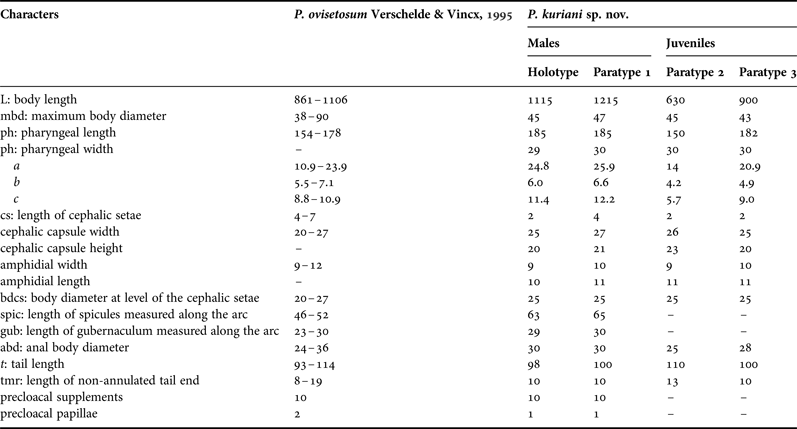
Morphometry of valid Psammonema species, all measurements are in micrometres.

TYPE SPECIMENS
Holotype male, Paratypes: one male and two juveniles [Slide No. IO/SS/NEM/00023]; Deposited at FORV Referral Centre, Centre for Marine Living Resources and Ecology, Cochin, Kerala, India, collected during cruise FORVSS 219 on 3.12.2003.
TYPE LOCALITY
Continental margin of north-east Arabian Sea – off Goa, 15°25′459″N 72°52′855″E, 214 m. Silty sand sediments with 3.61% organic matter content, bottom temperature 16.9°C, bottom salinity 35.30 psu, bottom dissolved oxygen concentration 0.55 ml l−1.
ETYMOLOGY
The species is named in honour of Dr C.V. Kurian, with deep gratitude and appreciation of his invaluable contributions to benthic studies in India.
DESCRIPTION OF HOLOTYPE (MALE)
(Figures 1 & 2): Large, thick cylindrical body with distinct cephalic capsule. Total body length 1115 µm. Maximum body diameter 45 µm. Cephalic capsule rounded triangle, well set off with thick cuticle. Labial region of cephalic capsule can be differentiated from the main region by the thickness of cuticle (Figure 1C, E). Main region of the cephalic capsule highly thickened while cuticle of the labial region is thin. Cephalic capsule ornamented with small vacuoles except in the labial region. Six smaller external labial papillae; four cephalic setae located at the base of amphid. No real sub-cephalic setae or additional setae. Amphids spiral, 1.25 turns, anteriorly placed, anterior edge of the amphid touching the anterior edge of the cephalic capsule. Somatic setae situated 10 µm behind the cephalic capsule. Buccal cavity equipped with 12 longitudinal rugae, one strong dorsal tooth, two latero-ventral teeth and a circle of denticles (Figure 1E). Pharyngeal end bulb tripartite with clear partition (Figure 1B). Inner pharyngeal lumen with thin cuticular walls. Pharynx 185 µm long. Body annuli slender with multi-layered cuticle. Lateral alae present beginning 48 µm posterior to pharyngeal bulb; narrow, without interdigitation and formed by local raising of each annule (Figure 1D). Somatic setae – slender and long (8–10 µm), arranged in eight rows at pharyngeal and posterior third of body, but in six rows at midbody region. At last third body region, latero-ventral row of somatic setae splitting into two rows of thickened setae, the more ventrally located ones being more thick (3 µm), long (20 µm) and firm. The thick setae posterior to cloacal region shorter (9 µm) (Figure 1A).
Reproductive system monorchic. Long testis and vas deferens, located on ventral side (Figure 2C). Spicules long (63 µm), strongly cuticularized, arcuate with short ventral beak-like projection in rounded capitulum. Velum hardly visible (Figures 2B & 3B). Gubernaculum with two lateral pieces surrounding spicule. Ten precloacal supplements, in the form of heavily cuticularized protrusion of the cuticle and without any setae. Single thick, stout and blunt precloacal seta. Tail long, conoid with rows of thick and thin somatic setae and short, cuticularized with non-annulated tip.
PARATYPE MALE
(Figure 3) Paratype male was slightly longer than that of holotype. All characters were similar to holotype but with comparatively large measurements in some of the morphological characters (Table 1).
PARATYPE JUVENILES
(Figure 4) Similar to adult males in general morphological appearance but differing in the morphological measurements. Early stage of genital primordium consisting of a group of cells, located in the posterior half of the body.
FEMALES
Not found.
DISCUSSION
The general morphology such as well set off labial region with thin cuticle, presence of narrow lateral alae without interdigitation, absence of real sub-cephalic setae or additional setae, presence of strong single dorsal tooth, two lateroventral teeth and a circle of denticles, tripartite pharyngeal end bulb with thin cuticle of internal lumen, presence of different sized somatic setae in the posterior third region, presence of precloacal supplements and pre-cloacal papillae, all place the present specimens in the genus Psammonema Verschelde & Vincx, Reference Verschelde and Vincx1995 (Figures 1–4; Tables 1). Even though the present specimens show some characters of the genus Pseudochromadora Daday, Reference Daday1899, such as lateral alae extending from posterior to the cardia, the present specimens differ from Pseudochromadora Daday, Reference Daday1899 in having a crown of denticles, tripartite pharyngeal end bulb, narrow lateral alae and cephalic setae placed at the posterior edge of amphid. In addition to this, the somatic setae of genus Pseudochromadora are thin and uniform in size whereas those of Psammonema are of different sizes in different body regions.
The genus Psammonema was raised by Verschelde & Vincx, Reference Verschelde and Vincx1995 based on the specimens of P. ovisetosum which is the type species. Psammonema kuriani sp. nov. is the second species assigned to this genus. The new species is sporadic in distribution and represented by only four individuals at a single location, despite analysing 288 core samples from an extensive survey along the eastern Arabian Sea margin covering 06°57′19″N – 21°30′639″N. The genus Psammonema Verschelde & Vincx, Reference Verschelde and Vincx1995 was previously described from the estuarine sediments of the Indian Ocean region and the present study reports the genus from the deep sea for the first time.
Differential diagnosis
The differentiating characters of Psammonema kuriani sp. nov. from P. ovisetosum are as follows. Amphids of males of P. kuriani sp. nov. are in the form of a spiral or closed loop whereas amphids in males of P. ovisetosum are in the shape of an open loop reaching the entire length of the cephalic capsule. Since females of the present species could not be retrieved it was not possible to comment on the sexual dimorphism of the present species. Cephalic setae are situated at mid-amphid level in P. ovisetosum whereas in P. kuriani sp. nov. cephalic setae are located below the base or at the posterior half of the amphid. Cephalic setae of P. kuriani sp. nov. are shorter compared with those of P. ovisetosum (2–4 vs 4–7 µm). Lateral alae of the P. ovisetosum begin a few micrometres below the cephalic capsule and run below the level of cloaca whereas in the case of P. kuriani sp. nov., they begin 48 µm behind the base of pharyngeal bulb and reach up to the cloacal region. Ten precloacal supplements of P. kuriani sp. nov. formed as thickened cuticular protrusions without any setae, but in addition to the supplements, a single thick, stout and blunt pre-cloacal seta was observed. In P. ovisetosum, there were 10–14 short spine-like setae which are considered as precloacal supplements and a pair of short and firm pre-cloacal setae were present. The gubernaculam of P. kuriani sp. nov. encircles the spicules with two lateral pieces lying parallel to it while that of P. ovisetosum is stretched out around the spicule with lateral pieces (Verschelde & Vincx, Reference Verschelde and Vincx1995).
ACKNOWLEDGEMENTS
This work was carried out under the Marine Living Resources Programme of the Ministry of Earth Sciences, Government of India. The support and encouragement of Dr V. N. Sanjeevan (Former Director, CMLRE) and Dr M. Sudhakar (Director, CMLRE) is gratefully acknowledged. The authors wish to thank colleagues Dr Abdul Jaleel K. U., Dr Neil S. Correya, Mr Nousher Khan K, Ms Usha V. Parameswaran, Ms Aiswarya Gopal and Mr Kevin Venugopal as well as the Officers, scientific team and support staff on board FORV ‘Sagar Sampada’ (219) for their efforts during sampling. Also the authors would like to thank the anonymous referees for their many insightful and constructive comments received during the writing of this manuscript.