1. Introduction
Much of the economics literature agrees that private property rights are associated with economic growth and development (Acemoglu and Johnson, Reference Acemoglu and Johnson2005; Rodrik et al., Reference Rodrik, Subramanian and Trebbi2004). There are important caveats to the evolving consensus. Private property rights may destroy wealth, especially when legal recognition of private property conflicts with spontaneously arising common-property institutions (Leeson and Harris, Reference Leeson and Harris2018; Ostrom, Reference Ostrom1990). The security of property rights also depends on informal institutions, such as trust and a belief in market institutions (McCloskey, Reference McCloskey2010; Williamson, Reference Williamson2009; Williamson and Kerekes, Reference Williamson and Kerekes2011). Nor are legal rights the only relevant rights (Barzel, Reference Barzel1997). Economic rights, which are informal rules that influence individual behavior, can also create incentives for wealth creation (Holcombe, Reference Holcombe2014). However, there remains significant agreement, even among the contrasting schools of thought within institutional economics, that private property rights – especially legal rights – are one of the foundations of market economies (Commons, Reference Commons1924; Hodgson, Reference Hodgson2015; North, Reference North1990).
A bigger challenge is that there is tremendous debate about why institutions differ even if we are able to reach an agreement on which institutions contribute to prosperity (Allen, Reference Allen2011; Chang, Reference Chang2011; Leeson, Reference Leesonforthcoming). An especially important challenge is to figure out the political foundation of institutions associated with the creation of wealth. According to Barzel (Reference Barzel2002), legal rights are the foundation of economic development but the state does not necessarily have the incentives to establish institutions that encourage production and exchange, including private property rights. For Barzel, the emergence of legal rights requires that individuals develop institutions of collective action that allow them to continually withstand the machinations of the predatory state.
We take Barzel's theory as a point of departure to examine the political foundations of private property rights to land, in particular whether private property rights are provided as a public good, selectively, or not at all. Security of private property is often conceptualized as a public good in which all (or at least most) in society have opportunities to own property and where ownership is decided primarily through markets (Demsetz, Reference Demsetz1967; Libecap, Reference Libecap1989; Riker and Sened, Reference Riker and Sened1991; Sened, Reference Sened1997). However, private property protection may also be provided selectively, which can result in a dual system of property rights in which only specific groups of people can own property (Greif, Reference Greif2006; Haber et al., Reference Haber, Razo and Maurer2003; Lemke, Reference Lemke2016). The state may also be unable establish private property rights even when it wants to do so.
We posit that whether property protection is provided as a public good, selectively, or the state is unable to specify and enforce private property depends on the following features of politics: political stability, the administrative and enforcement capacity of the state, political constraints, and the extent to which political and legal institutions are inclusive. Property rights protection is more likely to be provided as a public good when the state enjoys political stability and has the requisite administrative capacity to specify and enforce property rights. Providing property protection as a public good also depends on political constraints, which contribute to the credibility of private property rights. The extent to which property protection is broadly rather than selectively depends on the inclusivity of political and legal institutions. Selective enforcement also depends on political stability, capacity, and constraints because rulers must be able to commit to private property rights for privileged groups. However, one of the defining features of selective enforcement is that some groups do not have access to legal property rights protection or their rights are weaker.Footnote 1 Accordingly, selective enforcement is likely when political and legal institutions exclude groups from politics or legal institutions but when the state attains success on the other dimensions. Anarchy is likely in contexts of political instability or insufficient capacity to specify and enforce property rights.
We use three case studies to illustrate the political foundations of private property. The first is the US from the late eighteenth through nineteenth centuries, a time when legal reforms marched toward providing property rights protection as a public good. Despite important caveats – Blacks, Native Americans, and women had fewer opportunities to own property than white men during this time – a favorable political context enabled the expansion of private property protection. The second case is China in the era of economic reforms since 1978. Reforms that allow private use of land produced a fast-growing economy, but such protection has been selective due to discriminatory institutions that allow the state to expropriate land from millions of farmers for the benefit of others. The third case is Afghanistan, where legal private property is absent in most of the country. The absence of credible legal rights in Afghanistan reflects profound state weakness, although economic rights are effective in much of the country.
The organization of the paper is as follows. After reviewing the insights of economic theories of the state in section 2, we provide a theoretical framework to analyze the political origins of property rights in section 3. We present the empirical studies in section 4. Section 5 concludes by discussing the implications of our theory for legal titling and state ownership of land.
2. Economic theories of the state
One of the objectives of economic theories of the state is to understand when rulers delimit rights, including property rights (Barzel, Reference Barzel2002). Besides this shared desire to explain the origins of rights, there are important differences in economic approaches to the state. We follow Acemoglu and Johnson (Reference Acemoglu and Johnson2005), North (Reference North1981), and Vahabi (Reference Vahabi2016), in dividing the economics literature on the state into two distinct perspectives: the contract and predatory perspectives.
The contract perspective has its origins with Hobbes, who argued that the state was a socially beneficial response to disorder under anarchy. Hobbes did not believe order was possible without a state. He also believed that Leviathan would do what is in society's interest by providing law and order. Like Hobbes, North (1981) thought of the state as a result of voluntary contracting of people to government to facilitate economic exchange.
The contract perspective has been used to interpret the political economic history of Western Europe. According to North and Thomas (Reference North and Thomas1973), although feudalism was arguably an efficient institution for centuries, the state was better suited to promote commerce as economic interactions among strangers became more frequent. Adam Smith developed a similar theory in The Wealth of Nations, originally published in 1776. According to Weingast (Reference Weingast, Lamoreaux and Wallis2017), Smith viewed feudalism as a time of considerable violence. Towns arose from a political exchange for corporate rights to self-governance, which provided a framework for liberty, commerce, and security. The emergence of towns made possible transformation from a poor agrarian economy to one that encouraged wealth creation by facilitating impersonal exchange.
Another efficiency justification for the state is providing collective defense. For Batchelder and Freudenberger (Reference Batchelder and Freudenberger1983), the development of the state was a response to political upheaval from the cannon and other gunpowder weapons. The medieval castle was a self-contained fortification with advantages over large attacking forces but could not deter attacks against a region, which was more readily accomplished by a centralized, bureaucratic military organization. Centralized military organization is necessary once society establishes wealth-maximizing institutions, which, if effective, increase the incentives for plunder (Hendrickson et al., Reference Hendrickson, Salter and Albrecht2018). Early societies may limit capital accumulation for self-protection, but as societies develop, they are expected to finance defense through taxation and borrowing (Thompson, Reference Thompson1974, Reference Thompson1979).
The predatory theory rejects the idea that the state arises from a hypothetical contract between merchants and the sovereign whereby the former consent to taxation in exchange for property rights protection and collective defense. Rather, the predatory theory views rulers as motivated by the acquisition of revenue and labor, rather than improving social welfare (Levi, Reference Levi1988). According to Vahabi (Reference Vahabi2011, Reference Vahabi2015, Reference Vahabi2016), the scope of the state is determined by what rulers can capture, rather than market failures. Fugitive assets are movable and cannot be confiscated, which reduces vulnerability to expropriation. A captive asset is unmovable and subject to confiscation. The state is most likely to assert its authority over captive assets, such as land and oil, each of which can easily be seen by the state.
The predatory theory also provides an alternative perspective on the evolution of institutions. The contract theory starts with individual behavior, while the predatory theory begins with group behavior (Holcombe, Reference Holcombe2018; Vahabi, Reference Vahabi2009). The predatory theory also views social conflict and coalitions of social groups as steering the emergence of institutions (Knight, Reference Knight1992). It does not view political change as neutral, as required by the political Coase theorem. Destructive rather than productive power is the source of institutional change (Vahabi, Reference Vahabi2004). It therefore shares the Marxist view with class or social conflict as a driving force for institutional change. The predatory theory, because it does not view the state as necessary to provide public goods, has a role for self-governance of property, as well as recognizes that a weakening of state power can result in improvements in human freedom (Scott, Reference Scott2017).
3. The political foundations of legal private property
The predatory theory provides a more realistic view of the state than the contract theory. The predatory perspective also allows for the possibility of selective enforcement of property rights. However, beyond Barzel's observation that legal rights, including property rights, depend on collective action, the predatory theory does not have a political theory of property rights. Here, we provide such a theory.
The first factor to consider in the emergence of private property rights is political stability. According to Olson (Reference Olson1993), the state is a stationary bandit with authority over a realm or region. A stationary bandit is a residual claimant in production and so has incentives to establish institutions to encourage wealth creation. Even autocrats have incentives to respect property, provided they expect to be in power for the foreseeable future (Salter and Hall, Reference Salter, Hall, Coyne and Storr2015).
The state also requires administrative and enforcement capacity to establish private property rights. Legal private property rights depend in part on public infrastructure, including cadastral surveys and easily accessibly repositories of information on land ownership (Arruñada, Reference Arruñada2012). The capacity to implement cadastral surveys is one way to measure state capacity (Yoo and Steckel, Reference Yoo and Steckel2016). Property rights must also be enforced, or else owners may suffer property insecurity. Enforcement, in turn, depends on the state's capacity to provide a police force and, in some instances, enforcement may require a competent military.
Political constraints are the third dimension of a property-protecting state. Boettke and Candela (Reference Boettke and Candela2019) explain that state capacity in the absence of constraints is likely to increase the scope of the predatory state. Separation of powers at the national level influences the credibility of property rights because it limits the ability of the government to arbitrarily expropriate property (North and Weingast, Reference North and Weingast1989). The theory of market-preserving federalism argues that political decentralization is another feature of the political context that contributes to wealth-maximizing economic institutions (Myerson, Reference Myerson2014; Weingast, Reference Weingast1995).
Political ideology can also be thought of as a political constraint. According to Acemoglu (Reference Acemoglu2003) and North (Reference North2005), ideology is one of the explanations why politics does not result in the choice of “efficient” institutions. Informal institutions, such as culture, can also constrain the choice of institutions. Williamson (Reference Williamson2009) shows that informal institutions, such as a cultural belief in private property, contribute more to the security of private property rights than formal institutions, such as political constraints.
Both protection of property as a public good and selective enforcement benefit from political stability, state capacity, and political constraints, as well as supportive ideology and informal institutions. Selective enforcement, for example, requires that the state is strong enough to specify and enforce property rights and that political constraints force rulers to commit credibly to respect the property rights of the few. China serves as an example of autocratic commitment to market institutions, in part because of its de facto decentralized political structure (Liu and Weingast, Reference Liu and Weingast2018; Montinola et al., Reference Montinola, Qian and Weingast1995). However, it is also a selective enforcement regime that enables credible commitment to the property rights of land developers, in many instances at the expense of farmers.
What determines whether property protection is provided as a public good or selectively is typically the inclusiveness of political and legal institutions. Democracy should increase the chances that property protection is provided as a public good. In fact, collective action to establish democratic and other representative institutions often results from the desire to protect private property rights (Salter, Reference Salter2015). Polycentric political institutions are also likely to increase the extent property protection is provided equitably. Polycentricity is defined by competition and autonomy of local governments (Eusepi and Wagner, Reference Eusepi and Wagner2010; Ostrom, Reference Ostrom1994, Reference Ostrom2008), as well as by inclusion of non-government organizations in the political decision-making process (Aligica, Reference Aligica2014; Aligica and Boettke, Reference Aligica and Boettke2009). According to Lemke (Reference Lemke2016), political competition among local units in polycentric systems creates incentives for a more equitable property regime. Lemke shows that private property rights for women emerged in the US in the 19th century because law-makers were interested in attracting populations to their jurisdictions and consumers of law (in this case, women) could choose among jurisdictions. Jurisdictional competition thus resulted in a more rapid extension of property rights to women.
Legal institutions also vary in the extent to which they are inclusive. In Commons’ (1924) analysis of the legal foundation of capitalism, judges have an important role in the creation of property rights. Subsequent studies in Commons’ tradition of institutional economics emphasize the role of legal institutions in the development of capitalism (Deakin et al., Reference Deakin, Gindis, Hodgson, Huang and Pistor2017). However, legal institutions are not always accessible to all in society, in part because powerful groups may want to provide access to law selectively. Exclusionary legal regimes increase the chances of selective enforcement of property rights.
The state may also be unable to enforce property rights. According to Ho (Reference Ho2017), institutions are credible if they are enforced. Other institutions are “hollow.” Hollow institutions are not credible because they do not influence individual behavior. According to our framework, legal institutions are more likely to be hollow as a result of political instability or deficiencies in state capacity.
4. Illustrating the politics of private property rights to land
Property rights as a public good: the early US
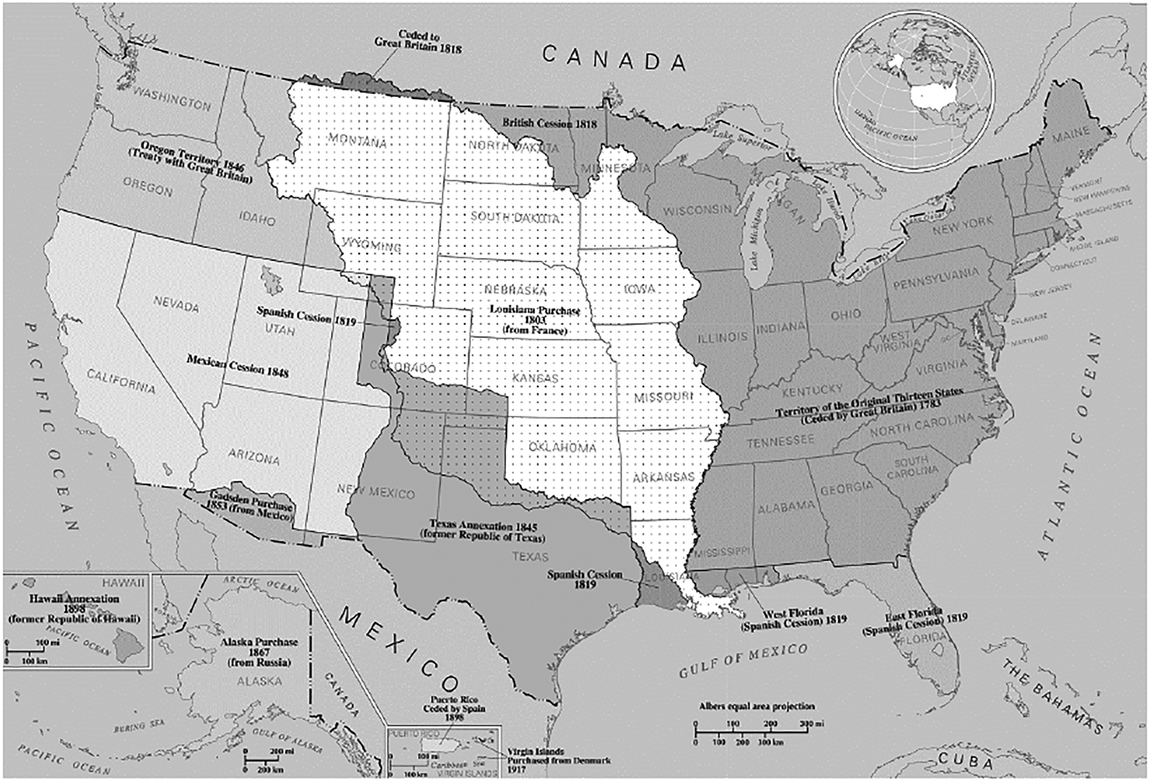
The US territorial expansion period began with the Treaty of Paris, which formally ended the Revolutionary War in 1783. The British ceded the original 13 colonies and the colonies’ additional territorial claims to the American government. The additional lands that the colonies claimed were subsequently ceded by the states to the US federal government. Through war, cession, and diplomacy, the government acquired around 1.2 billion acres of land from 1783 until the Gadsden Purchase, which in 1853 secured parts of Arizona and New Mexico. Figure 1 shows these acquisitions.
Territorial acquisitions of the US, 1783–1853

The national government did not want to be a perpetual landlord over all its land. To realize the vision of a nation of smallholder farmers, the Continental Congress established auctions to allocate public land to individuals with the Land Ordinance of 1785 and the Northwest Ordinance of 1787. Land auctions promised the federal government much-needed revenue. During the Articles of Confederation (1781–1789), the Continental Congress relied for funding on voluntary contributions from the state governments. However, the states usually contributed much less than they promised (Dougherty, Reference Dougherty2001).
Public land promised revenue but many people who wanted land were unable or unwilling to pay the market price. Those who occupied land illegally were often referred to as squatters. Some wanted to farm their land, though many were land speculators (Bogue and Bogue, Reference Bogue and Bogue1957; Swierenga, Reference Swierenga1966). Regardless of their motivation, illegal and extralegal occupation was rampant.
Squatters typically began to occupy land after the federal government set a date when land would be legally open for settlement. Squatters jumped the gun, occupying land prospectively. They established associations they called claim clubs or claim associations to regulate their communities. These clubs emerged spontaneously but had features like a government, including rules governing ownership, a basic criminal code, a tribunal of justice, and deliberative institutions to adjust their rules (Murtazashvili, Reference Murtazashvili2013).
One way that squatters secured legal title was through preemption legislation from Congress. Preemption laws, informally known as “squatters’ rights,” allowed settlers to acquire legal rights to 160 acres of land for a nominal fee of $1.25 an acre, paid over five years. Between the early 1800s and the opening of Kansas and Nebraska for settlement in 1854, Congress enacted dozens of these laws (Kanazawa, Reference Kanazawa1996). A second way was by colluding at land auctions. Claim clubs were organized gangs that could deter others from bidding against members at an auction with the threat of violence (Bogue, Reference Bogue1958; Dick, Reference Dick1970). The preambles to their constitutions sometimes referred to “anti-social” behavior as bidding against a member of the group.
These activities resulted in a massive increase in credible private property rights to land. However, the American state still engaged in predation during this time, including toward Native Americans. For Vahabi (2016), the US was a “predatory developmental” state in the 19th century because a symbiotic relationship between the army and railroads made possible the destruction of communal land owned by Native Americans and its transformation into private property. The US government “paved the road for securing private property rights, commercialization of agriculture and cattle ranching as well as extending a continental market by seizing the land from the Native Americans” (Vahabi, Reference Vahabi2016, p.171).
The exclusion of Native Americans, as well as Blacks, from private property ownership, suggests the supposed “public good” was reserved for more powerful groups – railroads, members of the professional army, and some settlers, but many were excluded from these public goods. However, for white settlers, the property regime had features of a public good, and there was over time increasing inclusiveness of those who could own land. Previously-excluded groups eventually enjoyed property protection as a public good.
The expansion of private property ownership can be understood as a consequence of politics. First, the US benefitted from political stability. The government also used land policy, including giving land to settlers, to pack the borderlands to reduce the costs of defending the American frontier (Barzel, Reference Barzel1997; Allen, Reference Allen1991). Political stability created incentives for the government to respect private property rights.
The American federal government did not develop substantial administrative capacity until after the Civil War, especially during the Northern reconstruction of the defeated South (Bensel, Reference Bensel1990). However, the system of surveying land was an administrative innovation. The Land and Northwest Ordinances established land markets and a commitment to private property (North and Rutten, Reference North and Rutten1987). These ordinances contributed at least some revenue to the government even though settlers undermined the auction system. The government's Rectangular Survey System (RSS) reduced the transaction costs of establishing private property compared to the British metes and bounds system, which demarcated land through geographical features, by allocating land in rectangular sections of 1,280 acres that would then be divided into sections of 320 and 160 acres (Libecap and Lueck, Reference Libecap and Lueck2011).
Political institutions, such as separation of powers, increased the cost of the federal government of renegotiating property rights once individuals acquired legal rights to their land (Weingast, Reference Weingast1995). The Constitution, by including property protection in the Bill of Rights, coordinated individuals on the content of their rights and liberties, including to property (Mittal and Weingast, Reference Mittal and Weingast2011; Weingast, Reference Weingast1997).
Ideology and culture supportive of individual ownership further contributed to the emergence of private property protection as a public good. During the 19th century, there was a distinctive distributive aspect of public land politics (Gailmard and Jenkins, Reference Gailmard and Jenkins2018). For example, the Republican Party of the mid-19th century embraced free land as a foundation for free people (Foner, Reference Foner1971). However, despite these debates over the price of land, there was no party opposed to private ownership, nor to the nascent capitalist economy. One possible exception was Abraham Lincoln's toying with the idea of nationalizing the gold mines to finance the Civil War, but that plan did not result in any concrete legislation (Murtazashvili, Reference Murtazashvili2013). In addition, individualistic values during this period appeared to reinforce limited government (Bazzi et al., Reference Bazzi, Fiszbein and Gebresilasse2017).
Political and legal institutions were also fairly inclusive. Federalism provided opportunities for people to defend their property interests at the state and local level. Interjurisdictional competition contributed to the expansion of property rights for women (Lemke, Reference Lemke2016). The common-law system of legal institutions in the US, which provides opportunities for judges to create legal rules in response to local demands, helped to ensure property rights reflected the interests of contracting parties (Kanazawa, Reference Kanazawa1998). The robust, polycentric system of legal institutions offers many avenues for individuals to defend their legal rights in court against government expropriation.
The characteristics of assets also provides insight into the evolution of property rights. The predatory theory of the state suggests that resources that can be captured more easily will reduce the scope of the predatory state (Vahabi, Reference Vahabi2018). The federal government continued to attempt to auction public land for nearly a century, relenting only with the Homestead Act of 1862, which gave land away for free. However, the federal government gave up its claim to mineral ownership of gold fairly quickly after the discovery of gold on John Sutter's private land in 1848 and the rapid, spontaneous emergence of property institutions among squatters panning for gold (Umbeck, Reference Umbeck1977). The US government tried to clarify ownership through the California Land Claims Act of 1851, which provided for a mechanism to resolve conflict (Clay, Reference Clay1999). However, by 1866 – less than two decades after the gold rush commenced – the government formalized the rules of the mining districts that emerged spontaneously to govern mining (Libecap, Reference Libecap1989). The predatory theory anticipates these developments: individuals are able to carry away gold, but not land, and so the predatory state withdrew more quickly from ownership of minerals than public land.
Selective enforcement of property rights: China
China's economic reform began from the countryside, specifically from reconfiguration of its rural land property rights. Under the socialist command economy, land was divided into state-owned urban land and collectively owned rural land. Thanks to the Household Responsibility System (HRS) introduced in the 1980s, collective farming was abolished and replaced by family farming, granting rural households the right to use land and to claim the residual income generated from their allocated land. In the process of dividing up collective land among its individual households, historical ownership was ignored in favor of formulas based on the number of household numbers. This process was therefore viewed as “strikingly egalitarian – few land tenure systems have ever allocated land so equally” (Andreas and Zhan, Reference Andreas and Zhan2016, p.799). The HRS improved security of land rights, enhanced individual incentives, and consequently contributed to a significant increase in agricultural production. However, the HRS did not alter the land ownership: rural land remains collectively owned and subject to reallocation by the collective. To maintain individual incentives, households sign contracts with the collective granting them land-use rights for periods that have been extended from originally three years to now 30 years (Ho and Lin, Reference Ho and Lin2003).
Another feature of the early economic transition is rapid rural industrialization in the form of Township and Village Enterprises (TVEs), which are a form of public enterprises formally owned by townships and village collectives. The success of TVEs was partly due to supportive local governments, and political and legal discrimination against the private sector (Whiting, Reference Whiting2000). In 1988, China amended its Constitution by adding that “[t]he state permits the private sector of the economy to exist and develop within the limits prescribed by law. The private sector of the economy is a complement to the socialist public economy” (Article 11, italic emphasis added by the authors). Under this context, private enterprises were struggling to survive by relying on informal finance and/or “wearing a red hat” – a strategy of disguising their private ownership by registering as TVEs (Huang, Reference Huang2008; Tsai, Reference Tsai2007).
Economic reform has shifted its focus from rural to urban development since the 1990s. One important reform focus has been on foreign direct investment (FDI), which, perhaps unintendedly, facilitated land marketization. Land was allocated administratively with no time limit and free of charge under the command economy; it became commodified in 1987 to accommodate foreign land users (Rithmire Reference Rithmire2015). Like the HRS, land commodification did not give rise to private land ownership, which remains prohibited today. Instead, the state transfers land use rights for periods that vary by land use: urban-land users must pay the state a lump-sum payment of land transfer fees to gain land use rights up to 50, 40, and 70 years when land is used for industrial, commercial, and residential use, respectively.
The massive influx of FDI in China reflects the government's distorted and discriminatory resource allocation: the state allocated financial and economic resources to state-owned enterprises, the least efficient firms, while denying the same resources to private enterprises, the most efficient firms; the result is an across-the-board uncompetitiveness of domestic firms, creating room for FDI surges in China (Huang, Reference Huang2003). Property protection for private enterprises has slowly improved. In 2004, the state amended the Constitution again and formally “protects the rights, interests, and legality of individual and private enterprises” (Article 11). In 2007, China adopted its first Property Law, which stated that “[t]he property rights of the state, collective, individual and other obligees shall be protected by laws and shall not be infringed by any institution or individuals” (Article 4). It took nearly three decades for the private sector to gain equal legal status and rights with the public sector.
The commodification of land and subsequently booming land markets have contributed to the breathtaking growth of China's real estate development (Man et al., Reference Man, Zheng, Ren and Man2011; Rithmire, Reference Rithmire2015). The socialist public housing allocation system was terminated at the end of 1998 and replaced by privatization of public housing and a market-based system of housing provision. China has quickly developed a vigorous urban housing market where houses legally built on urban land can be purchased, sold, transferred, pledged for mortgage, and so on. Generally speaking, urban-land users face no legal restriction on how many houses they can purchase, and only more recently the state issued property-purchasing restrictions and regulations, which are implemented on a temporary basis, in response to an overheated housing market (Yang and Chen, Reference Yang and Chen2014). This forms a stark contrast with the development of property rights to rural land. Each rural household is allocated with one, and only one, plot of homestead land, the size of which is strictly regulated; applications for a new plot of homestead land by those who have sold or leased their houses shall not be approved (Land Administration Law (LAL), 2004, Article 62). According to the Guarantee Law (1995), while the use right to urban land can be pledged, the use right to both rural agricultural and homestead land is allotted for personal needs and cannot be pledged (Articles 34 and 37).
Local governments expropriated massive amounts of agricultural land and made much of it available for the real estate development in the past two decades. The excessive land supply has created hundreds of “ghost towns” – the newly built empty towns that have everything but people. The quantity of land converted for urban use increased at an average annual rate of 22.8% during the period from 1999 to 2007 (Man et al., Reference Man, Zheng, Ren and Man2011). The housing boom has been fueled by revenue incentives of local governments. Perhaps more significantly, the discriminatory land property institutions facilitate local governments to pursue their revenue incentives. Specifically, only the state has the authority to acquire land from farmers for the sake of “public interest” (LAL, Article 2). The state compensates land-losing farmers for the loss of their land at below-market values (LAL, Article 47), but auctions off the acquired land in a well-functioning urban land market. The price differential arising from distorted land markets generates windfall revenue, which is captured by the state at the expense of land-losing farmers (Hsing, Reference Hsing2010; Rithmire, Reference Rithmire2015).
The discrimination against rural land has been consistently reflected in the land property institutions. Land administration has been gradually recentralized. In the 1980s local governments had the authority to approve conversion of agricultural land to non-agricultural use, allowing them to provide rural enterprises with access to land. Prior to 1986, such approval authority rested on township- and county-level governments.Footnote 2 After adopting the Land Administration Law (LAL) in 1986, this authority shifted upward to the government at the county level or above. In 1998 the state substantially revised the LAL and gave only the provincial and national governments the authority to approval such land conversion (Articles 44 and 45). It is increasingly hard, if not impossible, for rural enterprises to obtain non-agricultural land as a result of these revisions. Moreover, land laws are ambiguous on some crucial issues. For example, the scope of “public interest” in the process of land acquisition is not defined. Land laws also fail to define who represents the collective when it comes to the collective land ownership. Ho (Reference Ho2001) argues that such vagueness was intentionally designed to give local governments more leeway to interpret land laws and facilitate land acquisition, a situation he conceptualized as “deliberate institutional ambiguity.”
The discriminatory land property institutions produce active and pervasive black markets for land and private dwellings (Lin Reference Lin2009). For example, one problem associated with China's housing reform is that the housing price grew faster than the urban residents’ disposable income (Man et al., Reference Man, Zheng, Ren and Man2011; Yang and Chen, Reference Yang and Chen2014). Ghost towns with empty high-rise apartment complexes coexist with increasing demand for affordable housing as a result. In response, village collectives and farmers illegally build houses on rural land and sell them directly to housing consumers at much cheaper prices than houses built on urban land; however, buyers of such houses have no legal titles and thus cannot receive full legal protection for their houses (Qiao, Reference Qiao2017). Such houses received a nickname called “small property houses” (xiao chanquan fang). Despite being illegal, small property houses have grown rapidly because they make houses affordable for lower-income consumers and also create an opportunity for rural residents to receive a share of their land's market value.
To farmers, the lack of legal protection for their land rights has been coupled with limited representation opportunities for them to make their voices heard. China has introduced various channels through which to give ordinary citizens voice, rights, and votes (e.g. local elections, online comment portals). However, these participatory channels play only a limited role in representing the interest of ordinary citizens; rather, they first and foremost serve to stabilize and strengthen the authoritarian regime (He and Thøgersen, Reference He and Thøgersen2010; Manion, Reference Manion2016). In rural areas, the introduction of village elections in the early 1980s that produce popularly elected village committees (VCs), a village governing body, does not necessarily lead to an outcome where farmers’ interests are better represented, because of the dual power structure dividing authority between VCs and village communist party branches (Oi and Rozelle, Reference Oi and Rozelle2000). Cai and Sun (Reference Cai and Sun2018) find that only when the popularly elected VC leaders hold real power – rather than are subordinate to village party branches – land-losing farmers are more likely to receive better compensation and their interests are better represented during land acquisition processes. In addition, Mattingly (Reference Mattingly2016) finds that informal institutions (e.g. clans) increase the chances for village cadres to extract land from farmers, which suggests informal institutions further harm the interests of land-losing farmers.
The state's coercive power of land acquisition, inadequate legal protection, and limited representation channels together threaten land rights of farmers, escalating grievances and unrest against land acquisition and urbanization. Indeed, land disputes have become the primary source of social unrest in rural and peri-urban China (Liu et al., Reference Liu, Fang and Li2014; Sargeson, Reference Sargeson2013). It should be noted that the state has been aware of the insecure land rights facing farmers and made some compromises to resolve them. Heurlin (Reference Heurlin2016) finds that disruptive protests by land-losing farmers have the ability to induce the state to change policies that address the protesters’ grievances. Cai (Reference Cai2016) finds that some local governments have developed “land for welfare” programs whereby land-losing farmers are compensated with monthly pension payments for life in addition to cash compensation. Despite these problems, the Chinese Communist Party (CCP) has chosen to strengthen the existing land property institutions, because doing so allows the CCP to continue using land as “a tool of macroeconomic management, helping the CCP respond to domestic and international economic shocks and trends and manage expansion and contraction” (Rithmire, Reference Rithmire2017, p.124). The discriminatory land property institutions are likely to persist until the CCP is able to find a new instrument for macroeconomic development. Only time will tell us if this will be case.
The Chinese state features a monopoly of coercive power, strong capacity, and high autonomy (Ang, Reference Ang2016; Fukuyama, Reference Fukuyama2013; Heilmann, Reference Heilmann2008; Heilmann and Perry, Reference Heilmann and Perry2011). Despite its authoritarian nature, the state can still make a credible commitment to protecting property rights and to promote economic growth. The mechanisms that induce the state and its agencies to do so include market-preserving federalism (Montinola et al., Reference Montinola, Qian and Weingast1995), institutionalization of the communist ruling party (Gehlbach and Keefer, Reference Gehlbach and Keefer2011), centralized personnel control (Li and Zhou, Reference Li and Zhou2005), and Weberian and entrepreneurial bureaucracy (Rothstein, Reference Rothstein2015).Footnote 3 However, a discriminatory legal system and limited representation channels, together with a strong state, produce partial – not full – protection of property rights.
Beyond these factors, ideology provides insight into the development of property institutions in China. Leeson (forthcoming) uses Cheung's (Reference Cheung2005) analysis of China to make a broader point about the importance of ideas in the process of institutional change. According to Cheung, the CCP's victory over the Kuomintang was followed by a bloody history (e.g. the Great Leap Forward, the Great Famine, and the Cultural Revolution). Only knowledge could dispel the belief in the unqualified success of communism in China. This knowledge was costly to obtain because of indoctrination and intimidation into silence. Institutional changes became possible only after 1979, when, under the leadership of pragmatist Deng Xiaoping, Western economists’ ideas were welcomed and introduced into China. These ideals helped to erode old ideas about communism, reducing the costs of institutional change. Along similar lines, Coase and Wang (Reference Coase and Wang2012) observe that the economic reforms proceeded as “marginal revolutions” that brought market forces and entrepreneurship into China without threatening the one party rule. However, despite these broad improvements in protection of private property rights, there remains aspects of selective enforcement, which requires moving beyond ideology and to consider the additional political factors outlined above.
Hollow legal rights: Afghanistan
In 1747, local customary and tribal leaders approved Ahmad Shah, a Durrani Pashtun military leader, as the first ruler of the Afghan people. However, the early Afghan state had almost no capacity and was unstable, with local powerholders frequently revolting against whoever held the seat of power in Kabul (Barfield, Reference Barfield2010). Nonetheless, it had features of a cosmopolitan empire (Crews, Reference Crews2015). Trading routes emerged spontaneously (Hanifi, Reference Hanifi2011). Tribal leaders also provided conscripts to the state in exchange for tribal authority to parcel out land locally.
Efforts to centralize state capacity undermined the economic freedoms that emerged in the early Afghan state. Abdur Rahman, who ruled from 1880 to 1901, is the ruler most closely associated with centralization of state capacity. Abdur Rahman had been exiled but returned during the Second Anglo-Afghan War to defeat a key adversary at the Battle of Maiwand in 1879. Afterwards, the British thought it was in their best interest to allow Abdur Rahman to rule the country, which he did after declaring himself the amir (king) of Afghanistan. The Iron Amir, as Abdur Rahman was known, subsequently used subsidies from his British patrons to purchase weapons in international arms markets that allowed him to defeat adversaries that refused to acknowledge his rule.
Property insecurity was a tactic to maintain control, such as by engaging in large-scale repopulation campaigns to destabilize traditional and customary bonds in the hopes of replacing them with closer ties to the state (Murtazashvili and Murtazashvili, Reference Murtazashvili, Murtazashvili, I. and Murtazashvili2016b). Another tactic – one which nicely illustrates the theories discussed earlier regarding the defense externalities created by wealth creation – was to prohibit railroads in the country, which Abdur Rahman did based on his theory that a poor country would be less attractive to colonial meddling (Rahman, Reference Rahman1900). Abdur Rahman also believed that if he kept defeated adversaries poor, then they would never again rebel (Barfield, Reference Barfield2010). Thus, Abdur Rahman centralized power more than previous amirs, but because his power was still questionable, the increase in state capacity resulted in an increase in predation, which included harsh taxation of nearly everything that he could tax, backbreaking taxes on landholders, and internal wars of colonization to crush adversaries into submission.
There was very little progress in establishing legal property rights in the 20th century. From the 1930s to the early 1970s, Afghanistan enjoyed its long peace – a time of no civil wars, nor any international wars. However, the country became a complete rentier state subsisting on foreign subsidies during the long peace as the Soviets replaced the British as the chief Afghan patron. The subsidies contributed to political stability, but it had a cost: there was no incentive to establish institutions to promote economic development. The government was unable to generate hardly any revenue, which declined to almost nothing by the 1950s (Rubin, Reference Rubin2002). The government had almost no influence outside of its traditional strongholds of Kabul and Kandahar. For most of the mid-20th century, the regime seemed to be content with its limited rule and limited reach.
In April 1978, the Khalq, the more extreme faction of the Afghan communist party, seized control of the government. One of its justifications was the perception that the landholding system as “feudal” (Edwards, Reference Edwards2002). The Khalqis plan to redistribute land in small sections to farmers was not extensively implemented but the rumor of redistribution was a driving force in a resulting anti-communist insurgency (Murtazashvili and Murtazashvili, Reference Murtazashvili and Murtazashvili2017). The resulting conflict over the next 15 years destroyed much of the infrastructure in the country, including many of the land offices in each of the 34 provincial capitals, which housed land titles. From the time of the collapse of the communist government in 1992 until 1996, anarchy prevailed as groups competed for power and authority throughout the country. The situation became more stable from 1996 to 2001, when the Taliban controlled much of the country. However, the Taliban did little to promote economic or political development. Although the Taliban established basic property rights in some areas to facilitate opium trade, they imposed extremely harsh taxation on farmers and did almost nothing to facilitate economic development beyond the smuggling economy (Rashid, Reference Rashid2010).
Post-conflict reconstruction commenced in 2001, after US and Afghan special forces removed the Taliban from power. However, in the two decades since that time very few people have legal title to the land they own. To better understand landholding in the country, we included questions about ownership in an original public opinion survey of Afghans.Footnote 4 The survey showed that fewer than 10% of respondents have legal titles in rural parts of the country, where around 80% of the population resides. However, nearly all have customary deeds (around 94%), which are private property deeds countersigned by local representatives.
The near-absence of legal rights in much of the country reflects the political situation. One challenge is political instability. Abdur Rahman centralized power more than any other ruler but was still insecure in his hold on power, continually fighting rivals off throughout his reign. The long peace was bookended by a nine-month civil war in 1929 and the communist coup, followed by a decades-long civil war. The Taliban controlled much of the country for a few years, but never monopolized authority as several factions continued to resist the Taliban government. After 2001, the neo-Taliban insurgency quickly emerged to challenge the authority of the democratically elected government (Giustozzi, Reference Giustozzi2008). The costly state-building effort that commenced after 2001 has been unable to defeat or broker peace with the Taliban.
Another challenge is the inability of the government to administer land relations. The government has yet to complete a cadastral survey. Nor is it clear that the government can enforce property rights. The Afghan national police are still not a credible institution in Afghanistan (Giustozzi and Isaqzadeh, Reference Giustozzi and Isaqzadeh2013).
There are also few political constraints on leaders. Even though Afghanistan is a de facto federation, the post-2001 structure of government remains highly centralized, with nearly all budget authority held by the central government in Kabul. There have never been elections to village councils even though the Constitution promises them. Courts do not provide a reliable option for most Afghans, as they are among the most corrupt institutions in the country (Barfield et al., Reference Barfield, Nojumi, Thier and Isser2011). The weakness of courts is one of the reasons why people rely mainly on customary dispute resolution (which we describe below), except in a few urban areas where people rely on the state to resolve disputes up to half the time. However, in rural parts of the country, people resolve disputes through formal channels only around 1 or 2% of the time (AREU, 2017; Deschamps and Roe, Reference Deschamps and Roe2009).
Self-governance has proven robust despite formal institutional incoherence. Authority in Afghan villages is divided between customary councils, known as shura/jirga, and village representatives, known as maliks, and religious leaders (mullahs) (Murtazashvili, Reference Murtazashvili2016). The people in these councils are often referred to as “white beards,” which in the Afghan context refers to men who achieve a reputation or status in the community for fairness, rather than age. One of the key functions of customary governance is administration of property relations. Most rural Afghans have customary deeds to land and resolve disputes by convening a shura/jirga or by petitioning their malik to adjudicate land conflicts (Murtazashvili and Murtazashvili, 2016c).
Legal titling – registration of land through a centralized, legal process – has only been tried a few times since 2001, and when it was attempted, only a few people registered their land through a formal, judicial processes (Gaston and Dang, Reference Gaston and Dang2015). Part of the problem is that people do not trust the government, which is often implicated in land grabbing (AREU, 2017). Anarchy is for many Afghans a better option than dealing with the predatory Afghan government (Murtazashvili and Murtazashvili, Reference Murtazashvili and Murtazashvili2015). However, there have been some success with community-based land registration and adjudication. The defining feature of these community-based initiatives is that they register land ownership at the community level, without a role for the state (Murtazashvili and Murtazashvili, Reference Murtazashvili and Murtazashvili2016a). Such efforts are useful because they are initiated by community requests for assistance to help them improve land governance at the local level, but because they do not involve the state, people are often more willing to participate.
5. Conclusion
This paper examines the political foundations of private property rights to land, which according to our framework includes political stability, state capacity, political constraints, and inclusive political and legal institutions. Beyond the cases we considered, our framework helps to explain the challenges confronting legal tilting, which posits that legal recognition of informal rights can improve prospects for capitalist development (De Soto, Reference De Soto2000). Despite its widespread influence in developing contexts, legal titling has been criticized for lack of applicability in some contexts. Some studies find legal titling improves investment (Galiani and Schargrodsky, Reference Galiani and Schargrodsky2010). Others question whether government recording of land ownership increases security of land tenure (Bromley, Reference Bromley2009; Kerekes and Williamson, Reference Kerekes and Williamson2010). Another possibility is that what Holland (Reference Holland2017) calls forbearance – the decision to not enforce legal rules – can make communities better off. Our theory suggests why there are such differences in the consequences of legal titling. According to our framework, legal titling is only likely to improve property security where the state is relatively stable, enjoys basic administrative capacity, the government faces constraints, and political and legal institutions are inclusive.Footnote 5 Otherwise, land titling may be ineffective or result in a selective enforcement property regime.
Our theory also offers insight into state ownership of land, which in some contexts may be considered a public good. For example, Leon Walras proposed nationalization of land as a public good in Elements of Pure Economics, published originally in 1899. Walras did not argue to abolish property, with all rents reallocated to the state, as Karl Marx and Friedrich Engels (1848) did in the Communist Manifesto. Rather, Walras argued that the government should repurchase land at market price and then rent out agricultural and rural land.
Walras recognized early what later institutionalists understood, which is that private property is not inherently superior to other forms of ownership (Bromley, Reference Bromley1991; Schlager and Ostrom, Reference Schlager and Ostrom1992). Such views of the superiority of private property exemplifies what Bromley (Reference Bromley2019) refers to as the ideology of possessive individualism. Avoiding such biases requires recognizing that the appropriateness of property regimes depends on context, but also that the effectiveness of any property regime – whether private property, co-ownership, or state ownership – depends on the political context, especially political stability, state capacity, and constraints. We also expect that the extent to which the property regime fits with local context depends strongly on the inclusiveness of political and legal institutions.
Acknowledgements
We thank the editor, Geoffrey Hodgson, and three anonymous reviewers for exceptionally useful comments. For useful comments on the ideas presented in this paper, we thank Douglas Allen, Dan Berkowitz, Peter Boettke, Dan Bromley, Rosolino Candela, Chris Coyne, Bryan Cutsinger, Samuel DeCanio, Scott Gehlbach, Colin Harris, Prakash Kashwan, Peter Leeson, Wanlin Lin, Adam Martin, John Meadowcroft, Liya Palagashvili, Mark Pennington, Ennio Piano, Ben Powell, Louis Rouanet, Paul Sagar, Irena Schneider, Emily Skarbek, David Skarbek, Henry Thompson, Dave Weimer, and Andrew Young. We thank participants at “The Politics of Land and the Polemics of Urbanization” Workshop hosted by the University of Connecticut for valuable comments.