


Introduction
Care aides, also known as health care aides, continuing care assistants, or personal support workers, deliver most of the hands-on care in Canadian long-term care (LTC) homes. Their responsibilities include assisting residents with bathing, dressing, feeding, mobility, toileting, and emotional support (Estabrooks et al., Reference Estabrooks, Squires, Carleton, Cummings and Norton2015). This hands-on work puts care aides at the core of resident well-being and quality care; yet, they often provide care in highly challenging conditions, marked by chronic understaffing, high turnover, and increasingly complex needs among residents (Knopp-Sihota et al., Reference Knopp-Sihota, Niehaus, Squires, Norton and Estabrooks2015; Song et al., Reference Song, Hoben, Norton and Estabrooks2020).
In Canada, care aides are not part of a formally regulated profession. Unlike nurses, care aides hold no license, and there is no national standard governing their education or scope of practice (Berta et al., Reference Berta, Laporte, Deber, Baumann and Gamble2013; Estabrooks et al., Reference Estabrooks, Squires, Carleton, Cummings and Norton2015). Given that LTC is under provincial jurisdiction, variations in scope of practice, staff mix, and required training exist (Keefe et al., Reference Keefe, Cranley, Berta, Taylor, Beacom, McAfee, MacEachern, Boudreau, Hall, Thompson, Squires, Wagg and Estabrooks2021). Most provinces require completion of a college-level certificate program, typically several months to about a year in length, combining classroom instruction with supervised clinical practicum. However, the required curriculum, hours, and even the credential names (e.g., personal care worker; resident care worker, continuing care assistant) vary considerably by province (Estabrooks et al., Reference Estabrooks, Straus, Flood, Keefe, Armstrong, Donner, Boscart, Ducharme, Silvius and Wolfson2020). Care aides generally work under the direction of a regulated nurse (RN or LPN) and are not authorized to independently administer medication,Footnote 1 although some provinces are exploring this option (Keefe, Reference Keefe2026). The combination of an aging population and greater prevalence of dementia and multimorbidity continues to intensify staffing pressures (Ludlow et al., Reference Ludlow, Churruca, Mumford, Ellis, Testa, Long and Braithwaite2021; Wang et al., Reference Wang, Rihari-Thomas, Bail, Bala and Traynor2025). This can result in worse mental health and anxiety outcomes, especially for care aides (Keefe et al., Reference Keefe, Duynisveld, Stevens and Estabrooks2024).
When workload demands exceed available time and resources, staff must prioritize tasks. This often results in omissions (unfinished care) or hurried delivery (rushed care). Both unfinished and rushed care have been widely studied across hospitals and LTC homes and are consistently linked to adverse outcomes, including falls, infections, pressure ulcers, reduced resident satisfaction, and even unnecessary hospital admissions (Chiappinotto et al., Reference Chiappinotto, Papastavrou, Efstathiou, Andreou, Stemmer, Ströhm, Schubert, De Wolf-Linder, Longhini and Palese2022; Norman & Sjetne, Reference Norman and Sjetne2024). Systematic reviews have shown prevalence estimates of unfinished care ranging from 29 to 98 per cent internationally in LTC and nursing care (Jones et al., Reference Jones, Hamilton and Murry2015; Ludlow et al., Reference Ludlow, Churruca, Mumford, Ellis, Testa, Long and Braithwaite2021).
Evidence from LTC homes has highlighted the importance of the work environment and staffing on rushed and unfinished care. For example, Song et al. (Reference Song, Hoben, Norton and Estabrooks2020) reported that Canadian care aides in more favourable work environments (e.g., more effective leadership, better work culture, higher levels of buffering resources) were significantly less likely to miss or rush essential care tasks. Similarly, Knopp-Sihota et al. (Reference Knopp-Sihota, Niehaus, Squires, Norton and Estabrooks2015) found that unfavorable work environments in Western Canada were associated with higher rates of rushed and unfinished care. This pattern extends beyond Canada: in a multicentre study of Italian nursing homes, inadequate staffing, and unfavourable work–environment characteristics were similarly significant predictors of missed nursing care (Campagna et al., Reference Campagna, Conti, Clari, Basso, Sciannameo, Di Giulio and Dimonte2022). Systematic reviews confirm that inadequate staffing and poor work environments are key antecedents of unfinished care, while supportive environments and adequate skill mix can mitigate it (Chiappinotto et al., Reference Chiappinotto, Papastavrou, Efstathiou, Andreou, Stemmer, Ströhm, Schubert, De Wolf-Linder, Longhini and Palese2022; Norman & Sjetne, Reference Norman and Sjetne2024; Wang et al., Reference Wang, Rihari-Thomas, Bail, Bala and Traynor2025).
Despite these findings, important gaps remain. Much of the literature is cross-sectional, providing snapshots rather than evidence of change over time, and few studies offer repeated assessments within the same facilities that could speak to how staffing and care delivery shift across a major system disruption such as the COVID-19 pandemic. Few studies employ multilevel designs that account for the clustering of care aides within LTC homes, despite recognition that unit- and facility-level context strongly shape outcomes (Ludlow et al., Reference Ludlow, Churruca, Mumford, Ellis, Testa, Long and Braithwaite2021; Norman & Sjetne, Reference Norman and Sjetne2024). One exception, a Swiss time-series study, found that implicit rationing of nursing home care increased between 2013 and 2018, illustrating both the value of repeated assessments for detecting change and how rare such designs remain outside a small number of national contexts (Renner et al., Reference Renner, Ausserhofer, Zúñiga, Simon, Serdaly and Favez2022). Beyond these methodological gaps, substantive gaps also remain. Much existing literature treats unfinished or rushed care as a composite outcome, limiting insight into how staffing pressures differentially affect specific care tasks (Kalánková et al., Reference Kalánková, Kirwan, Bartoníčková, Cubelo, Žiaková and Kurucová2020), and few studies pair quantitative trends with qualitative accounts from LTC leadership to explain the structural mechanisms underlying observed changes (Chiappinotto et al., Reference Chiappinotto, Papastavrou, Efstathiou, Andreou, Stemmer, Ströhm, Schubert, De Wolf-Linder, Longhini and Palese2022). In Canada, evidence on how perceived staffing capacity impacts unfinished and rushed care remains limited, particularly outside Western Canada, where much of the existing literature is concentrated (Estabrooks et al., Reference Estabrooks, Squires, Carleton, Cummings and Norton2015; Knopp-Sihota et al., Reference Knopp-Sihota, Niehaus, Squires, Norton and Estabrooks2015).
Guided by Donabedian’s model (structure → process → outcomes), staffing capacity was conceptualized as a structural determinant that influences the process of daily care delivery. Specifically, whether tasks are unfinished or rushed (Donabedian, Reference Donabedian1988). In this study, the structural component is operationalized through care aides’ perceived staffing capacity, measured via the Alberta Context Tool (ACT) organizational slack subscale, while the process component is captured through the 17 task-level indicators of unfinished or rushed care described below. Conservation of Resources (COR) theory (Hobfoll, Reference Hobfoll1989) complements this structural framework by explaining the mechanism through which staffing shortages translate into compromised care processes: chronic resource depletion, such as persistent short staffing, erodes workers’ emotional and cognitive capacity (Hobfoll, Reference Hobfoll1989; Prapanjaroensin et al., Reference Prapanjaroensin, Patrician and Vance2017). This prompts care aides to conserve remaining resources by prioritizing tasks perceived as essential over those perceived as discretionary. For example, COR theory would predict that under sustained understaffing, care aides preserve resources for tasks with immediate safety implications (e.g., feeding, toileting) while deprioritizing tasks perceived as lower stakes but still consequential to resident well-being (e.g., hair care, talking; Kalánková et al., Reference Kalánková, Kirwan, Bartoníčková, Cubelo, Žiaková and Kurucová2020). Together, these frameworks suggest that staffing adequacy (structure) should predict both the frequency and the nature of unfinished care. Because COR theory frames resource depletion as cumulative and recovery as gradual, it also offers a lens for interpreting change over time: as staffing capacity increased following the pandemic, care aides may have had greater residual capacity to extend care beyond the most essential tasks, a hypothesis examined through the staffing-by-wave interaction included in our models.
This study uses a sequential explanatory mixed-methods design to address two linked research questions: (1) How does care aide staffing impact rushed or unfinished care in LTC homes, and how does this relationship change over time? (2) How do LTC administrators explain these staffing-related trends, and what structural changes have they implemented to account for them? To explore this question, care aide data gathered from seven LTC homes across Nova Scotia at two separate time periods, in 2021 and 2024, were analyzed. These two snapshots are particularly interesting as they represent the LTC staff experience during COVID-19 as well as their post-pandemic experience. A considerable body of research has pointed to significant structural issues that plagued LTC homes during the pandemic, including staffing shortages and heightened pressures on an already stretched workforce (Laher et al., Reference Laher, Robertson, Harrad-Hyde and Jones2022; Scheepers et al., Reference Scheepers, Van Den Broek, Cramm, Finkenflügel and Nieboer2023; Shen et al., Reference Shen, McGarry, Grabowski, Gruber and Gandhi2022). With this in mind, it is anticipated that the data will show a notable improvement in staffing when comparing the LTC situation in 2021 and 2024. The quantitative strand first examined the relationship between staffing and rushed/unfinished care, disaggregating care items to gain insight into task prioritization. Qualitative interviews were then conducted with LTC administrators to help explain the quantitative trends and identify the structural drivers underlying observed changes in staffing capacity.
Methods
Data and sample
This study employed a sequential explanatory mixed-methods design, in which quantitative data were collected and analyzed first, followed by a qualitative phase designed to help explain and contextualize the quantitative results (Creswell & Plano Clark, Reference Creswell and Plano Clark2018). Specifically, this study draws on quantitative data from a two-wave repeated cross-sectional survey of care aides and qualitative data from follow-up interviews with LTC administrators, conducted after preliminary quantitative results were available. All research received ethics approval from Nova Scotia Health (1027057 and 1029690) and Mount Saint Vincent University (2021-016 and 2023-112) research ethics boards.
Quantitative data was gathered through a survey administered in 2021 and again in 2024 with care aides working in LTC homes across the province of Nova Scotia. Study participation was optional and convenience-based, with a gift card provided for completing the surveys. To be eligible, staff were required to (a) have worked at the LTC home for at least 3 months and (b) work a minimum of six shifts per month. In 2021, 198 care aides from seven LTC homes participated in the survey (45.2% response rate); in 2024, 249 care aides from the same seven LTC homes participated (69.8% response rate). Some participants may have completed surveys at both time points; however, a linked sample was not possible.
To contextualize the quantitative findings, semi-structured interviews with administrators and directors of care were conducted in 2025. In total, seven people participated in the follow-up interviews representing six of the seven LTC homes from the quantitative portion of the study. Interviews took around 20 minutes and explored changes within the LTC home over time, including policy changes and workforce organization.
Quantitative measures and analysis
Outcome variables were 17 binary indicators of whether specific tasks were reported as unfinished or rushed during the most recent shift. Ten indicators referred to unfinished tasks (e.g., on your last shift did you leave any of the following activities undone because you did not have enough time … Nail care for residents? Bathing residents?), and seven indicators referred to rushed tasks (e.g., on your last shift did you feel rushed when completing any of the following activities … Talking with residents? Feeding residents?). These included feeding, bathing, toileting, dressing, mouth care, hair care, nail care, talking with residents, walks, and sleep preparation. In addition to these task-level indicators, two composite outcome variables were constructed to capture overall rushed care and overall unfinished care (Song et al., Reference Song, Hoben, Norton and Estabrooks2020). For each domain, the relevant binary items were summed (10 items for unfinished care; 7 items for rushed care) to create a count score, which was then standardized (z-scored) to form composite indices of rushed and unfinished care, respectively, with higher scores indicating a greater degree of rushed or unfinished care overall. These composite z-scores were used as continuous outcomes in linear multilevel models, complementing the task-specific logistic models estimated for each individual indicator.
The primary independent variable was care aides’ perception of staffing capacity. The ACT subscale for organizational slack in staffing was used in the models to investigate the relationship between perceptions of adequate staffing and unfinished/rushed care (Estabrooks et al., Reference Estabrooks, Squires, Cummings, Birdsell and Norton2009; Squires et al., Reference Squires, Hutchinson, Hayduk, Cranley, Cummings, Norton and Estabrooks2014). The ACT subscale for organizational slack in staffing has participants rate items on a 5-point Likert scale from strongly disagree to strongly agree. An example item is ‘we have enough staff to get the necessary work done.’ The subscale has been validated in previous studies (Estabrooks et al., Reference Estabrooks, Squires, Cummings, Birdsell and Norton2009; Squires et al., Reference Squires, Hutchinson, Hayduk, Cranley, Cummings, Norton and Estabrooks2014). To examine stability across time, the statistical interaction between staffing capacity and survey wave (2021 vs. 2024) was also tested. All models controlled for care aide age (categorical, in five-year increments), job tenure (years worked as a care aide), and survey wave (dummy-coded, with 2021 as the reference).
All analyses were conducted using two-level logistic regression models to account for the hierarchical structure of the data, with individual care aide responses (Level 1) clustered within LTC homes (Level 2). LTC home clusters ranged from 9 to 48 care aides in 2021 and 25 to 49 care aides in 2024. Odds ratios (ORs) with 95% confidence intervals (CIs) were estimated for each predictor. An OR < 1 indicates that higher staffing capacity was associated with reduced odds of reporting a task as unfinished or rushed. Models were specified with random intercepts for LTC homes.
Model fit was assessed using pseudo-R 2 values (calculated as proportional reduction in variance) and inspection of the intraclass correlation coefficient (ICC) to evaluate the extent of between-facility variation. All analyses were conducted in Mplus Version 8.9. Full-information estimation was used, assuming data were missing at random. Statistical significance was set at p < .05 (two-tailed).
Qualitative interviews
Following the analysis of the quantitative data, the research team conducted semi-structured interviews with LTC home administrators, in which they were asked to reflect on the experience and operations of their home between 2021 and 2024. Specifically, LTC administrators were asked to describe any changes that impacted their home, any challenges their home faced, or any new initiatives that were instituted within their home during this time period. Administrators were also provided with a brief report prior to the interview, which described some of the key quantitative findings associated with their facility. During the interview, they were asked to reflect on this report and discuss any potential explanations for the trends that emerged from the quantitative analysis.
Interviews were transcribed using Microsoft Teams live transcription. Transcripts were reviewed and compared with audio to ensure accuracy, and detailed summaries were then developed for each interview question as a means of familiarizing the team with the interview content. Thereafter, one member of the team undertook a thematic analysis of the interview data, carefully reading through each transcript while drawing out and coding emergent themes. The coded sections of the transcripts were then reanalyzed, and the main findings within each thematic thread were summarized.
Integration of qualitative and quantitative findings followed a sequential-explanatory mixed-methods logic, wherein qualitative results were used to interpret facility-level differences observed quantitatively in care-task outcomes.
Results
Participant demographics are presented in Table 1. Across the two points in time, the majority of participants were female (89% in 2021, 85% in 2024), aged 45–54 (34% in 2021, 26% in 2024), were married or living with a partner (47% in 2021, 46% in 2024), and had been working in their role as a care aide for approximately 6 years. While most participants were born in Canada, there was a higher proportion born outside of Canada in 2024 (25%) compared to 2021 (14%). Notably, care aides’ perceived staffing capacity was significantly higher in 2024 than in 2021 (γ = −.433, SE = 0.091, p < .001), a finding that is examined in detail below.
Demographic information and study characteristics

Table 1. Long description
The table consists of six columns.
1. Age: Divided into nine categories from less than 24 years to greater than 60 years. In 2021, the largest group was 45 to 49 years at 19 percent. In 2024, the largest group was 35 to 39 years at 14 percent. Chi-squared equals 9.064.
2. Sex: In 2021, 89 percent were female and 11 percent male. In 2024, 85 percent were female and 15 percent male. Chi-squared equals 1.353.
3. Born in Canada: In 2021, 86 percent said yes. In 2024, this dropped to 75 percent. Chi-squared equals 9.333 with a p-value less than .01.
4. Married or live with partner: In 2021, 47 percent said yes. In 2024, 46 percent said yes. Chi-squared equals .127.
5. Care for aging parents: In 2021, 8 percent said yes. In 2024, 12 percent said yes. Chi-squared equals 3.079.
6. Job tenure: Measured as Mean and S D. In 2021, 6.23 with S D 6.04. In 2024, 5.85 with S D 6.36. t equals 1.288.
7. A C T Staffing: Measured as Mean and S D. In 2021, 1.93 with S D 0.88. In 2024, 2.44 with S D 0.97. t equals minus 5.873 with a p-value less than .001.
Note: (a) χ2 test of differences used. (b) Independent t-test used. *p < .05, **p < .01, ***p < .001.
Survey findings
Table 2 presents the frequencies of care aides’ reports of unfinished and rushed tasks in 2021 and 2024. Unfinished care ranged from infrequent for feeding (3.6%) and dressing (7.3%) to highly prevalent for nail care (60.3%) and walks (75.6%). Rushed care was reported more frequently than unfinished care across most tasks, with the highest prevalence for dressing (77.6%) and bathing (76.3%). For example, while dressing was rarely left unfinished, it was often rushed. Generally, care aides report rushing and missing tasks more in 2021 than in 2024, consistent with the significant increase in perceived staffing capacity between waves noted above.
Frequency of care aides reports for unfinished/rushed care

Table 2. Long description
The table contains six columns: Task, 2021, 2024, Difference in percentage points, Cohen’s h, and chi-squared.
Section 1: Rushed Care Tasks
* Talking: 69.7% in 2021, 50.4% in 2024, difference 19.3, Cohen’s h 0.40, chi-squared 16.94.
* Feeding: 56.4% in 2021, 42.3% in 2024, difference 14.1, Cohen’s h 0.28, chi-squared 8.7.
* Bathing: 76.3% in 2021, 62.3% in 2024, difference 14.0, Cohen’s h 0.31, chi-squared 9.78.
* Toileting: 65.0% in 2021, 52.2% in 2024, difference 12.8, Cohen’s h 0.26, chi-squared 7.351.
* Dressing: 77.6% in 2021, 62.1% in 2024, difference 15.5, Cohen’s h 0.34, chi-squared 12.206.
* Mouth care: 65.8% in 2021, 54.7% in 2024, difference 11.1, Cohen’s h 0.23, chi-squared 5.653.
* Sleep prep: 51.4% in 2021, 47.9% in 2024, difference 3.5, Cohen’s h 0.07, chi-squared 0.49.
Section 2: Unfinished Care Tasks
* Talking: 54.3% in 2021, 42.2% in 2024, difference 12.1, Cohen’s h 0.24, chi-squared 6.506.
* Feeding: 3.6% in 2021, 4.9% in 2024, difference minus 1.3, Cohen’s h 0.07, chi-squared 0.45.
* Bathing: 20.0% in 2021, 10.6% in 2024, difference 9.4, Cohen’s h 0.26, chi-squared 7.6.
* Toileting: 13.2% in 2021, 8.0% in 2024, difference 5.2, Cohen’s h 0.17, chi-squared 3.17.
* Dressing: 8.2% in 2021, 7.3% in 2024, difference 0.9, Cohen’s h 0.03, chi-squared 0.14.
* Mouth care: 17.3% in 2021, 21.5% in 2024, difference minus 4.2, Cohen’s h 0.11, chi-squared 1.27.
* Sleep prep: 16.0% in 2021, 14.5% in 2024, difference 1.5, Cohen’s h 0.04, chi-squared 0.21.
* Nail care: 60.3% in 2021, 50.6% in 2024, difference 9.7, Cohen’s h 0.20, chi-squared 4.074.
* Hair care: 9.3% in 2021, 11.4% in 2024, difference minus 2.1, Cohen’s h 0.07, chi-squared 0.51.
* Walks: 75.6% in 2021, 66.1% in 2024, difference 9.5, Cohen’s h 0.21, chi-squared 4.331.
Note: Difference = 2021% − 2024% (positive values indicate a decrease in rushed/unfinished care from 2021 to 2024). Cohen’s h is a standardized effect size for the difference between two independent proportions (small = 0.2, medium = 0.5, large = 0.8; Cohen, Reference Cohen1988). *p < .05; **p < .01; ***p < .001.
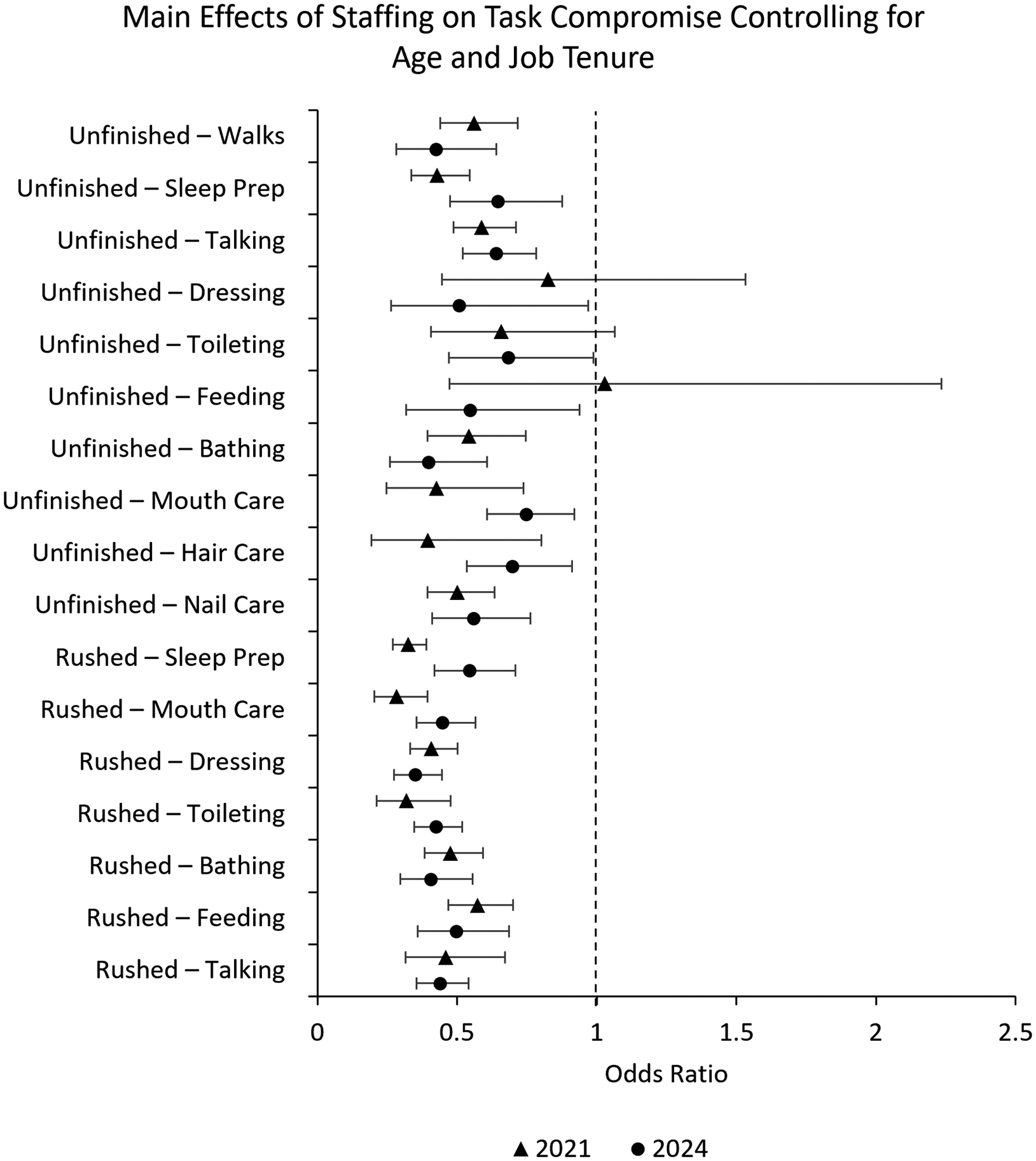
To obtain interpretable estimates of staffing effects, we estimated wave-stratified multilevel logistic regression models for 2021 and 2024. Across both waves, higher perceived staffing capacity was strongly and consistently associated with lower odds of reporting rushed or unfinished care tasks (Table 3). Age was only significantly associated with composite rushed care tasks in 2024, such that older care aides reported rushing fewer tasks, but missed more tasks than younger care aides. Next, we investigated how staffing capacity affects each independent care task. The results are presented in Table 4 and Figure 1.
Main effects of multilevel regression for composite z-scores of rushed/missed care

Table 3. Long description
The table is organized into eight columns: Care task, Variable, and two sets of three columns for 2021 and 2024 containing Coeff., 95% C I, and Sig.
Under the first care task, Rushed care – composite:
* Age: In 2021, Coeff. is minus .02, C I is [minus .169, .129], Sig. is .789. In 2024, Coeff. is minus .166, C I is [minus .242, minus .090], Sig. is less than .001.
* Job tenure: In 2021, Coeff. is .05, C I is [minus .105, .205], Sig. is .526. In 2024, Coeff. is .062, C I is [minus .061, .185], Sig. is .326.
* Staffing: In 2021, Coeff. is minus .481, C I is [minus .555, minus .407], Sig. is less than .001. In 2024, Coeff. is minus .418, C I is [minus .508, minus .328], Sig. is less than .001.
Under the second care task, Unfinished care – composite:
* Age: In 2021, Coeff. is .095, C I is [.024, .166], Sig. is .008. In 2024, Coeff. is minus .037, C I is [minus .180, .106], Sig. is .617.
* Job tenure: In 2021, Coeff. is minus .029, C I is [minus .158, .100], Sig. is .656. In 2024, Coeff. is .049, C I is [minus .071, .169], Sig. is .417.
* Staffing: In 2021, Coeff. is minus .282, C I is [minus .362, minus .202], Sig. is less than .001. In 2024, Coeff. is minus .320, C I is [minus .381, minus .259], Sig. is less than .001.
Note: p < .05; **p < .01; ***p < .001.
Main effects of multilevel logistic regression for care tasks

Table 4. Long description
The table presents main effects for care tasks including Bathing, Feeding, Toileting, Dressing, Sleep prep, Talking, Mouth care, Hair care, Nail care, and Walks. Data is organized into two primary year blocks: 2021 and 2024. Each year is subdivided into Unfinished and Rushed categories. For each category, three predictors are analyzed: Age, Job tenure, and Staffing. Values are presented as coefficients with standard errors in parentheses.
Key observations from the 2021 Unfinished section: Staffing shows significant negative associations across most tasks, such as Bathing 0.542, Sleep prep 0.428, and Nail care 0.500, all with p less than .001.
In the 2021 Rushed section: Staffing again shows strong significance across all measured tasks, including Toileting 0.319 and Mouth care 0.283. Note that Rushed care was not measured for Hair care, Nail care, or Walks.
In the 2024 Unfinished section: Staffing remains a significant predictor for tasks like Bathing 0.397 and Walks 0.425. Age shows a significant positive association with Feeding 1.214.
In the 2024 Rushed section: Staffing coefficients are significant across all tasks, ranging from 0.350 for Dressing to 0.544 for Sleep prep. Age shows significant negative associations with Bathing 0.836 and Toileting 0.834.
Note: Within the survey, rushed care was not measured for hair care, nail care, or walks. *p < .05; **p < .01; ***p < .001. Standard errors in parentheses.
Effects of perceived staffing on task compromise controlling for age and job tenure, stratified by time. Notes: Per CJA requirements, figures must be submitted as camera-ready TIFF files with a maximum width of 43 picas (7.25 inches). This figure presents a forest plot displaying the odds ratios (ORs) for staffing effects on each care task, stratified by survey wave (2021 and 2024). The plot shows: Odds ratios with 95% confidence intervals for unfinished care tasks (nail care, hair care, mouth care, bathing, feeding, toileting, dressing, talking, sleep preparation, walks). Odds ratios with 95% confidence intervals for rushed care tasks (bathing, feeding, toileting, dressing, sleep preparation, talking, mouth care). Separate panels or colour-coding for 2021 versus 2024 data. Reference line at OR = 1.0 indicating no effect. ORs < 1.0 indicate protective effects of higher staffing capacity.

Figure 1. Long description
The forest plot features a horizontal x-axis labeled Odds Ratio ranging from 0 to 2.5. A vertical dashed reference line is positioned at Odds Ratio 1.0. The y-axis lists 17 care task categories divided into Unfinished and Rushed groups. Each task has two data points: a triangle representing 2021 and a circle representing 2024, both with horizontal 95 percent confidence interval error bars.
From top to bottom, the Unfinished tasks include:
* Walks: Both years are well below 1.0.
* Sleep Prep: Both years are below 1.0.
* Talking: Both years are below 1.0.
* Dressing: 2021 is near 0.8 with a wide error bar extending past 1.5; 2024 is near 0.5.
* Toileting: Both years are near 0.6.
* Feeding: 2021 is slightly above 1.0 with a very wide error bar reaching 2.2; 2024 is near 0.5.
* Bathing: Both years are near 0.5.
* Mouth Care: Both years are below 1.0.
* Hair Care: Both years are below 1.0.
* Nail Care: Both years are near 0.5.
The Rushed tasks follow, all showing O R values and error bars entirely below the 1.0 reference line:
* Sleep Prep: 2021 is near 0.3; 2024 is near 0.5.
* Mouth Care: 2021 is near 0.3; 2024 is near 0.4.
* Dressing: Both years are near 0.4.
* Toileting: Both years are near 0.4.
* Bathing: Both years are near 0.5.
* Feeding: Both years are near 0.5.
* Talking: Both years are near 0.4.
Overall, the majority of data points for both 2021 and 2024 sit to the left of the 1.0 line, indicating that higher perceived staffing capacity generally correlates with a lower likelihood of task compromise.
Staffing had protective associations with unfinished care in both 2021 and 2024: as perceived staffing capacity increased, care aides were less likely to report tasks as unfinished. In 2021, staffing significantly reduced the odds of unfinished nail care, hair care, bathing, sleep preparation, and talking with residents. In 2024, staffing remained a significant predictor for many of these tasks, including unfinished nail care, bathing, and talking, in addition to feeding and walks. Tasks with very low occurrence, such as unfinished feeding, toileting, and dressing, showed wide CIs and were not consistently significant across waves, likely due to extremely low base rates.
Staffing was also protective for rushed care tasks in both waves: as perceived staffing capacity increased, care aides were less likely to report tasks as rushed. In 2021, ORs ranged from 0.28 to 0.57, with the strongest effects observed for mouth care, sleep preparation, and toileting. These associations remained statistically significant in 2024, ranging from 0.35 to 0.54, including mouth care, dressing, and bathing. Across all rushed tasks, effect sizes in 2024 were slightly weaker than in 2021 but remained substantial, indicating that perceived staffing capacity continued to exert a significant influence on the pace and completeness of direct care delivery.
Age demonstrated modest protective associations, but only for a few outcomes, and these patterns differed by wave. In 2021, older care aides were less likely to report unfinished hair care and more likely to report unfinished sleep preparation. In 2024, age had significant associations for several rushed tasks, including bathing, toileting, mouth care, and sleep preparation, suggesting that older workers were less likely to rush tasks requiring close personal care. Age was also positively associated with feeding, suggesting older care aides were more likely to report unfinished feeding. Across both waves, job tenure was not a significant predictor for any outcome, indicating that years of experience did not meaningfully alter the likelihood of care being rushed or left unfinished. Age and job tenure were moderately-to-strongly correlated (r = .581 in 2021; r = .636 in 2024), raising the possibility that job tenure’s null associations partly reflect shared variance with age rather than a true absence of any tenure-related effect. However, a variance inflation factor (VIF) analysis confirmed that collinearity between age and job tenure was not problematic, with VIF values below the commonly cited threshold of 5 (Tabachnick & Fidell, Reference Tabachnick and Fidell2013). Consistent with this conclusion, both variables were retained as simultaneous covariates.
Interview findings
During interviews, LTC administrators readily commented on the challenges they faced during the pandemic and the many ways in which they have since tried to make improvements for staff and residents. Although the context and corresponding changes to homes differed from one facility to the next, there were nevertheless some key themes that emerged across interviews. Namely, we found that the developments that have taken place since the pandemic largely involved: additional staffing, improved training opportunities, and changes in leadership.
Additional staffing
Interviewees noted significant recruitment challenges around the time of COVID, which left a lot of positions vacant and added strain to the existing workforce; often, homes would have to turn to agencies to provide short-term staff support. Since this time, LTC administrators have instituted various practices to help address staffing concerns, including offering more full-time rather than part-time positions, providing sign-on bonuses, and putting in place dedicated staff to manage recruitment and hiring. Thanks to these changes, interviewees noted that they are no longer reliant on agency staff to fill vacancies:
We would have, in 2021, had travel staff due to vacancies … And so we have done a lot of work … I can pretty much say that all of our positions are [now] full. We do not have significant vacancies [and] we were able to actually drop using the travel agency.
Homes are now sufficiently staffed to ensure positions are back-filled in the case of sick calls. In fact, several homes noted that when they draw up their schedules, they slot in additional staff as ‘relief positions’ for this very purpose. As one of our interviewees noted:
We changed the staff rotations, and I think that has helped them feel like they are not as frazzled as perhaps they once were. We changed it so that it would give more staffing for the day shift, and it also incorporated relief positions that we did not have before. So that if people called in sick, there was already built in two extra staff that would have been scheduled. So, it would provide them with shifts that were less short [staffed] or fully staffed. So, most days here, you are fully staffed where before it was probably hard to get that.
An interesting cultural shift that LTC administrators highlighted during our interviews was that, since the pandemic, they have found that staff are much more willing to call in sick in the event of any sign of illness, whereas in the past they would have come into work. This is possibly due to a new sense of urgency around cold-like symptoms that proved life-threatening during COVID-19. With an increased prevalence of sick calls, it has now become operationally imperative to have excess staff capacity built into the scheduling system.
Training
Alongside an increase in staffing numbers, LTC homes have made an effort to increase the expertise and capacity of their staff. This has been accomplished through a renewed emphasis on training and skills development.
LTC administrators noted that during the pandemic, staff training largely came to a halt as they were stretched thin and operating in ‘survival mode.’ Since COVID, however, there have been additional resources dedicated to ensuring staff are well trained and supported in their roles. For example, one home explained how they have overhauled their onboarding process in order to support staff as they first begin in their role:
In 2021, you were hired and sent directly onto the floor on your first day … Really, it was like throwing you in and seeing if you could swim. It was not purposeful, but that was just the traditional method. [Now] we have a much different onboarding process where we have orientation prior to ever starting a shift. We have scheduled check-ins during orientation [and after] 1 month and 3 months. It is a much more supportive situation now, and we achieved that by creating a role in which onboarding was the lead. So that’s huge.
Other homes spoke more broadly about the fact that they have increased the ongoing training opportunities offered to staff and have even added new roles specifically designed to provide continued education and support for care staff. As one home noted:
Like all that training and development … essentially stopped in 2021, and so we have started to reintegrate some of that [starting in] 2022–2023. So, it is picking up, doing a lot of that training… lots of training from a safety perspective, including physical safety, safe handling, safe mobility, psychological health, and diversity and equity. It is just a lot that has really happened in the last, you know, 3–4 years.
Administrators noted that they have also adjusted some staffing roles to reduce inefficiencies and ensure staff are operating within their full capacity. For some homes, this has included standardizing and increasing the scope of care aide roles, which has improved role delineation between care aides and nurses. According to interviewees, these changes have improved operations and boosted staff confidence and morale.
Leadership
The third key theme to emerge from interviews with administrators involves changes in leadership, which have occurred since 2021. Here, again, administrators spoke of vacancies that existed during the pandemic that they have since filled; this has resulted in a more fully staffed management team since COVID-19. Several homes also spoke about how they have restructured their leadership model and even added new roles to support managerial positions within the home. This has enabled the home to move beyond crisis-driven decision-making towards more proactive support to frontline workers. As one home explained:
I would say one of the main changes is that we were able to stabilize our leadership. So, in 2021 and throughout the pandemic, we had multiple manager and frontline manager vacancies. So that was able to be stabilized, and then in addition, in 2023, we made some changes within our model of care and implemented a clinical nurse lead role to help support the teams as well… I cannot underestimate how important it was to have consistent and dedicated leadership support on the unit to follow-up on things… I think strong leadership is often underestimated and is critically important.
Overall, it is clear that LTC homes have made considerable changes to their policies and practices since 2021. These internal transformations and their perceived benefits support our quantitative analysis, which reveals significant improvements in the care provided to LTC residents.
Discussion
Guided by Donabedian’s structure–process–outcome model (Donabedian, Reference Donabedian1988) and COR theory (Hobfoll, Reference Hobfoll1989), these findings show how staffing resources shape frontline care processes in the LTC sector. LTC homes reporting higher perceived staffing capacity had lower odds of unfinished or rushed tasks, and the association held consistently across both survey waves despite an overall improvement in perceived staffing between 2021 and 2024. Disaggregating care tasks revealed that this protective effect of staffing was not uniform. Tasks that can be deemed critical or safety-oriented, such as feeding and toileting, were rarely missed or rushed regardless of staffing level. More discretionary or psychosocial tasks, including sleep preparation, mouth care and talking with residents, were more vulnerable to being rushed or left unfinished under lower staffing conditions. Qualitative interviews with LTC administrators helped explain these quantitative trends. Interviews pointed to concrete structural changes, such as increased staffing levels, expanded training and onboarding supports, and more stable leadership, as contributing to the improvements observed between 2021 and 2024.
Thus, beyond staffing levels alone, our findings carry implications for the educational and professional context in which care aides operate. Unlike regulated health professionals such as nurses, care aides in Canada are not part of a licensed profession, and there is no national standard governing their training, credentialing, or scope of practice; requirements instead vary by province and typically consist of a college-level certificate program combining classroom instruction with a supervised practicum (Berta et al., Reference Berta, Laporte, Deber, Baumann and Gamble2013; Estabrooks et al., Reference Estabrooks, Squires, Carleton, Cummings and Norton2015). This lack of standardization means that ‘staffing capacity,’ while conceptually straightforward as a variable, may mask considerable variability in the competencies and preparedness of the staff being counted. Consistent with this, our qualitative findings suggest that LTC administrators did not treat staffing purely as a numbers problem: alongside adding staff, homes described substantial investments in onboarding, ongoing training, and clearer role delineation between care aides and nurses. This suggests that the improvements in rushed and unfinished care observed between 2021 and 2024 may reflect not only a larger workforce, but a better-prepared and more clearly defined one. From a policy perspective, this points to the value of considering care aide training and scope-of-practice standardization alongside staffing ratios; without attention to the educational and professional infrastructure supporting this workforce, increases in staffing numbers alone may not translate into consistent gains in care quality across facilities or provinces.
Our results contribute to the broader conversation on the importance of organizational context. As highlighted by Estabrooks and colleagues in the Translating Research in Elder Care program, favourable leadership, culture, and resources buffer the effects of staffing shortages, reducing rates of unfinished care (Estabrooks et al., Reference Estabrooks, Squires, Carleton, Cummings and Norton2015; Song et al., Reference Song, Hoben, Norton and Estabrooks2020). By showing that staffing capacity remained predictive of unfinished and rushed care even after accounting for age, tenure, and wave, our study reinforces the notion that structural and contextual conditions outweigh individual worker characteristics in shaping daily care delivery.
The task prioritization findings mirror patterns described internationally; in that, tasks like feeding and toileting were rarely skipped, while sleep preparation and mouth care were more vulnerable to compromise. Kalánková et al. (Reference Kalánková, Kirwan, Bartoníčková, Cubelo, Žiaková and Kurucová2020) noted that psychosocial and preventive tasks are disproportionately omitted when resources are scarce, compared to immediate survival tasks. This mirrors qualitative findings from Finnish nursing homes, where nurses described consciously prioritizing tasks tied to residents’ safety and physiological needs over psychosocial and relational care under time pressure (Hackman et al., Reference Hackman, Häggman-Laitila and Hult2025). This likely reflects triaging under time scarcity; however, it is consequential. Neglect of oral hygiene and sleep can accumulate into downstream risk (e.g., aspiration pneumonia, weight loss, worsening cognition and behaviour) (Delwel et al., Reference Delwel, Binnekade, Perez, Hertogh, Scherder and Lobbezoo2018; Vitiello & Borson, Reference Vitiello and Borson2001). Similarly, reduced conversation and engagement can contribute to social isolation, which is associated with elevated mortality risks (Pantell et al., Reference Pantell, Rehkopf, Jutte, Syme, Balmes and Adler2013). In other words, rushed and unfinished care in ‘lower priority’ domains may function as a latent hazard such that they are less visible on a single shift, but meaningful over time. This latent hazard may extend beyond residents to the care aides themselves. Repeatedly having to ration care in ways that conflict with one’s own standards of good practice has been linked to ethical or moral strain among LTC staff (Laher et al., Reference Laher, Robertson, Harrad-Hyde and Jones2022). This is a recognized contributor to burnout and turnover intentions in care settings. If left unaddressed, this raises the possibility of a reinforcing cycle, in which rushed or unfinished care contributes to staff strain and attrition, which further erodes staffing capacity, and increases the likelihood of rushed or unfinished care going forward. While this study did not directly measure moral distress or turnover, this potential feedback loop may be a useful direction for future research.
Importantly, the qualitative interviews revealed that simply increasing the number of staff hired is insufficient to address broader structural issues around the LTC workforce. Interviewees highlighted the importance of training and skills development, as well as having a strong leadership team. It was clear from our conversations with LTC administrators that in order to achieve these gains, homes had to purposefully restructure many of their practices; they also had to invest in new roles within their facilities in order to directly address key issues they identified. These additional roles served to support stronger onboarding, in-house training, and international staff recruitment. Thus, effective workforce improvements in LTC should consider not only the number of staff in the home but also implementation supports that strengthen local leadership, workforce planning, and training infrastructure. Without these complementary investments, additional hours of care risk being absorbed into existing inefficiencies.
These findings both align with and extend a substantial body of international literature linking staffing levels to unfinished and rushed care, while also offering some points of contrast. Consistent with Knopp-Sihota et al. (Reference Knopp-Sihota, Niehaus, Squires, Norton and Estabrooks2015), who found that three-quarters of Canadian care aides left at least one task unfinished and over 80 per cent felt rushed due to insufficient time, our results confirm that staffing shortfalls remain a persistent threat to care completion in Canadian LTC homes more than a decade later. However, unlike Knopp-Sihota et al. (Reference Knopp-Sihota, Niehaus, Squires, Norton and Estabrooks2015) and Song et al. (Reference Song, Hoben, Norton and Estabrooks2020), whose designs captured a single point in time, our repeated cross-sectional data show that the staffing–care relationship persisted despite a measurable system-wide improvement in perceived staffing following the COVID-19 pandemic. This suggests a durable structural pattern rather than a pandemic-specific artifact. In terms of clinical and practical significance, the magnitude of the staffing effect was substantial rather than marginal. Staffing-related ORs for rushed care ranged from 0.28 to 0.57 in 2021 and from 0.35 to 0.54 in 2024, indicating that higher perceived staffing capacity was associated with roughly a 43–72 per cent reduction in the odds of a task being rushed. This is echoed in the composite z-score models (Table 3), where staffing was associated with nearly a half-standard-deviation reduction in composite rushed care scores in both 2021 and 2024, and a smaller but still meaningful reduction in composite unfinished care scores. This pattern reinforces conclusions from systematic reviews (Kalánková et al., Reference Kalánková, Kirwan, Bartoníčková, Cubelo, Žiaková and Kurucová2020; Ludlow et al., Reference Ludlow, Churruca, Mumford, Ellis, Testa, Long and Braithwaite2021; Wang et al., Reference Wang, Rihari-Thomas, Bail, Bala and Traynor2025) that staffing is not just one of many factors leading to incomplete care; it is one of the most reliable and adjustable influences. At the same time, our findings add to much of this literature by disaggregating the outcome: rather than treating unfinished or rushed care as a uniform construct, our task-level results show that the protective effect of staffing was not evenly distributed across tasks, a nuance that composite-outcome studies in the existing literature are unable to capture.
While this study reveals meaningful improvements in the care provided to LTC residents in Nova Scotia since COVID-19, it also finds persistent unfinished care. This finding underscores the need for continued improvements to the LTC sector in the province. Drawing from this study, it is recommended that homes reflect not only on the number of staff within their homes but also on the structural issues that they may be facing at a facility level. A one-size-fits-all policy approach can be a helpful minimum policy standard; however, meaningful changes to the quality of care will require tailored approaches, including the willingness to dedicate resources to new or revised support roles in the home.
Strengths and limitations
This study contributes two-wave evidence from the same LTC homes, using multilevel models that account for clustering of care aides within LTC homes. Combining survey results with administrator case studies strengthens policy relevance by illustrating plausible implementation mechanisms linking staffing investments to frontline practice.
However, the design is a two-time-point design rather than a linked longitudinal cohort; therefore, causal inference cannot be established. The sample was also subject to potential selection bias: participation was voluntary, convenience-based, and incentivized with a gift card, and eligibility was restricted to care aides with at least 3 months of tenure and six shifts per month at the same facility. These criteria may have excluded newer, more transient, or highly casual staff, who could plausibly experience greater rates of rushed or unfinished care than reflected in our sample. If so, the prevalence estimates reported here may understate rather than overstate the true scope of the issue across the broader LTC workforce. Resident outcomes were not measured, and this study relied primarily on perceived staffing capacity rather than comprehensive objective staffing data (e.g., payroll-based hours worked, turnover, skill mix, acuity). However, perceived staffing adequacy has been shown to capture workload complexity and contextual demands that administrative headcounts often miss and is itself validly associated with care-relevant outcomes (van der Mark et al., Reference van der Mark, Vermeulen, Hendriks and Oostveen2021). Recent evidence directly comparing objective and subjective staffing metrics found that perceived adequacy predicted patient safety outcomes more strongly than objective staffing hours in some care settings, while the reverse held in others, suggesting the two approaches capture distinct information (Lake et al., Reference Lake, Pascale, Warshawsky, Henderson, Smith, Staiger, Perez, Venkataswamy and Rogowski2026). Nonetheless, without objective staffing data, we cannot determine whether the associations observed here reflect true differences in staff numbers, differences in how adequacy is perceived and reported, or both.
Additionally, the sample was limited to seven homes, which supports policy-specific insight but limits generalizability. Unmeasured contextual factors (e.g., resident acuity, ownership model, local labour markets) may also contribute to between-facility differences. The likely direction of this bias is difficult to establish with certainty.
Future research
Future research should extend the current design using a third survey wave within these LTC homes to clarify whether the staffing and care improvements observed between 2021 and 2024 reflect a durable structural shift or a temporary post-pandemic rebound. Additionally, future research should also link staffing and care compromise to resident outcomes (e.g., falls, infections, hospitalization, and pressure injuries). For example, Song et al. (Reference Song, Thorne, Norton, Poss, DeGraves and Estabrooks2022) found an association between rushed care and resident challenging behaviours. In addition, incorporating objective staffing indicators (hours worked, skill mix, turnover, and absenteeism) alongside perceptions of staffing adequacy would deepen our results. Stronger longitudinal designs that link individuals over time could clarify pathways from staffing investment to resource recovery, care processes, and resident outcomes. Finally, comparative work across jurisdictions could strengthen our understanding of how work environment and staffing impact rushed and unfinished care in LTC homes.
Conclusion
By combining repeated cross-sectional quantitative analyses with qualitative administrator perspectives, this study provides a nuanced, theory-driven understanding of how staffing improvements are associated with less rushed and more complete delivery of daily care tasks in these seven Nova Scotia LTC homes. Guided by Donabedian’s and COR frameworks, this study demonstrates that the translation of structural staffing resources into improved care processes depends on organizational readiness and conservation of workers’ energy. For policy makers, the results show that meaningful reform requires not only more staffing hours but also systems such as training, onboarding, and stable leadership that enable those hours to translate into more complete and less rushed care delivery.
Acknowledgements
We are unable to make the Alberta Context Tool used in this study available due to copyright restriction {2026, Carol Estabrooks}. All rights reserved (Estabrooks et al., Reference Estabrooks, Squires, Cummings, Birdsell and Norton2009). The data sets used in this study are not publicly available. They are housed within the University of Alberta Health Research Data Repository with limited access. For data and analytic code inquiries, contact the Atlantic Region Project Manager at arcltc@msvu.ca. This research was not pre-registered.
Author contributions
Conceptualization: J.K., C.E.; Data curation: J.K., C.E.; Formal analysis: I.H., H.D., E.H.; Funding acquisition: J.K.; Investigation: J.K., C.E.; Methodology: J.K., C.E.; Project administration: J.K.; Resources: J.K., C.E.; Supervision: J.K.; Validation: J.K., I.H., H.D., E.H.; Writing – original draft: I.H., H.D., E.H.; Writing – review and editing: J.K., I.H., H.D., E.H., C.E.
Financial support
This work was supported by Nova Scotia Health Research Fund (2020 and 2022 Competitions).
Competing interests
The authors declare no competing interests.



 Open access

