INTRODUCTION
It has long been assumed that native speakers (NS) of a language with an opaque gender system such as French can accurately attribute the appropriate gender(s) to existing nouns as well as pseudo-nouns (Tucker, Lambert, Rigault and Segalowitz, Reference Tucker, Lambert, Rigault and Segalowitz1968; Tucker, Lambert and Rigault, Reference Tucker, Lambert and Rigault1977) by relying on morpho-phonological endings and their intuition or “through experience, one just knows it, that's all” (Tucker, Reference Tucker1968: 6). Empirical evidence shows that grammatical gender knowledge emerges shortly after the first year (Höhle, Weissenborn, Kiefer, Schulz and Schmitz, Reference Höhle, Weissenborn, Kiefer, Schulz and Schmitz2004; Shi and Melançon, Reference Shi and Melançon2010), and that infants use the gender features of determiners to assign gender to pseudo-nouns (Cyr and Shi, Reference Cyr and Shi2013), while 30-month-old toddlers are faster during gender-matched trials than gender-unmatched trials with real and pseudo-words (Melançon and Shi, Reference Melançon and Shi2015). By the age of 3, children rarely make errors in attributing gender to nouns (Clark, Reference Clark and Slobin1985). However, French displays idiosyncracies, incongruences and asymetries in both gender attribution and gender agreement (e.g., Hulk and Tellier, Reference Hulk, Tellier, Authier, Bullock and Reed1998, Reference Hulk and Tellier2000; Schafroth, Reference Schafroth, Hellinger and Buβmann2003; Wagner and Pinchon, Reference Wagner and Pinchon1991), which, according to anecdotal evidence, may present difficulties even for NSs.
To the best of my knowledge, the only empirical data supporting this claim were collected for a second language (L2) acquisition study of grammatical gender and agreement by Anglophone learners (Ayoun, Reference Ayoun and Ayoun2007). The data from the French NS control group suggested that their judgments may not be as reliable as they are assumed to be, since a strong lexical effect was found, particularly with nouns exhibiting fluctuating gender. For instance, the results of a written gender assignment task (GAT) revealed significant differences between adult (n=20) and teenage (n=42) participants in that adults agreed more often on the gender of stimuli than teenagers. Thus, all adults rated 21 out of 50 nouns (54%) as feminine, but teenagers agreed 100% of the time on only one noun (cible ‘target’). Among nouns with very low accuracy percentages were idole ‘idol’ (42.9% for teenagers), oasis ‘oasis’ (50.0% for adults, 16.7% for teenagers) and primeur ‘scoop’ (42.9% for adults, 2.4% for teenagers). Moreover, participants appeared to rely on questionable cues from determiners and spelling word endings (Ayoun, Reference Ayoun2009).Footnote 1
The present study may be the first since Tucker et al. (Reference Tucker, Lambert, Rigault and Segalowitz1968, Reference Tucker, Lambert and Rigault1977) to focus on French NSs (n=168) to investigate their performance on: a) common and less common nouns; b) dual gender nouns (i.e., grammatical homonyms); c) compounds whose gender almost always differs from the gender of the second lexical item (or both). An important difference is that Tucker et al. (Reference Tucker, Lambert, Rigault and Segalowitz1968, Reference Tucker, Lambert and Rigault1977) used oral stimuli whereas the present study employs written stimuli. Although the gender of the lexical items remains the same, auditory stimuli may be processed differently than written stimuli. The main objectives of the present study are to determine: a) how reliable and consistent French NSs are at assigning the appropriate gender to common, uncommon nouns and compounds in a written gender assignment task; b) what underlying strategies may be used in doing so. It will be hypothesized that purely associative mechanisms are not sufficient and that gender must be acquired for each lexical item as morpho-phonological cues alone are unreliable. Lexical knowledge also comes into play in the case of idiosyncracies (i.e., fluctuating gender, grammatical homonyns/homophones, epicenes, compounds). Following an overview of the French gender system, selected studies will be reviewed before presenting the methodology, a discussion of the findings, and a few conclusions regarding both native speakers and second language (L2) learners.
GENDER ASSIGNMENT IN FRENCH
French is described as having a formal gender system with a weak semantic component because it exhibits both inherent lexical (or semantic) gender and grammatical gender, while other languages such as English have a system in which gender is not grammatically marked, but semantically motivated (Corbett, Reference Corbett1991, Reference Corbett and Griffin2003; Séguin, Reference Séguin1969).Footnote 2 In such a system, “semantic factors are sufficient on their own to account for assignment” (Corbett, Reference Corbett1991: 8): nouns referring to male human beings are masculine, while nouns referring to female human beings are feminine.
The gender that is assigned to all inanimate nouns in French is generally referred to as arbitrary because “grammatical gender for inanimate nouns has no conceptual basis, and does not go through a process of feature marking in mapping the conceptual notion onto a linguistic code” (Deutsch and Dank, Reference Deutsch and Dank2009: 116). In addition to a semantic (i.e., biological) gender and an arbitrary gender, French displays: a) a morphological gender at the word level from the same lexical entry (e.g., Italien ‘Italian-msc’, Italienne ‘Italian-fem’, pharmacien ‘pharmacist-msc’, pharmacienne ‘pharmacist-fem’); b) a relational syntactic gender between phrasal constituents used in syntactic concord as in la jolie fleur violette ‘the-fem beautiful-fem purple-fem flower’ where the determiner and adjective must agree in gender (and number) with the noun; c) referential gender for épicènes, nouns that are either masculine or feminine depending on their referent (e.g., un/une journaliste ‘a- msc/fem journalist’).
According to Séguin (Reference Séguin1969), semantically motivated gender categories account for only 10.5% of all French nouns, which means that 89.5% of nouns display a grammatical gender. Séguin also points out that there is an uneven distribution of masculine and feminine nouns since 58.6% of nouns are masculine, creating a potential bias toward the masculine, as discussed below. The perennial question is whether grammatical gender is assigned on a principled basis or is completely arbitrary (see e.g., Carroll, Reference Carroll2005; Maratsos and Chalkey, Reference Maratsos, Chalkley and Nelson1980; Müller, Reference Müller and Meisel1990).
How is grammatical gender assigned?
A variety of gender assignment rules were proposed that were first based on semantics and spelling (Bidot, Reference Bidot1925), then on phonological endings accounting for roughly 85% of frequently occurring nouns (Mel’čuk, Reference Mel’čuk and Rozencvejg1958), as well as a combination of semantic and phonological rules (Tucker et al., Reference Tucker, Lambert, Rigault and Segalowitz1968, Reference Tucker, Lambert and Rigault1977). In the comprehensive system Tucker et al. (Reference Tucker, Lambert and Rigault1977) proposed based on the lexicographical analyses of 26,725 nouns from the Petit Larousse, most rules are phonological, some are semantic and morphological, while different types of rules may overlap or conflict, and exceptions abound (e.g., Surridge Reference Surridge1993). Indeed, the French system “allows more exceptions than do other systems” (Corbett, Reference Corbett1991: 61).Footnote 3 Tucker et al. (Reference Tucker, Lambert and Rigault1977) contend that spelling also plays a role; for instance, -é and -ée yield both masculine (e.g., lycée ‘high school’, musée ‘museum’, comité ‘committee’) and feminine nouns (e.g., mosquée ‘mosque’, journée ‘day’). However, their own generalizations are plagued with counter-examples that they dismiss as “inappropriate” (ibid: 61), referring for instance to the fact that most nouns ending in -age are masculine, with the notable exceptions of page ‘page’, image ‘image’, cage ‘cage’, among others.
Another way to use morphology is to draw parallels between suffixation and gender assignment (e.g., Gervais, Reference Gervais and Sanders1993; Surridge, Reference Surridge1986, Reference Surridge1993), as in the following examples (taken from Surridge, Reference Surridge1986: 274):
-
(1)
-
a. Nouns derived from adjectives with the following suffixes are feminine:
-
-eur, -ie, -ité, -icité, -esse, -itude, -étude, -ance, -ence, -ise
-
b. Nouns derived from nouns with the following suffixes are feminine: -elle,
-
-ette, -elette, -iole, -ule, -aie, -eraie, -aine
-
c. Nouns derived from other nouns with the following suffixes are masculine: -eau, -ot, -on, -eron, -in, -et, -illon, -icule
-
d. Nouns derived from the suffixe –isme are masculine
-
Relying on suffixation requires a solid knowledge of morphology since only suffixes provide deterministic cues to gender, while similar endings do not (MacWhinney, Reference MacWhinney, Broeder and Murre2000). Thus, conversation ‘conversation’ is feminine because it ends with the suffixe -tion, whereas bastion ‘bastion’ is masculine, because it is not composed of bas-+-tion (Presson, MacWhinney and Tokowicz, Reference Presson, MacWhinney and Tokowicz2014).
Semantic rules appear to be used when phonological and morphological accounts fail. Thus, the semantic concept of ‘days of the week’ and ‘seasons’ is used to explain why all the words subsumed under these categories are masculine (Surridge, Reference Surridge1993). Beckett (Reference Beckett2010: 57) identifies five lexical fields: birds, fish, “other members of the animal kingdom”, “plant kingdom, limited to two areas – woody plants (trees, shrubs, vines) and fruits”, and human beings. Although Beckett pursues the “potential relationship between phonology and gender assignment [. . .] in relation to word-final syllable structure and morphology” (ibid: 57), it is argued that semantic features related to size, form or shape are helpful in accounting for gender assignment. In addition to the caveat that only 8,000 words were used, it is difficult to see how an account limited to only two categories of nouns can be useful beyond a semantic analysis of these very specific nouns.Footnote 4
One could argue that the masculine acts as the default gender because 58.6% of nouns are masculine, and because it is attributed to several categories such as: a) nominalized verbs (boire ‘drinking’, déjeuner ‘lunch’, lancer ‘throw’, pouvoir ‘power’, rire ‘laughter’, savoir ‘knowledge’, toucher ‘touch’, vouloir ‘will’, savoir-faire ‘know how’). However, nouns derived from verbs are feminine (entrée ‘entrance’, allée ‘alley’ arrivée ‘arrival’, fumée ‘smoke’, mêlée ‘fray’); b) nominalized adjectives and participles are masculine (chaud ‘hot’, froid ‘cold’, clair ‘clear’, bon ‘good’, mauvais ‘bad’), as are generally words borrowed from other languages (‘judo’, ‘spoutnik’, ‘gang’), although Desrochers (Reference Desrochers1986) argues that gender assignment for loan words can be either semantic or phonological.Footnote 5 Moreover, and in a similar way to the semantic analysis of very specific nouns, because such rules of thumb concern a very small subset of the data, they are not very useful; c) English borrowings tend to be masculine, but out of a corpus of 703 nouns drawn from popular music magazines, 51.49% were masculine, 12.09% feminine, while 36.2% were ambiguous (Guilford, Reference Guilford1994, Reference Guilford1999; Pergnier, Reference Pergnier1989 reports similar findings). Gender appears to often be assigned by semantic analogy (e.g., la house-fem for ‘house music’ by analogy with la maison-fem);Footnote 6 d) Foreign nouns code-switched in French also appear to be overwhelmingly assigned the masculine gender (Violin-Wigent, Reference Violin-Wigent2006).
Furthermore, gender conflict resolution always favors the masculine in standard usage as shown in (2):
-
(2)
-
a. Un cousin et une cousine amusants
-
a-msc cousin-msc and a-fem cousin-fem fun-msc-pl
-
b. *Un cousin et une cousine amusantes
-
a-msc cousin-msc and a-fem cousin-fem fun-fem-pl
-
‘Fun cousin and cousin’
-
This creates some semantic ambiguity (Irmen and Kurovskaja, Reference Irmen and Kurovskaja2010) as in (2a) where it is unclear whether both people are fun or not. It is generally resolved by assuming that a masculine interpretation is favored over a feminine interpretation in French (e.g., Gygax, Sarrasin, Lévy, Sato and Gabriel, Reference Gygax, Sarrasin, Lévy, Sato and Gabriel2013; Gygax and Gabriel, Reference Gygax and Gabriel2008), as in other languages such as German or Norwegian (e.g., Gabriel, Reference Gabriel2008; Irmen and Schumann, Reference Irmen and Schumann2011; cited in Gygax et al. Reference Gygax, Sarrasin, Lévy, Sato and Gabriel2013).
Tables 1 and 2 display oral data compiled from Tucker et al. (Reference Tucker, Lambert and Rigault1977) to highlight the predictive value of consonantal and vocalic final phones. Both tables are organized by the decreasing predictive value of the phones (% column).Footnote 7 Also given is the number of tokens for each phone, an important piece of information for if a phone has a high predictive value, but few tokens, its predictive value is reduced; conversely, a low predictive value is compounded by a large number of tokens. The ‘spelling’ column indicates all the possible forms for each phone.
Consonantal final phones, tokens and spellings

Vocalic final phones by tokens

Table 1 shows that only 3 out of 18 phones have a predictability value of 90% or above (a reliability criterion also used by Lyster, Reference Lyster2006), while 4 of them hover around 50% to 58%, including phones with large number of tokens such as [l] and [t], as well as numerous different spellings.
The data displayed in Table 2 reveal much better predictability values for vocalic final phones, although the number of tokens is smaller, particularly for [
 ] (only 17 tokens) and [ø] (only 189 tokens compared to 1963 tokens for [ã] for instance).Footnote
8
Moreover, [e] with the largest number of tokens (3416) has the lowest predictability value (57%). With the exception of [i], [e] and [
 ], vocalic phones are masculine, whereas consonantal phones are more evenly split between masculine and feminine.
Lyster (Reference Lyster2006: 72) also attempts to “determine the extent to which noun endings in French are reliable predictors of grammatical gender” with a written corpus. Using 90% as a reliability criterion, the analysis of the endings of 9,991 singular inanimate nouns selected from Le Robert Junior Illustré showed that only 6 out of 29 final phonemes (18% of the corpus) met that criterion (ibid: Table 1, p. 75). Noun endings were operationalized as spelling representations of rhymes.Footnote 9 Lyster argues that 81% of all feminine nouns and 80% of all masculine nouns in his corpus are rule-governed because their endings systematically predict their gender. However, the author is using a pre-selected corpus of nouns already classified as exhibiting typically masculine or feminine endings, and yet, only 81% of feminine nouns and 80% of masculine nouns within that corpus are indeed feminine or masculine. Moreover, dual gender and compound nouns were excluded. As previously noted, “arguably, nearly 400 spelling endings are too numerous to be of much use to L2 learners” (Tucker et al., Reference Tucker, Lambert and Rigault1977: 86).Footnote 10
It thus may be best to accept that grammatical gender assignment in French is based on a mix of morpho-phonological and lexical rules in addition to spelling and semantics, rather than insist on “crazy rules” (Enger, Reference Enger2009) that look like “post-factum rationalizations” (Comrie, Reference Comrie1999).
Idiosyncracies in gender
Although most nouns are masculine or feminine, grammatical homonyms are both, while the gender of a few other nouns fluctuates. Morevoer, although nouns referring to male human beings are masculine (e.g., neveu ‘nephew’), while nouns referring to female human beings are feminine (e.g., nièce ‘niece’), that is not always true of all animated beings. Thus, abeille ‘bee’, baleine ‘whale’, mouche ‘fly’, among many others, only have feminine forms and mâle ‘male’ is added to refer to the male species as in une abeille mâle, while phoque ‘seal’ or singe ‘monkey’, for instance, only have masculine forms, and femelle ‘female’ is added to refer to the female species as in un singe femelle.
Grammatical homonyms
Grammatical homonyms are pairs of nouns yielding a masculine form and a feminine form with identical spellings and pronunciation, but different meanings as exemplified in (3):
-
(3) un livre ‘a book’-msc, une livre ‘a pound’-fem
-
un moule ‘a mold’-msc, une moule ‘a mussel’-fem
-
un manche ‘a handle’-msc, une manche ‘a sleeve’-fem
-
le mémoire ‘memoir, thesis’-msc, la mémoire ‘memory’-fem
The gender fluctuation of some homonyms distinguishes between animate and inanimate nouns as in (4):
-
(4) aide ‘aid’-msc, aide ‘help’-fem
-
manœuvre ‘worker’-msc, manœuvre ‘manoeuvre’-fem
-
enseigne ‘ensign’-msc, enseigne ‘sign’-fem
-
secrétaire ‘secretary’-fem/msc, secrétaire ‘desk’-msc
-
page ‘page’-fem, page ‘page’-msc
Although the context disambiguates between their two possible meanings, these homonyms are clearly an exception to gender assignment based on phonological endings. There are about 50 grammatical homonyms (L'Huillier, Reference L'Huillier1999; Price, Reference Price2008).
Homophones
Homophones – words with different spellings, but identical pronunciation – form another category as exemplified in (5):
-
(5)
-
[sεl] sel ‘salt’-msc, selle ‘saddle’-fem
-
[fwa] foie ‘liver’-msc, fois ‘time’-fem, foi ‘faith’-fem
-
[ru] roux ‘redhead’-msc, roue ‘wheel’-fem
-
[rεn] renne ‘reindeer’-msc, reine ‘queen-fem
-
[po] pot ‘jar’-msc, peau ‘skin’-fem
-
Although the context eliminates any ambiguity, homophones are also a counter-example to gender assignment rules based on phonology. They are presumably stored with a single phonological representation with two different meanings (Gottlob, Goldinger, Stone and Van Orden, Reference Gottlob, Goldinger, Stone and Van Orden1999). The interesting questions of how they may be stored lexically, and how they may be accessed, have been addressed by a few studies reviewed below (e.g., Spinelli and Alario, Reference Spinelli and Alario2002).
Épicènes
Épicène nouns may be used with either grammatical gender depending on their referent, without a change in meaning or form:
-
(6) un/e ‘a-msc-fem’ artiste ‘artist’, juge ‘judge’, propriétaire ‘owner’, camarade
-
‘friend’, pensionnaire ‘boarder’, partenaire ‘partner’, stagiaire ‘trainee’
However, although personne ‘person’ is not an épicène per se, it could be argued that it is an exception in that it is always feminine regardless of its referent as in (7):
-
(7)
-
a. Ma sœur/mon frère est une personne intelligente/*intelligent
-
my-fem sister/my-msc brother is a-fem person intelligent-fem/*msc
-
‘My sister/my brother is an intelligent person’
-
b. Sa tante et ses oncles sont des personnes charmantes/*charmants.
-
his-fem aunt-fem and his uncles-msc are det-pl persons-fem
-
charming-fem/*msc
-
‘His/her aunt and his/her uncles are charming people’
-
Other nouns with animate referents (but not épicènes) are only feminine or masculine regardless of the gender of the referent: victime ‘victim’, sentinelle ‘sentry’, vedette ‘star’, connaissance ‘acquaintance’ or doublure ‘double, stand-in’ are always feminine, while génie ‘genius’, mannequin ‘model’, bébé ‘baby’, ange ‘angel’, témoin ‘witness’, ascendant ‘ascendant’ are always masculine. Moreover, some titles such as altesse ‘prince’, majesté ‘majesty’, Sainteté ‘Holiness’ are feminine although their referents may be masculine as well as feminine (except for Sainteté).
Gender fluctuation with number
The gender of a few nouns – amour ‘love’, gens ‘people’, délice ‘delight’, orgue ‘organ’ – fluctuates with number. The first two are very common and quite interesting, as shown in (8):
-
(8)
-
a. Les vieilles/*vieux gens sont méchants/*méchantes
-
the old-fem/msc people-pl are mean-msc/fem
-
‘Old people are mean’
-
b. Ces *belles/beaux jeunes gens sont méchants/*méchantes
-
these-fem-msc young-*fem/msc people are mean-msc/*fem
-
‘These young people are mean’
-
c. C'est l'histoire d'un/*une bel/*belle amour.
-
it is the story of a-msc/*fem beautiful-msc/*beautiful-fem love
-
‘It's a beautiful love story’
-
d. C'est l'histoire de *beaux/belles amours.
-
it is the story of det-pl *beautiful- msc/beautiful-fem love
-
‘These are beautiful love stories’
-
Gens ‘people’ is particularly idiosyncratic in that as a plural noun with either male and/or female referents, it triggers feminine agreement with preposed adjectives, but masculine agreement with postposed adjectives. Moreover, the phrase jeunes gens ‘young people’– in which it appears that the adjective has been nominalized – is always masculine (the referents may be both feminine and masculine or only masculine, but not all feminine).
Compounds
Hawkins and Towell (Reference Hawkins and Towell2010: 17–19) identify six types of compounds to which gender is added here: a) adjective + noun compounds take the gender of the head noun (rond-point ‘roundabout’-msc), but there are exceptions (rouge-gorge ‘robin’-msc); b) in noun + noun compounds, the gender is based on the head noun (mot-clé ‘a key word’-fem); c) adverb + noun compounds have the same gender as the head noun (arrière-pensée ‘after thought’-fem) so may be masculine or feminine, but with exceptions (guerre ‘war’-fem, après-guerre ‘period after the war’-msc); d) noun + prepositional phrase compounds take the gender of the first noun so may be masculine (chef d’œuvre ‘masterpiece’-msc, but œuvre-fem) or feminine (main d’œuvre ‘work force’-fem); e) verb + noun compounds are usually masculine (allume-cigarette ‘cigarette lighter’-msc) regardless of the gender of the noun (cigarette-fem); f) verb phrase compounds (qu'en-dira t-on ‘what people may say’-msc) are always masculine.
Thus, most types of compounds (particularly deverbal compounds) are masculine regardless of the gender of their lexemes as individual items as in (9):
-
(9) croûte ‘crust’-fem, casse-croûte ‘snack’-msc
-
glace ‘glass’-fem, essuie-glace ‘windshield wiper’-msc
-
faute ‘error’-fem, sans-faute ‘perfect score’-msc
-
tête ‘head’-fem, tête-à-tête ‘face-to-face’-msc
A few feminine compounds are listed in (10):
-
(10) fenêtre ‘window’-fem, porte-fenêtre ‘French window’-fem
-
temps ‘time’-msc, mi-temps-fem ‘half-time’ (but also ‘part-time’-msc)
-
part ‘share’-fem, quote-part ‘share’-fem
-
face ‘face’-fem, volte-face ‘flip-flop’-fem
-
garde ‘watch’-fem, garde-à-vue ‘observation’-fem
Both masculine and feminine compounds illustrate the fact that morpho-phonological endings are not reliable cues to gender because the same word can take on the opposite gender once it becomes part of a compound, although there are no morphological changes to its ending.Footnote 11
To sum up, French exhibits a formal gender system in which 89.5% of nouns display an arbitrary gender. Morpho-phonological regularities are simply due to the fact that a finite (albeit large) number of French morphemes and phonemes necessarily fall within one of the two gender categories of the masculine or feminine. However, the multiple spellings associated with morpho-phonological endings along with their highly variable predictability and idiosyncracies (i.e., fluctuating gender, grammatical homonyms, homophones, epicenes, compounds) create a seemingly unacquirable system. So, how do French NSs acquire grammatical gender? What cues do they rely on and do they do so consistently?
REVIEW OF SELECTED L1 FRENCH STUDIES
This section reviews studies that investigated how grammatical gender is acquired, assigned and/or processed by French NSs to address the issue of the types of cues (i.e., morphological and/or phonological) on which they may rely.
L1 acquisition studies
Tucker et al. (Reference Tucker, Lambert and Rigault1977) ran five studies to test NSs’ ability in assigning gender to real words – common and rare – and pseudo-words with real phonological and/or morphological endings. The stimuli consisted in randomized list of words previously recorded and presented orally. The first study tested 402 students (8 to 13 years old) and showed that they performed well on endings with high predictability values such as –ais [e], -oi [wa], -illon [i jõ], -eur [œr], -oir [war];Footnote 12 however, they showed some “confusion and ambiguity” (ibid: 25) with the endings -é, -eure and -oire which have low predictibility values (e.g., -oire and -eure are both 54% masculine). Tucker et al.’s suggestion that “native speakers might disambiguate the total category of “nouns ending with -é” by storing separately information about those that end with -té, with -ré, etc” is difficult to accept as it lacks a principled basis (i.e., aside from gender, it is unclear what the motivation would be), and unnecessarily complicates the processes of lexical storage and retrieval.
Karmiloff-Smith (Reference Karmiloff-Smith1979: 167) emphasized the importance of phonological rules as well, contending that French NSs construct “a very powerful, implicit system of phonological rules” that allows them to assign gender to most of the nouns they encounter. Her data showed that at about 5 years old, children prefer indefinite articles as gender cues over phonological noun cues, when these two types of cues were in conflict, while children as young as 3 years old used indefinite articles when they could not rely on phonological cues. The stimuli were presented aurally and the children responded orally.
Seigneuric, Zagar, Meunier and Spinelli (Reference Seigneuric, Zagar, Meunier and Spinelli2007) address two limitations of the study conducted by Karmiloff-Smith (Reference Karmiloff-Smith1979): first, the fact that only four pseudo-words were used, and second, the possibility that because the children's ability to assign gender was tested with an agreement task (producing a noun phrase with a determiner and an adjective), two different types of ability – assignment and agreement – were confounded. In Seigneuric et al., a large number of children (n=144) from 3- to 9-years old repeated pseudo-words (masculine, feminine, neutral endings) after the researcher, before indicating their gender either by providing a determiner verbally or by pointing to a picture. The children's ability to appropriately assign gender increased with age, with children as young as 4 years old showing they had acquired “a probabilistic system of phonological gender cues that is intimately connected to semantic cues” (ibid: 241), replicating findings in French and other languages (Sera, Elie, Forbes, Burch, Rodriguez and Dubois, Reference Sera, Elieff, Forbes, Burch, Rodriguez and Dubois2002). However, Seigneuric et al. point out “that showing an influence of word endings in gender attribution to words or pseudo-words does not imply that this type of information plays a major role in gender retrieval during “normal” comprehension” (ibid: 244).Footnote 13
In Harley (Reference Harley1979), children in immersion programs experienced greater difficulties in assigning gender during an oral task than monolingual francophones, and overgeneralized the masculine. The same finding was reported in Marinova-Todd (Reference Marinova-Todd1994) with older learners, and in Tarone, Frauenfelder and Selinker (Reference Tarone, Frauenfelder and Selinker1976) with grade 2 French immersion students. In a longitudinal study, Spilka (Reference Spilka1976) found that immersion students (grades 1 through 6) experienced persistent difficulties with gender, while Taylor-Browne (Reference Taylor-Browne1984) reported that other immersion learners did not appear to use phonological, semantic or syntactic cues to assign gender to novel nouns in a variety of experimental tasks.
More recent studies by Boloh and his colleagues (Boloh and Ibernon, Reference Boloh and Ibernon2010, Reference Boloh and Ibernon2013; Boloh, Escudier, Royer and Ibernon, Reference Boloh, Escudier, Royer and Ibernon2012) found no evidence that French children or adults use a phonological strategy when selecting a gender-marked determiner for inanimate pseudo-nouns in an elicited production task. When 4- to 10-year-old children performed the same task with incongruent determiner-noun pairs of inanimate pseudo-nouns, they never relied on phonological cues, leading Boloh et al. (Reference Boloh, Escudier, Royer and Ibernon2012) to conclude that children use the masculine as a default gender, and that the feminine is acquired based on its co-occurrence with feminine determiners. Boloh and Ibernon (Reference Boloh and Ibernon2013) administered an oral description task with pseudo-words to children (n=182) of various age groups (from 3;8 to 12;6), adolescents (n=24) and young adults (n=22), and similarly report no evidence of a phonological strategy.
Gender processing studies
Gender processing studies suggest that NSs assign gender more rapidly and accurately to words and pseudo-words exhibiting regular gender-ending correspondence than to words with unpredictable endings (e.g., Desrochers and Paivio, Reference Desrochers and Paivio1990; Desrochers, Paivio and Desrochers, Reference Desrochers, Paivio and Desrochers1989; Holmes and Dejean de la Bâtie, Reference Holmes and Dejean de la Bâtie1999; Holmes and Segui, Reference Holmes and Segui2004, Reference Holmes and Segui2006; Taft and Meunier, Reference Taft and Meunier1998). Gender decisions are also faster when nouns refer to human entities rather than to inanimate objects (Desrochers and Brabant, Reference Desrochers and Brabant1995). However, regular endings do not facilitate gender attribution to vowel-initial nouns, prompting the claim that endings play a secondary role to determiners (Desrochers and Brabant, Reference Desrochers and Brabant1995; Desrochers and Paivio, Reference Desrochers and Paivio1990; Desrochers et al., Reference Desrochers, Paivio and Desrochers1989; Taft and Meunier, Reference Taft and Meunier1998). Thus, Holmes and Dejean de la Bâtie (Reference Holmes and Dejean de la Bâtie1999: 480) contend that “[g]iven their extremely high frequency of occurrence in the language, definite and indefinite articles would be expected to play a major part in this process”, referring to gender acquisition as “purely associative mechanisms”. A claim based on empirical evidence showing that NSs “take substantially longer to indicate the gender of isolated nouns when asked to use these labels rather than to supply a determiner of the appropriate gender (Desrochers and Paivio, Reference Desrochers and Paivio1990; Desrochers, Paivio and Desrochers, Reference Desrochers, Paivio and Desrochers1989)(ibid: 481).
However, written corpus studies suggest that determiners may not be reliable gender markers. The analysis of 5016 DPs (i.e., noun phrases with determiners and/or adjectives as tokens, not types) from a written corpus of newspapers and magazines revealed that only 41.22% of nouns had a gender-marked determiner, while 49.76% of noun tokens were not gender-marked at all (the remaining 9.01% of nouns lacked a gender-marked determiner, but were modified by a gender-marked adjective)(Ayoun Reference Ayoun2010). Similarly, Hug (Reference Hug1989) reports that only 42.48% of nouns were gender-marked in a written corpus of 48 literary excerpts. The analysis of two oral corpora – 37.7 hours of immersion teachers in their classrooms and 33 hours of parent-child interactions – allowed Poirier and Lyster (Reference Poirier and Lyster2014) to report that 71% of the direct object clitics le, la, l’, les used by the teachers, and 54% of the pronouns used by the parents were not gender-marked. In Poirier (Reference Poirier2012), the same oral corpus of French Canadian immersion teachers revealed that the gender of 50% of nouns is indicated on their determiners or adjectives, while 50% of nouns are not gender-marked at all.
The written and oral input is thus ambiguous at best, but when it is unambiguous, it is used by NSs according to an experimental study monitoring the eye movements of participants as they performed a picture identification task in Dahan, Swingley, Tanenhaus and Magnuson (Reference Dahan, Swingley, Tanenhaus and Magnuson2000). Auditory stimuli were played and participants clicked on the relevant picture. Findings show that a gender-marked determiner (as opposed to a non gender-marked determiner) eliminated the activation of gender-inconsistent alternatives, constraining the possibilities entertained for noun recognition.
Likewise, Colé, Pynte and Andriamamonjy (Reference Colé, Pynte and Andriamamonjy2003) recorded lexical decision times and eye movements while French NSs performed a visual word recognition task with written stimuli targeting two types of regularities: ending-to-gender (i.e., final letters are predictive of gender) and gender-to-ending (e.g., the feminine generally predicts the final letter e). The predictability of the nouns’ endings was found to facilitate their recognition, at least for low frequency nouns. The authors conclude that NSs use noun ending-gender regularities in word recognition.
Spinelli and Alario (Reference Spinelli and Alario2002) carried out two cross-modal semantic priming experiments with auditory stimuli to determine how the two meanings of homophone words are activated by French NSs. The first experiment that presented words in isolation (a pair of homophones with both related and unrelated target words) showed that both genders are activated, but that there was a priming effect for the primary meaning. In the second experiment, homophones were presented with a determiner marked for the secondary meaning (e.g., la selle ‘saddle’ instead of le sel ‘salt’),Footnote 14 and findings only showed evidence of activation for the meaning triggered by the gender of the determiner. Spinelli and Alario conclude “that a gender-marked context constrains the meanings that are accessed during the perception of homophones. This pattern seems better explained by locating the gender context effect at the level of word form activation. It further suggests that homophone words do not share a common representation at this level” (ibid: 467).
Spalek, Franck, Schriefers and Frauenfelder (Reference Spalek, Franck, Schriefers and Frauenfelder2008) investigated the role of phonological regularities (i.e., gender is either congruent or incongruent with phonological endings) on gender processing: the first experiment focused on auditory language comprehension, while the second targeted language comprehension, both with auditory stimuli. In the gender decision task of the first experiment, participants were faster with nouns exhibiting congruent endings than incongruent endings, while the effect was weaker in the lexical decision task. No congruency effect was found with the picture naming task administered in the second experiment.Footnote 15
Meunier, Seigneuric and Spinelli (Reference Meunier, Seigneuric and Spinelli2008) suggest that the noun predictability effect found in these studies may be due to NSs’ ability to activate and process the morphological composition of complex nouns. Two experiments were carried out to investigate whether the gender of morphologically complex words derived from a base with an opposite gender is retrieved more slowly than the gender of a noun whose base matches that of the derived noun. The results of a gender assignment task, which presented written stimuli on a computer screen showed that participants decomposed the nouns into their constituent morphemes and activated their morpheme genders to identify them. However, as acknowledged by the authors, it is unclear whether the gender effect was in fact morphemic as opposed to orthographic, and few stimuli (both words and endings) were used.
Muller-Gass, Gonthier, Desrochers and Campbell (Reference Muller-Gass, Gonthier, Desrochers and Campbell2000) monitored the cognitive processing occurring before participants (n=10) indicated their response to stimuli in gender assignment tasks by measuring Event Related Potentials (ERP), in particular the P3 – a late positive wave whose amplitude is reduced with more difficult decisions. Participants viewed the written stimuli on a computer screen and pressed a key to indicate whether a gender label was correct or not while their EEG activity was recorded. Results showed a slower reaction time for superordinate labels (masculine, feminine) than for determiners (un, une), as well as for low as opposed to high frequency nouns; however, no significant P3 latency differences were found between determiners and superordinate labels. “Results are consistent with the hypothesis that participants decide on the gender of the target word by constructing a virtual noun phrase and subsequently verify the match between virtual article and gender labels presented on the screen” (ibid: 3530).
To sum up this brief literature review and to address the questions asked at the end of Section 2: French NSs appear to acquire grammatical gender by using the most reliable cues available to them, that is, the phonological cues of highly predictable endings, but not necessarily for vowel-initial nouns. More specifically, high frequency nouns were correlated with faster reaction times and fewer errors than low frequency nouns particularly when their endings were also highly predictive of their gender. Conversely, participants performed poorly with phonological endings that have low predictability. However, it was also found that they use semantic cues and (in)definite articles as well, in addition to being faster with nouns exhibiting congruent endings rather than incongruent endings, as could be expected.
None of these studies systematically investigated common versus uncommon nouns, vowel-initial versus consonant-initial nouns or compounds, nouns exhibiting both masculine and feminine genders, all at once; nor did they ask participants to think about the strategies they may use to assign a gender to stimuli. This is what the present study does to address the questions of how French NSs acquire grammatical gender, what cues do they rely on and whether they do so consistently.
METHODOLOGY
Research questions
The main research questions are as follows: a) how accurate and consistent are French NSs in assigning gender to nouns? b) what strategies do they use when they are unsure of the gender of a noun?
The following predictions will be tested: a) participants will be more accurate and consistent on common than uncommon nouns, animate than inanimate nouns, consonant-initial than vowel initial nouns; b) compounds will be overwhelming masculine; c) there will be a lexical effect in that the participants’ performance will vary with the stimuli.
These predictions imply that there should be a lexical effect that derives from the hypothesis that gender must be acquired for each individual lexical item as morpho-phonological cues alone are unreliable and vary greatly; lexical knowledge also comes into play in the case of idiosyncracies (i.e., fluctuating gender, grammatical homonyns, homophones, épicènes, compounds) and uncommon nouns.Footnote 16
Participants and tasks
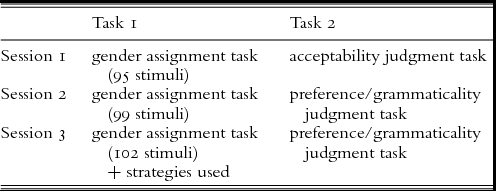
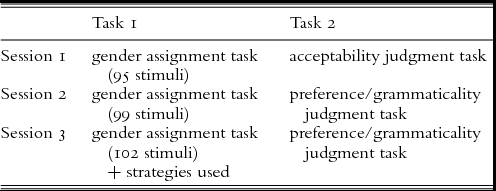
French NSs (n=168) who lived in various cities in France (e.g., Paris, Toulouse, Nantes, Montpellier, Caen) at the time of the data collection were recruited through academic listservs and asked to enlist their friends and families in order to reach people of various socio-economic backgrounds. The resulting composition of the participant pool was graduate students (n=57), professors (n=49), professionals with graduate degrees (n=13), non professionals (n=35), retired (n=14). Non professional participants had graduated from high school, but did not attend college, while professionals had graduate degrees, but were not academics. Most, but not all, of the retired participants indicated that they were former teachers or professors. There were 38 male and 130 female participants who averaged 39.51 years in age (range 19–74). They filled out a written background questionnaire before performing a written gender assignment task: they were asked to decide whether each isolated word was masculine, feminine, both, or if they didn't know. These four options were presented in a pull-down menu. They were also asked to check a box to indicate when they didn't know the meaning of a word.Footnote 17 The participants also completed a preference/grammaticality judgment task and an acceptability judgment task as part of a larger study; these findings will be reported elsewhere. All the tasks and stimuli were written and accessible from a webpage. The study was composed of three sessions to accommodate the data collection of two different tasks per session and to avoid performance errors due to fatigue, boredom or lack of concentration, as well as to include a large number of stimuli for each of the two different tasks administered per session. The stimuli were thus randomly divided across three sessions, but there were no differences in the way the gender assignment task was administered. In other words, participants performed three times the same task, once every two days, with different stimuli.
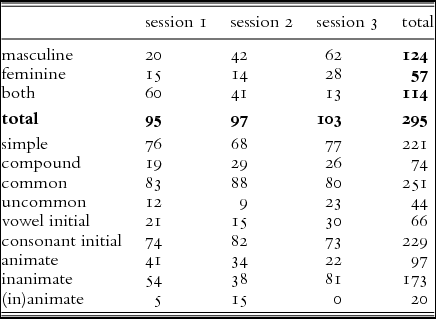
The stimuli were composed of a total 295 individual words illustrating vowel- and consonant-initial nouns, compounds, common and uncommon nouns, the former being defined as high frequency nouns (based on lexical databases such as Content et al., Reference Content, Mousty and Radeau1990 and lexique.org) such as mort ‘death’ or chose ‘thing’, as opposed to the latter which are much less frequent in daily use such as uvule ‘uvula’ or renoncule; ‘buttercup’ as well as nouns whose gender is known to be difficult even for NSs, but are common (according to Holmes and Dejean de la Bâtie, Reference Holmes and Dejean de la Bâtie1999; Batchelor and Offord, Reference Batchelor and Offord2000; Ayoun, Reference Ayoun and Ayoun2007).Footnote 18 Grammatical homonyms and épicènes were included so that the stimuli would be representative of French vocabulary. The distribution of the stimuli is displayed in Table 3 (see also Appendix A).
Distribution of the stimuli
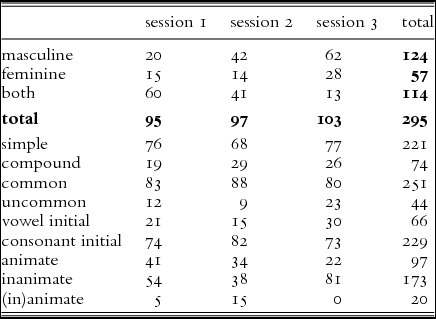
At the end of the last session, the participants were asked to think about the strategies they may have used when they were unsure of the gender of the nouns. They were given a choice of six different strategies, and for each one indicated whether they used it ‘always’, ‘often’, ‘sometimes’, ‘rarely’ or ‘never’. The strategies were chosen to test hypotheses proposed from the literature reviewed above, that is whether native speakers use determiners and/or phono-morphological cues, and/or whether they go beyond the noun itself and exploit any indications given by the adjective or the sentential context. The latter was based on Gollan and Frost's (Reference Gollan and Frost2002: 642) claim that “gender is accessed more efficiently in the presence of syntactic context (Roelofs, Reference Roché1992; Schriefers, Reference Surridge1993)”. No time limit was placed on performing the tasks. When participants were finished, they clicked on the submit button. The raw data were saved to a folder online to be later coded and analyzed with SPSS. The study design is summarized in Table 4.
Study design
FINDINGS
Overall accuracy
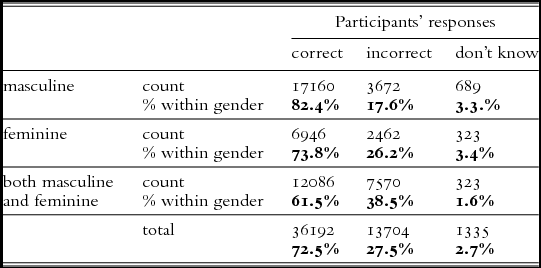
The accuracy means displayed in Table 5 show how often participants assigned the appropriate gender to the stimuli.
Accuracy on gender assignment tasks

Participants obtained an overall accuracy of 72.5% and their performance was significantly different with the gender of the stimuli (Pearson χ² = 2834.692, df = 4, p<.001): 82.4% for masculine nouns, 73.8% for feminine nouns and 61.5% for nouns which are both masculine and feminine. They chose the option ‘I don't know’ for a very small percentage of the stimuli (3.3% masculine, 3.4% feminine, 1.6% both masculine and feminine), suggesting they were confident. They could also indicate whether they knew the meaning of the stimuli or not. These findings are displayed in Table 6.
(Un)known meaning/gender accuracy

Participants indicated not knowing either the meaning or the gender for only 2.3% of the stimuli; they knew the meaning, but didn't know the gender of only 2.4% of the stimuli. When they didn't know the meaning of the noun, they still correctly attributed a gender for 54.5% of the stimuli. And finally, when they knew the meaning of the stimuli, they were accurate in attributing the gender of these stimuli most of the time (74.5%). These findings are statistically significant (Pearson χ² = 3341.847, df = 3, p<.001). So a strong confidence indicated by low percentages for unknown meaning and gender (2.3% and 2.4%, respectively) did not lead to a solid performance (74.5%), well below the 90% criterion usually required of native speakers (e.g., Dronjic and Helms-Park, Reference Dronjic and Helms-Park2014).
Accuracy by variables
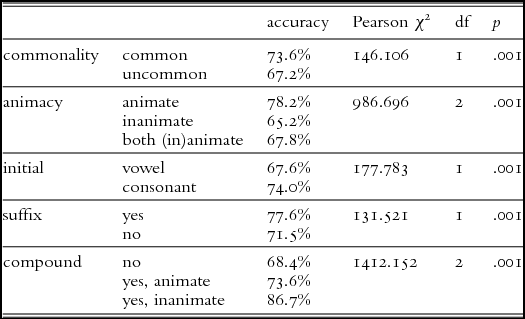
The data were also analyzed based on several variables such as commonality, suffix and initials; the accuracy percentages and statistics are displayed in Table 7.
Accuracy on GAT by variables
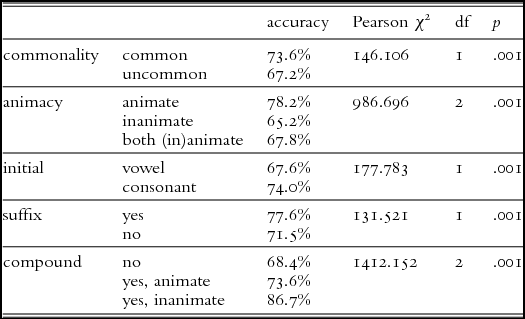
Participants performed better on common than uncommon words (average of 73.6% vs. 67.2%), animate than inanimate nouns or both animate and inaninate nouns (average of 78.2%, 65.2%, 67.8%, respectively), as well as consonant-initial nouns versus vowel-initial nouns (74.0% vs. 67.6%). They were slightly more accurate with the stimuli, which had a suffix (77.6% vs. 71.5%), and they obtained better results with compounds than non-compounds (68.4%) whether they were animate (73.6%) or inanimate (86.7%). All of these findings are statistically significant. However, no correlation was found between the frequency of the stimuli as determined by lexique.org and the participants’ performance (Pearson correlation = -0.067, p = 0.246).Footnote 19
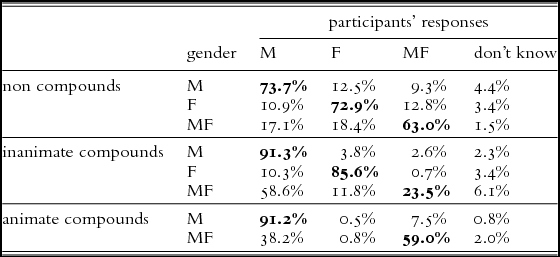
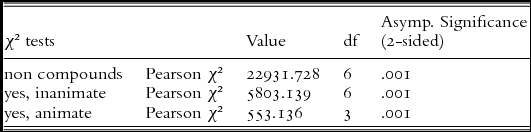
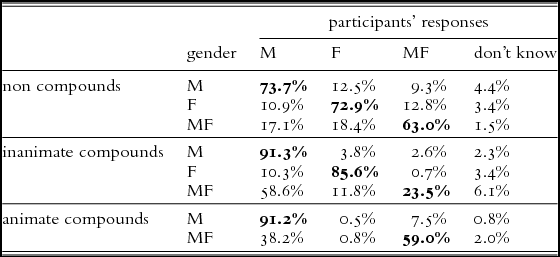
More detailed findings regarding the compounds are displayed in Tables 8a and 8b.
Accuracy on compounds
χ² tests for compounds

Participants performed significantly better on compounds (91.2%) than non-compounds (from 63.0% to 73.7%). They also did better with masculine stimuli (both compounds and non-compounds) than feminine stimuli, or stimuli that were both masculine and feminine. This is particularly noticeable for inanimate compounds that were found to be masculine (58.6%) more often than both masculine and feminine (23.5%), and to a lesser extent for animate compounds (38.2% masculine vs. 59.0% masculine and feminine). The percentages for ‘don't know’ vary and are the highest for inanimate compounds (6.1%), but remain low overall.
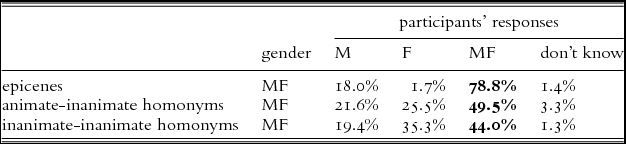
Table 9 displays the findings for épicènes and grammatical homonyms, which are all both masculine and feminine.
Accuracy on épicènes and grammatical homonyms

The participants performed much better on epicenes whose referents are animate (e.g., adversaire ‘adversary’-fem-msc) than on homonyms with both an animate referent and an inanimate referent (e.g., aide ‘aid, assistant’-fem-msc/‘help’-fem) or homonyms with two inanimate referents (e.g., vase ‘vase’-msc/‘mud’-fem). Their accuracy percentages are below chance level for the homonyms (49.5% and 44.0%) and higher for the epicenes (78.8%), but statistically significant (Pearson χ² = 3590.864, df = 6, p = 0.001), although the ‘don't know’ percentages are very low, indicating a strong confidence level.
Another interesting finding is the lack of correlation between the participants’ accuracy in attributing gender to the stimuli and the reliability index of the phonological endings (Tables 1 and 2). As Figure 1 shows, there was no correlation (Pearson correlation = -0.042, p = 0.474).
Correlation accuracy and reliability index

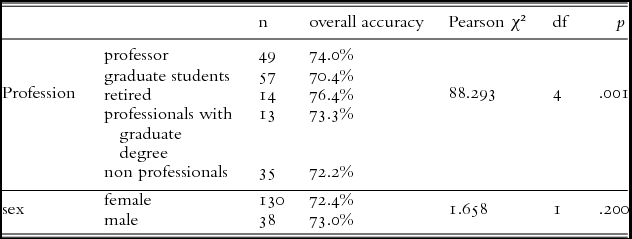
Finally, although the findings for accuracy by profession are statistically significant as shown in Table 10, the overall accuracy means are not very far apart from the highest means for retired participants who were mostly professors (76.4%) to the lowest for graduate students (70.4%).
Accuracy by profession and sex

Given the high level of education of the participants, findings may have been worse with participants with lower levels of education, that is, below the baccalauréat (high school diploma). There is no statistical difference between the performance of male vs female participants which is not surprising given the disparity between the number of male vs female participants, but their sex is unlikely to be a significant factor in their performance anyway.
Findings by stimuli
Table 11 displays stimuli that got low accuracy means. There are first a few compounds and then non-compounds by increasing means. Some of the compounds are common and yet were rarely attributed the appropriate gender (e.g., mi-temps ‘part-time, half-time’ 26.2%, après-guerre ‘post-war period’ 37.5%, garde-à-vue ‘detention’ 51.2%), while others are more rare and clearly affected the participants’ performance (e.g., garde-cendre ‘ash guard’ 1.2%, porte-voix ‘megaphone’ 6.0%, micro-cravate ‘lapel microphone’ 57.1%).
Findings by stimuli

Among the non-compounds, there are common (e.g., amour ‘love’ 59.5%, but amours ‘loves’ 47.6%, armistice ‘armistice’ 51.8%, primeurs ‘early vegetables’ 19.6%), uncommon nouns (e.g., renoncule ‘buttercup’ 44.0%, adobe ‘adobe’ 26.2%, effluve ‘scent’ 18.5%) as well as quite a few grammatical homonyms (e.g., espace ‘space’ 19.0%, vase ‘vase, mud’ 58.3%, somme ‘nap, addition’ 58.9%). The accuracy means go from 1.2% to 59.5%, indicating a strong lexical effect.
Strategies
At the end of the last session, participants were asked to indicate whether and how often they may have used several possible strategies when they were unsure of the gender of a noun.
Strategies used to attribute gender

The percentages displayed in Table 12 show that the NSs did not favor a single strategy since they often selected more than one. The first four were chosen the most often and are presented in decreasing order: using the word with an adjective (54.8% combining ‘always’ and ‘often’), using the word with an article (45.9%), using the word in a sentence and sounding it out mentally (42.3% for both strategies). What they did not do was use the first few letters (91.7% combining ‘rarely’ and ‘never’) or the last few letters (78.8%), contra Tucker et al. (Reference Tucker, Lambert and Rigault1977). So phonology played a role (sounding out the words was used 42.3% of the time), but the gender provided by the determiner such as un/une ‘a’-msc/fem or le/la ‘the’-msc/fem (presumably as an associative process) did as well (as found in Muller-Gass et al., Reference Muller-Gass, Gonthier, Desrochers and Campbell2000). This finding supports earlier claims that “when asked to classify a word's gender, people try to evoke implicitly the closest lexical associate, typically the definite article” (Holmes and Segui, Reference Holmes and Segui2004: 428). The participants who chose ‘did something else’ rarely provided an explanation. The few explanations participants wrote are about creating a context around the word, using general world knowledge, analogy or etymology (see Appendix B). The explanations provided appear to be typical of declarative knowledge as participants were able to articulate metalinguistic knowledge such as ‘I used similar compound words, or tried to see if the first word in the compound words were verbs or nouns’; in this case, the participant presumably thought that the type of compound influenced its gender. Two other explanations – ‘I used a past participle with a phonetically realized feminine agreement’ and ‘When I really didn't know, I tried to decompose the word and to guess its etymology’– also indicate a certain amount of metalinguistic knowledge, which is not surprising given that almost a third of the participants were teachers/professors (n = 49). If the participants tried to recall similar lexical items, they were using their procedural memory system as well as argued by Ullman (Reference Ullman2004: 233) according to whom “lexical memory depends largely on the declarative memory system whereas aspects of grammar depend on the procedural memory system”. To remember idiosyncratic lexical information, they probably relied on their mental lexicon (e.g., Chomsky, Reference Chomsky1995). Unfortunately, the participants did not provide enough explanations to better characterize their strategies and we can only speculate as to the exact type of knowledge they used, consciously or unconsciously, to make a decision while performing this task, especially given empirical findings that native speakers are not immune to task effects any more than L2 learners are (e.g., Foster and Tavakoli Reference Foster and Tavakoli2009).
DISCUSSION AND CONCLUSION
The present study set out to determine how reliable and consistent French NSs are at assigning the appropriate gender to common, uncommon nouns and compounds in a written gender assignment task and what strategies they may use in doing so. It was hypothesized that NS intuition and purely associative mechanisms are not sufficient; instead, gender must be acquired for each individual lexical item as morpho-phonological cues alone are unreliable, and numerous idiosyncracies create ambiguities.
The results of a gender assignment task revealed strong lexical and gender effects with an overall accuracy of 72.5% and a significantly better performance on masculine nouns (82.4%) than feminine nouns (73.8%) or nouns which are both masculine and feminine (61.5%). The NS speakers’ performance also varied depending on whether the stimuli were compounds or not, common or uncommon, or had a vocalic or consonantal initial. A strong lexical effect was also found, confirming our hypothesis that gender must be acquired for each individual lexical item. Following Acquaviva (Reference Acquaviva2008, Reference Acquaviva, Montermini, Boyé and Tseng2009) for Italian pairs such as braccio ~ braccia ‘arm ~ arms’ with different gender values in singular and plural, French grammatical homonyms may be considered as distinct lexemes as argued by Caramazza, Costa, Miozzo and Bi (Reference Caramazza, Costa, Miozzo and Bi2001) based on a translation task with Spanish-English bilingual speakers who needed more time to translate the low frequency twin in a pair of homophones. Biedermann, Blanken and Nickels (Reference Biedermann, Blanken and Nickels2002) also argue that although homophones may share a single word form representation for the sake of an efficient speech-processing system, when they have different grammatical genders, they should have different lemmas. Spinelli and Alario (Reference Spinelli and Alario2002) reach the same conclusion based on reaction times in the production of French homophones, supporting the Independent Network Model (Caramazza and Miozzo, Reference Caramazza and Miozzo1997).Footnote 20
The answer to our second research question related to the strategies French NSs reported using which varied from using the word with an adjective (54.8%), an article (45.9%), and in a sentence or sounding it out mentally (42.3% for both strategies). However, they did not use the last few letters (78.8%), contra Tucker et al. (Reference Tucker, Lambert and Rigault1977).
So phonology played a role, but so did the gender provided by the determiner. It thus appears that associative processes are insufficient (contra Sagarra and Herschensohn, Reference Sagarra and Herschensohn2010) when NSs are confronted with uncommon nouns, particularly if they are feminine and vowel-initial. Morpho-phonological cues alone are clearly unreliable – practically useless in the case of compounds – and lexical knowledge is essential in the case of idiosyncracies (e.g., Ayoun Reference Ayoun and Ayoun2007).
Holmes and Dejean de la Bâtie (Reference Holmes and Dejean de la Bâtie1999: 490) found that French NSs “took significantly longer to classify pseudo-words than regular words” and “unexpectedly [. . .] also made substantially more errors classifying pseudo-words than regular words”, but appeared to have used sublexical associations in attributing gender. Moreover, they reported that NSs “did not classify the items in terms of their endings 20% of the time (ibid: 493). A second experiment with pseudo-words did not support Tucker et al.’s (Reference Tucker, Lambert and Rigault1977) claim that NSs systematically establish a correspondence between endings and gender.
A task effect may explain some of these low accuracy percentages: participants were asked to attribute a gender to individual, decontextualized words from a pull-down menu (M, F, MF, DK). Presenting the words in context would clearly illustrate the nouns’ meaning and thus activate both genders in the case of grammatical homonyms if two different stimuli were used to illustrate the two different meanings (e.g., la vase ‘mud’ vs le vase ‘vase’). It would also be interesting to investigate whether the same gender assignment task carried out with auditory stimuli would yield similar results than with written stimuli. The gender processing studies reviewed above suggest that there may be differences since “the stimulus information in a written noun is processed in parallel, auditory information is processed sequentially” (Spalek et al., Reference Spalek, Franck, Schriefers and Frauenfelder2008: 431).
Grammatical gender is a complex lexical property that poses retrieval difficulties even for NSs as evidenced by their inconsistent performance on a gender assignment task with isolated stimuli, thus dispelling the myth of an infallible native speaker. Being at the interface of morpho-phonology and the lexicon, grammatical gender is inherently difficult, but it also appears to be one of the most deeply linguistically entrenched categories (Corbett, Reference Corbett1991; Comrie, Reference Comrie1999), relevant to both the lexicon and morpho-syntax for agreement. It is also important for “disambiguation and reference tracking in discourse (Corbett, Reference Corbett1991).Footnote 21
Without going as far as claiming that the native speaker is dead (Braine, Reference Braine1999; Edge, Reference Edge2006; Holliday, Reference Holliday2008), it is important to point out that the idealization of the native speaker cannot be maintained. Native speakers are not immune to performance difficulties due to linguistic complexities, nor are they isomorphic with the standard form of a language, contrary to the academic construct of the native speaker (Davies, Reference Davies2013). Moreover, their socio-economic and sociolinguistic background does affect their performance (Dronjic and Helms-Park, Reference Dronjic and Helms-Park2014; Mulder and Hulstijn, Reference Mulder and Hulstijn2011).
This conclusion has implications for L2 learners of French as well: acquiring grammatical gender will be a long and arduous process that will require a strong morpho-phonological and lexical knowledge as evidenced by mixed findings. The performance of instructed L2 learners is often inconsistent (e.g., Ayoun, Reference Ayoun and Ayoun2007; Dewaele and Véronique, Reference Dewaele and Véronique2001), although form-focused instruction appears to be more efficient than corrective feedback with immersion students (Lyster, Reference Lyster2004), but all participants improved in correctly assigning grammatical gender to French nouns regardless of the type of feedback they received (prompts or recasts) in Lyster and Izquierdo (Reference Lyster and Izquierdo2009). It is even claimed that L2 learners cannot fully acquire gender features lacking in their L1 (e.g., Franceschina, Reference Franceschina2005; Sabourin, Reference Sabourin, Foster-Cohen and Nizegorodcew2001; Sabourin, Stowe and Haan, Reference Sabourin, Stowe and Haan2006), but L2 learners’ performance improves with their proficiency levels (e.g., Sagarra and Herschensohn, Reference Sagarra and Herschensohn2012), suggesting they may eventually fully acquire grammatical gender although it is low in communicative value (Warden, Reference Warden1997). The fact that even bilingual children in immersion settings initially have difficulties, but show an improvement in proficiency (e.g., Swain, Reference Swain2000) indicates that although it is possible for L2 learners to acquire grammatical gender, it will take longer than in L1 acquisition. Finally, in assessing L2 learners we cannot require a level of performance that native speakers do not achieve, especially if we insist on using an idealized native speaker as a yardstick which may doom L2 learners to failure regardless of how near native they may become, as argued by others (e.g., Joseph, Reference Joseph2017).
APPENDIX A – STIMULI BY SESSION

APPENDIX B
Strategies participants used when they were unsure of the gender of a noun. The original French comments were translated (translation mine).
- “J'ai utilisé un participe passé avec lequel l'accord féminin est phonétiquement réalisé” (‘I used a past participle with a phonetically realized feminine agreement’).
- “J'utilise la connaissance du monde. Par exemple pour ‘proches’, il est évident que le mot va servir pour des hommes et des femmes, d'où M et F” (‘I use world knowledge. For example, for proches ‘loved ones’, the word obviously refers to both men and women, hence M and F’).
- “J'ai essayé de mettre le mot dans un contexte significatif. Par exemple pour le mot ‘Pâques’, je n'ai pas pu trouver une phrase qui permette de définir si le mot est masculin ou féminin: ‘la fête de Pâques’ ou ‘nous sommes allés à Pâques à. . .’, alors que la Pâque est pour moi nettement féminin si on la considère comme un nom” (‘I tried to place the word in meaningful context. For example, for the word Pâques ‘Easter’, I could not find a sentence that could define the word as masculine or feminine: ‘the-FEM Easter holiday’ or ‘at Easter, we went to. . .’, but for me Easter is clearly feminine if it is considered as a noun’).
- “J'ai construit une phrase”. (‘I created a sentence’).
- “Je disais directement le mot dans ma tête avec ‘un’, ‘une’, ‘le’, ‘la’”. ‘I would say the word mentally with ‘a’-msc, ‘a-fem’, ‘the-msc’, ‘the-fem’).
- “J'ai utilisé des mots composés similaires; ou vu si le premier mot dans les noms composés étaient des verbes ou des noms. . . parfois c’était aussi “le souvenir” dans ex ci-dessous je cherche le sujet clef! autre: agonie avec combien de. . . j'ai souvent changé d'avis MAIS probablement parce que j'enseigne. . .. les fleurs? J'en ai acheté (on ne fait pas l'accord avec ‘en’ si je souviens bien) mais ‘combien en as-tu achetées’ je fais l'accord instinctivement. . . (au son)”. (‘I used similar compound words, or tried to see if the first word in the compound words were verbs or nouns..sometimes, it was what I remembered, in the example below, I'm looking for the subject. Other: I agonized with ‘how many’. . .I often changed my mind BUT that's probably because I'm a teacher. . . flowers? I bought some (there is no agreement with ‘some’ if I remember correctly), but in ‘how many did you buy?’, I do the agreement instinctively (based on the sound)’.
- “J'ai essayé avec les deux et j'ai choisi celui qui m'avait l'air le plus naturel”. (‘I tried with both and picked the one that seemed the most natural’).
- “Pour les mots composés dont je ne connaissais pas le sens, j'ai procédé par analogie”. (“when I didn't know the meaning of compound words, I proceeded by analogy’.
- “Quand je ne savais vraiment pas, j'ai essayé de décomposer le mot et de faire des hypothèses sur son étymologie”. (‘When I really didn't know, I tried to decompose the word and to guess its etymology’).
- “J'ai utilisé les mots avec différents adjectifs comme beau/belle, bon/bonne mais aussi avec des articles pour être vraiment certain, mais je suis sûr de m’être quand même trompé”. (I used words with different adjectives such as beautiful-msc/fem, good –masc/fem, but also with articles to be really sure, but I'm certain I still made mistakes’).