Implications
The goal of using immunomodulators as food additives for pigs is to improve their immune system and, hopefully, the production parameters. It has been suggested that serum acute phase proteins, which are well known markers for infection and inflammation, may be used as an index for monitoring productive performance. Our results show that the use of a feed additive with immunomodulatory properties was able to improve the production parameters and that serum haptoglobin decreases concomitantly, suggesting an improved health status of the animals. Furthermore, haptoglobin serum concentration could be considered as a good biomarker to monitor production parameters and for monitoring Aujeszky modified live vaccine in animals reared under standard commercial conditions.
Introduction
Acute phase proteins (APPs) are a group of blood proteins that change its concentration in animals subjected to external or internal challenges such as infection, inflammation, surgical trauma or stress (Murata et al., Reference Murata, Shimada and Yoshioka2004). After the challenge, there is an increase in the plasma concentration of some APPs, such as haptoglobin (Hp), Pig-major acute phase protein (MAP), serum amyloid A and C-reactive protein; those are named as positive APPs. On the other hand, other proteins decrease, such as albumin, which represent the negative APPs. Positive APPs are synthesized in the liver under the stimulus of pro-inflammatory cytokines, such as interleukin (IL)-6, tumor necrosis factor-α and IL-1β (Murata et al., Reference Murata, Shimada and Yoshioka2004).
Concentrations of serum APPs have been related to the severity of underlying disease and therefore they may act as markers for the presence and extent of disease processes (Eckersall et al., Reference Eckersall, Duthie, Toussaint, Gruys, Heegaard, Alava, Lipperheide and Madec1999; Murata et al., Reference Murata, Shimada and Yoshioka2004; Petersen et al., Reference Petersen, Nielsen and Heegaard2004). Thus, increased serum levels of APPs have been reported in pigs experimentally infected with porcine reproductive and respiratory syndrome (PRRS) virus, porcine circovirus type 2, different serotypes of Actinobacillus pleuropneumoniae and Streptococcus suis (Heegaard et al., Reference Heegaard, Klausen, Nielsen, Gonzalez-Ramon, Pineiro, Lampreave and Alava1998; Asai et al., Reference Asai, Mor, Okada, Uruno, Yazawa and Shibata1999; Hulten et al., Reference Hulten, Johansson, Fossum and Wallgren2003; Diaz et al., Reference Diaz, Darwich, Pappaterra, Pujols and Mateu2005; Sorensen et al., Reference Sorensen, Tegtmeier, Andresen, Pineiro, Toussaint, Campbell, Lampreave and Heegaard2006; Stevenson et al., Reference Stevenson, McCullough, Vincent, Gilpin, Summerfield, Nielsen, McNeilly, Adair and Allan2006). Serum APPs also increase in pigs naturally infected with A. pleuropneumoniae (Hall et al., Reference Hall, Eurell, Hansen and Herr1992) and in field cases of post-weaning multisystemic wasting syndrome and porcine respiratory disease complex (Segales et al., Reference Segales, Pineiro, Lampreave, Nofrarias, Mateu, Calsamiglia, Andres, Morales, Pineiro and Domingo2004; Parra et al., Reference Parra, Fuentes, Tecles, Martinez-Subiela, Martinez, Munoz and Ceron2006).
It has been also suggested that serum APPs may be used as an index for monitoring productive performance. In particular, low serum APPs have been correlated with better production parameters in pigs (Eurell et al., Reference Eurell, Bane, Hall and Schaeffer1992; Clapperton et al., Reference Clapperton, Bishop and Glass2005; Pineiro et al., Reference Pineiro, Pineiro, Morales, Carpintero, Campbell, Eckersall, Toussaint, Alava and Lampreave2007a).
Nutraceutical is a food that provides medical or health benefits, including prevention or treatment of disease. Nutraceuticals are the fastest growing category of immunomodulators today (Hardy, Reference Hardy2000; Blecha, Reference Blecha2001). The goal of using immunomodulators as food additives for pigs is to enhance the immune responses after vaccination or to overcome infectious diseases in swine and, indirectly, to improve production parameters. The inmunomodulator used in this study, Inmunicin MAYMO, is based on plant foods phytosterols, and it is authorized in Spain as a complementary feed for pigs. This additive targets specific T-helper lymphocytes by increasing the Th1 activity and resulting in improved T-lymphocyte and natural killer cell activity (Fraile et al., Reference Fraile, Crisci, Weenberg, Armadans, Mendoza, Ruiz, Bernaus and Montoya2009).
Finally, Aujeszky modified live vaccination (MLV) is widely used in Spain because of the compulsory national eradication program in course. To our knowledge, there is information available about the APP response after challenge with wild type Aujeszky virus (Carpintero et al., Reference Carpintero, Alonso, Pineiro, Iturralde, Andres, Le Potier, Madec, Alava, Pineiro and Lampreave2007) but there is a paucity of information about the serum APPs profile in pigs undergoing standard vaccination programs under field conditions.
The main goal of this work was to study whether or not any correlation between serum levels of two APPs (Hp and Pig-MAP) and production parameters could be established in animals receiving or not receiving a feed additive with immunomodulatory properties. Secondly, we studied the relationship between APP concentrations and standard vaccination programs (Aujeszky vaccination) under field conditions.
Material and methods
Experimental design and production parameters
A total of 360 piglets ((Landrace × Duroc) × Pietrain); mixed males and females) from a commercial herd were used. The animals were weaned at 18 to 22 days of age and housed in a weaning room equipped with automatic heating and forced ventilation. At 6 weeks of age (3 weeks after being in this facility), the animals were allocated into 14 pens (seven pens per treatment) following a complete randomized design to get a similar starting weight at the beginning of the trial. One hundred and eighty animals were treated with immunomodulator mixed with its feed as previously described (Fraile et al., Reference Fraile, Crisci, Weenberg, Armadans, Mendoza, Ruiz, Bernaus and Montoya2009) (2 kg of Inmunicin MAYMO per tonne) from 6 to 14 weeks of age. The exact composition of Inmunicin MAYMO (immunomodulator, Laboratorios Maymó, SA, Barcelona, Spain), is protected under a Spanish patent (Tracking number: P200603091/4). The rest of the animals (180 pigs) were fed with standard feed according to the Institut National de la Recherche Agronomique (France) recommendations. At 8 weeks of age, they were moved to a finishing facility (30 min road transport) and distributed into 26 pens (13 pens per treatment). Moreover, animals were vaccinated with a Aujeszky MLV European vaccine (Auskipra GN, Hipra Laboratories, Amer, Girona, Spain) at 11 and 15 weeks of age. The piglets had free access to feed and water. All the animals were weighed at 6, 10 and 14 weeks of age and pen feed consumption was registered daily.
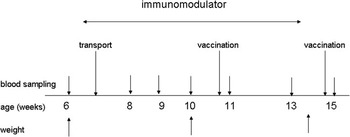
Blood samples were drawn in a fixed subpopulation of 30 animals by experimental group at 6, 8, 9, 10, 11, 13 and 15 weeks of age throughout the trial in tubes without anticoagulant. Moreover, sample collection at 8 weeks of age was carried out 24 h after transportation and sample collection at 11 and 15 weeks of age was performed 24 h after Aujeszky MLV. A schematic diagram of the experiment is shown in Figure 1.
Experimental design of blood sampling, immunomodulator supplementation, and Aujeszky modified live vaccine vaccination.

The experiment received prior approval from the Local Ethical Committee for Animal Experimentation of the Institution. The treatment, housing, husbandry and slaughtering conditions conformed to the European Union Guidelines (Council Directive 91/630/EEC).
Determination of APPs and ILs
Serum was collected by centrifugation and frozen at −20°C until assay. Haptoglobin was quantified by using a spectrophotometric method (hemoglobin binding assay) with commercial reagent from Tridelta Development Limited (Bray, Ireland) and performed on an automated analyzer (Olympus AU400, Hamburg, Germany). Pig-MAP levels were assessed with an ELISA kit (PigCHAMP ProEuropa, Segovia, Spain). Calibrators for both assays were supplied by the reagent manufacturer. The intra-assay and inter-assay coefficient of variations were determined by measuring haptoglobin and Pig-MAP concentrations on high (1.35 mg/ml for haptoglobin and 1.61 mg/ml for Pig-MAP) and low concentration (0.31 mg/ml for haptoglobin and 0.46 mg/ml for Pig-MAP) serum samples according to the Guideline EP15-A2 (User Verification of performance for Precision and Trueness) of Clinical and Laboratory Standards Institute (CLSI, 2005). Results were the following for high and low concentration serum: haptoglobin (intra-assay: 0.8% and 3.2%; inter-assay: 6.6% and 13.8%) and Pig-MAP (intra-assay: 8.2% and 11%; inter-assay: 12% and 25%). Results of haptoglobin were consistent with the manufacturer’s claim and results of Pig-MAP precision study were similar to those described by other authors (Tecles et al., Reference Tecles, Fuentes, Martinez Subiela, Parra, Munoz and Ceron2007). Detection limits were 0.05 mg/ml for haptoglobin and 0.0002 mg/ml for Pig-MAP as indicated by the manufacturer.
IL-6 and IL-1β were determined using an ELISA kit specific for porcine samples (Quantikine R&D Systems, MN, USA). Detection limit was 10 pg/ml for both cytokines.
Enzootic diseases diagnosis
In order to describe the infection dynamics of PRRSV, swine influenza virus (SIV) and Mycoplasma hyopneumoniae (Mhyo), antibodies to Mhyo, SIV and PRRSV were determined using HerdChek® Mhyo (Idexx Laboratories, Westbrook, ME, USA) antibody test, CIVTEST Suis Influenza (Hipra Laboratories, Amer, Girona, Spain) and HerdChek® Porcine Reproductive and Respiratory Syndrome (Idexx Laboratories) antibody test ELISA kits, respectively, following manufacturer’s instructions in both subpopulations selected for blood sampling times (30 animals in each experimental group) at 6, 8, 9, 10 and 15 week-old pigs.
Data analyses
Average daily gain (ADG) and feed conversion ratio (FCR) was calculated as follows:
ADG: It was calculated at 10 and 14 weeks of age as the difference between each individual final weight (10 and 14 weeks of age) and each individual initial weight (6 weeks of age) divided by 28 or 56, respectively.
FCR: It was calculated at 10 and 14 weeks of age as the feed consumption (pen level) during the study period (6 to 10 or 6 to 14 weeks of age)/(final weight − initial weight of all pigs belonging to each pen at the study period).
A non-parametric test (Mann–Whitney) was used to compare the concentrations of serum APPs between immunodulator-treated and control group at each sampling time. Thereafter, a similar statistical analysis was carried out between APPs serum concentrations observed at 10, 11, 13 and 15 weeks of age taking into account Aujeszky MLV as classification factor each sampling time. On the other hand, data on productive performance (ADG and FCR) were subjected to one-way ANOVA with immunodulator treatment as the classification factor, using the program NCLLS (Kaysville, UT, USA). To carry out the statistical analysis, pen was used as the experimental unit for feed efficiency and pig was used as the experimental unit for APPs and ADG. The α level used for determination of significance for all analyses was P < 0.05, with statistical tendencies reported when P < 0.10.
Results
Clinical examination and enzootic disease diagnosis
None of the groups had any relevant clinical sign at any time point during IM oral treatment or during the vaccination period. Treatment with IM did not cause any adverse reaction during the entire experiment period.
Serum antibodies against PRRSV, Mhyo and SIV were observed at the beginning of the trial (6 weeks of age) in 21 (35%), 30 (50%) and 48 (80%) out of 60 animals of the subpopulation selected for blood sampling, respectively, which were attributable to colostral antibodies (Kothalawala et al., Reference Kothalawala, Toussaint and Gruys2006; Fano et al., Reference Fano, Pijoan and Dee2007; Sibila et al., Reference Sibila, Pieters, Molitor, Maes, Haesebrouck and Segales2009). This percentage of positive animals, determined by serum antibodies, decreased progressively for Mhyo and SIV until all animals were serologically negative for these pathogens at 15 weeks of age. However, a sudden increase in the percentage of positive animals to PRRS virus was observed between 8 (35% positive animals) and 9 weeks (77% positive animals) of age indicating that this virus recirculated during this period of time in the pig population although clinical symptoms were absent. The recirculation pattern was similar between immunomodulator treated and control groups (not shown).
Productive performance
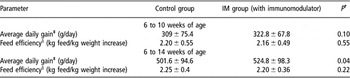
Data on growth performance are shown in Tables 1 and 2. At the beginning of the experiment (6 weeks of age), control and immunomodulator groups showed similar initial body weights (BWs) (basal homogeneity). However, total BW was progressively different between both groups throughout the experiment (Table 1). In fact, mean BW in the immunomodulator treated group was higher (1.43 kg) than the control group at 14 weeks of age, showing a tendency towards significance (P = 0.07). ADG in the immunodulator-treated group was 13.8 g/day higher than the control group during the period 6 to 10 weeks of age (322.8 v. 309 g/day, P = 0.10) and 23.2 g/day higher than the control group during the period 6 to 14 weeks (524.8 v. 501.6, P = 0.04). On the other hand, feed efficiency was always better in the immunomodulator treated group (lower numerical values) throughout the trial (Table 2) although significant differences were not observed (P > 0.05).
Total body weight of the pigs fed with control or IM supplemented diets

IM = immunomodulator.
†Variables were compared using one-way ANOVA.
Growth performance of the pigs fed with control or IM supplemented diets

IM = immunomodulator.
Results are expressed as arithmetic mean ± s.d.
†Variables compared using one-way ANOVA.
‡Average daily gain (ADG) = (body weight of each pig at week 10 or 14−initial weight of each pig at the beginning of the trial)/length of the study period (28 or 56 days, respectively).
§Feed efficiency at pen level = feed consumption during the study period (pen level) at week 10 or 14/(final weight of all pigs belonging to each pen at the study period−initial weight of all pigs belonging to each pen at the study period).
APPs and IL determinations
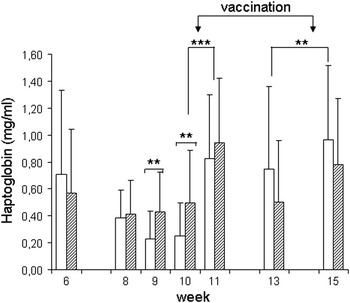
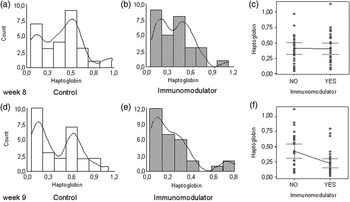
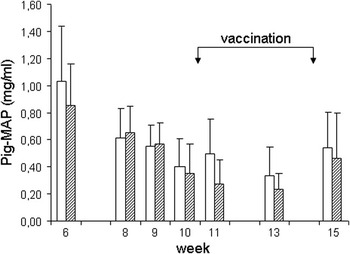
Given the differences in productive performance observed in both groups, APP concentrations were studied to assess whether or not there was a correlation between both parameters. Hp and Pig-MAP serum concentrations along the study are shown in Figures 2 and 4. At the beginning of the trial (6 weeks of age), control and immunomodulator treated groups showed similar Hp and Pig-MAP serum concentration profiles (basal homogeneity). Three weeks after immunomodulator treatment (week 9), Hp serum concentrations were significantly lower in pigs treated with this product compared to control pigs (P < 0.01). This observation was confirmed in two consecutive sampling points (9 and 10 weeks of age) (Figure 2). Hp serum concentration showed a bimodal distribution at week 8 in both control and immunomodulator treated groups (Figure 3a and b). However, at week 9, the control group showed a bimodal distribution of Hp values whereas the immunomodulator treated group showed a skewed distribution towards low Hp values (Figure 3d and e). A similar pattern was observed at week 10 (not shown). Figure 3c and f clearly showed that Hp means in control and immunomodulator treated groups were similar at week 8, but clearly different at week 9.
Haptoglobin concentration in the serum of pigs from 6 to 15 weeks of age in groups treated with (open bars) or not with the immunomodulator (dashed bars). **P < 0.01, ***P < 0.001.

Distribution of haptoglobin concentration in the serum of all studied pigs in groups treated with or not with the immunomodulator at 8 and 9 weeks of age. (a) and (b) control and immunomodulator treated groups at week 8; (d) and (e) control and immunomodulator treated groups at week 9; (c) and (f) bar chart for comparison of control and immunomodulator-treated animals.

Pig-major acute phase protein (Pig-MAP) concentration in the serum of pigs from 6 to 15 weeks of age in groups treated with (open bars) or not with the immunomodulator (dashed bars).

At 11 weeks of age (24 h after receiving an Aujeszky MLV), Hp serum concentrations significantly increased compared with the previous sampling time (P < 0.001). Afterwards, this value decreased in the following sampling time (2 weeks later) reaching the pre-vaccination values (Figure 2). A similar haptoglobin response was observed after the second Aujeszky MLV (15 weeks of age). The Hp response to vaccination was similar in both control an immunomodulator treated pigs.
In contrast, no significant differences (P > 0.05) were observed in Pig-MAP serum concentrations between immunomodulator treated and non-treated pigs or Aujeszky MLV vaccinated or non-vaccinated animals throughout the trial (Figure 4).
IL-6 and IL-1β serum concentrations were below the quantification limit of the technique in most of the individuals (data not shown).
Discussion
To test the assumption that APP measurement may be an indicator of productive performance in porcine farms, we have used an immunomodulator which is able to improve the production parameters and mortality in commercial conditions (Fraile et al., Reference Fraile, Crisci, Weenberg, Armadans, Mendoza, Ruiz, Bernaus and Montoya2009b) for assessing whether it was also able to lower APP levels in apparently healthy pigs. Our results indicated that this was indeed the case since lower haptoglobin levels together with improved production parameters were observed in immunomodulator treated animals. These findings suggested that the immunomodulator may actually enhance the immune status in the animals, in agreement with former results of our group (Fraile et al., Reference Fraile, Crisci, Weenberg, Armadans, Mendoza, Ruiz, Bernaus and Montoya2009b). The higher values of serum haptoglobin in control animals would probably be a consequence of APPs being released by the liver as a result of the acute phase response to subclinical infection, which would cause an infection-induced reduction in productivity. These results are in agreement with published data indicating a relationship between haptoglobin serum levels and productive performance in pigs younger than 13 weeks old (Eurell et al., Reference Eurell, Bane, Hall and Schaeffer1992; Grellner et al., Reference Grellner, Fangman, Carroll and Wiedmeyer2002) and also during the critical phase of post-weaning growth and adult pigs (Clapperton et al., Reference Clapperton, Bishop and Glass2005; Pineiro et al., Reference Pineiro, Pineiro, Morales, Carpintero, Campbell, Eckersall, Toussaint, Alava and Lampreave2007a). Moreover, haptoglobin was also found to be negatively correlated to growth rate in pigs fed a diet supplemented with β-glucans as growth promoter (Hiss and Sauerwein, Reference Hiss and Sauerwein2003). In contrast, the present results showed that Pig-MAP serum levels were not significantly altered during immunomodulator administration.
The APP response itself may contribute to the differences in growth performance between control and immunomodulator treated pigs, since it has been suggested that, in diseased animals or even after vaccination, aminoacids may be diverted from muscle protein synthesis to APPs synthesis (Gruys et al., Reference Gruys, Toussaint, Upragarin, Van, Adewuyi, Candiani, Nguyen and Sabeckiene2005). Noticeably, if the concentration of APP is diminished in immunomodulator treated pigs, a higher amount of aminoacids could be available for muscle protein synthesis providing a partial explanation for better production parameters observed in the immunomodulator treated group.
On the other hand, Aujeszky MLV as well as revaccination did cause a significant increment in haptoglobin serum concentration but it did not seem to affect Pig-MAP. This result agrees with those obtained in pigs clinically affected after experimental infection with Aujeszky virus and Aujeszky field cases, where a more sensitive response of haptoglobin changes is observed compared to Pig-MAP (Parra et al., Reference Parra, Fuentes, Tecles, Martinez-Subiela, Martinez, Munoz and Ceron2006; Carpintero et al., Reference Carpintero, Alonso, Pineiro, Iturralde, Andres, Le Potier, Madec, Alava, Pineiro and Lampreave2007), although, in our case, the magnitude of the increase is lower than the described for these authors. These results are foreseeable because the virulence of a MLV is always lower than the wild virus (Shams, Reference Shams2005).
Finally, it is worth highlighting the different kinetic profile of the haptoglobin and Pig-MAP response to the immunomodulator treatment and to Aujeszky vaccination. Although these results suggest that Pig-MAP may not be a good biomarker for productive performance or response to AD vaccination, it is worth mentioning that Pig-MAP seems to be a better marker than haptoglobin for other conditions, such as transport stress (Pineiro et al., Reference Pineiro, Pineiro, Carpintero, Morales, Campbell, Eckersall, Toussaint and Lampreave2007b) or as a screening tool for enzootic pneumonia or cranio-ventral pulmonary consolidation in slaughter-aged pigs (Saco et al., submitted).
Furthermore, despite the fact that haptoglobin and Pig-MAP seem to correlate in several diseases (Sorensen et al., Reference Sorensen, Tegtmeier, Andresen, Pineiro, Toussaint, Campbell, Lampreave and Heegaard2006; Martin de la Fuente et al., Reference Martin de la Fuente, Carpintero, Rodriguez Ferri, Alava, Lampreave and Gutierrez Martin2008), differences in both proteins have been described in viremic pigs subjected to experimental infections with African Swine Fever and Aujeszky disease (Carpintero et al., Reference Carpintero, Alonso, Pineiro, Iturralde, Andres, Le Potier, Madec, Alava, Pineiro and Lampreave2007), or in PRRS and Aujeszky disease field cases (Parra et al., Reference Parra, Fuentes, Tecles, Martinez-Subiela, Martinez, Munoz and Ceron2006). Our results clearly show that haptoglobin and Pig-MAP also display a different profile in pigs after an Aujeszky MLV or after receiving an immunomodulator that might improve their health status. These data show that some difference should exist in the fine regulation of both proteins, as already proposed (Clapperton et al., Reference Clapperton, Bishop, Pineiro, Campbell and Glass2007). Both APPs have been described as being IL-6-dependent (Marinkovic and Baumann, Reference Marinkovic and Baumann1990; Gonzalez-Ramon et al., Reference Gonzalez-Ramon, Alava, Sarsa, Pineiro, Escartin, Garcia-Gil, Lampreave and Pineiro1995). Unfortunately, serum IL-6 and IL-1β values were not detectable in most of the individuals and it did not give any information about the biochemical regulation of these proteins in pigs. Additional studies are clearly needed to clarify this question.
All together, haptoglobin is shown to be a better biomarker than inflammatory cytokines, since serum IL-6 and IL-1β values were below the quantification limit of the technique in most of the individuals in this study. It has been already reported that quantification of the systemic cytokine response is difficult because of low circulating concentrations, short half-life and the presence of inhibitors and antagonist, whereas the APPs are produced in significant amounts in response to these pro-inflammatory cytokines (Eckersall et al., Reference Eckersall, Gow, McComb, Bradley, Rodgers, Murray and Kennedy2001; Gruys et al., Reference Gruys, Toussaint, Upragarin, Van, Adewuyi, Candiani, Nguyen and Sabeckiene2005).
In conclusion, our results show that the use of a feed additive with immunomodulatory properties was able to improve the production parameters and that serum haptoglobin decreases concomitantly. Hence, haptoglobin serum concentration could be considered as a good biomarker to monitor production parameters and for monitoring Aujeszky MLV in animals reared under standard commercial conditions.
Acknowledgements
This work was funded by a research contract of Laboratorios MAYMO with Centre de Recerca en Sanitat Animal (CReSA) and by the following grants: AGL2006-13809-C02-01 and AGL2006-02364/GAN from the Spanish ‘Ministerio de Educacion y Ciencia’. The authors are extremely grateful to Lorenzo Mendoza, (Veterinarian of PICBER SA), Josep Solé and Ramón Ribau for their collaboration to this work.