INTRODUCTION
The Neolithic settlement of Makriyalos is situated near the coast of Pieria in northern Greece (Figure 1). The site was located on the route of the new railway construction and the highway, connecting Thessaloniki to Athens. Geographically it is defined between coordinates 40°24′32.67″N, 22°35′44.09″E (north end) and 40°24′12.57″N, 22°35′47.10″E (south end) and at an elevation of about 45 m above present-day sea level. The present distance from the coastline is 1.3 km, but this will have varied during the Neolithic period. Rivers bringing water and alluvial sediments will have provided an attractive environment for cultivation and stock-breeding. Rescue excavations took place in 1993–1994, while subsidiary research lasted until the end of the decade. The excavation revealed part of an extended flat settlement, a form which has been found to dominate in the area of central Macedonia. Two separate occupation phases, Makriyalos I and II, were clearly distinguished on different sides of a low hill (Pappa and Besios Reference Pappa and Besios1999; Pappa Reference Pappa2008). From the first results of pottery analysis, it was possible to draw a clear chronological distinction between the two phases. Both date to the Late Neolithic, with Makriyalos I (MKI) at the beginning of the period (LNI) and Makriyalos II (MKII) at the end (LNII). Excavation data suggest a strong contrast between communal and individual or domestic scales of activity during both settlement phases (Pappa et al. Reference Pappa, Halstead, Kotsakis, Bogaard, Fraser, Isaakidou, Mainland, Mylona, Skourtopoulou, Triantaphyllou, Tsoraki, Urem-Kotsou, Valamoti, Veropoulidou, Voutsaki and Valamoti2013).
Map of Greece and Europe showing the geographical area and expansion of the inlet with the specific location of Makriyalos in Macedonia, northern Greece.

THE SITE
During the earlier habitation phase MKI, a system of circuit ditches encloses an area of 28 ha. Within this phase clusters of habitation pits are situated in a loose setting (Figure 2). They define what may tentatively be labeled “households”. In contrast to these clusters of presumably “domestic” activity, the circuit ditches Alpha and Beta (Figure 3), an intermediate ditch Gamma and also a few large areas of earth removals, or “borrow-pits”, containing huge assemblages of finds, represent activity on a more collective scale. These ditches and “borrow pits” mark the settlement area. Ditches Alpha and Gamma were both cut and then recut in two distinct phases. In each case, they follow the same line, but their similar histories need not imply that Alpha and Gamma were cut contemporaneously. Ditch Beta follows the route of Alpha and is assumed to be related to the initial cutting or later recutting of the latter. That there is no reliable evidence, from stratigraphy or associated datable artifacts, for the chronological relationship of the three ditches influenced our priorities in sampling for dating.
Layout of the excavation at Makriyalos showing the two main phases of the settlement (MKI and MKII). The routes of Ditch Alpha, Beta and Gamma are marked, as are the extended earth removals or “borrow pits”. The routes of the successive phases (a) and (b) of Ditch Alpha and Gamma are identical. Inside the settlement, the area is formed by clusters of pits. Pit Chi, mentioned in the text, does not appear in the plan being situated further to the northwest.

Profile of Ditch Alpha. Under the two surface layers resulting from erosion of the site, two separate groups of layers divided by a thick line belong to phase Ditch Alpha (a) and Ditch Alpha (b) respectively.

“Borrow pits” were interpreted as the earliest cuttings that initially marked the settlement area. Ditches followed a route marked by “borrow pits”, while “borrow pit” 212 (“borrow pit Pi”) perhaps marked the center of the settlement area. The context from pit 212 stands out at Makriyalos, and indeed in the Neolithic of Greece, for its exceptional wealth of finds of nearly all categories (Pappa et al. Reference Pappa, Halstead, Kotsakis and Urem-Kotsou2004). Pit 212, like also the remaining “borrow pits” and the encircling ditches are public works and as such stress a sense of commonality during phase MKI.
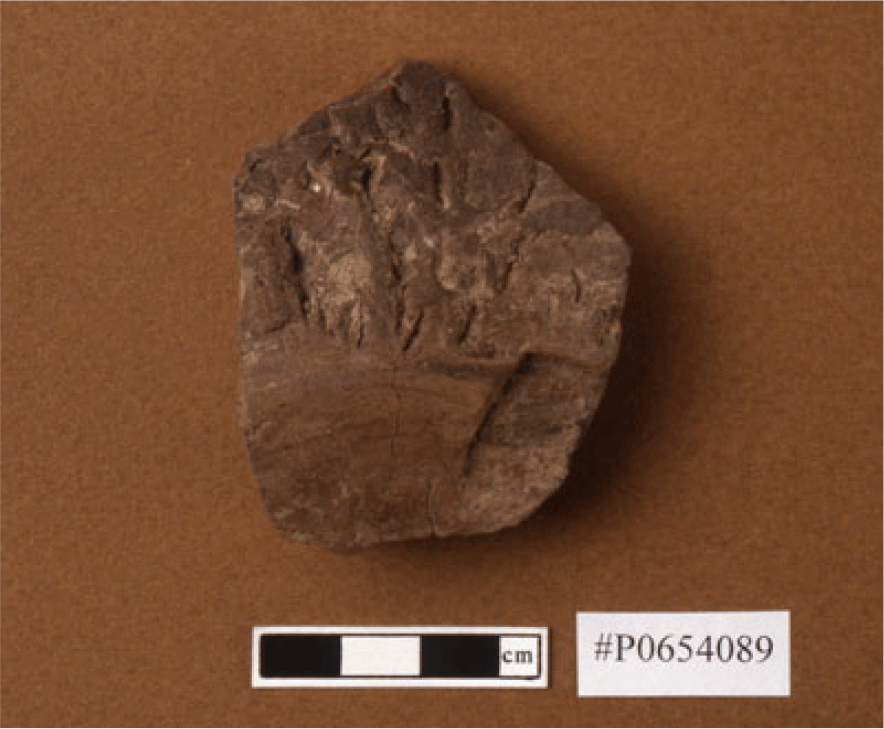
Ditch Gamma, an intermediate ditch might be interpreted as an earlier phase of the settlement enclosure or an internal boundary. Its lowest layers yielded some of the earliest pottery shards found on site, favoring the former interpretation (Pappa Reference Pappa2008). The shards belong either to the Middle Neolithic period, or to the earliest phases of the Late Neolithic period. One of the few shards with impressed decoration, which could be dated to the Middle Neolithic period, was part of this group (Figure 4). The “borrow pits” were also interpreted as belonging to the earliest activity marking the settlement area, although some may have a more extended time use. The phase (a) of Ditch Alpha was created by digging a continuous chain of deep pits. It is distinguished stratigraphically from the following phase (b) of Ditch Alpha, re-dug as a continuous V-shaped trench on the same line. Pits attributed to “domestic” activity might be contemporaneous with any of these three subphases. Characteristic pottery of this phase includes large quantities of black burnished and black-topped pottery, often with white painted or plastic decoration. The bowl with the anthropomorphic figures in place of the four handles (Figure 5) reflects relations to the Balkans (Pappa et al. Reference Pappa, Halstead, Kotsakis and Urem-Kotsou2004).
Makriyalos I, Ditch Gamma, phase (a): shard with impressed decoration dated to the Middle Neolithic period.

Makriyalos I, habitation area: cup with anthropomorphic figures in place of the handles, which dates to the LNI period.

Spatial analysis of the second habitation phase MKII suggests a greater emphasis on the individual or domestic over the collective (Pappa Reference Pappa2008, Reference Pappa, Dietz, Mavridis, Tankosić and Takaoğlu2018). “Borrow pits” were again found, with that in sector Eta distinctive in containing a large amount of pottery and other finds but no enclosure ditches were encountered. Two subphases were distinguished on the basis of the spatial organization of human activity. The main decorated categories of pottery are painted and reflect close relation to Thessalian sites. Large quantities of brown on cream and black on red (Figure 6) pottery dominate in the depositions of certain areas (Hitsiou Reference Hitsiou2017). The first subphase (MKIIa) comprises clusters of small pits packed much more densely than in MKI, belonging to LNII (Andreou et al. Reference Andreou, Fotiadis, Kotsakis and Cullen2001: 260; Gallis Reference Gallis and Papathanasopoulos1996: 28–29). In the second subphase (MKIIb), the pits gave way to above-ground built structures. They were located very close to the surface and as a result, yielded very little associated fill and no samples suitable for dating.
Makriyalos II, “borrow pit” in sector Eta: bowl with characteristic black on red decoration, which reflects close relations to Thessalian sites of the LNII period.

SAMPLES AND METHODS
We selected samples of burnt organic matter (charcoal) and animal and human bones, but not always of good quantity and quality in all trenches. Thirty-nine (39) samples were submitted for radiocarbon (14C) dating. From these 31 were charcoal and 8 animal and human bones. The size of the charcoal samples and the three samples from human skeletons prohibited conventional RC dating and, for this reason, they were submitted to the University of Arizona accelerator mass spectrometry facility (code: AA). The remaining five animal bone samples were submitted for conventional dating to the Laboratory of Archaeometry of NCSR “Demokritos” (code: DEM), which uses the gas proportional counting technique (GPC), to complement the charcoal results and check for any possible strong old-wood effects in the charcoal samples. Details for the protocols for pretreatment and measurement used for the different kind of samples by the two laboratories can be found in Burr and Jull (Reference Burr, Jull, Beauchemin and Matthews2010) for the Arizona AMS facility and in Maniatis et al. (Reference Maniatis, Oberlin, Tsirtsoni and Tsirtsoni2016) for the Laboratory of Archaeometry, NCSR “Demokritos”.
Having already a fairly safe general chronological frame based on pottery analysis, our major concern during sampling was to achieve absolute ages that would determine the main two phases MKI and MKII and their subphases. For that reason, a large number of phase MKI samples has been selected from the three recognized subphases: ditch Alpha (a) and (b), and ditch Gamma subphase (a). Subphase ditch Gamma (b) did not produce any credible samples for dating.
Two samples (AA35014 and DEM-2318), not coming from ditches but from habitation area and “borrow pit” in sector Pi (pit212) respectively, could be contemporaneous with the group of samples belonging to the earliest period (Ditch Gamma, phase a) of MKI and hence were grouped with them. Two more sampling groups were clearly separated, following the earliest group, the first deriving from ditch Alpha subphase (a) and the second from ditch Alpha subphase (b).
Subphase MKIIa produced good samples mainly from habitation areas and “borrow pit” in sector Eta. All samples from subphase MKIIa constitute one chronological group. The lack of context in subphase MKIIb, as mentioned above, did not allow sampling.
In addition, three human bone samples belonging to skeletons buried on the edge of phase MKI area and presumed to belong to a phase MKII cemetery had previously been submitted to the Arizona AMS facility by Dr. Sevi Triantaphyllou during her study of human bones from Makriyalos (Triantaphyllou Reference Triantaphyllou2001: 23). No stratigraphic evidence was available to assure this hypothesis and verification of the chronology was necessary, as organized cemeteries during the Late Neolithic are rare.
Finally, a charcoal sample (AA41902) comes from a pit situated outside the area surrounded by Ditch A and B and could suggest the use of space beyond the limits of the Late Neolithic period.
RESULTS
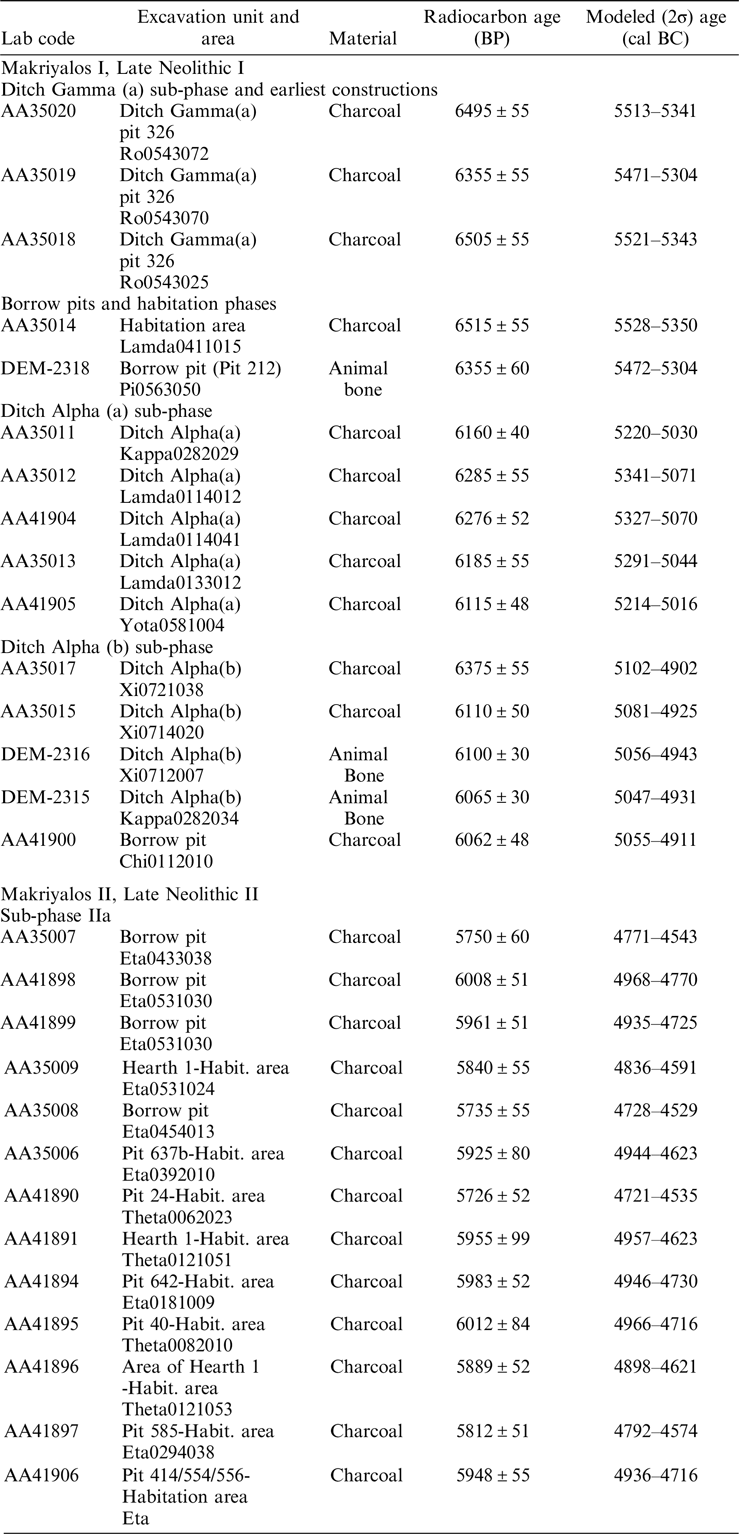
Table 1 lists all the samples treated and dated from Makriyalos according to the main phases and subphases of the settlement. The 14C ages with 1σ deviation are given and are all δ13C corrected for fractionation. The calibrated 2σ age ranges are also given unmodeled, using the calibration program OxCal v.4.3 (Bronk Ramsey Reference Bronk Ramsey2017) in conjunction with the latest dataset IntCal13 (Reimer et al. Reference Reimer, Bard, Bayliss, Beck, Blackwell, Bronk Ramsey, Buck, Cheng, Edwards, Friedrich, Guilderson, Haflidason, Hatté, Heaton, Hogg, Hofmann, Hughen, Kaiser, Kromer, Manning, Niu, Reimer, Richards, Scott, Southon, Staff, Turney and van der Plicht2013).
All Makriyalos samples with their archaeological coordinates, sample weight/mass, radiocarbon ages and unmodeled calibrated dates. The samples are ordered according to radiocarbon age within each major phase. Cells in italic font are samples to be excluded (see text).

*Sample is mostly dirt, about 15–20% charcoal, very small specks of charcoal.
**The date is the mean value of two separate measurements of sample aliquots.
There are several samples that give dates which cannot be accepted. In particular:
Sample AA35016, its age is quite high for the subphase in which it belongs stratigraphically (Ditch Alpha (b)). The sample is mostly soil and contained only small specs of charcoal (Table 1), so most likely was contaminated with old autochthonous carbon from the soil. We have to omit this sample from further discussion.
Sample DEM-2604, an animal bone sample, was partly burnt and produced no collagen, so it could not be dated.
Sample DEM-2317, another animal bone sample, badly weathered, produced a minimal amount of collagen (0.5%). Nevertheless, it was dated but gave an age much younger compared with the rest of the samples in phase LN I and all phases of Makriyalos. Its stratigraphic position is secure, so we have to omit this sample as contaminated.
Sample AA41903, a charcoal sample that contained an extremely small amount of carbon (0.07 mg) gave an erroneous age of 1650 ± 140 BP (Table 1), totally irrelevant to the Neolithic Makriyalos, obviously contaminated. We have to omit this sample also from further consideration.
Sample AA41901, a charcoal sample that also gave a totally irrelevant age of 150 ± 40 BP (Table 1). Its weight and mass of carbon seem OK, so we do not have an explanation for its age. Probably it came from disturbed upper horizons. This sample was omitted also from further consideration too.
Sample AA41892, a charcoal sample that gave an age 8820 ± 68 BP. There is no indication on the site for activity at such an early period. The mass of carbon in the sample was quite small (Table 1) so most probably the sample was contaminated with reworked carbon from the soil. We also omit this sample from any further discussion.
Sample AA41893, a charcoal sample that gave an age of 7330 ± 110 BP. Again, there is no indication on the site for activity as early as that and given the very small amount of carbon in the sample; this must be contaminated from old carbon in the soil too. Therefore, this sample has also to be omitted.
Thus, the above seven samples for different reasons were omitted from further discussion, leaving a series of 32 14C determinations for further consideration.
The calibrated date probability distributions of the 32 screened samples are plotted in Figure 7 using the OxCal v.4.3 program without any modeling. The samples have been plotted according to their RC age order. Only the main phases (MKI, II and the cemetery/later habitation) are marked in this plot. As can be seen from this figure, the overall age distribution indicates a Neolithic habitation on-site spanning from approximately 5500–4500 BC. The site seems continuously occupied through this period, with MKI occupying the second half of the 6th millennium and MKII the first half of the 5th millennium BC.
Probability distribution plot of unmodeled calibrated dates of all the Makriyalos screened samples, listed according to 14C age.

The three skeletons from the cemetery date to the first half of the 3rd millennium BC, thus clearly placing the cemetery chronologically in the Early Bronze Age and rejecting the hypothesis that it might be synchronous to the MKII phase. The same applies to sample AA41902 from beyond the limits of the ditches, which dates to the second half of the 3rd millennium, also within the Early Bronze Age (Maniatis Reference Maniatis, Stefani, Merousis and Dimoula2014; Arvaniti and Maniatis Reference Arvaniti and Maniatis2018).
Leaving aside the Early Bronze Age cemetery and late habitation dates, we concentrate on the Neolithic period dates, and we model the dates with Bayesian analysis (Bronk Ramsey Reference Bronk Ramsey2009a) taking into account the main phases and subphases recognized archaeologically and stratigraphically as discussed above. Thus, we grouped the samples as follows:
-
1. The first group of samples comes from Ditch Gamma (a) and “borrow pit” Pi (pit 212), which, as discussed above, are assumed to represent the earliest phase of the settlement. The consecutive subphase Gamma (b) did not produce any suitable samples for dating.
-
2. The second group of samples comes from the earliest phase (a) of Ditch Alpha.
-
3. The third group of samples derives from the layers of Ditch Alpha (b) phase, following just above the phase Alpha (a) (Figure 3). The sample AA41900 is derived from borrow pit Chi. The borrow pits are generally considered to belong to the earliest phase of the settlement, however the context in this area is not analyzed in detail, and hence the 14C age of this sample may indicate that some of these large “borrow pits” have a continuous use until even the end of the LNI phase of Makriyalos. Thus, and until further analysis we have grouped this sample together with the samples of the last phase of LNI.
-
4. The fourth group of samples, all belonging to LNII, comprises those from features attributed to MKIIa. The lack of context in subphase MKIIb did not allow sampling, as also discussed above.
The above four phases were used for modeling of the dates. The samples included in each phase are presented in Table 2. The resulting modeled dates for each individual sample are also given. This treatment was performed in order to get better-defined dates for the start and end of the two main phases and subphases, and test the hypothesized sequence of use of the various ditches, the “borrow pits” and the habitation areas.
The groups of samples used for the four-phase modeling. Last column are the modeled individual ages resulting from the treatment.

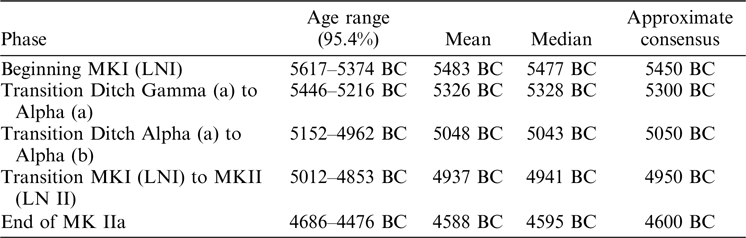
Initially, the model was run using a general outlier model [Outlier_Model(“General”,T(5),U(0,4), “t”);] and also a charcoal outlier model [Outlier_Model(“Charcoal”,Exp(1,-10,0),U(0,3), “t”);] for the charcoal samples (Bronk Ramsey Reference Bronk Ramsey2009b). All samples were given a prior outlier probability of 0.05 (5%). With both models, the posterior probability for the samples to be outliers in the phase assigned each was practically negligible (2%) for all samples except sample AA35017, whose probability of being an outlier was 85%. The 14C age of this outlier sample is almost 300 years older than the rest of the samples in this latest subphase Ditch Alpha (b) of MKI main phase in which it was assigned. Its position in the excavation in Ditch Alpha (b) phase is secure. The shift in age is far too much to consider an old-wood effect, so this sample is either contaminated with reworked carbon from the soil or ended in this phase from a lower one as a result of a disturbance while digging this ditch in antiquity. In either case, we marked this sample as a fixed outlier with a prior of 100% and reran the model without other outliers to get a better convergence for the rest of the samples. The overall convergence of the model was very good with indices Amodel=120.6 and Aoverall=118.3. All samples had an agreement of over 92% to be in the phases to which they were assigned, with just two having 85% and 87% but still quite good. The output of the model is plotted in Figure 8, and the numerical output is presented in Table 3.
Modeled calibrated dates of Makriyalos using a four-phase model according to stratigraphy, keeping the sample AA35017 as fixed outlier (prior = 1).

Summarized results of the Bayesian analysis with the four-phase model.

DISCUSSION
As can be seen from Figure 8 and Table 3, the use of space in the area of the Makriyalos settlement begins at a modeled date of around 5450 BC. This date is slightly earlier than the beginning of LNI observed at other sites in Macedonia, typically around 5400/5300 BC (Andreou et al. Reference Andreou, Fotiadis, Kotsakis and Cullen2001; Kotsakis Reference Kotsakis2014; Maniatis Reference Maniatis, Stefani, Merousis and Dimoula2014; Tsirtsoni Reference Tsirtsoni2016). It is more or less synchronous to the earliest settlements known so far in central and east Macedonia, like the early phases of Sitagroi in the Drama plain which dates just after 5500 BC. Also, the site of Dikili Tash, near ancient Philippi, dates around the same period, perhaps a little later (Kotsakis Reference Kotsakis2014). However, many sites that characterized archaeologically as Late Neolithic period and predominated in the region of C. and E. Macedonia date mostly in 5300–5200 BC and are accompanied by new pottery types, with different technologies and different forms of material culture (Kotsakis Reference Kotsakis and Koliopoulos2007). The site of Paliambela-Kolindros, about 15 km north of Makriyalos, is one of the earliest Early Neolithic settlements in Macedonia (~6550 BC) and continues until the MN and later giving a date around 5500 BC for one of the MN layers (Maniatis et al. Reference Maniatis, Kotsakis, Halsted, Adam-Veleni and Tzanavari2015). Also, close to Makriyalos and about 13 km south is the site of Revenia which is also one of the earliest Early Neolithic sites in the area preceding Makriyalos and spanning approximately 6550–6200 BC (Reference Maniatis and AdaktylouManiatis and Adaktylou in preparation)Footnote 1 .
In Thessaly the LNI period seems to start between 5500–5300 BC (Reingruber et al. Reference Reingruber, Toufexis, Kyparissi-Apostolika, Anetakis, Maniatis and Facorellis2017). The earliest was found at the cave of Theopetra (around 5500 BC) and a bit later, around 5450 and 5400 BC, at the sites of Prodromos and Makrychori, respectively, though these contexts are characterized as transitional MN-LNI (Maniatis et al. Reference Maniatis, Oberlin, Tsirtsoni and Tsirtsoni2016).
The modeled start date of the LN at Makriyalos around 5450 BC can be classified among the earliest in the region but may be also related to layers from slightly older phases such as MN or the transition MN-LNI. The bulk of the ceramics does not represent the earliest phase of LN but may reflect restricted activity during the Middle Neolithic period (a few MN shards were found in Ditch Gamma). They could even be related to a very early Late Neolithic phase that perhaps represents the initial cutting of features, but not their main period of use. Clarification of this point would require a much larger sample of organic materials for dating, which cannot be retrieved due to poor preservation.
The Late Neolithic II period at Makriyalos (MKIIa) begins at around 4950 BC without any traceable break from the preceding LNI period. This date is again earlier than what is observed at other sites in Macedonia, around 4800 BC (Tsirtsoni Reference Tsirtsoni2016), but their context is not always clearly defined. In Thessaly, the evidence for this LNII is also scarce. The site of Mandra gave the earliest date observed so far for this phase at 4900 BC (Reingruber et al. Reference Reingruber, Toufexis, Kyparissi-Apostolika, Anetakis, Maniatis and Facorellis2017).
The MKIIa phase of Makriyalos ends at 4600 BC, though this date does not represent the end of the LNII period, as there also exists a subsequent phase MKIIb on the site, which unfortunately did not provide suitable samples for dating.
Regarding the subphases within the LNI period (MKI), from Table 3, it can be seen that the Ditch Gamma (a) subphase ends at 5300 BC and is followed immediately by Ditch Alpha subphase (a), which ends at 5050 BC, each lasting for about 200 and 300 years, respectively. The subphase Ditch Alpha (b) ends at about 4950 BC, lasting only for about 100 years. It is followed by the LNII period.
Thus, it appears that Ditch Gamma represents the oldest construction phase at Makriyalos and, together with the “borrow pit” (Pit 212) and habitation areas (Table 2), characterizes the earliest human activity on site. Its filling might be related to the establishment of phase MKI and the process of marking the settlement area by digging “borrow pits”. The dating results from Makriyalos I habitation area can only verify that ditches and habitation pits date to the same period, although there may be cases where a “borrow pit” could have a more extended use (e.g. Borrow pit Chi).
The following Ditch Alpha phase (a), beginning at 5300 BC, is coeval with the appearance of LN I at many other sites in Macedonia and Thessaly (Kotsakis Reference Kotsakis and Koliopoulos2007).
A final word regarding the comparison between the dates from bone and charcoal samples: although the number of bones dated is not large enough for a sound statistical comparison, some conclusions may be drawn. Bone sample DEM-2318 fits nicely with the charcoal samples in the subphase Ditch Gamma (a). Also, the bone samples DEM-2315 and 2316 match perfectly with the charcoal samples AA35015 and AA41900 in the subphase Ditch Alpha (b). Hence, it seems there is no obvious or considerable old-wood effect with the charcoal samples that might be shifting the 14C dates and influencing the overall results. The outlier AA35017 exhibits far too large a shift to be attributed to old-wood effect as discussed earlier.
CONCLUSIONS
A series of radiocarbon dates were obtained and presented for the site of Makriyalos in Pieria, northern Greece. The samples selected were representative of the phases and subphases recognized in the excavation. The main phases in the occupation of the site are Makriyalos I and Makriyalos II and correspond to the LNI and LNII periods. The modeled beginning of human activity at the site was determined at about 5450 BC, which is synchronous or slightly earlier than the earliest appearance of the LNI in some other sites in Macedonia and Thessaly. A date of 4950 BC was determined for the appearance of the next phase (LNII) at Makriyalos which is earlier compared to other sites in Macedonia, but perhaps synchronous to some sites in Thessaly.
The early appearance of the beginning of the LNI at Makriyialos, even if this date reflects some restricted activity late in the MN period, may be explained by some connection/continuation with the settlements of the Early Neolithic close to Makriyalos. A revision of the already known chronologies would require a considerably larger group of safe samples and 14C dates from the whole area which may be a future project.
We also investigated some distinct features of the site, the circular ditches and large “borrow pits” chronologically. The 14C dates determined the time sequence in constructing these features and verified the archaeological assumptions. Ditch Gamma was the earliest feature to be cut along with major “borrow pits”. According to their archaeological associations, these early structures belong to the LNI, as already defined in the literature. Nevertheless, activity in the area of the settlement might have started a bit earlier. The dating of Ditch Alpha (a) at 5300 and Ditch Alpha (b) at 5050 BC is in both cases in accordance to the settlement interpretation model and the finds.
A cemetery unearthed in the area of the settlement was initially related to MKII (LNII) phase; however, its 14C dating showed that it was an Early Bronze Age cemetery dating in the beginning of the 3rd millennium. There was also limited evidence of habitation activity during the EBA.
ACKNOWLEDGMENTS
INSTAP funded the study of the Makriyalos Project, as also the charcoal samples submitted for radiocarbon dating to the Arizona Accelerator Mass Spectrometry Facility. M. Besios, co-excavator of the site, was a close collaborator in all aspects. Professor Emeritus K. Kotsakis was not only responsible for the ceramic study group of Makriyalos, but also a close discussant during the whole publication process of the Makriyalos Project, including the present paper. We would also want to thank Professor Paul Halstead for the detailed and generous review of the paper and also the second anonymous reviewer. They both contributed in completing and improving our work. We also like to thank Richard J. Cruz, research technician, Dr. George Burr and Professor Timothy Jull of the Arizona AMS facility, for measuring and providing information for the samples.