Port-cities, as gateways, commercial hubs, points of demographic attraction and connecting links between national and transnational areas, greatly contributed to the urban development of Europe during the modern period.Footnote 1 Similarly, on other continents most of the major urban agglomerations during the nineteenth century were port-cities, such as New York, San Francisco, Buenos Aires, Valparaiso, Shanghai, Singapore, Melbourne, Yokohama and Dubai. In nineteenth-century Greece too, the first three major poles of urban development were also port-cities: Patras, Piraeus and Hermoupolis, the capital of the island of Syros in the Cyclades.Footnote 2 All three differed in their primary function: Patras was an export-base port for Peloponnesian currants, the staple export of Greece in the nineteenth century; Piraeus was to become the main import-based, shipping and industrial port of the country – and is still one of the major seaports worldwide;Footnote 3 and Hermoupolis, the only insular port among them, served, in the period before Piraeus established its dominance, as the major trading, maritime and shipbuilding centre of the Aegean and the eastern Mediterranean catering for a transnational clientele. A port with a thoroughly international and cosmopolitan character, largely dependent on developments in international seaborne trade and foreign markets, Hermoupolis was largely differentiated from the economy of the small, emerging nation-state that Greece was at that time.Footnote 4
Given its major role as an international transit trade centre in the first half of the nineteenth century and its geomorphological specificity as a seaport located on a small island, Hermoupolis provides a rare and interesting field of observation of the processes of transition from merchant to industrial capitalism and their impact on the physical and socio-economic landscape of the city. In the case under study, the above mentioned transition is related to the impressive advance and subsequent decline of wooden shipbuilding, which dominated the economy of Hermoupolis as well that of the entire Greek secondary sector up to the 1860s. From then, it faced a gradual, but irreversible decline, along with the rest of the sailing ship economy and the interconnected function of Hermoupolis as a transit trade centre. However, the loss of eminence of Syros as a centre of transit trade after the Crimean War did not result in an overall decline of shipping or of the port economy. Instead, it led to a transition to new types of economic activity such as the spreading of factories and the growth of steamship navigation. The aim of this article is to analyse this transition and the antagonism aroused over the use of space between declining activities like shipbuilding and ship repairing and the newer ones represented by the factories involving local groups of interests, the civic authorities and the local press. In fact, the port of Syros, thanks to the long-established knowhow of its entrepreneurial class and a large pool of wage-dependent labour, shifted quite successfully to modern forms of shipping and secondary production, remaining an important maritime and industrial centre almost until World War II. This phenomenon also led to a metamorphosis of the landscape that is still evident today, as Syros is the only island in Cyclades with such an extended urban area, considerable population and an industrial district (half-reused, half-abandoned), in sharp contrast to the rural landscape of the rest of the islands.
The analysis will be divided into three parts: first I will try to define the role, function and characteristics of Syros’ port-city and integrate it into the wider discussion on port-cities, especially the questions concerning typology, hierarchy and hinterland in relation to its distinct insularity. I will then present the economic importance of Syros’ shipbuilding industry on a local, regional, national and international level; finally, I will turn to the core theme of changes in the economic landscape of Hermoupolis from the 1860s onwards and the conflicts and antagonism aroused over the use and exploitation of space during the transfer of shipbuilding and ship repairing yards from their older site to new areas of Syros’ harbour.
A Mediterranean insular port-city
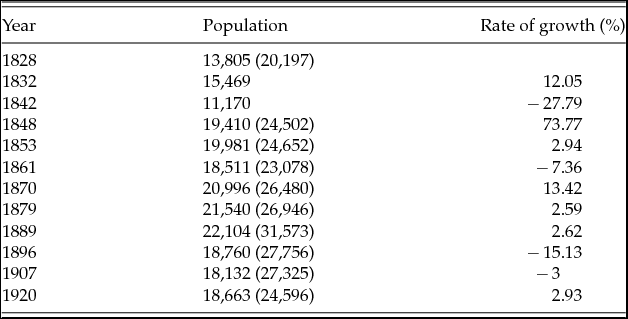
Insular port-cities occupy a very marginal position in the literature on the history of ports. Most of the case-studies concern continental ports, which admittedly had a much larger impact on the development of maritime trade and commerce and its related industries.Footnote 5 But even among insular port-cities, a distinction between smaller and larger insular configurations is necessary, for example between Hermoupolis located on a small island (84 km2) and the Japanese or Caribbean insular ports.Footnote 6 Ports on small islands would usually fall into the category of unimportant ports, as Gordon Jackson defined their role and function in port systems, but this is not the case with Hermoupolis, which, despite being located on a small island of Cyclades, became an important commercial, maritime and industrial port of the eastern Mediterranean.Footnote 7 Insularity for port-cities, especially in small islands, is considered an intrinsic weakness and proved ‘fatal’ in these ports’ competition with continental ports, as seen in the relationship between Syros and Piraeus in the second half of the nineteenth century. For Emile Kolodny, Hermoupolis continued the ephemeral growth of ‘emporia insulaires’ developed since the end of the eighteenth century, examples of which include Hydra, Spetses and Psara, and represented the ‘the last transitional stage from the deposit port-cities to the great continental ports’.Footnote 8 This handicap was linked to the lack of a hinterland. The hinterland of Hermoupolis should however be located not on its limited insular surface-area, but throughout the continental coasts and islands on both sides of the Aegean. Ports and maritime communities in these areas functioned as pools of human and material resources in constant communication, engendering a continuous interchange of people, commodities and ideas, thus sustaining the dense population which based its prosperity on the economic growth of Hermoupolis.Footnote 9 During the greater part of the nineteenth and the first decades of the twentieth century, Hermoupolis offered employment opportunities in trading activities, port jobs, handicraft and (after 1860) in factories and thus attracted large numbers of migrants from the surrounding islands and beyond.Footnote 10
The population of Hermoupolis and Syros (in parenthesis), 1828–1920

Source: For the years 1832, 1842, 1853, K. Komis, Ιστορική δημογραφία του Νεοελληνικού χώρου, 19ος αιώνας (Historic Demography of the Neohellenic Area. Sources, Nineteenth Century) (Ioannina, 2002), 95. For the rest, Kolodny, Îles et populations en méditerranée, 179.
Hermoupolis was also the first urban area of modern Greece. At a regional level, it was and still remains the capital of the Cyclades, providing an administrative and economic centre, having developed essential urban institutions: markets (covered public meat and grocery markets founded in 1846 and 1866 respectively), a hospital (founded 1825), a court of justice, a custom house (1834), trade warehouses, a quarantine, a public slaughterhouse, schools, orphanages, a gentlemen's club, a theatre (the Apollo founded in 1860) and also several local newspapers, most of which predate comparable papers in other areas of Greece. As a regional capital and as the only urban centre of the Aegean, it was symbolically, culturally and also in practice able to reproduce and convey standards and archetypes to its permanent or visiting population, through the diffusion of ideas, images, habits and lifestyles.Footnote 11
Hermoupolis emerged as a new city under the anomalous circumstances of the Greek War of Independence (1821–29). Initially, a settlement for refugees from the war, it soon developed a defined urban area and a busy port and maritime centre, comprising all the essential facilities and services for shipping and trade, fully complying with specific models on port studies: a good natural harbour, a large workforce, trade and shipping companies, port-based industries, port facilities and warehouses, financial capabilities, a merchant fleet and entrepreneurial and trade networks.Footnote 12 Adrian Jarvis, attempting a typology of ports, proposed different categories of classification, according to their principal traffic, their forms of ownership or administration, the nature of their trade and their demographic importance. All of these may also be used in the case of Hermoupolis, but its principal function was distributive, since it was the largest centre of the transit trade in the eastern Mediterranean.Footnote 13 The transit warehouses built in 1834–39, by German engineers in the service of the Greek state, are among the very first economic institutions in the city and definitely the most important, associated with the city's economic heyday and its main raison d’être as a port.Footnote 14 In the absence of serious competition from other large Aegean ports such as Izmir, where ‘even as late as 1854, the city had no transit trade infrastructure’, Syros constituted an effective commercial and maritime crossroads on the axes of the routes between the Black Sea, the eastern and the western Mediterranean.Footnote 15 Its main role as a commercial entrepôt was typical of many other Mediterranean and trans-Mediterranean ports during that same period, and this special function made it an indispensable partner in the long chain of port-cities, serving the growing demand for foodstuff and raw materials for an increasing urban population, and also for the developing industries of western Europe. Thus, its prosperity largely depended on the harvests and exports of cereals from the Black Sea and the commensurate demand for cereals, other agricultural products and raw materials in the markets of western Europe. Syros’ main direct partners were the ports of Odessa, Taganrog, Constantinople, Alexandria, Trieste, Leghorn, Marseilles and London, and a key element in this system was the network of long-established Greek enterprises in the above port-cities. The Hermoupolis entrepreneurial class was closely connected with members of these Greek merchant communities, among the most numerous and dynamic groups being the Chiots, who formed what Gelina Harlaftis called the ‘the Chiot Network’, an international business group able to control a large share of the Mediterranean and Black Sea trades.Footnote 16
A maritime and shipbuilding centre
The port of Syros possessed a well-endowed harbour in a perfect geographical location in the middle of the Aegean, and was also a large maritime centre, concentrating diverse industries and services around shipping. In 1855, its port registry accounted for 40.88 per cent of the total tonnage at a national level, followed by Spetses with 10.49 per cent. Although Piraeus had already surpassed it in economic importance in 1890, Syros managed to retain its pre-eminence among merchant fleets with 35.2 per cent, followed by Piraeus with 12 per cent.Footnote 17 Other port services and facilities provided included marine insurance companies, a market for second-hand vessels, a maritime loan market, a charter and maritime intelligence centre and a depot for ship supplies, victualling and naval stores. Last but not least, Syros served as a nodal point of steam navigation routes. In addition, the shipbuilding and repairing zone (discussed in detail below) constituted a full shipbuilding centre providing every type of service or material required for the construction or repair of a sailing ship.Footnote 18 The spatial distribution of economic activities in the port area was divided between the eastern ‘commercial’ side of the port, occupied by the custom house, the transit warehouses, a sanitary office and coffee-houses, and the western ‘industrial’ side of the port, occupied by the ship repair zone at its northern end and the shipbuilding zone at its southern end. The concentration and interaction of all these related businesses in the port area of Hermoupolis had strong agglomerative effects contributing to the reduction in transaction cost through easier and cheaper access to capital, labour, raw materials, information spillover and increasing returns obtained through pecuniary, productivity and innovation externalities.Footnote 19 Thanks to the effects of agglomeration economies, the port of Syros was a privileged meeting point for all kinds of transactions related to shipping and trade. Notarial sources are eloquent about the different occupational status, ethnic origin and provenance of people who circulated and conducted business in every part of the town's market, coffee-houses, commercial shops, offices, working yards, etc.
Capital, labour, technical knowhow and a fast-growing merchant fleet were the key factors for the development of a thriving shipbuilding industry. Hermoupolis, as the first urban area of Greece, concentrated a large proletarian population and among them many experienced shipwrights and craftsmen. These came mostly from Chios, a long-established maritime crossroads on the commercial routes of the Ottoman empire.Footnote 20 The local merchant and shipowning class, as well as many others from the rest of maritime Greece, the Ottoman empire, the Black Sea ports and the rest of the Mediterranean, ensured steady demand and financed the construction of hundreds of sailing ships. Furthermore, shipbuilding activity generated serious linkages to the local economy with the creation of support industries such as blacksmithery, rope making and pulley making. Depots of imported maritime stores included timber, which mobilized groups of specialized lumberjacks, intermediaries and coastal transporters from the wider area of the Aegean.Footnote 21
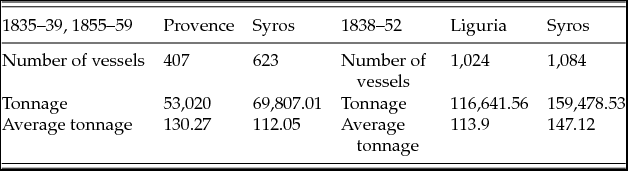
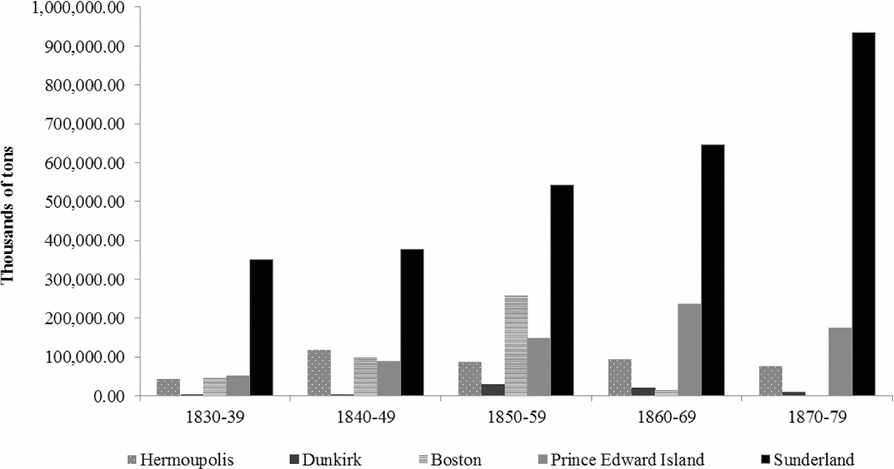
Between 1828 and 1880, the Syros shipyards built 3,178 sailing vessels totalling 429,301 tons.Footnote 22 In the period 1843–58, its shipbuilding output accounted for 52.54 per cent of the national total in terms of tonnage, followed by Spetses (17.34 per cent) and Galaxidi (7.03 per cent), and it also dominated in terms of average tonnage with 147.76 tons, followed by Galaxidi (111 tons) and Spetses (68.95 tons).Footnote 23 The estimated contribution of the Syros shipbuilding industry to the secondary sector of national GDP in the period 1838–66 approached one third (31.55 per cent), whereas its contribution to total GDP was 1.02 per cent.Footnote 24 As seen in Table 2, Syros was also among the significant shipyards of the middle of the nineteenth century. It can be compared with areas with a developed and deeply rooted tradition in shipbuilding such as Provence and Liguria, their main ports of Marseilles and Genoa being among the biggest in the Mediterranean. At a global level, Syros was a medium-scale shipyard, able to compete in terms of tonnage only with some, like Dunkirk, Boston and Prince Edward Island in the 1840s and 1850s, but afterwards steadily losing ground to ports such as Prince Edward Island, whereas Sunderland was consistently ahead (Figure 1).
Mediterranean shipyards in comparison

Source: A. Delis, ‘Mediterranean wooden shipbuilding in the nineteenth century: production, productivity and ship types in comparative perspective’, Cahiers de la méditerranée, 84 (2012), 93–4.
Global shipbuilding output (in tons) in comparison, 1830–79. Source: Delis, ‘Ερμούπολη (Σύρος)’, 100.
However, from the 1860s wooden shipbuilding began to decline and became progressively marginalized. During this period, two crucial and interrelated phenomena took place that changed the way Syros’ economy was regarded and affected sailing ship and wooden shipbuilding. The first and most important was the loss of its position as a centre of transit trade due to structural transformations that occurred in the international economy in the second half of the nineteenth century. Technological improvements in transport systems and communication (steamships, railways and telegraphs) and changes in the organizational patterns of trade and business no longer required the deposit and intermediation services which the port of Syros and its entrepreneurial class continued to provide for almost 40 years.Footnote 25 A report discussing this transformation was made by the British consul at Leghorn (a particularly important deposit for the trade in Black Sea cereals) in 1883:
In 1834 this place [Leghorn] was one of the main centres of transit trade in Mediterranean. . .But it was impossible to maintain this position after the rapid developments in land and sea transports. . .today these advantages (the cereals warehouses for transit) are no longer useful, for the cargoes of cereals are transported directly from the Black Sea to London in British steamers.
Substitute Hermoupolis for Leghorn and the same picture applies.Footnote 26 This decline is confirmed quantitatively from the duties collected by the Custom District of Syros on transit. In 1869, these accounted for the 54.87 per cent of the national total, whereas five years later this figure had been reduced to 37.82 per cent. In absolute numbers, the monetary value of duties collected on transit between 1869 and 1874 had been reduced by 37.69 per cent.Footnote 27
The second phenomenon that changed the perspective for Syros’ economy was the spreading of the factories, which had begun in the 1860s and continued with some fluctuations up until World War II.Footnote 28 This shift is also seen as a gradual integration of Syros into the national economy after the loss of its interregional and international market orientation and dependence. However, the first industries were linked to previously developed port activities related to international commerce, either the long-established tanneries focused on exports or the new steam-powered flour mills, which have been interpreted as an attempt to support the declining role of the port in the deposit of cereals by transforming it into a centre for the export of flour.Footnote 29 In 1871, four steam flour mills employing 220 workers and three steam-powered tanneries employing 600 workers, along with a glass manufactory employing 55 workers, are reported. The cotton-spinning factory Omonoia employing 60 men and women was founded in 1870, though it closed down seven years later and was re-opened under different ownership in 1887.Footnote 30 Another port-based industry was the arsenal of the Hellenic Steam Navigation Company founded in 1861. It mainly focused on the repair of steamships, both those owned by the company as well as those owned by other Greek and foreign shipowners and companies. The factory also diversified into the manufacturing of boilers, steam engines, oil presses and a number of weapon components during the Cretan Revolution (1866–69), but very few small steamships or tugs were built there during this period and up until the beginning of the twentieth century.Footnote 31 Textiles, developed in the last decades of the nineteenth century, constituted a further important industrial sector for Hermoupolis. In contrast to the previous industries, textiles were strictly connected to the domestic market. By 1904, Hermoupolis had four spinning, three weaving and one textile factory alongside other related manufactures, such as knitting and screen printing, thus having transformed into ‘a small cottonopolis’.Footnote 32 The shift to factories is perhaps even more eloquently told in terms of the occupational structure of its population. In 1853, the percentage of workers engaged in the secondary sector accounted for 18 per cent of the total active population, most of it employed in shipbuilding and tanneries, whereas the tertiary sector had the lion's share with 76 per cent, divided between 33 per cent in trade, banking and insurance services and 30.7 per cent in navigation. In 1870, the secondary sector increased to 39.8 per cent, while the tertiary sector's employment share was reduced to 58.9 per cent of the total.Footnote 33
The decrease of competitiveness of wooden shipbuilding is also revealed through comparison with other local industries. In 1875, the mayor of Hermoupolis reported to the prefect of Cyclades that 1,500 men were employed in wooden shipbuilding and that the value of ships built totalled 3,500,000 drachmas, while the 10 tanneries of the town employed approximately the same number of workers, but the value of their total production of 14,000,000 drachmas was four times greater.Footnote 34 However, despite the decline of wooden shipbuilding, thanks to the rise of the tramp steamer business, Syros remained an important maritime centre up to the twentieth century. The trend towards investing in second-hand tramp steamers from Britain began in the 1880s, and by 1900 their tonnage in the port registry surpassed that of sailing ships, whereas as late as 1923 Syros still maintained one of the largest fleets of cargo steamships in Greece.Footnote 35 These investments were funded by groups of local capitalists, who were also engaged in industries and banking and often were associated with Greek diaspora entrepreneurs as well as those from emerging shipping communities, especially Andros.Footnote 36
Spatial antagonism, landscape metamorphosis and social dynamics
The continuous expansion of the urban area of Hermoupolis during the course of the nineteenth century required the transfer of wooden shipbuilding and ship repairing activities from their initial worksites to new areas further south and along the western coast of Syros bay, the only directions where further development was possible. Despite interconnections, shipbuilding and ship repairing were distinctive working units, historically established in different parts of the port, so their transfer took place separately.
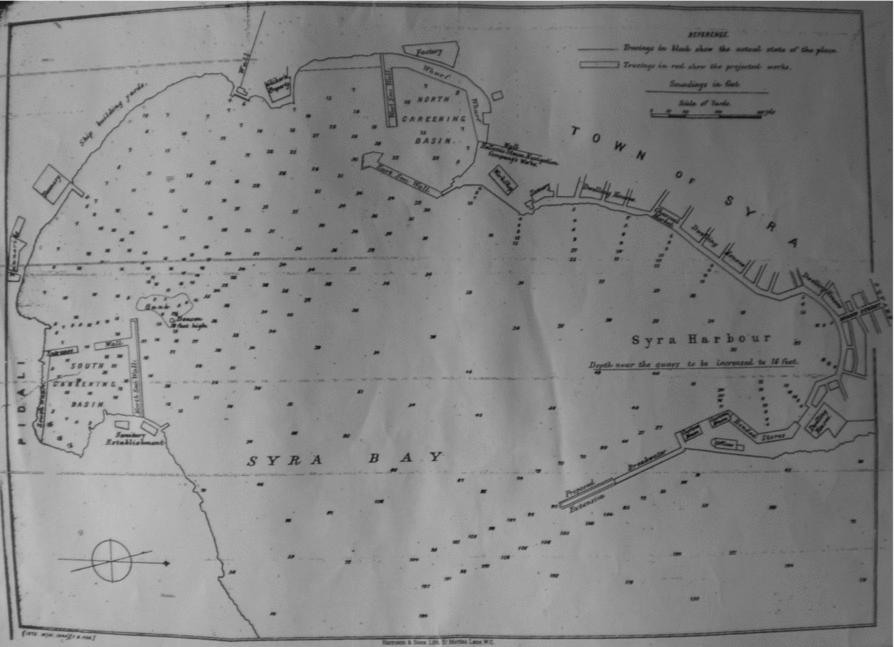
The municipality was already discussing the necessity of transferring the shipbuilding zone in 1861: ‘either because the entire existing shipbuilding area belonged to private properties, or because the town has already expanded to that position [the shipyards area] and necessitates for safety reasons to be transferred outside the urban area’. A committee of shipbuilders, shipowners and merchants was formed in order to suggest a new more appropriate site for the shipyards.Footnote 37 The new area selected was the coast south of the arsenal of the Hellenic Steamship Navigation Company (where its successor, the Neorion Shipyards, still stands). This remained uninterruptedly a wooden shipbuilding zone until the present day (see Figure 2). On 30 September 1866, a Royal Decree approved the foundation of a joint stock company named Company of Hermoupolis Shipyards. This had already been established by 23 July 1866 following a public invitation by the mayor of Hermoupolis to shareholders.Footnote 38 The creation of joint stock companies for the funding of the construction and management of municipal projects was a long-established practice in Hermoupolis. Major civic establishments such as the fish and meat market, the grocery market, the municipal coffee-house, the Apollo Theatre and the gentlemen's club Hellas were constructed in accordance with this business practice. Shareholders received all the revenues from the municipal enterprises until their invested funds were repaid with additional interest, thereafter their shares were transferred to the municipality, which gradually assumed total ownership. The earliest known list of shareholders of the company for the new shipyards is dated 1870 and comprised 23 individuals including six merchants, one captain and shipowner, one timber merchant, one usurer, one lawyer, four who were not further identified, an anonymous shareholder and the widow of a wealthy Chiot master shipbuilder.Footnote 39
Port of Syros. Foreign Office, Annual Series, Report by Consul Binney on the Trade and Commerce of the Cyclades for the Year 1879.
However, the transfer from the old to the new site threw up a number of problems. The coast of the old shipbuilding area which belonged to the state had already in 1863 been divided into four plots and a decision had been made to auction the area. This decision caused serious damage to ongoing shipbuilding activity, as the sale of this land from the state to a private individual in order to raise buildings before the complete transfer to the new site would result in disturbances. The mayor of Hermoupolis addressed the prefecture of Cyclades in 1866 and warned that ‘in ship construction, in Hermoupolis, are employed more than one thousand workers, heads of families; having destroyed the existent shipyard by the erection of buildings, large part of this workforce will end up in a difficult situation of unemployment due to the reduction of works, forcing those who want to build ships to resort to other shipyards’. The mayor also tried to delay the selling of the land until the new site was ready. The only effective solution in the long run proved to be the purchase of these plots by the municipality itself. Up until the end of the 1880s the appropriate use of the area – the municipality's principal aim being the building of warehouses – was to be a constant source of concern.Footnote 40
A second major issue was the dispute between the Company of New Shipyards and tanners and other manufacturers situated nearby. In 1867, the committee of representatives of the company issued a complaint concerning the sewage emitted by the tanneries which ended up in the shipyard area, thus obstructing the works and damaging the materials. They demanded the construction of dikes to stop the flow of used water. The tanners and other manufacturers for their part argued for the construction of a wall that impeded the natural flowing of water wastage to the sea. This, they argued, created stagnant water and infective foci and they demanded modifications with fenders or the opening of waterways through the shipbuilding area. The tanners were represented by a number of major local industrialists such as the Chiots Panayotis Kaloutas and Ioannis Kourkoutakis, who owned factories of 250 workers and 150 workers respectively, along with other important producers such as the Cretan Menelaos Kornilakis and the Chiots Panayotis Glykas and Georgios Lagouros. However, another important tanner, the Cretan Emmanouil Saloustros, also a factory owner of 200 employees, did not become involved in this dispute, perhaps because his factory was located further from the new shipyards area. The Thessalian George Veltsos, who employed 45 workers at a steam flour mill located further from the dispute area, was, however, to become one of the leading figures in this group. The marriage of his son Christodoulos to the sister of Georgios Lagouros, Zinovia, in 1862 may perhaps explain his involvement.Footnote 41 The opponents, however, had the support of numerous representatives of the shipbuilding and maritime trading professions and a strong lobby in the municipal council. Both before and after the elections of March 1870, several shareholders of the New Shipyards Company held elected positions in the municipal council, among them the major shareholder and a very influential magnate Stamatios K. Proios. In this latter council, the other side was represented by George Veltsos and the tanner Emmanouil Saloustros, who, as mentioned, was not involved in the dispute.Footnote 42
Besides, the Company of New Shipyards was a municipal establishment, despite being funded by private individuals, and as a result the tanners and others around them could not find easy support within the town's administrative board. Having addressed their petition to the mayor and the prefect of Cyclades, they finally appealed to the Ministry of Internal Affairs and in November 1870 they obtained a Royal Decree authorizing the opening of two waterways and consequent modifications to the protecting wall within the area of the shipyards. This provoked a strong reaction from the managing committee of the Company of New Shipyards, the mayor himself, the Chiot merchant and banker Dimitrios Vafiadiakis, along with the entire sector of shipbuilders and similar professions. Complaints were made to the mayor as well as to the prefecture that this decision raised costs and broke the unity of the working area.Footnote 43 Furthermore, two contemporary letters from this group argued that the demolition of the wall was intended to prevent the planned construction of the warehouses within the area of the shipyards and thus to raise the value of the surrounding land, and therefore the value of the buildings which could be used as warehouses for shipbuilding material.Footnote 44 The central government, after considering these objections, agreed to allow the local authorities to modify their initial plan, and the municipal council in the meeting of 13 February 1871 decided to open a single waterway, 8 metres wide, in the middle of the shipyards area. A few modifications to the wall were to be carried out, but not the demolition of the entire complex. The entrance of the shipyards was to be left accessible day and night.Footnote 45
Up until November 1874, however, newspapers still reported the complaints and protests of the shipbuilders and shipowners against the managing committee of the Company of New Shipyards for its negligence in building the necessary warehouses within its precinct.Footnote 46 The fact that the petition of 7 December 1870 against the implementation of the decision of the Royal Decree was signed by 192 professionals, shipbuilders, timber merchants, shipbuilding material suppliers, rope makers, ironsmiths, shipowners and others, sheds an interesting light on the social dynamics of this dispute.Footnote 47 This numerically large representation is explained by the many economic linkages shipbuilding had with other sectors of the local economy due to the non-verticalized structure of these businesses. Local newspapers also repeatedly reported on news and issues related to the wooden shipbuilding industry, affirming its importance for the local economy and basing their argument on the impact of the scale of human and capital resources it mobilized.Footnote 48 On the other hand, despite employing a large number of workers and obtaining a high business turnover, the tanners and the mill owners engendered far fewer spin-off effects. Moreover, their workforce was fully alienated from the means of production, such disputes therefore being outside their perceived range of interests.
Another issue was related to the practice of depositing shipbuilding timber outside the limits of the shipbuilding zone, which provoked complaints from the director of the spinning factory ‘Omonoia’ in 1870. Despite a number of prohibitions issued by the police from April 1868 on, this phenomenon continued until at least 1874. The timber merchants for their part complained about the scarcity of the predetermined area for the storage of timber in the new shipyards and the erroneous policy of renting this space to certain individuals who subsequently sublet it for a higher rent. On 10 May 1867, the mayor of Hermoupolis invited the owners of shipbuilding timber to declare within a 15-day period the sites they had already occupied and also those they intended to occupy (and thus to pay rent on). He thus established a defined space for the storage of shipbuilding timber within the boundaries of the new shipyards. In early July 1867, the construction of new ships in the new shipbuilding area commenced. The transfer to this new space changed the management practices and the procedure for shipbuilding dramatically. From then on, investors who sought permission to build a ship had to file an application form with the committee of the new shipyard company. Those who intended to rent a space for the storage of shipbuilding timber had to follow similar processes.Footnote 49
The ship repairing area – which, as noted above, was separate from the shipbuilding area – initially lay on the north side of the western coast, between the actual building of the Regional Authority of the Southern Aegean and the former warehouses of the Hellenic Steamship Navigation Company.Footnote 50 This position very soon became problematic, both due to the expansion of the urban zone and due to dangers caused by exposed inflammable caulking materials. A fire took place on 7 August 1839, though this was without consequences thanks to the prompt intervention of the municipal firemen.Footnote 51 Already from 1848, the advantages of the selection of a new repairing zone were being commented on in the reports of the police and prefecture. The area occupied was not only exposed to the dangers of fire, but also obstructed the easy circulation of people and the functioning of the commercial activities of the shops and warehouses. In 1855, in correspondence with the Prefecture of Cyclades, the Chamber of Commerce posed the problem of congestion and of the loading of ships at anchor in close proximity to those being repaired, risking fire spreading to the entire harbour.Footnote 52 Earlier in 1852, a commission consisting of the mayor, the harbour master, a wealthy merchant, a shipowner and an engineer had proposed the use of the southern bay of the promontory, the old quarantine, at that time the site of the factory of the Hellenic Steamship Navigation Company. In its report, the commission provided for the construction of a stone mole with a capacity for four medium size ships, 80 metres long and 5 metres wide. Finally a royal decree of 9 June 1856 approved the construction of a ship repairing zone in the old quarantine bay and the transfer took place towards the end of 1857.Footnote 53
Although the establishment of a new site for the repairing of ships helped reduce the dangers of fire, it was not sufficient to cover the demand for the repair of ships in one ‘of the largest ports, not only of Greece, but of the entire Levant’, as stated by a commission of 70 shipowners, captains and others from similar professions in a letter in December 1868 written to the mayor stressing the lack of capacity, and also the danger due to hazardous winds which blew into the anchorage. A further difficulty was caused by the arsenal of the Hellenic Steam Navigation Company (situated next-door) as this did not permit the anchorage of sailing ships within its area. This situation resulted in a loss of earnings for the ship repairing business, as many captains were forced to turn elsewhere in order to repair their ships. The commission demanded the construction of an extension to the existing mole and the abolition of the jurisdiction of the Hellenic Steam Navigation Company within the ship repairing zone. Similar complaints followed in 1875, but this time the representatives who signed a petition to the mayor totalled 552 professionals from the shipping, the timber trade and the shipbuilding sectors.Footnote 54 The local press frequently referred to the necessity of building a repair and careening basin. An 1873 report discussed the losses due to the lack of an adequate infrastructure for ship repairs in the port of Syros, estimating them at approximately one million drachmas per year. The local press also stressed the economic advantages derived from the movement of ships arriving for repairs and also how important the repair facilities were for the construction of new ships and for the turnover of the port as a whole.Footnote 55 Finally, as indicated in the map (Figure 2) the two sea walls were to be built on the existing ship repairing site, whereas further south in Syros harbour, at Pidali bay, another ship repairing site with two further sea walls were also projected. However, none of these projects were implemented.Footnote 56
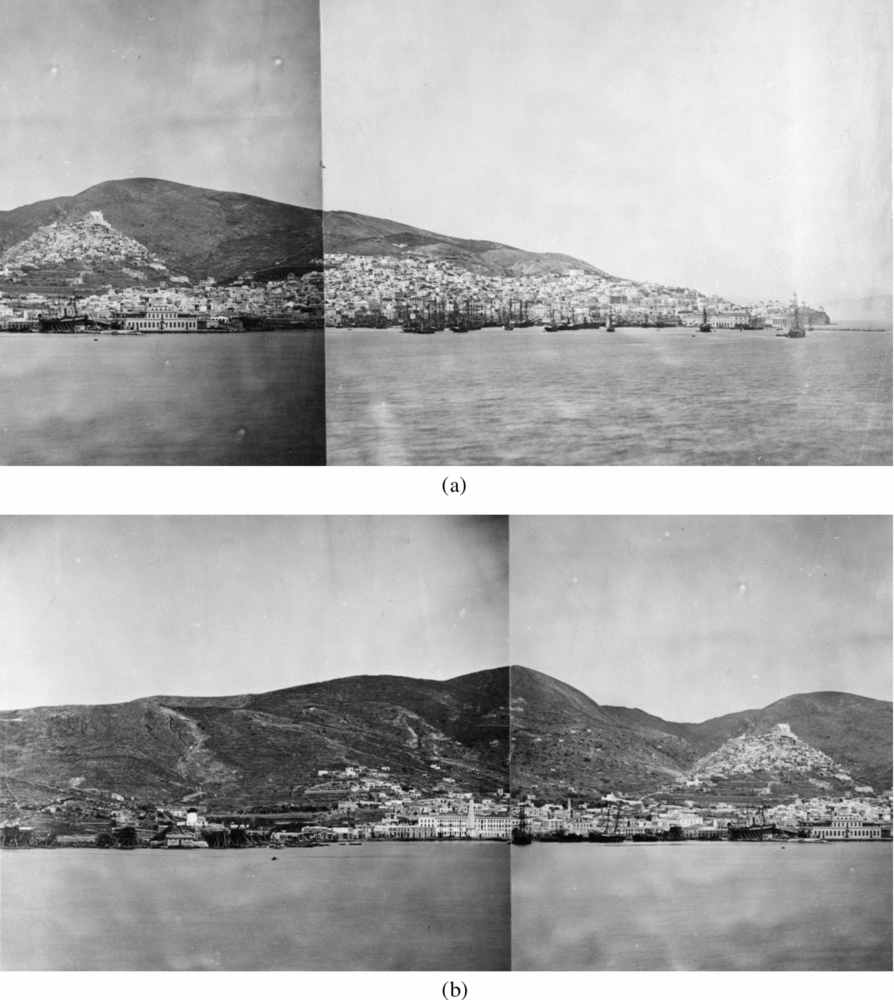
The expansion of factories in the southern part of Syros bay, in between the wooden shipyards and the ship repairing areas, strongly affected the physical landscape of the coast. Photographs dated to the later decades of the nineteenth century can be contrasted with earlier photographs in the 1840s. Figure 3, dated 1843, shows a sparsely built area between the old shipyards and the town with the windmills being the only ‘industrial’ establishments. Instead, in Figure 4 dated post-1867, the area is densely built. The arsenal of the Hellenic Steam Navigation Company (Figure 4a on the left of the picture) along with imposing factory buildings stands in the foreground and the new shipyards area with ships under construction on the left end of Figure 4b works as a terminus post quem for the dating of the photograph. The metamorphosis is even more evident in Figure 5 dated in the 1900s with the proliferation of industrial buildings and chimneys encompassing the wooden shipbuilding and ship repairing areas.
View of the south-western bay of Syros taken by Joseph Philibert Girault de Prangey in 1843. http://gallica.bnf.fr/ark:/12148/btv1b6903475w/f1.highres.
4a and b: General view of Hermoupolis taken by unknown artists dated post-1867. http://www.loc.gov/pictures/item/94513340/.
General view from the south in the 1900s. Postcard.
This metamorphosis in the physical landscape reflected parallel changes in the socio-economic landscape of the port. As seen above, new types of industrial investment found favour in the specific economic conditions of the 1860s and 1870s. Women and children were employed in the new textile factories that flourished in the final decades of the nineteenth century, thus inaugurating the phenomenon of female and child wage-labour in Greek urban manufacture.Footnote 57 A major consequence of the introduction of the factory system was the gradual creation of a working class, with elements of class consciousness, or, at least, with an awareness of its differentiated socio-economic status. This is reflected in the first strike in Greece, which took place on Syros in 1879 and was begun by the shipyard workers followed by employees in the tanneries.Footnote 58 The strike was caused by the speculative devaluation of the Russian and Ottoman currencies in the local market, which seriously affected the workers’ ability to purchase essential foodstuffs such as bread as these coins were the only ones to circulate on Syros.Footnote 59 However, some newspapers reported that the shipyard workers constituted an official working union seeking fixed wages according to their specialization, a shortening of their working hours and the abrogation of lump sum payments, whereas the tanners in factories demanded the abrogation of the lump sum payments, an adjustment of their wages to reflect monetary devaluation, the shortening of their working hours and, finally, the abrogation of the extra two hours they worked on Sundays.Footnote 60 According to this second interpretation of the causes of the strikes, shipyard workers come across as victims of the decreased competitiveness of the wooden sailing ship. Master shipwrights, the contractors, who should be characterized as small entrepreneurs rather than capitalists, were compelled to offer prices that were up to one third lower, cutting profit margins and therefore compressing salaries.Footnote 61
Conclusion
Hermoupolis is a useful paradigm of the adaptability of an insular port to transformations which occurred in the period of transition from commercial to industrial capitalism. What makes this case-study even more special is that Hermoupolis developed into a major seaport despite being located on a small island, and also managed to maintain its economic importance up to the middle of the twentieth century, contributing to the already understudied topic of insular ports. As long as it remained an essential partner in the network of Mediterranean and Black Sea ports in the service of the transit trade, it experienced considerable prosperity. Related sectors such as shipping and shipbuilding also saw considerable growth. The first signs of the forthcoming decline appeared after the Crimean War, when newly developed transport and communication technologies and new business patterns and methods began gradually to replace the old intermediaries and threatened the supremacy of the sailing ships on which the maritime industry of Hermoupolis was based.Footnote 62
In a city whose role, needs and priorities were changing irreversibly, shipbuilding was no longer to be the sole or even the dominant industry. It had to compete for a highly restricted area with the other manufacturers and factories that expanded during the 1860s and 1870s. The management of the shipyards by a joint stock company and its reorganization to make use of the limited space brought structural changes to shipbuilding activities which stand in contrast to the more ‘fluid’ exploitation of space during earlier periods. Steamship navigation and other structural and technological advances inherited from the second industrial revolution meant that the previously dominant sailing ship was to experience a continuous and irreversible decline over the last decades of the nineteenth century. That the wooden shipbuilding of Hermoupolis experienced an analogous decline should not be considered a local particularity, but part of a wider phenomenon common to many ports and maritime communities in the Mediterranean, northern Europe and North America during the second half of the nineteenth century.Footnote 63 In place of shipbuilding, the factories of tanneries, flour mills, textiles and others flourished as well as the infrastructures for the ever-growing fleet of cargo steamships, such as the arsenal of the Hellenic Steam Navigation Company and coal supply stations.
The visitor who today approaches Syros from the sea cannot ignore this legacy. First, he sees on his left the cranes and the imposing infrastructure of the Neorion Shipyards with ships under repair along with the buildings of the old factories in a better or worse state of preservation. Some are used as centres for the arts or as cultural heritage, such as the Industrial Museum of Hermoupolis, while others serve commercial purposes and others are abandoned.Footnote 64 All constitute an eloquent testimony to the former industrial district of Hermoupolis, which together with a large nineteenth-century style urban area provides a unique insight into Greek insular landscape, if not into the entire Mediterranean as well.