INTRODUCTION
Living with a life-threatening disease means living with the knowledge that the future may be limited, so that existential issues might become inevitable for the ill person and their family. The terms “existential issues” and “spiritual issues” are sometimes used interchangeably. Existential issues deal with questions on the basic conditions of being a human being, those that allow us to create a system of values and construct meaning in our lives. One of a great number of definitions of spirituality is “a dynamic and intrinsic aspect of humanity through which persons seek ultimate meaning, purpose, and transcendence, and experience relationship to self, family, others, community, society, nature, and the significant or sacred. Spirituality is expressed through beliefs, values, traditions, and practices” (Puchalski et al., Reference Puchalski, Vitillo and Hull2014, p. 646). This definition is close to the meaning of existential issues, except that the religious dimension is not as significant in existential issues, and, accordingly, existential issues could be regarded as being a more comprehensive concept than the spiritual (Sessanna et al., Reference Sessanna, Finnell and Jezewski2007). La Cour and Hvidt (Reference la Cour and Hvidt2010) posit that there is no consensus concerning definitions of the overlapping existential, spiritual, and religious concepts. They also do not define which concept is broader than the other. In addition, they hold that, while they all focus on meaning making, none should dominate the other.
Patients with incurable cancer have a desire to discuss existential issues (Strang, Reference Strang2001), but studies indicate that healthcare staff seldom raise these issues with patients (Phelps et al., Reference Phelps, Lauderdale and Alcorn2012; Balboni et al., Reference Balboni, Sullivan and Amobi2013; Pearce et al., Reference Pearce, Coan and Herndon2012), and when spiritual needs are unmet, patients are at risk for depression and a reduced sense of spiritual meaning and peace (Pearce et al., Reference Pearce, Coan and Herndon2012). One explanation for the hesitation of healthcare staffs to raise existential issues in dialogue with patients might be a lack of training (Balboni et al., Reference Balboni, Sullivan and Amobi2013).
An overview on the treatment of the elderly from the Swedish National Board of Health and Welfare notes that there is an extensive need for training and support of healthcare staff regarding how to talk about death, for meeting existential needs, and for training to be better able to meet the needs of dying patients (National Board of Health and Welfare, 2004). The literature also indicates that education of healthcare staff regarding existential issues is insufficient and that there is a vagueness concerning the staff's role (McSherry & Cash, Reference McSherry and Cash2004), which could result in the healthcare staff trying to keep death at a distance by concentrating on practical tasks and avoiding patients who are dying (Österlind et al., Reference Österlind, Hansebo and Andersson2011). An analysis of supervision sessions with healthcare staff at a surgery clinic showed that staff were conscious about patients' feelings of despair and isolation but lacked strategies for dealing with them (Udo et al., Reference Udo, Melin-Johansson and Danielson2011). However, research has shown that education can increase a staff's confidence in communication about existential issues (Morita et al., Reference Morita, Murata and Kishi2009). In an international survey of researchers' and clinicians' research priorities in spiritual care, one important area was found to be the development and evaluation of conversation models for spiritual conversations with patients (Selman et al., Reference Selman, Young and Vermandere2014). Because there is a paucity of conversation models and training, the intervention described in the present study was targeted toward an appropriate training program for healthcare staff. The aim of our study was thus to describe the development process of an existential support training program for nurses to facilitate conversations about existential issues with severely ill patients.
METHODS
Using the Medical Research Council (MRC) framework for the development and evaluation of complex interventions described by Campbell and colleagues and updated by Craig and coworkers, an intervention targeting existential issues in patients with cancer was developed and evaluated (Campbell et al., Reference Campbell, Fitzpatrick and Haines2000; Craig et al., Reference Craig, Dieppe and Macintyre2008). The framework consisted of four phases:
-
• development
-
• feasibility and piloting
-
• evaluation
-
• implementation
A detailed description of the steps and choices made throughout the development and feasibility phases of the educational intervention for healthcare professionals about existential issues will be described. The evaluation phase of the program will be described in the Results section, and the implementation phase will be described very briefly.
Development Phase
In the development phase, the aim was to identify existing evidence, identify or develop theory, and model the process of reaching the outcomes (Campbell et al., Reference Campbell, Fitzpatrick and Haines2000; Craig et al., Reference Craig, Dieppe and Macintyre2008). The existing evidence must first be explored in order to establish whether the intervention can be expected to have a worthwhile effect.
Identifying the Evidence Base
According to Craig et al. (Reference Craig, Dieppe and Macintyre2008), a key early task is to develop a theoretical understanding of the likely process of change by drawing on existing evidence and, if needed, supplemented by new primary research. To identify the evidence base, some explorative studies were conducted. The existing evidence was explored in two literature reviews, one encompassing existential issues in patients with cancer (Henoch & Danielson, Reference Henoch and Danielson2009) and the other related to relatives of patients with chronic illness (Melin-Johansson et al., Reference Melin-Johansson, Henoch and Strang2012). Neither review found any studies describing interventions that could be easily implemented in everyday healthcare practice (Henoch & Danielson, Reference Henoch and Danielson2009; Melin-Johansson et al., Reference Melin-Johansson, Henoch and Strang2012). Focus-group interviews were conducted with healthcare staff who work with cancer patients in different stages, that is, in surgical wards, oncology wards, palliative homecare teams, and inpatient hospices (Browall et al., Reference Browall, Melin-Johansson and Strang2010).
Identifying and Developing the Theory
The theoretical base for our intervention was existential psychotherapy, as described by Yalom (Reference Yalom1980), who defined the main existential issues to be death, freedom, isolation, and meaninglessness. When analyzing the three studies described above, these concepts were confirmed in the studies. A further concept that is necessary to internalize the concepts identified by Yalom is reflection, which is needed to comprehend how death, meaning, freedom, and isolation can be included in conversations with palliative care patients.
Death
Yalom describes death as the most anxiety-provoking phenomenon, and this was confirmed by the literature review, where the struggle to maintain self-identity was one of the main themes (Henoch & Danielson, Reference Henoch and Danielson2009). As long as a person is able to maintain self-identity, the self is sheltered and life maintained. The remedy for maintaining self-identity is the will to live. Self-identity is threatened when the person begins to despair about his or her continuing existence, that is to say, when death is nearing, when life is considered to be unpredictable and uncertain, and when one feels vulnerable (Henoch & Danielson, Reference Henoch and Danielson2009). In the literature review of relatives' existential issues (Melin-Johansson et al., Reference Melin-Johansson, Henoch and Strang2012), one important aspect was to be reminded about death in the environment and in the deterioration of the ill person. Death was also present for the relatives in that they lost their shared future with the ill person. In the focus-group interview study (Browall et al., Reference Browall, Melin-Johansson and Strang2010), the staff acknowledged that, while the awareness of death was imminent, there was also the joy of living. Although the studies described death as being present at the end of life, they also emphasized the importance of life. Therefore, the concepts of life and death were both considered to be important.
Meaning and Meaninglessness
According to Yalom (Reference Yalom1980), to find meaning is an important human existential issue. In the literature review (Henoch & Danielson, Reference Henoch and Danielson2009), meaning was described as being how patients use meaning and purpose in life, hope, and autonomy to maintain self-identity. In the literature review about relatives' existential issues (Melin-Johansson et al., Reference Melin-Johansson, Henoch and Strang2012), hope, purpose in life, and meaningfulness were also present in the situation in that the relatives tried to find meaning in illness. The meaning had three dimensions: meaning in the past consisted of good memories; the current meaning concerned knowledge and daily routines; and meaning in the future was to pass on the skills and interests of the patient to the next generation. Experiencing hope was also important in terms of a feeling of future meaningfulness. In the focus-group interview study (Browall et al., Reference Browall, Melin-Johansson and Strang2010), meaning included acceptance, reevaluation of life, hope, and faith.
Freedom
Yalom (Reference Yalom1980) describes freedom as giving the individual the choice in all situations, a choice for which one is responsible. Responsibility can, in some situations, evoke guilt and shame for one's past choices. In the literature review (Henoch & Danielson, Reference Henoch and Danielson2009), guilt and unresolved issues were considered to be threats to self-identity. In the literature review about relatives (Melin-Johansson et al., Reference Melin-Johansson, Henoch and Strang2012), it was found that they also felt a responsibility to help the patient, and they felt guilty if they did not, or as if they were not doing enough to help. Relatives could also experience survivor's guilt. In the focus-group interview study (Browall et al., Reference Browall, Melin-Johansson and Strang2010), the staff acknowledged that responsibility concerned feelings of guilt and reconciliation, about why things happened, and about the patients' responsibility for their situation.
Isolation
Existential isolation refers to an unbridgeable gulf between oneself and other beings (Yalom, Reference Yalom1980), and that humans have to face essential moments in life in isolation; alone. In the literature review (Henoch & Danielson, Reference Henoch and Danielson2009), loss of relationships, isolation, aloneness, and loss of roles were threats to self-identity. In the literature review about relatives (Melin-Johansson et al., Reference Melin-Johansson, Henoch and Strang2012), family members experienced that the former united lives were now separated, and they began psychological preparations for a changed but ongoing existence. In the focus-group interview study (Browall et al., Reference Browall, Melin-Johansson and Strang2010), the relationships were concerned with the notion that they were alleviating anxieties about loneliness if they were open and clear, and also that sometimes the patients became dependent on the relatives and staff, and that the patients experienced a loss of relationships when they were about to die. Because the isolation had its counterweight in developing new relationships, which the studies considered to be important, feelings of loneliness were eliminated.
Reflection
In addition to the four domains identified by Yalom, reflection could also be a way to involve death, meaning, freedom, and loneliness into the healthcare professionals' own conceptualization of the world and to understand how to involve them in encounters with patients. Important to reflection is the experience and discovery of an affective reaction to the experience (Schön, Reference Schön1987; Wong et al., Reference Wong, Loke and Wong1997). Reflection in action redesigns thinking and acting during action. Thinking and action are complementary, and they nourish each other while at the same time limiting each other (Schön, Reference Schön1987).
Modeling Process and Outcomes
Process
In the focus-group interviews (Browall et al., Reference Browall, Melin-Johansson and Strang2010), it was acknowledged by the staff that they lacked the training to converse with patients about existential issues; therefore, the components of the intervention consisted of an educational program for healthcare staff in relation to communicating about meaning, death, freedom, and loneliness. Because existential issues are present in everyone, reflection was considered to be an appropriate learning activity for the intervention. We decided that the most appropriate design to evaluate the intervention was a randomized controlled trial. The intervention was designed to be a training or education program and included a pamphlet providing short descriptions about the topic areas, questions for reflection and discussion during the training sessions, and suggestions for the types of questions that might apply to the topic areas that could be raised with patients. The teachers in the training groups (n = 4) were trained by the research staff about Yalom's theory and presented with results from previous research.
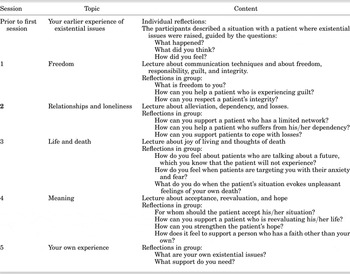
Because healthcare practice today is rather severely streamlined, it was assumed that managers in healthcare wards would be reluctant to let staff attend a long-term training program. Therefore, the intervention was designed to comprise five 90-minute sessions over an 8-week period, with theoretical training in existential issues combined with individual and group reflection sessions in order to achieve greater understanding. In the individual reflection sessions, the critical incident (CI) technique was employed (Flanagan, Reference Flanagan1954; Bradbury-Jones & Tranter, Reference Bradbury-Jones and Tranter2008). The procedure for the training is presented in Table 1.
Overview of the training sessions

Outcomes
The effectiveness of the intervention was measured in the randomized controlled trial, with differences found between the intervention and control groups, and differences found in the intervention group before and after training. An increase in the staff's confidence in communication skills was determined to be the main outcome, as the training was intended to help staff raise existential concerns with patients. Another potential outcome could be that the staff's attitude toward caring for dying patients would be changed by the training. This resulted in the decision to use two instruments as outcome measures—The Attitudes Toward Caring for Patients Feeling Meaninglessness scale (Morita et al., Reference Morita, Murata and Kishi2009) and the Frommelt Attitude Toward Care of the Dying (FATCOD) tool (Frommelt, Reference Frommelt1991; Henoch et al., Reference Henoch, Browall and Melin-Johansson2013a )—both of which were translated into Swedish by the research team with the adoption of the recommended procedures for questionnaire translation (White & Elander, Reference White and Elander1992; Maneesriwongul & Dixon, Reference Maneesriwongul and Dixon2004). The instruments were distributed prior to the first session, right after the last session, and five months later. The control group did not receive any training but completed the questionnaires at the same time as the intervention group.
In order to understand the change process, two steps were taken. First, the individual reflections, using critical incidents (CI) technique prior to the first session, were collected and analyzed. Second, because reflection was considered to be an important part of the training, the training sessions were recorded and analyzed in order to understand the healthcare staff's reasoning about existential issues. The results from the evaluation phase are presented in the Results section.
Feasibility and Piloting Phase
Testing Procedures
According to Craig et al. (Reference Craig, Dieppe and Macintyre2008), evaluations of interventions are often undermined by problems that could have been predicted by thorough pilot testing. Therefore, the intervention was tested on a smaller scale in a surgery clinic at a county hospital (Udo et al., Reference Udo, Melin-Johansson and Henoch2014). Some 42 nurses from three surgical wards were randomly assigned to an intervention or control group. Nurses in both groups completed a questionnaire at equivalent time intervals: at baseline before the educational intervention, directly after the intervention, and 3 and 6 months later. Some 11 face-to-face interviews were conducted with nurses directly after the intervention and 6 months later. In conjunction with the pilot study, work-related stress was also measured, and all nurses in all measurements rated themselves halfway between low and high burnout levels (Udo et al., Reference Udo, Danielson and Henoch2013b ). However, the intervention group's response indicated a long-term decrease in feelings of work-related stress, decreased stress associated with workload, and less disappointment in their work.
During the pilot phase, the CI technique was also employed with the aim of gaining a deeper understanding of the nurses' experiences of existential care situations. Ten surgical nurses described existential care incidents by writing about their experiences. After 1 to 2 weeks, individual interviews were conducted with the same nurses about their written accounts. In the analysis, three themes were identified, each emphasizing the impact of integration between nurses' personal self and professional role in existential care situations (Udo et al., Reference Udo, Danielson and Melin-Johansson2013a ).
Estimating Recruitment and Retentions
In the pilot study, there was significant attrition, which was mostly related to high workload levels in the wards, which prevented the nurses from participating in training sessions. However, the design of the intervention to include five sessions was considered to be the minimum number to achieve a change in staff communications with patients.
Determining Sample Size
The sample was determined based on previous research that showed that, in the determination of sample size where the difference between groups is not known, one can use half the standard deviation as a measure of the expected difference (Sloan et al., Reference Sloan, Cella and Hays2005). With the significance level at 0.05 and with a power of 0.80, about 60 participants were needed for each group. Therefore, in the main study, the nursing staff was estimated to total 120, so that 60 participants were required.
RESULTS
Evaluation Phase
The evaluation phase consisted of assessment of the effectiveness of the intervention, to understand the change process, and assessment of cost effectiveness (Craig et al., Reference Craig, Dieppe and Macintyre2008). Cost effectiveness was not assessed, as a training intervention with five sessions was considered to be the minimum in order to achieve a change, and if this could lead to decreased work-related stress, this would be a cost-effective intervention, but this element must be further explored.
Assessing Effectiveness
The main intervention study was conducted as a randomized controlled trial with 102 registered nurses and enrolled nurses from hospices, oncology clinics, and a palliative homecare team, with 60 in the intervention group and 42 in the control group. The main outcome, that is, confidence in communication, increased significantly in the training group from baseline to both the first and second follow-ups, whereas attitudes toward care of dying patients did not change after the training program (Henoch et al., Reference Henoch, Danielson and Strang2013b ). There were no significant differences between intervention and control groups at baseline, but at both the first and second follow-ups there were significant differences between the groups. The attitudes toward care of dying patients did not change pre- and posttest, and there were no significant differences between the intervention and control groups (Henoch et al., Reference Henoch, Danielson and Strang2013b ).
Understanding the Change Process
We assumed that confidence in communication should increase after the interventions, and we also wanted to know how the participants reflected about existential issues, and so we recorded the training sessions in order to closely follow their reflections. In the sessions, the nurses reflected on how to communicate with severely diseased patients (Strang et al., Reference Strang, Henoch and Danielson2014c ). The reflections about nurses' communication were concerned with the themes of the conversations, which included living, dying, and relationships. The process of the conversations included how to open up conversations, being present and accommodating, being sensitive and confirming, and using both words and silence. The meaning of the conversations were concerned with feeling honored and professional, being burdened, and requiring external prerequisites (Strang et al., Reference Strang, Henoch and Danielson2014c ).
Prior to the start of the training, the staff wrote a critical incident report (CI) about a situation in which existential issues were brought up, and, of the 102 participants, 83 nurses wrote about 88 CIs. The nurses described such situations, which were mostly related to encounters with existential pain experiences, which were concerned with facing death and facing loss; and encountering experiences of hope, which were concerned with balancing honesty and the desire to live. The results from the analysis of the CIs concluded that healthcare professionals need to be aware of patients' feelings of abandonment in such exposed situations as patients' feelings of existential loneliness. There are some patients who express a desire to die, and this makes the nurses feel uncomfortable, and they find it difficult to confront these occurrences. Therefore, it is important to listen to patients' stories, regardless how care is organized, in order to gain access to patients' inner existential needs (Browall et al., Reference Browall, Henoch and Melin-Johansson2014).
Implementation Phase
According to Craig et al. (Reference Craig, Dieppe and Macintyre2008), the implementation phase includes dissemination, surveillance, and monitoring, as well as long-term follow-up, and the effectiveness of the implementation is dependent on providing a clear description of each step of the intervention.
Some steps in the implementation of this intervention have been taken, but these have to be further evaluated. The assessment of effectiveness and understanding of the change process indicates that the theory of Yalom was an appropriate base for a discussion of existential issues (Yalom, Reference Yalom1980). Therefore, some studies were undertaken to confirm the appropriateness of the concepts in Yalom's theory for patients, relatives, and others. One interview study with patients with late-stage COPD about existential anxiety (Strang et al., Reference Strang, Ekberg-Jansson and Henoch2013) showed that both life and death evoked existential anxiety for patients. But when facing death anxiety, they also tried to find counterweights to this by maintaining a defiant sense of joy, such as by celebrating good relationships and hobbies. The patients also experienced death anxiety as separation anxiety (Strang et al., Reference Strang, Ekberg-Jansson and Henoch2013), which also has been acknowledged by Yalom (Reference Yalom1980). In another interview study in patients with late-stage COPD about their experience of guilt (Strang et al., Reference Strang, Farrell and Larsson2014b ), the patients' own responsibility for the disease was highlighted. Despite the well-known association between smoking and COPD, only a minor percentage of patients expressed that they had experienced guilt that affected their daily lives (Strang et al., Reference Strang, Farrell and Larsson2014b ).
In a study where nursing students completed a questionnaire about their attitude toward the care of dying patients, the open-ended questions about their reasoning about their care of dying patients (Strang et al., Reference Strang, Bergh and Ek2014a ) revealed that students acknowledged that the arrival of death could be very scary, but some expressed that they thought they ought to have the courage to stay with the patient. The students tried to find meaning in being present beside the dying patients, and they expressed that their responsibility extended to the expectation that nurses ought to be present with, listening to, confirming of, and supportive of patients (Strang et al., Reference Strang, Bergh and Ek2014a ).
Yalom's (Reference Yalom1980) theory was also used as a theoretical framework in a doctoral project about the experiences of relatives of persons with dementia (Hogsnes et al., Reference Hogsnes, Melin-Johansson and Norbergh2014). In one of the interview studies, 11 spouses of persons with dementia described the existential life situations before and after relocation to a nursing home. Before relocation, the spouses described feelings of shame and guilt, and of being isolated in the nursing home. After the relocation, spouses described feelings of guilt and freedom, grief and thoughts of death, feelings of loneliness in the spousal relationship, and striving for acceptance (Hogsnes et al., Reference Hogsnes, Melin-Johansson and Norbergh2014). These studies further confirmed that the inclusion of Yalom's (Reference Yalom1980) concepts in the training was appropriate.
DISCUSSION
The knowledge gained from the project mainly concerns: (1) that healthcare staff recognize situations where existential issues are present and need to be taken care of; (2) that it is possible to implement a five-session training program about existential issues in different kinds of healthcare organizations; and (3) that it is possible to increase a healthcare staff's confidence in communication via a short training program.
The healthcare staff are well aware of situations where existential issues arise (Browall et al., Reference Browall, Henoch and Melin-Johansson2014). Although nurses are aware of patients' existential issues and can describe situations where existential issues are brought up, it has also been acknowledged that nurses do not know what their responsibility is with respect to spiritual care (van Leeuwen et al., Reference van Leeuwen, Tiesinga and Post2006). Because healthcare staff showed that they were aware of existential situations, the training could have been deepened in some aspects. In Norway, a project has been designed in which healthcare professionals in palliative care may reflect on their views about their own death (Hirsch & Röen, Reference Hirsch and Röen2007). During the ten sessions, the staff reflected on the first time they experienced the death of someone close to them, how it was to see them die, how they wanted to say goodbye, their own funeral, beliefs about what happens after death, and what to do if you only had a year left to live. It also reflects on what work does to the body, sleep, family, and views of life, and what it is that takes and gives strength (Hirsch & Röen, Reference Hirsch and Röen2007). This is a possible method for deepening reflections in the present training intervention.
Other ways to improve the intervention could involve other evidence-based elements, such as dignity therapy (Chochinov et al., Reference Chochinov, Hack and Hassard2005), where the patient's life story is used as a tool to help the patient find meaning. By telling a story, various pieces fall into place, and the story is often created in the storytelling. The aim of dignity therapy is to reduce suffering, improve quality of life, and strengthen a sense of purpose and dignity. Patients were offered the opportunity to take up important events or things they want to remember in a recorded conversation 30 to 60 minutes long. An edited transcript of these sessions was then returned to the patient, who could do what they wanted with the text, such as show it to their children and grandchildren (Chochinov et al., Reference Chochinov, Hack and Hassard2005). Listening to a patient's life story could be a part of a training program to increase nurses' ability to communicate with severely diseased patients.
In our project, confidence in communication significantly improved (Henoch et al., Reference Henoch, Danielson and Strang2013b ; Strang et al., Reference Strang, Henoch and Danielson2014c ), an outcome supported by other studies that found that communication skills can be improved by training (Morita et al., Reference Morita, Murata and Kishi2009; Moore et al., Reference Moore, Rivera Mercado and Grez Artigues2013). When comparing healthcare professionals who received communication skills training to control groups without training, the intervention group improved significantly in showing empathy and using open-ended questions. It was not clear whether the improvement in communication skills was sustained over time and which types of communication skills training were best (Moore et al., Reference Moore, Rivera Mercado and Grez Artigues2013). Because the present project was built on training in communication, the results showing that confidence in communication increased were expected. The training did not change healthcare staff's attitudes toward caring for dying patients. In other studies, education has been found to influence attitudes toward care of the dying (Mutto et al., Reference Mutto, Errazquin and Rabhansl2010; Mallory, Reference Mallory2003; Frommelt, Reference Frommelt1991); however, this outcome might be dependent on the focus of the education program.
During the implementation phase, our purpose was to examine the implementation of the intervention in practice (Craig et al., Reference Craig, Dieppe and Macintyre2008) through dissemination, surveillance, and monitoring, as well as long-term follow-up. As described in the results, some minor steps to implementation have been taken, and some studies have confirmed the appropriateness of inclusion of Yalom's concepts (Strang et al., Reference Strang, Ekberg-Jansson and Henoch2013; Reference Strang, Bergh and Ek2014a; Reference Strang, Farrell and Larsson2014b). However, prior to implementation, the present system must be further tested in order to establish the stability of the intervention and to broaden the subject groups as well as explore possible extensions of the training. As the content of the training was built on literature and staff experiences, patients' perceptions of important existential issues must be explored, as well as staff's perceptions of the support given. Therefore, it would be appropriate to ask the patients if the healthcare staff's ability to communicate about existential issues had improved. To involve the patients in projects targeting their existential issues is compelling and needs to be explored further.
CONCLUSIONS
In our study, the Medical Research Council framework was used as a theoretical guide for intervention development, provided in a detailed description of the development process of a training intervention about existential issues for healthcare staff. This crucial element is often missing in reports of complex intervention trials (Campbell et al., Reference Campbell, Fitzpatrick and Haines2000; Craig et al., Reference Craig, Dieppe and Macintyre2008). To report the details of the elaboration process is essential to understand the different components of the intervention and enhance understanding of the trial results.
The present study shows that healthcare staff are able to identify situations where existential issues are raised, and that their confidence in communication about existential issues can increase with completion of a short-term training program that includes the element of reflection. In order to design a program that should be permanently implemented, more knowledge is needed of patients' perceptions about the quality of the healthcare staff's existential support.
ACKNOWLEDGMENTS
Funding for this project has been gratefully received from the Royal Society of Arts and Sciences in Gothenburg, the Adlerbert Research Foundation, the Wilhelm and Martina Lundgren Fund, and the Assar Gabrielsson Fund, the Cancer Research Foundation in Northern Sweden, and the Cancer Rehabilitation Fund.