Introduction
Partial deafness is a condition where substantial low frequency hearing co-exists with profound sensorineural hearing loss at high frequencies, resulting in poor speech discrimination and limited benefits from hearing aids.Reference Skarzynski, Lorens and Piotrowska1, Reference Hogan and Turner2 For many years, such patients have not been considered good candidates for cochlear implantation because of the high risk of residual hearing loss.Reference Hogan and Turner2, Reference Skarzynski, Lorens, Matusiak, Porowski, Skarzynski and James3 Recently, combined electric acoustic stimulation has become a viable solution for these patients, although there remains the risk of traumatising inner-ear structures during electrode insertion, with consequent loss of hearing.Reference Skarzynski, Lorens, Piotrowska and Anderson4–Reference Skarzynski, Matusiak, Piotrowska and Skarzynski9 The most anatomically favourable and least traumatic approach to the cochlea is the round window approach, which gives direct access to the scala tympani.Reference Skarzynski, Lorens and Piotrowska1, Reference Skarzynski, Lorens, Piotrowska and Skarzynski5, Reference Skarzynski, Lorens, Piotrowska and Anderson10, Reference Cohen, Xu, Xu and Clark11
Our institute has been perfecting this round window approach using various electrodes, first in adults, from 1997, and in children since 2004.Reference Skarzynski, Lorens and Piotrowska1, Reference Skarzynski, Lorens, Piotrowska and Anderson4 This experience has convinced us that for the purpose of preserving intra-labyrinthine structures, the use of a straight and slim electrode is the best solution. The Nucleus® Slim Straight (CI422) electrode is 25 mm long, with a diameter of 0.3 mm at the tip and 0.6 mm at the proximal end; it has two markers at 20 and 25 mm. The CI422 has been used in a clinical trial in Warsaw among a group of 35 adults, and resulted in a good hearing preservation rate and improvement in speech recognition (at both 20 and 25 mm insertion depths).Reference Skarzynski, Lorens, Matusiak, Porowski, Skarzynski and James3, Reference Skarzynski, Lorens, Matusiak, Porowski, Skarzynski and James12, Reference Skarzynski and Podskarbi-Fayette13 This encouraged us to undertake a CI422 clinical trial in children. Children with a high frequency hearing loss face the risk of a developmental slowdown because of communication impediments, especially at school and with peers. This study aimed to measure the benefit of this electrode on speech recognition (post-operative compared to pre-operative) in quiet and in noise, and to gauge how well residual hearing had been preserved following implantation.
Materials and methods
The study included 19 children. Informed written consent was obtained from the parents of all participants. The study was approved by the Bioethics Committee of the Institute of Physiology and Pathology of Hearing, Warsaw, and the Office for Registration of Medicinal Products, Medical Devices and Biocidal Products in Warsaw, Poland. The study was conducted in accordance with the principles of the Declaration of Helsinki.
Inclusion criteria
All patients were aged over three years, with profound sensorineural hearing loss for frequencies over 750 Hz, confirmed audiometrically. Only candidates for routine cochlear implantation, with pre-, peri- or post-lingual deafness, were included in the study. All patients were willing to comply with the requirements of the clinical study.
Exclusion criteria
Patients with cochlear ossification or other anomalies (confirmed with magnetic resonance imaging), which prevented electrode array placement, were excluded from the study. Additional exclusions included those with: congenital, bilateral, profound sensorineural hearing loss across all frequencies; central or retrocochlear hearing loss confirmed with diagnostics (including magnetic resonance imaging); and medical or psychological conditions preventing participation in a cochlear implantation procedure.
Population
The children were aged 6 to 18 years (mean of 11.9 years, standard deviation (SD) = 3.2) at implantation. Ten of the patients were boys and nine were girls. Implantation was performed in the right ear in nine cases. In 37 per cent of cases, genetic aetiology of hearing loss was confirmed (deletion 35G in the GJB2 gene). Twenty-one per cent became hearing impaired due to peri-delivery complications. Five per cent became hearing impaired due to ototoxic drug use. Five per cent had hearing loss due to post-inflammatory causes. In 32 per cent, the cause of deafness was unknown. The duration of hearing impairment ranged from 3.5 to 18 years (mean of 10.5 years). Based on progressive hearing loss being defined as a 10 dB shift at two consecutive frequencies, or 15 dB at one frequency, over a period of one year, then in all cases the hearing loss at low frequencies was not progressive.Reference Skarzynski, Lorens, Piotrowska and Anderson4 Eighty-nine per cent of patients were bilateral hearing aid users, with the duration of hearing aid use ranging from 1 to 15 years (mean of 8.14, SD = 3.9).
Audiometric evaluation
Pure tone audiometry (PTA) was performed using calibrated audiometers with outputs of 90 dB HL at 125 Hz, 105 dB HL at 250 Hz, 110 dB HL at 500 Hz, 120 dB HL at 1 kHz, 120 dB HL at 2 kHz, and 115 dB HL at 4 kHz. For unaided testing, the assessments were conducted in a double-walled sound booth using earphones. The PTA, using tones in the range of 0.125 to 6 kHz, was performed pre-operatively, and at 1, 5, 9, 12 and 24 months after activation of the speech processor. Hearing threshold evaluation in PTA was performed following the modified Hughson and Westlake procedure with 5 dB precision.Reference Tyler and Wood14 Pre-operative hearing levels were categorised according to Skarzynski and colleagues’ definitions.Reference Skarzynski, Lorens, Piotrowska and Skarzynski5
Surgical technique
In all cases, cochlear implantation was conducted according to the six-step Skarzynski et al. partial deafness method, using CI422 electrodes inserted via the round window.Reference Skarzynski, Lorens, Piotrowska and Skarzynski5 The steps involve: antromastoidotomy, posterior tympanostomy to allow visualisation of the round window niche, puncture and incision of the round window membrane, insertion or partial insertion of the electrode array into the scala tympani, electrode fixation in the round window niche, and fixation of the device in the bony well.
Steroids were administered as follows: 0.1 mg/kg/day dexamethasone intravenously in 2 doses per day for 3–4 days. A questionnaire and surgical recording were used to collect surgical data, including the surgeon's intra-operative report on electrode insertion depth (first marker = 20 mm, halfway between markers = 22 mm and second marker = 25 mm).
Imaging
Flat-panel, high-resolution computed tomography (CT) (Somatom® Definition AS scanner and a Siemens Multimodality Workplace workstation) was used for imaging. In all 19 patients, CT scans of the temporal bones were carried out in the early post-operative period. Reconstructions of the cochlear image (‘cochlear view’) were prepared according to the method described by Xu et al. and used for the angle measurement.Reference Xu, Xu, Cohen and Clark15 The reference 0° angle was defined according to a consensus panel.Reference Verbist, Skinner, Cohen, Leake, James and Boex16 Insertion depth angles were estimated in each case according to the method described by Cohen et al.Reference Cohen, Xu, Xu and Clark11 Analysis of CT scans was performed for all patients by the same investigator, in a non-blinded setting.
Activation and follow-up tests
Implant activations were performed at about one month after surgery, using the Nucleus Freedom Hybrid™ speech processor.
Data analysis
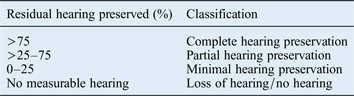
To calculate hearing preservation, the new hearing preservation classification system proposed by Skarzynski et al., based on pre- and post-operative PTA, was used.Reference Skarzynski, Van de Heyning, Agrawal, Arauz, Atlas and Baumgartner17 It is calculated using the formula: S (percentage) = (1 − ((PTApost − PTApre) / (PTAmax − PTApre)) × 100), where ‘S’ is hearing preservation, ‘PTApost’ is post-operative PTA, ‘PTApre’ is pre-operative PTA and ‘PTAmax’ is the limit of the audiometer. For the purpose of reporting and analysis, the percentages were converted into categories, as in Table I.
Hearing preservation classification system categoriesReference Skarzynski, Van de Heyning, Agrawal, Arauz, Atlas and Baumgartner17

Statistical analysis
Statistical analysis was performed using Statistica™ 10 software. Hearing preservation analysis for implanted and non-implanted ears was performed using a non-parametric Friedman analysis of variance and the Kendall compliance coefficient. The relation between hearing preservation rate and angular insertion depth was estimated using Pearson's linear correlation. For both tests, a significance level of p < 0.05 was adopted.
Results
All 19 subjects in the study group completed 24 months’ follow up.
Surgery
All implantations were performed by the first author. Insertion was rated as easy in 3 cases, very easy in 13 cases and difficult in 1 case.
Radiological evaluation
Proper positioning of the electrode array within the scala tympani was confirmed in all cases. Reconstructions of a ‘cochlear view’ were obtained, from which angular insertion depths were estimated. They varied from 310° to 540° (mean of 424°, SD = 59°).
Hearing preservation
In all subjects, PTA hearing thresholds were measured across frequencies over the 24 months’ follow up.
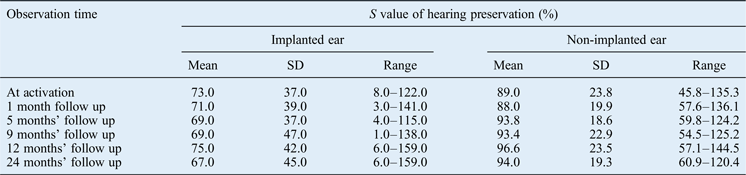
Following the hearing preservation classification,Reference Skarzynski, Van de Heyning, Agrawal, Arauz, Atlas and Baumgartner17 the mean S value of hearing preservation in the implanted ear at activation was 73 per cent. At the same time, the mean S value of hearing preservation in the non-implanted ear was 89 per cent. Mean S values for both ears of the study group, at all analysed intervals, are shown in Table II.
Comparison of hearing preservation during follow up
SD = standard deviation
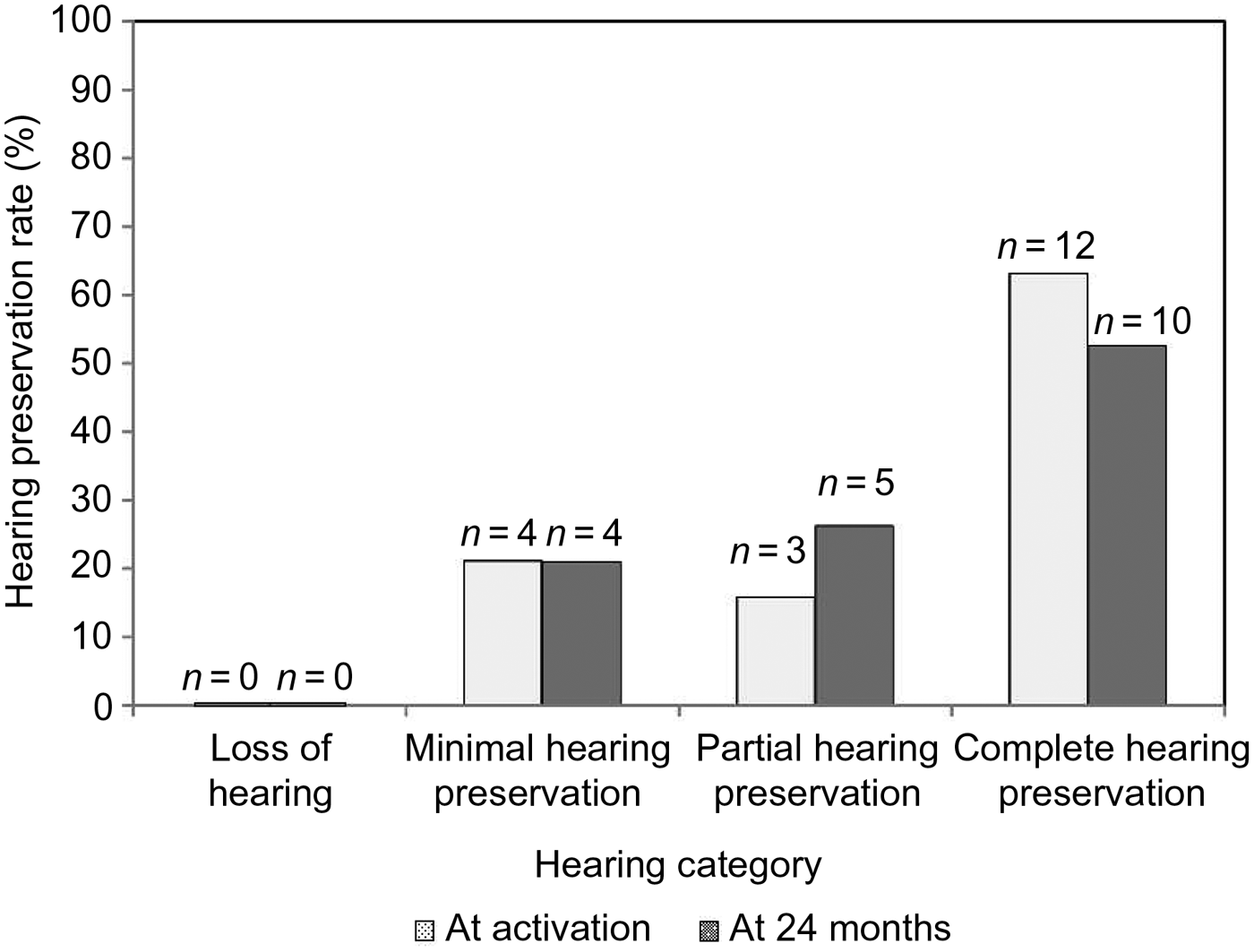
Converted to categories of hearing preservation, our results were as follows. At activation, minimal hearing preservation was noted in 4 cases, partial hearing preservation in 3 cases and complete hearing preservation in 12 cases. At 24 months’ follow up, minimal hearing preservation was noted in 4 cases, partial hearing preservation in 5 cases and complete hearing preservation in 10 cases (Figure 1).
Rates of hearing preservation in four categories: loss of hearing, minimal hearing preservation, partial hearing preservation and complete hearing preservation.
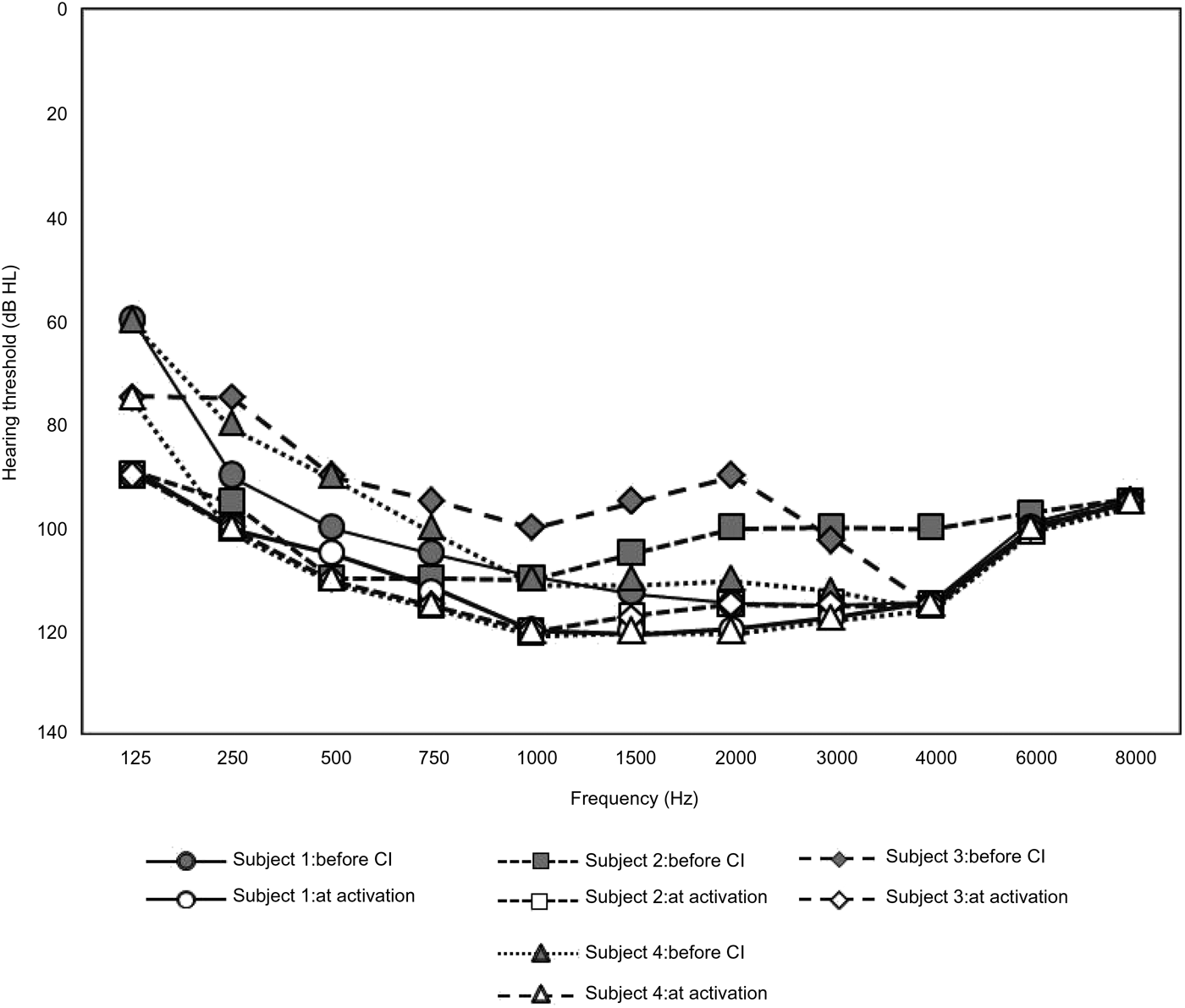
All four patients with minimal hearing preservation (Figure 2) were in the partial deafness treatment by electric stimulation group, representing patients who, before implantation, had non-functional residual hearing at low frequencies.
Pure tone audiograms of four subjects who had minimal hearing preservation. Black lines represent pre-operative hearing thresholds and grey lines represent post-operative (activation) thresholds. CI = cochlear implantation
The 4 subjects with minimal hearing preservation (Figure 2) were implanted at age 7 to 16 years. Three of them were diagnosed with a genetically based hearing loss; in the other subject, the aetiology was unknown. In all cases, the surgical procedure and post-operative course were uneventful, and electrodes had been inserted up to the second marker. Insertions were rated as very easy in all cases. Radiological evaluation showed the following angular insertion depths: 420°, 450°, 540° and 475°, which were some of the deepest insertions in the studied group.
Hearing preservation and insertion depth
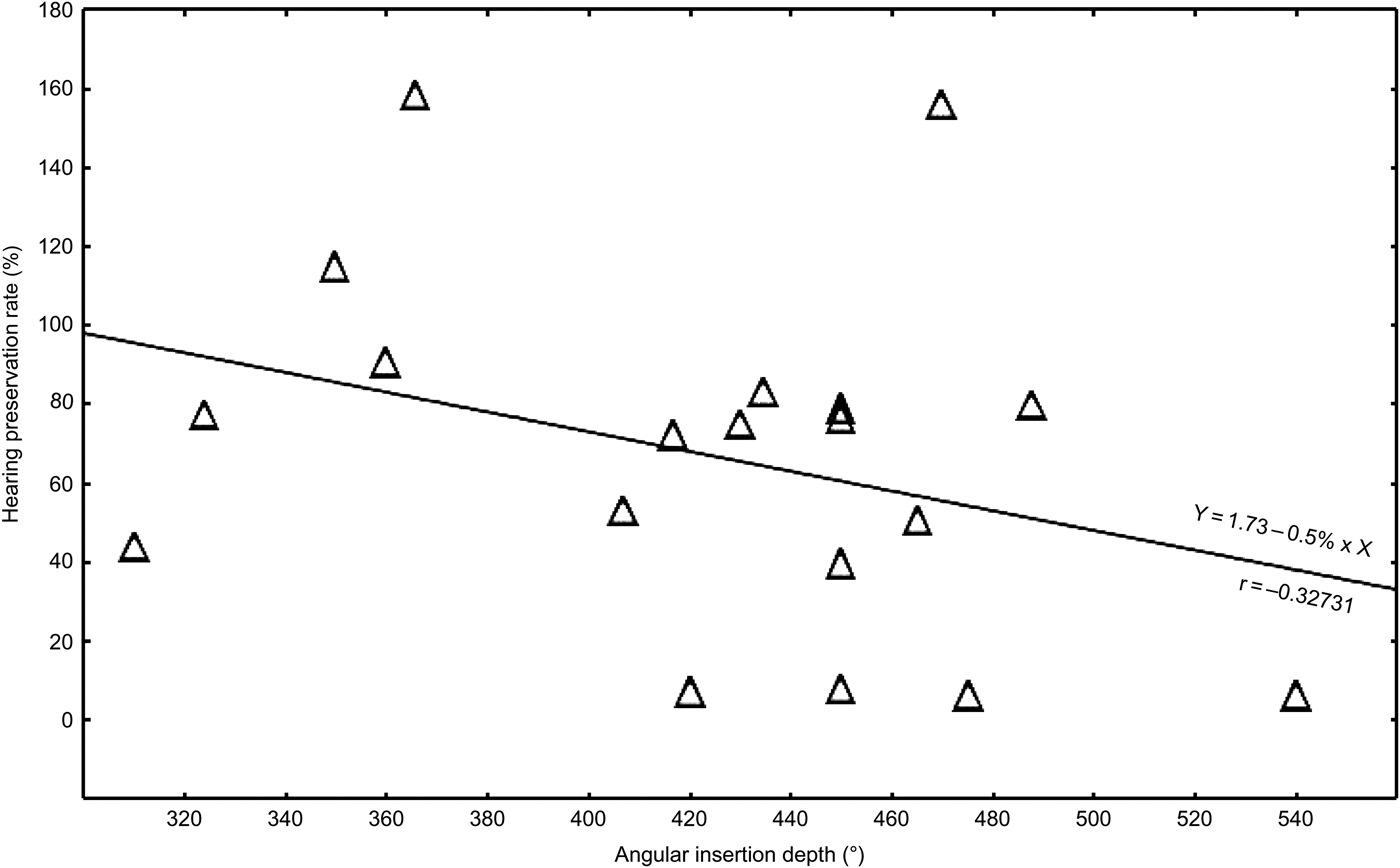
For the whole studied group, the relationship between the S value of hearing preservation and array angular insertion depth was calculated at 24 months’ follow up (Figure 3). This relationship was found to be statistically insignificant (p = 0.17).
Relation across subjects between insertion depth angle and S value of hearing preservation at 24 months’ follow up.
Long-term hearing thresholds
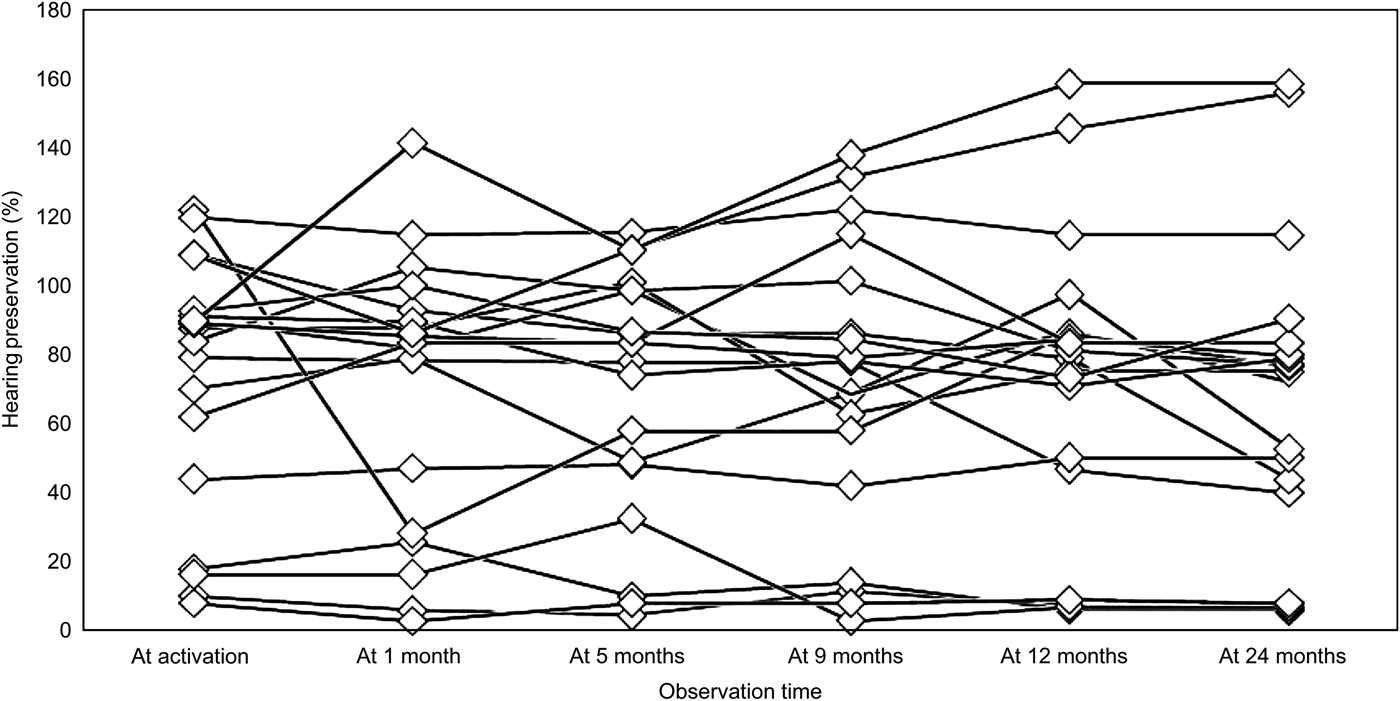
The mean S value of hearing preservation after 24 months was 67 per cent. The stability of PTA thresholds over 24 months is presented in Figure 4.
Individual hearing preservation in the study group over 24 months.
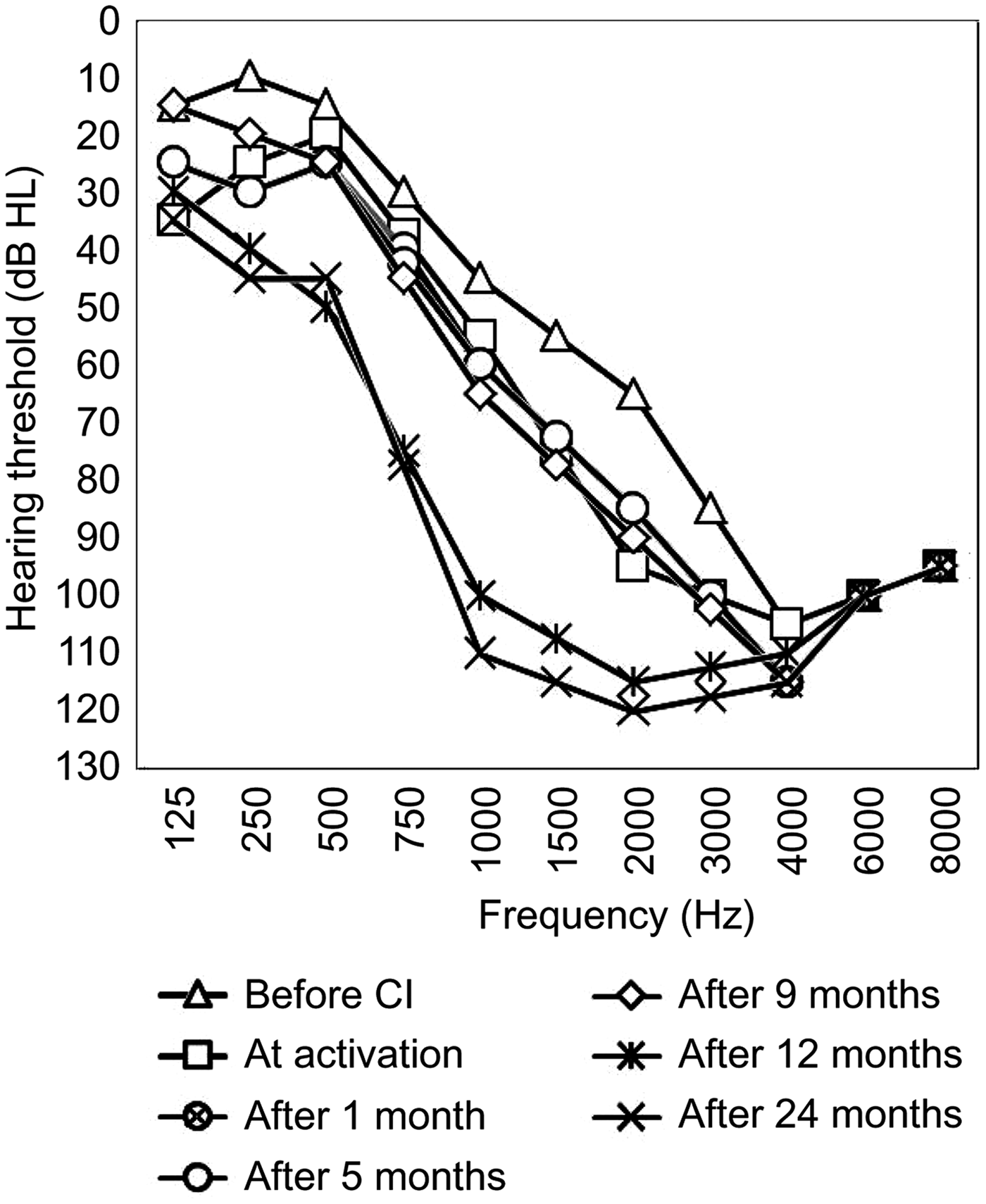
There were no cases of complete hearing loss in this group in the follow-up period, but in some cases we observed a substantial hearing loss (Figure 2). One subject, implanted at nine years old, underwent bilateral partial deafness treatment by electric complementation. In the intra-operative report, her electrode insertion was rated as difficult as a result of some resistance. Nevertheless, the surgery and post-operative period were uneventful. In addition, although the insertion angle was relatively large at 450°, her hearing preservation was complete (S = 79 per cent) for up to 12 months’ follow up, when a sudden hearing deterioration was observed in the implanted ear (Figure 5). No relevant medical event was reported at that time. Steroids were administered, but with no response. Hearing preservation dropped to 37 per cent and so shifted to partial hearing preservation. As hearing in the contralateral ear remained stable, this event cannot be plausibly explained by disease progression.
Example of substantial hearing loss between 9- and 12-months’ follow up. CI = cochlear implantation
Discussion
Hearing preservation surgery is a rapidly growing approach to cochlear implantation.Reference Skarzynski, Lorens and Piotrowska1, Reference Skarzynski, Lorens, Matusiak, Porowski, Skarzynski and James3, Reference Skarzynski, Lorens, Zgoda, Piotrowska, Skarzynski and Szkielkowska7 Key issues that need to be considered by implanting centres are: the use of a standardised procedure for pre-operative assessment, especially for children; the use of atraumatic surgical procedures; the introduction of a system to assess and monitor post-operative hearing thresholds; and a quantification system for hearing preservation.Reference Skarzynski, Van de Heyning, Agrawal, Arauz, Atlas and Baumgartner17 The existing literature provides scarce data on any of these issues related to cochlear implantation for hearing preservation in the paediatric population.Reference Skarzynski, Lorens, Piotrowska and Anderson4, Reference Kuthubutheen, Hedne, Krishnaswamy and Rajan18, Reference Brown, Hullar, Cadieux and Chole19
Hearing preservation classification
By definition, cochlear implantation to preserve hearing targets a heterogeneous group of patients, as both pre-operative hearing status and aetiology of hearing loss differ widely across subjects.Reference Skarzynski, Lorens, Piotrowska and Skarzynski5 Our clinical study included subjects with substantial functional low frequency hearing, as well as those with only residual low frequency hearing.
The main criterion of hearing preservation, widely used over the last few years across centres, is the post-operative increase of mean threshold in PTA.Reference Skarzynski, Lorens, Matusiak, Porowski, Skarzynski and James3, Reference Skarzynski, Van de Heyning, Agrawal, Arauz, Atlas and Baumgartner17–Reference Adunka, Dillon, Adunka, King, Pillsbury and Buchman20 This criterion, in which complete hearing preservation is defined as an increase of mean threshold less than 10 dB, was used by Kuthubutheen et al. in their study of five implanted children. They reported complete hearing preservation over a frequency range of 125–500 Hz in all cases.Reference Kuthubutheen, Hedne, Krishnaswamy and Rajan18 Adunka et al. reported a mean increase in hearing thresholds after cochlear implantation of more than 15 dB over the frequency range 0.250–1 kHz in their group of 18 subjects who underwent partial deafness treatment by electric acoustic stimulation.Reference Adunka, Dillon, Adunka, King, Pillsbury and Buchman20 Brown et al. published results of a study on 31 children with residual low frequency hearing.Reference Brown, Hullar, Cadieux and Chole19 They proposed their own hearing preservation classification, in which complete hearing preservation was defined as an increase of the mean PTA value not higher than 10 dB for 250, 500 and 1000 Hz. In their study, complete hearing preservation was achieved in 45.2 per cent of cases, and at least partial hearing preservation (loss of ≤40 dB according to their classification) was reported in 90.3 per cent of cases.
In our study, we used the hearing preservation classification system proposed by Skarzynski et al.Reference Skarzynski, Van de Heyning, Agrawal, Arauz, Atlas and Baumgartner17 This system circumvents the disadvantages of earlier classification systems. According to this system, complete hearing preservation at activation was achieved in 63.2 per cent of cases and, at 24 months of follow up, in 52.6 per cent of cases in our study.
Surgical approach, electrode design and angular insertion depth
Regardless of the patient's hearing status, cochlear implantation surgery should be as atraumatic as possible, aiming to preserve intra-labyrinthine structures and maintain the patient's chances of taking advantage of future treatment modalities.Reference Skarzynski, Lorens, Matusiak, Porowski, Skarzynski and James3, Reference Skarzynski, Lorens, Piotrowska and Anderson4, Reference Skarzynski, Lorens, Piotrowska and Skarzynski5, Reference Skarzynski, Lorens, Zgoda, Piotrowska, Skarzynski and Szkielkowska7, Reference Bruce, Bates, Melling, Mawman and Green21–Reference Sampaio, Araújo and Oliveira23 In our clinical study, the surgical method of choice was the round window approach, which eliminates drilling of the cochlear bony capsule, and thus reduces the risk of acoustic trauma and the incorporation of bone dust.Reference Skarzynski, Lorens and Piotrowska1, Reference Skarzynski, Lorens, Matusiak, Porowski, Skarzynski and James3, Reference Skarzynski, Lorens, Piotrowska and Skarzynski5, Reference Lenarz, Stóver, Buechner, Paasche, Briggs and Risi6, Reference Carlson, Colin, Driscoll, Gifford, Service and Tombers8, Reference Skarzynski, Matusiak, Piotrowska and Skarzynski9, Reference Skarzynski, Matusiak, Lorens, Skarzynski and Porowski24, Reference Wright and Roland25 Among the other factors affecting structure preservation is the depth of electrode insertion and its design.Reference Jeyakumar, Peña and Brickman22, Reference Wright and Roland25, Reference Erixon, Köbler and Rask-Andersen26 It is known that deeper insertions, exceeding 20 mm or 360° angular depth and penetrating into the apical regions of the cochlea, increase the risk of intracochlear trauma.Reference Skarzynski, Lorens, Zgoda, Piotrowska, Skarzynski and Szkielkowska7, Reference Brown, Hullar, Cadieux and Chole19, Reference Erixon, Köbler and Rask-Andersen26–Reference Nguyen, Miroir, Kazmitcheff, Sutter, Bensidhoum and Ferrary28
An initial study in children with residual hearing (modest functional hearing amplifiable with hearing aids) was published by Skarzynski in 2007.Reference Skarzynski, Lorens, Piotrowska and Anderson4 In that study, a standard Med-El™ 1.3 mm electrode was partially inserted (up to 20 mm) through the round window. Pre- and post-operative hearing PTA results showed that 16 of 26 patients (62 per cent) retained residual hearing within 5 dB HL, and only 5 of 26 patients (19 per cent) lost all measurable hearing.
Adunka et al. used Med-El Flex EAS electrodes and a cochleostomy approach in their study of children who underwent partial deafness treatment with electric acoustic stimulation, and who had a mean PTA of 40 dB at 500 Hz.Reference Adunka, Dillon, Adunka, King, Pillsbury and Buchman20 Insertion depths were up to 20 mm. Two electrode contacts remained outside the cochlea: one was situated at the cochlear opening and the other was outside the cochlea and not activated. At 12 months’ follow up, hearing thresholds were stable in all but one case; the affected patient had total loss of hearing in the early post-operative period.
Brown et al. reported the outcomes of 31 children with pre-operative hearing thresholds in the partial deafness treatment by electric stimulation range, and who had a mean pre-operative PTA value across low frequencies of 83.3 dB.Reference Brown, Hullar, Cadieux and Chole19 They used the round window cochleostomy technique, and inserted one of three different types of electrodes: the HiFocus™ 1J, the Nucleus Freedom with Contour Advance, or the standard Med-El Pulsar CI 100 electrode. Complete hearing preservation (according to their criterion of hearing threshold elevation at low frequencies of PTA ≤10 dB) was achieved in 14 of 31 patients, and complete loss of residual hearing occurred in 3 of 31 patients. Mean post-operative low frequency PTA was 103.3 dB.
In our study, complete hearing preservation was achieved in 12 of 19 patients (63 per cent), and, at 24 months’ follow up, in 10 of 19 patients (53 per cent). No case of complete hearing loss was reported (Figure 1).
On the basis of these results, it would seem that, when using the cochleostomy technique and pre-curved standard size electrodes, it is difficult to attain both hearing preservation and deep insertion at the same time.Reference Brown, Hullar, Cadieux and Chole19 Bruce et al. reported a group of 18 patients (adolescents and adults) who had modest residual hearing after implantation with FlexSoft™ 31.5 mm electrodes.Reference Bruce, Bates, Melling, Mawman and Green21 In 14 subjects, full insertion was performed, and in 4 subjects the last electrode contact was placed outside the cochlea. The authors reported a mean increase of hearing threshold in the low frequency range of 22 dB at 250 Hz, 26.5 dB at 500 Hz, and 10 dB at 1 kHz.
In our study, we had four patients with minimal hearing preservation (S value of hearing preservation <25 per cent), who, pre-operatively, had low frequency residual hearing (i.e. ‘corner audiograms’). Angular insertion depth in these cases was among the greatest in the group, with a mean of 471° for all four patients, a considerable distance beyond the basal turn. However, some patients implanted with a similar angular depth (more than 400°) had complete hearing preservation (Figure 4). In some subjects, hearing preservation changed during the follow-up period. For the whole group, the relationship between hearing preservation level at 24 months’ follow up and angular insertion depth was not significant (p = 0.17). This is in line with the results of Prentiss et al., who conducted a similar analysis for Med-El electrodes.Reference Prentiss, Sykes and Staecker29
• Partial deafness cochlear implantation is a state-of-the-art surgical intervention aimed at preserving cochlear structures
• It potentially allows a patient to benefit from both electric and acoustic stimulation
• Success of such a technique in adults has been proven; however, paediatric reports are scarce
• This study showed that hearing preservation in children with partial deafness is possible in 100 per cent of cases
• The round window approach and use of slim, straight electrodes can preserve structure and hearing in children
When to implant?
Patients, especially children, with functional residual hearing face the risk of progressive hearing deterioration. An important question is when to perform cochlear implantation.Reference Kuthubutheen, Hedne, Krishnaswamy and Rajan18–Reference Adunka, Dillon, Adunka, King, Pillsbury and Buchman20 In the partial deafness treatment by electric stimulation group, surgery can be justified at a younger age if there is no usable hearing even in the best-aided conditions. In cases of substantial low frequency hearing, the question is difficult to answer. Kuthubutheen et al. maintain that it is possible to implant children from 18 months of age, and to evaluate their hearing by means of visual reinforcement audiometry.Reference Kuthubutheen, Hedne, Krishnaswamy and Rajan18 Consequently, they have performed five paediatric implantations with Flex EAS electrodes (Med-El). In our study, the youngest child was six years old; their hearing evaluation was based on PTA, as in our experience other methods of hearing evaluation at that age are not fully reliable.
Study limitations
The small number of cases enrolled into this study is a limitation in terms of statistical power. In addition, the non-homogeneous aetiology of hearing loss among the children, and their disparate ages, present limitations for analysis.
Conclusion
In many countries, there is, for a range of reasons, a substantial reluctance to perform cochlear implantation in children with partial deafness. In our view, centres need to implement a very meticulous assessment and observation programme to confirm in each particular case that the gains from hearing aids are insufficient. In partial deafness treatment by electric acoustic stimulation and partial deafness treatment by electric complementation cases, cochlear implantation at the age of four to five years is preferable, when the results from a more reliable objective test (e.g. PTA) are available. According to this study's results and the literature in general, implantation with a minimal 20 mm insertion depth is recommended. Considering that there were no cases of ‘loss of hearing’ in our study, we can confirm that hearing preservation to varying degrees was achieved in 100 per cent of our patients. The round window approach, introduced to hearing preservation surgery by the first author, is a recommended approach, as it gives better results in terms of hearing preservation when soft, straight electrodes are used. Considering that the future will no doubt bring new technologies or the need for re-implantation, it is worth keeping in mind that a straight electrode is probably much easier to remove from the inner ear without causing harm than a perimodiolar one.