Introduction
For decades, gerontological researchers have studied and debated the concept of “successful aging”. Early work tended to frame the discussion of successful aging using researcher-imposed biomedical or psycho-social models (Bowling, Reference Bowling2007). Recently, investigators have expanded their focus by including the views of older persons and asking for their definitions of successful aging (Bassett, Bourbonnais, & McDowell, Reference Bassett, Bourbonnais and McDowell2007; Bowling, Reference Bowling2006; Charbonneau-Lyons, Mosher-Ashley, & Stanford-Pollock, Reference Charbonneau-Lyons, Mosher-Ashley and Stanford-Pollock2002; Duay & Bryan, Reference Duay and Bryan2006; Hsu, Reference Hsu2007; Knight & Ricciardelli, Reference Knight and Ricciardelli2003; Phelan, Anderson, Lacroix, & Larson, Reference Phelan, Anderson, Lacroix and Larson2004; Tate, Lah, & Cuddy, Reference Tate, Lah and Cuddy2003; von Faber, Bootsma-van der Wiel, van Excel, Gussekloo, Lagaay, Dongen et al., Reference von Faber, Bootsma-van der Wiel, van Excel, Gussekloo, Lagaay and van Dongen2001). Incorporating lay views provides socially relevant, multidimensional frameworks – as well as the opportunity – for capturing new and evolving themes.
A variety of approaches have been taken to seek older persons’ views on successful aging, including (a) structured or semi-structured face-to-face interviews (Bassett, Bourbonnais, & McDowell, Reference Bassett, Bourbonnais and McDowell2007; Bowling, Reference Bowling2006; Duay & Bryan, Reference Duay and Bryan2006; Guse & Masesar, Reference Guse and Masesar1999; Hsu, Reference Hsu2007; Knight & Ricciardelli, Reference Knight and Ricciardelli2003; von Faber et al., Reference von Faber, Bootsma-van der Wiel, van Excel, Gussekloo, Lagaay and van Dongen2001), (b)focus groups (Reichstadt, Depp, Palinkas, Folsom, & Jeste, Reference Reichstadt, Depp, Palinkas, Folsom and Jeste2007), (c) written questionnaires with predefined checklists or closed questions (Charbonneau-Lyons, Mosher-Ashley, & Stanford-Pollock, Reference Charbonneau-Lyons, Mosher-Ashley and Stanford-Pollock2002; Montross, Depp, Daly, Reichstadt, Golshan, Moore et al., Reference Montross, Depp, Daly, Reichstadt, Golshan and Moore2006; Phelan et al., Reference Phelan, Anderson, Lacroix and Larson2004), and (d) mail-in surveys seeking open-ended narratives (Tate, Lah, & Cuddy, Reference Tate, Lah and Cuddy2003). Not surprisingly, considerable overlap in definitions has resulted, but researchers have particularly noted differences in the frequency of reporting of themes (Bowling, Reference Bowling2007; Duay & Bryan, Reference Duay and Bryan2006). Comparisons between lay definitions of successful aging and researcher-defined models of successful aging have shown that key elements of lay definitions have been inadequately captured by researcher-defined models (Bowling, Reference Bowling2006; Cernin, Reference Cernin2006; Depp & Jeste, Reference Depp and Jeste2006; Montross et al., Reference Montross, Depp, Daly, Reichstadt, Golshan and Moore2006; Strawbridge, Wallhagen, & Cohen, Reference Strawbridge, Wallhagen and Cohen2002; von Faber et al., Reference von Faber, Bootsma-van der Wiel, van Excel, Gussekloo, Lagaay and van Dongen2001).
Baltes and Baltes (Reference Baltes, Baltes, Baltes and Baltes1990) described aging as a continual lifelong process in which individuals adapt their lifestyles and goals according to the limitations imposed on them by aging. Some researchers have suggested that our understanding of the aging process might be helped by examining how definitions of successful aging, given by older individuals, change over time (Kleinspehn-Ammerlahn, Kotter-Gruhn, & Smith, Reference Kleinspehn-Ammerlahn, Kotter-Gruhn and Smith2008; Phelan & Larson, Reference Phelan and Larson2002).
To interpret trajectories in definitions over time requires that definitions be obtained repeatedly from an individual. Definitions might be arbitrary or random thoughts provided without any context and subject to change if the respondent were asked again a short time later. Or, a change in an individual’s health status in the intervening time period may impact his or her definition of successful aging. Or, perhaps the idea of successful aging has been a lifelong ideal to which the respondent aspires to regardless of changing circumstances. Hence, short-term consistency of definitions of successful aging should be established before researchers investigate and interpret long-term trajectories in those definitions.
The objectives of this paper are twofold. The first is to assess the short-term consistency of definitions of successful aging provided by older men on two mailed questionnaires over a 4-week period. The second objective is to examine if individuals’ specific characteristics or changes in those characteristics influence the consistency of their definitions.
Methodology
The Manitoba Follow-up Study
Since July 1, 1948, the Manitoba Follow-up Study (MFUS) has followed a cohort of 3,983 World War II Royal Canadian Air Force male aircrew recruits with annual contact and requests for routine medical examinations (Mathewson, Manfreda, Tate, & Cuddy, Reference Mathewson, Manfreda, Tate and Cuddy1987). At entry to the study, all cohort members were free of evidence of ischemic heart disease. The mean age of the cohort was 30 years with 90 per cent of the men aged 20 to 39 years. MFUS was designed to study incident cardiovascular disease, with a prime interest in investigating the prognostic significance of abnormalities in electrocardiograms. In recent years, MFUS has turned to understanding aging and functioning of older men. By 1996, 2,043 of the MFUS cohort were alive at a mean age of 78 years. That year, the first of a series of Successful Aging Questionnaires (SAQs) was administered to the cohort (SAQ-1996). Since then the SAQ has been administered eight times: in 2000, 2002, and annually from 2004 to 2009. Among an extensive set of questions concerning health status, functioning, activities, marital status, accommodations, and whether the man felt he had aged successfully, each SAQ has included the open-ended question, “What is YOUR definition of successful aging?” Throughout this manuscript, each man’s narrative responding to this question will be referred to as his “definition of successful aging”.
Identifying Themes in a Definition of Successful Aging
As part of our ongoing research program on successful aging, we developed a coding system to identify themes from definitions of successful aging. Built upon an inductive, qualitative approach, the coding system was developed using a content analysis of all verbatim definitions of successful aging provided by study members on SAQ surveys up to 2004. Details of this coding system can be found in Tate, Loewen, and Bayomi (Reference Tate, Loewen and Bayomi2009). Our coding system for definitions of successful aging has nine main themes: (a) Health (capturing ideas of physical, mental, and cognitive health); (b) Health Behaviors (physical and mental activity or interests, including health care and lifestyle); (c) Having Life (longevity, being alive, and resistance to aging); (d) Productivity (being useful, contributing, volunteering); (e) Independence (in mobility and self care); (f) Spirituality/Faith (in whatever way stated); (g) Acceptance/Adaptation (including coping mechanisms); (h) Social Networks (both family and friends, and social activity); and (i) Life Experience (earlier choices in occupations, education, and retirement to support quality of life).
Sub-Study to Assess Consistency of Definitions of Successful Aging
A sub-study within our ongoing cohort study was designed to examine how consistently main themes are provided by older men in their definitions of successful aging. MFUS members were asked to provide their definition of successful aging at two points in time, via two self-administered questionnaires, mailed 4 weeks apart. The first questionnaire, referred to as the Spring Short Aging Questionnaire (Short-2004), was a single-page survey mailed May 3, 2004. The second questionnaire, referred to as the 2004 Successful Aging Questionnaire (SAQ-2004), was a 12-page survey mailed May 31, 2004. Both questionnaires included the identically worded open-ended question asking his definition of successful aging. Also, the SAQ-2004 captured many aspects of health and functioning including self-rated health, life satisfaction, limitations in nine basic and 16 instrumental activities of daily living (Katz, Ford, Moskowitz, Jackson, & Jaffe, Reference Katz, Ford, Moskowitz, Jackson and Jaffe1963) and the SF-36 survey which assesses eight sub-scales of mental and physical functioning (Ware & Sherbourne, Reference Ware and Sherbourne1992).
Our decision for the 4-week time interval between surveys was based on reasoning that a man’s health and functioning might be reasonably stable over that time. Consequently, there would be minimal influence from changes in health on his definition of successful aging.
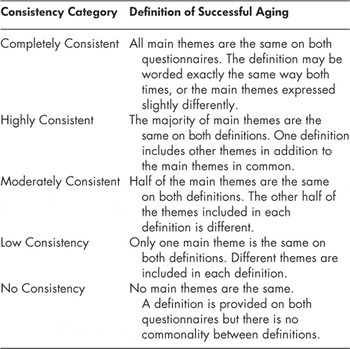
To meet the first objective, the two responses to the identically worded question asking for a definition of successful aging were compared for consistency in main themes. Consistency categories were labeled as Completely Consistent (same main themes provided both times), Highly Consistent, Moderately Consistent, Low Consistency, and No Consistency (two completely different definitions with no main themes in common). A detailed description of the five categories of consistency is provided in Table 1. Three reviewers (authors RT, BL, DB) independently read both definitions of successful aging, for which each reviewer provided a consistency category. Consensus among the three reviewers was reached by choosing the consistency category that two or all three reviewers agreed upon.
Definition of Consistency Categories for pairs of definitions of successful aging

Assessing Characteristics Related to Consistency of Definition of Successful Aging
To address the second objective, at the time the SAQ-2004 was administered we examined the variation in age, physical and mental functioning, activity limitations, and general health and life satisfaction across consistency categories. These factors have been mentioned by others investigating definitions of successful aging (Bowling, Reference Bowling2006; Montross et al., Reference Montross, Depp, Daly, Reichstadt, Golshan and Moore2006; Phelan et al., Reference Phelan, Anderson, Lacroix and Larson2004) and are questions that had been included on all of our SAQs. Other possibilities could have been to explore effects of living arrangements, aspects of retirement, or socio-economic status; however, these factors were found to be quite homogeneous across the cohort at this time of their lives. For example, by 2004, the mean age of the men was 83 years, all were retired, and about 80 per cent lived with a spouse.
We derived three binary variables:
• Excellent or very good self-rated health, versus good, fair, or poor self-rated health
• Excellent or very good life satisfaction, versus good, fair, or poor life satisfaction
• A “yes” answer to the question “Would YOU say you have “AGED SUCCESSFULLY”?” versus any other response to this question (including responses such as “no”, “maybe”, “I don’t know”).
Contingency tables were constructed for each of these binary variables by the five consistency categories. For each 2 × 5 contingency table, a chi-square test for independence (with 4 degrees of freedom) was calculated to test the hypothesis of equality of the proportions for each binary variable across the five consistency categories.
We calculated the Mental Component Score and Physical Component Score, as well as the domain-specific sub-scale scores from the SF-36 to examine the relationship between consistency categories and (a) functioning and (b) change in functioning. Since six of the eight sub-scales of the SF-36 are grounded on the premise “During the past 4 weeks …”, and the two surveys were mailed 4 weeks apart, we were able to assess how reported changes in specific components of functioning might influence consistency of the respondent’s definition of successful aging. The hypotheses of equality of mean values of these continuous variables, as well as number of basic and instrumental activities of daily living across the five consistency categories, were tested using one-way analysis of variance.
Results
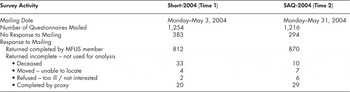
Response to the two surveys is shown in Table 2. The Short-2004 was mailed to 1,254 study members, with 871 responses to the mailing (69% response rate) and 812 (65%) surveys completed and returned. Four weeks later the SAQ-2004 was mailed to 1,216 men, with 922 responses (76%) providing 870 (72%) completed surveys. Some men returned only one survey, but 734 men, at a mean age of 82 years, returned both. Among these 734, 6 men did not provide a definition of successful aging on either questionnaire, and 74 others provided one definition on one of the two questionnaires and either left his second definition “blank” or wrote “see previous questionnaire”. Thus, 654 men provided two definitions of successful aging, one on each survey.
Response to the Spring Short Aging Questionnaire (Short-2004) at Time 1 and Successful Aging Questionnaire (SAQ-2004) at Time 2

Consistency of Definition of Successful Aging
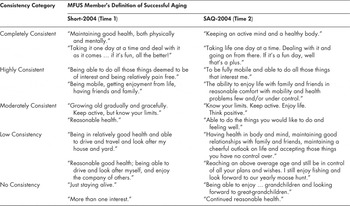
Table 3 presents examples of pairs of successful aging definitions typical of men in each of the five consistency categories. Some men in the Completely Consistent category worded their two definitions exactly the same (e.g., via the short phrase “keep busy”). Others worded their two definitions differently, but included all the same common themes.
Examples of consistency categories for pairs of definitions of successful aging provided by MFUS members four weeks apart

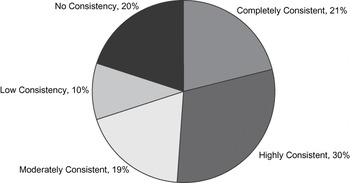
Our evidence for consistency is based on the distribution of consistency category scoring of the 654 pairs of definitions. As presented in Figure 1, just over half (51%) of the men provided Completely Consistent or Highly Consistent definitions of successful aging. An additional 123 men (19%) were labeled Moderately Consistent with half of the same themes on both definitions. The 10 per cent of men with only one main theme repeated were labeled Low Consistency. A definition of consistency based on at least half of the themes repeated (i.e., placed in Moderately Consistent or better) would identify almost 70 per cent of the men. Only 20 per cent were considered to have No Consistency in their two definitions. It should also be noted that 74 men provided a definition on the first questionnaire and wrote “see previous questionnaire” on the second questionnaire. If these 74 men were placed in the Completely Consistent category, then 29 per cent of the 728 respondents would be in the Completely Consistent category and 56 per cent would be in Completely Consistent or Highly Consistent categories.
Distribution of consistency for 654 pairs of definitions of successful aging

Characteristics and Changes in Characteristics of Participants
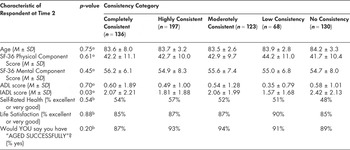
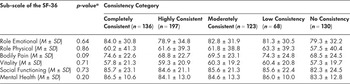
No significant differences (p > 0.05) were apparent in mean age and mean SF-36 Physical or Mental Component Score across the five consistency categories. As shown in Table 4, only the mean number of limitations in instrumental activities of daily living (IADL) varied significantly (p = 0.03) across consistency categories. The greatest number of limitations were reported by those at the two extremes of the consistency scale. That is, a greater mean number of limitations in instrumental activities were reported by those with Completely Consistent definitions or those with No Consistency in their two definitions. The proportion of men reporting high self-rated health, high life satisfaction, or having aged successfully did not significantly vary across the five consistency categories. As presented in Table 5, there was no statistical variation across the five consistency categories in any of the means of the six SF-36 sub-scales assessing change in functioning “During the past 4 weeks …”.
Distribution of characteristics of respondents by consistency category for pairs of definitions of successful aging

a F test for equality of means, one-way ANOVA
b chi-square test for independence, from 2 × 5 contingency table
ADL = activities of daily living; IADL = instrumental activities of daily living; M = mean; SD = standard deviation
Distribution of six sub-scales of the SF-36 by consistency category for pairs of definitions of successful aging

a F test for equality of means, one-way ANOVA
M = mean; SD = standard deviation
Discussion
To our knowledge, this is the first report of an examination of the consistency of lay definitions of successful aging. Our methodology relied on a man’s writing a narrative response to an open-ended question. The phrase “successful aging” did not appear on the questionnaire anywhere before the man was asked to define successful aging. We have shown that 80 per cent of our cohort of older Canadian men, when asked 4 weeks apart, provided two definitions of successful aging containing at least one main theme in common and that 70 per cent of men provided pairs of definitions with at least half of their main themes in common.
There is no “gold standard” for consistency. It is unreasonable to expect 100 per cent of respondents to reproduce exactly the same definition over any period of time. However, in order to interpret our results, we are left with the question, What is a reasonable degree of consistency? To be consistent, should 90, 80, or 70 per cent of definitions be repeated with exactly the same themes, most of the same themes, half of the same themes? We present our results in a positive light and feel we have sufficient evidence to support the premise that the majority of our older men are not just providing a definition of successful aging at random, and indeed that there is consistency to their definitions of successful aging.
We found no association between consistency of definitions and respondent characteristics, such as age, mental and physical functioning, activity limitations, and self-rated health. Also, no associations were apparent between consistency of definitions and recent changes in respondent functioning. Thus, inconsistencies in pairs of definitions can be attributed to random, rather than systematic, variation.
We acknowledge caveats to our methodology for assessment of consistency. Our coding system for definitions of successful aging includes nine main themes (Tate et al., Reference Tate, Loewen and Bayomi2009). Some men reported definitions with multiple main themes. The number of themes in a definition has clear implications for the assessment of a consistency category. As the number of themes in a definition increases, the likelihood of providing Completely Consistent definitions is likely to decrease. Another factor that may influence the assessment of consistency is the ability of reviewers to determine a consistency score. The three reviewers agreed with their categorization in 299 instances, although two of three reviewers agreed and the third differed by no more than one category (consensus was determined by the majority) in 303 cases. For only 52 pairs of definitions (8%), the three reviewers disagreed with their initial consistency categorization, and these were resolved with an open review to reach consensus. Hence, 92 per cent of our definition pairs were placed in consistency categories with minimal or no disagreement among reviewers.
A limit to the generalizability of our results is that MFUS is a cohort of very old men. Consistency of definitions of successful aging might be different for women or for men at younger ages. The SAQ is a postal survey mailed in the spring to MFUS members annually requesting written definitions of successful aging. With study members living all across Canada, and indeed in countries around the world, it is not feasible to conduct annual face-to-face interviews. We acknowledge this as a limitation to our protocol that leads to our inability to probe for more detail behind a man’s definition of successful aging. An example of how probing would prove to be useful would be if a man wrote “golfing” as a component of his definition of successful aging. Without further clarification, should “golfing” imply a main theme of physical activity (walking the course), or social aspects of his life (an outing with friends), or maintaining interests (for a man who has golfed for many years)?
We believe it is important to learn not just if, but how and why, an elderly individual might age successfully, despite illness and adversity. To do so, we must consider the concept of successful aging throughout the lifespan. An ongoing goal of MFUS is to examine the dynamic process of successful aging. We continue to survey cohort members annually for their definitions of successful aging. We plan to study factors that support repeated common themes provided in annual definitions or precede change in their definitions of successful aging. We will examine the implication of change in the themes of a man’s definition through subsequent follow-up.
In support of these broad objectives for MFUS, it is important that we first establish that the themes in a man’s definition of successful aging are at least consistent or dependable over the short term. By establishing consistency in his definitions, as different themes emerge over a longer period (one year or longer), such differences might be interpreted as real change in his view of successful aging. Our analysis has provided evidence for the consistency of definitions of successful aging within a short period of time. This evidence supports the value of our and others’ continued examination of the precursors and implications of older individual’s definitions of successful aging.