


Introduction
Insomnia is a chronic difficulty that involves problems initiating or maintaining sleep, poor sleep quality, or waking in the morning not feeling restored. The definition of insomnia also includes that the sleep difficulties are accompanied by daytime symptomatology (Edinger et al., Reference Edinger, Bonnet, Bootzin, Doghramji, Dorsey and Espie2004), e.g. fatigue/malaise, social/vocation dysfunction, mood disturbance/irritability, daytime sleepiness, and concerns or worries about sleep. It is one of the most prevalent health problems reported by 10% of the population (Ancoli-Israel and Roth, Reference Ancoli-Israel and Roth1999). The consequences for the sufferer include functional impairment, work absenteeism, impaired concentration and memory, and increased use of medical services (Roth and Ancoli-Israel, Reference Roth and Ancoli-Israel1999). It is therefore regarded as a serious public health problem.
The focus in treatment research on insomnia has tended to be almost exclusively on the night-time symptoms associated with insomnia. This is surprising and problematic given that diagnostic systems (e.g. DSM-IV) and research criteria (Edinger et al., Reference Edinger, Bonnet, Bootzin, Doghramji, Dorsey and Espie2004; social/vocational dysfunction or poor school performance) require that some form of functional impairment has to be related to the night-time symptomatology in order to fulfill the criteria for insomnia. The World Health Organization also underscores the aspect of dysfunction by highlighting disability as an overarching term covering impairments, activity limitations, and participation restrictions (World Health Organization, 2011). As a result of the almost exclusive focus on night-time symptoms in treatment research on insomnia, knowledge on how various interventions influence day-time symptomatology is lacking. Although this is problematic from a theoretical perspective, the lack is also apparent from a clinical viewpoint (Riedel and Lichstein, Reference Riedel and Lichstein2000). The lack of standardized dysfunction measures is apparent in treatment settings and within the treatment literature. Several extant scales [e.g. the Pittsburgh Sleep Quality Index (Buysse, Reynolds, Monk, Berman and Kupfer, Reference Buysse, Reynolds, Monk, Berman and Kupfer1989) and the Insomnia Severity Index (Bastien, Vallieres and Morin, Reference Bastien, Vallieres and Morin2001)] contain single items assessing functional impairment. These impairment items do not, however, provide information regarding which life domain impairment can be observed and are not validated in their own right.
In trials investigating cognitive-behavioural therapy for insomnia (CBT-I), the focus has mainly been on subjective sleep parameters (Morin et al., Reference Morin, Bootzin, Buysse, Edinger, Espie and Lichstein2006). Across the majority of CBT studies, indexes of sleep onset latency, wake after sleep onset, sleep quality, and total sleep time are commonly included. More recent CBT trials also incorporate indexes of daytime symptoms, such as anxiety, depression, fatigue, sleepiness, and health measures. Although it is a methodological advantage and of clinical relevance to index both subjective sleep and day-time symptoms, very few clinical investigations have yet used instruments tapping dysfunction, despite that functional impairment is considered a diagnostic feature of insomnia (Edinger et al., Reference Edinger, Bonnet, Bootzin, Doghramji, Dorsey and Espie2004).
To my knowledge, only two dysfunction measures have been used in the CBT-I treatment literature. The first one is the Insomnia Impact Scale (IIS; Hoelscher, Ware and Bond, Reference Hoelscher, Ware and Bond1993), assessing the impact of poor sleep on wakeful functioning (physical, cognitive, emotional, social, and occupational aspects). The IIS is a self-report instrument that measures the participant's level of agreement to 40 statements. The IIS has been shown to discriminate patients with insomnia that presented at a sleep disorder centre, those in college, and self-reported normal sleepers. Two disadvantages of the IIS may limit its use in treatment research and clinical settings: (1) the scale does not have validated norms and, perhaps more importantly, (2) the instrument does not appear to be sensitive to treatment. For example, in two separate investigations, no significant change on the IIS over time was demonstrated for relaxation training, sleep compression, and relaxation plus stimulus control (Lichstein, Riedel, Wilson, Lester and Aguillard, Reference Lichstein, Riedel, Wilson, Lester and Aguillard2001; Lichstein, Wilson and Johnson, Reference Lichstein, Wilson and Johnson2000).
The second dysfunction measure that has been used in the CBT-I treatment literature is the Work and Social Adjustment Scale (WSAS; Mundt, Marks, Shear and Greist, Reference Mundt, Marks, Shear and Greist2002). The WSAS is a 5-item instrument that assesses an individual's ability to perform daily activities, including work, home management, family, and relationship interaction as well as social and private leisure activities. Each item is rated on a 9-point scale ranging from 0 (not at all a problem) to 8 (very severely impaired). The total score ranges from 0 to 40, and a high score denotes high dysfunction. The psychometric properties of the WSAS were originally examined in patients with depression and obsessive-compulsive disorder (Mundt et al., Reference Mundt, Marks, Shear and Greist2002). The findings suggested acceptable internal consistency and test-retest reliability, high correlations with clinician interviews, relatively high correlations with disorder severity, and sensitivity to treatment change. The WSAS was also reported by patients as an instrument easy to understand and to complete. The WSAS has further been shown to display acceptable psychometric properties in patients with phobic disorders (Mataix-Cols et al., Reference Mataix-Cols, Cowley, Hankins, Schneider, Bachofen and Kenwright2005); the internal consistency was acceptable to high, the analyses indicated a one-factor solution (47–73% of the variance), there were high correlations between self-ratings and clinical ratings, and the WSAS showed sensitivity to treatment change. The reliability and validity of the WSAS has further been demonstrated in patients with chronic fatigue syndrome (CFS) (Cella, Sharpe and Chalder, Reference Cella, Sharpe and Chalder2011). More specifically, in CFS patients, the internal consistency of the WSAS was acceptable to high and analyses indicated a one-factor solution (59–68% of the variance). Also, higher scoring on the WSAS was related to a high number of physical symptoms as well as severe fatigue, depression, anxiety, poor sleep quality, and poor physical fitness. In addition, following CBT for CFS, the WSAS score decreased significantly and remained stable at follow-up.
The WSAS has so far been used in three treatment trials on insomnia patients. First, the WSAS was employed in an open trial in which cognitive therapy for insomnia was administered to 19 insomnia patients (Harvey, Sharpley, Ree, Stinson and Clark, Reference Harvey, Sharpley, Ree, Stinson and Clark2007) and the results showed a significant decrease on the WSAS (within-group d = 2.20, 76% reduction). In the second trial, CBT-I was compared with a wait-list condition (WLC) in patients with insomnia co-morbid with hearing impairment (Jansson-Fröjmark, Linton, et al., Reference Jansson-Fröjmark, Linton, Flink, Granberg, Danermark and Norell-Clarke2012), and the results suggested a significant reduction on the WSAS within the CBT group (d = 1.10–1.22, 41–47% reduction) but not within the WLC group (d = 0.17–0.24, 8–13% reduction). In the third trial, behaviour therapy for insomnia was compared with behaviour therapy plus a constructive worry intervention in primary insomnia patients (Jansson-Fröjmark, Lind and Sunnhed, Reference Jansson-Fröjmark, Lind and Sunnhed2012). Both behaviour therapy (d = 0.57–0.72, 16–18% reduction) and behaviour therapy plus constructive worry (d = 1.27–1.96, 26–37% reduction) resulted in a significant decrease on the WSAS, but no group difference emerged. The WSAS thus displays clear signs of treatment-sensitivity; while active treatments result in moderate to large reductions, control groups show relative stability on the WSAS over time.
The WSAS thus seems to be a promising measure of dysfunction for insomnia patients in research and clinical settings. Although the WSAS appears to be treatment sensitive, a number of questions regarding its psychometric properties remain: for example, its internal consistency, factorial validity, test-retest reliability, cut-off, convergent validity, and criterion validity. The aim of the current study was to examine the psychometric properties of the WSAS for use in patients with chronic insomnia.
Method
Overview of the design
To examine the psychometric properties of the WSAS in insomnia patients, 73 patients with primary, chronic insomnia were recruited. The statistical analyses then focused on exploring the reliability and validity of the WSAS in insomnia patients. The study was approved by the Centre for Research Ethics in Uppsala, Sweden, and followed the ethical guidelines as formulated by the American Psychological Association. All the participants signed an informed consent document.
Study participants
The sample consisted of 73 primary insomnia patients from three different subsamples. The diagnostic assessment was mainly executed by the author (87% of all the patients in this study), two clinical psychologists (Ida Flink and Annika Norell-Clarke), and two psychology students during their 5th year of training (Marcus Lind and Rikard Sunnhed). After inclusion, all the patients completed baseline measures.
First, 32 patients were recruited for a treatment study comparing CBT-I with a wait-list condition in patients with insomnia co-morbid with hearing impairment (subsample I; Jansson-Fröjmark, Lind et al., Reference Jansson-Fröjmark, Lind and Sunnhed2012). Subsample I was recruited from audiology clinics. The candidates were first approached at the clinics and basic criteria were checked. At a later stage, candidates completed sleep diaries at home. A telephone and a face-to-face assessment with a certified psychologist were finally executed. During the face-to-face interview, the Duke Structured Interview for Sleep Disorder (DSISD; Edinger et al., unpublished material) and Structured Clinical Interview for DSM-IV Axis I disorders (SCID-I; First, Gibbon, Spitzer and Williams, Reference First, Gibbon, Spitzer and Williams1997) were administered. The DSISD assesses DSM-IV-TR sleep disorders (i.e. insomnia, hypersomnia, circadian-rhythm sleep disorder, and parasomnia) and associated psychiatric and medical conditions, medications, drugs, substances, beverages, and allergies. The DSISD has showed acceptable reliability and discriminant validity in studies (Carney, Ulmer, Edinger, Krystal and Knauss, Reference Carney, Ulmer, Edinger, Krystal and Knauss2009). If psychiatric symptoms were reported, the Structured Clinical Interview for DSM-IV Axis I disorders (SCID-I; First et al., Reference First, Gibbon, Spitzer and Williams1997) was used. Inclusion criteria were: (1) age between 18 and 65 years; (2) hearing impairment; (3) reporting insomnia complaints (difficulties with sleep initiation, sleep maintenance, early morning awakenings, non-restorative sleep, or poor sleep quality) during the past 6 months (Edinger et al., Reference Edinger, Bonnet, Bootzin, Doghramji, Dorsey and Espie2004); (4) based on a 7-day sleep diary showing sleep onset latency and/or wake time after sleep onset longer than 31 minutes during 3 nights or more in the past week (Lichstein, Durrence, Taylor, Bush and Riedel, Reference Lichstein, Durrence, Taylor, Bush and Riedel2003); and (5) insomnia symptoms causing day-time impairment. Exclusion criteria were: (1) reporting that the cause for the insomnia complaints might be psychiatric symptoms, medical conditions, medications, drugs, substances, beverages, other sleep disorders, or severe tinnitus distress; (2) insomnia better explained by another sleep disorder, psychiatric condition, medical disease, or sleep-disturbing agents; (3) existence of another primary sleep disorder (e.g. sleep apnea); and (4) evidence of a psychiatric or medical condition that required immediate intervention (e.g. suicidal actions or cancer) or one that might be contra-indicated (e.g. psychotic or bipolar disorder), based on the fact that the CBT interventions consisted of sleep restriction, a component that might result in new or aggravated episodes.
Second, 22 patients with insomnia participated in a treatment study investigating the effects of behaviour therapy with behaviour therapy plus constructive worry (subsample II; Jansson-Fröjmark, Linton, et al., Reference Jansson-Fröjmark, Linton, Flink, Granberg, Danermark and Norell-Clarke2012). Subsample II was recruited via advertisements in newspapers and via posters. A telephone and a face-to-face assessment with a certified psychologist or psychology students in their 5th year of training were used to ascertain study criteria. During the face-to-face interview, the Duke Structured Interview for Sleep Disorder (DSISD; Edinger et al., unpublished material) and the PRIME-MD (Spitzer et al., Reference Spitzer, Williams, Kroenke, Linzer, deGruy and Hahn1994) was used. The PRIME-MD is a screening questionnaire and diagnostic interview based on the DSM-IV system. The instrument has shown good concordance between PRIME-MD diagnoses and those of independent mental health professionals using lengthier interview protocols. The PRIME-MD provided the basis for identifying major psychological disorders that are known to affect sleep, including major depressive disorder, generalized anxiety disorder, panic disorder, and posttraumatic stress disorder. With four exceptions, the inclusion and exclusion criteria were identical to those used when screening subsample II: (1) the age criterion was set at 18–75 years; (2) the patients did not have to report hearing impairment; and (3) a score of 15 points or more on the Insomnia Severity Index was required to ensure a clinical level of insomnia (Bastien et al., Reference Bastien, Vallieres and Morin2001); and (4) a score of 3 or more (“much” or more) was required on the worry/distress item from the Insomnia Severity Index. Although the psychology students involved in this study were trained in administering the diagnostic instruments and received supervision, criterion 3 was added to accommodate the fact that the psychology students were relatively inexperienced.
Third, 19 patients with insomnia were self-referred, consecutive patients assessed and treated with CBT-I at our research clinic at Örebro University (subsample III). The patients completed sleep diaries at home and underwent a telephone and a face-to-face assessment with a certified psychologist. Identical to the screening procedure for subsample I, the face-to-face interview consisted of the DSISD (Edinger et al., unpublished material) and the SCID-I (First, Spitzer and Gibbon, Reference First, Gibbon, Spitzer and Williams1996). With two exceptions, the inclusion and exclusion criteria were identical to those used when screening subsample I; the age criterion was set at 18 years and above and the patients did not have to report hearing impairment.
Measures
The following self-report instruments were employed. The Work and Social Adjustment Scale was used to assess dysfunction (WSAS; score range: 0–40; Mundt et al., Reference Mundt, Marks, Shear and Greist2002). The five WSAS items determine the following impairment domains: (1) work; (2) home management; (3) social leisure activities; (4) private leisure activities; and (5) relationships with others. For all the items, the patients were instructed to complete the items in relation to their current sleep problem. The Insomnia Severity Index was used to assess severity of insomnia (ISI; score range 0–28; Bastien et al., Reference Bastien, Vallieres and Morin2001) and consists of seven items focusing upon difficulty falling asleep, difficulty staying asleep, problems waking up too early, dissatisfaction with sleep pattern, function interference due to sleep problem, quality of life impairment as perceived by others, and worry/distress concerning the sleep problem. Daily sleep diaries were completed by the patients during one week and consisted of three sleep parameters [sleep onset latency (SOL in minutes), wake after sleep onset (WASO in minutes), and total sleep time (TST in hours)].
Procedure
The patients were asked at both pre- and posttreatment to complete the WSAS, the ISI, and sleep diary at home, and then to return the instruments by mail or by giving them to a member of our research group at a prescheduled appointment. For subsamples II and III, the WSAS was completed at two time points (prescheduled appointments), one week apart, to examine its test-retest reliability. In between the pre- and the posttreatment, all the participants received either a cognitive-behaviourally framed therapy or a wait-list. The active interventions followed a manual, lasted for four to seven sessions, and were administered on an individual basis by certified psychologists or psychology students in their 5th year of training. In subsample I (Jansson-Fröjmark, Linton, et al., Reference Jansson-Fröjmark, Linton, Flink, Granberg, Danermark and Norell-Clarke2012), participants were randomized to either cognitive-behavioural therapy for insomnia (CBT-I) or a wait-list condition (WLC). In subsample II (Jansson-Fröjmark, Linton, et al., Reference Jansson-Fröjmark, Linton, Flink, Granberg, Danermark and Norell-Clarke2012), participants were randomized to either behaviour therapy (BT-I) or behaviour therapy plus constructive worry (BT-I + CW). In subsample III, participants were administered cognitive-behavioural therapy for insomnia (CBT-I).
Statistical analysis
Descriptive statistics were first used to examine the participants’ demographic and clinical parameters. To investigate potential differences between the three subsamples, analysis of variance (post-hoc test: Games-Howell) and chi-square analysis were used. Further, Pearson's correlation coefficient was employed to examine associations between on the one hand the WSAS and on the other hand demographic and clinical parameters. To investigate internal consistency, Cronbach's alpha was used, and 0.70 was considered as the minimum acceptable criterion of instrument internal reliability (Kline, Reference Kline1993). To reveal any latent variables within the WSAS that cause the manifest variables to co-vary, exploratory factor analysis was used in line with recommendations (Osborne and Costello, Reference Osborne and Costello2005). To ensure that the characteristics of the data set were suitable for the factor analysis to be conducted on the study sample, the Kaiser-Meyer-Olkin measure of sampling adequacy (KMO) and the Bartlett Test of Sphericity (BTS) were conducted on the data. A maximum likelihood factor extraction procedure with oblique rotation (direct oblimin) was employed since this approach is particularly useful in extracting meaningful factors and because of the possibility that the extracted factors may be correlated (Osborne and Costello, Reference Osborne and Costello2005). The scree test was used to decide the number of meaningful factors that might be in the data set. The minimum loading of an item was determined at .32, a recommended threshold (Tabachnik and Fidell, Reference Tabachnick and Fidell2001). Test-retest reliability was examined with Pearson's correlation coefficient. To derive a cut-off for the WSAS, a receiver-operator characteristic (ROC) curve was used to graphically depict the relation between the sensitivity and specificity of the WSAS. The sensitivity represents the probability of detecting a case when it is present, and specificity represents the probability of not identifying a case when it is not present. The ROC curve is plotted for all values; the further the ROC curve lies above the diagonal reference line, the more accurate the test (Mossman and Somoza, Reference Mossman and Somoza1991). The area under the curve (AUC) is another index of accuracy and represents the probability that a test result for a randomly chosen positive case will exceed the result for a negative case. Test accuracy has been defined as “low” for AUC values under 0.7, “moderate” for AUC values between 0.7 and 0.9, and “high” for values greater than 0.9 (Swets, Reference Swets1988). Convergent validity was examined with Pearson's correlation coefficient. Criterion validity was investigated by stratifying the participants into three categories based on the ISI scores and then comparing the three categories with one another on the WSAS with analysis of variance. Treatment sensitivity was examined with t-tests, employing pre- and post-treatment data.
Results
Study participants
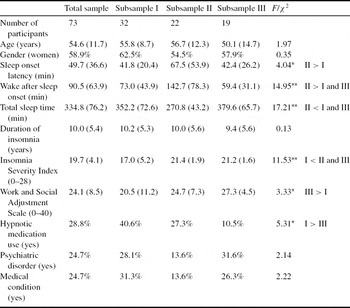
The descriptive statistics for the total sample and for the three separate subsamples are presented in Table 1. In the total sample, the mean age was approximately 55 years, and 59% were women; the subsamples did not differ in terms of age and gender. On average, the participants’ SOL was approximately 50 minutes, WASO 90 minutes, and TST 335 minutes; subsample II had higher SOL and WASO and lower TST than subsample I as well as higher WASO and lower TST than subsample III. In the total sample, the duration of insomnia was on average 10 years; no subsample differences emerged. The patients’ average score on the ISI was 19.7; subsamples II and III had a higher ISI score than subsample I. The patients’ average WSAS score was 24.1; subsample III had a higher WSAS score than subsample I. For WSAS item 1 (work) the mean was 4.8 (SD = 2.0), for item 2 (home management) 4.4 (SD = 1.7), for item 3 (social leisure activities) 4.9 (SD = 2.1), for item 4 (private leisure activities) 5.5 (SD = 2.1), and for item 5 (relationships with others) 4.6 (SD = 2.0).
Descriptive statistics for the study participants in the total sample and in the three subsamples

p < .05. **p < .001
Of the patients, nearly 30% reported using a hypnotic medication; more patients in subsample I than in III reported hypnotic medication use. As assessed by the SCID-I or the PRIME-MD, 24.7% fulfilled criteria for a psychiatric disorder (generalized anxiety disorder: n = 6, major depression: n = 6, specific phobia: n = 2, panic disorder: n = 1, social phobia: n = 1, obsessive-compulsive disorder: n = 1, and anorexia nervosa: n = 1). Of the patients, 24.7% self-reported a medical condition (pain: n = 9, headache: n = 4, irritable bowel syndrome: n = 3, and pulmonary disease: n = 2). No subsample differences emerged for psychiatric disorders or medical conditions.
Association between patient characteristics and the WSAS
No significant correlation emerged for the association between age and the WSAS (r = −.21, p = .10) and there was no statistical gender difference on the WSAS (t = −0.25, p = .81). There were no significant correlations between the WSAS and sleep-related clinical parameters (SOL: r = −.03, p = .82; WASO: r = .16, p = .23; TST: r = .09, p = .50; or duration of insomnia: r = −.16, p = 23). There was not a significant difference on the WSAS between those who used hypnotic medication (M = 25.7, SD = 6.5) and those who did not (M = 23.5, SD = 9.1) (t = −0.84, p = .41), between those who fulfilled criteria for a psychiatric disorder (M = 23.6, SD = 9.4) and those who did not (M = 24.2, SD = 8.3) (t = 0.24, p = .81), and between those who reported a medical condition (M = 24.8, SD = 9.2) and those who did not (M = 23.9, SD = 8.5) (t = −0.35, p = .73).
Internal consistency, factorial validity and test-retest reliability of the WSAS
The inter-relationships between the five WSAS items are displayed in Table 2. As can be seen, the inter-relationships between the WSAS items were between .47 and .89. The internal consistency of the WSAS was high at α = .91. An exploratory factor analysis with the maximum likelihood factor extraction procedure with oblique rotation (direct oblimin) was executed (Osborne and Costello, Reference Osborne and Costello2005). Preparatory analyses showed that the KMO yielded an index of 0.78 and the BTS was significant (χ2 ( df = 10) = 244.95, p < .001). The scree plot clearly suggested a one-factor solution, dysfunction, accounting for 73.7% of the variance (Eigenvalue: 3.69). The factor loadings were as follows: for the first item .64, for the second item .84, for the third item .98, for the fourth item .90, and for the fifth item .70.
Correlations between the Work and Social Adjustment Scale and the Insomnia Severity Index

**Significant at the .01 level
Notes: WSAS = Work and Social Adjustment Scale; ISI = Insomnia Severity Index
Test-retest reliabilities were computed for the five WSAS items separately and for the entire scale. The test-retest reliability for item 1 was r = .90, for item 2 r = .95, for item 3 r = .98, for item 4 r = .95, and for item 5 r = .99. The test-retest reliability for the entire WSAS was r = .99.
Cut-off for the WSAS
A receiver-operating characteristics (ROC) analysis was executed to establish a cut-off for the WSAS. In the ROC analysis, insomnia diagnostic categories (according to the ISI; Bastien et al., Reference Bastien, Vallieres and Morin2001) were used as the state variables [subthreshold insomnia 8–14 points (n = 11) versus moderate or severe clinical insomnia 15–28 points (n = 62)] and the WSAS as the test variable. The area under the curve (AUC) value was significant and high at .92 (SE = .04). The optimal cut-off for discriminating between those with subthreshold from those with moderate or severe clinical insomnia was at 17 points. Employing the cut-off at 17 points resulted in 88.2% sensitivity (categorizing those with moderate or severe clinical insomnia correctly) and 77.8% specificity (categorizing those with subthreshold insomnia correctly).
Convergent and criterion validity of the WSAS
The convergent validity was examined by correlating the WSAS and its five items with the ISI and its seven items. Of special importance was the correlation between the WSAS and its items and the function interference item from the ISI (“To what extent do you consider your sleep problem to interfere with your daily functioning?”). As can be seen in Table 1, the WSAS was significantly, positively correlated at a high degree with the ISI (r = .72). Impairment at work and during private leisure activities was more strongly associated with the ISI (r = .67–.71), relative to impairment at home, during social leisure activities, and in relationships with others (r = .53–.58). The WSAS was most strongly associated with the ISI item determining function interference (r = .71), followed by worry/distress (r = .65, item 7), problem waking up too early (r = .61, item 3), quality of life impairment (r = .55, item 6), dissatisfaction with sleep pattern (r = .41, item 4), difficulty staying asleep (r = .41, item 2), and difficulty falling asleep (r = −.03, item 1).
Criterion validity was further explored by stratifying the patients’ ISI scores into the following categories (Bastien et al., Reference Bastien, Vallieres and Morin2001): 8–14 points indicating subthreshold insomnia (n = 11), 15–21 points suggesting moderate clinical insomnia (n = 38) and 22–28 points indicating severe clinical insomnia (n = 24). The average WSAS score was 12.6 (SD = 6.9) for those with subthreshold insomnia, 23.7 (SD = 7.8) for those with moderate clinical insomnia, and 29.9 (SD = 3.4) for those with severe clinical insomnia. There was a significant difference on the WSAS across the three groups (F = 21.93, p < .001). The severe clinical insomnia group had a higher WSAS score than the subthreshold (p < .001) and moderate clinical (p = .005) insomnia groups. The moderate clinical insomnia group had a higher WSAS score than the subthreshold insomnia group (p < .001).
Treatment sensitivity
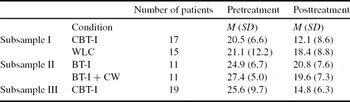
To examine the treatment sensitivity of the WSAS, t-tests were used, employing pre- and posttreatment data (see Table 3). Due to the variability in therapies received, the three subsamples were analysed separately. For those receiving cognitive behaviour therapy for insomnia in subsample I, there was a significant reduction in WSAS scores [t(16) = 6.02, p < .001]. No significant change on the WSAS occurred for those in the wait-list control in subsample I [t(14) = 1.27, p = .225]. For those receiving behaviour therapy for insomnia and those administered behaviour therapy for insomnia plus constructive worry in subsample II, there was a significant reduction on the WSAS [t(10) = 3.43, p = .006; t(9) = 4.35, p = .002]. For those receiving cognitive behaviour therapy for insomnia in subsample III, there was a significant reduction in WSAS scores [t(18) = 7.79, p < .001].
Treatment sensitivity: WSAS scores across two assessment points for patients receiving cognitive behavior therapy for insomnia, behaviour therapy for insomnia, behaviour therapy for insomnia plus constructive worry compared to a wait-list control

Notes: BT-I = behaviour therapy for insomnia; CBT-I = cognitive behaviour therapy for insomnia; CW = constructive worry; WLC = wait-list control.
Discussion
This study documented strong psychometric properties for the Work and Social Adjustment Scale in insomnia patients. Except for insomnia severity, there was no evidence that the WSAS was associated with the patient characteristics assessed in this study (i.e. age, gender, sleep parameters, insomnia duration, hypnotic medication use, psychiatric disorder, and medical condition). It thus seems that the WSAS in insomnia patients is unrelated not only to demographic parameters but also to variables that could potentially increase dysfunction (e.g. psychiatric disorder). However, it is important to emphasize that the WSAS instruction used in this study asked the participants to respond to the items based on their sleep problem, which, in itself, could explain the non-significant associations between the WSAS and patient characteristics. Nevertheless, it is important to underscore that while this study did not find significant associations between the WSAS and clinical parameters, other investigations have demonstrated inter-relationships between the WSAS and symptom severity. For example, previous research on patients with chronic fatigue syndrome has demonstrated medium-sized associations between the WSAS and fatigue and depression scores (Cella et al., Reference Cella, Sharpe and Chalder2011). Also, in patients with various psychiatric disorders, significant associations have been documented between the WSAS and symptom severity (Mataix-Cols et al., Reference Mataix-Cols, Cowley, Hankins, Schneider, Bachofen and Kenwright2005; Mundt et al., Reference Mundt, Marks, Shear and Greist2002). Based on previous research, the current findings are thus perhaps surprising. Although there are several ways to hypothesize about this, the most parsimonious explanation, in my view, which is strengthened by the high correlation between the WSAS and the ISI in the current study (r = .72), is that there is indeed a high association between the WSAS and symptom severity in insomnia patients. It thus seems as if the WSAS is strongly associated with global perception of insomnia severity (i.e. the ISI) but weakly related to specific correlates of insomnia (e.g. psychopathology or sleep parameters captured in a sleep diary). A surprising finding should also be emphasized: the WSAS was more strongly associated with ISI-indexes of late insomnia than with early and middle insomnia. Although research is lacking, two hypothetical explanations may shed light on this association: (1) relative to difficulties initiating and maintaining sleep, early awakenings are, due to their closer proximity in time to daytime functioning, remembered to a higher degree and may thus fuel perceived dysfunction to a higher degree; and (2) relative to difficulties initiating and maintaining sleep, early awakenings might physiologically lead to more daytime dysfunction.
Other results also suggested favourable psychometric properties of the WSAS. The internal consistency of the WSAS was high, indicating strong reliability (Nunnally, Reference Nunnally1978). The Cronbach's alpha was slightly higher in this study (α = .91) compared to studies using the WSAS on patients with depression or obsessive-compulsive disorder (α = .70–.94; Mundt et al., Reference Mundt, Marks, Shear and Greist2002), patients with phobias (α = .57–.90; Mataix-Cols et al., Reference Mataix-Cols, Cowley, Hankins, Schneider, Bachofen and Kenwright2005), and patients with chronic fatigue syndrome (α = .79–.94; Cella et al., Reference Cella, Sharpe and Chalder2011). The factor analysis in this study indicated that the WSAS determines one factor (dysfunction), accounting for approximately 74% of the variance. Although the variance accounted for by the WSAS has varied across previous studies, the WSAS has consistently been shown to index one factor, namely dysfunction (Mataix-Cols et al., Reference Mataix-Cols, Cowley, Hankins, Schneider, Bachofen and Kenwright2005; Cella et al., Reference Cella, Sharpe and Chalder2011). The test-retest reliabilities were high for the WSAS items separately and for the entire scale (r = .99), and, in relation to a previous study (r = .73: Mundt et al., Reference Mundt, Marks, Shear and Greist2002), the current study indicated a higher test-retest reliability.
Other psychometric properties were also documented for the WSAS in insomnia patients. An optimal cut-off for discriminating between those with subthreshold from those with moderate or severe clinical insomnia was at 17 points (88% sensitivity and 78% specificity). This cut-off at 17 points is similar to the one documented for patients with depression or obsessive-compulsive disorder (20 points; Mundt et al., Reference Mundt, Marks, Shear and Greist2002). Further, the WSAS was significantly, positively associated at a high degree with insomnia severity. The two functional domains with the strongest association with insomnia severity were impairment at work and during private leisure activities. As expected, of all the Insomnia Severity Index items, the WSAS was most strongly related to interference in function, thus indicating convergent validity. Among the other ISI items, the WSAS was also associated at a high degree with worry/distress, problems waking up too early, and quality of life impairment. Criterion validity was established by showing higher WSAS scores among those with severe clinical insomnia, relative to those with moderate clinical and subthreshold insomnia. Also, the moderate clinical insomnia group had a higher WSAS score than the subthreshold insomnia group. The WSAS was also shown to be a treatment-sensitive measure; while active treatments (cognitive-behavioural therapy or behavioural therapy with and without constructive worry) resulted in moderate to large reductions from pre- to post-treatment, a control group (wait-list condition) showed relative stability on the WSAS over time.
A number of methodological limitations may limit the conclusions. First, all the patients were recruited via audiology clinics, advertisements, posters, or patient-initiated referrals to our research clinic, possibly indicating that the findings might not be generalizable to insomnia patients in clinical settings (Davidson, Aime, Ivers and Morin, Reference Davidson, Aime, Ivers and Morin2009). This pertains especially to the normative data and cut-offs for the WSAS that were documented in the current study. It is however important to stress that the current sample, consisting of three subsamples, was relatively heterogeneous, particularly evident on subjective sleep parameters, insomnia severity, dysfunction, and hypnotic medication use. Also, the sample consisted of patients diagnosed with psychiatric disorders or self-reported medical conditions, a typical finding in epidemiological studies. The heterogeneity could possibly be viewed as confirmation that the current sample is relatively representative of insomnia patients in clinical settings, such as primary care. A second limitation might be the limited sample size when using factor analysis. However, for two reasons, the limited sample size might be of less importance in the current study: first, the subject to item ratio (number of subjects divided by number of scale items) in the current study was 15:1, higher than what is commonly used in psychological research (10:1; Osborne and Costello, Reference Osborne and Costello2005). Second, given the strong data documented in this paper (e.g. high communalities), a small sample size can still provide accurate results (Osborne and Costello, Reference Osborne and Costello2005). The factor-analytical findings should nevertheless be interpreted with caution. Third, although participants were instructed to respond to the WSAS items in relation to their current sleep problem, it cannot be ruled out that the daytime impairment (detected by the WSAS) was also, at least partially, due to other clinical correlates (e.g. anxiety, depression, or pain) and not only to the patients’ insomnia complaints.
Taken as a whole, the current study indicated that the WSAS is a reliable and valid measure of dysfunction in chronic insomnia. To my knowledge, this is the first dysfunction measure with not only strong psychometric properties for patients with insomnia but also with clear, consistent indications of treatment-sensitivity. Additional advantages that underline its potential usefulness in clinical and research settings are its exclusive focus on dysfunction as well as the fact that the WSAS is short and appears to be easy to complete. Based on the current findings, the use of WSAS is recommended both for assessment and treatment evaluation.




Comments
No Comments have been published for this article.