Learning a second language (L2) is a variable process, and speakers often differ in their acquisition of each component of the linguistic system. Attainment of nativelike perception and production of L2 phonetic segments has been shown to be an especially difficult task (Flege, Yeni-Komshian, & Liu, Reference Flege, Yeni-Komshian and Liu1999; Mack, Reference Mack1989; Pallier, Bosch, & Sebastián-Gallés, Reference Pallier, Bosch and Sebastián-Gallés1997; Sebastián-Gallés & Soto-Faraco, Reference Sebastián-Gallés and Soto-Faraco1999). While most people are familiar with the notion of speaking with a “foreign” or first language (L1)-influenced accent, previous studies have shown that language users also “hear with an accent” (Jenkins, Strange, & Polka, Reference Jenkins, Strange, Polka, Lubinski and Dawis1995). There is ample evidence that bilinguals of various language pairs show language-specific perception patterns reflecting their attunement to the phonology of their L1, which is typically their dominant language. For instance, native English-speaking adults experience difficulty discriminating the Hindi dental versus retroflex initial stop contrast (Polka, Reference Polka1991; Werker & Lalonde, Reference Werker and Lalonde1988), and Japanese speakers often have difficulties categorizing and discriminating the English /r/–/l/ contrast (Goto, Reference Goto1971; MacKain, Best, & Strange, Reference MacKain, Best and Strange1981; Miyawaki et al., Reference Miyawaki, Strange, Verbrugge, Liberman, Jenkins and Fujimura1975; Sheldon & Strange, Reference Sheldon and Strange1982). The examination of the perception of language-specific phonological contrasts provides an opportunity to better understand how bilinguals categorize speech sounds, how sensitive they are to phonetic variation in their nondominant language, how cross-linguistic influence hinders their ability to perceive L2 sounds natively, and how these sounds are stored in the bilingual mental lexicon.
Research on the acquisition of L2 phonological contrasts has produced evidence of maturational effects, showing that late learners are typically less successful than early learners in producing and perceiving L2 sounds natively and typically exhibit accent transfer from their L1 (DeKeyser, Reference DeKeyser2000; Flege, Reference Flege, Meyer and Schiller2003; Lenneberg, Reference Lenneberg1967; Patkowski, Reference Patkowski1990; Scovel, Reference Scovel1988; see Long, Reference Long1990, for a review). This is not a surprising outcome based on L1 acquisition studies that have shown that the L1 sound system becomes “entrenched” at a very young age. Language discrimination is an imperative task for the bilingual infant, who very early in life needs to be able to separate the input received by identifying the set of phonetic segments that is relevant to his/her specific language and map them onto the phonological categories for that language. Over the course of the first year of life, monolingual and bilingual infants are considered to be generalized listeners, capable of discriminating between both native and nonnative speech contrasts. However, during their first year of life, there is early phonological attunement, and these infants become specialized listeners, whose language discrimination is closely restricted to the phonemic inventory of their own native language or languages (Bosch & Sebastián-Gallés, Reference Bosch and Sebastián-Gallés2003; Kuhl et al., Reference Kuhl, Conboy, Coffey-Corina, Padden, Rivera-Gaxiola and Nelson2008; Maye, Weiss, & Aslin, Reference Maye, Weiss and Aslin2008; Werker & Tees, Reference Werker and Tees1984). There is evidence of age of acquisition effects in many L2 acquisition studies, but these acquisition deficits are not expected to affect early bilinguals who have been exposed to two languages and have used them continuously since birth.
Even though early bilinguals should have everything in their favor to be able to acquire phonetic contrasts that are particular to any one of their languages, previous research has claimed that age of acquisition does not necessarily guarantee that the perception of L2 sounds is going to be nativelike (Flege & MacKay, Reference Flege and MacKay2004). A frequently cited example of phonological deficits despite early acquisition is of Spanish–Catalan bilinguals in Barcelona, who have been reported to have difficulties in acquiring the Catalan-specific mid vowel contrasts. These studies have shown that early and extensive exposure to an L2 (i.e., Catalan) may not be sufficient to attain nativelike phonetic abilities in the language (Bosch, Costa, & Sebastián-Gallés, Reference Bosch, Costa and Sebastián-Gallés2000; Pallier et al., Reference Pallier, Bosch and Sebastián-Gallés1997; Sebastián-Gallés & Bosch, Reference Sebastián-Gallés, Bosch, Kroll and de Groot2005; Sebastián-Gallés, Echeverría, & Bosch, Reference Sebastián-Gallés, Echeverría and Bosch2005; Sebastián-Gallés & Soto-Faraco, Reference Sebastián-Gallés and Soto-Faraco1999). The study of Spanish–Catalan bilinguals provides the opportunity to examine the attainment of language-specific phonetic categories by early and highly proficient bilinguals in a situation of extensive language contact. Spanish and Catalan are two Romance languages that, despite being genetically related and sharing many structural similarities, differ crucially with respect to their vowel inventories. Spanish has a five-vowel system, with the vowels contrasting along two dimensions: along the height dimension, there are two high vowels (/i/ and /u/), two mid vowels (/e/ and /o/), and one low vowel (/a/); and along the frontness/backness dimension, there are two front vowels (/i/ and /e/), one central vowel (/a/), and two back vowels (/u/ and /o/). In contrast, Catalan has a seven-vowel system, with an additional contrast in height, distinguishing higher-mid vowels /e/ and /o/ from lower-mid vowels /ɛ/ and /ɔ/ in stressed syllables.
Much recent literature has focused on the production, perception, and processing of the Catalan mid vowels. Over 20 years ago, Recasens (Reference Recasens1991) stated that in Barcelona the four Catalan mid vowels (/e/, /ɛ/, /o/, and /ɔ/) were merging into two Spanish-like mid vowel categories (/e/ and /o/) especially in the speech of the younger speakers in the community. In addition to studies investigating the loss of the contrastive height dimension in production, there is ample evidence that Spanish–Catalan bilinguals in Barcelona have difficulty distinguishing the Catalan mid vowel contrasts, and that Spanish dominants in particular are significantly less accurate than Catalan-dominant bilinguals in discriminating between the /e/–/ɛ/ contrast (Bosch et al., Reference Bosch, Costa and Sebastián-Gallés2000; Navarra, Sebastián-Gallés, & Soto-Faraco, Reference Navarra, Sebastián-Gallés and Soto-Faraco2005; Pallier et al., Reference Pallier, Bosch and Sebastián-Gallés1997; Sebastián-Gallés & Soto-Faraco, Reference Sebastián-Gallés and Soto-Faraco1999). These difficulties in perception have also been shown to extend to the lexicon (Larsson, Vera-Constán, Sebastián-Gallés, & Deco, Reference Larsson, Vera-Constán, Sebastián-Gallés and Deco2008; Pallier, Colomé, & Sebastián-Gallés, Reference Pallier, Colomé and Sebastián-Gallés2001; Sebastián-Gallés et al., Reference Sebastián-Gallés, Echeverría and Bosch2005; Sebastián-Gallés, Rodríguez-Fornells, de Diego-Balaguer, & Díaz, Reference Sebastián-Gallés, Rodríguez-Fornells, de Diego-Balaguer and Díaz2006; Sebastián-Gallés, Vera-Constán, Larsson, Costa, & Deco, Reference Sebastián-Gallés, Vera-Constán, Larsson, Costa and Deco2008). A number of models, including the speech learning model (Flege, Reference Flege and Strange1995), the perceptual assimilation model (Best, Reference Best and Strange1995), and Perceptual Assimilation Model for Language Learners (Best & Tyler, Reference Best, Tyler, Bohn and Munro2007), predict that the acquisition of L2 segments depends on the perceived phonetic similarity between these sounds in the L2 and the most similar segments in the L1 phonetic inventory. Therefore, the acquisition of the Catalan-specific mid vowel contrasts by Spanish speakers can pose a severe challenge because both elements of the contrast may be assimilated to the same L1 category.
In order to be considered nativelike, bilingual speakers/hearers must acquire a nonnative phonemic inventory containing phonological contrasts that may not exist in their L1, and must also establish lexical representations that encode these novel L2 contrasts. Early learners, as opposed to adult L2 learners, are expected to be capable of establishing additional phonetic categories for similar L2 sounds, as early learners’ L1 phonetic categories are still malleable while late learners’ L1 categories are already fully developed. One of the aims of this study is to examine in which ways L1 phonemic categories interact with the acquisition of L2-specific categories when the acquisition of L2 contrasts occurs at an early age, and how different input distributions affect the acquisition of phonological contrasts. Spanish-dominant bilinguals in Majorca, with extended experience in the L2, and especially with appropriate quantity and quality of input, may be able to overcome assimilation, and as a result develop a separate category for the L2 sound(s). In the case that Spanish-dominant bilinguals in Majorca are able to discriminate between the Catalan mid vowel contrasts, can we assume that these bilinguals have established lexical representations that encode these language-specific mid vowel contrasts in their lexicon?
The main goal of the present study is to examine the perception and processing of the Catalan mid vowel contrasts (/ɛ/–/e/ and /ɔ/–/o/) by 60 early and highly proficient Spanish–Catalan bilinguals in a different bilingual setting (Majorca, Spain), who have been raised in a bilingual community and who started learning their L2 before 4 years of age. The investigation of the perceptual abilities of early Spanish–Catalan bilinguals in Majorca provides the opportunity to considerably reduce confounding factors that could have influenced previous results in Barcelona. Due to differences in the historical evolution of the vowel systems in the dialects of Catalan, Majorcan Catalan has a phonological system and lexical distribution distinct from the variety spoken in Barcelona, and this variation particularly affects the Catalan mid vowel contrasts.Footnote 1 This study contributes new data to the study of the relationship between the perception and processing of both Catalan mid vowel contrasts by early and highly proficient bilinguals along a continuum of language dominance.
PERCEPTION OF THE CATALAN MID VOWEL CONTRASTS
The influence of early language exposure and the role it plays on the perceptual abilities of Spanish–Catalan bilinguals has been the subject of a large body of research, specifically in the urban center of Barcelona. Pallier et al. (Reference Pallier, Bosch and Sebastián-Gallés1997) investigated Spanish–Catalan bilinguals’ perception of the Catalan /e/–/ɛ/ contrasts using a seven-step synthesized continuum. Forty Spanish–Catalan bilinguals completed an identification task, an AX discrimination task, and a typicality judgment task. The results showed robust differences between Catalan- and Spanish-dominant bilinguals, with Spanish dominants, classified as bilinguals with Spanish-speaking parents, failing to discriminate between the Catalan front mid vowel contrasts. The data showed that Spanish-dominant bilinguals performed at chance, revealing functional deafness to the mid vowel contrast, while Catalan dominants perceived the continuum categorically.
This perceptual deficit has been further analyzed in a number of recent studies in Barcelona. In Sebastián-Gallés and Soto-Faraco (Reference Sebastián-Gallés and Soto-Faraco1999), the perception of the mid-front vowel contrast was investigated together with the mid-back vowels (/o/–/ɔ/) and two consonantal contrasts (/s/–/z/ and /ʃ/–/ʒ/). In a series of gating tasks, Spanish-dominant bilinguals systematically performed worse than Catalan-dominant bilinguals (i.e., they needed longer portions of the signal to correctly identify the stimuli), suggesting that differences in their processing abilities had kept the Spanish-dominant bilinguals from achieving nativelike performance in these online tasks. Studying a very similar population, Bosch et al. (Reference Bosch, Costa and Sebastián-Gallés2000) investigated the ability of early Spanish–Catalan bilinguals to categorize and discriminate the front mid vowels in both Spanish and Catalan (Catalan /e/ and /ɛ/; Spanish /e/). Because it was expected that the order of acquisition would affect their performance, participants in the study were considered dominant in the language spoken by their parents at home. Their findings seem to confirm a deficit in the acquisition of these Catalan-specific contrasts by Spanish-dominant bilinguals, and the results are interpreted as an indication that L2 phonemic categories are not perceived in the same way as phonemes in the L1. In other words, early exposure to an L2 is not sufficient to build phonemic categories as robust as in the L1.
One of the criticisms leveled against these types of perception studies is that they have typically consisted of explicit discrimination tasks in which participants are required to make judgments regarding whether a certain sound belongs to a phonemic category, but these types of measures may not reflect potential unconscious sensitivity to these Catalan mid vowel contrasts (Sebastián-Gallés, Reference Sebastián-Gallés, Pisoni and Remez2005). For this reason, a follow-up study by Navarra et al. (Reference Navarra, Sebastián-Gallés and Soto-Faraco2005) tested sensitivity to the Catalan /e/–/ɛ/ contrast in nonwords by means of an implicit measure of phoneme discrimination. These investigators used an adaptation of the speeded syllable classification task in which participants were asked to classify the first syllable of disyllabic stimuli in words that could exhibit variation between /e/ and /ɛ/ in the second syllable (e.g., /pukɛ/–/puke/ or /tikɛ/–/tike/). It was expected that those participants who are sensitive to the /e/–/ɛ/ contrast would take longer in responding because of an increased attention to the differences in the final syllable. The results indicated that Catalan dominants responded more slowly in lists where the second syllable varied between /e/–/ɛ/, while Spanish dominants did not suffer this same interference. No differences were found between the responses of the Spanish-dominant bilinguals and the Spanish monolingual control group with no previous exposure to Catalan, further suggesting that these Spanish-dominant bilinguals were not able to process the Catalan-specific /e/–/ɛ/ contrast in a nativelike manner.
LEXICAL ENCODING OF THE CATALAN MID VOWEL CONTRASTS
While the perceptual studies examined above show differences between Spanish-dominant and Catalan-dominant bilinguals in their discrimination of Catalan-specific vowel contrasts, everyday linguistic performance involves much more than the ability to focus exclusively on isolated phonemic segments. In human communication, a combination of phonetic segments are necessarily embedded in words, so beyond the perceptual ability to discriminate acoustic stimuli, native speakers must also learn which combination of vowel and consonant phonetic units are contained in a given word and be able to explicitly recognize which words include a certain phonemic category. In other words, language users need to be able to establish lexical representations that encode these novel L2 contrasts in their mental lexicon.
Following this assumption, Pallier et al. (Reference Pallier, Colomé and Sebastián-Gallés2001) and Sebastián-Gallés et al. (Reference Sebastián-Gallés, Echeverría and Bosch2005) extended previous segmental perception studies on this bilingual group to study their perception at the lexical level. In Pallier et al. (Reference Pallier, Colomé and Sebastián-Gallés2001), participants completed an auditory lexical decision task on lists that contained Catalan minimal pairs. These target words differed in only the mid vowel contrast (e.g., /netə/ “granddaughter”-/nɛtə/ “clean”). Each member of a pair appeared twice, because participants typically respond more rapidly when a word is encountered for a second time than for the first time. If minimal pairs are processed distinctly, there should be no priming for the second word of a pair. Conversely, if these minimal pairs that differ in the Catalan-specific sounds are processed as being phonologically the same, participants are expected to respond as if the words were homophones and there would be a similar priming effect as for a repetition. The results of this study indicated that both Catalan-dominant and Spanish-dominant bilinguals exhibited the expected repetition effect when a word was repeated (i.e., /netə/ followed by /netə/). However, when tested in the experimental condition (i.e., /netə/ followed by /nɛtə/), Spanish-dominant bilinguals showed a repetition priming effect similar to that observed for the repetition of two identical segments, while Catalan dominants did not show this priming effect. Even though both Spanish-dominant and Catalan-dominant bilinguals showed no differences in reaction time and error rates, these results reveal processing differences between Spanish-dominant and Catalan-dominant bilinguals, suggesting that nonnative perception difficulties have consequences for lexical access.
The processing abilities of these bilinguals were more recently investigated in Sebastián-Gallés et al. (Reference Sebastián-Gallés, Echeverría and Bosch2005). A similar group of Spanish–Catalan bilinguals in Barcelona participated in a lexical decision task on Catalan words and nonwords, in which nonwords were based on real words, but with the stressed vowel “switched” (i.e., Catalan phoneme /e/ was substituted for /ɛ/, or vice versa). The results indicated that bilinguals in Barcelona had great difficulty distinguishing between words and nonwords that differed in a Catalan-specific vowel contrast, and that these bilinguals showed a performance asymmetry across experimental conditions: there was a higher error rate for /ɛ/ words that were turned into a nonword by switching the stressed vowel to /e/, than for /e/ to /ɛ/. Significant differences were also found based on a speaker's dominant language: Spanish-dominant bilinguals exhibited higher error rates than did Catalan-dominant bilinguals in recognizing stimuli that include the front mid vowel contrast, supporting the notion that early exposure has a lasting effect on the way L1 and L2 sounds are perceived. In addition, neuroimaging techniques employed to investigate the differential processing of these Catalan words and nonwords also point to similar findings. Using event-related potentials, Sebastián-Gallés et al. (Reference Sebastián-Gallés, Rodríguez-Fornells, de Diego-Balaguer and Díaz2006) showed that Spanish dominants had great difficulty in rejecting experimental nonwords, and they displayed a high error rate without an error-related negativity effect,Footnote 2 but both Catalan-dominant and Spanish-dominant bilinguals showed a similar correct-related negativity when making correct decisions. These results are consistent with previous findings showing that it is particularly difficult for Spanish-dominant bilinguals to perceive mispronunciations involving the Catalan mid vowel contrast. The fact that there were no differences in the N400 component between experimental words and nonwords supports the explanation that the L1 lexicon may incorporate phonological variants of these mid vowels. For instance, Catalan /ɛ/ words may be stored together with their Spanish-accented mispronounced /e/ words in their lexicon, and this would account for the asymmetrical results found in the behavioral data (Larsson et al., Reference Larsson, Vera-Constán, Sebastián-Gallés and Deco2008; Sebastián-Gallés et al., Reference Sebastián-Gallés, Vera-Constán, Larsson, Costa and Deco2008).
These experimental studies demonstrate that among early Spanish–Catalan bilinguals residing in Barcelona, Spanish-dominant bilinguals differ from Catalan dominants in their ability to discriminate and process Catalan-specific phonemic contrasts. These studies suggest that highly proficient bilinguals who were exposed to Catalan early in life, but were raised in Spanish-speaking households, perceive the Catalan mid vowels as a single Spanish-like mid vowel category, resulting in functional deafness to the contrast. The research in Barcelona also indicates that the lack of sensitivity to the Catalan mid vowel contrast extends into how the words in Catalan are represented in the mental lexicon of these bilinguals. The question that remains is why early Spanish–Catalan bilinguals in Barcelona have difficulties acquiring these Catalan-specific phonemic categories.
WHY ARE THESE CATALAN MID VOWEL CONTRASTS SO DIFFICULT TO MASTER?
The studies reviewed above show that the perception and processing of these vowel contrasts remains difficult in spite of early and extensive exposure and everyday use of Catalan. This is a remarkable finding if we consider that these bilinguals have had many years of experience in their L2, they have been exposed to their L2 during the very first years of their lives, they have attained a high proficiency in the language, and they use both Spanish and Catalan on a daily basis. One explanation that has been provided is that the perceptual deficit of Spanish-dominant bilinguals in this community is a consequence of “a striking lack of behavioral plasticity” (Pallier et al., Reference Pallier, Bosch and Sebastián-Gallés1997, p. 1). This interpretation implies that the amount of exposure during the first months of life has permanent effects that can be measured in adulthood as “early exposure to Spanish appears to permanently degrade sensitivity to the Catalan /e/–/ɛ/ contrast in words” (Ramón-Casas, Swingley, & Sebastián-Gallés, Reference Ramón-Casas, Swingley and Sebastián-Gallés2009, p. 116). Therefore, only those speakers who have been exclusively exposed to (unaccented) Catalan since birth possess four phonemic categories in the mid vowel region. In other words, exposure to merged mid vowels in Catalan hampers learning in these bilinguals, which ultimately affects the development of this contrast in their nondominant language (Sebastián-Gallés et al., Reference Sebastián-Gallés, Echeverría and Bosch2005). An alternative explanation that has been proposed to account for these results is the lack of robustness of the Catalan mid vowels rather than the loss of plasticity (Mora, Keidel, & Flege, Reference Mora, Keidel, Flege, Wrembel, Kul and Dziubalska-Kołaczyk2011; Mora & Nadeu, Reference Mora and Nadeu2012). This view claims that the Catalan mid vowel contrasts are unstable because of system-internal factors. For instance, there is variation in how the mid vowels are realized phonetically across Catalan dialects (Recasens & Espinosa, Reference Recasens and Espinosa2009). In addition to the fact that the mid vowel contrasts are not consistently realized in a relatively large number of words in the dialect spoken in Barcelona, the mid vowels tend to merge in the productions of young speakers in Barcelona (Recasens, Reference Recasens1991), and Spanish-accented input contributes to the loss of the mid vowel contrasts for those learning Catalan in Barcelona (Cortés, Lleó, & Benet, Reference Cortés, Lleó, Benet, Braunmuller and House2009; Lleó, Benet, & Cortés, Reference Lleó, Benet and Cortés2007, Reference Lleó, Benet, Cortés, Kabatek and Pusch2009; Lleó, Cortés, & Benet, Reference Lleó, Cortés, Benet, Siemund and Kintana2008). Furthermore, due to there being relatively few minimal pairs involving the mid vowel contrasts, these mid vowels may have a low functional load. Finally, a competing explanation has adopted a typological approach, arguing that complex and marked phenomena in one language tend to be permeated by the other language if the structure, or in this case, the vowel inventory, is simpler and less marked (Lleó et al., Reference Lleó, Cortés, Benet, Siemund and Kintana2008; Lleó & Rakow, Reference Lleó, Rakow, Cohen, McAlister, Rolstad and MacSwan2005). The notion of markedness is related to frequency, with unmarked entities being more frequent than marked ones. In the case of vowel systems, having two degrees of height within the mid vowels is less frequent than having just one degree (Maddieson, Reference Maddieson1984). Therefore, Catalan mid vowels are vulnerable to Spanish influence because the Catalan vowel system is typologically less preferred than the Spanish one.
Rather than being due to a lack of mental plasticity (Pallier et al., Reference Pallier, Bosch and Sebastián-Gallés1997; Ramón-Casas et al., Reference Ramón-Casas, Swingley and Sebastián-Gallés2009; Sebastián-Gallés & Soto-Faraco, Reference Sebastián-Gallés and Soto-Faraco1999), the lack of robustness of the Catalan vowel system (Mora et al., Reference Mora, Keidel, Flege, Wrembel, Kul and Dziubalska-Kołaczyk2011; Mora & Nadeu, Reference Mora and Nadeu2012), or the potentially linguistically marked vowel system of Catalan (Lleó et al., Reference Lleó, Cortés, Benet, Siemund and Kintana2008; Lleó & Rakow, Reference Lleó, Rakow, Cohen, McAlister, Rolstad and MacSwan2005), these earlier findings may be an artifact of the variety of Catalan being acquired. Previous dialectal comparisons of Catalan have noted that there are differences between the Catalan vowel systems of Barcelona and other Catalan-speaking regions. For instance, the magnitude of the acoustic distance between the mid vowels is larger for Majorcan Catalan than for other dialects of Catalan: Majorcan Catalan /e/ and /o/ are produced lower than in Barcelona, while /ɛ/ and /ɔ/ are more “open”; that is, they are articulated with a higher F1 and lower F2, and the Catalan mid vowel contrasts are maintained in the productions of these Spanish–Catalan bilinguals (Amengual, Reference Amengual and Ortiz2011, Reference Amengual2013, 2014; Carrera-Sabaté & Fernández-Planas, Reference Carrera-Sabaté and Fernández-Planas2005; Herrick, Reference Herrick2003, Reference Herrick and Montreuil2006, Reference Herrick2007, Reference Herrick2008; Recasens & Espinosa, Reference Recasens and Espinosa2006, Reference Recasens and Espinosa2009; Simonet, Reference Simonet2011, Reference Simonet2014). While much is known about the perception, production, and processing of the Catalan front mid vowel contrast in Barcelona, to my knowledge there have not been any attempts to investigate the perception and processing of both Catalan-specific mid vowel contrasts in Majorca by a representative sample of speakers along a continuum of language dominance. This study contributes new data from bilingual individuals in a community where the mid vowels have a different distribution and where a robust contrast may be more available in the ambient input all bilinguals receive.
THE PRESENT STUDY
This study investigates the perception and processing of the Catalan mid vowel contrasts (/ɛ/–/e/ and /ɔ/–/o/) by 60 early and highly proficient Spanish–Catalan bilinguals in Majorca (Spain). The three experiments included in this study are binary forced-choice identification, AX discrimination, and lexical decision tasks. The main goal is to examine the role of language dominance, which encompasses variables such as language use, language history, language proficiency, and language attitudes in the perception and processing of both Catalan mid vowel contrasts. Given that recent acoustic studies have shown that the magnitude of the acoustic distance between /ɛ/–/e/ and /ɔ/–/o/ is larger for Majorcan Catalan than for other dialects of Catalan, it is assumed that the input to which Majorcan Spanish–Catalan bilinguals are exposed to contains more robust Catalan mid vowel contrasts than the input available to bilinguals in Barcelona. As a result, it is predicted that Spanish-dominant bilinguals in Majorca will not show the perceptual deafness that has been reported in Barcelona. However, if these early bilinguals show a high accuracy rate in discriminating the Catalan-specific mid vowel contrasts, it still remains to be investigated if they have also established lexical representations that encode these mid vowel contrasts.
METHODS
Participants
A total of 60 Spanish–Catalan bilinguals (33 females, 27 males) participated in the identification, AX discrimination, and lexical decision tasks. All participants were born, raised, and educated exclusively in Majorca,Footnote 3 and they reported having extensive exposure to both languages on a daily basis. In addition, they exclusively used Catalan and/or Spanish in the household and were not native in any other language. Their ages ranged from 18 to 36 (M = 21.5, SD = 3.79). All participants reported normal speech and hearing and normal or corrected to normal vision, and received a stipend for their participation in the study.
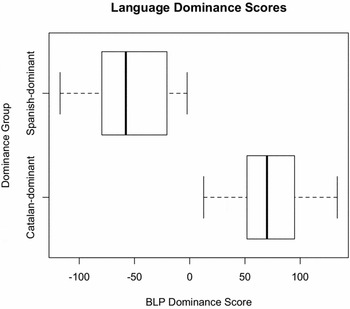
Each participant completed the Bilingual Language Profile (BLP) questionnaire (Birdsong, Gertken, & Amengual, Reference Birdsong, Gertken and Amengual2012). The BLP is an instrument for assessing language dominance through self-reports, and it produces a continuous dominance score and a general bilingual profile taking into account multiple dimensions: age of acquisition of the L1 and L2, frequency and contexts of use, competence in different skills, and attitudes toward each language. All of these factors are organized in four modules, which received equal weighting (language history, language use, language proficiency, and language attitudes).Footnote 4 The BLP was administered prior to beginning the experiments, and was provided in either Spanish or Catalan, depending on participant preference. The classification of participants as Spanish dominant or Catalan dominant was determined by their responses to the questionnaire, which generated a language particular score for each module, a global score for each language, and a global score of dominance. The point system was converted to a scale score, with the Catalan score subtracted from the Spanish score. Dominance scores ranged from –117 (strongly Spanish dominant) to 133 (strongly Catalan dominant). Participants with negative scores were classified as Spanish dominant, while participants with positive scores were classified as Catalan dominant. Figure 1 provides the distribution of the Spanish- and Catalan-dominant groups.
Language dominance as a function of group according to the Bilingual Language Profile.

Experiment 1: Identification tasks
In order to examine the perceptual abilities of early and highly proficient Spanish–Catalan bilinguals, both Spanish-dominant and Catalan-dominant bilinguals completed a binary forced-choice identification task for each mid vowel contrast (/e/–/ɛ/ and /o/–/ɔ/). The main goal of these experiments is to investigate if Spanish–Catalan bilinguals in Majorca are able to perceive an acoustic difference between the Catalan mid vowel phonemic categories, and if there are differences in their perceptual abilities as a result of their language dominance. Based on the previous perception studies reported in the introductory section, it is hypothesized that stimulus will strongly impact the identification pattern of the Catalan-dominant participants. Because previous work in Barcelona has reported that Spanish-dominant bilinguals do not master the vowel contrasts that are specific to their nondominant language, Majorcan Spanish-dominant bilinguals may also differ from their Catalan-dominant counterparts in terms of their perceptual accuracy. Given that recent acoustic studies have indicated that the magnitude of the acoustic distance between /e/–/ɛ/ and /o/–/ɔ/ is larger for Majorcan Catalan than for other dialects of Catalan, and that this height contrast is maintained in their productions, it is hypothesized that the input to which Majorcan Spanish–Catalan bilinguals are exposed contains more robust Catalan mid vowel contrasts than the input available to bilinguals in Barcelona. As a result, Spanish-dominant bilinguals in Majorca may not show the perceptual deafness to the Catalan-specific mid vowel contrasts that has previously been reported in Barcelona.
Design and materials
The perception of the Catalan mid vowel phonemes was investigated with the selection of two minimal pairs, one for each mid vowel contrast: /te/ “letter T” versus /tɛ/ “tea,” and /donə/ “he/she gives” versus /dɔnə/ “woman.” The experimental stimuli were obtained from the productions of a male native Majorcan Catalan speaker. The sound files were recorded in a sound-attenuated booth using a Shure SM10A dynamic head-mounted microphone and a solid-state digital recorder (Marantz PMD660), and digitized at 44 kHz and 16 bits.
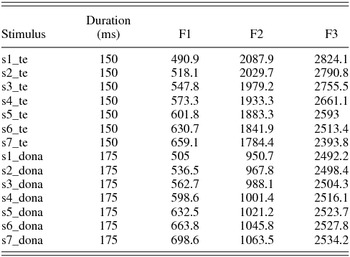
Two series of seven synthetic vowel tokens were generated along a continuum from /e/ to /ɛ/ and from /o/ to /ɔ/ using Akustyk 1.9.2 (Plichta, Reference Plichta2012). The method to create the seven-step speech continua was based on PSOLA and linear predictive coding analysis/resynthesis methods. The formant trajectory was dynamically estimated and automatically synthesized in seven steps in terms of spectral change over time. The formant values were manipulated with an analysis window of 0.05 ms applied to a time step of 0.01 ms. The vowel tokens were manipulated so that all tokens had exactly the same intensity and vowel duration. As noted above, the two endpoints for both the target mid-front and mid-back vowels formed mid vowel minimal pairs, specifically, “te” “letter T” versus “te” “tea” for the /e/–/ɛ/ contrast, and “dóna” “give” versus “dona” “woman” for the /o/–/ɔ/ contrast. The formant values of the experimental stimuli were in the range previously reported for male Majorcan Catalan speakers (Recasens & Espinosa, Reference Recasens and Espinosa2006), and are provided in Table 1.
Formant values (Hz) for each synthesized stimulus along the /e–/ɛ/ and /o/–/ɔ/ continuum

Procedure
Participants completed the forced-choice minimal-pair identification task for each mid vowel contrast using the stimulus presentation software SuperLab Pro 4.5 (Cedrus Corporation, USA) on a Mac computer. Participants listened to the stimuli on a set of headphones at a self-adjusted volume in front of a computer display in a quiet room. There were both verbal and written instructions, which were consistently in Spanish. After the researcher gave the instructions participants were asked to press the button box on a USB Response Pad (RB-730), which represented each member of the minimal pair, as fast and as accurately as possible after listening to each stimulus. Pictures were used rather than written words in order to avoid orthographic effects.
Each identification task (/e/–/ɛ/ and /o/–/ɔ/ contrast) was completed separately. For each mid vowel contrast, participants responded to 77 stimuli: 7 practice stimuli (one full block of stimuli) + 70 randomized test stimuli (7 stimuli × 10 repetitions). After 5 blocks, the participants were invited to take a short break. In total there were 7 stimuli × 10 repetitions × 60 participants for each identification task, which resulted in 4,200 possible responses for each identification task. A nonresponse was recorded if the participant did not press a key in the 2-s interval allowed. There were a total of 9 nonresponses for the /e/–/ɛ/ identification task and 23 nonresponses for the /o/–/ɔ/ identification task.
Experiment 2: AX discrimination tasks
In order to further test the perception of these mid vowel contrasts, and specifically, to explore the boundary where Catalan-dominant and Spanish-dominant bilinguals in Majorca separate both Catalan-specific mid vowel categories, the same group of Spanish–Catalan bilinguals completed AX discrimination tasks for each mid vowel contrast.
Design and materials
This task differs from the previous identification experiment in that each participant is introduced to two stimuli and has to decide whether the two stimuli in a pair are acoustically the same or different. The stimuli were drawn from the same seven-step continua used in the previous identification tasks. For each of the seven steps, a “same” pair was created in which both sounds are acoustically identical (e.g., s1–s1, s2–s2) for a total of seven “same” pairs. In addition, five “different” pairs, which consisted of a combination of two different sounds in two-step increments (e.g., s1–s3, s2–s4), were also created. The interstimulus interval was 1000 ms, and the intertrial interval was 1500 ms.
Procedure
Using the same equipment and experimental setting as in the identification tasks, participants listened to the “same” and “different” pairs, and were instructed to press either of the two buttons depending on if they considered that they had heard two acoustically identical sounds, or if the sounds in the pair were different. The “same” and “different” trials appeared in randomized order. For each condition (front and back mid vowels), participants responded to 108 trials: 12 practice trials (one full block of “same” and “different” stimuli) + 96 randomized test trials (12 stimuli × 10 repetitions). Therefore, the experimental data consisted of 8 blocks of 12 randomized trials (7 “same” and 5 “different”). After 4 blocks, the participants were invited to take a short break. Because there were 12 trials × 8 repetitions × 60 participants for each AX discrimination task, the total number of possible responses was 5,760 for each discrimination task. A nonresponse was recorded if the subject did not press a key in the 3-s interval allowed. There were a total of 50 nonresponses for the /e/–/ɛ/ discrimination task and 61 nonresponses for the /o/–/ɔ/ discrimination task.
Experiment 3: Lexical decision task
In this task, participants were presented with visual and auditory stimuli and were asked to categorize the stimuli as being either a real word or a nonword. Nonwords were created by replacing the stressed mid vowel with the other member of the contrast. The experiment was designed to replicate Sebastián-Gallés et al. (Reference Sebastián-Gallés, Echeverría and Bosch2005) and Sebastián-Gallés and Baus (Reference Sebastián-Gallés, Baus and Cutler2005) but with two main modifications: for a sense of completeness, this experiment investigated real words and mispronounced words involving both the front and back mid vowel contrasts, and the aural stimuli were presented together with a visual display of a nonambiguous picture. Previous studies in Barcelona have shown that the failure of Spanish–Catalan bilinguals to perceive Catalan-specific mid vowel contrasts has consequences at the lexical level (Pallier et al., Reference Pallier, Colomé and Sebastián-Gallés2001; Sebastián-Gallés et al., Reference Sebastián-Gallés, Echeverría and Bosch2005). The goal of this experiment is to investigate if Spanish–Catalan bilinguals in Majorca are able to establish lexical representations that encode the Catalan mid vowel contrasts. If these bilinguals have difficulties distinguishing between words and nonwords that differ in the Catalan-specific mid vowels, it will be evidence that they have stored lexical representations containing /e/–/ɛ/ and /o/–/ɔ/ as a single, merged (Spanish-like) front and back phonemic category.
Design and materials
The experimental stimuli for the lexical decision task consisted of 80 words (40 real words and 40 nonwords). The Catalan experimental items, which contained the target mid vowels /e/, /ɛ/, /o/ or /ɔ/ in stressed position (10 for each mid vowel), were matched in word frequency (Rafel i Fontanals, Reference Rafel i Fontanals1998). For the front mid vowel items, written word frequency (average tokens per million) for /e/ words (M = 1154.7, SD = 1355.2) and /ε/ words (M = 968.8, SD = 1213.4) did not differ significantly, F (1, 18) = 0.104, ns. The back mid vowel /o/ words (M = 1435.3 SD = 1371.1) and /ɔ/ words (M = 1782, SD = 1494.5) were also not significantly different, F (1, 18) = 1.783, ns. The 40 corresponding incorrectly pronounced words (i.e., nonwords) were created by replacing the stressed mid vowel for each real word with the other member of the contrast. For instance, the Catalan nonword */’bosk/ was created from the real word /’bɔsk/ “forest.” Conversely, the correct pronunciation of /’bokə/ “mouth” appeared alongside */’bɔkə/ (see Appendix A). Stimuli were recorded several times by three male Majorcan Catalan native speakers in a sound-isolated recording booth at a sampling rate of 44,100 Hz with a 16 bits resolution. Recordings were normalized for amplitude and spliced into separate sound files. The recordings of the words and nonwords were made using a Shure SM10A dynamic head-mounted microphone and a solid-state digital recorder (Marantz PMD660), and digitized at 44 kHz and 16 bits.
In order to select the best exemplars for each word and nonword, three separate data sets (one for each speaker) were created including the median F1 and F2 values for each target word as a condition of vowel and vowel status (correct/incorrect).Footnote 5 Each data set was subdivided into two subsets: front mid vowels and back mid vowels. In order to ensure that there were only significant acoustic differences between the higher and lower mid vowels independently of vowel status, each subset was submitted to a repeated measures analysis of variance (ANOVA) with F1 (Hz) as the dependent variable, vowel (low-mid and high-mid) and vowel status (correct and incorrect). After confirming that the tokens selected based on F1 differed with respect to the identity of the vowel, but not because of vowel status (e.g., a mispronounced /ɛ/ in a /e/-type vowel was not significantly different from a correctly pronounced /ɛ/ in a /ɛ/-type word), the same data set was submitted to a repeated measures ANOVA with F2 (Hz) as the dependent variable, and with vowel and vowel status as the independent variables. The statistical analyses supported the selection of the median F1 as a measure to select the best exemplar of a word and nonword for each speaker. To summarize, the stimuli selected contained lexical items in which a properly pronounced /e/ or /o/ was not significantly different in height (F1) or fronting (F2) from a mispronounced target item produced with /e/ or /o/ for any of the three speakers. The stimuli were normalized for peak intensity (so that they did not differ in loudness). If there was a DC offset, it was removed and the maximum amplitude was normalized to –0.5 dB at a project rate of 44 kHz. The auditory stimuli were paired with illustrations representing nonambiguous objects (Snodgrass & Vanderwart, Reference Snodgrass and Vanderwart1980).
Procedure
Participants completed the lexical decision task seated comfortably in front of a computer screen, and the stimulus presentation software SuperLab Pro 4.5 (Cedrus Corporation, USA) controlled the presentation of visual and auditory stimuli. Participants were warned that the stimuli would consist of words and nonwords, and they were told that the change would involve the replacement of the stressed vowel (e.g., /e/ to /ɛ/ or /o/ to /ɔ/, and vice versa). Participants were asked to classify each stimulus as being either a word or a nonword by pressing the corresponding button on the USB Response Pad (RB-730) immediately after hearing each experimental item, and they were encouraged to respond as quickly as possible and to keep their response fingers over the response buttons. The identity of the buttons was counterbalanced between subjects, and the order of presentation was randomized for each participant. Participants responded to a total of 244 trials: 4 practice trials + 240 randomized test trials. Therefore, the experimental data consisted of 40 tokens × 2 type (correct/incorrect) × 3 voices = 240 responses per participant. Because there were 60 participants, the total number of responses in the data set was 14,400.
RESULTS
Results are presented in the subsections below, beginning with the identification and AX discrimination tasks, and followed by the lexical decision task.
Identification tasks
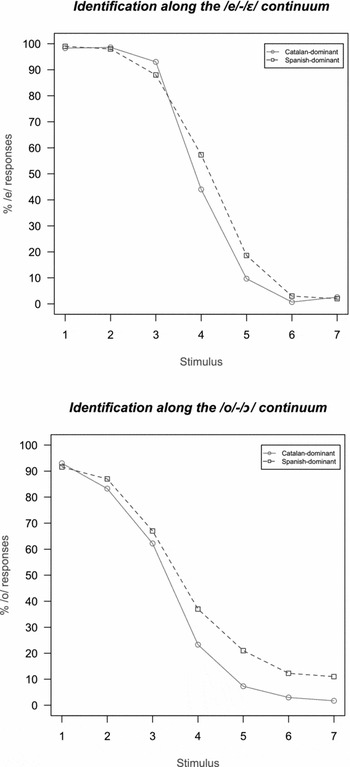
The statistical analyses for the identification tasks consisted of a mixed-model ANOVA for each mid vowel contrast, with language dominance (Spanish dominant, Catalan dominant) as the between-subjects factor, stimulus (s1–s7) as the within-subjects factor, and subject as the random term. In the analysis of the /e/–/ɛ/ data, the dependent variable was the proportion of /e/ responses (i.e., selection of the word te “letter T”Footnote 6 ). The model yielded a main effect of stimulus, F (6, 348) = 740.81, p < .001, and an interaction between stimulus and language dominance, F (6, 348) = 3.61, p < .01. The analysis also revealed that there was not a significant effect of language dominance, F (1, 58) = 1.80, ns. In order to explore the interaction between stimulus and language dominance, a series of seven two-sample, Bonferroni corrected, paired t tests compared the responses of Spanish-dominant and Catalan-dominant participants for each stimulus. The analyses did not reveal a significant difference between Spanish-dominant and Catalan-dominant bilinguals in any of the steps along the continuum. These results show that both groups similarly identified the stimuli along the /e/–/ɛ/ continuum, with a categorical identification of two separate mid vowel categories. The analysis of the /o/–/ɔ/ mid vowel contrast consisted of a mixed-model design with the same factors as in the /e/–/ɛ/ data. In this case, the dependent variable was the proportion of /o/ responses by selecting the word dóna “give.” The analysis yielded a main effect of language dominance, F (1, 58) = 7.52, p < .001, and stimulus, F (6, 348) = 274.98, p < .001, but there was not an interaction between stimulus and language dominance, F (6, 348) = 1.52, ns. Bonferroni corrected pairwise comparisons examined the responses by each group for each step. These comparisons yielded significant differences in the responses between both groups for Step 5 (–13.66), t (29) = –3.10, p < .01, Step 6 (–9.33), t (29) = –2.90, p < .01, and Step 7 (–9.26), t (29) = –2.79, p < .01. In other words, Spanish dominants responded differently than Catalan dominants, particularly with respect to the categorization of the stimuli in the /ɔ/ acoustic region. This suggests that the perception of the back-mid vowel contrast may be more robust for the Catalan dominants in comparison to the Spanish dominants. Figure 2 shows the proportion of /e/ and /o/ responses as a function of language dominance, where both curves follow a similar trajectory from s1 to s7, demonstrating that these bilinguals perceive two distinct phonemes.
Identification of stimuli along the /e/–/ɛ/ and /o/–/ɔ/ continuum.

AX discrimination tasks
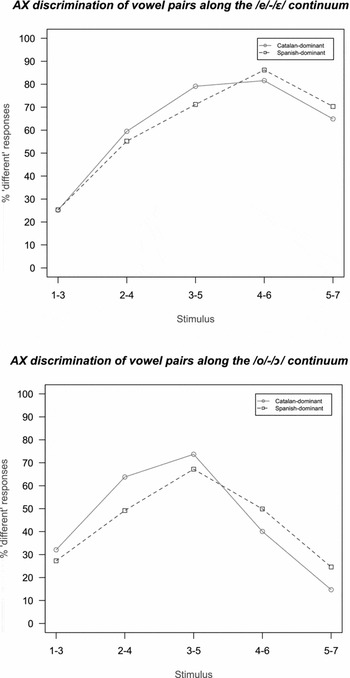
The /e/–/ɛ/ and /o/–/ɔ/ data were analyzed in two separate mixed-model ANOVAs with language dominance (Spanish dominant, Catalan dominant) as a between-subjects factor, stimulus (1–3, 2–4, 3–5, 4–6, 5–7) as a within-subjects factor, and subject as the random term. The dependent variable in both ANOVAs was the proportion of correct responses (i.e., proportion of “different” responses when the stimulus is “different”); thus, only the “different” stimuli were included in the analyses. The analysis of the /e/–/ɛ/ data yielded a main effect of stimulus, F (4, 232) = 55.98, p < .001; however, no effects of language dominance were found, F (1, 58) = 0.01, ns, and there was not a significant interaction between stimulus and language dominance, F (4, 232) = 0.88, ns. The analysis of the /o/–/ɔ/ data also revealed a main effect of stimulus, F (4, 232) = 42.76, p < .001, and there was a significant interaction between stimulus and language dominance, F (4, 232) = 3.01, p < .05. However, there were no effects of language dominance, F (1, 58) = 0.13, ns. In order to explore the interaction between stimulus and language dominance, the potential differences between the responses of Spanish-dominant and Catalan-dominant bilinguals for each stimulus were analyzed in five Bonferroni corrected paired t tests. These pairwise comparisons revealed that there were no significant differences between both groups in any of the stimuli. As shown in Figure 3, both Spanish-dominant and Catalan-dominant participants show the same peak in their discrimination of the front mid vowels, for the 4–6 stimulus pair. In addition, a drop in accuracy is especially noted in the neighborhood of the Catalan /e/ phoneme prototype (e.g., 1–2, 2–4). With regard to the back mid vowels, the responses from both the Spanish-dominant and the Catalan-dominant groups also pattern very similarly. Specifically, both groups show a peak in discrimination accuracy on the 3–5 pair. This heightened sensitivity suggests that the boundary where both dominance groups partition the continuum into two distinctive back mid vowel categories is located between s3 and s5. Conversely, an accuracy drop is noted in both the prototypical /o/ and /ɔ/ acoustic regions.
Discrimination of the /e/–/ɛ/ and /o/–/ɔ/ “different” pairs.

Lexical decision tasks
The analyses of the error rates are presented in order to investigate if both groups differ in their categorization of mispronounced and properly pronounced words. For this purpose, two data sets were created: one consisting of responses to correctly produced real words (correctly pronounced /e/- and /ɛ/-type words or /o/- and /ɔ/-type words), and another one only including the responses to mispronounced words (/e/-type words produced with */ɛ/ and /ɛ/-type words produced with */e/, or /o/-type words produced with */ɔ/ and /ɔ/-type words with */o/). The lexical decision data were analyzed under a series of mixed-design ANOVAs for each mid vowel contrast, with language dominance (Spanish dominant, Catalan dominant) as the between-subjects factor, vowel (/e/ and /ɛ/ type words for the front mid vowel analysis; /o/ and /ɔ/ type words for the back mid vowels) as the within-subjects factor, and subject as the random term. The dependent variable was the error rate (%).
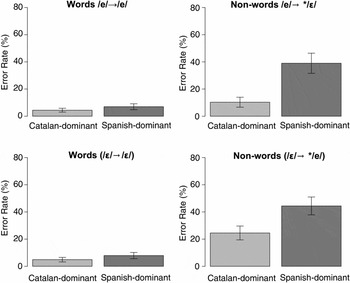
The mixed-design model of the correctly pronounced words containing the front mid vowel contrast (/e/ → /e/ and /ɛ/ → /ɛ/) revealed main effects of language dominance, F (1, 58) = 11.09, p < .001, and vowel, F (1, 58) = 14.41, p < .001, but no significant interactions. These results show that Spanish-dominant bilinguals had a higher error rate than did Catalan dominants when recognizing properly pronounced /e/ and /ɛ/ words. In addition, both language dominance groups were found to have a slightly higher error rate when categorizing correctly pronounced /ɛ/ words in comparison to /e/ words. The analysis of mispronounced words (/e/ → */ɛ/ and /ɛ/ → */e/) also yielded significant main effects of language dominance, F (1, 58) = 15.78, p < .001, and vowel, F (1, 58) = 54.54, p < .001, and there was not a significant interaction between language dominance and vowel. As with real words, Spanish dominants consistently miscategorized nonwords more frequently than did Catalan dominants. The effect of vowel also shows that both Spanish-dominant and Catalan-dominant bilinguals were more likely to accept an /ɛ/-type word incorrectly produced with */e/ (e.g., /ərɛl/ “root” as */ərel/) than vice versa. This asymmetry was robust, as in some cases /ɛ/-words mispronounced with */e/ were accepted by Spanish-dominant bilinguals around 60% of the time. Figure 4 shows the error rate (%) in the categorization of words and nonwords for each front mid vowel as a function of vowel and language dominance.
Error rate (%) in the lexical decision task as a function of vowel type (/e/, /ɛ/) and word status (word, nonword) by language dominance.

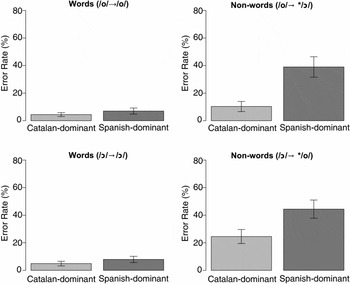
The analysis of the real words with /o/ and /ɔ/ (/o/ → /o/ and /ɔ/ → /ɔ/) yielded a significant main effect of language dominance, F (1, 58) = 4.73, p < .001, but not vowel, F (1, 58) = 0.54, ns, and there was no significant interaction between language dominance and vowel. These results also confirm that Spanish-dominant bilinguals had a higher error rate than did Catalan dominants when recognizing properly pronounced words. The analysis of the nonword data containing the back mid vowels (/o/ → */ɔ/ and /ɔ/ → */o/) revealed significant main effects of language dominance, F (1, 58) = 22.62, p < .001, and vowel, F (1, 58) = 17.18, p < .001, but the model did not show a significant interaction between language dominance and vowel. These results indicate that Spanish-dominant and Catalan-dominant bilinguals differed in their categorization of nonwords. Specifically, Spanish-dominant bilinguals showed great difficulty in categorizing mispronounced words that only differed in the back mid vowel contrast. Figure 5 shows the error rate (%) in the categorization of words and nonwords for each back mid vowel as a function of vowel and language dominance.
Error rate (%) in the lexical decision task as a function of vowel type (/o/, /ɔ/) and word status (word, nonword) by language dominance.

In addition to having a high error rate (in some cases bilingual participants responded at chance), these results revealed that Spanish-dominant participants overall produced more errors than did Catalan dominants when deciding if a word was a real word or a mispronunciation based on the Catalan mid vowel. These results seem to confirm that Spanish-dominant bilinguals have poorer lexical knowledge than their Catalan-dominant counterparts. Visual inspection of the data also suggests that most of the errors consisted of accepting a mispronunciation as a real word. In particular, both Spanish dominants and Catalan dominants were more likely to accept a nonword containing /e/ or /o/ when the correct pronunciation includes the Catalan-specific mid vowel /ɛ/ or /ɔ/.
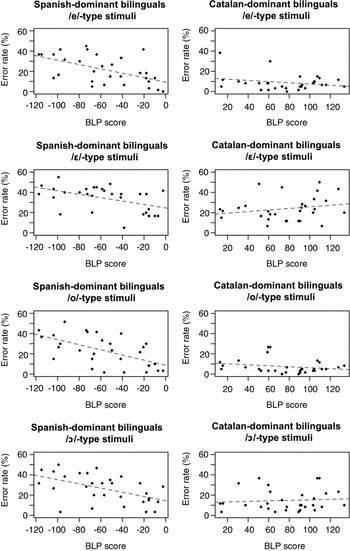
In order to gain more insight into the individual variation of the data, the error rate for each vowel type was calculated for each individual participant. As expected, inspection of the plots shows that the error rates are overall smaller for Catalan dominants (i.e., individuals with a positive BLP score) than for Spanish dominants (i.e., individuals with a negative BLP score), although there is a certain amount of overlapping between the Spanish dominants that are approximating the zero score (balanced bilinguals) and the rest of the Catalan-dominant bilinguals (see Figure 6). Figure 6 plots the error rate (%) in the lexical decision task as a function of the BLP scores for each individual bilingual.
Error rate (%) for experimental words and nonwords divided by vowel type plotted as a function of a speaker's Bilingual Language Profile score. Fitted lines are for (left) Spanish dominants and (right) Catalan dominants.

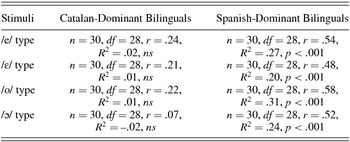
Individual error rates were correlated with the participants’ language dominance score as reported in the BLP. The correlations between BLP score and error rate when categorizing the /e/-type, /ɛ/-type, /o/-type, and /ɔ/-type stimuli are presented in Table 2.
Results from the correlations between Bilingual Language Profile score and error rate for each stimulus type
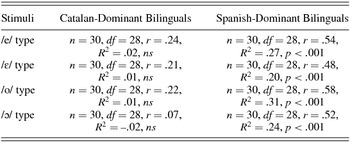
The analyses of the front and back mid vowel data reveal that there was not a significant correlation for the Catalan-dominant group in any of the stimulus types but there consistently was a significant correlation for the Spanish dominants. Moderately to strongly Spanish-dominant participants, whose BLP scores ranged between –41 and –117, were more likely to have difficulties in distinguishing between mispronounced and properly pronounced words that differed in the Catalan-specific mid vowel contrasts. This confirms that the degree of language dominance plays a significant role in the way phonological information is represented in the lexicon and, as such, is a strong predictor of accuracy in the lexical decision task.
DISCUSSION
The present study investigated the perception and processing of the Catalan mid vowel contrasts (/e/–/ɛ/ and /o/–/ɔ/) by 30 Spanish-dominant and 30 Catalan-dominant bilinguals in Majorca (Spain), who have been raised in a bilingual community and exposed to Catalan and Spanish before the age of 4. A review of the literature revealed that even though there is a wealth of research on the production, perception, and processing of the Catalan /e/–/ɛ/ contrast by Spanish–Catalan bilinguals residing in Barcelona, there is a lack of studies that examine the perception and processing of both Catalan-specific mid vowel contrasts in Majorcan Catalan, which is known to maintain a robust acoustic distance between the mid vowels. While previous studies in Barcelona have reported a tendency toward a merger of the Catalan mid vowels into a single Spanish-like mid vowel category, studies on the Majorcan Catalan mid vowels have indicated that speakers of this variety of Catalan produce lower mid vowels than their counterparts in Barcelona and that the acoustic distance between the mid vowel categories is larger for Majorcans than for speakers of other Catalan varieties (Carrera-Sabaté & Fernández-Planas, Reference Carrera-Sabaté and Fernández-Planas2005; Recasens & Espinosa, Reference Recasens and Espinosa2006, Reference Recasens and Espinosa2009). One of the main contributions of the present study is to examine the perception and lexical representations of early Spanish–Catalan bilinguals in a dialect that has a phonological system and lexical distribution distinct from the variety spoken in Barcelona.
This study posed two key questions regarding the perceptual abilities of these bilinguals. Are early Spanish–Catalan bilinguals in Majorca able to perceive the acoustic difference between Catalan /e/–/ɛ/ and /o/–/ɔ/? Do these bilinguals have four mid vowel phonemes in their vowel inventory? In addition to the loss of the mid vowel contrasts in production, early Spanish–Catalan bilinguals in Barcelona have also been shown to have difficulties in perceiving the Catalan mid vowel contrasts. These studies have indicated that early and extensive exposure to Catalan may not be sufficient to attain nativelike perceptual abilities in the language, a finding that this study partially contests. This seems to not only be an example of vowel contrasts that exists in Catalan and not in Spanish but also contrasts that even in Catalan they are less robust and more variable than other contrasts in the language (see Coveney, Reference Coveney2001; Dufour, Nguyen, & Frauenfelder, Reference Dufour, Nguyen and Frauenfelder2007; Fagyal, Jenkins, & Kibbee, Reference Fagyal, Jenkins and Kibbee2006, for similar findings with the perception of the /e/–/ɛ/ contrast in varieties of French).
Contrary to previous results in Barcelona (Bosch et al., Reference Bosch, Costa and Sebastián-Gallés2000; Pallier et al., Reference Pallier, Bosch and Sebastián-Gallés1997, Reference Pallier, Colomé and Sebastián-Gallés2001; Sebastián-Gallés & Soto-Faraco, Reference Sebastián-Gallés and Soto-Faraco1999), data from identification and AX discrimination tasks show that Spanish–Catalan bilinguals in Majorca categorically perceive the contrast between the Catalan /e/–/ɛ/ and /o/–/ɔ/ pairs. These results do not support previous accounts of severe limitations in the acquisition of Catalan-specific categories under conditions of early and extensive exposure (Sebastián-Gallés & Soto-Faraco, Reference Sebastián-Gallés and Soto-Faraco1999). Spanish-dominant bilinguals in Majorca are not deaf to the Catalan-specific vowel contrasts, and despite the acoustic similarity between the Catalan and Spanish mid vowels, these early bilinguals are capable of maintaining language-specific contrasts.
Flege (Reference Flege, Cole and Hualde2007) argues that the quantity and quality of L2 input received by an L2 learner are important determinants of ultimate degree of attainment in an L2. A plausible explanation for the different perception patterns found in Barcelona and Majorca is that bilinguals in each community may vary as a function of the (accented) input that they receive. Because the Catalan mid vowel contrasts are more robustly maintained in Majorca than in Barcelona (Carrera-Sabaté & Fernández-Planas, Reference Carrera-Sabaté and Fernández-Planas2005; Recasens & Espinosa, Reference Recasens and Espinosa2006, Reference Recasens and Espinosa2009), more instances of acoustically distinctive mid vowels may be available in the ambient input all bilinguals receive in Majorca. Based on these dialectal differences, we can assume that there is presumably less exposure to input containing merged mid vowels in Majorca, with Catalan /ɛ/ words and /ɔ/ words produced closer to /e/ or /o/. This hypothesis is also supported by previous findings showing that the quality of the input can predict the robustness of the Catalan mid vowels in the productions of children and adults in Barcelona (Cortés et al., Reference Cortés, Lleó, Benet, Braunmuller and House2009; Lleó et al., Reference Lleó, Benet and Cortés2007, Reference Lleó, Cortés, Benet, Siemund and Kintana2008, Reference Lleó, Benet, Cortés, Kabatek and Pusch2009). These studies suggest that the Catalan mid vowel merger is present to different degrees in Barcelona, depending on the place of residence: it is precisely in highly Spanish-influenced districts where there is more variable input (i.e., Spanish and Spanish-accented Catalan) that bilinguals are merging the Catalan mid vowel categories in their productions. In other words, the Catalan vowel categories in the input that Spanish-dominant bilinguals receive in Majorca may be more acoustically distinctive (i.e., more prototypical and with a larger acoustic distance between the mid vowel categories), ultimately facilitating acquisition. Therefore, it may be not only the establishment of phonological categories during the first year of life but also the continued exposure to certain distributions of these categories. In order to directly test this hypothesis, future studies should examine the perceptual and production patterns of early Spanish–Catalan bilinguals from Barcelona who have permanently moved to Majorca in order to investigate if their mid vowel categories start to separate more robustly, in spite of early exposure to the distributions in Barcelona.
In addition to examining the perception of isolated phonemic segments by early Spanish–Catalan bilinguals in their dominant or nondominant language, this study also set out to investigate the lexical representations that these bilinguals have stored in memory. Even if Spanish-dominant bilinguals in Majorca are able to acoustically discriminate between the mid vowel contrasts, does their language experience affect their lexical representations? Do Spanish-dominant and Catalan-dominant bilinguals differ in the way they process these Catalan-specific phonetic categories? Previous studies in Barcelona have shown that the failure of Spanish–Catalan bilinguals to perceive Catalan-specific mid vowel contrasts has consequences at the lexical level (Pallier et al., Reference Pallier, Colomé and Sebastián-Gallés2001; Sebastián-Gallés et al., Reference Sebastián-Gallés, Echeverría and Bosch2005). This study provided a different scenario. Are early Spanish-Catalan bilinguals who demonstrate robust perception of the Catalan mid vowel contrasts able to establish lexical representations that encode these phonemic contrasts? The results showed that even though Spanish-dominant and Catalan-dominant bilinguals were able to accurately perceive the contrast between the Catalan-specific /e/–/ɛ/ and /o/–/ɔ/ categories in perceptual identification and AX discrimination tasks, their performance dramatically decreased when asked to identify experimental words and nonwords that differed in the Catalan mid vowel contrasts. These bilinguals had great difficulties distinguishing between words and nonwords that differed in the Catalan-specific mid vowel contrasts, similarly to what has been reported in Barcelona (Pallier et al., Reference Pallier, Colomé and Sebastián-Gallés2001; Sebastián-Gallés & Baus, Reference Sebastián-Gallés, Baus and Cutler2005; Sebastián-Gallés et al., Reference Sebastián-Gallés, Echeverría and Bosch2005).
A closer look at the data revealed that these Spanish–Catalan bilinguals have a higher error rate when responding to non–words than to real words and when responding to the /ɛ/-type and /ɔ/-type stimuli rather than to the /e/-type and /o/-type stimuli. Both bilingual groups were more likely to accept an /ɛ/-type word or an /ɔ/-type word incorrectly produced with */e/ or */o/ than vice versa. This asymmetry in error rate has previously been interpreted as evidence that Catalan-specific phonemes are more variable and might be incorrectly categorized because of Spanish-accented input, where /ɛ/ and /ɔ/ words are frequently pronounced with /e/ and /o/. In contrast to the results from the identification and AX discrimination tasks, significant differences were also found based on a speaker's dominant language: Spanish-dominant bilinguals exhibited higher error rates than did Catalan dominants when recognizing words and nonwords that include the front and back mid vowel contrasts. These differences based on language dominance suggest that the lexical representations of Spanish dominants may not include as much detailed information as the representations of Catalan-dominant bilinguals (Sebastián-Gallés et al., Reference Sebastián-Gallés, Echeverría and Bosch2005).Footnote 7 Examination of the individual variation in the data showed that the moderate to strongly Spanish-dominant bilinguals who reported a more frequent daily use of Spanish over Catalan displayed a higher error rate in the lexical decision task. Taken together, these results demonstrate that making explicit judgments regarding whether a certain sound belongs to a phonemic category (i.e., as accomplished via identification and discrimination tasks) does not entail that listeners have an appropriate representation at the lexical level. This finding raises one important question: how can we explain that the ability to properly perceive phonemic contrasts in the speech signal is not sufficient to establish accurate phonological representations in the lexicon of early bilinguals?
Sebastián-Gallés and Baus (Reference Sebastián-Gallés, Baus and Cutler2005) report similar findings in Barcelona. In their study, they compared the perceptual accuracy of Spanish–Catalan bilinguals raised in monolingual Spanish families across three different perception tasks involving the /e/–/ɛ/ contrast: a categorization task, a gating task, and a lexical decision task. The accuracy of these participants decreased across tasks, with over half of these bilinguals performing in the range of the Catalan-dominant control group in the categorization task. A lower accuracy rate was found for these same participants in the gating task. Finally, only a few participants showed a nativelike level of performance in the lexical decision task. The present findings with a bilingual group in Majorca who have no difficulties discriminating isolated phonemes also show a similar task effect. In comparison to the identification and AX discrimination tasks using synthesized data, participants presumably had a higher processing load in the lexical decision task because they were exposed to highly variable natural speech from three different speakers, and the target vowels were presented with coarticulatory variation as a function of neighboring consonants, which may have complicated accurate and reliable access to their lexical representations.
In order to account for the patterns of performance in these experiments, a model of L2 phonological acquisition must not only take into consideration the age of acquisition, the amount of experience with the language, and the quality of the ambient input that is received, but also should be able to explain the differing rates of success depending on whether the perceptual task employed is testing either the sensitivity to phonemic identification or the access to phonological representations stored in memory. As stated in Sebastián-Gallés and Díaz (Reference Sebastián-Gallés and Díaz2012), “to accomplish the categorization task, participants merely needed to notice the difference between isolated vowels and to know (even if only in a metalinguistic way) the properties of the categories. However, to successfully complete the lexical decision task, participants needed to build up an adequate representation of the stimulus presented during the experiment and compare it with the information stored in their phonological lexicon” (pp. 136–137). This assumes that bilinguals are not required to access their lexical representations when completing the identification and discrimination tasks and may instead employ their “raw” perception abilities (Hayes-Harb & Masuda, Reference Hayes-Harb and Masuda2008). In contrast, in the lexical decision task they have to access their lexical representations, and if those representations do not accurately encode the Catalan-specific phonological contrasts, their performance will be poorer.
Díaz, Broersma, Mitterer, and Sebastián-Gallés (Reference Díaz, Broersma, Mitterer and Sebastián-Gallés2012) and Sebastián-Gallés and Baus (Reference Sebastián-Gallés, Baus and Cutler2005) have proposed a processing hierarchy by which the identification of phonemes in the speech signal constitutes a separate (and prior) process to the selection of appropriate lexical entries. In this model, phoneme units activate the lexicon in a “cascaded fashion,” by which if a phonemic contrast is not accurately perceived, these difficulties will impair the appropriate phonological representation at the lexical level. In other words, word recognition requires a hierarchy of processing units, and the development of phonemic categories precedes accurate lexical representations. There is a body of literature, however, that has challenged the assumption that phonetic distinctions must precede phonological encoding in the lexicon. These studies have shown that L2 leaners may establish lexical contrasts but still exhibit persistent perceptual errors in the discrimination of phonemic contrasts in categorization tasks (Cutler, Weber, & Otake, Reference Cutler, Weber and Otake2006; Darcy et al., Reference Darcy, Dekydtspotter, Sprouse, Glover, Kaden and McGuire2012; Escudero, Hayes-Harb, & Mitterer, Reference Escudero, Hayes-Harb and Mitterer2008; Hayes-Harb & Masuda, Reference Hayes-Harb and Masuda2008; Weber & Cutler, Reference Weber and Cutler2004). The fact that advanced L2 learners may acquire knowledge of lexical contrasts despite unreliable performance on discrimination tasks confirms that the establishment of a lexical contrast is independent of the acquisition of phonetic categories. In this respect, the results from the categorization and lexical decision tasks with early and highly proficient bilinguals, who have been exposed to both languages from an early age, are in line with previous findings in L2 acquisition studies that invite “a reconsideration of the causal link between phonological categories and lexical representations in the acquisition of L2 phonological contrasts” (Darcy et al., Reference Darcy, Dekydtspotter, Sprouse, Glover, Kaden and McGuire2012, p. 29). More specifically, phonological categorization and lexical encoding seem to be separately acquired, and for early and highly proficient bilinguals, having the ability to perceive sounds in isolation does not guarantee that these contrasts are correctly encoded in the lexicon.
Conclusions
The present study examined the perception and processing of the Catalan mid vowel contrasts, at the levels of segmental categorization and lexical representation, by 60 early and highly proficient Spanish–Catalan bilinguals in Majorca (Spain). The results from the binary forced-choice identification and AX discrimination tasks show that Spanish–Catalan bilinguals in Majorca have two independent phonetic categories in the Catalan front and back mid vowel space, and as a result perceive both Catalan-specific categories despite the overlap with one phonetic category in Spanish. Data from the lexical decision task, however, show that even if these bilinguals perform at ceiling in the perceptual tasks that consist of identifying and discriminating between isolated phonemes, their performance decreases when the tasks tap into lexical processes. While much work remains to be done to fully understand the interactions between the phonetic and lexical representations of early bilingual individuals, this study has provided evidence that these early bilinguals exhibit difficulty using the vowel contrasts to distinguish lexical items, that the choice of a particular task affects their accuracy, that the ability to recognize phonological contrasts requires a different skill than recognizing words that contain these phonemes, and that the ability to accurately perceive phonemic contrasts in the speech signal does not guarantee that early bilinguals will establish accurate phonological representations in the lexicon.
APPENDIX A
Stimuli in lexical decision task

ACKNOWLEDGMENTS
I gratefully acknowledge technical and logistical support from Miquel Simonet, Barbara Bullock, Almeida Jacqueline Toribio, and David Birdsong. I also thank Ana Schwartz, three anonymous reviewers, and especially Stephanie Lain and Natalya Samokhina from the UCSC Applied Linguistics writing group for helpful comments on earlier drafts. I am solely responsible for any remaining errors in the paper. This work was supported by NSF DDIG #1226964.