Introduction
Trace minerals such as Zn, Cu, Fe and Mn have been proven to be essential for the metabolic functions of all life. Zinc is a known cofactor of more than 200 enzymes and plays a very important role in chick growth, feathering, the immune system and disease resistance. Copper is required for the activity of multiple enzymes, normal red blood cell formation, bone and elastin formation, normal myelination of brain cells and spinal cord, maximum immune response and normal hair and wool pigmentation. Iron is an essential part of haemoglobin and many enzymes in the body. Manganese is required for growth, bone development and fertility of animals. Even though these minerals play such important role, little research involving micro-mineral nutrition of poultry has been conducted in the past a few decades.
The trace mineral requirements recommended by NRC (1994) for broiler chickens and laying hens are based on very limited research from the 1950's and 60's. Many values are estimates based on extrapolation from other species or birds of different ages (Leeson, Reference LEESON2005). Also, the experiments were conducted by using old-fashioned breeds of commercial chickens and with inorganic mineral ores. Over the past four decades, production of broiler chickens and laying hens has advanced in both genetics and feeding practices. However, no updated requirements of minerals for modern breeds and production techniques have been recommended so far.
For poultry producers, mineral salts such as oxide and sulphate are routinely oversupplied in poultry diets to ensure adequate levels because they are relatively cheap. This practice has caused the following major concerns: 1) the oversupply of one mineral in the diet may cause inadequacy of another mineral due to well-known inter-relationships between minerals (Underwood and Suttle, Reference UNDERWOOD and SUTTLE1999); 2) the formation of a chelate between minerals (such as Cu or Zn) and phytate in the diet can reduce the efficacy of phytase (Maenz et al., Reference MAENZ, ENGELE-SCHAN, NEWKIRK and CLASSEN1999; Ondracek et al., Reference ONDRACEK, APPLEGATE, PANG, THOMPSON and JAYNES2002; Banks et al., Reference BANKS, THOMPSON, JAYNES and APPLEGATE2004) and 3) excess minerals in the manure may increase environmental burden (Blanco-Penedo et al., Reference BLANCO-PENEDO, CRUZ, LOPEZ-ALONSO, M. CASTILLO, HERNANDEZ and BENDEDITO2006).
In recent years, extensive research work has been done to investigate the bioavailability of minerals that are in a chemically organic form such as proteinates and amino acid chelates. It has already been established by many researchers (Wedekind and Baker, Reference WEDEKIND and BAKER1989; Wedekind et al., Reference WEDEKIND, HORTIN and BAKER1992; Reference WEDEKIND, COLLINGS, HANCOCK and TITGEMEYER1994; Cao et al., Reference CAO, HENRY and GUO2000; Guo et al., Reference GUO, HENRY, HOLWERDA, CAO, LITTELL, MILES and AMMERMAN2001; Li et al., Reference LI, LUO, LIU, CRENSHAW, KUANG, SHAO and YU2004; Ao et al., Reference AO, PIERCE, POWER, DAWSON, PESCATORE, CANTOR and FORD2006, Reference AO, PIERCE, PESCATORE, FORD, CANTOR, DAWSON and PAUL2008a, Reference AO, PIERCE, PESCATORE, CANTOR, DAWSON, PAUL and FORD2011b) that chelated minerals are more bioavailable than inorganic salts for several possible reasons including: 1) passive absorption is increased because the ring structure of organic minerals neutralises the positive charge of metal ion and protects the mineral from unwanted interactions with other nutrients in the gastrointestinal tract (Miles and Henry, Reference MILES and HENRY1999); 2) chelation increases solubility and movement of minerals through cell membranes (Miles and Henry, Reference MILES and HENRY1999); 3) chelates may pass intact through the intestinal wall into the blood stream, and so are absorbed more efficiently and by different routes than inorganic mineral ores (Aldridge et al., Reference ALDRIDGE, SADDORIS and RADCLIFFE2007). Theoretically, the supplemental level of minerals should be lowered when an organic mineral source is used. Since 2003, an extensive research project, which is being conducted on a global basis and aims to encompass all main commercial species, has been initiated to redefine the mineral requirement of farm animals based on organic mineral sources (Pierce et al., Reference PIERCE, AO, CHARLTON and TUCKER2009).
The purpose of the following paper is to update the findings relating to mineral supplementation in poultry and to compare inorganic with organic sources (specifically proteinate) in terms of retention, bioavailability, excretion and requirement.
Beneficial effects of replacing inorganic minerals with organic minerals in poultry diets
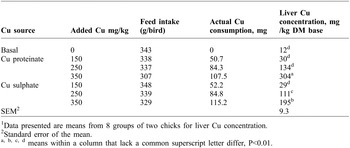
Several trials have been conducted to investigate the retention rate and bioavailability of organic mineral proteinates (Bioplex®) compared with inorganic mineral salts. Pierce et al. (Reference PIERCE, PESCATORE, FORD and CANTOR2005a) conducted a trial to compare the retention rate between organic and inorganic Cu sources. In this three week broiler trial, the dietary supplemental level of Cu was 0, 5, 10 and 20 mg/kg diet. The results indicated that Cu retention was 35% higher (P = 0.03) for the birds fed organic Cu compared to those receiving CuSO4, although in both cases, retention increased linearly with intake. Another broiler trial in the U.S. (Ao et al., Reference AO, PIERCE, PESCATORE, CANTOR, DAWSON, PAUL and FORD2011b) showed that the relative bioavailability of copper proteinate was 138% that of copper sulphate based on liver Cu accumulation (Table 1).
Effects of dietary supplementation of copper proteinate and reagent grade copper sulphate on liver Cu concentration of chicks1 (from Ao et al., Reference AO, PIERCE, PESCATORE, CANTOR, DAWSON, PAUL and FORD2011b).

1Data presented are means from 8 groups of two chicks for liver Cu concentration.
2Standard error of the mean.
a, b, c, d means within a column that lack a common superscript letter differ, P<0.01.
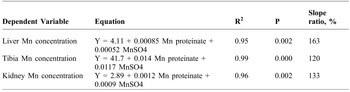
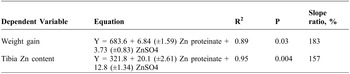
The bioavailability of organic (Bioplex®) Mn vs. Mn sulphate was evaluated using tissue Mn accumulation of broiler chicks (Ao et al., Reference AO, PIERCE, PESCATORE, FORD, CANTOR, DAWSON and PAUL2008a). Pharmaceutical levels of Mn (1000, 2000 and 3000 mg/kg) were supplemented in the practical diet in the trial. The Mn concentration in tissues including liver, tibia and kidney was analysed at the end of the trial. The relative bioavailability of organic Mn compared with reagent grade MnSO4•H2O was 139% based on average value of the slope ratio that resulted from the multiple linear regression of tissue Mn concentration against dietary supplemental level of Mn (Table 2). In another study, broiler chicks given corn-soybean meal diet with supplemental levels of 0, 5, 10, 20 and 40 mg Zn/kg of diet from different sources were raised for three weeks. The relative bioavailability of organic (Bioplex®) Zn versus ZnSO4 was 183% based on growth rate, and 157% based on bone zinc accumulation (Ao et al., Reference AO, PIERCE, POWER, DAWSON, PESCATORE, CANTOR and FORD2006, Table 3).
Multiple linear regression equations and slope ratio of tissue Mn concentration vs. dietary supplemental levels of Mn from different sources (from Ao et al., Reference AO, PIERCE, PESCATORE, FORD, CANTOR, DAWSON and PAUL2008a).

Multiple linear regression equations and slope ratio of growth rate and tibia Zn content vs. dietary supplemental levels of Zn from different sources (from Ao et al., Reference AO, PIERCE, POWER, DAWSON, PESCATORE, CANTOR and FORD2006).

The antagonism between minerals such as Zn, Cu and Fe has been known for decades (Van Campen and Scaife, 1967; Hall et al., Reference HALL, YOUNG and BRENNER1979; Southern and Baker, Reference SOUTHERN and BAKER1983; Abdel-Mageed and Oehme, Reference ABDEL-MAGEED and OEHME1991). The competition for mineral binding ligands and mineral uptake sites in the mucosa of the gut was proposed as the main factor causing an antagonism between these minerals (Oestreicher and Cousins, Reference OESTREICHER and COUSINS1985; Santon et al., Reference SANTON, GIANNETTO, STURNIOLO, MEDICI, D'INCA, IRATO and V. ALBERGONI2002). Results from animal studies indicated that the antagonism between these minerals could be avoided by using organic forms of the minerals. Du et al. (Reference DU, HEMKEN, JACKSON and TRAMMELL1996) reported that the utilisation of organic (Bioplex®) Cu by rats is higher than that of Cu sulphate in the presence and absence of 1000 ppm Zn or Fe in the inorganic form. The rats given organic Cu had higher concentrations of Fe and Zn in the liver, as well as a higher concentration of Fe and lower concentration of Cu in the kidneys compared with those fed inorganic Cu. In a chicken trial, Pierce et al. (Reference PIERCE, PESCATORE, FORD and CANTOR2005a) showed that liver Zn concentrations were depressed with increasing levels of dietary Cu from sulphate but not organic Cu. Another chick trial conducted by Ao et al. (Reference AO, PIERCE, POWER, PESCATORE, CANTOR, DAWSON and FORD2009a) indicated that the gain to feed ratio of chicks was depressed by feeding chicks inorganic Zn and Cu but not organic forms. These results suggest the antagonism between these minerals could be diminished by using organic forms.
Maenz et al. (Reference MAENZ, ENGELE-SCHAN, NEWKIRK and CLASSEN1999) showed that both Zn2+ and Cu can bind phytate causing a conformational change in the phytate moiety and render it less accessible to phytase. Champagne and Fisher (Reference CHAMPAGNE and FISHER1990) reported that Zn can form a complex with phytic acid in-vitro that is quite stable and precipitated out of solution. One Zn2+ ion might bridge two phytate molecules over time. David et al. (Reference DAVID, CARMEN, REX and HENRY1999) reported that the rank order of mineral potency as inhibitors of phytate hydrolysis was Zn2+ > Fe2+ > Mn2+ > Fe3+ > Ca2+ > Mg2+. Results from pig and chick trials by Augspurger et al. (Reference AUGSPURGER, SPENCER, WEBEL and BAKER2004) indicated that pharmacological levels of Zn decreased the availability of phytate for hydrolysis by phytase. The results from Ondracek et al. (Reference ONDRACEK, APPLEGATE, PANG, THOMPSON and JAYNES2002) indicated linear reductions in apparent P retention as a percentage of the diet due to increasing Cu concentrations as copper sulphate even with inclusion of 600 FTU phytase/kg diet. Banks et al. (Reference BANKS, THOMPSON, JAYNES and APPLEGATE2004) showed that supplementation with 250 ppm Cu from copper sulphate resulted in decreased apparent P retention when fed to broiler chicks. Data by Hamel et al. (Reference HAMEL, SEFTON, PIERCE, AO, ADAMS, MIRELES, RAO and HUMPHREY2010) demonstrated that excess dietary copper sulphate limits the efficacy of exogenous enzymes with phytase activity in diets low in calcium and available phosphorus.
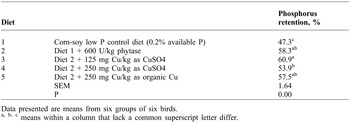
In order to investigate the effect of different forms of Zn and Cu on the efficacy of phytase in chick diets, a series of in-vitro and in-vivo trials were conducted. An in-vitro trial by Glenney et al. (Reference GLENNEY, FILER, AO and PIERCE2010) was performed to determine the impact of different form and level of Zn on the activity of phytase. The trial used three Zn sources including Zn sulphate, Zn proteinate (Bioplex® Zn) and Zn methioninehydroxy analogue chelate (Zn chelate); with nine Zn levels; 0, 3, 6, 12, 23, 47, 94, 188 and 375 ppm. The release of inorganic phosphate from phytic acid by enzymes with phytase activity was determined. The release of phosphate decreased with increasing level of Zn, confirming the negative impact of Zn on the activity of phytase. However, there was a significant source effect; as well as an interactive effect between source and level. The Zn proteinate treatment had the highest (P<0.01) phosphate release across all Zn levels at 0.2354 micro moles P/ml, compared to 0.1824 for Zn chelate and 0.1701 for Zn sulphate. At each Zn level, the treatment group with Zn proteinate had significantly higher phosphate release compared to the Zn sulphate or Zn chelate groups. One chick trial by Ao et al. (Reference AO, PIERCE, DAWSON, PESCATORE, CANTOR and FORD2010) was designed to investigate the effects of supplementing high levels of Cu as sulphate or copper proteinate (Bioplex® Cu) on the efficacy of enzymatic feed supplements with phytase activity. Chicks were fed a corn-soy low P diet with a phytase added alone, or with 125 or 250 mg/kg Cu as sulphate or 250 mg/kg Cu as Cu proteinate. Eight replicate cages of six chicks were randomly assigned to each of five dietary treatments. Chicks were housed in starter cages for 3 weeks. At the end of trial, faecal samples were collected and assayed for P retention using Cr2O3 as a marker. Phytase improved performance and P retention of chicks. Compared to the treatment group supplemented with phytase plus 125 mg/kg Cu as sulphate, the P retention rate was significantly lowered by feeding phytase together with 250 mg/kg Cu as sulphate, but not as proteinate (Table 4). In another layer trial by Ao et al. (unpublished, 2011), eight replicate groups of 12 Hy-line brown shell layers were assigned to each of five dietary treatments in 60 week laying period. Dietary treatments included two supplemental levels and two forms (inorganic and organic) of trace minerals including Cu, Mn, Fe and Zn. Phytase (600 PU/kg) was used in all the diets except positive control diet. The overall egg production and feed intake of layers was not affected by feeding treatment diets. However, the shell percentage of eggs from layers fed high level (100% NRC) trace mineral as inorganic salt with phytase was significantly lower than that of eggs from layers fed other treatment diets indicating inorganic trace mineral salts, not organic ones negatively affected the efficacy of phytase.
Effects of dietary treatments on the phosphorus retention rate (from Ao et al., Reference AO, PIERCE, DAWSON, PESCATORE, CANTOR and FORD2010).

Data presented are means from six groups of six birds.
a, b, c means within a column that lack a common superscript letter differ.
The results from these trials suggested that supplementing trace minerals as inorganic salt in poultry diets containing phytase has negative impact on the efficacy of phytase, which could be overcome by feeding organic minerals.
Replacing inorganic minerals with mineral proteinates in poultry diets to optimise performance and minimise the impact of minerals on the environment
Numerous trials have been conducted globally to investigate the total replacement of Zn, Cu, Mn and Fe in their inorganic salt form with lower amounts of the same minerals in the proteinate form. These trials have used broilers, pullets and laying hens with different ages and in various practical conditions including cages and floor pens. Most results indicated that replacing inorganic minerals with proteinates in poultry diets could not only maintain or optimise growth and reproductive performance, but also reduce the mineral content of excreta.
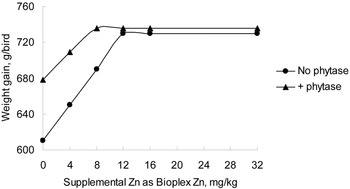
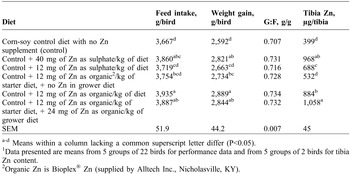
Ao et al. (Reference AO, PIERCE, POWER, DAWSON, PESCATORE, CANTOR and FORD2006, Reference AO, PIERCE, PESCATORE, CANTOR, DAWSON, FORD and SHAFER2007, Reference AO, PIERCE, PESCATORE, CANTOR, DAWSON, FORD and PAUL2011a) conducted a series of trials to redefine the requirement of Zn for broiler chicks by using zinc proteinate (Bioplex® Zn). Corn-soybean meal diet containing 23-31 mg Zn/kg diet was used as a basal diet in all the trials. In trial 1, dietary treatments consisted of feeding the basal diet alone or with four supplemental levels of Zn (5, 10, 20 and 40 mg/kg) either from zinc proteinate or from analytical ZnSO4·7H2O. Eight replicate cages of six chicks were randomly assigned to each of nine dietary treatments for three weeks. Weight gain and feed intake increased quadratically (P<0.05) with the increasing levels of Zn as zinc proteinate and increased linearly with the increasing levels of Zn as ZnSO4·7H2O. Broken-line analysis of the weight gain data determined the required supplemental level of Zn as zinc proteinate was 9.8 mg/kg of diet and as sulphate was 20.1 mg/kg of diet, for optimal growth rate. In trial 2, dietary treatment structure consisted of a 2 x 6 factorial arrangement with two levels of phytase (0 or 500 U/kg) and six levels of zinc proteinate providing 0, 2, 4, 8, 16 and 32 mg Zn/kg diet. Dietary supplementation of zinc proteinate linearly (P<0.01) increased feed intake, weight gain, plasma Zn concentration, liver Zn concentration and tibia Zn content. One slope, straight broken-line analysis of weight gain regressed on the supplemental Zn level provided as zinc proteinate indicated that 12 mg/kg supplemental Zn without phytase and 7.4 mg/kg supplemental Zn with phytase were required for the optimal weight gain of chicks (Figure 1). Trials 3 and 4 were conducted in floor pens for an entire six week growing period. In trials 1 and 2, the chicks were raised for only starting period (d1-21). In trial 3, broiler chicks were tested in an entire growing period including starting period (d1-21) and growing period (d22-42). In this trial, the NRC (1994) recommended Zn level of 40 mg/kg for broiler chicks was used as a supplemental level in a positive control diet by using Zn sulphate as a Zn source. The supplemental level of 12 mg Zn/kg of diet as zinc proteinate was used as a redefined level of Zn that was derived from the results of Trials 1 and 2. Dietary treatments included a corn-soy control diet with no Zn supplementation, the control diet supplemented with 12 or 40 mg of Zn/kg of diet as sulphate over a 42 d period and a control diet supplemented with 12 or 24 mg Zn/kg of diet as zinc proteinate over a 21 d or 42 d period (Table 5). Overall, chicks given 12 and 24 mg of organic Zn in the starter and grower phases, respectively, had better performance and bone zinc content than chicks fed the other treatment diets except those fed 40 mg Zn/kg of diet as sulphate. In Trial 4, the dietary supplemental levels of zinc as sulphate were based on both NRC recommended level and commercially used levels. The dietary supplemental levels of zinc as zinc proteinate were based on the results from previous trials. Dietary treatments included corn-soy control diet with no Zn supplementation, control diet supplemented with 40 or 80 mg Zn as sulphate/kg of diet and a control diet supplemented with 12 or 24 mg Zn as zinc proteinate/kg of diet. Even though no significant effect of dietary treatment on the performance of chicks over the entire six weeks was found, those given 24 mg organic Zn/kg diet had significantly higher weight gain than chicks fed inorganic treatment diets in the first 21 day period. Chicks fed the control diet with no zinc supplementation had significantly lower tibia zinc than those fed other treatment diets. Chicks given 24 mg organic Zn/kg diet had an equivalent tibia Zn content compared to those given 40 mg of Zn as sulphate. The results from this trial proved once again that replacing inorganic Zn in corn-soy diet with lower level of organic one may better support the growth performance of chicks.
Broken-line analysis plot of weight gain as a function of supplemental Zn as Bioplex® Zn with or without phytase (from Ao et al., Reference AO, PIERCE, PESCATORE, CANTOR, DAWSON, FORD and SHAFER2007).

Effects of different levels and forms of Zn on the performance and tissue Zn content of chicks1 (from Ao et al., Reference AO, PIERCE, PESCATORE, CANTOR, DAWSON, FORD and PAUL2011a).

a-d Means within a column lacking a common superscript letter differ (P<0.05).
1Data presented are means from 5 groups of 22 birds for performance data and from 5 groups of 2 birds for tibia Zn content.
2Organic Zn is Bioplex® Zn (supplied by Alltech Inc., Nicholasville, KY).
Peric et al. (Reference PERIC, MILOSEVIC and ZIKIC2007) reported that organic minerals including Cu, Mn, Fe and Zn at 30% of NRC recommendation maintained performance of broilers in a 1- 42d trial. Pierce et al. (Reference PIERCE, SHAFER, POWER and DAWSON2005b) replaced all four inorganic trace minerals with only 25% of the NRC requirement in the form of proteinate (no inorganic salts were fed). The results showed a 34% reduction in mineral excretion without compromising weight gain. Similar findings were reported by Bao et al. (Reference AO, PIERCE, PESCATORE, CANTOR, DAWSON, FORD and SHAFER2007), who reported that organically chelated minerals at levels of 4 ppm Cu and 40 ppm Fe, Mn and Zn were sufficient to maintain performance of broilers whilst reducing excreta mineral losses. Nollet et al. (Reference NOLLET, VAN DER KLIS, LENSING and SPRING2007) conducted an experiment with 2,040 Ross 308 broiler chickens to determine the effect of substituting inorganic with organic minerals in broiler feed on performance of broilers and mineral excretion. The experiment comprised two dietary treatments, each with 6 replicates of 170 mixed-sex broiler chickens per pen. The control diet was formulated with inorganic Mn, Zn, Fe, and Cu sulphates at levels of 70, 37, 45, and 12 ppm, respectively. The organic mineral diet was supplemented with lower levels of Mn, Zn, Fe (all 10 ppm), and Cu (2.5 ppm) supplied as organic (Bioplex®) minerals. Production performance was measured during the 39-d trial period and mineral excretion was evaluated at 26 days of age. In the starter period (0 to 14 d), FCR tended to improve (P=0.06) in broilers fed the organic mineral diet. However, no significant differences were observed in any of the productive performance parameters measured during the trial. Significantly lower (P<0.05) excretion rates were recorded for all minerals in faecal samples taken from broilers receiving the organic mineral diet; faecal levels of Mn, Zn, Fe, and Cu were 46, 63, 73 and 55%, respectively, compared to the controls. A similar trial was carried out by Petrovic et al. (Reference PETROVIC, MARCINCAK, POPELKA, NOLLET and KOVAC2009). In this trial, Ross 308 broiler chicks were randomly divided at the day of hatching into four groups and fed for 42 days with the diets containing different amounts and forms of Cu, Fe, Zn, Mn and Se. The diets for the 1st and 2nd group of birds were supplemented with the equivalent amounts of trace elements in an inorganic form (Cu sulphate, 5 mg/kg; Fe sulphate, Zn oxide and Mn oxide, 50 mg/kg). Treatment 1 contained sodium selenite and treatment 2 contained selenium yeast, both included to provide 0.3 mg Se/kg of diet. The 3rd and 4th group received the same feed as chickens in the 1st and 2nd group but with reduced amount of minerals in the organic (Bioplex®) form (Cu, 2.5 mg/kg; Fe, Zn and Mn, 10 mg/kg). Birds fed the organic mineral diet, despite lower levels of mineral had the same body weight, carcass and breast weight, as well as concentration of trace minerals in the muscle; when compared to birds fed higher levels of inorganic minerals.
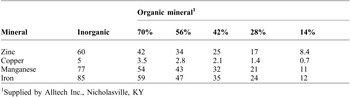
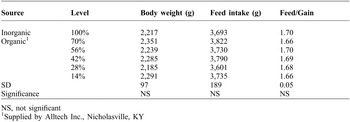
Leeson and Caston (Reference LEESON and CASTON2008) performed a broiler trial totally replacing the inorganic minerals with organic forms (Bioplex®). The positive control chicks were fed a maize-soy diet supplemented with commercial levels of trace minerals provided by inorganic salts (Tables 6 and 7). Other treatment diets included Bioplex minerals at 70-14% of the control diet levels. After 42d growing period, no effect of dietary treatments on body weight or feed efficiency was detected for the chicks fed organic minerals, even at 20% of inorganic mineral level in the control diet.
Dietary supplemental levels of trace minerals in broiler diets, mg/kg (from Leeson and Caston, Reference LEESON and CASTON2008).

1Supplied by Alltech Inc., Nicholasville, KY
Effects of dietary supplementation of different levels and sources of trace minerals on the performance of chicks (0-42d) (from Leeson and Caston, Reference LEESON and CASTON2008).

NS, not significant
1Supplied by Alltech Inc., Nicholasville, KY
Replacement of inorganic minerals with mineral proteinates for layers
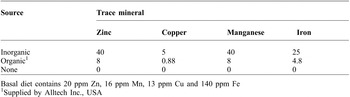
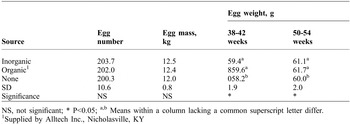
Two trials by Ao et al. (Reference AO, PIERCE, PESCATORE, CANTOR, DAWSON K.A. and FORD2008b, Reference AO, PIERCE, PESCATORE, CANTOR, DAWSON and FORD2009b) were conducted to evaluate the effects of feeding reduced levels of trace minerals in organic (Bioplex®) form on the development and bone mineral status of both white and brown pullets. Treatments consisted of feeding an un-supplemented corn-soybean meal-based starter and grower diets (control) and diets supplemented with Cu, Mn, Fe and Zn at 25, 50 or 100 per cent of the NRC (1994) requirements, either in the form of proteinate or 100 per cent of the NRC requirements in the form of inorganic salts. The results indicated that 25% NRC level of supplementation as the proteinate in pullet diets had no negative effect on body weight, uniformity and tissue mineral concentration in comparison with 100% NRC level of supplementation as inorganic salts. Boruta et al. (Reference BORUTA, SWIERCZEWSKA, GLEBOCKA and NOLLET2007) monitored performance of hens fed inorganic minerals at 100% NRC levels against those fed 8, 17 or 33% of those levels in the organic form. Laying performance was similar in all treatment groups. Bone strength increased with a reduction in faecal excretion in the organic groups compared to the control. Cantor et al. (Reference CANTOR, PIERCE, PESCATORE, FORD, AO and GILLESPIE2008) used diets to supply 25, 50 and 100% of NRC recommended mineral level in both inorganic and organic forms for brown layer hens. After 40 weeks of production, body weight and overall egg production were not affected by dietary treatments. Similar results were obtained by Macalintal et al. (Reference MACALINTAL, CANTOR, AO, PIERCE, PESCATORE, DAWSON, FORD, KING and GILLESPIE H.D.2010), in their trial, seven dietary treatments consisted of feeding corn-soybean meal diet alone or supplemented with Cu, Mn, Fe and Zn at 25, 50, or 100% of the NRC (1994) requirements provided by either inorganic salts or organic sources. White pullets of Hy-line W-36 were raised till 17 weeks of age fed the treatment diets. Then, pullets were transferred to laying cages. During 28 weeks of production, overall body weight, feed intake and hen-day egg production rate were not affected by treatment. In the trial by Leeson and Caston (Reference LEESON and CASTON2008), layers were fed conventional levels of trace minerals as inorganic salts, no trace minerals, or 20% of conventional levels as organic mineral (Bioplex®). No effect of dietary treatments on egg production was detected from 38 – 70 weeks of production (Tables 8 and 9). Egg size was always reduced in birds fed diets which were not supplemented with trace minerals. There was a 66% reduction in excretion of zinc and 78% reduction in excretion of Mn when birds were fed the lower levels of organic minerals. Results from these trials indicated that lower than NRC or practical level of trace minerals as organic form could be used to maintain the performance of layers and reduce mineral content of manure.
Dietary supplemental levels of trace minerals in layer diets, mg/kg (Leeson and Caston, Reference LEESON and CASTON2008).

Basal diet contains 20 ppm Zn, 16 ppm Mn, 13 ppm Cu and 140 ppm Fe
1Supplied by Alltech Inc., USA
Effects of dietary supplementation of different levels and sources of trace minerals on the performance of layer (38-70 weeks of age) (Leeson and Caston, Reference LEESON and CASTON2008).

NS, not significant; * P<0.05; a,b Means within a column lacking a common superscript letter differ.
1Supplied by Alltech Inc., Nicholasville, KY
Conclusions
Research results indicated that using lower supplemental level of high bioavailable mineral proteinate to replace inorganic mineral salts can not only maintain or promote the performance of pullets, laying hens and broilers, but also avoid antagonism between minerals, diminish negative impact of trace minerals on the efficacy of dietary phytase, increase tissue mineral reserves and decrease excretion of minerals into environment.