Healthcare utilization and costs are approximately 81 percent higher for morbidly obese individuals compared with nonobese persons and 47 percent higher compared with the nonmorbidly obese population (Reference Flegal, Carrol, Ogden and Johnson1;Reference Arteburn, Maciejewski and Tsevat2).
The Brazilian Family Budget Survey (3) of subjects aged 20 years and above has shown that obesity currently affects 12.5 percent of Brazilian males and 16.9 percent of Brazilian females, comprising 18.5 million individuals. The prevalence of morbid obesity—defined as a body mass index (BMI) of 40 kg/m2 or more—increased by 70 percent over the past 5 years (3). In 2012, 0.8 percent of the population was affected, comprising approximately one million individuals, of which 0.4 percent were male and 1.1 percent were female (Pesquisa de Orçamentos Familiares 2008, unpublished data).
The burden of severe obesity (morbid obesity or a BMI ≥ 35 kg/m2 with life-threatening comorbidities) is well known, as are the medical benefits of bariatric surgery. This procedure results in greater weight loss compared with other approaches and this outcome persists for at least 10 years. Additionally, weight loss is accompanied by improvement of comorbidities, such as diabetes and elevated blood pressure, and less need for medication. Short-term (up to 2 years) improvements as measured by health-related quality of life assessments have been reported. Long-term (2 to 10 years) effects, however, are less clear (Reference Colquitt, Picot, Loveman and Clegg4).
Bariatric surgery is considered a safe procedure, but carries the usual risks and threats of surgical interventions in general. Postoperative adverse events, some of which require further procedures, include leaks at the site of anastomosis, pneumonia, pulmonary embolism, band slippage, and band erosion. Death is rare, but may occur during or after the procedure. Stricture of the anastomosis and reoperations are more frequent in laparoscopic surgery. Wound infections and hernias are more common after open surgery (Reference Flum, Belle and King5).
There are few published papers on the economic gains following bariatric surgery, most of which are controversial. A survey of the literature (using the terms “Bariatric Surgery/economics” [Mesh] OR “Bariatric Surgery/utilization” [Mesh]) yielded papers comparing obese individuals matched with patients undergoing bariatric surgery. Some of these articles showed that the average total cost was higher in the operated group (Reference Maciejewski, Livingston and Smith6;Reference Agren, Narbro and Jonsson7). Conversely, other articles revealed that total healthcare costs were higher in the control group (Reference Cremieux, Buchwald and Shikora8–Reference Christou, Sampalis and Liberman10). A comparison of two cohorts of obese patients with diabetes showed that medication costs decreased significantly in the operated group (Reference Klein, Ghosh, Cremieux, Eapen and McGavock11). Before-and-after studies have shown that total costs were higher after surgery (Reference Bleich, Chang and Lau12–Reference Weiner, Goodwin and Chang15). The cohorts in the majority of these studies were health-insured patients (Reference Maciejewski, Livingston and Smith6;Reference Cremieux, Buchwald and Shikora8;Reference Finkelstein, Allaire, Burgess and Hale9;Reference Klein, Ghosh, Cremieux, Eapen and McGavock11–Reference McEwen, Coelho and Baumann13), rather than patients in public healthcare (Reference Agren, Narbro and Jonsson7;Reference Christou, Sampalis and Liberman10;Reference Zingmond, McGory and Ko14;Reference Weiner, Goodwin and Chang15). Furthermore, follow-up was consistently shorter in studies of individuals treated in public healthcare settings. Therefore, longer follow-up periods are needed to assess costs and outcomes in the surgical treatment of these patients in low- and middle-income countries to fully understand the advantages and economic benefits of bariatric surgery.
In this study, we compared severely obese patients before and after bariatric surgery to investigate differences in healthcare utilization and costs. The study period was 2004 to 2011. Our hypothesis was that healthcare utilization and costs would be lower following bariatric surgery because of decreases in bodily weight and comorbidities.
METHODS
The study sample consisted of health-insured patients (by an insurance company that provides health insurance to over a million individuals) from Belo Horizonte, a city in Southeastern Brazil, who underwent surgery at any time between 2004 and 2010. Enrolment required the following criteria: subjects aged at least 18 years with a BMI of at least 40 kg/m2 or at least 35 kg/m2 plus two comorbidities (generally elevated blood pressure, diabetes, and/or sleep apnea), with medical and psychological clearance for surgery, and with healthcare insurance during at least 1 month before and after surgery. The Roux-en-Y gastric bypass procedure (RYGB), the only technique approved by the healthcare provider between 2004 and 2010, was done in all patients.
The healthcare utilization pattern before-and-after surgery, perioperative events, long-term surgical complications, and cost-utility data were taken from the health insurance company database. Available variables were sex, age, procedure codes for hospital admissions, emergency department visits, and diagnostic codes (ICD 10th revision), healthcare costs and supplementary preoperative audits of the BMI and comorbidities for each patient. Healthcare expenses included all payments to physicians and healthcare institutions. Outpatient prescriptions were not included.
Time zero (T = 0) was defined as the date of bariatric surgery. The month before surgery was defined as “-1” and consisted of healthcare utilization and costs during the month up to the day patients were admitted into hospital for surgery. The month after surgery was defined as “+1” and consisted of healthcare utilization as costs during the month after the day patients were discharged following bariatric surgery. Patients were monitored equally before and after surgery. For instance, a patient entering the cohort 12 months before surgery and declining health insurance 5 years after bariatric surgery would have healthcare utilization data gathered only for 1 year before and 1 year after surgery. Our aim was to have each patient yielding a similar observation period before and after surgery. This approach also avoids inflated healthcare costs after surgery in less healthy patients, who tend to remain covered by healthcare insurance for longer time frames; the opposite also applies. The unit was “patient-year,” which expressed the incidence of pertinent events for this study. These rates were calculated by dividing the number of incidents over the total time patient were at risk during the same period.
Costs were measured up to 48 months before and up to 48 months after surgery. To minimize the influence of surgery on the utilization and cost profile of these patients, in the context of a sensitivity analysis, expenses during 6 months immediately before and 6 months immediately after surgery were removed; these expenses could reflect preparation costs of surgery and immediate postoperative care. Hospital admissions were recorded in the database as admission and discharge dates. The follow-up period continued until one of the following, whichever occurred first: death of the patient, loss of healthcare insurance, and the end of the study (December 31, 2011). Deaths in hospital or within 30 days of surgery were recorded in the healthcare insurance company database.
The diagnoses of hospital admissions and emergency department visits before and after bariatric surgery were recorded as the rate of patient-years of observation, and were categorized into ICD-10 groups of diseases per bodily system as follows: (i) digestive system; (ii) circulatory system; (iii) genitourinary system; (iv) endocrine, nutritional, and metabolic conditions; (v) musculoskeletal system and connective tissue conditions; and (vi) others.
Additional disease groups were applied for emergency department visits, as follows (i) respiratory system; (ii) skin and subcutaneous tissue conditions; (iii) certain infections and parasitic infestations; (iv) conditions related to blood and blood-forming organs and of the immune system; (v) nervous system; (vi) mental and behavioral conditions; (vii) injury, poisoning, and other consequences of external causes; and (viii) others. The cost unit of analysis was the patient.
Healthcare costs for each bariatric surgery patient were compiled separately, and total costs were reported as consolidated expenses incurred by the health insurance company to health providers before and after bariatric surgery. The mean cost per person, per month, or per semester was obtained by dividing the total costs of all patients by the number of eligible patients for the same period. The cost of bariatric surgery admission was not included in these calculations.
Descriptive cost analysis was presented including and excluding costs due to pregnancy and/or esthetic surgery. Costs were inflation-adjusted for December 2011 in Brazilian currency. Adjustment was based on the Consumer Price Index (IPCA) and on the exchange rate for U.S. dollars (USD) according to the Brazilian Central Bank exchange rate on December 2011 (USD 1.00 = R$ 1.88)
Statistical Analysis
A descriptive analysis was made of the comorbidities present before surgery (elevated blood pressure, diabetes, joint diseases, and sleep apnea). We also assessed subgroups with a BMI of 50 kg/m2 or more, and subjects aged 50 years and above.
Patient data were presented as frequency distributions for categorical variables, and mean and standard deviations for continuous variables. Data before were compared with data after surgery to estimate changes in healthcare use as a result of surgical treatment of obesity.
The distribution of variables was tested for normalcy. Outcome measures included differences between the mean number of hospital admissions, emergency department visits, and costs per patient/year, for each year. The Wilcoxon signed-rank test was used to examine differences between continuous variables. Overall costs were presented as average payments incurred by the health insurance company for every operated patient per semester. To a best-line fit calculation, curve and the corresponding quadratic equation with its R 2 value was included to find the best model for analyzing cost trends.
The EPI Info TM version 6.04 were used for data entry. The Stata Statistical Software Release 12 (College Station, TX: Stata Corp LP) was used for data analysis. The Ethics Research Committee of the Minas Gerais Federal University (COEP UFMG ETIC—0074.0.203.000.11) approved this study. Signed informed consent was not required.
RESULTS
There were 4,006 subjects enrolled in this study. These patients underwent bariatric surgery between 2004 and 2010. The follow-up period continued until December 31, 2011, or until death or exclusion from the health insurance coverage, whichever occurred first. The cohort consisted mostly of females (80 percent). One or more comorbidities was preset in 51 percent of cases. The median duration of follow-up after enrollment in the cohort (the day of surgery) was 4 years, and the total number of person-years of observation was 75,942. At the baseline, the mean and median ages were, respectively, 36.2 years (SD 10.3) and 34.2 years. The mean and median BMI were, respectively, 42.8 kg/m2 (SD 4.8) and 42.0 kg/m2. There were 528 (13.2 percent) patients aged 50 years or more. There were 383 patients (9.6 percent) with a BMI ≥ 50 kg/m2. Before surgery, 37.9 percent patients presented with elevated blood pressure, 12.5 percent had diabetes, 9.2 percent had joint diseases, and 3.6 percent had sleep apnea. The Supplementary Table 1 presents the baseline characteristics of the 4,006 study patients. This table also shows the characteristics of subjects in other published papers assessing costs and health insurance use after bariatric surgery.
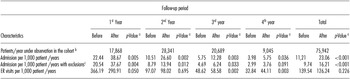
There were 23 deaths (0.6 percent) within the first month after surgery. The number of hospital admissions during the study period was 2.605; of these, 854 were before and 1,751 were after surgery (p < .001). The number of hospital admission, for the entire study period was 1,971 after excluding pregnancy-related hospital admissions before and after bariatric surgery and esthetic surgery after bariatric surgery. Of these, 37.5 percent were before and 62.5 percent were after bariatric surgery (p < .001). The rate is 11.20 hospital admissions per 1,000 patient-years before bariatric surgery, and 23.06 hospital admissions per 1,000 patient-years after bariatric surgery (p < .001). If procedures related to pregnancy and esthetic surgery are excluded, the rates were 9.74 per 1,000 patient-years before and 16.21 per 1,000 patient-years after surgery. The full number of emergency department visits was 10,597 before bariatric surgery, and 9,587 visits after surgery. The incidence rates of emergency department visits per 1,000 patient-years during the 4-year follow-up period (Table 1) were 139.54 before surgery and 126.24 after surgery (p = .23). The incidence rate of emergency department visits was lower in the first 2 years, but tended to increase 3 years and beyond after surgery; this increase was statistically significant.
Inpatient Hospital Admissions and Emergency Department Visits before and after Bariatric Surgery in 4,006 Patients between 2004 and 2011

a Wilcoxon signed-rank test.
b Each patient contributed equal time of follow-up before and after surgery.
c Excluded hospital admissions related to pregnancy or esthetic surgery.
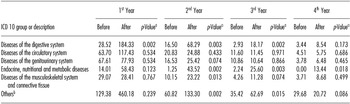
The hospital admission incidence rates per 1,000 patient-years in selected groups of diseases are shown on Table 2. These diagnoses accounted for 60 percent of hospital admissions. Admission rates due to digestive, endocrine and metabolic diseases increased significantly throughout the study period. There was no statistical difference in hospital admission rates for circulatory and genitourinary diseases.
Admission Rate per 1,000 Patient-Years, Categorized by ICD-10 Codes, before and after Bariatric Surgery, by Year of Assessment in the Study

a p-Value, Wilcoxon signed-rank test.
bOthers included: diseases of the eyes, ears, mastoid, congenital malformation, deformities, external causes of morbidity and mortality, pregnancy, childbirth and the puerperium, injury, poisoning and certain other consequences of external causes; diseases of skin and subcutaneous tissue; diseases of the respiratory system; neoplasms, mental and behavioral disorders; symptoms, signs, and abnormal clinical and laboratory findings; infectious or parasitic disorders not elsewhere classified.
The rate of emergency department visits due to genitourinary, hematologic, and specific immune disorders increased significantly within the first year following bariatric surgery. Circulatory and respiratory diseases were less frequent postoperatively. Supplementary Table 2 shows additional data.
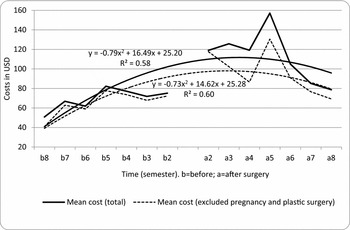
Overall costs increased during follow-up. Figure 1 shows average health insurance payments per patient before and after surgery, excluding 6 months before and 6 months after surgery. The continuous line is the total average cost per patient during follow-up. The dotted line is costs except for esthetic surgery and pregnancy-related procedures. The two lines showing postsurgical costs trended upward. The estimated cost trend showed that costs initially increase with time; eventually the rate of increase diminishes and at some point start to decrease. On average, expenses were higher after bariatric surgery.
Average healthcare costs per patient and per semester, before and after bariatric surgery, during a 4-year follow-up period.

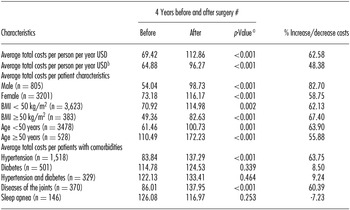
The average costs of the RYGB per patient was USD 4,951.28. Table 3 shows the average costs per patient per year before and after bariatric surgery. Altogether, there is a statistically significant increase in costs per patient after bariatric surgery, even after excluding esthetic surgery and pregnancy-related expenses. The average costs per patient were statistically higher among male patients, those with a BMI ≥ 50 kg/m2, those aged ≥ 50 years, and those with joint diseases. Supplementary Table 3 shows average costs per patient per year.
Average Costs (in USD) per Patient per Year, and Percent of Increase/Decrease Costs before and after Bariatric Surgery, in 4,006 Patients Undergoing Bariatric Operation, between 2004 and 2011

#Excluding 6 months immediately before and immediately after bariatric surgery.
a p-Value Wilcoxon signed-rank test.
b Excluding in-hospital care of pregnancy and esthetic surgery.
DISCUSSION
Our results showed consistently increased incidence rates for hospital admissions and the mean healthcare costs per patient up to 4 years after bariatric surgery. An important outcome supporting RYGB for the treatment of obesity is the improvement resolution of obesity-related comorbidities such as diabetes, sleep apnea, and high blood pressure (Reference Zingmond, McGory and Ko14). Therefore, fewer hospital admission are to be expected after the surgery, at least for the short- and mid-term. However, if hospital admission is considered as a proxy for diseases, an increase in admission rates suggests lack of improvement or worsening of health after surgery. Our results suggest that the surgical procedure itself may be a significant cause of increased hospital admissions after surgery, at least within a 4-year follow-up period.
There was a consistent increase in digestive, endocrine, nutritional, and metabolic diseases. These findings concur with those of other authors (Reference Christou, Sampalis and Liberman10;Reference Neovius, Narbro and Keating16) describing increased healthcare utilization after bariatric surgery within the first 6 years after bariatric surgery. Gastrointestinal complications of obesity surgery can occur at any time. According to Abell and Minocha (Reference Abell and Minocha17), these complications are dumping, vitamin and mineral deficiency, vomiting and nausea, staple line failure, infection, stenosis, bowel obstruction, ulceration, and splenic bleeding or injury. Weight loss, intestinal bacterial overgrowth, and diarrhea may occur.
Besides additional hospital admissions for treating diseases and for esthetic surgery after massive weight loss, there probably is a delayed demand for other elective procedures which would have been postponed because of obesity. There is evidence of an increased number of hip or knee replacements as individuals become more active after surgery. It is likely that such operations would not have taken place if patients had not lost weight significantly (Reference Kulkarni, Jameson, Woodcock, Muller and Reed18).
An evaluation of emergency department visits revealed that genitourinary and hematologic diseases are more frequent after bariatric surgery. In the study by Encinosa et al. (Reference Encinosa, Bernard, Chen and Steiner19), genitourinary diseases (urinary tract infections and calculi) were found in 10 percent of emergency department visits. Hematologic diseases are probably due to iron-deficiency anemia, a condition that may affect as many as two-thirds of postbariatric surgery patients (Reference Drygalski and Andris20;Reference Vargas-Ruiz, Hernández-Rivera and Herrera21). We found downward trends in emergency department visits for circulatory, respiratory, and musculoskeletal diseases, possibly in line with an expected decrease of comorbidities (Reference Ricci, Gaeta and Rausa22).
Several reasons may explain why costs after bariatric surgery remain high. Our analysis indicates that health insurance costs increase significantly after bariatric surgery up to 4 years after this procedure. This finding concurs with published studies. Several papers have reported increased costs after bariatric surgery in before-and-after studies (Reference Bleich, Chang and Lau12–Reference Weiner, Goodwin and Chang15) and in comparative studies between operated patients and matched non-operated controls (Reference Maciejewski, Livingston and Smith6–Reference Christou, Sampalis and Liberman10;Reference Neovius, Narbro and Keating16). On the other hand, there seems to be a decrease in costs after bariatric surgery if out-of-pocket expenses with medication are included in the analysis (Reference Klein, Ghosh, Cremieux, Eapen and McGavock11;Reference Neovius, Narbro and Keating16).
Using information based on data from health insurance claims may be a challenge. Clinical outcomes are better than financial metrics for assessing healthcare. The database we used in this study is used for payment of healthcare by the health insurance company. Although information about healthcare use and costs after bariatric surgery could be better evaluated by randomized controlled trials, such a study has not been conducted and probably will never be due to ethical concerns. Thus, we rely on observational studies as the best available evidence on this topic. Each type of study has its own bias; within-group comparisons are often limited by a duration bias. To minimize this effect, for each patient we compared a time period before bariatric surgery with a similar time period after surgery to avoid any effect resulting from duration of observation on healthcare use, given that such use is time-dependent. This strategy also yielded a consistent control group where each operated patient was his or her own control.
Few studies on healthcare costs after bariatric surgery in middle or low-income countries have been conducted. The present study is the first mid-term assessment of the outcomes after bariatric surgery in a large Brazilian cohort. Cumulative evidence in developed countries suggests that no economic benefit results from weight-loss surgery (Reference Maciejewski, Livingston and Smith6;Reference Agren, Narbro and Jonsson7;Reference Klein, Ghosh, Cremieux, Eapen and McGavock11–Reference Weiner, Goodwin and Chang15;Reference Livingston23). It should be noted that our cohort was younger and had a lower average BMI as well as more favorable comorbidity profile compared with other cohorts in the majority of published papers. There is no doubt that bariatric surgery improves the health and well-being of most morbidly obese patients; however, it does not seem to results in cost savings for healthcare insurance companies (Reference Maciejewski, Livingston and Smith6;Reference Agren, Narbro and Jonsson7;Reference Klein, Ghosh, Cremieux, Eapen and McGavock11–Reference Weiner, Goodwin and Chang15;Reference Livingston23).
Our data describe patients covered by a private healthcare insurance company that has no restrictions on coverage. Approximately one-fourth of the Brazilian population (which is close to 200 million individuals) has private healthcare insurance. The healthcare use pattern may be different in patients treated under the Brazilian Universal Public Health System. As bariatric surgery is applied to treat impaired health, rather than merely an esthetic procedure, postoperative care will be given even if access to public healthcare is more difficult. The outcomes and costs reported in this study may support estimates made by private and public healthcare providers to meet the healthcare and funding requirements for assisting these patients.
CONCLUSION
Bariatric surgery does not reduce overall mid-term healthcare costs and use. Our data may be of interest to managed-care decision makers. Further studies may offer a broader assessment of the healthcare and the costs of bariatric surgery, including quality of life and medication use. This may yield a more comprehensive evaluation of changes before and after surgery.
SUPPLEMENTARY MATERIAL
Supplementary Table 1–3 http://dx.doi.org/10.1017/S0266462315000653
CONFLICTS OF INTEREST
The authors declare that there is no conflict of interest.