INTRODUCTION
With the appearance and extensive applications of high power and high energy laser system, the damage of laser to human eyes and optical instruments has attracted widespread attention. To solve the problem, a great deal of optical limiting materials and their limiting mechanisms have been widely researched in theories and experiments during the past several decades. Currently, organic compounds containing large π-conjugate system (Liu et al., Reference Liu, Zeng and Segawa1999), such as fullerenes (Tutt & Kost, Reference Tutt and Kost1992), metal-phthalocyanine complex (MPC) (Perry et al., Reference Perry, Mansour and Marder1994), porphyrins (Blau et al., Reference Blau, Byrne and Dennis1985), carbon nanotubes (Wang et al., Reference Wang, Chen and Blau2009a), have been the focus of theoretical and experimental investigation due to large nonlinear optical limiting effect. Optical limiting mechanisms of those materials include nonlinear absorption (Lin et al., Reference Lin, Tonucci and Campillo1998), nonlinear refraction (Dovgalenko et al., Reference Dovgalenko, Klotz and Salamo1996), nonlinear scattering (Wang & Blau, Reference Wang and Blau2008), and nonlinear reflection (Michael & Lawson, Reference Michael and Lawson1992). Although optical limiting based on those materials provides safe protection for human eyes and optical instruments to some extent, they also shows some disadvantages to the practical applications of optical limiting, such as low optical limiting threshold, low damage threshold, and non-flattening output energy.
While most research regarding stimulated Brillouin scattering (SBS) has been focused on the characteristics of backscattered light for phase conjugation and laser pulse compression (Kong et al., Reference Kong, Shin, Yoon and Beak2009; Shin et al., Reference Shin, Park, Kong and Yoon2010; Gao et al., Reference Gao, Lu, He, Dong and Hasi2009; Wang et al., Reference Wang, Lu, He, Zheng and Zhao2009b; Zhu et al., Reference Zhu, Lu and He2009), there are few studies as to the characteristics of transmitted light. When the pump intensity exceeds the SBS threshold, a strong SBS process takes place through the SBS medium, leading to a quick energy transfer from pump to the Stokes light, and accordingly an optical limiting characteristic in the transmitted light. Optical limiting based on SBS is first proposed by Lu et al. (Reference Lu, Lu and Yang2003), which exhibits the performances of high optical limiting threshold, fast response speed, and high damage threshold, thereby particularly suitable for providing safe protection for high power laser system from the exposure of a high input power density. Although the energy limiting based on SBS can be easily implemented, the feature of energy limiting is dissatisfied due to an inadequate energy transfer from input to Stokes light, thus showing a negative effect to the practical application (Hasi et al., Reference Hasi, Lu, Gong, Li, Lin and He2008). To solve the problem, methods based on double SBS optical limiting and single SBS optical limiting following a nonlinear material optical limiting are proposed by Hasi et al. (Reference Hasi, Lu, Fu, Lu, Gong, Lin and He2009a, Reference Hasi, Lu, Fu, Lu, Gong, Lin and He2009b, Reference Hasi, Geng, Jin, Fan, Lin, He and Lu2011), however, these experimental setups are complicated for the practical application of optical limiting.
In order to simplify experimental setup and improve optical limiting performance, a scheme of compound optical limiting based on nonlinear material dissolved into Brillouin medium is proposed in this paper. There is a fundamental difference of the proposed scheme compared with the conventional compound optical limiting. The conventional compound optical limiting is composed of a kind of optical limiting material with two kinds of optical limiting mechanisms (such as, excited state absorption/thermal optical limiting, thermal defocusing/scattering optical limiting, two-photon absorption/self-defocusing optical limiting and so on) (Van Stryland et al., Reference Van Stryland, Vanherzeele, Woodall, Soileau and Smirl1985), or two types of optical limiting materials with different optical limiting mechanisms (Scott et al., Reference Scott, Marisol, Xavier, Roman, Mauricio and David2005). However, compound optical limiting based on the proposed scheme in this paper consists of nonlinear material and its solvent, solvent used as SBS medium mainly contributes to SBS optical limiting. Due to the combined optical limiting effect of nonlinear material and its solvent in the proposed scheme, the compound scheme presents a low output clamp value and flat output energy.
In this paper, we analyze optical limiting mechanism of SBS and MPC, respectively. The dependence of output energy of compound optical limiting on the input energy is numerically simulated and validated in Continuum's Nd:YAG seed-injected laser. The theoretical results are well agreed with experimental ones. Those results indicate that the output clamp value and output energy based on the compound optical limiting shows much lower and flatter features than that based on single SBS. Some properties of compound optical limiting, such as limiting threshold, limiting energy range, limiting waveband, response speed and damage threshold, also are analyzed and discussed in the later part of this paper.
THEORETICAL ANALYSIS
When the input power density exceeds the SBS threshold, a strong SBS effect within Brillouin medium occurs, thus leading to a rapid energy transfer from input to the stokes light, and correspondingly a optical limiting trait in the transmitted light. Optical limiting based on SBS exhibits the characteristics of high optical limiting threshold, fast response speed and high damage threshold, thus especially suitable for safe protection of high power laser system. Both nonlinear material optical limiting and SBS optical limiting have similarly experimental conditions, namely, a beam of input light is focused into nonlinear material sample or Brillouin medium. The solvent of nonlinear material can be used as Brillouin medium to generate optical limiting due to SBS, so a compound optical limiting based on the combination of nonlinear material and SBS optical limiting can be prepared through making nonlinear material dissolved into Brillouin medium. With the double effects of both nonlinear materials and SBS, compound optical limiting presents much better optical limiting performance compared with single SBS.
The optical limiting threshold of nonlinear optical material (several μJ) is usually lower than that of SBS (hundreds of μJ to several mJ), however, some nonlinear optical limiting materials and their derivatives, such as fullerenes, MPC, metallic porphyrin complexes and nano materials, have high optical limiting threshold that is close match to the SBS threshold, thereby they can combine with SBS optical limiting to form a compound optical limiting.
Danilo et al. (Reference Danilo, Guo and Michael2003) reports that heavy MPC exhibits good optical limiting performance in input wavelength of 532 nm, so F16PCCu is dissolved into acetone to prepare a compound optical limiting in this paper. Optical limiting mechanism of MPC mainly results from reverse saturable absorption (RSA), namely, absorption coefficient increases with the increasing input intensity. RSA usually takes place in the region of non-resonant or near-resonant of linear absorption spectrum (the valley value region of linear absorption spectrum of nonlinear material), and thus presenting a high linear transmissivity. At a low input intensity, the absorption of MPC mainly comes from the linear absorption of the ground state; in contrast, the excited singlet-singlet and the triplet-triplet state absorption of the MPC can be induced in the case of a high input intensity; therefore, the absorption coefficient of the MPC increases with the increasing input intensity.
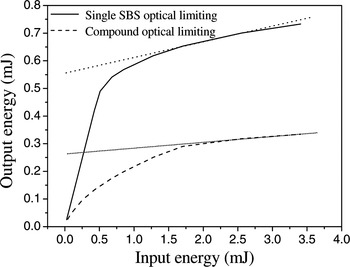
According to the SBS optical limiting model (Lu et al., Reference Lu, Lu and Yang2003) and RSA model (Blau et al., Reference Blau, Byrne and Dennis1985), we numerically simulate the dependence of output energy of optical limiting based on single SBS and compound optical limiting scheme on input energy and the simulation results are shown in Figure 1. The parameters used in simulation are as follows: the input wavelength is 532 nm with a pulse width of 8 ns and divergence angle of 1.29 mrad. The Brilloun cell length is 10 cm and the focal length of the lens for it is 30 cm. The ratio of absorption cross section of excited state to ground state of nonlinear material is K = 12.5 and the linear transmissivity of the sample is T 0 = 0.8.
The simulation curves of the dependence of output energy on the input energy based on single SBS and compound optical limiting.

It can be seen from Figure 1 that the output clamp value of compound optical limiting (about 0.3 mJ) is lower than that based on single SBS optical limiting (about 0.6 mJ). In addition, the output energy of compound optical limiting shows much better optical limiting performance compared with that based on single SBS. The slope is used to denote the flat index of output energy of optical limiting, which is defined as the slope value of the straight line given by linear fit of output energy over the optical limiting threshold. Obviously, a small slope means flat output energy of optical limiting. According to the simulation results, the slope is 0.07 for single SBS and 0.03 for compound optical limiting, respectively.
EXPERIMENTAL INVESTIGATION
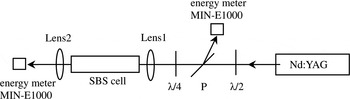
The experimental setup is shown in Figure 2. The Continuum's Nd:YAG seed-injected laser outputs s-polarized light, which becomes p-polarized after passing the 1/2 wave plate and circular polarized after passing the 1/4 wave plate and then injected into the SBS system. The SBS system is composed of lens 1 and SBS cell. The input light is focused into SBS cell to produce stokes light. Polarizer P together with a 1/4 wave plate forms a light isolator, preventing backward SBS light from entering the YAG oscillator. The Stokes light becomes s-polarized after passing the 1/4 wave plate, and then is reflected by polarizer P. The divergence beam after SBS optical limiting becomes parallel after passing the lens 2. The input energy is altered by adjusting the 1/2 wave plate in the experiment. The energies of input pulse, transmitted pulse and Stokes pulse are measured with energy meter MIN-E1000.
Experiment setup.

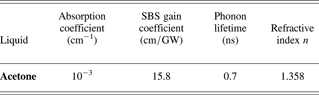
In experiment, the output wavelength of Continuum Nd:YAG seed-injected laser is 532 nm with a repetition rate of 1 Hz, pulse duration 8 ns and divergence angle 1.29 mrad. The SBS medium is prepared by making F16PCCu dissolved into acetone. The SBS parameters of acetone are listed in Table 1 (Jones, Reference Jones1997). The procedure in preparing the F16PCCu/acetone solution is as follows: the F16PCCu is first put into acetone and then oscillated for 24 h in the ultrasonic oscillator. The concentration of sample is 1.25 × 10⁻³ mg/ml. The focal length is 30 cm for lens 1 and lens 2, respectively, the Brillouin cell length is 10 cm.
SBS parameters of acetone
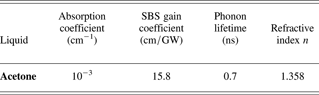
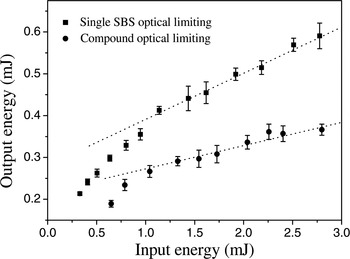
Figure 3 gives the experimental curves of output energy versus input energy based on single SBS optical limiting and compound optical limiting, which shows similarly trend with the simulation results. It can be seen that the compound optical limiting shows a lower output clamp value and flatter output energy compared with that based on single SBS. In experiment, the output clamp value and slope of compound optical limiting is 0.3 mJ and 0.06 mJ, while the output clamp value and slope based on single SBS optical limiting is 0.5 mJ and 0.11 mJ, respectively. By comparing Figure 1 and Figure 3, we can find that there is some deviation between them. This is because that, in theory simulation, we did not consider the effects of beam quality, optical components and other nonlinear effects on optical limiting, but in experimental studies these factors have a certain influence on the results, which would lead to the deviation between theoretical simulation and experimental results. However, their changing trends will be same.
The experimental results of the dependence of output energy on the input energy based on single SBS and compound optical limiting.

CHARACTERISTICS OF COMPOUND OPTICAL LIMITING
The proposed scheme in this paper is not only to present the characteristics of low output clamp value and flat output energy, but also has some excellent advantages, such as widely limiting energy range, broad limiting bandwidth, fast response speed, high limiting threshold, and damage threshold.
Optical limiting based on nonlinear material is more suitable for working in the case of a low input energy (the order μJ to mJ), while SBS optical limiting can produce good optical limiting effect in a high input energy (the order mJ to J) (Hasi et al., Reference Hasi, Lu, Gong, Li, Lin and He2008), so compound optical limiting can work in a low input energy as well as a high input energy. For example, when there is a low input energy, nonlinear material optical limiting plays a important role in the compound optical limiting, while when input energy is high, compound optical limiting mainly results from SBS optical limiting effect, furthermore, when input energy is at the same energy limiting range of nonlinear material optical limiting and SBS optical limiting, two kinds of optical limiting effect can work simultaneously, therefore, compound optical limiting exhibits the characteristic of a wide range of energy limiting.
SBS optical limiting can work in a waveband range from ultraviolet to infrared (Yoshida et al., Reference Yoshida, Fujita, Nakatsuka, Ueda and Fujinoki2007), so compound optical limiting with different wavebands can be prepared by the combination of SBS and nonlinear material optical limiting with different wavebands. For instance, an ultraviolet compound optical limiting can be made by making nonlinear materials with ultraviolet waveband dissolved into SBS medium, similarly, an infrared compound optical limiting can be prepared by making nonlinear materials with infrared waveband dissolved into SBS medium, thus the compound method presents a feature of broad limiting waveband.
Both SBS optical limiting and some nonlinear material optical limiting containing large π-conjugate system exhibits the characteristics of fast response speed, high limiting threshold and damage threshold (Liu et al., Reference Liu, Zhang, Hu, Guo, Ye, Dai and Zhu2002), therefore, the compound optical limiting based on the combination of SBS and those nonlinear materials also presents the same characteristics. Currently, we are carrying out some research related to these specific characteristics, and the details will be reported in another article.
CONCLUSIONS
Due to the similarly experimental conditions between SBS optical limiting and nonlinear material optical limiting, a scheme of nonlinear material dissolved into SBS medium to prepare SBS/nonlinear material compound optical limiting is proposed in this paper. The output energy curves based on single SBS and compound optical limiting are numerically simulated and demonstrated experimentally in Continuum's Nd:YAG seed-injected laser. The theoretical and experimental results indicate that compound optical limiting based on the combination SBS and nonlinear material optical limiting shows a low output clamp value and flat output energy compared with that based on single SBS. In addition, compound optical limiting not only presents simple configuration, but also possesses the characteristics of extensive limiting energy range, wide limiting waveband, high limiting threshold and damage threshold.
ACKNOWLEDGEMENTS
This work is supported by the National Natural Science Foundation of China (Grant No. 61138005), the Program for New Century Excellent Talents in University (Grant No. NCET-08-0173), and the Fundamental Research Funds for Central Universities (Grant No. HIT.BRET2.20100/2).