Staphylococcus spp. are the main pathogens causing intramammary infection in small ruminants and buffaloes, with emphasis on non-aureus Staphylococci (NAS) (Acosta et al., Reference Acosta, Silva, Medeiros, Pinheiro-Júnior and Mota2016). Mastitis caused by NAS usually occurs without noticeable clinical signs (Taponen and Pyörälä, Reference Taponen and Pyörälä2009). However, NAS often cause persistent intramammary infections, resulting in higher somatic cell counts (SCC), besides the emergence of antimicrobial resistance, and are considered to be reservoirs of resistance genes with potential transmission for other species (Taponen and Pyörälä, Reference Taponen and Pyörälä2009).
Beta-lactams are the most frequently used drugs worldwide to treat both mastitis and other infectious diseases, either in cattle, goats, sheep, buffaloes or other species (Fejzić et al., Reference Fejzić, Begagić, Šerić-Haračić and Smajlović2014). It is important to highlight that antimicrobial resistance is rising to dangerously high levels due to the regular use of these drugs (Fernandes et al., Reference Fernandes, Amador and Prudêncio2013).
Considering the important role of NAS on mastitis etiology in small ruminants and buffaloes, the objective was to study NAS genotypic and phenotypic resistance profiles to beta-lactams and other antimicrobials in strains isolated from goat, sheep and buffalo mastitis in the Northeast region of Brazil.
Materials and methods
Full details of the methodology are provided in Supplementary File Materials and Methods.
The experimental procedures were approved by the Ethics Committee on the Use of Animals (CEUA) of Federal Rural University of Pernambuco (UFRPE), Recife, Brazil (License No. 079/2014).
Bacterial isolates
A total of 190 NAS strains, isolated from milk samples collected from buffalo (n = 52), goats (n = 66), and sheep's (n = 72) mastitis cases between March 2014 and July 2017 in different states in Brazilian Northeast Region as pointed localizeds in Alagoas: São Luiz do Quitunde (43 buffalo); Viçosa (10 goats)/Bahia: Valente (14 goats)/Paraíba: Bananeiras (20 sheep)/Pernambuco: Custódia (3 goats; 11 sheep); Floresta (9 sheep); Limoeiro (8 sheep); Petrolina (9 sheep); Ribeirão (9 buffalo); Santa Maria (18 goats); Serra Talhada (7 sheep); Sertânia (21 goats; 8 sheep). Location of these states is shown in online Supplementary Fig. S1. The isolates were stored under freezing in glycerinated BHI (Brain Heart Infusion) broth at −20°C at the Laboratory of Infectious Diseases (LDIC) – UFRPE. Biochemical identification of the isolates was performed by testing the coagulase and acetoin as recommended by the National Mastitis Council (NMC, 2017).
Antimicrobial susceptibility test
In vitro antimicrobial resistance was determined by disk-diffusion method for the following drugs: amoxicillin (30 μg), ampicillin (10 μg), cefotaxime (30 μg), cefoxitin (30 μg), ceftriaxone (30 μg), gentamicin (10 μg), norfloxacin (10 μg), oxacillin (1 μg), penicillin G (10 U), sulfazotrim (23.75/1.25 μg), tetracycline (30 μg) and vancomycin (30 μg). Multiple antimicrobial resistance (MAR) index was calculated according to Krumperman (Reference Krumperman1983). The minimum inhibitory concentration (MIC) for antimicrobials (amoxicillin, cephalexin, cefotaxime, ceftriaxone and oxacillin) was also detected according to CLSI (2015).
Genomic DNA extraction and polymerase chain reaction (PCR)
Bacterial genomic DNA was extracted from 1 mL of culture grown in BHI (Brain Heart Infusion) broth using the Wizard Kit SV Genomic DNA Purification System (Promega®-Madison, Wisconsin, USA) according to manufacturer's instructions. Polymerase chain reaction (PCR) was performed for amplification of blaZ gene (see online Supplementary Fig. S2), which encodes beta-lactamases, in addition to mecA and mecC genes detection, which are inducers of the beta-lactam site of action modification.
Statistical analysis
Statistical analyses were performed with GraphPad Prism version 7.04 for Windows (GraphPad Software, La Jolla, California, USA) and Epi Info™ version 7.2 for Windows (Epi Info™ software, Atlanta, Georgia, USA). χ2 test was used to verify the statistical significance in the antimicrobial resistance frequencies and MIC values for different species studied. Kaplan–Meier curves were used to assess the concentration-dependent surveillance probability from the first contact with the drug in vitro until the complete suppression of NAS growth in each group of animals (buffaloes, goats and sheep). The analysis was performed using increasing drug concentration in place of the usual time variable. Comparison of survival curves was evaluated using Wilcoxon test. Statistically significant differences were considered for P < 0.05.
Results and discussion
In this study, according to MAR index calculated, 30.8% (16/52), 25.8% (17/66) and 25.0% (18/72) of isolates presented multidrug resistance for buffalo, goat and sheep, respectively. Only 7.7% (4/52) of buffalo isolates, 6.1% (4/66) of goats and 11.1% (8/72) of sheep were susceptible to all antimicrobials simultaneously. None of the isolates were resistant to all antimicrobials at the same time. Despite this, it should be noted that NAS are present in animal and human skin, besides being considered reservoirs of resistance genes for strains of S. aureus that are generally more virulent and present greater clinical importance for human and other animal species (Tulinski et al., Reference Tulinski, Fluit, Wagenaar, Mevius, Van De Vijver and Duim2012).
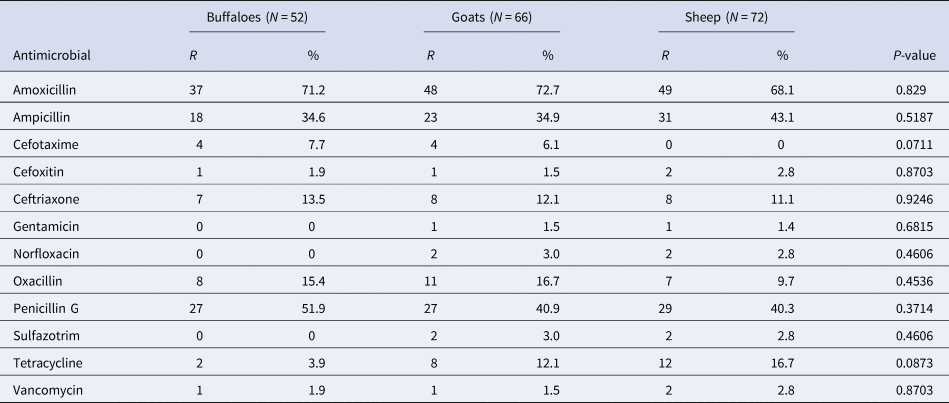
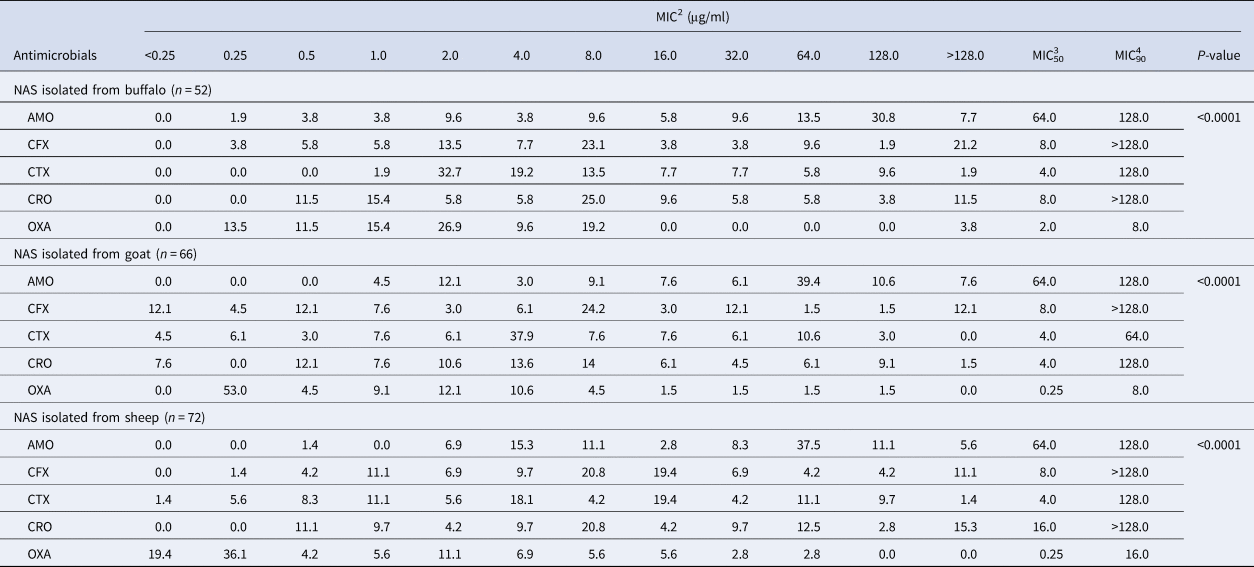
Percentages of antimicrobial resistance detected in disk-diffusion technique for NAS analyzed are described in Table 1. Amoxicillin, ampicillin and penicillin had high resistance indexes by phenotypical analyses, corroborating with genotypic findings, since resistance to non-stable penicillins, (e.g. penicillin and ampicillin) is determined by the action of beta-lactamases encoded by blaZ gene (Dias et al., Reference Dias, Pinheiro and Aguiar-Alves2015). Therefore, gentamicin, norfloxacin, sulfazotrim and vancomycin are alternatives for the treatment of mastitis caused by NAS mastitis. Considering MIC results, amoxicillin showed the highest resistance rates with 76.9% (40/52) among NAS from buffalo, 80.3% (53/66) from goat and 76.4% (55/72) from sheep, once again evidence of the ability of beta-lactamases to act as resistance inducing mechanisms in NAS. Despite the variation of only one dilution between the MIC50 and MIC90 observed, in agreement with results obtained by Oliveira et al. (Reference Oliveira, Langoni, Hulland and Ruegg2012), MIC50 (64 μg/ml) compared to cutoff point for this antimicrobial (8 μg/ml) demonstrates a worrying tolerance to this antimicrobial. Observed MICs, by species, for each of the beta-lactams tested are described in Table 2.
Percentage of antimicrobial resistance of non-aureus Staphylococci isolated from mastitis in buffaloes, goats and sheep in Northeast of Brazil by disk-diffusion technique

N, total of samples; R, resistant; %, relative frequency.
Relative frequency of isolates inhibited for each tested concentration and MIC50 and MIC90 values for different beta-lactams in non-aureus Staphylococci isolates of buffalo, goat and sheep mastitis in Northeast Brazil

aIn vitro essays for non-aureus Staphylococci (n = 190).
bMIC, minimum inhibitory concentration (μg/ml).
cMIC50, minimum inhibitory concentration to inhibit 50% of tested non-aureus Staphylococci isolates.
dMIC90, minimum inhibitory concentration to inhibit 90% of tested non-aureus Staphylococci isolates.
In this study, 42.3% (22/52) of buffalo origin isolates were positive for blaZ gene. Among isolates from goat origin, this percentage was 43.9% (29/66), while for those of sheep origin 23.6% (17/72) were positive for this gene. All the isolates analyzed were negative for mecA and mecC genes.
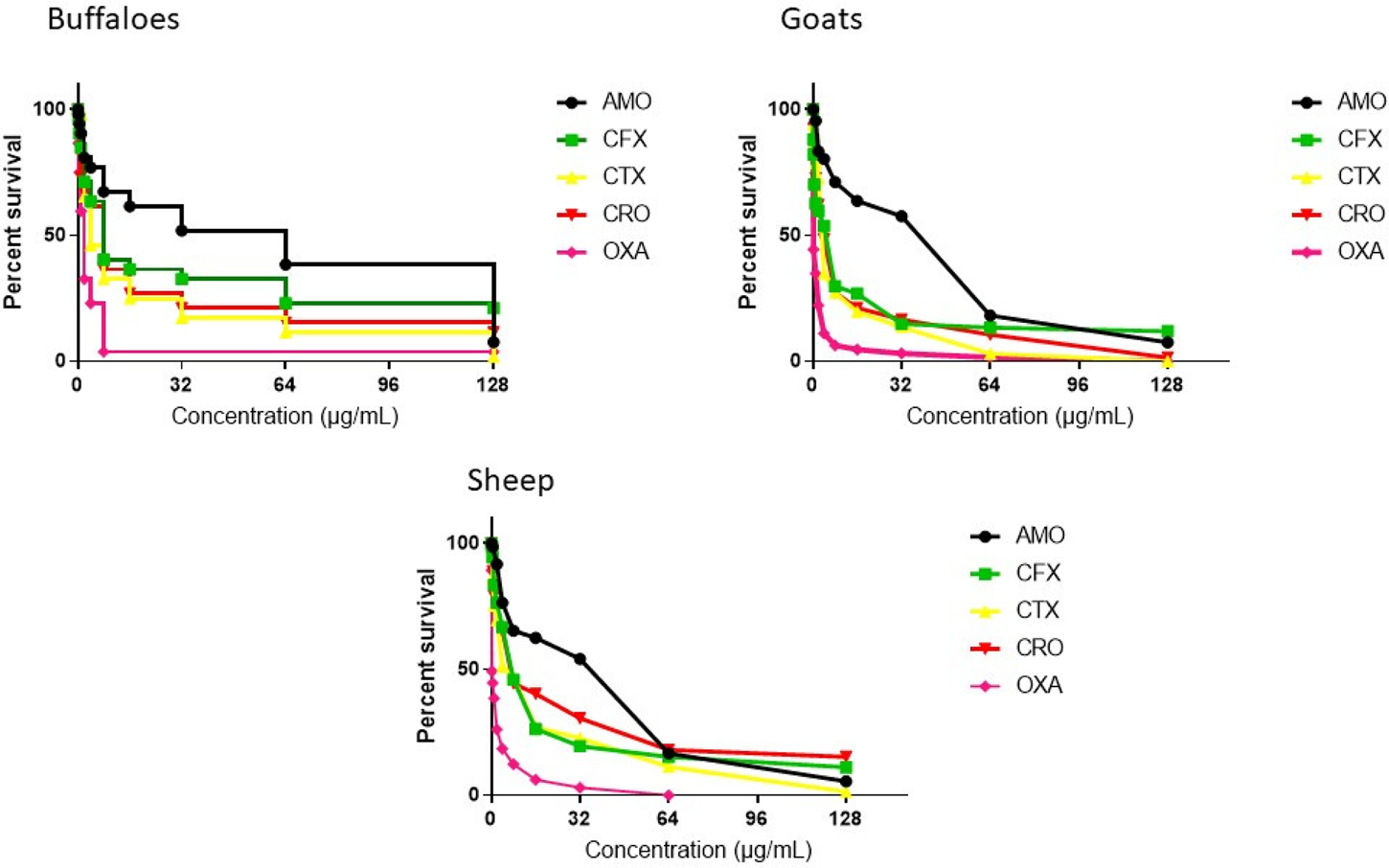
The analysis of Kaplan–Meier survival curves constructed for NAS isolates from buffaloes, goats and sheep, is shown in Fig. 1. NAS isolates from buffaloes, goats and sheep had similar sensitivity/resistance profile to the set of studied drugs. In general, higher concentrations of amoxicillin were required (P < 0.0001) for complete suppression of NAS growth. Comparison of the survival curves of NAS among animals groups revealed the same pattern for oxacillin (low concentrations of these drugs inhibited the growth of a higher number of NAS strains, P < 0.0001).
The comparison of Kaplan–Meier survival curves for MICs of drugs used against NAS isolates from buffaloes, goats and sheep.

In the Northeast region of Brazil, sheep are mainly raised for meat and antimicrobial use is less frequent compared to buffalo and goat species. Thus, there is a lower selective pressure of microorganisms carrying resistance genes, such as blaZ, causing sheep mastitis. Despite the importance of NAS in mastitis etiology, data on blaZ gene detection in this group of microorganisms are still scarce, especially in Brazil. In this study, the detection of blaZ gene in all NAS isolates from these three animal species was compatible to phenotypic resistance profiles of penicillin, amoxicillin and ampicillin. According to Dias et al. (Reference Dias, Pinheiro and Aguiar-Alves2015), this usually occurs due to beta-lactamases action, whose production is induced by blaZ gene.
All the isolates analyzed were negative for mecA and mecC genes and the absence of these genes is in agreement with a study carried out by França et al. (Reference França, Peixoto, Cavalcante, Melo, Oliveira, Veschi, Mota and Costa2012) in this same Brazilian region, suggesting a greater epidemiological importance of blaZ gene as an inducer of beta-lactam resistance. The phenotypic results showed a different picture to genotypic analysis. Strains resistant to oxacillin, ceftriaxone and cefotaxime were detected, but they were negative for mecA and mecC genes. According to Mendonça et al. (Reference Mendonça, Marques, Melo, Alencar, Coelho, Coelho and Souza2012), the absence of mecA and mecC genes in oxacillin-resistant isolates can be explained by the existence of other resistance mechanisms independent of gene expression, such as the occurrence of homologous genes and the production of other classes of penicillin binding proteins, and also due to a beta-lactamase hyperproduction.
In conclusion, high rates of resistance to beta-lactams are presented among NAS isolated from mastitis cases in buffaloes, goats and sheep in Northeast region of Brazil. Among these isolates, the most active mechanism of resistance is beta-lactamase production that may be causing resistance even to more stable classes of beta-lactams. These results provide an alert to animal and human health researchers, suggesting that the frequency of NAS needs to be reduced because they carry resistance genes which might increase the existing levels of antimicrobial resistance.
Supplementary material
The supplementary material for this article can be found at https://doi.org/10.1017/S0022029920000771.
Acknowledgments
The authors thank CAPES (Coordination for the Improvement of Higher Education Personnel) for their support.