Introduction
In the European meat sector, organically produced pork is still a small niche. In 2011, Germany and Denmark, which are the largest producing countries in conventional pig production, reached market shares of only 0.5 and 0.3%, respectively, while the highest market shares of organic pig production were recorded in Austria (1.6%) and Switzerland (1.0%)Reference Früh, Bochicchio, Edwards, Hegelund, Leeb, Sundrum, Werne, Wiberg and Prunier1. The main reason is the difficult integration of pigs with high genetic potential for muscle growth into organic systemsReference Zollitsch2. As long as supply with high-quality protein is sufficient, these pigs produce the lean carcasses demanded by today's consumers. In conventional pig fattening, high-quality soybean meal as a by-product from solvent extraction of soya oil, is the most common protein-rich feed component. Both components are usually supplemented by feed-use amino acids. Both soybean meal and feed-use amino acids are not allowed in European organic agriculture3. Soybean cake, which is the residue from mechanical extraction of soya oil, is allowed and available in organic quality, but its supply is scarce and its price high. Apart from equally high-priced skimmed milk powder and potato protein, the main protein-rich feeds in organic pig production are grain legumes, mostly faba beans (Vicia faba) and peas (Pisum sativum). Peas are particularly variable in their grain yield due to their sensitivity to drought and a weak competitive ability towards weedsReference Liebman and Dyck4, Reference Hauggaard-Nielsen and Jensen5, and long rotation breaks of up to 10 years are necessary in order to prevent problems with plant health. These problems have led to a decrease in the cultivation area of grain legumes in Europe in the past 10 years, despite an increase in the organically cultivated area6.
Therefore new alternative and locally produced protein sources are of great interest to organic pig producers in Europe. The currently under-utilized legume sainfoin (Onobrychis viciifolia) was identified as one possible feed resource for pigs. Sainfoin has been a popular tanniniferous and therefore non-bloating forage legume for ruminants and horses for centuries, but since it is not suitable for intensive agriculture, its cultivation area in Europe has dwindled during the past 40 yearsReference Borreani, Peiretti and Tabacco7. Recently, sainfoin has been rediscovered as a resilient forage legume with anti-parasitic propertiesReference Hayot Carbonero, Mueller-Harvey, Brown and Smith8, and between 2007 and 2010 an EU research project named ‘Healthy Hay’ dealt with sainfoin exclusively (see www.sainfoin.eu). Compared with red clover, white clover and alfalfa, both its forage yield and the amount of nitrogen fixed by sainfoin were found to be considerably lowerReference Cormack, Shepherd and Wilson9. But sainfoin is more resistant to drought than alfalfaReference Peel, Asay, Johnson and Waldron10, and the most suited forage legume to soils with a pH of over 6Reference Piano, Pecetti, Boller, Posselt and Veronesi11, therefore it can be recommended for cultivation on dry and alkaline marginal sites. The mostly single-seeded pods remain intact even when reaching maturity, consequently the nutrient value of sainfoin seeds can be greatly improved by dehulling. Historically, the high-protein sainfoin seeds have only been fed in times of severe feed shortage. The seed yield has never been a subject of breeding efforts and is quite modest, with only 500–1000 kg ha−1Reference Traudtner12. But with increasing sainfoin cultivation, seed surpluses are bound to arise. In Austria, advisors report such local seed surpluses, especially on stockless farms where sainfoin is planted because of its nitrogen fixation rather than its qualities as a forage, and farmers are interested in their feeding valueReference Traudtner12.
Knowledge about feeding sainfoin seeds is scarce, and there is no feeding trial with pigs known to the authors. The condensed tannins present in the vegetative parts of sainfoin have been found in the seeds as wellReference Goplen, Howarth, Sarkar and Lesins13, therefore a possible anti-nutritive effect cannot be ruled out. Furthermore, Ditterline et al.Reference Ditterline, Newman and Carleton14 report the presence of a trypsin inhibitor in the seeds that can be removed by heat, but because the growth of rats was only slightly improved when autoclaved sainfoin seeds were fed, the authors did not deem the inactivation of the inhibitor necessary.
To test the suitability of sainfoin seeds for feeding, seeds with and without hulls were used in amounts of 10–16% (as fed basis) in diets for weaned piglets. Weaned piglets were chosen because they are particularly sensitive to anti-nutritive compounds and off-flavors. The overall aim of the feeding trial was to reach a conclusion whether or not sainfoin seeds can be recommended as feed for piglets. In detail, the objectives were to examine possible effects of including sainfoin seeds in the diet on feed intake, piglet's growth and their health. For that purpose, performance parameters, medical treatments, the gait of the piglets and several blood metabolites were analyzed and documented, respectively.
Animals, Materials and Methods
The feeding trial with sainfoin seeds (O. viciifolia) was conducted at the Austrian Research and Education Center, Institute of Biological Agriculture and Biodiversity of Farm Animals in Wels, Austria between November 2011 and May 2012.
Experimental design and animals
The experimental design was a complete 4×4 latin square with pen and replicate being the two blocking factors in order to control variability caused by these factors. The allocation of the four diets to the four pens was different in each of the four replicates to ensure that each diet was fed once in each pen. Diets were fed to groups of piglets, in total 137 piglets (crosses of [Pietrain×Duroc]×[Landrace×Large White]), during the 4-week post-weaning phase. Piglets were weaned at an age of 43±2.0 days (mean±standard deviation) and assigned to one of four groups of nine piglets each, with the aim of obtaining four groups with the same mean body weight and blood-haptoglobin level (details of analysis see section ‘Data collection and analytical procedures’), the same ratio between female and male piglets in the pen and from a comparable number of litters (sows). In order to achieve a similar distribution of piglets within the groups, initial blocks of heavy, medium-weight and light piglets were formed, divided into four groups and then balanced for the other parameters by exchanging piglets between groups, but only within blocks. In replicate three, each group consisted of only eight piglets because fewer piglets than usual had been weaned. Throughout the feeding trial a total of three piglets died, and the autopsies showed that two of them had died because of severe diarrhea and one of unknown reasons. Although all three dead piglets had been fed the same diet (D 16, containing 16% sainfoin seeds, details see section ‘Feeding regimen’), the frequency of persisting diarrhea did not differ between the dietary treatments (see section ‘Results and Discussion’, section Feed intake and growth performance).
The four piglet groups were housed in four pens next to each other. Each straw-bedded pen measured 5×1.7 m and was equipped with a creep area, drinkers and an outdoor area of 3×1.7 m. The feeding trial was conducted according to the EU Directive 2010/63/EU for animal experiments15 and the Austrian Act on animal experiments16. The only invasive procedure performed on the piglets was taking blood samples at weaning and at the end of the experimental period.
Feeding regimen
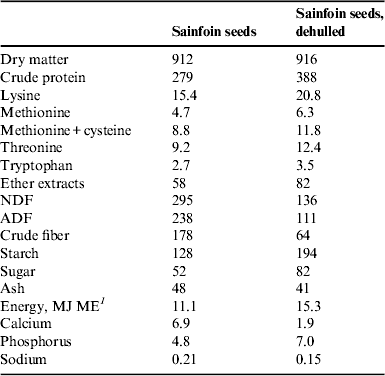
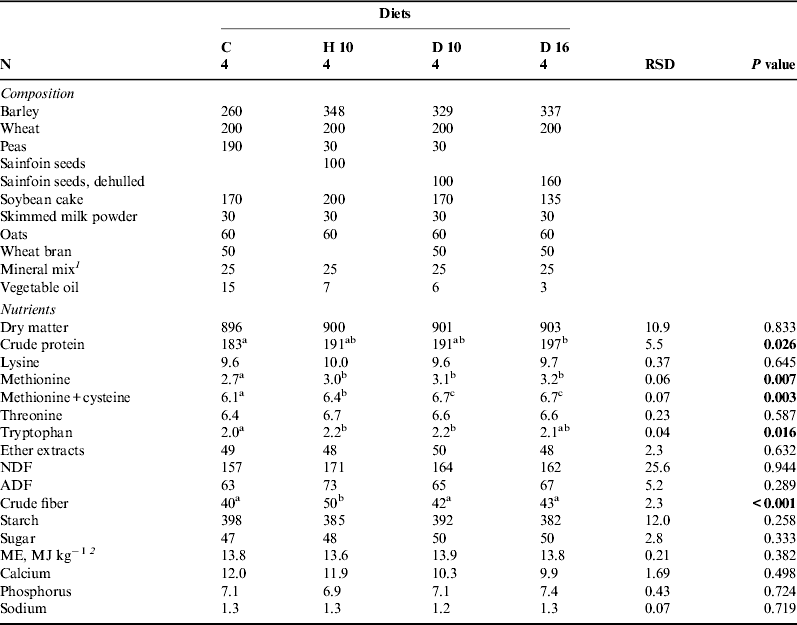
Sainfoin seeds harvested in 2011 were purchased from an organic farmer in the Austrian province of Burgenland. Prior to the experiment, no information about dehulling sainfoin seeds had been available. We found that a simple centrifugal dehulling machine commonly used for spelt worked well without technical problems and yielded 60% sainfoin seeds and 40% hulls. Before weaning, all piglets received a commercial organic piglet starter feed consisting of wheat, barley, soybean cake, oats, peas, skimmed milk powder, pumpkin seed cake, calcium carbonate, monocalcium phosphate, sodium chloride and magnesium phosphate. According to the feed mill, the starter feed contained 207 g crude protein, 35 g ether extracts, 42 g crude fiber, 61 g ash, 9.6 g total lysine, 6.9 g calcium, 6.9 g phosphorus and 2.2 g sodium kg−1 and the estimated energy content was 13.6 MJ ME kg−1 (as fed basis; ME calculated according to GfE17). In the feeding trial, four experimental diets were compared: A control diet (C), one diet containing 10% sainfoin seeds with hulls (H 10) and two diets with 10% (D 10) and 16% (D 16) dehulled seeds, respectively (as fed basis). The nutrient content of sainfoin seeds, which was not subjected to statistical analysis, is summarized in Table 1. The composition and nutrient content of the experimental diets (statistically analyzed, see section ‘Statistical analysis’) are presented in Table 2. The diets were formulated to be iso-energetic and have the same total lysine content. The main protein-rich components of the control diet were peas and soybean cake. In diets H 10 and D 10, peas were partly replaced by sainfoin seeds, while in diet D 16 peas were completely removed from the diet and the proportion of soybean cake was reduced. The dehulled sainfoin seeds contain almost twice as much crude protein as peas, while the difference in lysine content is not as pronounced (see also section ‘Results and Discussion’). In diet D 10, 10% dehulled sainfoin seeds and 3% peas replaced the 19% peas in the control diet (as fed basis), resulting in a higher crude protein but similar lysine content. Because the proportion of sainfoin seeds and peas were the same in the diet with sainfoin seeds with hulls, diet H 10 required a slightly higher proportion of soybean cake in order to maintain the same lysine content as in the control diet. The entire amount of feed needed for the feeding trial was produced before the start of the trial, at the feed mill Vitakorn Biofuttermittel GesmbH. The granulated diets were fed quantitatively restricted, using an automated feeding system programed to supply feed 5 times a day, in amounts slightly increasing every day. Feed allowance was based on recommendations by LfL18, but in order to prevent diarrhea, feed allowance was restricted and adjusted daily in order to insure complete intake of each meal until the next feeding time. Therefore feed supply differed between the groups of piglets depending on their individual feed intake, and effects of including sainfoin seeds in the diets on feed intake would still be visible.
Nutrient contents of sainfoin seeds, g kg−1 (as fed) unless stated otherwise.

NDF, neutral detergent fiber; ADF, acid detergent fiber; ME, metabolizable energy.
1 Metabolizable energy content was calculated according to GfE17.
Composition and nutrient contents of the experimental diets, g kg−1 (as fed) unless stated otherwise. C, control diet; H 10, 10% sainfoin seeds with hulls; D 10, 10% dehulled sainfoin seeds; D 16, 16% dehulled sainfoin seeds.

NDF, neutral detergent fiber; ADF, acid detergent fiber; ME, metabolizable energy.
1 The mineral mix consisted of calcium carbonate, monocalcium phosphate and sodium chloride and contained 22.6% calcium, 9.2% phosphorus and 4.7% sodium.
2 Metabolizable energy content was calculated according to GfE17.
P values <0.05 are considered to indicate significant differences and are printed in bold. Entries followed by differing superscripts are significantly different.
Data collection and analytical procedures
Throughout the experiment, feed allowance of each pen was automatically recorded by the feeding system. Because feed allowance was restricted, hardly any refusals were observed. When feed intake of a meal was not complete at the next feeding time, feed refusals were weighed and substracted from feed allowance. When no feed refusals were observed, feed allowance was taken as feed intake. Piglets were weighed once a week. The feed conversion ratio (FCR) was calculated as feed intake divided by live weight gain, using averages per group and week. At the beginning and end of each replicate, blood samples were obtained from piglets by vena jugularis externa puncture using vacutainer tubes. Within an hour after drawing the samples, blood was centrifuged at 3500 rpm for 10 min and serum was stored at −21 °C until analysis at the laboratory of the Institute of Biological Agriculture and Biodiversity of Farm Animals. The concentrations of serum cholesterol, albumin, urea and total protein were photometrically determined with commercial kits (cobas® c 111 system, Roche Diagnostics GmbH, Mannheim, Germany; 2009, 2011, 2012 and 2012, respectively), following the recommended procedures. For the photometrical determination of the concentration of serum haptoglobin a commercial kit by BioRépair GmbH, Sinsheim, Germany was used.
For each replicate, samples from two feed bags were taken for each diet and were pooled into one, therefore a total of four feed samples were taken from each diet throughout the experiment. The feed samples were analyzed at a commercial laboratory according to the German Handbook of Agricultural Experimental and Analytical Methods19, and method numbers are given below. The dry matter content of feed was determined by oven-drying at 105 °C (3.1). Ash, ether extracts, sugar and starch contents were analyzed using methods 8.1, 5.1.1, 7.1.1 and 7.2.1, respectively. Contents of crude protein were assayed with Dumas combustion (4.1.2). Neutral detergent fiber (NDF, 6.5.1) was determined using a heat stable amylase. Both NDF and acid detergent fiber (ADF, 6.5.2) are expressed inclusive of residual ash. Contents of metabolizable energy (ME) were calculated according to GfE20. In replicates 1 and 3, an additional sample per diet was taken for analysis of the amino acid profile at the laboratory of the Department of Chemistry, Division of Biochemistry at Boku Vienna. Amino acid concentrations were determined with a high-performance liquid-chromatographic (HPLC) system of Hewlett-Packard (1050 Series) and a Shimadzu RF 535 variable wavelength fluorescence detector, using samples that had been hydrolyzed in 6 M HCl for 20 h. Tryptophan was stabilized with alkaline Ba(OH)2, and to avoid methionine and cysteine loss, samples were oxidized21–23.
On the last day of the experiment, all piglets were examined for lameness and their gait was scored according to the following assessment scheme: score 0=no impairment of posture and gait; score 1=weakness in the hind legs, visible as unsteady gait with front legs wider than usual and head bowed low to keep the balance; score 2=lameness of the hind legs, piglet can either only stand on the front legs or cannot stand up at all. Whenever symptoms of diarrhea were observed, all piglets were given tea of Cortex quercus, dry peat and an electrolyte solution. Persisting diarrhea in individual piglets was treated with antibiotics (Baytril).
Statistical analysis
All statistical analyses were conducted using SAS 9.1 package24. Multiple comparison of means was done using the Tukey's test, and statistical differences were considered to be significant when P<0.05. Results from chemical analysis of the experimental diets were analyzed using proc GLM, with a model including the fixed effect of treatment only. Of the animal-related parameters, the parameters of feed intake (g day−1 piglet−1) and the FCRs (kg feed intake kg−1 weight gain) were measured on groups of piglets, and statistical analysis was conducted using proc GLM. The parameters body weight, daily weight gain and blood metabolites were measured on individual piglets, therefore analysis was done using proc MIXED, which is able to consider the random effect of individual piglet. The models were as follows:
Feed intake and feed conversion ratio
 $$Y_{klmn} = {\rm \mu} + {\rm Diet}_k + {\rm Pen}_l + {\rm Replicate}_m + b_{\rm 1} \times {\rm day} + b_{\rm 2} \times {\rm day} \times {\rm day} + b_{\rm 3} \times {\rm f\_m} + {\rm \varepsilon}_{klmn} $$
Body weight and daily weight gain
 $$Y_{klmnopq} = {\rm \mu} + {\rm Diet}_k + {\rm Pen}_l + {\rm Replicate}_m + {\rm Day}_n + {\rm Sow}_o ({\rm replicate}_m ) + b_{\rm 4} \times {\rm bw}\_{\rm weaning} + {\rm Piglet}_p ({\rm diet}_k ) + {\rm \varepsilon}_{klmnopq} $$
The effect of sex was initially included in the model, but because it affected neither body weight nor daily weight gain, it was removed from the model. Eight potentially suitable covariance structures (unstructured, autoregressive, heterogeneous autoregressive, autoregressive moving average, compound symmetry (CS), heterogeneous CS, toeplitz and heterogeneous toeplitz) were tested and their Bayesian information criterion (BIC) was used as a best fit-indicatorReference Littell, Milliken, Stroup, Wolfinger and Schabenberger25. Unstructured (UN) was chosen because its BIC was closest to zero, which indicates the best fit of the model to the dataReference Wang and Goonewardene26.
Blood metabolites
 $$Y_{klm} = {\rm \mu} + {\rm Diet}_k + {\rm Piglet}_l ({\rm diet}_k ) + {\rm \varepsilon}_{klm} $$
The blood metabolites were analyzed separately for the first and last day of the experimental period, using the covariance structure CS.
Legend for models: Y, variable studied; μ, overall mean; diet, fixed effect of diet (k=C, H, D 10, D 16); Pen, fixed effect of pen (l=1, 2, 3, 4); Replicate, fixed effect of replicate (m=1, 2, 3, 4); day, continuous effect of day in the feeding trial; day×day, quadratic effect of day; b 1, regression coefficient of day; b 2, regression coefficient of day×day; day, fixed effect of day in the feeding trial (n=8, 15, 22 and 29); b 3, regression coefficient of f_m; f_m, continuous effect of ratio between female and male piglets in the pen; Sow(replicate), fixed effect of sow within replicate (o, ear tag number of sow); b 4, regression coefficient of bw_weaning; bw_weaning, continuous effect of body weight at weaning; Piglet(diet), random effect of piglet within diet (p=ear tag number of piglet); ε, random error.
Results and Discussion
This study was conducted in order to test the suitability of sainfoin seeds as a protein source for weaned piglets. The main protein-rich components of control diet C, peas and soybean cake, were (partly) substituted for by sainfoin seeds with (diet H 10) and without hulls (diets D 10 and D 16).
Throughout the trial, signs of lameness were observed in three piglets during the gait scoring at the end of each replicate. One of them was fed diet H, one diet D 10 and the third one received the control diet. In all three piglets, lameness was caused by minor injuries next to joints and therefore did not seem to be connected with the dietary treatment. Tables 3–5 show ls-estimates for diets from regression analysis, P values for the effect of diet and the residual standard deviation (RSD). Tables 3 and 4 also include P values for the effects of pen, replicate and day. Significant effects of the ratio between female and male piglets in the group, sow within replicate, body weight at weaning and the quadratic effect of day are mentioned in footnotes. Differing superscripts indicate significant differences between diets.
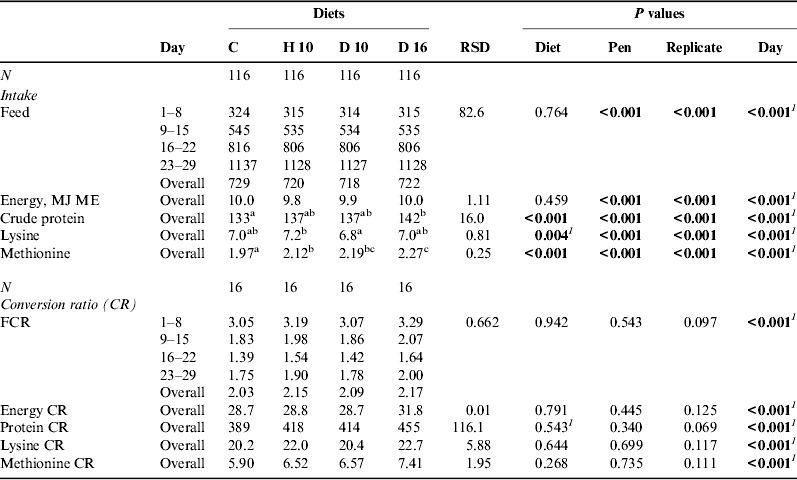
Parameters of feed intake and FCR of piglets fed organic diets with or without sainfoin seeds, g day−1 (as fed) unless stated otherwise. C, control diet; H 10, 10% sainfoin seeds with hulls; D 10, 10% dehulled sainfoin seeds; D 16, 16% dehulled sainfoin seeds.
ME metabolizable energy; FCR, feed conversion ratio.
1 P value of day×day <0.001.
2 P value of f_m=0.004 (for lysine intake) and 0.021 for protein conversion ratio.
P values <0.05 are considered to indicate significant differences and are printed in bold. Entries followed by differing superscripts are significantly different.
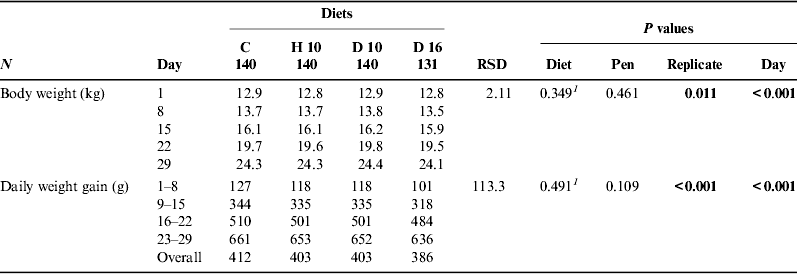
Body weight and daily weight gain of piglets fed organic diets with or without sainfoin seeds. C, control diet; H 10, 10% sainfoin seeds with hulls; D 10, 10% dehulled sainfoin seeds; D 16, 16% dehulled sainfoin seeds.
1 P values of sow(replicate) and bw_weaning <0.001.
P values <0.05 are considered to indicate significant differences and are printed in bold.
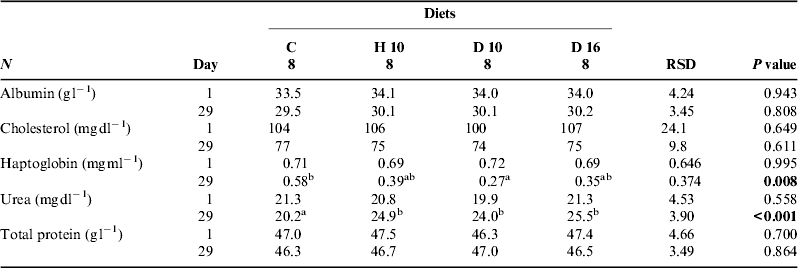
Blood metabolites of piglets fed organic diets with or without sainfoin seeds. C, control diet; H 10, 10% sainfoin seeds with hulls; D 10, 10% dehulled sainfoin seeds; D 16, 16% dehulled sainfoin seeds.
P values <0.05 are considered to indicate significant differences and are printed in bold. Entries followed by differing superscripts are significantly different.
Feed composition
Prior to the experiment, only few reports were available covering the crude protein content of sainfoin seeds: Woodman and EvansReference Woodman and Evans27 found 264 and 366 g kg−1 crude protein in seeds with and without hulls (as fed basis), respectively. Similarly, Ditterline et al.Reference Ditterline, Newman and Carleton14 reported 356–360 g kg−1 crude protein in dehulled seeds (as fed basis). In their book on commercial feedstuffs, Wöhlbier and KlingReference Woehlbier and Kling28 gave a crude protein content of 303 g kg−1 DM for the whole seeds. Based on these reports, sainfoin seeds were expected to contain high levels of protein, and indeed they even exceeded expectations: sainfoin seeds contained 279 g kg−1 crude protein before and 388 g kg−1 after dehulling (as fed basis). Dehulling greatly increased the content of crude protein, amino acids, ether extracts, sugar and starch, while reducing NDF, ADF, ash and calcium content.
Lysine content of sainfoin seeds was found to be 15.4 g kg−1 before and 20.8 g kg−1 after dehulling (as fed basis), which is slightly lower than the level of 22.6–22.9 g kg−1 (as fed basis) that was reported for dehulled seedsReference Ditterline, Newman and Carleton14. Relative to lysine, contents of methionine+cysteine, threonine and tryptophan were 56, 60 and 17%. This amino acid profile is quite close to the ideal of 100:60:65:18 recommended for piglets with 5–20 kg body weightReference Blair29. Considering that the widely fed peas are much lower in methionine+cysteine and tryptophan (100:33:53:1330) and that soybean cake is a costly and usually imported feed, the amino acid profile of sainfoin seeds seems to emphasize their potential as a valuable (partial) substitute for peas and soybean cake.
The statistical analysis of the nutrient composition of the total diets (see Table 2) showed that diets were isoenergetic and contained almost identical amounts of lysine, as had been planned. As a side-effect of balancing diets for lysine content, crude protein content differed significantly and was the highest in diet D 16, which is partly due to the soybean percentage being the lowest in this diet. Contents of methionine and methionine+cysteine were significantly lowest in the control diet, which can be explained by the fact that sainfoin seeds are higher in the sulfur-containing amino acids than the peas that they were substituted for.
Feed intake and growth performance
The time directly after weaning is a very challenging period for piglets, due to the changing diet combined with a changing environment. When piglets react by reducing feed intake, not only their current growth is reduced, but also their overall growth performance up until slaughter may be negatively affectedReference Pluske, Le Dividich and Verstegen31. Therefore, maintaining adequate feed intake after weaning is crucial both for the piglets’ health and the farmers’ economic success.
Aside from the roots, sainfoin contains tannins in all parts of the plant, including the seedsReference Goplen, Howarth, Sarkar and Lesins13, Reference Lees, Suttill and Gruber32. Although the tannin content of seeds was not analyzed in this study, tannins can therefore be expected to be present in the seeds. As a forage legume, its tanniniferous nature makes sainfoin a non-bloating forage that may reduce the numbers of internal parasites. When protein supply is generous, it can improve the amino acid supply to the small intestine by reducing protein degradation in the rumenReference Waghorn33. However, tannins can also exhibit harmful effects both in ruminants and monogastric animals, and monogastric animals seem to be more sensitive than ruminantsReference Mueller-Harvey34. For pigs, effects on weight gain depend on the tannin content and the type of tanninReference Jansman35: when feeding sorghum with a tannin content of 38 g kg−1 DM at an inclusion rate of 72% to young pigs, Myer and GorbetReference Myer and Gorbet36 found a 5.4% reduction in daily weight gain, while feeding 14% untreated faba beans with a tannin content of up to 5.1 g kg−1 DM had no effect on weight gain of weaned pigletsReference Fekete, Willequet, Gatel, Quemere and Grosjean37. In the present experiment, no effect of including 10% sainfoin seeds or 10–16% dehulled sainfoin seeds in diets was found on piglets’ feed intake (on average 722 g day−1, Table 3). Feed supply was restricted, but because the aim was complete intake of each meal until the next feeding time, feed supply differed between the groups of piglets depending on their individual feed intake. Therefore an effect of including sainfoin seeds in the diets would have still been visible, even though the level of feed intake was probably slightly lower than it would have been if piglets had been fed ad libitum. Since feed intake did not differ, tannins which can be expected to be present in the seeds did not have any negative effect on feed intake, when up to 16% of dehulled sainfoin seeds were included in the diet. Dehulling the seeds had no influence on feed intake either.
Because energy content of the diets did not differ, energy intake did not differ either, and was on average 10 MJ ME day−1 (Table 3). However, intake of crude protein, lysine and methionine was significantly influenced by diet: in analogy to the significantly higher crude protein content of diet D 16, crude protein intake was significantly higher as compared to the control diet. Even though lysine contents did not differ significantly between the diets, lysine intake was significantly higher when diet H 10 was fed as compared to diet D 10, while it was very similar for all other diets (Table 3). This is due to a combination of the numerical, but not significant, differences in lysine content and feed intake. Because contents of methionine were higher in sainfoin seeds than in peas, substituting peas with sainfoin seeds resulted in significantly higher intakes of methionine when diets containing sainfoin seeds were fed as compared to the control diet. Also, methionine intake was significantly higher when diet D 16 was fed as compared to diet H 10. Combining peas with sainfoin seeds might therefore be a possible strategy in reducing the proportion of soybean cake in diets without compromising amino acid balance. For all parameters of feed intake, the effects of pen, replicate, day and day×day were highly significant (P<0.001), confirming the importance of including them in the model. The effect of the ratio between female and male piglets in the group was only significant for lysine intake.
Table 4 summarizes body weight and daily weight gain of piglets, for which no significant effect of dietary treatments were found. Both for body weight and daily weight gain, the effects of replicate, day, sow within replicate and body weight at weaning were significant. Piglets were weaned at an average weight of 12.9 kg, and after the 4-week post-weaning phase they had reached an average weight of 24.4 kg, which resulted in an average daily weight gain throughout the whole post-weaning phase of 401 g day−1. This is in accordance with previous reports about a feeding trial with piglets reared under comparable conditions: when testing 100% organic diets consisting mostly of on-farm feed components (‘medium and low external inputs’), Weißmann et al.Reference Weißmann, Bussemas, Falk, Rahmann and Godinho38 found daily weight gains of 396 and 398 g day−1. Since neither feed intake nor piglet growth were influenced by dietary treatment, no differences with regard to the parameters of feed conversion (see Table 3) were found either. For all parameters of feed conversion, the effects of day and day×day were highly significant (P<0.001). The effect of the ratio between female and male piglets in the group was only significant for crude protein conversion (P=0.021). On average, 2.1 kg feed, 29.5 MJ ME, 419 g crude protein, 21 g lysine and 6.6 g methionine were needed to achieve 1 kg of body weight gain. Irrespective of dietary treatment, the FCR was considerably higher during the first week after weaning as compared to the rest of the post-weaning phase (Table 3). In general, this observation might be related to energy intake being quite low relative to maintenance requirements in the first week after weaning, but because almost all treatments against diarrhea occurred during the first 2 weeks post-weaning, with a peak around day 8 (data not shown), post-weaning diarrhea most likely played a role as wellReference Van Beers-Schreurs, Vellenga, Wensing and Breukink39. Among others, a higher FCR caused by post-weaning diarrhea has been reported by Officer et al.Reference Officer40, who found a FCR of 2.44 during the first week after weaning and 1.76 in the following 3 weeks for the control group in a feeding trial on the use of enzymes in diets of conventionally reared, early-weaned piglets (29 days at weaning). In organic animal husbandry, phytotherapeutic products shall be used in preference to antibiotics, therefore tea of C. quercus and dry peat were given to all piglets when symptoms of diarrhea were observed. In replicates 1, 2 and 4, tea and peat were given twice and three times during the first week after weaning, respectively, while in replicate 3, this was done 5 times during the first and three times during the second week (data not shown). Individual piglets were treated with antibiotics if their condition did not improve. In total, antibiotic treatment was necessary for 13 piglets fed the control diet, 10 piglets fed diet H 10, 12 piglets fed diet D 10 and 13 piglets fed diet D 16, which corresponds to 37, 29, 34 and 37% of the piglets, respectively. In a comprehensive study examining health and welfare of organic pigs in six European countries, the prevalence of diarrhea was found to be highly variable with values between 0 and 100%, but the median prevalence was 0% because groups were scored rather than pigletsReference Dippel, Leeb, Bochicchio, Bonde, Dietze, Gunnarsson, Lindgren, Sundrum, Wiberg, Winckler and Prunier41. A study on 106 conventional French pig farms using medicated creep feed and weaning piglets at 27 days revealed a maximum prevalence of 35% pens affected by diarrhea around 7–9 days post-weaning, which is in accordance to the observations made in the present studyReference Madec, Bridoux, Bounaix and Jestin42.
Prior to the present feeding trial, no experiment was known to the authors in which sainfoin seeds were fed to pigs. However, two feeding trials with sainfoin seeds fed to other animal species have been reported: Back in 1947, Woodman and EvansReference Woodman and Evans27 tested sainfoin seeds with hulls as feed for sheep in a digestion trial and found them to be a palatable feedstuff. The authors’ aim was to utilize batches of seeds discarded due to unsatisfactory germination as feed instead of disposing them as waste. In 1977, Ditterline et al.Reference Ditterline, Newman and Carleton14 compared dehulled sainfoin seeds with soybean meal as a protein-rich feedstuff for rats and found only minor differences in body weight gain and FCR. Even though observations made in these previous studies cannot be directly compared with our results due to differences in animal species and their digestive systems, there is a common conclusion from these three feed trials: sainfoin seeds may be a palatable feed which allows for satisfying feed intake and supports animal performance.
Blood metabolites
In Table 5, blood metabolites, which were analyzed on the first and last day of the experiment, are summarized. At weaning, none of the blood metabolites showed any significant difference, indicating equally distributed groups of piglets. At the end of the 4-week post-weaning phase, however, significant differences were found for blood haptoglobin and blood urea. Blood haptoglobin is one of the acute-phase proteins, which are a component of the body's response to infections, and an elevated blood haptoglobin level may be seen as a non-specific indicator for health problemsReference Petersen, Nielsen and Heegaard43. Nevertheless, all blood haptoglobin values obtained during the feeding trial were within the reference range for healthy pigletsReference Petersen, Nielsen and Heegaard43, Reference Piñeiro, Piñeiro, Morales, Andrés, Lorenzo, del Pozo, Alava and Lampreave44. Levels at weaning were in accordance with reports by Piñeiro et al.Reference Piñeiro, Piñeiro, Morales, Andrés, Lorenzo, del Pozo, Alava and Lampreave44 and Pomorska-Mol et al.Reference Pomorska-Mol, Kwit and Markowska-Daniel45, who measured blood haptoglobin of conventionally reared pigs in different productive stages and from birth to slaughter, respectively. However, blood haptoglobin levels at the end of the experimental period were lower than those reported by said authors, indicating a generally good health status of piglets. Also, blood haptoglobin level at the end of the experimental period was significantly higher when the control diet was fed as compared to diet D 10 (all other differences were not significant), pointing to the absence of any negative health effects connected to the use of sainfoin seeds in the diet.
Blood urea is an indicator for the supply of total protein and amino acids, because a relative surplus of any amino acid is degraded to urea prior to excretion. At the end of the experimental period, blood urea levels were significantly lower when the control diet was fed as compared to all other diets, which did not differ from each other. This observation can be explained by the fact that crude protein intake was significantly higher when diet D 16, and numerically higher when diets H 10 and D 10 were fed as compared to the control diet, which resulted from balancing the diets for lysine content. However, all analyzed blood urea values were relatively low and within the reference range given by Kraft and DürrReference Kraft and Dürr46.
Conclusions
From the results presented herein, and from the limited literature information, we conclude that sainfoin seeds can be a valuable protein-rich feed component for rearing organic piglets. Sainfoin seeds with and without hulls were (partly) substituted for the peas and soybean cake in a control diet for weaned piglets. At inclusion rates of 10 and 10–16%, respectively, they were found to provide an equally adequate amino acid supply as the control diet. Where sainfoin can be cultivated easily and the seeds are harvested, they may offer an interesting option for contributing to the amino acid supply to organic piglets, mainly because their content of methionine and cysteine is higher than in peas. Although no disadvantages were observed when feeding the whole seeds, dehulling is recommended for increasing the nutrient density of the diet.
Acknowledgements
This research was part of the ICOPP project (Improved contribution of local feed to support 100% organic feed supply to pigs and poultry, see www.organicresearchcentre.com/icopp) within the ERA-NET CORE Organic II programme. Funding for the research was provided by the Austrian Federal Ministry of Agriculture, Forestry, Environment and Water Management. We are grateful to Franz Traudtner, an advisor from Bio Austria, for his valuable advice during the planning phase and assistance in acquiring the sainfoin seeds. Furthermore the authors want to thank two anonymous reviewers for their valuable comments on an earlier version of this paper.