


Introduction
Major depressive disorder (MDD) is a commonly occurring (17% lifetime prevalence in the US) disabling disorder with a high public health impact (Andrade et al., Reference Andrade, Caraveo-Anduaga, Berglund, Bijl, De Graaf and Wollebergh2006; McLaughlin, Reference McLaughlin2011). Despite the various pharmacotherapy and psychotherapy options available for treating depression, approximately 30–40% of patients with depression do not improve with these interventions (Casacalenda, Perry and Looper, Reference Casacalenda, Perry and Looper2002; Rush et al., Reference Rush, Trivedi, Wisniewski, Nierenberg, Steward and Warden2006), and more intensive daily cognitive behavioral therapy (CBT) for severely depressed patients is costly and of limited availability (Thase, Dubé, Bowler and Howland, Reference Thase, Dubé, Bowler and Howland1996).
A growing body of information about the neurobiological mechanisms underlying depression has served as an impetus for treatments designed to directly target these processes. Effective neurobehavioral therapies have several potential advantages for treating patients with severe and/or chronic depression. First, they could be used in conjunction with conventional therapies to enhance effectiveness by specifically targeting underlying biological mechanisms that maintain depression. Second, because they can be automated, neurobehavioral therapies can be administered without requiring the same level of training or resources as traditional psychotherapies. Third, for patients who are resistant to medication or engaging in empirically supported therapies, neurobehavioral approaches may provide an alternative (Siegle, Thompson, Carter, Steinhauer and Thase, Reference Siegle, Thompson, Carter, Steinhauer and Thase2007).
One such approach, neurobehavioral therapy, has emerged as an important area for research. Influenced by the model of cognitive rehabilitation for brain injuries, the neurobehavioral approach begins with the identification of specific brain regions associated with disorder-specific functional deficits. The therapy is then designed to recruit and activate these neural networks via repeated behavioral exercises, with the aim of strengthening cognitive and emotional functions (Park and Ingles, Reference Park and Ingles2001; Siegle, Ghinassi and Thase, Reference Siegle, Ghinassi and Thase2007). Thus far, neurobehavioral interventions have been tested for a range of psychiatric disorders and have been shown to improve attention, memory, and executive functioning as well as associated psychiatric symptoms (Amir, Beard, Burns and Bomyea, Reference Amir, Beard, Burns and Bomyea2009; Elgamal, McKinnon, Ramakrishnan, Joffe and MacQueen, Reference Elgamal, McKinnon, Ramakrishnan, Joffe and MacQueen2007). The present study is an extension of work by Siegle, Ghinassi and colleagues (Reference Siegle, Ghinassi and Thase2007), who examined a specific neurobehavioral therapy for severely depressed patients.
Unipolar depression is characterized by decreased function in areas of the prefrontal cortex (PFC) associated with executive control and emotion regulation, for example, the dorsolateral prefrontal cortex (DLPFC) (Baxter, Schwartz, Phelps and Mazziotta, Reference Baxter, Schwartz, Phelps and Mazziotta1989; Bench, Friston, Brown, Frackowiak and Dolan, Reference Bench, Friston, Brown, Frackowiak and Dolan1993; Diener et al., Reference Diener, Kuehner, Brusniak, Ubl, Wessa and Flor2012; Mayberg et al., Reference Mayberg, Liotti, Brannan, McGuinnis, Mahurin and Jerabek1999; (Siegle, Thompson, et al., Reference Siegle, Thompson, Carter, Steinhauer and Thase2007). The DLPFC has been hypothesized to play a crucial role in emotion regulation by recruiting resources necessary for executive control while also recruiting regions more directly associated with inhibiting emotional processing in limbic areas (such as the amygdala and ventromedial regions of the PFC) (Davidson, Reference Davidson2000; Drevets and Raichie, Reference Drevets and Raichle1998; Kühn, Vanderhasselt, De Raedt and Gallinat, Reference Kühn, Vanderhasselt, De Raedt and Gallinat2012; Mayberg et al., Reference Mayberg, Liotti, Brannan, McGuinnis, Mahurin and Jerabek1999; Ochsner, Bunge, Gross and Gabrieli, Reference Ochsner, Bunge, Gross and Gabrieli2002). Executive control includes the allocation of attentional resources, information processing, evaluation, and decision-making. To the extent that disruptions of affective processing associated with depression – such as sustained negative affect, hyper-reactivity to negative feedback, and rumination – are associated with increased and sustained limbic reactivity (Erk et al., Reference Erk, Mikschl, Stier, Ciaramidaro, Gapp and Weber2010; Ray et al., Reference Ray, Ochsner, Cooper, Robertson, Gabrieli and Gross2005; Siegle, Steinhauer, Thase, Stenger and Carter, Reference Siegle, Steinhauer, Thase, Stenger and Carter2002; Siegle, Thompson, et al., Reference Siegle, Thompson, Carter, Steinhauer and Thase2007; Surguladze et al., Reference Surguladze, Brammer, Keedwell, Giampietro, Young and Travis2005; Taylor Tavares et al., Reference Taylor Tavares, Clark, Furey, Williams, Sahakian and Drevets2008), increasing prefrontal control could help to address these problems. In fact, neuroimaging studies of patients who have recovered from depression show increased prefrontal reactivity to emotional stimuli (Davidson, Irwin, Anderle and Kalin, Reference Davidson, Irwin, Anderle and Kalin2003; Fales et al., Reference Fales, Barch, Rundle, Mintun, Mathews and Snyder2009) in addition to increased tonic prefrontal activity (Liotti and Mayberg, Reference Liotti and Mayberg2001; Liotti, Mayberg, McGinnis, Brannan and Jerabek, Reference Liotti, Mayberg, McGinnis, Brannan and Jerabek2002). Interventions geared in part toward increasing executive control are, indeed, associated with decreased amygdala reactivity (Goldin and Gross, Reference Goldin and Gross2010).
Siegle and colleagues’ neurobehavioral therapy for depression, CCT, was designed to increase prefrontal cortex activity in order to promote increased attentional and cognitive control in the face of negative affect (Siegle, Ghinassi, et al., Reference Siegle, Ghinassi and Thase2007; Siegle, et al., in press). To achieve this, CCT therapy uses two well-studied tasks administered by computer. Based on Wells’ Attention Control Training intervention (Wells, Reference Wells2000), the first exercise requires participants to practice directing their attention to unique sounds in a naturalistic soundscape recording. Participants must exert executive control to remain focused on the task, as opposed to engaging in more automatic emotional processes such as rumination. They also must exercise selective attention processes in distinguishing the specified stimuli from background noises. The second CCT task is an adaptive variant of the Paced Auditory Serial Attention Task (Gronwall, Reference Gronwall1977) that involves continuously adding serially presented digits in working memory, with the pace automatically adjusted based on participants’ performance. Because the task is challenging and known to induce frustration, it demands the exercise of executive control in the face of negative affect.
In the initial study, Cognitive Control Training (CCT) was tested as an adjunctive therapy with severely depressed individuals in a day hospitalization program (Siegle, Ghinassi, et al., Reference Siegle, Ghinassi and Thase2007). Participants were randomly assigned to receive treatment as usual (TAU) or six sessions of CCT during a 2-week period in addition to TAU. Participants in the CCT group demonstrated a significant reduction in depression and rumination symptoms relative to the participants who received TAU. Also, participants in the CCT group had improved performance on novel tasks requiring executive function, and neuroimaging measures revealed increased DLPFC activity and reduced sustained amygdala activity during cognitive and emotional tasks, indicating a more normal pattern of brain functioning (Siegle, Ghinassi, et al., Reference Siegle, Ghinassi and Thase2007; Siegle et al., in press).
Given the promising results from this study, we conducted a pilot study using an analog sample to investigate several questions (Calkins et al., Reference Calkins, Deveney, Weitzman, Hearon, Siegle and Otto2010). Specifically, we sought to determine if CCT could be effective in a single dose of training (reflecting short-term activation of extant prefrontal resources) or whether more extensive training would be needed according to a model of neural plasticity (leading to brain change). We also sought to determine whether a CCT intervention would reduce reactivity to negative stimuli in individuals who did not have the functional deficits characteristic of depression. Findings from this study indicated that one session of CCT did not consistently alter participants’ responses to emotional stimuli. However, those who performed well on the CCT task tended to rate the emotional images more positively.
The current study was designed to further investigate the efficacy of CCT for improving depressed mood. In particular, given the previous effects Siegle and colleagues found in reducing mood symptoms in depressed individuals in a partial hospital program, we were interested in examining whether the effects of CCT would be apparent for depression and ratings of state affect in a sample of community individuals with depressed mood. We selected three sessions of CCT as an adequate dose, given the promising trends of our previous single-session analog study. In the current study we examined the acceptability of CCT and whether it was associated with changes in mood in a community sample of adults with depression. Eligible participants were randomly assigned to either a CCT intervention or a Peripheral Vision Training (PVT) control group that was designed as a comparison to CCT because it does not recruit pre-frontal activation. Participants completed three sessions of training prior to a second measure of symptoms. We hypothesized that relative to a control condition (PVT), engaging in three sessions of CCT would be associated with less self-reported negative mood and more positive ratings of state affect.
Method
Participants
Participants were recruited from community volunteers in Boston and from the Boston University undergraduate student population. Participants were recruited for an experimental study on attention and mood via online advertisements and flyers posted on community bulletin boards; there was no mention of treatment in the advertisements. Inclusion/exclusion criteria were that participants had to be at least 18 years-old, have basic computer familiarity, e.g. were comfortable using a keyboard and mouse and had a BDI-II score ≥17 and < 35 at screening. Participants received either $60 or an introductory psychology course credit in exchange for their participation. This experiment was approved by the Boston University Institutional Review Board (IRB). After being fully informed regarding the nature of the study, all participants gave written consent.
Measures
Participants self-reported their age, sex, educational attainment, and race/ethnicity. Participants were assessed at baseline for severity of depressive symptoms, trait positive and negative affect, and trait worry using the following measures respectively: Beck Depression Inventory-II (BDI-II; Beck, Steer and Brown, Reference Beck, Steer and Brown1996); the trait version of the Positive and Negative Affectivity Scale (PANAS; Watson, Clark and Tellegen, Reference Watson, Clark and Tellegen1988); and the Penn State Worry Questionnaire (PSWQ; Meyer, Miller, Metzger and Borkovec, Reference Meyer, Miller, Metzger and Borkovec1990). These measures were selected as relevant baseline measures to assess for possible preintervention differences between groups.
At the end of the first study visit and at each subsequent study visit, participants completed ratings of depression symptoms using the BDI-II (Beck et al., Reference Beck, Steer and Brown1996), state affect using the state version of the PANAS (Watson et al., Reference Watson, Clark and Tellegen1988), and two versions of the Visual Analogue Scale (VAS; Little and McPhail, Reference Little and McPhail1973) consisting of two 115-mm vertical lines with the following bipolar dimensions: “happy/sad” and “relaxed/tense” for rating current mood. Higher scores on these scales indicate higher levels of sadness or tenseness.
Training tasks
Cognitive Control Training (CCT)
A modified version of the Paced Auditory Serial Addition Task (PASAT; Gronwall, Reference Gronwall1977) and the Attention Control Intervention (Wells, Reference Wells2000) were used to train participants’ attentional control in accordance with procedures used by Siegle and colleagues (Siegle, Ghinassi, et al., Reference Siegle, Ghinassi and Thase2007). A personal computer (PC) with keyboard, mouse control, and external speakers was used to run both the CCT tasks
PASAT (Gronwall, Reference Gronwall1977)
In the modified PASAT, participants were asked to add serially presented numbers and the speed of number presentation was adapted based on participants’ performance in order to minimize frustration associated with this task. Participants began the task with a 3000 ms Interstimulus Interval (ISI). After four consecutive correct trials, the task increased in speed by 100 milliseconds (ms) ISI. After four consecutive incorrect trials, the task decreased in speed by 100 ms ISI. Participants completed three 5-minute blocks of this task. This task has been shown to increase DLPFC activity in healthy populations (Lazeron, Rombouts, de Sonneville, Barkhof and Scheltens, Reference Lazeron, Rombouts, de Sonneville, Barkhof and Scheltens2003). The PASAT records participants’ responses and response time, and indicates whether they answered correctly, incorrectly, or missed answering the question.
Attention Control Intervention (ACI; Wells, Reference Wells2000)
In the Attention Control Intervention, individuals were asked to attend differentially to multiple auditory sources (e.g. by counting tones, discriminating the location of tones, and moving their attention between auditory sources for a prolonged period). Therefore, the task trained individuals to direct attention and possibly permit them to regain voluntary control over automatic attentional processes. There were no quantifiable responses collected during this task. This task lasted for 15 minutes, for a total of 30 minutes for the two tasks making up CCT.
Peripheral Vision Task (PVT; C. Moore, personal communication)
During this task participants viewed a circular array of 15 discs and were asked to focus on a central fixation cross while being aware of the array in their peripheral vision, and moving their attention clockwise around the array while auditory tones were presented. Following the presentation of a distinct target tone, all 15 discs changed color and participants reported the color of the disc they last held in their peripheral vision by pressing a designated button on the keyboard. Each possible color was dramatically different as to not be a color discrimination task. To control for mastery effects, as with the PASAT, an adaptive version was adopted in which for each four consecutive correct answers, another disc was added to the circle and the size of the discs were decreased proportionally. For each four incorrect answers, a disc was subtracted and the size of the discs was increased proportionally. This task was developed to be a non-active control condition for the PFC as it targets the visual and occipital areas of the brain, and therefore allows us to discriminate between the effects of completing a computer-based task from CCT which specifically targets the PFC. There are no quantifiable responses recorded during the PVT. This task lasted approximately 25–30 minutes. PVT provides a task comparable in duration to CCT, but recruits different brain regions. The same computer, a PC desktop computer with external speakers, was used for the PVT task.
Procedure
After completing a phone screening, participants were scheduled for three visits of approximately one hour each within a 2-week period of time, with at least 1 day between each visit. At the first visit, participants gave informed consent and then completed a battery of self-report questionnaires, including demographic information, BDI-II, trait PANAS, and PSWQ measures. Next, participants completed either the CCT or PVT tasks. Task assignment was randomized across eligible study participants and the order of PASAT and ACI tasks was counter-balanced for participants in the CCT condition. For both CCT and PVT tasks, participants were seated approximately 60cm from the computer screen. Following the training tasks, participants reported on their current mood state using the PANAS (state) and VAS scales. At the second and third visits, participants completed either the CCT or PVT tasks followed by self-report of current mood state using the PANAS (state) and VAS scales, and depressive symptoms using the BDI-II.
Data reduction and statistical analyses
Goodness-of-fit to a normal distribution was examined using visual inspection and Kolmogorov-Smirnov Z for quantitative variables. Group differences on self-report measures were evaluated using separate independent samples t tests or Chi-square tests for categorical data. For the state affect ratings, separate difference scores were calculated by subtracting pretraining task scores from each of the subsequent BDI-II, PANAS state and VAS scores. Independent t tests and 2 × 3 (group x time) repeated measure general linear models (GLM) were run separately for each of the affect rating comparisons across groups. Additional correlations were calculated with PASAT performance, the slope of PASAT performance, and self-report ratings of affect (BDI-II, PANAS and VAS scores). Effect sizes are reported in Cohen's d values for t-tests respectively.
Results
Demographic characteristics of the experimental groups
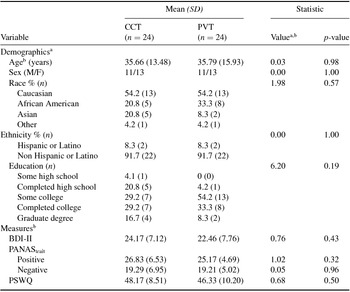
One hundred and twenty-nine individuals who were phone screened did not meet eligibility criteria (BDI-II score too low) and five declined to participate. A total of 56 participants were randomized and 48 participants completed the three study visits (ages 18–68 years, see Table 1 for more demographic information). Sample size was selected to allow adequate power (beta = 0.8) to detect the large effect size seen in previous studies of CCT relative to TAU (d = 1.26; Siegle, Ghinassi, et al., Reference Siegle, Ghinassi and Thase2007). Six participants did not return for the second visit and two participants did not return for the final visit. There were no dropout differences by experimental group (χ2 = 0.00, p > 0.95). Groups did not differ significantly on any demographic or self-report measure using t tests or Chi-square tests (all p's > .19), indicating no pretraining differences (see Table 1 for full demographic data).
Baseline and demographic characteristics

Notes: CCT = Cognitive Control Training; PVT = Visual Control Task; BDI-II = Beck Depression Inventory; PANAS = Positive and Negative Affectivity Scale (Trait Version); PSWQ = Penn State Worry Questionnaire
aChi-square statistics reported for all demographic variables except age
bt-values reported for all affective measures and age (df = 46)
BDI-II analysis - depression severity
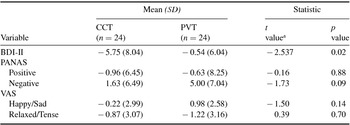
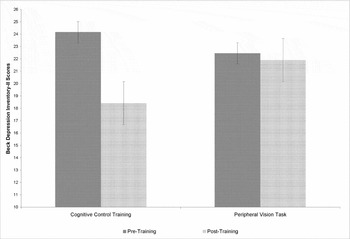
An independent t test revealed significant group differences in BDI-II change score (change between baseline and session 3; t (46) = 2.54, p < .05, d = 0.73, see Table 2), indicating a significantly greater decrease in BDI-II scores in the CCT group over the PVT group. See Figure 1 for pretraining to postsession 3 graph of BDI-II scores by group. The degree of change correlated with a change from moderate to mild depression range for the BDI-II in the CCT group; however, the PVT group remained in the moderate range. An additional repeated measure GLM found significant group differences by time (with the addition of data from session 2; F(2,46) = 5.40, p < .05).
Means and standard deviations of outcome measure change by training group

Notes: CCT = Cognitive Control Training; PVT = Visual Control Task; BDI-II = Beck Depression Inventory; PANAS = Positive and Negative Affectivity Scale; VAS = Visual Analogue Scale
Baseline and posttraining scores with standard error bars for each condition for the 48 participants for the Beck Depression Inventory, with a significant difference in the change scores between the two conditions

PANAS and VAS – positive and negative state affect
Independent t tests and repeated measure GLMs of PANAS and VAS measures did not find significant group differences in state affect, see Table 2 (PANASpositive change t (46) = −0.16, p > .85, d = 0.21; PANASpositiveF(2, 46) = 0.02, p > .85; PANASnegative change t (46) = −1.73, p > .05, d = 0.50; PANASnegativeF(2, 46) = 2.98, p > .05; VAShappy/sad change t (46) = −1.49, p > .10, d = 0.43; VAShappy/sadF(2, 46) = 2.37, p > .10; VASrelaxed/tense change t (46) = 0.39, p > .65, d = 0.11; VASrelaxed/tenseF(2, 46) = 0.18, p > .65). However, the effect sizes for PANASnegative change and VAShappy/sad change were in the medium range indicating the CCT group as compared to the PVT group had non-significant trends toward lower negative affect at Visit 3 as compared to baseline.
Analyses of PASAT performance were assessed relative to state affect to further evaluate the effects of the CCT training within individuals who received CCT. PASAT performance improved for all participants (mean pretraining ISI = 3.08 seconds; mean posttraining = 2.65 seconds; t (22) = −.400, p > .001, d = 0.52). Correlations showed significant relationships between PASAT performance (average ISI) and state affect ratings (PANASpositive and VASrelaxed/tense) at visit 3 (the better the PASAT performance, the more positive and relaxed the ratings were; r = 0.46, p < .05; r = 0.45, p < .05). PASAT performance was not significantly correlated with other state affect or BDI-II scores (r's < 0.30, p's > .10).
Discussion
The aim of this study was to explore the efficacy of a neurobehavioral training intervention in individuals with depressed mood. We found significant differences in the primary outcome measure, BDI-II, between training groups. The current study builds on previous research (Siegle, Ghinassi, et al., Reference Siegle, Ghinassi and Thase2007) by using a randomized controlled design that included a control condition (PVT). Additionally, to further examine the number of sessions necessary, half of the previously administered dose of CCT was used in the present study. We replicated and extended the findings from Siegle and colleagues (Siegle, Ghinassi, et al., Reference Siegle, Ghinassi and Thase2007) and found that three sessions of CCT directed at increasing activation in the DLPFC is associated with an improvement in depressed mood as compared to a control condition (PVT) in non-treatment seeking community members. Our key findings include that the significant degree of change in depressed mood on the BDI-II following CCT reflects a medium to large effect size (d = 0.73). Additionally, while the CCT group's depression severity moved from moderate depression into the mild depression range for the BDI-II, the PVT group remained in the moderate range, reflecting a clinically meaningful difference in mood (between mild and moderate depression).
Similar trends were found for our secondary outcome measures with the PANASnegative and VAShappy/sad effect sizes in the medium range (d = 0.43–0.50), indicating less negative state affect rating in the CCT group as compared to the PVT group. Yet in a sample of 48, these trends did not reach significance. Taken as a whole, our results highlight the potential of CCT as a neurobehavioral intervention useful for mood. These results further the previous research on CCT that was studied in severely depressed individuals enrolled in a day hospitalization program (Siegle, Ghinassi, et al., Reference Siegle, Ghinassi and Thase2007). In that study, participants who received CCT exhibited improved performance on novel executive functioning tasks that rely on PFC activity as well as a significant reduction in depression and rumination symptoms (Siegle, Ghinassi, et al., Reference Siegle, Ghinassi and Thase2007). Our similar results on BDI-II scores complement these findings and highlight the potential of CCT as a neurobehavioral training useful for modification of depression. This potential for clinical utility is especially promising as CCT is a brief computer training that could be added to existing treatments as a time and cost-effective way of enhancing learning effects, should future studies support this indication.
Further study in clinical samples is warranted, as is further evaluation of brain correlates of this training. Future studies would benefit from follow-up assessments as well as assessments of cognitive function in addition to affect measures. Indeed, limitations of this study include the use of self-reported symptoms of depression and state affect rather than biological or brain-state data. Study staff were not blind to the participants’ study condition; however, due to the reliance on self-report data, this was unlikely to have influenced the results. We did not collect data past the three-study visit period. Also, we did not assess DSM-IV criteria of major depressive disorder. Future research would benefit from the additional evaluation of the number of sessions of CCT (dose), a longer follow-up period, and diagnostic evaluations as well as broadening of the sample to include other disorders. To date, though, pilot investigations of CCT indicate it may show promise in clinical application.



Comments
No Comments have been published for this article.