Biotopia
In 1908, the US literary magazine Atlantic Monthly published a prominent review of new books on evolution and heredity; its writer, Edwin Tenney Brewster, observed that their sheer number was evidence of ‘the world's perennial interest in the topic’. According to Brewster, the public was intrigued because organisms were proving increasingly malleable as science showed us ‘the means by which they may be made something else’. He offered two quotations, from two very different authors, as evidence of biology's new capacities. The first was by the British biologist Reginald C. Punnett, from Mendelism (1907), the second edition of his brief introduction to what would soon be called genetics. Punnett listed various questions that geneticists had been unable to answer just a couple of years earlier, but to which they had been confident that ‘experiment would give us the solution’; he concluded triumphantly, ‘our confidence has been justified’. Brewster reinforced Punnett's view with a quote from an ‘Illinois farmer writing in a farm paper’ who claimed that, by applying Mendel's laws, the stockbreeder could ‘obtain any character you desire from any breed and graft this character on to your favorite breed’.Footnote 1 In Brewster's view, these examples proved that just ten years earlier, ‘organic evolution was one of the speculative sciences’, whereas today's farmer could demand such things as that ‘his wheat must ripen by such and such a date’ and the modern scientific breeder could ‘build … him the plant to order’.Footnote 2 The expectation that plants – and eventually other living things – could be built to order is central to this story, but equally important is the fact of that promise being made by such different writers, addressing quite distinct audiences, with the Atlantic Monthly then ensuring it spread to an even wider audience. As a result, many who would never study the new biology came to know about the kinds of future it offered.Footnote 3
One source of the breeders’ new confidence was the newly rediscovered theories of Gregor Mendel. However, while Mendelism was important to the emergence of biotopianism, it has been so extensively studied by historians that other important theories of the period tend to be overlooked.Footnote 4 Brewster's review, like many of the other sources considered here, stressed the importance of Hugo de Vries's mutation theory, which is now all but forgotten but was at least as important as Mendelism in fuelling early twentieth-century biological speculations.Footnote 5 Brewster reviewed de Vries's most recent book, Plant-Breeding, calling its author ‘the world's first authority in his field’, and encouraging the Atlantic’s readers to read his works for themselves, since of ‘his three general works, [Plant Breeding] is much the briefest and least technical’.Footnote 6 (The apparent accessibility of the new biology was also important to its appeal.) Thanks to Mendel and de Vries, evolution was rapidly becoming an experimental science that promised not merely to improve existing plants and animals (including human ones), but to invent entirely new ones, at a time when America's rapidly growing population gave added urgency to the interest in improving agricultural techniques.Footnote 7 Thanks to what was usually called ‘experimental evolution’, many of the writers whose works Brewster reviewed shared a ‘living faith in the power of science to transform humanity and thereby to make men happy’, because they believed that someone using science could ‘transform himself into the kind of man who will be happy amid his own handiwork’.Footnote 8 The utopian claim that science, particularly biology, could ‘make men happy’ implied (as one of Brewster's biologists put it) that ‘the scientific philosopher must not think of existing human nature as immutable, but must try to modify it for the advantage of mankind’.Footnote 9 In Brewster's view such biological transformations were inevitable; scientists had already begun remaking the whole organic world – including humanity – and the future would belong to ‘that nation which does it first’.Footnote 10
Brewster's confidence was characteristic of the early decades of the twentieth century, when many believed that a new kind of utopia was imminent. Defining ‘utopia’ is notoriously complex, but for present purposes, I will follow J. Colin Davis and assume that, unlike other kinds of ideal society (such as Arcadias), utopias are created by human effort.Footnote 11 As a result, Davis argued, a utopia is the only kind of ideal society that can be created using science (including applied science/technology). And the specifically scientific utopia (of which Francis Bacon's New Atlantis (1627) was the first) assumes that ‘nature is deficient or unaccommodating and must be altered’ – and that science could achieve that.Footnote 12 Taking Davis's definition as a starting point, I would add that – as numerous scholars have noted – utopia is also, primarily, a literary genre, which invites its readers to imagine alternatives to the existing world.Footnote 13
Prior to the early twentieth century, the physical sciences tended to provide the basis for scientific and technological utopias (particularly in the USA), for example by imagining how new machinery would bring material abundance and leisure to all.Footnote 14 Such forecasts shared a premise with earlier utopias (whether scientific, religious, political or legal), that nature – including human nature – was largely immutable; we could no more change ourselves than we could persuade flowers to bloom in the desert. That assumption resulted from the Christian origins of the modern utopian tradition, most of whose writers took it for granted that human nature was deeply flawed, as the expulsion from Eden proved. That same supposition persisted in a secularized form as the Malthusian fear that overpopulation made utopia impossible. Of course, the idea that evolution was a doctrine of perfectibility was a key reason for its initial nineteenth-century popularity (particularly among progressives and early socialists), but for other thinkers original sin was simply secularized, reimagined in the claim that evolution had burdened us with an insatiable instinct to reproduce and compete with one another; the explanation for human nature had changed, but not the belief that we were inherently flawed.Footnote 15 Since most utopias shared this assumption, they focused on minimizing humanity's failings with such reforms as better laws or moral codes.
However, the early twentieth century saw the advent of a new utopian hope; biologists came to believe that humans might reverse the Fall and remove the last traces of even this secularized form of original sin. The hope that biology could re-create Eden by making the world a utopian garden was apparent in a new mode of writing that became widespread in both the USA and Britain, as a few examples will show.Footnote 16 In 1901, Charles Howard Shinn, inspector of experiment stations at the University of California, described recent pioneers of scientific plant breeding, such as California's Luther Burbank, as explorers. Their discoveries, he claimed, ‘when rightly understood shall in due season release brain-tired men from gray city pavements, sending each one to his own well-watered, fruit-giving, life-supplying acre’. This, he announced, was now possible as a result of the ‘marvellous gospel of plant-evolution’, which was inspiring ‘a new literature’ that is ‘fresh, bright, helpful, more fascinating than any novel’.Footnote 17 (The claim that evolution was a ‘marvellous gospel’ is a reminder that, for many, evolution became central to a secular faith in progress during these decades.Footnote 18) Burbank and his contemporaries also inspired the popular US horticultural writer William Harwood to describe the promise of American scientific agriculture in The New Earth (1906). He argued that ‘the Old Earth was far from paradise … [a] cheerless, desolate home, often untidy and usually cursed with food unfit to eat’. However, science had produced such achievements as the ‘creation of new and better cereals, one of the master acts of the men of the New Earth’; they would ensure a future characterized by
[b]road acres, well kept and well stocked … a modern home with its good cheer, its books, its music, its culture; a close touch with progress … the pride of strong men and sensible women in a calling as old as the human race, but never until now come into its own.
Altogether these were ‘the tokens of the New Earth’.Footnote 19 (Harwood's vision directly inspired Vladimir Lenin to inaugurate scientific agricultural research in the infant Soviet Union.Footnote 20)
As crop breeders like Burbank began to create new plants and a new Garden of Eden, it seemed that science might also create new people to populate it. In 1907, the Washington Evening Star ran the story ‘New species to order’, accompanied by sub-headings that announced ‘Man in his new role of inventing creator’ thanks to ‘EXPERIMENTAL EVOLUTION’. The story began by telling its readers, ‘The dream of [Francis] Bacon, who saw in the New Atlantis gardens a land devoted to the modification of animals and plants at man's will, is being realized by the Carnegie Institution at its new “Station for Experimental Evolution”’. The paper quoted the laboratory's director, Charles Davenport, as saying, ‘when we know the law we may control the process, the principles of evolution will show the way to an improvement of the human race’.Footnote 21 (Again, evolution is equated with progress.) In similar vein, the US feminist Charlotte Perkins Gilman imagined a women-only utopia, Herland (1915), whose inhabitants had used scientific crop breeding and forestry to make ‘a pleasant garden’ of their country. Herland's people had been improved as much as its crops; its children were like ‘perfectly cultivated richly developed roses compared with – tumble weeds’.Footnote 22 On the other side of the Atlantic, H.G. Wells offered a utopia ‘where ill-bred weeds, it seemed, had ceased to thrust and fight amidst the flowers’ (Men Like Gods). Wells's utopians were as orderly as their garden-like world, which (like Gilman's Herland) had undergone ‘a great cleansing … from noxious insects’.Footnote 23 And the British biologist J.B.S. Haldane (Daedalus) imagined a future where deliberately modified algae fed the world and had turned the oceans purple, yet the colour had come to seem ‘so natural’.Footnote 24
These and other examples will be analysed in more detail below. Despite their different genres they share characteristic tropes: the world would become a scientifically cultivated garden, non-human nature would be changed to suit human needs, and human nature itself would be transformed. All these claims were built on the idea of accelerating and directing evolution by understanding heredity more fully. Despite some continuities with earlier scientific utopias, using the new life sciences rather than the old physical ones gave these utopias distinctive characteristics. For example, many featured the deliberate eradication of certain species, an aspect that is profoundly jarring to twenty-first-century ecological sensibilities, as are other features of these supposedly perfected worlds. Even to their original readers, they were sometimes read as biological dystopias, so I will refer to them simply as ‘biotopias’, not least because their ambiguity, so often characteristic of the utopian genre, helped ensure both their original impact and their lasting influence.Footnote 25
‘This old Hag, our Mother’
Two utopian novels, published within a decade of each other, exemplify the main characteristics of the biotopian mode: Charlotte Perkins Gilman's Herland (1915) and H.G. Wells's Men Like Gods (1923). Herland originally appeared in serial form in Gilman's magazine The Forerunner, but appears not to have been reviewed at the time, so its initial readership would have been modest (The Forerunner’s circulation never exceeded 1,500).Footnote 26 By contrast, Wells was world-famous and his new novel was widely reviewed. One American reviewer, Howard Shinn (the same writer who espoused the ‘marvellous gospel of plant-evolution’ so enthusiastically above) believed that the book would be added to the list of ‘Wellsian masterpieces’ and be read ‘as long as time endures’ because it offered imaginative solutions to ‘problems which we must solve if we would salvage our civilization’.Footnote 27 The New York Times concurred, telling its readers that ‘utopia’ had long been a synonym for impossibility, but that today ‘many believe’ that ‘we might arrive there, land and take possession’. It credited Wells for this change.Footnote 28 Gilman knew and admired Wells's work, but praised him not so much for his fiction (she was critical of the attitudes towards women that some of his books displayed), but for ‘electrifying the world's slow mind to the splendid possibilities of life as it might be’.Footnote 29 Although Gilman was not as famous as her British contemporary, she was a well-known writer and lecturer on women's rights and economics, and – for present purposes – an important example of how biology was read and interpreted by non-biologists. The similarities between these two writers’ work also suggest that, to some degree, a common Anglo-American culture framed the discussions of contemporary biology's potential (and was shaped by such discussions); for example, many of the books discussed here were published, reviewed and discussed on both sides of the Atlantic. However, there were also important differences in British and American responses, as will become clear.
Herland (like many other utopias) is constructed as a traveller's tale, a ‘Lost World’ narrative that describes the discovery of an isolated country amid unidentified jungles.Footnote 30 Three men – Van, Terry and Jeff – use an aeroplane to reach the previously unattainable country and are immediately struck by its being ‘a land in a state of perfect cultivation, where even the forests looked as if they were cared for; a land that looked like an enormous park, only it was even more evidently an enormous garden’. After making contact with the country's inhabitants – all of whom are women – the visitors learn its history. Two thousand years earlier, while most of the men were away at war, an earthquake blocked the only accessible pass. The only men left were slaves, who revolted and killed the remaining masters, intending to enslave the women. But the women slew their would-be oppressors and so, as Gilman's narrator, Van, puts it, only women remained ‘on this beautiful high garden land’. Farming was their first concern, and Van comments that ‘they worked out a system of intensive agriculture surpassing anything I ever heard of, with the very forests all reset with fruit or nutbearing trees’. The image of paradise as a garden was not, obviously, a new one, but Herland's utopian garden had been deliberately created through scientific plant breeding. For example, the women decided to grow only trees with edible fruits or nuts, to make the best use of their small country, but there was one tree they loved for its beauty that produced nothing they could eat, so they had spent nine hundred years patiently breeding it until it bore an edible crop. As Van summarized, the women ‘had made a pleasant garden’ of their land, ‘a very practical little heaven’.Footnote 31 That image of a garden as a practical heaven, created by conscious effort, recurs in biotopian writing.
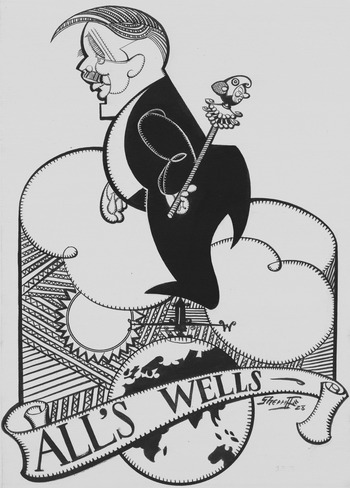
H.G. Wells depicted as an optimistic colossus, bestriding the world with his jesting predictions. (Robert Stewart Sherriffs, c.1928–1936. Courtesy: National Portrait Gallery, London.)

As noted, Men Like Gods also featured a garden-like landscape devoid of ‘ill-bred weeds’. The story centres on Mr Barnstaple, a disillusioned journalist who finds himself (along with an assortment of other ‘Earthlings’) in ‘Utopia’, a parallel earth into which they have been accidentally pulled by some Utopian physicists. Wells's hero was immediately struck by ‘a band of greensward, of a finer grass that Mr Barnstaple had ever seen before – and he was an expert and observant mower of lawns’. Catapulting a little lawn-mowing suburbanite into a sublime utopia was a characteristic piece of Wellsian wit that also emphasized the horticultural work that had created this new world. When the Earthlings are taken to meet a council of Utopians, they are flown over a landscape that is described as ‘garden pasture’, complete with ‘extensive farming or dairying establishments’ and other evidence of modern farming. As in Herland, this is not an unspoilt arcadia but a cultivated, technological landscape: ‘Plants and flowers, always simpler and more plastic in the hands of the breeder and hybridiser than animals, had been enormously changed in Utopia’, and the plants ‘had been trained and bred to make new and unprecedented secretions, waxes, gums, essential oils and the like, of the most desirable quality’.Footnote 32 As with biotopianism more generally, the Utopians’ work had begun by exploiting the ‘plasticity’ of plants, but had been successfully extended to other animals, including themselves, an achievement that Wells (and others) hoped would eventually be emulated in reality.
After he had explored more thoroughly, Barnstaple reflected that he ‘knew enough of Utopia now to know that the whole land would be like a garden, with every natural tendency to beauty seized upon and developed and every innate ugliness corrected and overcome’.Footnote 33 The Earthlings discover that ‘correcting’ nature's ‘innate’ ugliness has indeed been one of the Utopians’ long-standing concerns – and some of them hate it. Freddy Mush (a ‘gentleman of serious aesthetic pretentions’) objects to the destruction of the ‘Balance of Nature’, exemplified by the absence of swallows; Wells explains that ‘there were no swallows to be seen in Utopia’ because of ‘an enormous deliberate reduction of insect life’, which had largely destroyed the birds’ food supply.Footnote 34 The Utopians had engaged in ‘a systematic extermination of tiresome and mischievous species’ and, in contrast to Mush, Barnstaple regards this ‘revision and editing, this weeding and cultivation of the kingdoms of nature by mankind’, as (paradoxically) ‘the most natural and necessary phase in human history. “After all,” he said to himself, “it was a good invention to say that man was created a gardener”’.Footnote 35
The ‘revision and editing’ of nature was the heart of Mush's objection to Utopia (‘I hold by the swallows’, he explains). In response to the Earthling's criticisms, a Utopian called Urthred tells the Earthlings to look objectively at Mother Nature:
she is purposeless and blind. She is not awful, she is horrible. She takes no heed to our standards, nor to any standards of excellence. She made us by accident; all her children are bastards – undesired; she will cherish or expose them, pet or starve or torment them without rhyme or reason. She does not heed, she does not care. She will lift us up to power and intelligence, or debase us to the mean feebleness of the rabbit or the slimy white filthiness of a thousand of her parasitic inventions. There must be good in her because she made all that is good in us but also there is endless evil. Do not your [sic] Earthlings see the dirt of her, the cruelty, the insane indignity of much of her work?
He explained how before the Utopians ‘took this old Hag, our Mother, in hand’, more than half the species on the planet were ‘ugly or obnoxious, insane, miserable, wretched, with elaborate diseases, helplessly ill-adjusted to Nature's continually fluctuating conditions’. They had to suppress ‘her nastier fantasies’, to wash and comb her and teach her. As a result they are no longer ‘the beaten and starved children of Nature, but her free and adolescent sons. We have taken over the Old Lady's Estate. Every day we learn a little better how to master this planet’.Footnote 36
This language of male mastery over ‘Mother Nature’ is, of course, a long-standing feature of Western science. Wells's very title and the misogynistic image of the ‘adolescent sons’ calling Mother Nature an ‘old Hag’ and taking over her ‘estate’ epitomize science as a form of gendered violence, in which active and arrogant men interrogate or even torture passive nature, in order to extract knowledge from ‘her’ (usurping God's power in the process).Footnote 37 This makes the similarities between the ideas in Wells's and Gilman's books disturbing, and may explain why many Gilman scholars have failed to note that the women of Herland are as intent on the ‘revision and editing’ of nature as Wells's Utopians. Gilman's main female character, Ellador, is a forester whose interest in forestry began in childhood when she caught a strange butterfly and learned it was an Obernut moth, potentially very destructive of one of Herland's cherished trees. The teacher who identified it added, ‘We have been trying to exterminate them for centuries’, so Ellador and the other children are promptly set to work to find and kill all that survive.Footnote 38 However, these are not urbanized children, who have grown up swatting intrusive insects; Herland's children ‘grew up as naturally as young trees’ and were raised largely out of doors, ‘naked darlings playing on short velvet grass, clean-swept’. Their education took place ‘in an environment which met their needs; just as young fawns might grow up in dewy forest glades and brook-fed meadows. And they enjoyed it as frankly and utterly as the fawns would’.Footnote 39 The image of the ‘naked darlings’, supposedly as ‘natural’ as trees or fawns, setting out on a systematic ecocide captures the same biotopian paradox as Barnstaple's description of ‘editing’ nature as ‘most natural’. This is the paradox at the heart of the biotopian mode: nature is both exalted and manipulated. Instead of adapting themselves to nature's constraints and limited resources, the inhabitants of biotopia are constantly forcing nature to adapt to them; the language of gardening, of ‘cultivating’ a plot of waste ground to make it beautiful and fertile, helps collapse the distinction between nature and culture.Footnote 40
The biotopian mode emerged from the new biological theories of the early twentieth century that prophesied human control over nature.Footnote 41 Wells's biological expertise – rooted in his time as a student of Thomas Henry Huxley – is well known.Footnote 42 And Herland demonstrates how well informed about contemporary biology Gilman was.Footnote 43 For example, when the Herlanders explain how they have survived for two thousand years without men, they tell their visitors that after the last men were killed one of the women began, quite suddenly, to give birth parthenogenetically, and that all her daughters inherited her ability. Parthenogenesis was widely discussed in the biological community at the time, primarily because of the publicity around the Chicago biologist Jacques Loeb's successful induction of artificial parthenogenesis in sea urchins around 1900.Footnote 44 Gilman demonstrated her knowledge of these continuing discussions when she wrote in The Forerunner that some ‘subscribers have asked if there is any foundation in biology for the condition of parthenogenesis – virgin birth – alleged in Herland’. She explained that it was quite widespread in various insects, including bees and aphids, and gave details.Footnote 45 In the novel Terry argued that there must be men somewhere, since if the Herlanders ‘were parthenogenetic they'd be as alike as so many ants or aphides [sic]’, a point Gilman made when explaining to The Forerunner’s readers that parthenogenesis was regarded as a primitive form of reproduction, because it reduced the variability of a species.Footnote 46
Gilman's novel also referred to de Vries's mutation theory; when the men ask the Herlanders ‘how they accounted for so much divergence without cross-fertilization’, they are told that the women attributed it ‘partly to the law of mutation. This they had found in their work with plants, and fully proven in their own case’.Footnote 47 Like the Herlanders, de Vries had experimented with plants to understand how inheritance and evolution worked, and improving crops was one of his goals. He found a species of evening primrose, Oenothera lamarckiana, that appeared to be generating new species overnight by mutating (just as the women in Herland became instantly parthenogenetic), rather than through the slow, gradual selection of minute variations associated with conventional Darwinian natural selection. Gilman was aware of the ferment of excitement surrounding de Vries's theory – indeed, as a progressive intellectual with an interest in biology, she could hardly have avoided learning about it. The theory was discussed regularly in the Atlantic Monthly (which she both read and wrote for). For example, Brewster (in a round-up of the latest science books that appeared three years before the one discussed above) proclaimed that de Vries had ‘seen the origin of a really new species by one clean jump’ and that as a result his Species and Varieties was ‘clearly the book of the year’.Footnote 48 Gilman also read the Popular Science Monthly (PSM), which covered the theory extensively, including its possible applications to human society.Footnote 49 These and other general-interest publications (such as The Nation and Harper's Monthly) not only discussed de Vries's ideas, but also explored their application to human society.Footnote 50 For example, an article on ‘Industrialism’ in the PSM asserted, ‘As the biologist might say, the Industrial Age is a period of rapid mutation … It is a day of hope and of optimism, such as the world has not hitherto known’, a claim that epitomized the mutation theory's appeal.Footnote 51
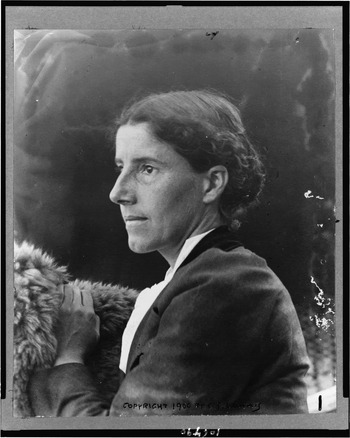
Charlotte Perkins Gilman, pictured, appropriated various aspects of contemporary biology to bolster her argument that women's equality could be achieved by deliberately remaking nature to meet human needs. (Courtesy: Library of Congress. No known copyright restrictions.)

Lamarckian inheritance (as well as the challenge to it mounted by August Weismann) is also discussed explicitly in Herland. Gilman's eclectic use of biological ideas reflected her broad belief in the need to ‘have faith in evolution’ (which she also equated with progress). She argued that ‘many people nowadays’ had lost their faith in providence and so (like Wells's Utopians) were inclined to ‘discuss the merits’ of each organism ‘according to its “use” to us’. According to Gilman, we should no longer assume that each creature has a divinely ordained purpose, but instead ask whether it is ‘a step up, or a step down’. In her view, ‘the force called Evolution … is always pushing, pushing, upward and onward’, and so ‘[y]ou can count on it. It is always there’. Part of Gilman's argument for trusting evolution was that doing so had clearly worked for plant and animal breeders who had ‘already done wonders’ in creating new organisms. Their principles could just as easily be applied to humans; ‘we must provide right conditions’, she asserted, then ‘that great pushing life-force of Evolution [will do] the rest’.Footnote 52 Plant and animal breeding as a model for improving the whole of nature, including humans, was a recurring theme in Gilman's work, and one of her inspirations was the work of Luther Burbank. As she argued (in an article tellingly entitled ‘Assisted evolution’), Burbank had already done more than nature had managed. Even though it had ‘taken Mother Nature long, long ages to turn fierce greedy hairy ape-like beasts into such people as we are’, humans could be sure that if they were to model themselves on Burbank and take charge of evolution, it would only require ‘two or three close-linked generations to make human beings far more superior to us than we are to the apes’.Footnote 53
Herland imagined how nature could be reshaped by emulating Burbank and trusting evolution. Perhaps the most significant change of all those Gilman envisaged was that animal instincts could be reshaped as readily as the trees. The Herlanders kept cats in order to control mice and similar ‘enemies of the food supply’, but had found the cats’ meowing irritating. The narrator, Van, asks, ‘What do you think these Lady Burbanks had done with their cats?’Footnote 54 The answer was that they had reshaped feline nature and ‘developed a race of cats that did not sing!’ The redesigned cats still purred, but no longer killed birds; their instincts had proved as plastic as the plants in Wells's utopia (which also featured tamed cats, notably a leopard). The same process has been applied to the Herlanders themselves; instincts of which the Herlanders approved had been encouraged while antisocial impulses had been weeded out. As the men discover (to varying degrees of consternation), the instinct of ‘sex-feeling’ had atrophied from disuse in Herland; even the most fundamental of human instincts could be modified as readily as the cat's meow.Footnote 55 The abolition of the sex instinct had allowed the Herlanders to escape the Malthusian trap; they had learned to control their parthenogenetic reproduction through sheer willpower, ensuring that their population stayed at a level their country could support. (Wells's Utopians had done the same in Men Like Gods, presumably through more conventional means.) And, of course, Gilman's main reason for imagining a re-engineered nature was to show a world in which women's supposedly natural inequality had also been abolished. Freed from the constraints of sex, marriage and the family, the Herlanders could invent their own, post-natural motherhood, which Gilman hoped her readers would find liberating, but which some of her contemporaries would doubtless have found repulsively unnatural.Footnote 56
Both the Herlanders and their cats had been cleansed of original sin; the Malthusian instincts to reproduce, compete and kill had all been subdued by science. Revising and editing nature had become a ‘natural’ approach, and allowed them to reinvent the most seemingly natural category of all, gender; and to do rapidly what ‘Mother Nature’ did slowly (or could not do at all). And the description of the Herlanders as ‘Lady Burbanks’ is a reminder that for Gilman – as for many of her contemporaries, particularly in America – the biotopian promise was particularly vivid in writings about (or by) Burbank.
Burbank in Biotopia
As Katherine Pandora has demonstrated, the horticulturalist Luther Burbank, of Santa Rosa, California, became the most famous plant breeder in the world during the early decades of the twentieth century, partly because he seemed to exemplify a series of distinctly American virtues (he even lived behind a white picket fence).Footnote 57 His fame also rested on a rapidly expanding population and press market; Burbank's new crops promised to feed America's many mouths and stories about them helped fill the ever-increasing number of newspaper pages. And he was a master publicist, at a time when there was widespread excitement about American inventiveness, who promoted his achievements in a series of catalogues with the eye-catching title New Creations in Fruit and Flowers. Hyperbole was common in nursery catalogues, but Burbank's New Creations outdid its rivals, implying that he had overtaken the original Creator.Footnote 58 Some regarded such claims as blasphemous, but many more were willing to participate in the quasi-religious aura that surrounded Burbank; when California's State Board of Trade gave a banquet in his honour in 1905, the toastmaster stressed that Burbank's work to ‘make the earth more fruitful and its bloom more radiant has been part of the religious life of the honored guest of the evening’.Footnote 59 The sacred aura surrounding Burbank reminded readers of the Judaeo-Christian tradition's belief that humanity had been given dominion over nature. As one US magazine asked its readers in 1905, why ‘should anybody marvel at the achievements of Luther Burbank?’ since ‘control over the life of this globe … is the birthright of humanity’, according to the book of Genesis.Footnote 60 And in Britain (where Burbank was generally received with more scepticism than in the US) the broadly evangelical British magazine The Quiver announced, ‘The links which unite science and religion have been strengthened by the testimony recently given by that wonder-worker of California – Luther Burbank’.Footnote 61 Articles like these (and there are dozens more) treated Burbank as an almost religious figure.
Perhaps surprisingly, at a time when many (particularly in the USA) believed science and religion to be in conflict, Burbank was also routinely praised for being a true disciple of Darwin who had (as numerous commentators put it) ‘evolved’ new plants.Footnote 62 A key part of Burbank's appeal was democratic; as Pandora has noted, numerous periodicals told their readers that they should not only accept Burbank as a scientist, but also emulate him by conducting experiments and making their own discoveries.Footnote 63 As I have argued elsewhere, some recognized members of the scientific community acknowledged such claims, and attempted to enlist Burbank in their arguments over the interpretation of evolutionary theory that were so prevalent at the time. Others rejected his claims, and some changed their minds – initially accepting Burbank's scientific claims, but later rejecting them.Footnote 64 Burbank's contested status made him an obvious point of reference in public debates over experimental evolution. As the new approach developed, many in the scientific community became confident that biology was shedding ever more light on life's origins, promising more control over its future, statements that struck opponents of Darwin as arrogant and contributed to the anti-evolutionary backlash that was one of the factors in the Scopes trial.Footnote 65 (It is a mark of how complex Burbank's reputation was that he was invited to testify by both sides in Tennessee.Footnote 66) The promotion of experimental evolution gave added interest to Burbank's experiments, just as the publicity around Burbank fed curiosity about mutation and Mendelism. Yet the more one reads about Burbank, the more the contradictions multiply: he was depicted as both a highly trained expert and an untaught innocent; as an altruistic benefactor to mankind and an important ally of commerce (his famous Burbank potato was supposedly worth millions of dollars a year to the US economy); and, most importantly of all, he was invariably described as living and working in harmony with nature, yet was also celebrated for his ability to master Mother Nature, correcting her mistakes, curbing her wastefulness and teaching the old lady ‘new tricks’.Footnote 67
The contradictory meanings that attached to him prove central to understanding what the wider public believed ‘Burbank’ signified. As we have seen, for Gilman he embodied the promise of human control over nature (including human nature), and her interpretation was a common one because Burbank's name began to be used as a verb: the Atlantic Monthly’s 1908 review of recent biology books (see above) commented that the advances they described implied that ‘a benevolent and all-powerful despot backed by a scientific commission could “Burbank” the soberness of Jew or Chinaman into the most drunken of races, and make the saloon as innocuous as the public library’, a presumably light-hearted example that nevertheless demonstrates the potentially dystopian aspects of applying Burbank's methods (at least for saloon keepers).Footnote 68
A comprehensive survey of the press coverage of Burbank would fill several volumes, but as Pandora has noted, there was considerable repetition (and some plagiarism) that helped spread the ideas analysed here, making a brief sample sufficient to demonstrate the key themes.Footnote 69 For example, the widely read general-interest monthly Century Magazine published a two-part article on Burbank by William S. Harwood, one of the most prolific and successful writers about Burbank (his articles were expanded into a successful book, New Creations in Plant Life, later that year and he also wrote The New Earth, mentioned above).Footnote 70 Harwood's articles offered ‘an authoritative account’ under the title ‘A wonder-worker of science’, which began by quoting a fulsome tribute to Burbank by de Vries.Footnote 71 Yet Harwood emphasized the complexity of Burbank's relation to the scientific community, claiming that only a decade earlier Burbank had been ‘denounced by scientific men as little less than a charlatan, a producer of spectacular effects, a seeker for the uncanny and abnormal, an enemy to all true scientific progress’.Footnote 72 However, as Burbank's fame grew, many who had come ‘to scoff’ now ‘stayed to pray’ (evoking the science/religion paradox again).Footnote 73 Being a ‘wonder worker of science’ who was ‘denounced by scientific men’ was not the only contradictory aspect of Burbank's scientific standing. Although Harwood quoted evidence of the scientific community's approval, he also stressed that Burbank had ‘no laboratory at all, save that of the earth and the air and the sun … He has had the seeds, he has had the generations of plants, he has had the earth’.Footnote 74 Burbank's success was simply the result of ‘his masterly judgment, backed by a wonderful intuition, enabling him to accomplish that which indeed seems little short of a miracle’.Footnote 75 An earlier account (by Liberty Hyde Bailey, professor of practical and experimental horticulture at Cornell University), commented that Burbank ‘has not studied the books. He has not been taught. Therefore he is free’.Footnote 76 Clearly, Burbank's status as a natural, untaught genius was at least as important as his scientific standing to the expectations he embodied.
Paradoxes recur in writings about Burbank. When the noted zoologist David Starr Jordan, president of Stanford University, came to describe what he called the ‘scientific aspects’ of Burbank, he wrote that ‘Burbank's ways are Nature's ways, for Burbank differs from other men in this, that his whole life is given to the study of how Nature does things’. Yet Jordan also emphasized what might be called Burbank's ‘engineering’ aspect, by claiming that he had produced plants ‘which but for him, would have existed only among the conceivable possibilities of creation’.Footnote 77 He had, in effect, helped Nature do what she could not have done unaided. Similar points were made by The Cosmopolitan, which published its own two-part article on Burbank in 1905, many of the details of which seem to have been lifted from Century’s earlier pieces. (The constant repetition between different articles is a reminder of how widely circulated these portrayals of Burbank were.) The Cosmopolitan’s writer, Garrett P. Serviss (also a pioneer of pulp science fiction), claimed that only a man of Burbank's character ‘can get close to nature, and in his closeness to nature lies his whole secret. He does not create, but he guides nature in creating’. Yet once again the natural/unnatural paradox was emphasized, since – thanks to Burbank – ‘the face of the landscape may be made a mirror of the human mind’ because ‘man can produce species and do it in a dozen summers!’ The first article's title explained that Burbank ‘shows how man can govern evolution’, and encapsulated the contradiction of his being in harmony with nature yet exercising power over it. As Serviss wrote, Burbank's plants ‘can only be described as new creations. Some of them bridge the supposed impassable chasms between species, and between genera’. This implied a violation of the natural order, emphasized by the claim that every aspect of ‘the life and growth of plants’ was in reach of ‘human interference’ and could ‘be made to follow the dictates of man's wishes’. Yet at the same time, Burbank's plum–apricot hybrid, the plumcot, was not, ‘in any sense, an un-natural product. Mr. Burbank did not create the tendencies that gave birth to it; he simply discovered and guided those tendencies’.Footnote 78 Another Serviss article emphasized Burbank's respect for nature by claiming that he had learned a lesson from one of his mistakes, namely that ‘nature often knows better than man what ought to be done’.Footnote 79 Yet such claims were undermined by comments such as that ‘nature might never spontaneously have turned … in the direction’ which Burbank had chosen.Footnote 80
The engineering facet of Burbank's work made plants seem unexpectedly unnatural, giving them a startling quality that made them particularly attractive to newspaper writers. When the Los Angeles Times previewed the city's Pacific Lands and Products Exposition, it did so under the headline ‘Plant freaks to be shown’, adding that ‘Wizard Burbank will exhibit some queer ones’. Plant ‘freaks’ or ‘monsters’ were not new, of course, but in earlier centuries they had always been described as ‘freaks of nature’, whereas Burbank's were deliberate, human creations. The paper told its readers that ‘the greatest single attraction’ of the show would surely be the Burbank exhibit. One of the organizers had apparently ‘solemnly stated’ that Burbank would exhibit ‘a tree, part palm and part oak, on which will be growing simultaneously oranges, apples, bread fruit, mangelwurtzels [sic], watermelons and sweet potatoes’. Edward H. Brown, secretary of the Santa Rosa chamber of commerce, admitted that this was an exaggeration, but asserted that ‘plant freaks almost as inconceivable would be on exhibit’. The journalist noted that among the ‘Burbankisms’ on display would be his new, spineless cactus and commented, ‘the possibilities of such an idea are of course staggering – most things Burbankesque are’. The cactus could be safely eaten by both cows and people, so that visitors to the exhibition would be able taste the future – both candy and cake made from Burbank's cacti would be on sale. The writer speculated that the ‘thrifty housewife’ of the future would avoid expensive meat and head ‘blithely out onto the desert and lay in a supply of cacti’.Footnote 81 Articles like this border on parody, and routinely comic examples of ‘Burbanking’ nature emerged in impossible claims, such as that one might ‘Burbankize a breed of roosters that lay three eggs a day’.Footnote 82
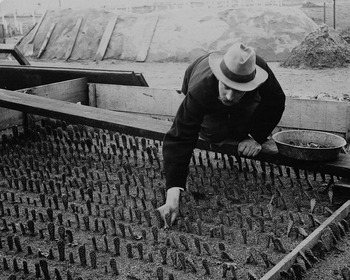
Luther Burbank with some of the cacti he hoped could be persuaded to grow without spines. (Courtesy: Library of Congress. No known copyright restrictions.)

The borderlines between journalistic exaggeration and full-blown fiction became very porous around Burbank; roosters that laid eggs might seem no more unlikely than cacti without spines – or Gilman's cats that did not wail. The ‘Burbankesque’ promised some strange, but enticing, possibilities. And yet joking about ‘freaks’ and ‘queer ones’ might also hint at a slight anxiety about various kinds of perversity; the disapproving use of the word ‘unnatural’ sometimes haunted the writing around Burbank (and, as we shall see, provides a link to other biotopian writings).Footnote 83 The faint fear that scientific breeders like Burbank might violate the natural order helps explain why writers found it necessary to stress his saintly image (he worked from his home and lived with his elderly mother), which perhaps helped domesticate his uncanny power over nature.Footnote 84 Yet the homely details of Burbank's life and work produced an uncomfortable contrast with the hints of violence the ran through descriptions of his methods for ‘correcting’ nature's mistakes.
In 1895, Burbank had told an audience of fruit growers that if they wanted to know ‘[h]ow to produce new trees, fruits and flowers’, they should listen ‘patiently, quietly, and reverently to the lessons … which Mother Nature has to teach’. He counselled, ‘She conveys her truths only to those who are passive and receptive, accepting truths as suggested, wherever they may lead’.Footnote 85 The idea of simply following nature's lead had a wide appeal (particularly at a time when rapid industrialization and urbanization were cutting many Americans off from what they thought of as nature).Footnote 86 Unsurprisingly, Burbank's words were often repeated by his admirers. Harwood quoted Burbank as explaining that ‘[n]ature will do her part always. She never lies; she never deceives’, and yet ‘in the sight of man and from his standpoint, she fails’. So, in addition to listening ‘close to her great heart’, it was also necessary to ‘come to her aid’ with ‘all haste and power’. In the case of the cactus, Burbank claimed that nature had ‘wasted’ her energy on producing thorns; ‘I have simply helped her … and have left her free to put all her energy upon producing food’.Footnote 87 And when the governor of California, George Cooper Pardee, spoke at the 1905 banquet, he praised Burbank as ‘a genius capable of playing tricks with Nature’ who had ‘set the seal of his disapproval upon much that to him and us seems wrong in Nature's handiwork’.Footnote 88 Clearly Mother Nature did not always know best.
Almost every writer who described Burbank emphasized his ability to control and manipulate plants – that, after all, was the most arresting fact about him. The Scientific American, for example, claimed that he had proved that ‘plants could be made to respond to a dominant will’; every aspect of the plant ‘might be controlled or altered’ to produce new types, ‘never dreamed of or imagined’.Footnote 89 Yet, however wonderful and natural it seemed, Burbank's ability to transcend nature invariably hinted at a kind of assault. For example, when he described how he redeemed a plant ‘from among a race of vile, neglected orphan weeds’, he acknowledged that a plant might need ‘the overpowering shock of re-creation’, and ‘must irrevocably break with the past’.Footnote 90 His method was to cross a plant with as many others as possible, so as to ‘break up its life tendencies’. Harwood noted the unpleasant consequences of these shocks and breaks:
In the breaking-up it may produce a whole series of monstrosities, the most strange and grotesque plants that ever took root in the soil of the earth. Some of these plants are hideous, and all such are put to death.Footnote 91
If imitation is indeed the highest form of flattery, Serviss flattered Harwood mightily when he acknowledged that Burbank's experiments sometimes created ‘strange monstrous forms’, so ‘useless’, ‘repellent’ and ‘horrible even, that instantly he destroys them as things unfit to live’. The faint hint of anxiety conveyed by the reference to Burbank's plants as ‘queer’ or ‘freaks’ seems a little stronger here, which may explain why Serviss tried to absolve Burbank of blame: the monsters emerged, he explained, ‘from the deep of the past’ and ‘nature's past, like that of a human life, is not made up entirely of beautiful and desirable elements’. It was nature, not Burbank, who was to blame: ‘She has had her tragedies and her sins’.Footnote 92 Luckily for nature, the world-famous Californian breeder was ready to ‘put to death’ her more shameful progeny.
The Cosmopolitan’s readers would surely have been struck by the language with which Serviss described Burbank discovering possible new plants that nature had neglected: until Burbank recognized them they were like ‘dim eager faces, hidden behind nature's draperies – starved, neglected children for whom there is no room and no hope, whose mother amid a multitude of pressing duties has no time, no thought and no place for them’. Here (as in Men Like Gods) Mother Nature is an uncaring parent; whenever one of her ‘neglected children … peeps forth with momentary boldness’, Serviss wrote, they were ‘rudely thrust back’, unless lucky enough to catch Burbank's eye.Footnote 93 Burbank has effectively become an alternative mother to the hapless plants and his media image often focused on what would then have been regarded as feminine qualities (such as gentleness and love of children); the childless Burbank often referred to plants as his children, especially in his celebrated book, The Training of the Human Plant, which directly applied some of his horticultural techniques to child rearing. Burbank's post-natural garden also challenged conventional gender roles, albeit not as radically as Herland did.
The image of Burbank as a kind of mother was used by Serviss in a newspaper article about Burbank: in creating a red Californian poppy, Burbank had given the flower ‘the chance that nature denied it’, because – he explained – ‘nature usually frowns upon departure from her customary lines. She stamps out independence’ and ‘has little mercy for the nonconformist among her children’.Footnote 94 Burbank had stepped in when mother nature failed, but the implicit feminizing of Burbank added to the discomfort when his work was described in faintly violent terms; for example, another writer explained that Burbank tried to direct each plant's evolution and to govern any ‘outlaw tendencies’ that appeared. However, ‘the blood of atavism’ would sometimes reassert itself once the plant's ‘persistent type is ruptured’. Such ‘outlaw’ plants were dealt with harshly. ‘Of the mass which give no definite or hopeful perturbations, there is a massacre’; they were burnt in large numbers.Footnote 95 Harwood, too, stressed the violent way in which Burbank treated his failures: ‘the rejected plants, shrubs or trees are gathered in large bonfires and burned … In a single year as many as fourteen of these huge bonfires have been lighted … consuming hundreds of thousands of plants’.Footnote 96 And an earlier article described Burbank as using his ‘keen eyes and capable mind’ to examine ‘[m]illions upon millions of cross-bred seedlings’, assessing their worth and then ‘choosing, destroying; their very god incarnate’.Footnote 97 Burbank was depicted both as a creator and as a rather vengeful, Old Testament deity who sat in judgment on his creation. The paradox of the gentle, almost feminine, Burbank correcting nature's mistakes (with cleansing fire if necessary) is reminiscent of Wells's Mr Barnstaple describing the Utopians’ ‘revision and editing’ of nature as ‘most natural and necessary’, or of Gilman's ‘naked darlings’ exterminating unwanted insects and growing up to correct nature's mistakes by replanting entire forests. Experimental evolution was not straightforwardly utopian, but invariably contained hints of a darker, oppressive side to the control of nature (as, perhaps, all utopias do).
Perversion and ‘radical indecency’
The natural/unnatural paradox that was the core of the biotopian mode was presented in its most vivid and unsettling form in 1924, in a small book called Daedalus; or, Science and the Future, by the British biologist John Burdon Sanderson (J.B.S.) Haldane. Daedalus demonstrates continuities between British and American biotopianism, but also highlights some stark differences. Haldane made the striking claim that ‘every biological invention is a perversion’, but – far from condemning such violations of the natural order – he celebrated their ‘profound emotional and ethical effect’ on humanity. His examples of biological inventions included the domestication of plants, animals and fungi, and ‘the artificial control of conception’.Footnote 98 Some of these breakthroughs were so familiar that Haldane suspected his readers would no longer notice how profoundly ‘indecent and unnatural’ they were, so he invited them to consider the dairy industry, built on stealing a cow's milk (symbol of the ‘intimate and almost sacramental bond between mother and child’), in order that it could be ‘drunk, cooked, or even allowed to rot into cheese’. (Interestingly, Gilman's vegan Herlanders have no dairy industry; the only milk in Herland is their own.) Haldane observed, ‘We have only to imagine ourselves as drinking any of its other secretions, in order to realise the radical indecency of our relation to the cow’. Not only was such ‘indecency’ tolerated, but he observed that while every biological invention ‘tends to begin as a perversion’, over time it often becomes ‘a ritual supported by unquestioned beliefs and prejudices’.Footnote 99
Haldane argued that ‘a sentimental interest’ in Prometheus had distracted us from ‘the far more interesting figure of Daedalus’, who helped create the Minotaur, the monstrous hybrid of human and cow that symbolized the ability of humans to remake nature. Titling the book after the monster maker was a celebration of perversion (whereas, as we have seen, Burbank's supporters generally sought to distance him from any hint of the monstrous or unnatural). Haldane was unafraid to link the mythical monster and the achievements of twentieth-century genetics, arguing that if only ‘the housing and feeding of the Minotaur [had] been less expensive’ Daedalus might ‘have anticipated Mendel’. (Though perhaps, he pondered, an annual sacrifice ‘of 50 youths and 50 virgins [was] excessive as an endowment for research’). The modern biologist was heir to Daedalus, able to pervert nature to serve human needs and so, despite being ‘a poor little scrubby underpaid man’ (a distinctly Wellsian figure), Haldane was convinced that ‘the biologist is the most romantic figure on earth at the present day’.Footnote 100
To justify his claim, Haldane borrowed a familiar narrative device used in utopian and science fictions and presented a report from the future, in the form of an undergraduate essay written ‘150 years hence’ that described the scientific breakthroughs that had created a much-perfected future world. (In another borrowing from the utopian/science fictional genre, Haldane made his essay as believable as possible, sprinkling it with the names of the imaginary scientists who had made the various breakthroughs, and making it as brief, under-referenced and laden with generalizations as a real Cambridge undergraduate essay.) But before presenting his forecast in this science fictional form, Haldane felt that ‘a word on Mr. H.G. Wells might not be out of place’, since the ‘very mention of the future suggests him’. Haldane asserted that Wells's forecasts in Anticipations (1902) were all ‘singularly modest’, such as the prediction that heavier-than-air flying machines would be used for war by 1950, and Haldane promised to make ‘no prophecies rasher’ than these. Adding that Wells was ‘a generation behind the time’, having been raised when flying, radio and telegraphy were scientific problems, Haldane observed, ‘Now these are [merely] commercial problems, and I believe that the centre of scientific interest lies in biology’.Footnote 101 (Haldane had perhaps been too busy to read Men Like Gods, but Daedalus had originally been a talk given in Cambridge in February 1923, before Wells's novel was published.)
Daedalus forecast drugs that would modify human moods, artificial foods synthesized directly from inorganic chemicals, and coal and oil being replaced by renewable energy. However, it was the biological inventions that took centre stage in the ‘undergraduate essay’ portion of the book. An artificially modified alga had been invented that fixed nitrogen so efficiently that global food gluts resulted. When a strain escaped into the ocean, fish stocks increased so much that they became the world's main source of protein, finally abolishing hunger. The artificiality of this future world is emphasized in various asides, such as noting that it was after the alga's escape that ‘the sea assumed the intense purple colour which seems so natural to us, but which so distressed the more aesthetically minded of our great grand-parents [sic] who witnessed the change’ (anything, Haldane implies, can come to seem natural in time, from eating cheese to purple oceans).Footnote 102 Haldane's undergraduate narrator described another biological invention, a new lichen that stabilized the drifting sands of deserts, allowing them to support crops. This well-fed world with its newly created plants and cultivated deserts sounds distinctly Burbankian, and the ‘naturalness’ of purple seas, the products of laboratories working to feed the world, are the epitome of biotopia. Yet so is the distress of ‘the more aesthetically minded’ who witnessed its creation; one person's biotopia is another's ecocatastrophe – a world without swallows.Footnote 103
The most famous of Haldane's future biological inventions was ectogenesis; babies grown outside human bodies in artificial wombs. Haldane's book was a key source for Aldous Huxley's Brave New World, but while the latter is usually considered a dystopia, Haldane's narrator depicted ectogenesis in strongly utopian terms, arguing (perhaps with tongue in cheek) that it had allowed for the scientific selection of the best men and women as parents, with ‘very startling’ results, including both an ‘increased output of first-class music’ and ‘decreased convictions for theft’. Moreover, had ectogenesis not been invented, the undergraduate narrator was in no doubt that civilization would have collapsed very rapidly ‘owing to the greater fertility of the less desirable members of the population in almost all countries’. The fears of human degeneration that haunted these decades were clearly present in Haldane's book, but he was contemptuous of the common solutions on offer at the time, describing the widely proposed eugenic official as a compound of ‘the policeman, the priest and the procurer’.Footnote 104
With the undergraduate essay complete, Haldane resumed the narrator's role and drew a few conclusions from the future he had imagined. The theme that united these was that both human biology and ethics would prove as malleable to the biologist as the colour of the oceans. ‘We can already alter animal species to an enormous extent’, he noted, and ‘it seems only a question of time before we shall be able to apply the same principles to our own’.Footnote 105 Sex and reproduction will be permanently separated, changing family and personal relationships completely. Haldane was apparently uninterested in the impact such changes would have on supposedly natural gender roles, but the implications of ectogenesis were enthusiastically explored by some women.Footnote 106 He also forecast that in the post-natural world, ageing and disease would be controlled to the point where death becomes ‘a physiological event like sleep’, causing both the fear of death and the resulting ‘desire for an afterlife’ to fade away; drugs, hypnosis and hormones would modify human behaviour and multiply sources of pleasure (ectogenesis was not the only idea that Brave New World took from Daedalus).
Science, in Haldane's view, could be defined as ‘man's gradual conquest, first of space and time, then of matter as such, then of his own body and those of other living beings, and finally the subjugation of the dark and evil elements in his own soul’. Banishing these demons would free humans to reflect rationally on moral questions, but that did not imply that their choice of ethical system would then become arbitrary. On the contrary, scientific knowledge imposed new moral obligations, he argued, because ‘an alteration in the scale of human power will render actions bad which were formerly good’. Increased medical knowledge had ‘transformed resignation and inaction in the face of epidemic disease from a religious virtue to a justly punishable offence’.Footnote 107
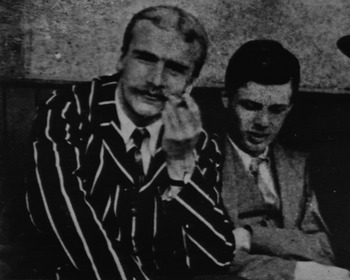
Leading British biotopians J.B.S. Haldane and Aldous Huxley at Oxford. (Courtesy: Cold Spring Harbor Laboratory Archives.)

Haldane's claim that scientific discoveries shaped new moral standards led him to take issue with Thomas Henry Huxley (grandfather of Aldous) for assuming that ‘traditional morals were sacrosanct and impregnable’ to the challenge of science; on the contrary, Haldane argued, ‘We must learn not to take traditional morals too seriously’.Footnote 108 Huxley senior had asserted that evolution epitomized the ‘cosmic process’, indifferent to human interests or goals, whereas ‘[s]ocial progress means a checking of the cosmic process at every step and the substitution for it of another, which may be called the ethical process’. Since nature really is red and tooth and claw, it contains no ethical guidance for us; thus Huxley argued that late Victorians must instead rely on traditional moral codes (including those drawn from Christianity). He asserted that ‘the ethical progress of society depends, not on imitating the cosmic process, still less in running away from it, but in combating it’, and the telling image he used to describe civilization was a garden hacked out of a wilderness.Footnote 109 By contrast, Haldane asserted that science could never accept any ‘unalterable moral tradition’. (He argued that only a religion whose ‘mythology and morals are provisional … would satisfy the scientific mind’, and added that it was ‘very doubtful’ whether such a faith ‘could properly be called a religion at all’.Footnote 110) The contrast with the quasi-religious celebration of Burbank is obvious; Haldane rejected any notion of natural morality, arguing instead that ethical standards must evolve as scientific knowledge did. Daedalus is a short book, epigrammatic in style, and Haldane did not devote much space to this topic, but he clearly did not endorse a simplistic version of the naturalistic fallacy (e.g. that we can be happy by simply following nature's laws), but nor does Daedalus endorse the kinds of traditional moral code that Huxley saw as a barrier to the heartless cosmic process.Footnote 111 Indeed, Haldane does not endorse any fixed moral code at all, only the idea that as science changes – and particularly as it changes us – our moral codes will be forced to change too.
Haldane left his readers with a rather chilling image of the ‘scientific worker of the future’ who, he predicted, would ‘more and more resemble the lonely figure of Daedalus as he becomes conscious of his ghastly mission, and proud of it’.Footnote 112 That pairing of ‘proud’ and ‘ghastly’ reaches deep into the uncomfortable heart of biotopianism. Over the previous few centuries, a central strand of traditional Christian thinking (particularly in the English-speaking world) had regarded nature as evidence of its divine Creator's limitless benevolence. Alternatively, some Enlightenment thinkers implied that Nature could provide an alternative to a traditional deity – a source of ‘good laws, of useful arts, of the sweetest pleasures and of happiness’, as one French Revolutionary put it.Footnote 113 In Huxley's view, Darwin had fatally undermined both these approaches, demolishing both God and a benevolent vision of Nature. All that was left was for us to create a little garden within which to preserve whatever ethical values we could accept.Footnote 114 However, Huxley's humanist garden was – he acknowledged – doomed to fail; the wilderness must ultimately win and he concluded that ‘the prospect of attaining untroubled happiness, or of a state which can, even remotely, deserve the title of perfection, appears to me to be as misleading an illusion as ever was dangled before the eyes of poor humanity’. For Huxley, there could be no utopia because, like many of his contemporaries, he assumed that the legacy of humans’ evolutionary struggles was that every person sought to maximize pleasure and minimize pain with no thought for the needs of society as a whole:
That is their inheritance (the reality at the bottom of the doctrine of original sin) from the long series of ancestors, human and semi-human and brutal, in whom the strength of this innate tendency to self-assertion was the condition of victory in the struggle for existence.
Humans must, of course, struggle against these innate tendencies as hard as they can, but Huxley argued they could not finally triumph ‘unless men's inheritance from the ancestors … their dose of original sin, is rooted out by some method at present unrevealed’.Footnote 115
Thomas Huxley's beliefs were largely built on orthodox Darwinian natural selection, which was more widely accepted in Britain than in the USA, and thus one factor that distinguishes British biotopianism from its American counterpart. For Huxley, as for most nineteenth-century thinkers, the prospect of removing our ‘dose of original sin’, that ‘innate tendency to self-assertion’, was impossible; natural selection relied on competitiveness and overabundant breeding – without them, all progress would stop. Like most Victorians (but, again, perhaps even more strongly in the old country of Britain) he tended to imagine heredity in terms of what humans brought with them out of the past; for a fortunate few, it was a valuable inheritance (land, a title or just a healthy constitution), but for many it was a burden (usually of debt or disease). However, this understanding began to change around the year 1900 as heredity was increasingly seen as a set of future possibilities rather than of past burdens, and the optimism of the dawning American century helped make this interpretation more widespread there.Footnote 116 Experimental evolution – which initially grew out of de Vries's mutation theory and Mendelism – offered the possibility of speeding up, improving and above all controlling the evolutionary process. Remaking nature meant, of course, that humans could no longer turn to it for guidance, but perhaps they would be able to finally root out that last trace of secularized original sin. Haldane clearly believed that, and so did Huxley's one-time pupil, H.G. Wells (at times, at least): in Men Like Gods, another of the Earthlings who objects to Utopia is Father Amerton, a Catholic priest who is ‘dreadfully outspoken about the sins of society and all that sort of thing’ and is condemned by Mr Barnstaple for embodying all that is ‘wrong and ugly and impossible in Catholic teaching’.Footnote 117 There is no organized religion in Wells's Utopia and no belief in original sin, even its secularized form. Since population is carefully regulated and managed, there is no need for struggle, and humanity's ‘innate tendency to self-assertion’ has apparently been ‘rooted out’. And, as we have seen, Gilman's Herlanders had made the same breakthrough.
Daedalus shocked many readers when it was first published, but it was widely reviewed. Many reviewers offered religious objections, not least because Haldane had called the scientific worker a deicide (in sharp contrast to the almost religious biotopianism embodied by Burbank). One writer on the Washington Post was appalled by Haldane's vision of a ‘dehumanized humanity’, ‘wholly mechanical, with love and religion outgrown’.Footnote 118 By contrast, the New York Times commented that he proposed the remodelling ‘not of life's paraphernalia, but of life itself’, and enthusiastically recommended a book it believed would ‘send off the thoughts of the average educated layman into entirely new directions’.Footnote 119 In Britain, the authoritative scientific weekly Nature argued that Haldane ‘is right’ to suggest that ‘we are on the verge of scores of new inventions of a biological nature’, and predicted that readers would find in Daedalus ‘not only entertainment but also food for much thought’.Footnote 120 Many readers of such reviews would have assumed that the biologically inspired future predicted by Haldane was – for good or ill – both possible and imminent.
Conclusion
Daedalus was a sensation, selling fifteen thousand copies in its first year, and its success prompted other scientists to try their hand at prophecy.Footnote 121 Just three years later, Haldane's fellow Cambridge academic, John Desmond Bernal, produced The World, the Flesh and the Devil: An Inquiry into the Future of the Three Enemies of the Rational Soul, which was inspired by (and shared many themes with) Daedalus.Footnote 122 Similar ideas emerged in Out of the Night, by the US geneticist Hermann J. Muller, which featured a prominent promotional blurb from Haldane, describing Muller as ‘one of the world's leading biologists’, and adding that ‘his proposals, whether or not they are desirable, are entirely practicable. If they are adopted, the results will be as important as those of the industrial revolution’.Footnote 123 By the early 1930s, the claim that biology would reshape humanity and its world was both widespread and credible. Overt fictions were produced in parallel to these serious, prophetic works and they shared common elements; as we have seen, Howard Shinn referred to work like Luther Burbank's as embodying the ‘marvellous gospel of plant-evolution’, and also reviewed Wells's Men Like Gods, commenting that it offered solutions to ‘living problems which we must solve if we would salvage our civilization’.Footnote 124 The latter comment could just as easily have been referring to Burbank, illustrating the rich web of connections between apparently very different genres of writing.
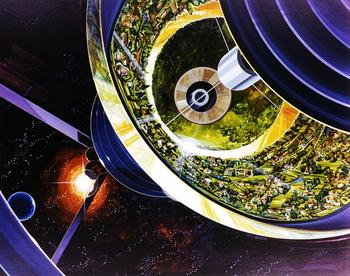
J.D. Bernal's prophetic fiction The World, the Flesh and the Devil (1929) forecast that humans would be biologically modified so that they could live in space colonies created from hollowed-out asteroids. Half a century later, space colony studies were conducted by NASA and artists were invited to imagine such colonies. The image shows a cutaway view of a Bernal sphere by Rick Guidice, and illustrates another aspect of the lasting influence of the biotopians. (Courtesy: NASA Ames Research Center.)

However, Shinn's reference to the problems that threatened civilization is a reminder that a sense of biological crisis was at least as widespread as the optimism that has been analysed here. The secularized version of original sin that motivated various forms of the Malthusian fear reached a crescendo in the decades around the year 1900, as diffuse but pervasive fears of degeneration became increasingly widespread.Footnote 125 The most common form was the fear that what Thomas Huxley had called ‘the cosmic process’ (natural selection) had been softened by the ‘ethical process’ of civilization, allowing the weaker members of society to survive and breed, indeed to breed more prolifically than their supposed betters, leading to a sharp (perhaps terminal) decline in human intelligence and morals. The most popular response to this fear was, of course, eugenics, the catch-all title for various schemes to selectively breed human beings that was typically divided into negative eugenics (reducing the reproduction of the unfit) and positive schemes to encourage the allegedly superior to breed faster. Eugenics and biotopianism were, to varying degrees, both indebted to recent biological science and their concerns and goals intersected in various ways. For example, Haldane explicitly saw ectogenesis as sharing the goals of eugenics, but as providing a more effective means of achieving them (as did Muller's eutelegenesis in Out of the Night). Positive eugenics had a popular appeal that clearly overlapped with that of biotopianism (for example, Burbank's Training of the Human Plant espoused his own, typically idiosyncratic, version of eugenics focused on child rearing).Footnote 126 In its more biotopian mode, eugenics offered the chance to help make better people, whereas negative eugenics was more often linked to the earlier sense of heredity as a burden from the past that needed to be eliminated. (A fuller understanding of these connections might produce a more sophisticated understanding of the popular appeal of eugenics, particularly among women, in these decades; the topic requires too much space to be discussed here and will be treated in a forthcoming book on biotopia.)
The overlap between eugenics and biotopianism was also apparent in many American and British biology textbooks, which culminated in The Science of Life, a massive (and hugely popular) textbook that appeared first in serial form, as a series of magazines with attractive colour covers, and then as a book that was widely reviewed and sold well on both sides of the Atlantic.Footnote 127 It ended with an optimistic section called ‘Life under control’, in which the three authors (H.G. Wells, his son G.P. Wells, and Julian Huxley, brother of Aldous) assured their readers that ‘our species will survive and triumph over its present perplexities’, as long as ‘Man’ was willing to ‘take control not only of his own destinies but of the whole of life’. The ‘clumsy expedients of the old-time animal and plant breeder’ would be ‘replaced by more assured and swifter and more effective methods’. There was a clear echo of the utopian ideals of Wells's earlier Men Like Gods, when The Science of Life assured its readers that ‘every species of plant and animal man may judge, whether it is to be fostered, improved or eliminated. No species is likely to remain unmodified’. As a result, ‘the wilderness’ would become ‘a world-garden’. The image of the garden remained the most potent embodiment of biology's hopes and was a reminder that gardening is a creative art, as well as a practical one; Wells and his co-authors suggested that once humans had learned to manipulate the germ plasm of plants, animals and people directly, man would master ‘a new art, with living protoplasm as his medium’. The book ended on a biotopian crescendo, that (to borrow Wells's earlier famous phrase) hurled humanity into futurity:
these mightier experiences and joys of the race to come will be in a sense ours, they will be the consequence and fulfilment of our own joys and experiences, and a part, as we are a part, of the conscious growth of life, for which no man can certainly foretell either a limit or an end.Footnote 128
The varied nature of the network of texts analysed here shows that to fully understand science's cultural impact and its historical significance we have to look beyond the lab and the conventionally defined scientific world. The history of twentieth-century biology, in particular, is often tightly focused on the technicalities of theory and practice –and thus on science's ideas, institutions and individuals. As a result, it tends to overlook the interpreters of science, yet I would argue that scientific facts and theories are of very limited interest to historians until they leave the lab and are interpreted for wider publics; this is when they take flight and become part of society's wider conversations. The historiography of public science in the twentieth century is still rather dominated by the unhelpful assumption that such science is merely ‘popularized’ – diluted, misunderstood and oversimplified – and that it seeps out into the public mind through a passive process of diffusion. The many careers of experimental evolution reveal a very different kind of story, whose tellers appropriated whatever bits of science they found useful and adapted them to new and unexpected ends. Conventional historians of biology might dismiss these imaginative interpretations as mistakes, part of the catalogue of errors that today's scientists constantly battle to eradicate from the public's mind, but their historical importance is indisputable when we examine biotopianism's lasting influence.
The biotopian tradition reached its peak in the early 1930s; although its echoes are apparent whenever the public grapples with biology's implications, the optimism and excitement of these early decades would never be recaptured. There are complex reasons for this, which need fuller analysis, but there is little doubt that the depression, mass unemployment and the rise of both fascism and Stalinism blunted the optimism that was characteristic of the century's early decades. Changes within biology were also important: as I have argued elsewhere, de Vries's mutation theory held the wider public's interest long after biologists had largely abandoned it.Footnote 129 (And it has continued to exercise an influence over popular culture: the successful movie franchise X-Men (2000–), is just one of several examples of the way in which the de Vriesian sense of mutation, a new species in a single, optimistic jump, has persisted.) Nevertheless, one important aspect of biotopianism was the apparent practicality of creating a utopian garden, and of doing so rapidly – and the original meaning of mutation was central to that. During the 1920s and 1930s, geneticists gradually redefined mutation to mean genetic changes that could be small and were often deleterious; even though these new definitions spread slowly and unevenly (especially to non-scientists), the early excitement engendered by de Vries's theory gradually faded. As Luis Campos and Helen Curry have shown, new approaches to modifying plants and animals developed, using mutagenic chemicals, such as colchicine, and radioactive materials, such as radium.Footnote 130 These new techniques allowed biotopianism to persist into the 1930s and beyond, but as the geneticists’ new understanding of mutation spread, the hopes of speeding up and controlling evolution gradually faded, and – of course – radioactivity began to acquire less positive associations after the Second World War.
Brave New World (1932) might be called the last biotopia, but its well-deserved fame has somewhat overshadowed the complex web of texts out of which Aldous Huxley's novel grew and with which it is effectively in dialogue.Footnote 131 For example, Brave New World is, amongst other things, an Englishman's reaction to the spectacle of modern America; it satirizes its excesses but is also unwillingly entranced by this sexy world of technological and biological innovation. A key topic that I will return to in future is the differences between Britain and America, which are central both to Huxley's novel and to the nature and fate of biotopianism, but even from this brief, preliminary discussion, it is evident that there were important contrasts between Britain's and America's different faiths – in God, evolution and progress. And America's vision of itself as a new, growing country whose best years lay ahead of it also contrasted sharply with Britain, where in 1900 the London Times told its readers, ‘An Empire such as ours requires as its first condition an Imperial Race – a race vigorous and industrious and intrepid … The survival of the fittest is an absolute truth in the modern world’.Footnote 132 Britain's near defeat during the Boer War left many Britons doubting their fitness and the emergence of a shell-shocked generation after the First World War reinforced these doubts, while the USA emerged stronger than ever, confident that it had saved the old countries of Europe from chaos.
A fuller analysis of the sources to which Brave New World was indebted recaptures their original context and is important because the biotopian mode continues to shape the ways in which we talk, write and think about biology's likely impact on the future. An obvious example is that Brave New World is invariably referred to whenever some new breakthrough in genetics is announced (when it is usually interpreted as unmistakably dystopian, despite being as ambiguous as any of the texts analysed here). And the promise of new crops, blooming deserts and an end to hunger remain the stock-in-trade of today's biotechnology companies; despite the changes over the twentieth century, we are still living with the biotopians’ legacy. However, the interpretation of Brave New World as a straightforward dystopia may partly be explained by the fact that when molecular biology reawakened biotopian hopes, it was in a very different post-war atmosphere, after a sea change in public attitudes had severely eroded public confidence and trust in science.Footnote 133 It was much harder to have ‘faith in evolution’, or in the idea of scientists directing it. Yet despite this, the biotopian vision of a post-natural garden persisted, for example in novels such as Marge Piercy's Woman on the Edge of Time (1976), in which ectogenesis is used to create a ‘perverse’ but liberating re-engineering of gender roles (including men who breastfeed), or in the film Silent Running (1972), which concludes with a stunning image of an artificial Garden of Eden, a post-human paradise, cleansed of sin (and of humans; the artificial robot life we have created having succeeded us). In the twenty-first century, re-examining the complex and contradictory legacy of biotopianism might help us think more clearly about our ecological responsibilities. Instead of pretending to be preserving a mythical ‘nature’, we should perhaps be asking ourselves what kinds of gardeners we want to be.