Introduction
Over the past 30 years, the frequency of disasters has increased, driven by environmental degradation, poverty, and climate change. These events have claimed millions of lives and displaced billions.Reference Farah, Pavlova and Groot1 Disasters are complex and inevitable events that disrupt multiple sectors of society, including health, infrastructure, politics, and economics. These events often overwhelm the ability of affected communities to respond effectively, while also posing significant challenges to individuals, families, and communities by impacting both physical health and mental well-being.2, Reference Makwana3 Nurses are often the first health care professionals to arrival at the scene, providing immediate medical care to those injured or affected by a disaster. Their ability to assess and treat a wide range of medical conditions is crucial in such situations. In addition to clinical assessment, nurses play a key role in resource allocation, communication, and ethical decision-making in high-stress environments.Reference Faheim, Ahmed, Aly and Hegazy4
In countries highly prone to disasters, it is essential that nurses possess the knowledge, skills, and personal resilience required to effectively manage mass casualty incidents (MCIs).Reference Cui and Shaw5, Reference Christian6 Effective MCIs management extends beyond clinical professionals to include resource coordination, clear communication, strong leadership, and meticulous logistical planning. Accurate triage constitutes a fundamental component of comprehensive incident management. Rapid and efficient triage remains crucial in saving lives and optimizing resource allocation when disasters occur. Triage is a systematic process used to prioritize victims based on the urgency of medical intervention, ensuring that medical resources are used effectively and efficiently.Reference Al Dhefeeri, Aldhafeeri and Alsharari7, Reference Bazyar, Farrokhi and Khankeh8 Common triage systems in MCIs are designed to quickly categorize patients based on the severity of their injuries to prioritize treatment. Simple Triage and Rapid Treatment (START) and Sort, Assess, Lifesaving interventions, Treatment/transport (SALT) are the 2 widely used systems. Both are essential for prioritizing the most critical patients, ensuring efficient use of available resources in situations where demand exceeds the capacity of health care facilities.Reference Bazyar, Farrokhi and Khankeh8
Nurses with strong knowledge, skills, and resilience for disasters are better equipped to respond effectively, thereby reducing mortality and improving patient outcomes.Reference Khorram-Manesh, Nordling, Carlström, Goniewicz, Faccincani and Burkle9, Reference Singh, Lamine, Sapkota, Bahattab and Eriksson10 Without proper training, nurses may struggle with critical decisions, resulting in delays and increased casualties.Reference Reinhardt11 Indonesia, one of the most disaster-prone countries globally, suffers a disproportionate impact due to its location within the Pacific Ring of Fire.12–Reference Setyawati, Lu, Liu and Liang15 This makes the region highly vulnerable to earthquakes, floods, volcanic eruptions, and tsunamis.Reference Cui and Shaw5 Research has shown a potential link between insufficient education and training in disaster preparedness and a lack of competency in managing disasters among health care professionals.Reference Chiang, Ting, Chao and Chen16, Reference Said and Chiang17 Despite the importance of disaster education and training, the lack of systematic, theory-driven triage training further exacerbates this challenge.Reference Singh, Lamine, Sapkota, Bahattab and Eriksson10 Therefore, this study aims to develop a triage training program and assess its effectiveness in enhancing knowledge, skills, and resilience in managing MCIs among nurses in Indonesia. The research findings will provide valuable insights for designing disaster education and training within clinical health care systems.
Materials and Methods
Study Design
A randomized controlled trial was conducted with nurses at two government hospitals in Bengkulu Province, Indonesia. Eligible participants were randomly assigned in a 1:1 ratio to either the experimental or control group. This study was reported in accordance with the Consolidated Standards of Reporting Trials (CONSORT) guidelines.Reference Hopewell, Chan and Collins18
Study Setting and Participants
The study was conducted from September 1, 2024, to October 30, 2024. Registered nurses were recruited based on the following inclusion criteria: at least six months of work experience, a diploma degree, literacy in Bahasa Indonesia, and consent to participate. Head nurses, team leaders, supervisors, and those unwilling to participate were excluded from the study. The sample size was calculated using G*Power analysis, with an effect size of 0.25, α set at 0.05, and a power of 0.80.Reference Faul, Erdfelder, Buchner and Lang19, Reference Faul, Erdfelder, Lang and Buchner20 Accounting for a 20% dropout rate, the target sample size was 104 participants.
Development of the Triage Training Program
The triage training program for MCIs was developed using the Analysis, Design, Development, Implementation, and Evaluation (ADDIE) model and is aligned with the International Council of Nurses (ICN) Framework. The ADDIE model is a systematic instructional design framework widely used to develop educational and training programs.Reference Noh, Oh, Kim, Jang, Chung and Lee21 The ICN Framework for Disaster Nursing (version 2.0) provides a structured approach for nurses to develop the knowledge, skills, and attitudes necessary to effectively manage and respond to disasters.2 These approaches ensure the triage training program is well-structured, evidence-based, consistent, and effective, ultimately enhancing better learning outcomes. For the needs assessment, disaster agency trainers from Indonesia’s Regional Disaster Agency, along with disaster nursing experts and nursing managers, were invited to provide insights to tailor the training to the specific needs of hospital nurses. The training curriculum and content were developed to cover key concepts, topics, and skills. The program consisted of 3 main topics over 4 hours: Preparation and Planning, Communication, and Incident Management (30 mins); Safety and Security (30 mins); and Assessment and Intervention (3 hours). The teaching strategies and activities included lectures, quizzes, group discussions, demonstrations, and scenario-based practice, with a specially focus on dealing with floods and earthquakes. Teaching materials, such as lesson plans, handouts, quizzes, and simulation exercises, were created to reinforce learning. The detail content of the training program, along with the learning objectives tailored to the needs of the target audience and measurable criteria to assess learner performance and program success, is presented in Table 1.
Disaster triage training for MCIs for this study

Note: DM: Disaster management; MCIs: mass casualty incidents; START: Simple Triage and Rapid Treatment.
Validation of the Triage Training Program
The validation process resulted in several refinements to the training program. Feedback from multidisciplinary experts helped improve content, delivery methods, and overall quality. Pilot testing with 10 nurses led to revisions that better addressed learner needs, while interviews confirmed the program’s effectiveness and guided further adjustments. Together, these changes strengthened the program’s credibility, applicability, and its ability to enhance nurses’ triage knowledge, skills, and resilience in disaster situations.
Data Collection
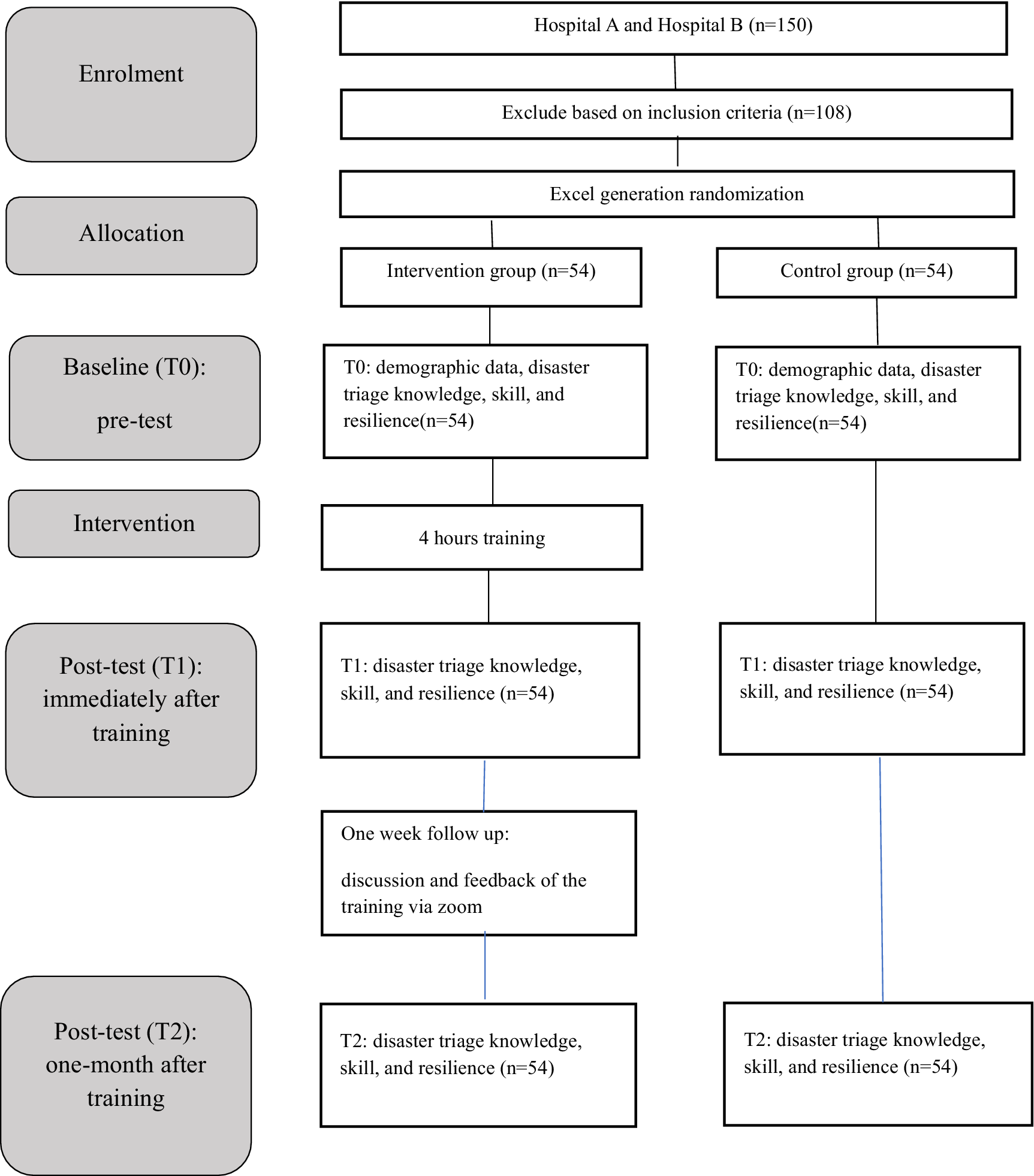
Of 150 participants, 108 met inclusion criteria and were individually informed about the study’s purpose, procedures, and their right to withdraw at any time. After providing the written consent, participants were randomly assigned to either the control or experimental group using a random number generator in Microsoft Excel, with 54 participants in each group. During the baseline evaluation, a basic information sheet was used to collect demographic data and work-related variables, including age, gender, marital status, education level, work experience, position, and disaster training experience. This information was collected to identify potential confounders and minimize research bias. The Disaster Triage Knowledge Scale (DTKS), Disaster Triage Skill Scale (DTSS), and Resilience Evaluation Scale (RES) were assessed at 3 time points: before training (T0), immediately after training (T1), and 1 month post-training (T2). Data were collected via WhatsApp and Google Forms. The flow chart of data collection for this study is presented in Figure 1. The content validity of all measurements was evaluated by 5 experts (2 nurse lecturers, 1 nursing manager, and 2 disaster trainers) using the Content Validity Index (CVI), yielding a perfect score of 1. After the training, 20 participants from the experimental group were invited to join a focus group via Zoom to provide qualitative feedback on the program. This feedback offered valuable insights for the future design of the training program.
Flow chart for data collection.

Outcome measurements
To assess the effectiveness of the disaster triage training program, tailored metrics encompassing disaster triage knowledge, disaster triage skills, and resilience in disaster contexts.
Disaster Triage Knowledge Scale (DTKS): The research team developed the Disaster Triage Knowledge Scale (DTKS) to evaluate nurses’ knowledge of disaster triage. The scale comprises 20 items covering key domains: (1) principles and objectives of triage in MCIs; (2) the START and Jump START triage systems; (3) triage categories (Immediate, Delayed, Minor, Expectant); (4) assessment criteria, including respirations, perfusion, and mental status (RPM); (5) communication and documentation practices (e.g., triage tags and acronyms such as Mechanism of injury, Injuries sustained, Signs and symptoms, and Treatment given[MIST]and Rapid Assessment of Pediatric Injury Data[RAPID]); and (6) essential equipment for disaster triage. Each item is scored dichotomously (1 point for a correct response, 0 for an incorrect response), yielding a total score range of 0-20, with higher scores reflecting greater knowledge. The reliability of the scale was confirmed through a pilot test with 30 nurses, yielding a Cronbach’s alpha of 0.84, and a Cronbach’s alpha of 0.81 in the formal study with 108 nurses.
Disaster Triage Skill Scale (DTSS): The scale consists of 10 case-based multiple-choice items derived from disaster scenarios such as earthquakes and floods. Each case provides patient information—including vital signs, injuries, and environmental conditions—requiring nurses to make rapid decisions regarding triage categorization, prioritization, and initial interventions. The content domains assessed are: (1) assignment of triage categories (Immediate/Red, Delayed/Yellow, Minor/Green, Expectant/Black); (2) application of the START triage method; (3) prioritization of interventions in MCIs; (4) interprofessional communications; (5) selection of appropriate immediate management actions. Items are scored dichotomously (1 = correct, 0 = incorrect), producing a total score ranging from 0 to 10, with higher scores reflecting greater competence in disaster triage. The reliability of the scale was confirmed with a Cronbach’s alpha of 0.81 in the pilot test and 0.82 in the formal study.
Resilience Evaluation Scale (RES): This scale, developed by Primasari et al., assessed nurses’ resilience to disasters.Reference Primasari, Hoeboer, Bakker and Olff22 It consists of 9 items, rated on a 5-point Likert scale (1-5), with a total score of 45. A higher score indicates a greater level of resilience. The RES demonstrated good internal consistency (Cronbach’s alpha = 0.82) and test-retest reliability (r = 0.76).Reference Primasari, Hoeboer, Bakker and Olff22 The reliability of the scale was confirmed with a Cronbach’s alpha of 0.87 in the pilot test and 0.83 in the formal study.
Ethical Considerations
This study was approved by the Institutional Review Board at Health Polytechnic of the Ministry of Health, Bengkulu (IRB No. KEPK.BKL/629/08/2024). Participants were provided with detailed information about the study’s purpose and significance. Prior to data collection, written consent form was obtained from all participants. They were assured that their data would be securely collected and kept confidential, and exclusively for academic research purposes. Each participant received Rp 50,000 upon completion of the study. After collecting post-test data from both groups, the researcher offered the training program to the control group to ensure the ethical integrity of the study.
Data Analysis
The data were analyzed using SPSS software version 29. Independent sample t-test and chi-square tests were employed to assess differences between groups in demographic and work-related variables. A Generalized Estimating Equation (GEE) model was applied to control for the effects of study covariates and to analyze the independent effects of the training program on disaster knowledge, skills, and resilience. A P-value <.05 (two-tailed) was considered statistically significant.
Results
Participants’ Characteristics
Out of 150 participants initially approached, 42 were excluded for not meeting the inclusion criteria. As a result, 108 participants were included in the study, with 54 assigned to the control group and 54 to the experimental group. The mean age of the participants was 33.88 + 6.91 years. The majority of participants were male (70.4%) and Muslim (95.4%). Significant differences in age, religion, work experiences, and job position were observed between the control and experimental groups (P <.05; Table 2).
Differences in participants’ demographics and work-related variables between groups (N = 108)

Note: *P <.05, ***P <.001
Effects on Disaster Knowledge, Skills, and Resilience
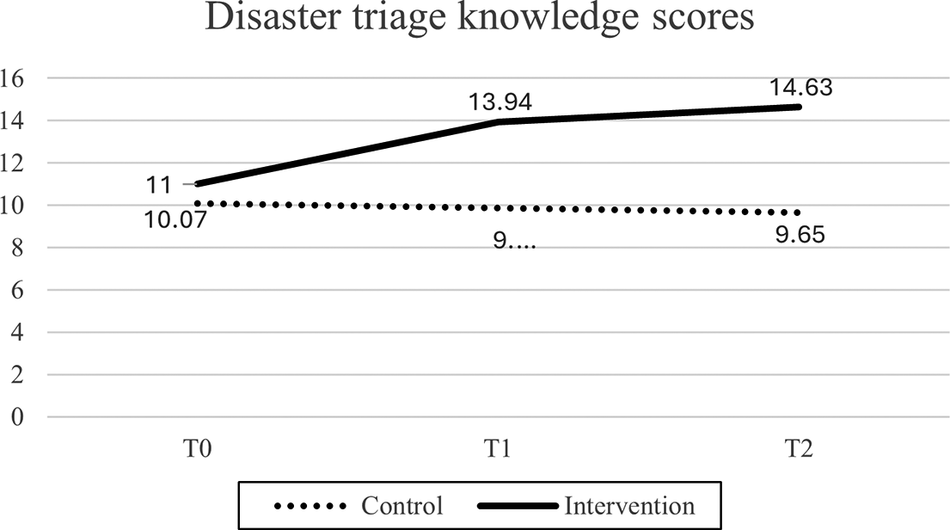
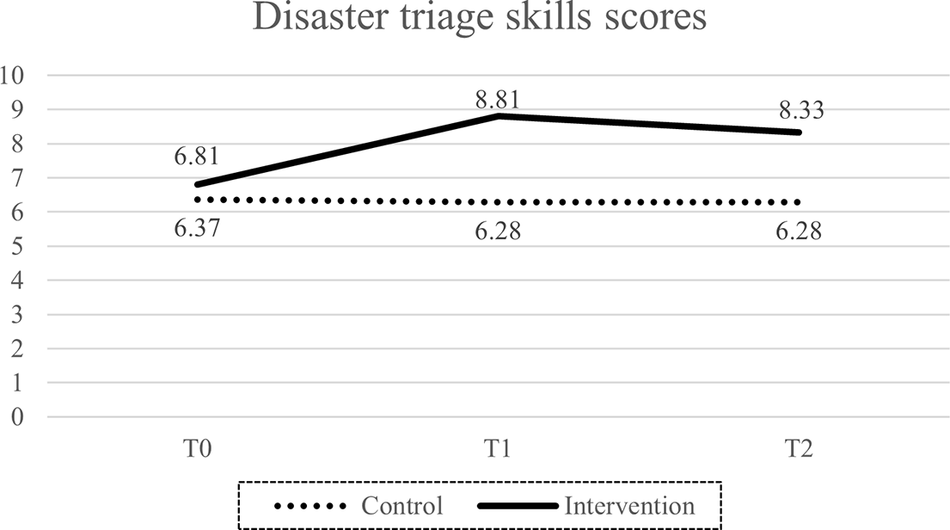
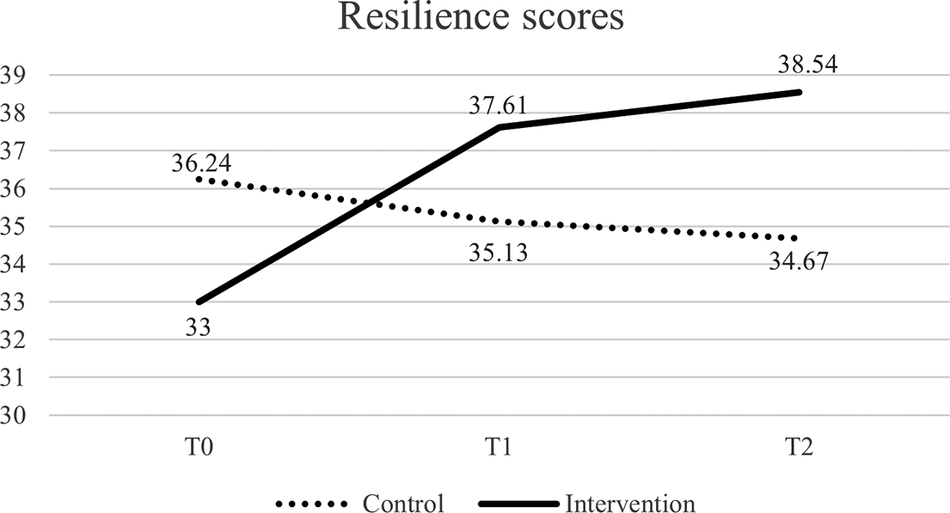
Table 3 presents the descriptive results of DTKS, DTSS, and RES scores at different observation time points across the 2 groups. The experimental group’s mean DTKS scores were 11.0 ± 2.57 at T0, 13.94 ± 2.28 at T1, and 14.63 ± 2.89 at T2. Their mean DTSS scores were 6.81 ± 2.39 at T0, 8.81 ± 1.39 at T1, and 8.33 ± 1.47 at T2. For RES, the group scored 33.00 ± 6.94 at T0, 37.61 ± 4.71 at T1, and 38.54 ± 4.68 at T2. In contrast, the control group’s mean DTKS scores were 10.07 ± 3.20 at T0, 9.87 ± 2.94 at T1, and 9.65 ± 2.84 at T2. Their DTSS scores were 6.37 ± 2.53 at T0, 6.28 ± 2.21 at T1, and 6.28 ± 2.23 at T2. For RES, they scored 36.24 ± 6.39 at T0, 35.13 ± 5.64 at T1, and 34.67 ± 5.30 at T2. Independent t-tests revealed that, following the intervention, the experimental group achieved significantly higher mean scores in DTKS, DTSS, and RES compared with the control group at both T1 (t = –2.48 to –8.05) and T2 (t = –4.02 to –9.02), with all differences reaching statistical significance (P <.05; Figures 2-4). Considering the effects of covariates (age, religion, work experiences, and job position), the GEE analysis confirmed that scores on the DTKS (β = 3.14~4.05***), DTSS (β = 2.09~1.61***), and RES (β = 5.72~7.11***) were significantly higher in the experimental group compared to the control group at both the T1 and T2 observation time points, after controlling for covariances (Table 4).
Participants’ disaster triage knowledge, skills, and resilience at different observation time points (N = 108)

Note: T0 = pre-test, T1 = post-test immediately after training, T2 = post-test 1 month after training, **P <.01, ***P <.001
Changes in disaster triage knowledge scores for different obsecration time points. T0: pre-test; T1: post-test immediately after training; T2: post-test 1 month after training.

Changes in disaster triage skills scosres for different obsecration time points. T0: pre-test; T1: post-test immediately after training; T2: post-test 1 month after training.

Changes in resilience scores for different obsecration time points. T0: pre-test; T1: post-test immediately after training; T2: post-test 1 month after training.

Generalized Estimating Equations (GEE) examining the effects of disaster triage training on outcome variables (N = 108)

Note: T0: pre-test; T1: post-test immediately after training; T2: post-test 1 month after training. **P <.01, ***P <.001; Group*Time = interaction effect of group (experimental vs. control) and measurement time points.
Discussion
Continuous on-the-job disaster training is essential for nurses’ professional growth, enabling them to acquire new knowledge, skills, and personal resilience. This ongoing development is crucial for responding effectively to disasters, ultimately reducing mortality and improving patient outcomes. Studies have shown that training should be designed to meet the specific needs of nurses’ roles and responsibilities, equipping them with the necessary knowledge and skills to perform their duties effectively.Reference Khorram-Manesh, Nordling, Carlström, Goniewicz, Faccincani and Burkle9 This study aimed to develop a disaster triage training program and assess the effectiveness of knowledge, skills, and personal resilience in managing MCIs among hospital nurses in Indonesia.
The triage training program developed in this study demonstrates several strengths. First, it is grounded in solid theoretical foundations, incorporating the ADDIE framework and the ICN Framework, ensuring that the program is both evidence-based and highly relevant to real-world applications.2, Reference Noh, Oh, Kim, Jang, Chung and Lee21, Reference Bell and Bell23, Reference Munna and Kalam24 Second, a variety of innovative teaching strategies are employed to effectively deliver the content. These activities enable nurses to practice their skills, thereby boosting both their confidence and competence in handling MCIs. Additionally, the program is thoughtfully structured to address the specific needs of nurses, bridging the gap between academic knowledge and its real-world application in disaster scenarios, making it highly effective in preparing nurses for disaster triage.Reference Brinjee, Al Thobaity, Almalki and Alahmari25–Reference Watson, Drake and Anderson28
The results of this study demonstrated that the implementation of the disaster triage training program effectively enhanced nurses’ knowledge, skills, and resilience, leading to improved disaster preparedness and response in health care settings. The findings of this study are consistent with previous reports, suggesting that structured training programs improve knowledge, skills, and personal resilience.Reference Bhatia, Singh, Giri and Sahoo29 The training program in this study specifically focuses on local disaster scenarios, such as earthquakes and floods, incorporating role-playing and case studies, which contributed to improve knowledge acquisition and disaster preparedness.Reference Farra, Smith and Bashaw30–Reference Goniewicz, Khorram-Manesh, Timler, Al-Wathinani and Goniewicz32
Disaster triage is complex and demands quick, accurate decision-making. The hands-on nature of the training in this study, aligned with Kolb’s Experiential Learning Theory, played a crucial role in skill acquisition by reinforcing active, practical learning.Reference Haritha and Rao33, Reference Kolb34 The training program in this study significantly enhanced nurses’ skills, aligning with the findings of Yang and Kim, where nurses who participated in an educational program showed improved problem-solving abilities and strategic thinking in disaster triage.Reference Yang and Kim35 Furthermore, the findings of this study support previous research highlighting the effectiveness of simulation-based training in high-pressure environments.Reference Smith, Farra and Hodgson27, Reference Kim and Choi36 Skills-based training not only improves learner’s knowledge retention but also boosts confidence in real-life applications.Reference Gros37, Reference Madani, Bahramnejad, Farsi, Alizadeh and Azizi38
Psychological training through simulated disaster scenarios helped nurses develop effective coping strategies, enhancing their emotional regulation and resilience in a realistic yet controlled environment. Studies suggest that hands-on engagement in high-stress situations enables individuals to practice and strengthen their adaptive responses, ultimately improving their ability to manage stress.Reference Tint, McWaters and Raymond39 Additionally, team-based training fostered social support, a crucial factor in resilience and stress reduction.Reference Albott, Wozniak, McGlinch, Wall, Gold and Vinogradov40 This combination of practical experience and social reinforcement likely contributed to the observed improvements in resilience among nurses in the experimental group in this study.
A post-training focus group conducted via Zoom revealed that the trained nurses valued hands-on simulations and e-learning resources and facilitated the application of theoretical knowledge to realistic disaster scenarios. They recommended expanding the range of triage cases, injury severities, disaster phases, and reassessment techniques to further strengthen decision-making skills. Their emphasis on practical training reflects global trends in disaster medicine, where continuous, scenario-based exercises are critical to sustaining competency and critical thinking under pressure.
In contrast, the control group showed declines in knowledge, skills, and resilience, possibly due to reduced confidence after observing the progress of their peers without receiving complementary training. The GEE model appropriately captured these temporal group differences. Religion and job position also influenced resilience, highlighting the role of personal coping resources and workplace hierarchies.Reference Pouraghaei, Sadegh Tabrizi, Moharamzadeh, Rajaei Ghafori, Rahmani and Najafi Mirfakhraei41 Focus group discussions further reinforced the experimental group’s capabilities through shared support, while indirectly disadvantaging the control group.Reference Kalanlar and Akkaya42 These findings suggest that ongoing triage education may be more effective than relying solely on baseline training. Although the generalizability of the findings may be limited by the sample size, the results support incorporating disaster triage training as a standard component of nursing education. Future research should compare innovative and traditional training approaches to determine the most effective strategies for developing and sustaining disaster response competencies.
Limitations
This study has several limitations, including being conducted in only 2 governmental hospitals from the same region with a limited sample size, which may affect its generalizability. The follow-up assessment was conducted just 1 month after the training, lacking a long-term evaluation of the program’s effectiveness. Additionally, this study could not assess how trained nurses perform in actual emergency events. To address these limitations, future research should involve larger sample sizes across multiple regions, incorporate longer follow-up periods to evaluate sustained effects, and examine nurses’ performance in real disaster situations to better assess the program’s real-world applicability. In particular, longitudinal follow-up would provide valuable insights into the durability of training effects and help determine the optimal frequency of refresher sessions. Such studies could track changes in resilience, knowledge, and decision-making performance over time, thereby informing evidence-based recommendations for integrating disaster triage training into nursing education and practice.
Conclusions
This study confirms that a well-designed, needs-based, and multidisciplinary disaster triage training program, grounded in a solid theoretical foundation, can effectively enhance nurses’ knowledge, skills, and resilience. Regular disaster education and training should be implemented in clinical health care systems. Additionally, assessing the roles, responsibilities, and abilities of nurses in disaster preparedness and emergency response is critical for strengthening the nation’s capacity to plan for and respond to such events.
Acknowledgments
This study was made possible through the invaluable support of our collaborators—the National Disaster Agency, Dr. M. Yunus Hospital, and Bhayangkara Hospital in Bengkulu, Indonesia—whose contributions to coordination and contextualization were essential and are deeply appreciated. We also extend our sincere gratitude to all the nurses who generously participated in this study.
Author contribution
ADS conceived this study, conducted data collection, and drafted the manuscript. YYL provided supervision and contributed to manuscript revisions. SFW and SYL performed a critical appraisal of the manuscript. All authors reviewed and approved the final version of the manuscript.
Funding statement
The authors stated they received no financial support from any institution or publisher for this research study.
Competing interests
The authors declared no conflicts of interest, authorship disputes, or competing interests related to this article.
Ethical standard
This study was approved by the Institutional Review Board at Health Polytechnic of the Ministry of Health, Bengkulu (IRB No. KEPK.BKL/629/08/2024).