Advances in cardiac surgery and early diagnosis have been considerably raising the life expectancy of children and adolescents with congenital heart disease. In face of this new context, the evaluation of health-related quality of life is gaining more attention as an important health outcome in all age groups among this population.
In childhood and adolescence, there is evidence that the presence of congenital heart disease can affect physical and weight development, as well as motor, cognitive, and neurological functioning.Reference Huber, Peres and Santos 1 , Reference Marino, Lipkin and Newburger 2 There is also a higher incidence of academic difficulties, behavioural problems, speech delays, hyperactivity, and attention deficits in patients with complex congenital heart disease.Reference Wernovsky 3 , Reference Shillingford, Glanzman and Ittenbach 4 Besides these clinical evidence, the need for continuous medical monitoring and recurrent hospitalisations can affect the self-esteem and self-image of these children and lead to delays in completing the tasks of normal development,Reference Sable, Foster and Uzark 5 which may possibly affect their quality of life.
Current research on the evaluation of health-related quality of life in children and adolescents with congenital heart disease has presented conflicting results, possibly owing to the lack of methodological and conceptual rigour.Reference Moons, Van Deyk, Budts and De Geest 6 However, it is possible to affirm that a major part of these studies have found a lower level of health-related quality of life among children and adolescents with congenital heart disease when compared with healthy controls,Reference Janiec, Werner, Sieminska and Ravens-Sieberer 7 – Reference Tahirović, Begić, Tahirović and Varni 12 in dimensions such as Physical Well-Being,Reference Janiec, Werner, Sieminska and Ravens-Sieberer 7 autonomy, motor functioning and social and emotional functioning,Reference Landolt, Valsangiacomo Buechel and Latal 10 depressive symptoms, and psychological adjustment.Reference Miatton, De Wolf, François, Thiery and Vingerhoets 13 , Reference Latal, Helfricht, Fischer, Bauersfeld and Landolt 14 In contrast, other studies have shown that adolescents with congenital heart disease have an equal or higher health-related quality of life than healthy norms,Reference Teixeira, Coelho and Proença 15 – Reference Kwon, Mussatto, Simpson, Brosig, Nugent and Samyn 17 especially when they have a good social support network and parental support.
Although many patients with congenital heart disease acquire a stable health condition, part of them remain with residual defects and sequels during adult life. Children and adolescents with complex congenital heart disease with signs of cyanosis, residual lesions, and who have gone through invasive procedures present an inferior level of health-related quality of life than those with mild congenital heart disease, according to some authors,Reference Uzark, Jones, Slusher, Limbers, Burwinkle and Varni 9 , Reference Silva, Vaz and Areias 18 whereas other studies have not found any association between health-related quality of life and the severity of congenital heart disease.Reference Krol, Grootenhuis and Destrée-Vonk 8 , Reference Spijkerboer, Utens, De Koning, Bogers, Helbing and Verhulst 11
The present study aims to evaluate the health-related quality of life of adolescents with congenital heart disease, describing quality of life according to the diagnosis and severity of congenital heart disease, identified by clinical variables such as the presence of symptoms, surgical interventions, and medication use, among others. The evaluation of health-related quality of life in adolescents with congenital heart disease helps to detect groups at risk and provides valuable information for the elaboration of intervention strategies focused on their health needs.
Methods
A contemporary cross-sectional study was conducted on 203 adolescents with congenital heart disease attended at the Pediatric Cardiology ambulatory of a reference hospital in the south region of Brazil. The study obtained the approval of the Research Ethics Committee of this institution. The adolescents were invited to participate and were previously informed about the ethical aspects and the objectives of the study, before agreement and signature of the consent form. The authorisation and signature of the parent or adult accompanying the adolescent was necessary.
Adolescents with congenital heart disease from 10 to 18 years of age, literates, and accompanied by parents or guardians were included in the study. Adolescents with other organic or congenital syndromes, developmental disorders, and severe difficulties in reading that could impair the comprehension of the instrument were excluded from the sample. The decision to not use a control group was related to the objective of the study, which was to evaluate the impact of different diagnoses of congenital heart disease among this specific sample of adolescents.
Data collection was carried out by three researchers trained for the method, from March, 2011 to March, 2012. The subjects were recruited according to the eligibility criteria. A number of 211 adolescents were invited to participate moments before their appointment. Six adolescents declined to participate in the study; of the 205 patients who enrolled into the study, two were excluded for presenting with other congenital syndromes, totalising a sample of 203 subjects.
Instruments
A socio-demographic data record was used for the characterisation of the sample and for the collection of information such as gender, age, colour, body mass index, schooling, educational level of parents, family income, and family structure. The measurement of height and weight of the subjects for the calculation of body mass index was realised according to the parameters established by the World Health Organisation by age group.Reference de Onis, Onyango, Borghi, Siyam, Nishida and Siekmann 19
The Brazilian version of the questionnaire KIDSCREEN-27 was used for the assessment of health-related quality of life.Reference Guedes and Guedes 20 The KIDSCREEN is a self-report questionnaire designed to address generic health-related quality of life across different countries, aiming to measure the personal experiences of children and adolescents about their health and well-being. Ravens Sieberer and the KIDSCREEN GroupReference Ravens-Sieberer, Gosch and Rajmil 21 propose that the conceptualisation of health-related quality of life implies a comprehensive, subjective, and multidimensional model of health, defined as a psychological construct that describes physical, psychological, mental, social, and functional aspects of well-being.
Furthermore, the KIDSCREEN is a generic health-related quality of life instrument for use in both healthy and chronically ill populations. The literature review identified some studies that used KIDSCREEN-27 to evaluate the health-related quality of life of children and adolescents in context of health and disease, such as chronic illnesses – cancer, diabetes, heart disease, and juvenile arthritis,Reference Békési, Török and Kökönyei 22 psychiatric disorders,Reference Mohler-Kuo and Dey 23 , Reference Weitkamp, Daniels, Rosenthal, Romer and Wiegand-Grefe 24 , and obesity,Reference Wille, Bullinger and Holl 25 demonstrating to be a valid instrument for the evaluation of quality of life in different contexts and populations. The KIDSCREEN Project followed a methodology that consists of several work phases, reflecting a stepwise instrument development procedure, which was corroborated by large research, proving to be a good instrument choice for the purpose of the present study.
The KIDSCREEN-27 has 27 questions that evaluate the following dimensions: Physical Well-Being (5 items); Psychological Well-Being (7 items); Autonomy and Parent Relations (7 items); Social Support and Peers (4 items); and School Environment (4 items). Each question presents five possible answers according to the intensity (not slightly/moderately/commonly/very/extremely) or by the frequency (never/seldom/sometimes/often/always) of the situation or attitude that is being presented. 26
Information related to the congenital heart disease diagnosis and clinical variables – number of surgical interventions, age at first surgery, presence of residual lesion or sequels, medication use, and symptoms – were collected from the medical records of the patients. Data related to the type of congenital heart disease were divided into two groups – acyanotic and cyanotic – and four diagnostic categories, according to the severity of the congenital heart disease – mild acyanotic, acyanotic with repercussion, tetralogy of Fallot, and complex congenital heart disease. This evaluation was carried out with the collaboration of a paediatric cardiologist. Information regarding the use of medication and presence of clinical symptoms – cyanosis, dyspnoea, fatigue, chest pain, and others – were collected directly from the patients.
Statistical analysis
Descriptive analysis included media and percentages at a confidence interval of 95%. T-test was used to compare two groups of congenital heart disease – acyanotic and cyanotic – residual lesion or sequels, previous surgery, medication use, and presence of symptoms. Variance analysis – ANOVA – was used for polytomic variables – diagnostic categories – and Pearson correlation to verify the correlation between the different dimensions of the instrument. Spearman correlation was used to describe the association between age of first surgery and health-related quality of life.
The sample size was estimated in 200 subjects, for a correlation of 0.5 with α of 0.05 and β of 0.20. For data analysis, the statistical program SPSS version 19.0 was utilised and the recodifications of certain items of the instrument were performed according to the instructions of the Manual KIDSCREEN.Reference Ravens-Sieberer, Gosch and Rajmil 21 Mean values of the scale are considered 50 with a standard deviation around 10 – higher values indicate a higher health-related quality of life.
Results
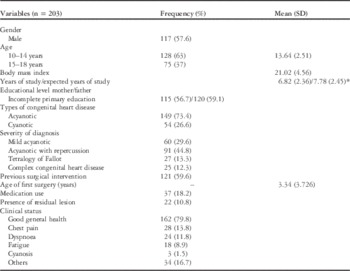
The adolescents participating in this study were mostly from a low socio-economic status (51.2%), measured by family income. A percentage of 57.6 participants were male, the mean age was 13.64 years and mean body mass index was 21.02; 64.5% of the participants were evaluated as eutrophic, 26.1% were overweight or obese, and 9.4% were undernourished. As for family structure, 62.1% of the adolescents lived with both parents, 24.6% lived only with the mother, and 13.3% had other family configurations. Educational level of the participants measured by the number of years of the study showed significant difference when compared with the expected number of years of the study according to age (p=0.000). Table 1 presents the main socio-demographic information and clinical variables that characterise this sample.
Characterisation of the socio-demographic profile of the sample (n=203) and clinical variables.

*p<0.001 (level of significance p<0.05)
Table 2 shows the results of KIDSCREEN-27 for the acyanotic and cyanotic groups and for the different diagnostic categories according to the severity of congenital heart disease. There was no statistically significant difference between the acyanotic and cyanotic groups, as well as for the different diagnosis of congenital heart disease. The most frequent diagnosis of heart lesions found in the sample were: interventricular communication (15.8%), aortic stenosis (13.8%), tetralogy of Fallot (12.8%), interatrial communication (11.3%), pulmonary stenosis (9.9%), and the combination of more than one lesion.
Results (mean and standard deviation) of KIDSCREEN-27 according to the type of CHD and severity of diagnosis.

ARep=acyanotic with repercussion; CC=complex CHD; CHD=congenital heart disease; MA=mild acyanotic; TF=tetralogy of Fallot
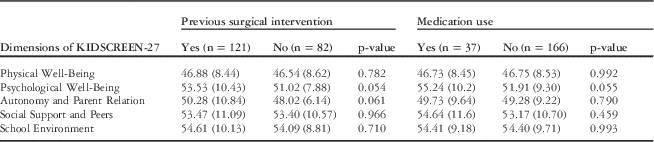
Although the results for the group with previous surgical intervention did not present statistically significant difference from the group without surgery, they showed a trend for better health-related quality of life in the dimension of Psychological Well-Being (p=0.054). Of the 121 patients who had undergone surgery, 84 had only one surgical intervention, 24 had two interventions, and 13 had three or more surgeries. In the same manner, the group that used medication also presented this trend (p=0.055) in the Psychological Well-Being dimension. Medication included AAS, Furosemide, Warfarin, Captopril, Carbamazepine, Digoxin, Propanolol, among other types of medication not related specifically to the heart condition. A number of 20 of the 149 acyanotic patients made use of medication, whereas 17 of the 54 cyanotic patients used medication. These results are described on Table 3.
Results (mean and standard deviation) of KIDSCREEN-27 according to previous surgical intervention and use of medication.

Pearson correlations test was used between all the dimensions of KIDSCREEN-27 and presented moderate to strong correlations for a level of significance of p<0.01, with coefficients ranging from 0.34 to 0.56. The strong correlations between Psychological Well-Being and Autonomy and Parent Relations (0.56), and the moderate correlations between Physical Well-Being and Autonomy and Parent Relations (0.46) and between Psychological Well-Being and Social Support and Peers (0.42) were the most evident. Spearman test did not show correlation between age of first surgery and health-related quality of life.
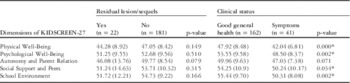
Table 4 presents the results of health-related quality of life for residual lesion/sequels and clinical status. Residual lesion is defined as what the surgery, intentionally or not, has not eliminated, and sequel is the result that follows the intervention, also intentional or not; both residual lesions and sequels did not present statistically significant difference between the groups. As for clinical status, the group that referred a good general health had better results than those that mentioned the presence of symptoms, and a statistically significant difference was observed in the following dimensions: Physical Well-Being (p=0.000), Psychological Well-Being (p=0.002), Social Support and Peers (p=0.034), and School Environment (p=0.002). The only dimension that did not present significant difference was Autonomy and Parent Relations.
Results (mean and standard deviation) of KIDSCREEN-27 according to residual lesion and clinical status.

*Level of significance (p<0.05)
Discussion
Regarding clinical variables, results showed no relation between the level of health-related quality of life and the severity of the congenital heart disease when analysing the acyanotic and cyanotic groups, as well as the different diagnostic categories. These findings corroborate the evidence found in various studiesReference Krol, Grootenhuis and Destrée-Vonk 8 , Reference Landolt, Valsangiacomo Buechel and Latal 10 , Reference Spijkerboer, Utens, De Koning, Bogers, Helbing and Verhulst 11 , Reference Goldbeck and Melches 27 that the severity of congenital heart disease is not associated with, or only moderately related to, the level of health-related quality of life perceived by the patients. The presence of residual lesion or sequels also did not present any association with health-related quality of life, as well as the age for first surgery, which is in line with the outcomes of the study by Majnemer et al.Reference Majnemer, Limperopoulos, Shevell, Rohlicek, Rosenblatt and Tchervenkov 28
As for surgical intervention and medication, a better score was found in the dimension Psychological Well-Being for the groups that have gone through surgery and used medication, although the difference was not statistically significant (p=0.055). Such results might be related to the possible clinical improvement provided by the correction of the heart defect and control of symptoms because of medication, therefore elevating the level of Psychological Well-Being of these patients. It can also be related to a process of positive adaptation to the heart disease, also called resilience. MoonsReference Moons and Norekvål 29 presented the term “sense of coherence” as a hypothesis to understand why some patients who grow up with congenital heart disease can feel satisfied with life, despite the adversities caused by their condition. The explanation is that they develop and continue to refine over time a series of adaptive mechanisms to face the disease, making use of internal and external resources to promote their health and well-being.
The results for adolescents that referred a good general health and those who had symptoms presented significant difference in all KIDSCREEN dimensions, with the exception of Autonomy and Parent Relations. These findings agree with the study by Janiec et al,Reference Janiec, Werner, Sieminska and Ravens-Sieberer 7 that evaluated health-related quality of life in children and adolescents with the mitral valve prolapsed using KIDSCREEN-27, and the results showed that the frequency of clinical symptoms had greater impact on the quality of life.
It also supports the results found by Moons, Van Deyk, and De Geest et alReference Moons, Van Deyk, De Geest, Gewillig and Budts 30 in the study that evaluated the impact of congenital heart disease over health-related quality of life in the adult population, where functional status – according to the Criteria Committee of the New York Heart Association that classifies physical activity limitations and symptoms – was more related to the decrease in the health-related quality of life than the initial diagnosis and disease course. However, information on the systematic review conducted by Latal et alReference Latal, Helfricht, Fischer, Bauersfeld and Landolt 14 contradict these findings, as it indicates no relationship between the decrease in health-related quality of life and the physical correlates of congenital heart disease, according to children’s perception.
The strong correlation found between the dimensions Psychological Well-Being and Autonomy and Parent Relations, as well as moderate correlations between other dimensions of KIDSCREEN confirm the hypothesis developed by Sieberer et al,Reference Ravens-Sieberer, Gosch and Rajmil 21 in which health-related quality of life is a multidimensional and subjective construct, formed by the interaction of multiple determinants. It also corroborates the results of some qualitative studies on adolescents with congenital heart diseaseReference McMurray 31 , Reference Lee and Kim 32 that pointed out the process of individualisation from the family and autonomy as an important factor to better cope with the disease, improving the adolescent’s self-esteem and enabling social integration, which helps to improve the overall perception of quality of life.
Concerning an important aspect of the socio-demographic profile of the sample, the significant difference found between the number of school years of the adolescents and the expected number of years according to age must be discussed. This information is not a surprise considering that previous studies have mentioned more cognitive and academic problems in children with congenital heart disease.Reference Uzark, Jones, Slusher, Limbers, Burwinkle and Varni 9
It is possible that school delay is related to the heart disease; however, the sociocultural and educational context of the country must be addressed. Data from the Brazilian Institute of Geography and Statistics 33 affirm that 37.8% of Brazilian children and adolescents present delays in the number of years of study according to age. In addition, the sample of this study was collected in a Pediatric Cardiology outpatient clinic that attends mostly children and adolescents from a low socio-economic status. Therefore, this finding should be seen carefully, as it might be reflecting the cultural context of a developing country and not be related to the congenital heart disease condition.
Finally, this study contributes to the research on the quality of life and congenital heart disease, focusing on the adolescent, patient period in which they are faced with different needs and the challenges of growing up with a medical condition. In addition, the large sample comprised different types of congenital heart lesions, interventions, and clinical conditions, enabling to evaluate a wide range of diagnosis and describe how they have an impact on the quality of life of the congenital heart patient.
Conclusions
Type of congenital heart disease and initial diagnosis did not seem to affect the perception of health-related quality of life, corroborating findings of previous studies. Surgical interventions and the use of medication can improve the previous clinical status, and therefore it seems to be beneficial in terms of the Psychological Well-Being provided to these patients. In conclusion, the results of this study revealed that the presence of clinical symptoms was the variable that causes the largest impact on the perception of health-related quality of life, possibly because of the impairment they bring to the daily lives of these patients.
According to these findings, the perception of a good general health is related to a good perception of health-related quality of life, improving the sense of general well-being. Questions remain whether the perception of good general health found in this sample means the absence of symptoms or is more related to appropriate coping strategies in the face of congenital heart disease. Future research could address issues related to personality traits and coping strategies in the evaluation of quality of life in patients with congenital heart disease.
Study limitations
Some study limitations should be considered. Lack of a control group did not allow the comparison of congenital heart disease with healthy subjects. A larger sample of congenital heart disease patients would permit the inclusion of more diagnostics and the generalisation of these results for this population. Finally, the KIDSCREEN questionnaire is an adequate, transcultural, and generic health-related quality of life instrument; however, it does not present a disease-specific module for congenital heart disease.
Acknowledgement
None.
Financial Support
This research received no specific grant from any funding agency, commercial, or not-for-profit sectors.
Conflicts of Interest
None.