Implications
The meta-analyses of collagen characteristics identified and quantified the effect of muscle, DOM, breed and type of animal. However, the great variability of data made it difficult to use the fitted equations for the purpose of prediction. Hence, a model was constructed relying on the meta-analysis results and on physiological mechanisms. The model was constructed for total and insoluble collagen content for each type of muscle linked to an existing model for animal performance. This model will complement an existing model of other meat characteristics to construct a model to predict meat tenderness, according to animal management.
Introduction
Collagen is a group of proteins of the connective tissue. It is a major protein of the striated muscle, accounting for 1% to 15% of the dry weight in beef muscle, depending on the muscle (Purslow, Reference Purslow2005). The role of collagen in muscle is both to support the muscle cells and transmit their contractile force to the skeleton, and thus produce movement (Bailey, Reference Bailey1985). Moreover, collagen might be closely involved in the development of muscle (Bailey, Reference Bailey1985).
Collagen content is negatively correlated with meat tenderness (Light, Reference Light1985; Renand et al., Reference Renand, Picard, Touraille, Berge and Lepetit2001), but not always with cooked meat tenderness (Lepetit, Reference Lepetit2008). In fact, total collagen content is mainly responsible for the background toughness of meat postmortem, which is the minimal toughness that can be reached by meat after cooler aging. Consequently, total collagen content is an important determinant of the variability of the meat texture between muscles (Purslow, Reference Purslow2005). However, the contribution of collagen to tenderness is muscle dependent (Koohmaraie et al., Reference Koohmaraie, Kent, Shackelford, Veiseth and Wheeler2002). On the other hand, meat tenderness is positively correlated with connective tissue solubility (Cross et al., Reference Cross, Carpenter and Smith1973; Renand et al., Reference Renand, Picard, Touraille, Berge and Lepetit2001). Bailey and Light (Reference Bailey and Light1989) reported that it is the quality of collagen rather than the quantity of collagen that affects textural properties of meat. Collagen quality involves type of collagen, heat stability of the intermolecular cross-links, the overall extent of the cross-linking in the collagen matrices of muscle, the size of collagen fibres and fibre bundles and the damage incurred by collagen during conditioning and cooking (Bailey and Light, Reference Bailey and Light1989). The cross-links are the bonds that stabilise the helicoidal structure of collagen. Thus, according to the above-mentioned authors, reasons for differences in solubility may be complex and might not necessarily reflect variations in textural qualities.
Detailed reviews have been published in relation to the contribution of collagen to meat toughness (Bailey, Reference Bailey1985; Light, Reference Light1985; Bailey and Light, Reference Bailey and Light1989; Harper, Reference Harper1999; McCormick, Reference McCormick1999; Purslow, Reference Purslow2005; Lepetit, Reference Lepetit2008). However, information on pre-slaughter factors affecting collagen characteristics in beef was briefly included in few of them (Light, Reference Light1985; Bailey and Light, Reference Bailey and Light1989; Harper, Reference Harper1999; McCormick, Reference McCormick1999). Several factors (muscle, breed, growth rate, diet, sex, age, etc.) influence the amount and nature of the connective tissue (Bailey and Light, Reference Bailey and Light1989). DOM of the animal is the major determinant of meat texture primarily because of the maturation of the collagen fibres (Bailey and Light, Reference Bailey and Light1989). However, there are complex interactions among these factors (Boccard et al., Reference Boccard, Naudé, Cronje, Smit, Venter and Rossouw1979; Schreurs et al., Reference Schreurs, Garcia, Jurie, Agabriel, Micol, Bauchart, Listrat and Picard2008; Archile-Contreras et al., Reference Archile-Contreras, Mandell and Purslow2010).
To construct a dynamic and mechanistic model of collagen content in muscle, the main factors of variation have to be stated. To summarise and quantify knowledge acquired through prior published research, two approaches can be undertaken: (i) a classical approach based on literature reviews, which, however, can be subjective (Sauvant et al., Reference Sauvant, Schmidely, Daudin and St-Pierre2008) and (ii) the second approach through meta-analysis of data. The aim of this paper was to identify, quantify and organise into a hierarchy the main factors that mainly contribute to the variation in collagen characteristics. This paper will rely on meta-analyses on raw data from muscles measured in labs of INRA-UMR1213 Herbivores and grouped in a unique database.
Materialand methods
Database collection and collagen determination
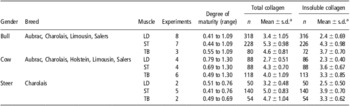
We used an updated database since 2007 (Schreurs et al., Reference Schreurs, Garcia, Jurie, Agabriel, Micol, Bauchart, Listrat and Picard2008), which was created to compile experiments conducted at the Herbivore Research Unit (INRA) in France and to allow the investigation of the effects of animal factors such as muscle, gender, breed and DOM on muscle characteristics, usually associated with beef quality. Detailed description of the muscle characteristics included in the database can be found in a study by Schreurs et al. (Reference Schreurs, Garcia, Jurie, Agabriel, Micol, Bauchart, Listrat and Picard2008). The collagen sub-database comprised 22 experiments with 1165 and 1145 measurements of total and insoluble collagen, respectively (Table 1). DOM of each animal at slaughter was included in the database. It a priori helps to compare individuals on a physiological basis (Robelin, Reference Robelin1986). DOM is an index of development of each animal and it accounts for differences between early- and late-maturing genders and breeds in the study. DOM was calculated as the proportion of mature BW achieved when the muscle sample was taken. One unique mature BW was defined for each gender (bull, steer and cow) in each breed (Schreurs et al., Reference Schreurs, Garcia, Jurie, Agabriel, Micol, Bauchart, Listrat and Picard2008). This results in possible DOMs >1, as individuals could have a higher BW than the mature one.
Description of the data used for the meta-analyses

LD = Longissimus dorsi; ST = Semitendinosus; TB = Triceps brachii.
ag OH-proline/g dry matter.
Collagen characteristics included in the database were contents of total collagen (μg of OH-proline/mg) and insoluble collagen (μg of OH-proline/mg) in dry muscle. Muscle sampling and collagen determination procedures were standardised in the laboratory to minimise the sources of intra- and inter-assay variability (Listrat and Hocquette, Reference Listrat and Hocquette2004). Muscle weighing ∼100 g was frozen and homogenised in a household cutter, then lyophilised for 48 h and then pulverised in a horizontal blade mill. Insoluble collagen content was determined on muscle powder rehydrated for 1 h and heated in a water bath at 75°C for 1 h to remove possible effects of temperature on collagen solubility.
Statistical analyses
This meta-analysis used the measurements from individual animal muscles of each experiment rather than treatment means that are commonly used in meta-analytic studies in which only published results are available. Although very infrequent, this type of meta-analysis should lead to the same results as the meta-analysis performed on summary statistics (Sauvant et al., Reference Sauvant, Schmidely, Daudin and St-Pierre2008). As a result, the weighting of experiments including a large number of animals was automatically higher than that of experiments with a low number of animals. Thus, any additional weighting of the observations was not included.
Muscle, breed and gender were the factors studied with DOM as the predictive continuous variable. The effect of muscle was investigated in interaction with DOM with one separate analysis for each gender because of different ranges of DOMs in steers and bulls, relatively to cows. Muscles considered were the Longissimus thoracis, the Semitendinosus and the Triceps brachii in bulls, steers and cows.
Breed effect was studied in interaction with DOM as the predictive continuous variable separately for each muscle, with separate analyses for bulls and cows. To make comparisons between breeds, data were classified according to two categories: beef breeds grouping Charolais and Limousin and non-beef breeds grouping Aubrac, Holstein and Salers (Schreurs et al., Reference Schreurs, Garcia-Launay, Hoch, Jurie, Agabriel, Micol and Picard2010). Gender effect (bull v. steer) was studied separately in Longissimus, Semitendinosus and Triceps brachii muscles in Charolais males.
Data were plotted for each muscle, gender and breed successively against age, weight and DOM as potential continuous predictor variables. Means of treatments within experiment were also plotted and connected to highlight the intra-study relationship as suggested by Sauvant et al. (Reference Sauvant, Schmidely, Daudin and St-Pierre2008). Finally, DOM was chosen as the best continuous predictive variable because it is more synthetic, data were more evenly distributed among DOMs and it allows for comparisons between early- and late-maturing breeds with different frame sizes at maturity.
Data were analysed using mixed models (Proc mixed, v 9.1.3. SAS Institute Inc., Cary, NC, USA) with restricted maximum likelihood estimation to obtain the variance components. The degrees of freedom used for testing were corrected with the Satterthwaite correction to account for possible unequal number of observations (Kaps and Lamberson, Reference Kaps and Lamberson2009). Each analysis investigated the effect of the continuous predictive variable DOM and the qualitative factor (τ) being muscle, breed or gender, with model (1) when investigating muscle effect and with model (2) when investigating breed or gender effect. When appropriate, quadratic and cubic models were also fitted to the data:
 $$no{{{Y}_{ijkl}}\, = \,{{B}_0}\, + \,{{E}_i}\, + \,{{\tau }_j}{{ \, +\, \delta \tau }_{jk}}\, + \,{{B}_1}{{DOM}_{ijkl}}\cr\quad + \,{{b}_{jk}}{{DOM}_{ijkl}}\, + \,{{B}_j}{{DOM}_{ijkl}}\, + \,{{e}_{ijkl}}$$
 $$no{{{Y}_{ijkl}}\, = \,{{B}_0}\, + \,{{E}_i}\, + \,{{\tau }_j}\, + \,{{B}_1}{{DOM}_{ijk}}\cr \quad+ \,{{b}_i}{{DOM}_{ijk}}\, + \,{{B}_j}{{DOM}_{ijk}}\, + \,{{e}_{ijk}}$$
Yijk is the dependent variable, B 0 is the overall intercept, Ei is the random effect of the ith experiment, assumed ∼iidN(0,σE 2), τj is the fixed effect of the jth level of factor τ, B 1 is the overall regression coefficient of Y on X, Bj is the effect of the jth level of the discrete factor τ on the regression coefficient, bi is the random effect of the ith study on the regression coefficient of Y on X, assumed ∼iidN(0,σb 2) and eijk the residual errors, assumed ∼iidN(0,σe 2). In model (1) specifically, δτjk is the random effect of the breed nested in the muscle on the overall intercept, assumed ∼iidN(0,στ 2) and bjk is the random effect of the breed nested in the muscle on the regression coefficient of Y on X, assumed ∼iidN(0,σb 2). Model (1) was selected to account for possible differences in the regression of Y on DOM between the different breeds in each muscle.
Experiment was always included as the random effect because its removal can lead to biased probability parameter estimates of the effects and in the variance estimates (Sauvant et al., Reference Sauvant, Schmidely, Daudin and St-Pierre2008). The statistical model included the random intercept and linear effects and a possible covariance between them (option type = un). If the covariance parameter was not correlated, it was removed from the model and the analyses were repeated.
For each model fitted, normality of the residuals was checked with the Shapiro–Wilk test available in PROC UNIVARIATE. When not normal, the residuals were carefully studied with statistics of influence diagnostic provided by PROC MIXED for each observation: external studentised residuals, Cook's Distance and leverage (Schabenberger, Reference Schabenberger2004). Values with external studentised residuals higher than 3 (Sauvant et al., Reference Sauvant, Schmidely, Daudin and St-Pierre2008) and extreme values of Cook's distance and leverage were checked and removed. Finally, the R 2 value for the models shown in tables is an approximation that was obtained using a linear regression of observed values on values predicted from the fitted mixed model (as performed by McMeniman et al. (Reference McMeniman, Tedeschi, Defoor and Galyean2010)).
Results
Relationships between collagen contents and DOM according to the muscle type
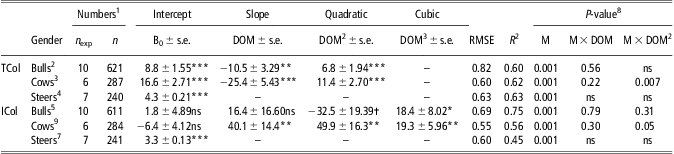
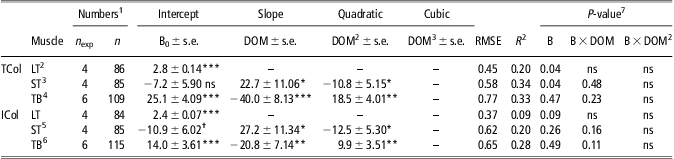
Results are presented separately for each gender as the analyses were performed separately because of the difference in the ranges of the DOM (between genders; Table 1). Models of total and insoluble collagen content fitted to investigate muscle factor with DOM (Table 2) explained 45% to 75% of the variability.
Effect of M and DOM on TCol and ICol collagen contents (μg OH-proline/mg DM) of young bulls, cows and steers in muscles LD, ST and TB
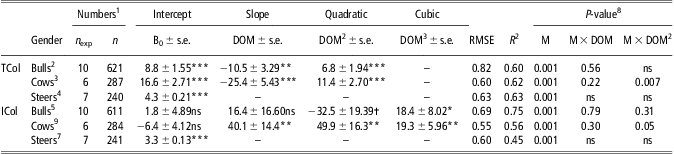
M = muscle; DOM = degree of maturity; TCol = total collagen; ICol = insoluble collagen; DM = dry matter; LD = Longissimus dorsi; ST = Semitendinosus; TB = Triceps brachii.
1n exp = number of experimental groups in the model; n = number of observations in the model.
2Muscle effect on the intercept (Δ = −2.6 for LD, 0.7 for ST 0 for TB) and the slope (Δ = 1.3 for LD, −0.7 for ST, 0 for TB).
3Muscle effect on the intercept (Δ = −14.3 for LD, 15.3 for ST, 0 for TB), the slope (Δ = 25.2 for LD, 30.8 for ST, 0 for TB) and the quadratic coefficient (Δ = −12.0 for LD, −14.9 for ST, 0 for TB).
4Muscle effect on the intercept (Δ = −1.0 for LD, 0.5 for ST, 0 for TB).
5Muscle effect on the intercept (Δ = −4.5 for LD, −3.3 for ST, 0 for TB), the slope (Δ = 8.1 for LD, 10.0 for ST, 0 for TB) and the quadratic coefficient (Δ = −4.8 for LD, −6.8 for ST, 0 for TB).
6Muscle effect on the intercept (Δ = −18.0 for LD, 14.5 for ST, 0 for TB), the slope (Δ = 32.6 for LD, 29.1 for ST, 0 for TB) and the quadratic coefficient (Δ = −15.3 for LD, −14.0 for ST, 0 for TB).
7Muscle effect on the intercept (Δ = −0.8 for LD, 0.5 for ST, 0 for TB).
8The cubic interaction was always not significant.
†Tendency at P < 0.10; *P < 0.05; **P < 0.01; ***P < 0.001; ns = not significant (P > 0.10).
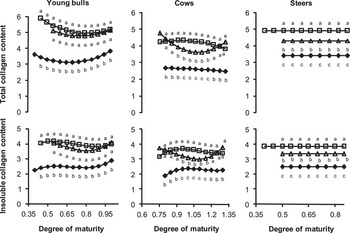
In young bulls, total collagen content was affected by the muscle and had a quadratic evolution with the DOM, regardless of the muscle studied, first decreasing and then increasing afterwards (Figure 1; Table 2). Longissimus muscle had lower total collagen content than Semitendinosus and Triceps brachii muscles (P < 0.05), which had similar content (Figure 1; Table 2).
The relationship between collagen content (μg OH-proline/mg DM) and degree of maturity in Longissimus (⧫), Semitendinosus (□) and Triceps brachii (Δ) muscles in young bulls, cows and steers.

In cows, total collagen content in Longissimus and Semitendinosus muscles had a different pattern of evolution with DOM from Triceps brachii muscle (Figure 1). Longissimus muscle had the lowest total collagen content throughout the DOM studied (P < 0.05). However, Semitendinosus muscle had greater total collagen content than Triceps brachii muscle from 0.95 to 1.15 of the DOM (P < 0.05) but similar in the remaining ranges studied. Collagen content in Triceps brachii muscle had a delayed development compared with the other two muscles.
In Charolais steers, total collagen content was only affected by the muscle studied (Figure 1 and Table 2). Longissimus muscle had the lowest total collagen content, Triceps brachii intermediate and Semitendinosus muscle the greatest (P < 0.001).
Insoluble collagen content was also affected by the DOM in bulls and cows but not in steers (Table 2). It showed a cubic relationship with DOM in bulls and cows (Figure 1), regardless of the muscle studied.
Longissimus muscle had lower insoluble collagen content than the other two muscles for bulls, cows and steers (Figure 1). As in total collagen content, Semitendinosus and Triceps brachii muscles had similar insoluble collagen content in bulls but different in steers. In cows, Semitendinosus muscle had greater insoluble collagen content than Triceps brachii between 0.95 and 1.15 of the DOM (Table 3).
Relationships between collagen contents and DOM according to the type of breed
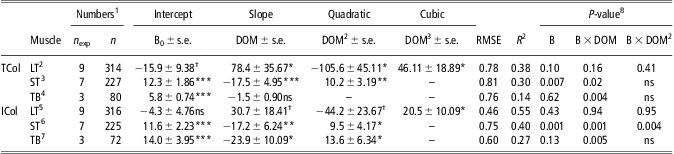
As mentioned earlier, results were presented separately for young bulls and cows. All the models fitted explained a relatively low proportion of the variability, from 9% to 55% (Tables 3 and 4).
Effect of the type of B and DOM on TCol and ICol collagen contents (μg OH-proline/mg DM) in young bulls for muscles LD, ST and TB
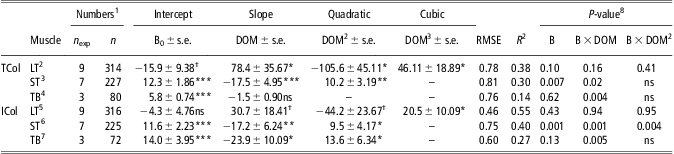
B = breed; DOM = degree of maturity; TCol = total collagen; ICol = insoluble collagen; DM = dry matter; LD = Longissimus dorsi; ST = Semitendinosus; TB = Triceps brachii.
1n exp = number of experimental groups in the model; n = number of observations in the model.
2Type of breed effect on the intercept (Δ = 10.4 for beef, 0 for non-beef), the slope (Δ = −28.4 for beef, 0 for non-beef) and the quadratic coefficient (Δ = 19.3 for beef, 0 for non-beef).
3Type of breed effect on the intercept (Δ = −2.6 for beef, 0 for non-beef) and the slope (Δ = 3.4 for beef, 0 for non-beef).
4Type of breed effect on the intercept (Δ = −2.9 for beef, 0 for non-beef), the slope (Δ = 4.0 for beef, 0 for non-beef).
5Type of breed effect on the intercept (Δ = 2.4 for beef, 0 for non-beef), the slope (Δ = −7.9 for beef, 0 for non-beef) and the quadratic coefficient (Δ = 6.1 for beef, 0 for non-beef).
6Type of breed effect on the intercept (Δ = −11.9 for beef, 0 for non-beef), the slope (Δ = 29.1 for beef, 0 for non-beef) and the quadratic coefficient (Δ = −17.5 for beef, 0 for non-beef).
7Type of breed effect on the intercept (Δ = −4.1 for beef, 0 for non-beef) and the slope (Δ = 5.1 for beef, 0 for non-beef).
8The cubic interaction was always not significant.
†Tendency at P < 0.10; *P < 0.05; **P < 0.01; ***P < 0.001; ns = not significant (P > 0.10).
Effect of the type of B and DOM on TCol and ICol collagen contents (μg OH-proline/mg DM) in cows for muscles LD, ST and TB
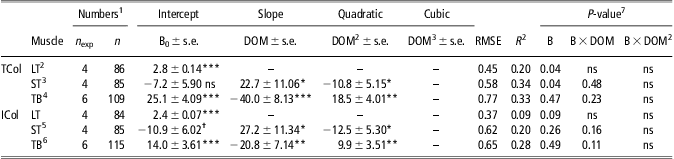
B = breed; DOM = degree of maturity; TCol = total collagen; ICol = insoluble collagen; DM = dry matter; LD = Longissimus dorsi; ST = Semitendinosus; TB = Triceps brachii.
1n exp = number of experimental groups in the model; n = number of observations in the model.
2Type of breed effect on the intercept (Δ = −0.2 for beef, 0 for non-beef).
3Type of breed effect on the intercept (Δ = 2.1 for beef, 0 for non-beef) and the slope (Δ = −2.5 for beef, 0 for non-beef).
4Type of breed effect on the intercept (Δ = −2.5 for beef, 0 for non-beef), the slope (Δ = 2.6 for beef, 0 for non-beef).
5Type of breed effect on the intercept (Δ = 3.6 for beef, 0 for non-beef), the slope (Δ = −3.8 for beef, 0 for non-beef).
6Type of breed effect on the intercept (Δ = 1.9 for beef, 0 for non-beef), the slope (Δ = −2.0 for beef, 0 for non-beef).
7The cubic interaction was always not significant.
†Tendency at P < 0.10; *P < 0.05; **P < 0.01; ***P < 0.001; ns = not significant (P > 0.10).
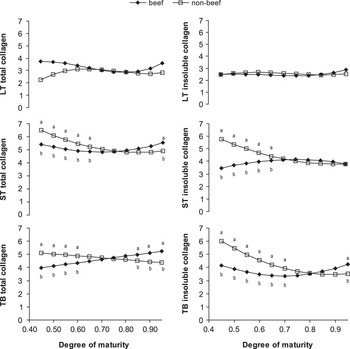
In bulls, total collagen differed between beef and non-beef breeds in the Semitendinosus and Triceps brachii muscles with high collagen content but not in Longissimus muscle (Table 3; Figure 2). In this muscle, total collagen content had a cubic evolution with the DOM (Table 3). In the Semitendinosus muscle, total collagen content evolved differently in both types of breeds. Beef breeds had lower total collagen content than non-beef breeds when the DOM was below 0.70, and similar between 0.70 and 0.95. In Triceps brachii, total collagen content evolved linearly with DOM, but differently, in both types of breeds. In beef breeds, total collagen content increased, whereas it remained unchanged in non-beef breeds. Consequently, beef breeds had lower total collagen content in Triceps brachii muscle than non-beef breeds when DOM was below 0.60 and above 0.80 (Figure 2).
The relationship between collagen content (μg OH-proline/mg DM) and degree of maturity in Longissimus (LT), Semitendinosus (ST) and Triceps brachii (TB) muscles in beef (Charolais and Limousin) and non-beef (Aubrac and Salers) breeds in bulls.

In bulls, insoluble collagen content was affected by breed type in ST Semitendinosus and Triceps brachii but not in Longissimus muscle (Figure 2). Its evolution with DOM differed between beef and non-beef breeds in the Semitendinosus and Triceps brachii in bulls. In the Semitendinosus muscle, insoluble collagen content was greater in non-beef than beef breeds when DOM was below 0.65, similar between 0.65 and 0.90, and lower at 0.95. In the Triceps brachii, insoluble collagen content of both types of breeds had similar evolution with the Semitendinosus muscle.
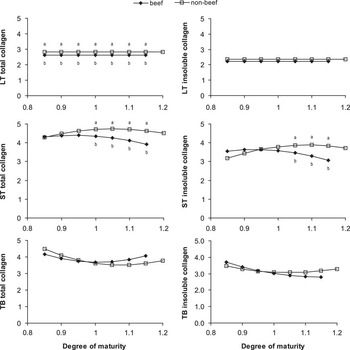
In cows, non-beef breeds had greater total collagen content than beef breeds in the Longissimus muscle (P < 0.05), but similar in the Triceps brachii muscle (Table 4). In the Semitendinosus muscle, non-beef breeds had greater total collagen content than beef breeds when DOM was >1 (Figure 3).
The relationship between collagen content (μg OH-proline/mg DM) and degree of maturity in Longissimus (LT), Semitendinosus (ST) and Triceps brachii (TB) muscles in beef (Charolais and Limousin) and non-beef (Aubrac, Holstein and Salers) breeds in cows.

In cows, non-beef breeds tended to have greater insoluble collagen content than beef breeds in the Longissimus muscle (Table 4) and similar in the Triceps brachii muscle. In the Semitendinosus muscle, non-beef breeds had greater insoluble collagen content than beef breeds when DOM was >1.05 (Figure 3).
Relationships between collagen contents and DOM in Charolais bulls and steers
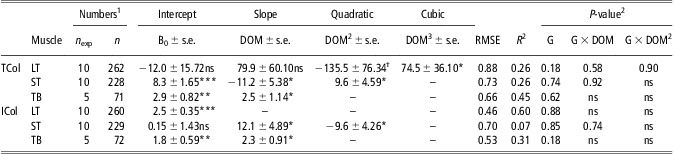
Total and insoluble collagen contents did not differ between bulls and steers in any of the muscles studied (Table 5). Total and insoluble collagen contents had different patterns in Longissimus, Semitendinosus and Triceps brachii muscles.
Effect of the G and DOM on TCol and ICol collagen contents (μg OH-proline/mg DM) for muscles LD, ST and TB.
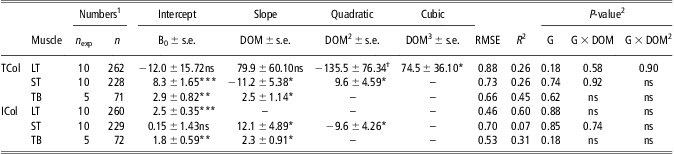
G = gender; DOM = degree of maturity; TCol = total collagen; ICol = insoluble collagen; DM = dry matter; LD = Longissimus dorsi; ST = Semitendinosus; TB = Triceps brachii.
1n exp = number of experimental groups in the model; n = number of observations in the model.
2The cubic interaction was always not significant.
†Tendency at P < 0.10; *P < 0.05; **P < 0.01; ***P < 0.001; ns = not significant (P > 0.10).
Discussion
The comparison between the results of the current meta-analyses and the previously published results was difficult because basic information was not available in many of them. For instance, information on gender, slaughter age or weight of the breeds was not available in several articles (Jeremiah et al., Reference Jeremiah, Dugan, Aalhus and Gibson2003; Von Seggern et al., Reference Von Seggern, Calkins, Johnson, Brickler and Gwartney2005), and information on slaughter weight was not provided in many others (Liboriussen et al., Reference Liboriussen, Bech Andersen, Buchter, Kousgaard and Juel Møller1977; Rhee et al., Reference Rhee, Wheeler, Shackelford and Koohmaraie2004; Stolowski et al., Reference Stolowski, Baird, Miller, Savell, Sams, Taylor, Sanders and Smith2006). Moreover, the adult weight of some breeds or their crosses has not been published. Thus, it was not possible to estimate the DOM in most of the published articles.
Effect of muscle type on total and insoluble collagen contents and their evolution
The intramuscular connective tissue varies in the amount and spatial distribution between muscles, reflecting differences in physiological functions (Purslow, Reference Purslow2005).
Several studies reported that the muscle had an effect on total collagen content in cattle (Jeremiah et al., Reference Jeremiah, Dugan, Aalhus and Gibson2003; Torrescano et al., Reference Torrescano, Sánchez-Escalante, Giménez, Roncalés and Beltrán2003; Rhee et al., Reference Rhee, Wheeler, Shackelford and Koohmaraie2004; Von Seggern et al., Reference Von Seggern, Calkins, Johnson, Brickler and Gwartney2005; Stolowski et al., Reference Stolowski, Baird, Miller, Savell, Sams, Taylor, Sanders and Smith2006). Total collagen differs among muscles depending on the age of the animal (Damergi, Reference Damergi1996), DOM (Schreurs et al., Reference Schreurs, Garcia, Jurie, Agabriel, Micol, Bauchart, Listrat and Picard2008) or intramuscular fat deposition (Nishimura et al., Reference Nishimura, Hattori and Takahashi1999). Our meta-analyses showed that the Longissimus muscle has a lower total collagen content than Semitendinosus and Triceps brachii in bulls, cows and steers, as observed earlier (Gerrard et al., Reference Gerrard, Jones, Aberle, Lemenager, Diekman and Judge1987; Nishimura et al., Reference Nishimura, Hattori and Takahashi1999; Torrescano et al., Reference Torrescano, Sánchez-Escalante, Giménez, Roncalés and Beltrán2003; Rhee et al., Reference Rhee, Wheeler, Shackelford and Koohmaraie2004; Stolowski et al., Reference Stolowski, Baird, Miller, Savell, Sams, Taylor, Sanders and Smith2006; Archile-Contreras et al., Reference Archile-Contreras, Mandell and Purslow2010). Torrescano et al. (Reference Torrescano, Sánchez-Escalante, Giménez, Roncalés and Beltrán2003) reported that Semitendinosus muscle had greater total collagen content than Triceps brachii in Brown Swiss young bulls, whereas total collagen concentration was similar in the Semitendinosus and Triceps brachii muscles in young bulls in our meta-analysis. Our result was obtained on beef breeds, with DOMs lower than 1, whereas it was not possible to calculate DOM of the young bulls used by Torrescano et al. (Reference Torrescano, Sánchez-Escalante, Giménez, Roncalés and Beltrán2003).
Stolowski et al. (Reference Stolowski, Baird, Miller, Savell, Sams, Taylor, Sanders and Smith2006) reported that the Semitendinosus muscle had greater total collagen content than Triceps brachii in heifers, which agrees with the results of the meta-analysis in DOMs between 0.95 and 1.15.
In steers, the Semitendinosus muscle had greater total collagen content than Triceps brachii muscle (Stolowski et al., Reference Stolowski, Baird, Miller, Savell, Sams, Taylor, Sanders and Smith2006), as in the current meta-analysis. Conversely, Rhee et al. (Reference Rhee, Wheeler, Shackelford and Koohmaraie2004) found that Triceps brachii had greater total collagen content than the Semitendinosus muscle. This discrepancy could be attributed to samples elaborated on different sampling sites in the two studies (Rhee et al., Reference Rhee, Wheeler, Shackelford and Koohmaraie2004).
According to the results from the meta-analyses, total collagen did not change with DOM in steers, which agrees with the results reported by Nishimura et al. (Reference Nishimura, Hattori and Takahashi1999) and Boccard et al. (Reference Boccard, Naudé, Cronje, Smit, Venter and Rossouw1979). The pattern of total collagen content in cows was similar in Longissimus and Semitendinosus muscles; however, Triceps brachii muscle had a delayed development compared with the other two muscles, which agrees with the differences of maturity reported for these muscles (Robelin, Reference Robelin1986). Several studies reported that total collagen differed with age in the muscles studied in the meta-analyses. However, slaughter weights in these different studies were not available to estimate the DOM of the animals used. Thus, results will be discussed using the chronological age. In the entire male cattle, total collagen content at birth is higher than at all other ages, in association with the earlier development of connective tissue proteins than contractile proteins in muscle (Boccard et al., Reference Boccard, Naudé, Cronje, Smit, Venter and Rossouw1979), and subsequently decreases until 8 to 12 or 8 to 16 months, depending on the muscle studied (Damergi, Reference Damergi1996). An increase is then observed between 8 and 16 months concomitant with the sexual development (Liboriussen et al., Reference Liboriussen, Bech Andersen, Buchter, Kousgaard and Juel Møller1977; Boccard et al., Reference Boccard, Naudé, Cronje, Smit, Venter and Rossouw1979; Damergi, Reference Damergi1996). From 16 to 24 months, a constant level of collagen content is reached and maintained in different muscles (Boccard et al., Reference Boccard, Naudé, Cronje, Smit, Venter and Rossouw1979; Dikeman et al., Reference Dikeman, Reddy, Arthaud, Tuma, Koch, Mandigo and Axe1986). However, other studies reported that after the maximum concentration concomitant with testosterone peak, total collagen decreases in the Longissimus muscle (Cross et al., Reference Cross, Schanbacher and Crouse1984; Nishimura et al., Reference Nishimura, Hattori and Takahashi1999).
Reducible cross-links of collagen are transformed into more stable non-reducible compounds with the chronological age of cattle (Cross et al., Reference Cross, Schanbacher and Crouse1984; Gerrard et al., Reference Gerrard, Jones, Aberle, Lemenager, Diekman and Judge1987). This brings about an increase in insoluble collagen content and a decrease in collagen solubility, resulting in tougher beef (Boccard et al., Reference Boccard, Naudé, Cronje, Smit, Venter and Rossouw1979). Insoluble collagen content is affected by the interaction between breed and muscle (Jurie et al., Reference Jurie, Martin, Listrat, Jailler, Culioli and Picard2006; Schreurs et al., Reference Schreurs, Garcia, Jurie, Agabriel, Micol, Bauchart, Listrat and Picard2008).
Insoluble collagen content was only reported by Torrescano et al. (Reference Torrescano, Sánchez-Escalante, Giménez, Roncalés and Beltrán2003), whereas others reported collagen solubility (Gerrard et al., Reference Gerrard, Jones, Aberle, Lemenager, Diekman and Judge1987; Nishimura et al., Reference Nishimura, Hattori and Takahashi1999; Stolowski et al., Reference Stolowski, Baird, Miller, Savell, Sams, Taylor, Sanders and Smith2006; Archile-Contreras et al., Reference Archile-Contreras, Mandell and Purslow2010). Thus, insoluble collagen content can be inferred from them.
In young bulls, Longissimus muscle had lower insoluble collagen content than Semitendinosus and Triceps brachii muscle, consistent with the studies by Nishimura et al. (Reference Nishimura, Hattori and Takahashi1999), Torrescano et al. (Reference Torrescano, Sánchez-Escalante, Giménez, Roncalés and Beltrán2003) and Archile-Contreras et al. (Reference Archile-Contreras, Mandell and Purslow2010).
The pattern of the insoluble collagen content was similar to that observed for total collagen content in bulls, cows and steers (Figure 1). This shape agrees with the ones observed in bulls between 12 and 17 months (Unruh et al., Reference Unruh, Gray and Dikeman1986) and 15 and 24 months of age (Jurie et al., Reference Jurie, Martin, Listrat, Jailler, Culioli and Picard2005).
Breed effect on collagen content
It seems unlikely that any major differences would be expected in collagen content, as even interspecies differences among the domestic animals are few (Bailey and Light, Reference Bailey and Light1989). Breed differences may exist in other connective tissue characteristics such as collagen cross-linking, collagen fibre size and type distribution of collagen. According to Bailey (Reference Bailey1985), the higher the rate of turnover, the less mature the collagen and the less tough the meat; thus, the late-maturing animals are likely to produce relatively more tender meat.
Most of the studies have used the Longissimus muscle, which has a low variability (Jeremiah et al., Reference Jeremiah, Dugan, Aalhus and Gibson2003) to estimate breed effect.
As in the current meta-analyses, there were no differences in results in the Longissimus muscle between breeds in steers (Aberle et al., Reference Aberle, Reeves, Judge, Hunsley and Perry1981; Tatum et al., Reference Tatum, Gronewald, Seideman and Lamm1990; Whipple et al., Reference Whipple, Koohmaraie, Dikeman and Crouse1990) or young bulls (Jurie et al., Reference Jurie, Martin, Listrat, Jailler, Culioli and Picard2005). Studying specialised, double purpose and rustic Spanish beef breeds (Sañudo et al., Reference Sañudo, Albertí, Campo, Olleta and Panea1998; Campo et al., Reference Campo, Santolaria, Sañudo, Lepetit, Olleta, Panea and Alberti2000; Sañudo et al., Reference Sañudo, Macie, Olleta, Villarroel, Panea and Alberti2004; Serra et al., Reference Serra, Guerrero, Guardia, Gil, Sanudo, Panea, Campo, Olleta, Garcia-Cachan, Piedrafita and Oliver2008) ascribed the differences found in collagen content in the Longissimus muscle to differences in maturity, as earlier-maturing breeds tend to deposit more collagen than late-maturing breeds.
A few studies evaluated the effect of breed in muscles with greater collagen content than Longissimus muscle. Total collagen content did not differ among breeds of steers in several muscles (Stolowski et al., Reference Stolowski, Baird, Miller, Savell, Sams, Taylor, Sanders and Smith2006), for the Semitendinosus muscle (Kuber et al., Reference Kuber, Busboom, Duckett, Mir, Mir, McCormick, Gaskins, Cronrath, Marks and Reeves2004) and the forequarter and hindquarter muscles (Bailey and Light, Reference Bailey and Light1989).
As in the current meta-analyses in young bulls and cows, insoluble collagen content in the Longissimus muscle was similar among different breeds of bulls slaughtered at various slaughter points in previous studies (Cross et al., Reference Cross, Schanbacher and Crouse1984; Waritthitham et al., Reference Waritthitham, Lambertz, Langholz, Wicke and Gauly2010). However, no information was available for slaughter weight or age. In contrast, differences can be noticed and related with differences in maturity because early-maturing breeds had greater insoluble collagen content than late-maturing breeds (Sañudo et al., Reference Sañudo, Albertí, Campo, Olleta and Panea1998; Campo et al., Reference Campo, Santolaria, Sañudo, Lepetit, Olleta, Panea and Alberti2000; Sañudo et al., Reference Sañudo, Macie, Olleta, Villarroel, Panea and Alberti2004; Serra et al., Reference Serra, Guerrero, Guardia, Gil, Sanudo, Panea, Campo, Olleta, Garcia-Cachan, Piedrafita and Oliver2008). Similarly, specialised beef breeds contained the lowest amount of insoluble collagen, whereas the dairy breeds had more insoluble collagen than all other breeds (Christensen et al., Reference Christensen, Ertbjerg, Failla, Sañudo, Richardson, Nute, Olleta, Panea, Albertí, Juárez, Hocquette and Williams2011).
Effect of gender on collagen content and solubility
In several previous studies, total collagen content in the Longissimus muscle was not affected by gender in bulls and steers slaughtered at the same age (Boccard et al., Reference Boccard, Naudé, Cronje, Smit, Venter and Rossouw1979; Klastrup et al., Reference Klastrup, Cross, Schanbacher and Mandigo1984; Burson et al., Reference Burson, Hunt, Unruh and Dikeman1986; Dikeman et al., Reference Dikeman, Reddy, Arthaud, Tuma, Koch, Mandigo and Axe1986; Mandell et al., Reference Mandell, Gullett, Wilton, Kemp and Allen1997), as in the current meta-analyses in the Longissimus, Semitendinosus and Triceps brachii muscles.
However, results may differ according to the muscle and breed studied. According to Boccard et al. (Reference Boccard, Naudé, Cronje, Smit, Venter and Rossouw1979), castration has a greater effect on collagen content in collagen-rich muscles in a breed that had greater collagen at birth and was in a more advanced stage of sexual development than in a breed that had lower collagen at birth. In the Triceps brachii and Semitendinosus muscles, there were few differences in total collagen content between intact bulls and castrates of Montbeliard breed in the study of Damergi (Reference Damergi1996).
Other studies also reported an increased collagen synthesis near puberty in intact bulls, relatively to castrates (Cross et al., Reference Cross, Schanbacher and Crouse1984). This would lead to an increase in the proportion of immature collagen, resulting in a further increase of cross-linking and consequently of insoluble collagen. The differences reported in the effect of castration could be related to the age of castration, which affected total collagen content in collagen-rich muscles as Triceps brachii muscle but not in Longissimus muscle in the studies by Destefanis et al. (Reference Destefanis, Brugiapaglia, Barge and Lazzaroni2003) and Micol et al. (Reference Micol, Oury, Picard, Hocquette, Briand, Dumont, Egal, Jailler, Dubroeucq and Agabriel2009).
These previous studies highlight that our conclusions on gender effect should be extracted cautiously because the range of the DOM available in steers is narrow in our study, especially in the Triceps brachii muscle.
Synthesis and model development
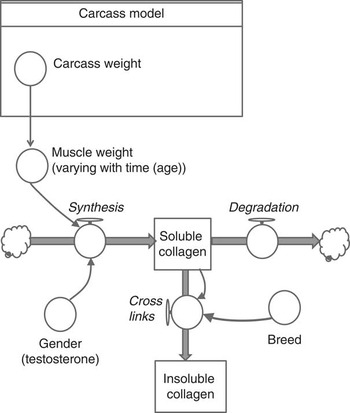
The results of the meta-analysis clarify fairly the effects of muscle, breed and DOM together on total and insoluble collagen contents in young bulls, cows and steers. However, the accuracy of some of the models, according to R 2, was low. Thus, another type of modelling will be recommended for the purpose of prediction. Our findings are helpful for further model development because they rely on a database consistent in terms of sampling size and site and in terms of cooking temperature. In this sense, together with results from the literature, they allowed us to draw the main biological hypotheses of a future dynamic model of total and insoluble collagen contents in bovine muscle. We propose a diagram for this model, relying on the formalism of Forrester compartmental models (Radzicki and Taylor, Reference Radzicki and Taylor2008), widely encountered in pharmacokinetics and in dynamic modelling of the processes occurring at the animal, metabolism or organ level or in the field (Figure 4).
Flow diagram of the model of soluble and insoluble collagen content in a muscle.

The overall approach is a model of quantities of total and insoluble collagen and of muscle weight, which will allow estimation of collagen content and solubility. The model relies on two compartments: soluble and insoluble collagen. Variation of soluble collagen content is dependent on three flows, synthesis, cross-links and degradation, whereas variation of insoluble collagen depends on cross-linking of soluble collagen content. At this stage, the following hypotheses can be extracted from the meta-analysis and the review of literature:
• General hypotheses: Total collagen content at birth is greatest (Boccard et al., Reference Boccard, Naudé, Cronje, Smit, Venter and Rossouw1979) but it differs among muscles. From birth to puberty, there is a dilution of collagen content in the muscle (observed in bulls in the meta-analysis) because the rate of muscle growth is greater than that of collagen accretion. Modelling this dilution, through the evolution of muscle weight and of collagen synthesis and degradation, accounts for growth rate in relation to different production itineraries, relying on either high concentrate or pasture-based diets. Modelling muscle weight permits taking into account differences in growth rate because of sex type and breed. During puberty, the rate of collagen deposition increases with a higher rate than muscle growth.
The pattern of total collagen content evolution with ageing is similar among muscles, but with delayed dynamics, because muscles have different growth gradients according to their anatomical position (Hammond, Reference Hammond1952; Robelin, Reference Robelin1986). To account for the interaction with the animal level, this model could be linked to a growth model that estimates carcass weight, such as MECSIC (Hoch and Agabriel, Reference Hoch and Agabriel2004), and muscle weight could be estimated from allometric equations obtained by Robelin (Reference Robelin1986).
• Hypotheses for soluble collagen: The flow of soluble collagen synthesis would follow the derivative of a growth curve declining as the animal approaches maturity. Moreover, soluble collagen synthesis is linked to testosterone concentration, which affects the shape of the curve and explains differences among animal types.
• Hypothesis for insoluble collagen: Insoluble collagen comes from soluble collagen because of cross-links according to a mass action law, because it is suggested that, the more soluble collagen is produced, the more insoluble collagen will be produced later (Bailey and Light, Reference Bailey and Light1989).
• From the meta-analyses, it can be suggested that dairy and rustic breeds have greater total collagen content than beef breeds. Therefore, parameterisation of soluble collagen synthesis could be made separately for beef and non-beef breeds, as it has already been done to model contractile and metabolic properties of muscle (Schreurs et al., Reference Schreurs, Garcia-Launay, Hoch, Jurie, Agabriel, Micol and Picard2010).
• Changes with DOM are delayed between muscles because of differences in muscle dynamics. Therefore, the parameters to fit the model should vary according to this difference.
Conclusions
Total and insoluble collagen contents were differently affected by the muscle, type of breed (beef v. non-beef) and DOM in bulls, cows and steers. The interactions observed among factors could be linked to differences in precocity between muscles and types of breeds, which were already discussed in the literature. The present meta-analyses, relying on a consistent database in terms of sampling and cooking methodologies, clarify to some extent the impact of these animal factors. The resulting conceptual model constitutes a good basement for a dynamic mechanistic model that would account for animal factors through the biological hypotheses on the dynamics of collagen synthesis and cross-linking, but also for management factors through the link to a dynamic growth model.
Acknowledgements
The authors thank Matthieu Reichstadt, the staff of the Experimental Unit, the staff of the Theix Experimental Slaughterhouse and the technicians of the ‘Croissance et Métabolisme du Muscle’ laboratory (INRA). This study was conducted with the financial support of the Conseil Régional de Auvergne (T3A).