


Introduction
School refusal is a school attendance problem commonly associated with anxiety (e.g. Egger, Costello and Angold, Reference Egger, Costello and Angold2003), somatic symptoms (e.g. Bernstein, Massie, Thuras and Perwein, Reference Bernstein, Massie, Thuras and Perwein1997), depression (e.g. Heyne and King, Reference Heyne, King, Barrett and Ollendick2004), and low self-efficacy (e.g. Heyne et al., Reference Heyne, King, Tonge, Rollings, Pritchard, Young and Myerson1998). Reviews of cognitive-behavioural therapy (CBT) for school refusal point to the efficacy of CBT for this problem (Heyne and Sauter, Reference Heyne, Sauter, Essau and Ollendick2012; King and Bernstein, Reference King and Bernstein2001). In addition, Silverman and colleagues’ (Silverman, Pina and Viswesvaran, Reference Silverman, Pina and Viswesvaran2008) review of psychosocial treatments for anxiety disorders indicated that CBT for school refusal can be regarded as “possibly efficacious” (p. 109). At the same time, about one-third to one-half of anxious school refusers show little or no response to CBT (Heyne, Sauter, van Widenfelt, Vermeiren and Westenberg, Reference Heyne, Sauter, van Widenfelt, Vermeiren and Westenberg2011; Heyne et al., Reference Heyne, King, Tonge, Rollings, Young and Pritchard2002; King et al., Reference King, Tonge, Heyne, Pritchard, Rollings and Young1998; Last, Hansen and Franco, Reference Last, Hansen and Franco1998), signaling the need for improved treatment. Efforts to improve CBT for youth warrant investigation of the mediators of treatment outcome (Chu and Harrison, Reference Chu and Harrison2007; Holmbeck, Reference Holmbeck1997; Hudson, Reference Hudson2005; Kazdin and Nock, Reference Kazdin and Nock2003; Prins and Ollendick, Reference Prins and Ollendick2003; Weersing and Weisz, Reference Weersing and Weisz2002). Knowledge of the variables that mediate the effects of CBT facilitates the identification of effective treatment components. In turn, knowledge of effective components informs adaptations to CBT and facilitates the dissemination of key components to clinical practice.
Cognition is hypothesized to be involved in the development and maintenance of school refusal (Heyne, Reference Heyne, Fisher and O'Donohue2006; Heyne et al., Reference Heyne, King, Tonge, Rollings, Pritchard, Young and Myerson1998; Mansdorf and Lukens, Reference Mansdorf and Lukens1987; Maric, Heyne, de Heus, van Widenfelt and Westenberg, Reference Maric, Heyne, de Heus, van Widenfelt and Westenberg2011; McNamara, Reference McNamara1988; Okuyama, Okada, Kuribayashi and Kaneko, Reference Okuyama, Okada, Kuribayashi and Kaneko1999; Place, Hulsmeier, Davis and Taylor, Reference Place, Hulsmeier, Davis and Taylor2000, Reference Place, Hulsmeier, Davis and Taylor2002) and it is thus a prime candidate for studying mediation of CBT outcome. Self-efficacy, referring to a person's beliefs about their capacity to perform well in certain situations (Bandura, Reference Bandura, Ramachaudran and Friedman1994), is a cognitive construct that has received attention in the school refusal literature. There have been various accounts of school refusers underestimating their ability to cope with anxiety-provoking situations such as handling peers’ questions about absence from school or being separated from parents (Heyne, Reference Heyne, Fisher and O'Donohue2006; Heyne et al., Reference Heyne, King, Tonge, Rollings, Pritchard, Young and Myerson1998; Heyne and King, Reference Heyne, King, Barrett and Ollendick2004; Place et al., Reference Place, Hulsmeier, Davis and Taylor2000, Reference Place, Hulsmeier, Davis and Taylor2002). Related, self-efficacy is regarded as a key target in CBT for school refusal (Heyne and Rollings, Reference Heyne and Rollings2002; Kearney and Albano, Reference Kearney and Albano2007) and it has been included as an outcome variable in studies of CBT for school refusal (Heyne et al., Reference Heyne, King, Tonge, Rollings, Young and Pritchard2002, Reference Heyne, Sauter, van Widenfelt, Vermeiren and Westenberg2011; King et al., Reference King, Tonge, Heyne, Pritchard, Rollings and Young1998).
To date, no studies have examined the nature of the relationship between changes in self-efficacy and the outcome of treatment for school refusal. This is despite Bandura and colleagues’ (Bandura, Adams and Beyer, Reference Bandura, Adams and Beyer1977) early contention that the impact of therapy upon behaviour change is mediated by the extent to which individuals acquire the belief that they can engage in the behaviours that are the focus of treatment. Individuals with a stronger sense of self-efficacy are held to be more likely to engage in new behaviours and to persist in those behaviours, whereas individuals who view themselves as incapable of coping with challenging situations will tend to avoid such situations. Studies on adults with internalizing problems support the notion that self-efficacy can be manipulated during treatment and that improved clinical outcomes are associated with increased self-efficacy (e.g. Bouchard et al., Reference Bouchard, Gauthier, Nouwen, Ivers, Vallieres and Simard2007).
It is possible that treatment components in CBT for school refusal (e.g. cognitive therapy; role-playing; graded exposure) promote self-efficacy for facing the anxiety-provoking situation of attending school, yielding positive treatment outcome in the form of increased school attendance. Along these lines, Pina and colleagues (Reference Pina, Zerr, Gonzales and Ortiz2009) recently suggested that improvements in school attendance may be mediated by increases over the course of treatment in youth's perceived self-efficacy for handling school situations. The goal of the present study was to determine whether self-efficacy is indeed a mediator of CBT outcome for school refusal. Both primary outcome variables (i.e. school attendance; school-related fear; anxiety) and secondary outcome variables (i.e. depression; internalizing problems) were investigated. Three theoretically-driven (Bandura, Reference Bandura, Ramachaudran and Friedman1994; Bandura et al., Reference Bandura, Adams and Beyer1977) and empirically-driven (e.g. Heyne et al., Reference Heyne, King, Tonge, Rollings, Pritchard, Young and Myerson1998, Reference Heyne, King, Tonge, Rollings, Young and Pritchard2002, Reference Heyne, Sauter, van Widenfelt, Vermeiren and Westenberg2011) mediational models were tested using product of coefficient test procedures (MacKinnon, Reference MacKinnon2008). The first model was in line with the temporal precedence requirement of mediation (Kraemer, Wilson, Fairburn and Agras, Reference Kraemer, Wilson, Fairburn and Agras2002; MacKinnon, Reference MacKinnon2008) and assumed that post-treatment increases in self-efficacy would mediate primary and secondary outcome variables at follow-up. The second model assumed that post-treatment increases in self-efficacy would mediate primary and secondary outcome variables at post-treatment. Finally, the third model assumed that primary and secondary outcome variables at follow-up would be mediated by increases in self-efficacy at follow-up.
Method
The current study is part of a broader study investigating the efficacy of the ‘@school program’ (Heyne, Sauter and van Hout, Reference Heyne, Sauter and van Hout2008), a developmentally-sensitive CBT for anxiety-based school refusal in adolescence. The study was conducted jointly by the Leiden University Institute of Psychology and the Academic Centre for Child and Adolescent Psychiatry (Curium-LUMC), The Netherlands. Treatment was conducted within the @school clinic, located in Curium-LUMC. The institutional review board of Curium-LUMC approved this investigation, and written informed consent was obtained from youth and their parents. No incentives were provided to youth or parents for their participation in the study. Information regarding the participants and procedures are summarized below and described in more detail elsewhere (see Heyne et al., Reference Heyne, Sauter, van Widenfelt, Vermeiren and Westenberg2011).
Participants
The sample in the original study (Heyne et al., Reference Heyne, Sauter, van Widenfelt, Vermeiren and Westenberg2011) consisted of 20 adolescents who participated in the evaluation of the @school program. All participants met Berg and colleagues’ (Berg, Reference Berg and Lewis2002; Berg, Nichols and Pritchard, Reference Berg, Nichols and Pritchard1969) five criteria for school refusal. To operationalize the first criterion (i.e. reluctance or refusal to attend school), adolescents were included if they attended school less than 80% of the time during the past 2 school weeks (excluding legitimate absences). In fact, the majority of adolescents (n = 14, 74%) had not attended school at all during the 2 weeks of pre-treatment assessment, and one adolescent attended school only 10% of the time. The second criterion (i.e. emotional upset at the prospect of attending school) was operationalized as the presence of a DSM-IV anxiety disorder (except obsessive-compulsive disorder and posttraumatic stress disorder), assessed via administration of the ADIS-C/P (Silverman and Albano, Reference Silverman and Albano1996; Siebelink and Treffers, Reference Siebelink, Treffers, Silverman and Albano2001). Eight adolescents (42%) also met criteria for a depressive disorder. The other three criteria that applied were: parents could account for the adolescent's whereabouts on days absent; no current DSM-IV conduct disorder; and current enrolment at school together with parental commitment for their child to achieve regular school attendance. The 19 treatment completersFootnote 1 who constituted the sample for the current study (13 boys and 6 girls) were aged 12 to 17 years (M = 14.8, SD = 1.5). Data were available for all 19 adolescents at post-treatment and for 15 adolescents (79%) at 2-month follow-up. All adolescents were of Dutch origin.
Procedure
Pre-treatment assessment (T1) of adolescent functioning was based on functioning during the 2 weeks prior to the commencement of treatment. Post-treatment assessment (T2) and 2-month follow-up (T3) were based on functioning during the 2 weeks following treatment completion and the 2 weeks prior to follow-up, respectively. T1 assessment was conducted by project clinicians (four psychologists with Masters-level training in clinical/developmental psychology and two with post-graduate training in clinical psychology) and trained Masters-level students. T2 and T3 assessments were conducted by trained Masters-level students blind to treatment progress. Treatment outcome and mediator variables were assessed at T1, T2, and T3.
Measures
Treatment outcome. Primary outcome variables were school attendance, school-related fear, and anxiety. School attendance is a pivotal behavioural measure that is meaningfully related to treatment for school refusal. Based on the researchers’ review of school-based attendance registration, a percentage of attendance was calculated by tallying the number of half days (i.e. morning and afternoon) that the adolescent was in attendance during the previous 2 school weeks. For example, 25% school attendance is equivalent to school attendance during 5 of the 20 half days associated with the 10 school days preceding assessment. In cases where school-based attendance registration was incomplete, parents were asked to provide a detailed account of their child's school attendance (5 cases at pre-treatment, 6 at post-treatment, and 8 at follow-up).
The School Fear Thermometer (SFT; Heyne and Rollings, Reference Heyne and Rollings2002) is a visual analogue scale (from 0 = no fear to 100 = maximum fear) used by school refusers to rate their highest level of fear about attending school over the past 2 weeks (SFT-I) and their level of fear about attending school the next day (SFT-II). Researchers have reported adequate reliability and validity for the fear thermometer and its variants (Kleinknecht and Bernstein, Reference Kleinknecht, Bernstein, Hersen and Bellack1988) and good test-retest reliability for the SFT in particular (Heyne, Reference Heyne1999).
The Fear Survey Schedule for Children-Revised (FSSC-R; Ollendick, Reference Ollendick1983; Dutch translation by Oosterlaan, Prins, Hartman and Sergeant, Reference Oosterlaan, Prins, Hartman and Sergeant1995) is a child self-report measure of the intensity of 80 fears rated on a 3-point scale (0 = no fear, 1 = some fear, 2 = much fear). Ollendick (Reference Ollendick1983) reported good reliability (Cronbach's α's ranging between 0.92 and 0.95) and moderate correlations with trait anxiety (mean r's = .49), self-concept (mean r's = −.46), and locus of control (mean r's = −.48). In the current study, the 12 school-related items of the FSSC-R were used (i.e. FSSC-R-SI), given the historical link between school-based fear and school refusal (Kearney, Reference Kearney2007) and given that these items have been found to distinguish between young people with and without school refusal behaviour (Kearney, Eisen and Silverman, Reference Kearney, Eisen and Silverman1995). Exemplary school-related items include “taking a test”, “giving an oral report”, “being sent to the principal” and “getting sick at school”.
The Multidimensional Anxiety Scale for Children (MASC; March, Parker, Sullivan, Stallings and Conners, Reference March, Parker, Sullivan, Stallings and Conners1997; Dutch translation by Utens and Ferdinand, Reference Utens and Ferdinand2000) is a 39-item self-report instrument to assess anxiety in youth, making use of a 4-point Likert scale (from 0 = never to 3 = often). Items assess four domains of anxiety: physical symptoms (e.g. “I'm jumpy’), social anxiety (e.g. “I worry about what other people think of me”), harm avoidance (e.g. “I try to do everything exactly right”), and separation anxiety (e.g. “I try to stay near mum or dad’). Good internal consistency has been reported for both the English- and Dutch-language versions (Cronbach's α's ranging between .87 and .93; Muris, Gadet, Moulaert and Merckelbach, Reference Muris, Gadet, Moulaert and Merckelbach1998; Muris, Merckelbach and Luitjen, Reference Muris, Merckelbach and Luitjen2002; Rynn et al., Reference Rynn, Barber, Khalid-Khan, Siqueland, Dembiski and McCarthy2006). The Dutch-language version also has good validity (r's between .60 and .80; Muris et al., Reference Muris, Merckelbach and Luitjen2002) and good temporal stability (mean r's = .83; Muris et al., Reference Muris, Gadet, Moulaert and Merckelbach1998).
Secondary outcome measures were employed to assess broader symptomatic change. The Children's Depression Inventory (CDI; Kovacs, Reference Kovacs1992; Dutch translation by Braet and Timbremont, Reference Braet and Timbremont2002) is a 27-item instrument widely used to measure depression in youth. Each item consists of three statements (e.g. 0 = I am sad once in a while; 1 = I am sad many times; 2 = I am sad all the time). The English- and Dutch-language versions of the CDI have good reliability (Cronbach's α's ranging between .71 and .89) and good convergent validity (mean r's = .44) and divergent validity (mean r's = −.61) (Braet and Timbremont, Reference Braet and Timbremont2002; Kovacs, Reference Kovacs1992).
The Child Behavior Checklist (CBCL; Achenbach, Reference Achenbach1991; Dutch translation by Verhulst, Van der Ende and Koot, Reference Verhulst, Van der Ende and Koot1996) was used to assess maternal reports of the adolescents’ internalizing behaviour. Items are rated on a 3-point scale according to how well the item describes the young person (0 = not at all true as far as is known; 1 = somewhat or sometimes true; 2 = often true). The Dutch version has good reliability (Cronbach's α's ranging between .72 and .87) and validity (r's ranging between .59 and .88; Verhulst et al., Reference Verhulst, Van der Ende and Koot1996).
Mediator
The Self-Efficacy Questionnaire for School Situations–Dutch version (SEQ-SS-NL; Heyne, Maric, Duizer, Sijtsma and Van den Leden, Reference Heyne, Maric, Duizer, Sijtsma and Van den Leden2007) is a 23-item self-report instrument developed to assess children's and adolescents’ perceptions of their ability to cope with situations associated with school attendance (e.g. “How sure are you that you could handle questions from others about why you've been away from school?”). Items are answered on a 5-point scale from 1 = really sure I couldn't to 5 = really sure I could. The Dutch version has good internal consistency (Cronbach's α = .83; Van der Leden, Reference Van der Leden2008) and moderate correlations with general self-efficacy (r = .53) and anxiety (r = −.51) (Duizer, Reference Duizer2007). Good temporal stability has also been reported for the original English version of the SEQ-SS (intraclass correlation = .90; Heyne et al., Reference Heyne, King, Tonge, Rollings, Pritchard, Young and Myerson1998). The Dutch and English versions both demonstrate treatment sensitivity (Heyne et al., Reference Heyne, King, Tonge, Rollings, Young and Pritchard2002, Reference Heyne, Sauter, van Widenfelt, Vermeiren and Westenberg2011; King et al., Reference King, Tonge, Heyne, Pritchard, Rollings and Young1998).
Treatment
The CBT treatment was designed as a developmentally-sensitive, modularized treatment comprising cognitive and behavioural interventions. Exemplary modules with adolescents included “Setting Goals”, “Managing Stress”, “Dealing with Cognition”, and “Attending School”. Exemplary parent-focused modules included “Reducing Maintenance Factors”, “Responding to Behaviour”, “Bolstering a Young Person's Confidence”, and “Facilitating School Attendance”. Adolescents and parents also participated in several joint sessions focused on “Solving Family Problems”. For school staff, exemplary modules included “Organizational Issues”, “Emotional Issues”, and “Promoting Progress”. Approximately 13 sessions were held with the adolescent (M = 13.3; SD = 2.5) and 13 sessions with his/her parent(s) (M = 12.5; SD = 2.9). These 13 sessions included the sessions conducted with the adolescent and parents together (M = 1.8, SD = 1.3). Most commonly, school staff participated in two school-based meetings (M = 1.7, SD = 0.9). Two booster sessions were offered in the 2 months following treatment (M uptake: adolescents = 0.8, parents = 0.5). Treatment integrity was examined via reviews of module adherence (MA) as conducted by two independent observers using the following scale: 0 = module not covered; 1 = module covered inadequately; 2 = module covered adequately; 3 = module covered more than adequately. Clinicians adhered adequately to the treatment manual (M MA = 2.4 for adolescent sessions and 2.2 for parent sessions).
Mediational models and statistical analyses
Three single mediator models were tested, each with self-efficacy as the mediator under investigation. Theoretically, the mediation effect represents processes in which CBT causes change in the mediator, which in turn causes change in the CBT outcomes. This mediating effect was tested in a three-wave model in which CBT precedes change in the mediator at T2 and change in the mediator precedes CBT outcomes at T3 (T1-T2-T3; Model 1). To capture the immediate and delayed effects of the mediator on the CBT outcomes, two two-wave models were also tested. Via two-wave mediation models, potential mediators that are not detected in the fully prospective model may be identified (Cole and Maxwell, Reference Cole and Maxwell2003). In the first two-wave model it was investigated whether the effects of CBT on the mediator at T2 mediate CBT effects on the outcome measured at T2 (T1-T2; Model 2). We also investigated whether the effects of CBT on the mediator at T3 mediated CBT effects on the outcomes measured at T3 (T1-T3; Model 3). To test mediator models in this study, asymmetric distribution of product of coefficients test was used rather than the more frequently used Baron and Kenny (Reference Baron and Kenny1986) approach to mediation because it has greater power and more appropriate Type 1 error rates (MacKinnon, Lockwood, Hoffman, West and Sheets, Reference MacKinnon, Lockwood, Hoffman, West and Sheets2002). Further, it has the same power as the bias-corrected bootstrap, but it has a more conservative Type 1 error rate (MacKinnon, Lockwood and Williams, Reference MacKinnon, Lockwood and Williams2004).
Mediator analyses were conducted following MacKinnon (Reference MacKinnon2008). For each mediator, four values (c, a, b, c’) characterized the relationships among the CBT treatment (X), mediator (M), and outcome (Y). The c path is the total effect of the CBT treatment X on outcome Y. The a path is the effect of the CBT treatment X on the mediator M. The a path was calculated using a dependent-samples t-test in which the changes in the mediator from T1 to T2 were tested for significance in Models 1 and 2, and changes in the mediator from T1 to T3 were tested for significance in Model 3. This approach is specific to the case where there is no control group (i.e. data are only available from experimental conditions so there is no comparison group with which to compare changes) and where measures are taken before and after treatment (D. MacKinnon, personal communication, 3 November, 2009). The b path is the relationship of mediator M to outcome Y. The b path (mediator to outcome) for Models 1 to 3 was tested by regressing the change score of the outcome variables on the change score of the mediator. The product of the a and b paths, ab, is the mediated effect, the part of the total program effect transmitted through the mediator. Statistical significance of the ab estimate is evidence of mediation. The c’ path is the direct effect of the CBT treatment X on outcome Y not transmitted through the mediator.
Results
Preliminary analyses
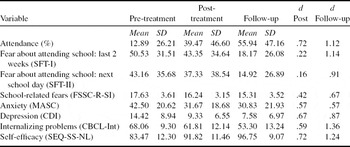
Outlier analyses were conducted to identify cases that might have large influences on the parameters of the regression model. An outlier was defined as any case having a standardized df ß above 2 (Stevens, Reference Stevens2002). Investigation of standardized df ßs revealed that the values of all cases were below 2. Thus, no meaningful outliers were found. Table 1 presents the means and standard deviations for all variables at pre-treatment, post-treatment, and 2-month follow-up. Increases in self-efficacy were accompanied by an increase in school attendance and decreases in school-related fear, anxiety, depression, and parent-reported internalizing behaviour. The average effect size (Cohen's d) of the improvements between pre-treatment and post-treatment was .51. Between pre-treatment and follow-up the average effect size of improvements was .99.
Means and standard deviations of outcome variables and mediator variable at pre-treatment, post-treatment, and 2-month follow-up

Notes: SFT = School Fear Thermometer; FSSC-R-SI = Fear Survey Schedule for Children-Revised, School Items; MASC = Multidimensional Anxiety Scale for Children; CDI = Children's Depression Inventory; CBCL-Int = Child Behavior Checklist, Internalizing Problems T score; SEQ-SS-NL = Self-Efficacy Questionnaire for School Situations- Dutch Version
Mediator analyses for CBT outcomes
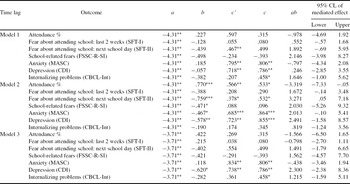
The results of the mediation analyses are presented in Table 2. In all three models, self-efficacy increased across participants, as indicated by significant a paths. Changes in self-efficacy from T1 to T2 were not related to any of the outcome measures at T3 (b paths, Model 1). Changes in self-efficacy from T1 to T2 were significantly related to outcome with respect to school attendance, school-related fear, anxiety, and depression at T2 (significant b paths, Model 2). Changes in self-efficacy from T1 to T3 were significantly related to outcome with respect to depression at T3 (significant b path, Model 3). Significant ab paths supported mediation in two instances. This is seen in Table 2 (Model 2) whereby the asymmetric confidence limits (CL) that did not include zero indicated the significance of an ab path. Thus, increases in self-efficacy at post-treatment significantly mediated post-treatment increases in school attendance and decreases in fear about attending school the next day. Finally, significant c’ paths related to these two results were consistent with self-efficacy partially mediating post-treatment school attendance and fear about attending school the next day. When reciprocal mediation models were tested (i.e. school attendance and fear about attending school as the mediators and self-efficacy as the outcome), significant a and b paths were found for fear of school as a mediator of self-efficacy outcome, but the product of these paths was not significant, indicating no significant mediation relation.
Summary of the mediation effects (self-efficacy as mediator) for two- and three-wave longitudinal mediation models

Notes: SFT School Fear Thermometer; FSSC-R-SI = Fear Survey Schedule for Children-Revised, School Items; MASC = Multidimensional Anxiety Scale for Children; CDI = Children's Depression Inventory; CBCL-Int = Child Behavior Checklist, Internalizing Problems T score; Model 1 = CBT->T2 mediator->T3 outcome, Model 2 = CBT->T2 mediator->T2 outcome, Model 3 = CBT->T3 mediator ->T3 outcome; p*<.05, p**<.01, p***<.001
As indicated by asymmetric CL that did include zero, none of the results from the other two models were shown to be significant. Thus, changes in self-efficacy between pre- and post-treatment were not found to be associated with changes in treatment outcome at 2-month follow-up (Model 1), and changes in self-efficacy between pre-treatment and 2-month follow-up were not found to be associated with changes in treatment outcome at 2-month follow-up (Model 3).
Discussion
The present study is, to the best of our knowledge, the first to address the question of how CBT for school refusal works. In effect, this is also the first study to examine the broader question of whether self-efficacy mediates the outcome of CBT for internalizing problems in youth. The study made use of statistical approaches for studying mediation in small samples in the absence of a control condition (MacKinnon, Reference MacKinnon2008). It was assumed that increases in self-efficacy would mediate the effects of CBT on primary outcomes (school attendance; school-related fear; anxiety) and secondary outcomes (depression; internalizing behaviour) for adolescent school refusers with an anxiety disorder. The findings support the notion that self-efficacy mediates the post-treatment effects of CBT with respect to increased school attendance and reduced school-related fear. Reciprocal mediation analyses indicated that increased school attendance and reduced school-related fear did not mediate increases in self-efficacy. No evidence was found for the mediating role of self-efficacy at 2-month follow-up.
The finding that self-efficacy mediated outcomes at post-treatment is consistent with several studies investigating cognitive mediators of outcome for youth internalizing problems. That is, post-treatment decreases in the negative self-statements of anxious youth (Kendall and Treadwell, Reference Kendall and Treadwell2007; Treadwell and Kendall, Reference Treadwell and Kendall1996) and in the negative automatic thoughts of depressed youth (Kaufman, Rohde, Seeley, Clarke and Stice, Reference Kaufman, Rohde, Seeley, Clarke and Stice2005) have been found to mediate CBT outcome at post-treatment. The cognitive construct of self-efficacy is now also associated with enhanced treatment outcome, alongside the construct of negative cognitive content (i.e. self-statements and automatic thoughts). Even a relatively small change in self-efficacy (i.e. an increase in the mean SEQ-SS-NL score, from 83.5 to 91.8) appears to be sufficient to enhance post-treatment outcome. This represents a change in the mean item score from 3.6 (i.e. between “maybe” and “probably could”) to 4.0 (i.e. “probably could”). Although this change is small, numerically, it may be the sort of clinically-relevant cognitive change required to increase school attendance and reduce school-related fear.
Significant post-treatment mediation effects were found for two of the primary outcome variables, namely school attendance and fear about attending school (SFT). Such effects were not found for the other primary outcome variables (i.e. fears related to diverse school situations [FSSC-R-SI]; self-reported anxiety [MASC]) or for the secondary outcome variables (i.e. self-reported depression [CDI]; parent-reported internalizing behaviour [CBCL]). It could be argued that increased self-efficacy for handling situations related to school attendance had an effect on the two measures that are most closely connected with the phenomenon of school refusal - the amount of time spent at school and fear associated with school attendance. This may point to specificity in the mechanisms of change during CBT for school refusal, in much the same way that Chu and Harrison (Reference Chu and Harrison2007) suggested that there may be anxiety-specific and depression-specific mediators of CBT outcome for youth with either an anxiety disorder or a depressive disorder. That is, CBT for school refusal may work predominantly because it helps young people to feel more confident about being at school per se. It is also conceivable that a more general measure of self-efficacy (i.e. self-efficacy not specific to school situations) may have yielded significant mediation effects at post-treatment with respect to self-reported anxiety and depression and parent-reported internalizing behaviour.
With regard to school-related fear, significant mediating effects were only found for fear about attending school the next day (SFT-II). Effects were not found for the highest level of fear about attending school during the past 2 weeks (SFT-I) nor for the general presence of fears related to diverse school situations (FSSC-R-SI). This may be explained by the fact that a sense of self-efficacy is usually related to engagement in future behaviours (Bandura, Reference Bandura, Ramachaudran and Friedman1994), and the SFT-II was the only measure that specifically focused on an imminent situation (i.e. attending school the next day).
The second two-wave model and the three-wave model indicated that self-efficacy did not mediate treatment outcomes at follow-up. This might be explained in several ways. First, the smaller sample size at follow-up relative to post-treatment (i.e. n = 19 at post-treatment and n = 15 at follow-up) may have reduced the likelihood of finding mediating effects. Second, with regard to the three-wave model, it is possible that the spacing of assessment points (i.e. between pre-treatment, post-treatment, and 2-month follow-up) was inadequate to capture a temporal sequence of change in self-efficacy causing change in functioning at 2-month follow-up. Third, it is possible that self-efficacy is instrumental in achieving increased school attendance (i.e. our results at post-treatment), but thereafter other factors may be instrumental in maintaining regular school attendance. These other factors may include, for example, positive experiences with peers and school staff. It has also been suggested that treatment outcomes at follow-up may be mediated by youths’ use of skills acquired during treatment (Alfano et al., Reference Alfano, Pina, Villalta, Beidel, Ammerman and Crosby2009; Kaufman et al., Reference Kaufman, Rohde, Seeley, Clarke and Stice2005). Future treatment outcome studies should directly test the hypothesis that different variables mediate immediate and delayed outcomes.
Two limitations associated with the current study deserve particular attention. First, in the absence of a wait-list control condition, it is possible that the post-treatment changes observed in self-efficacy, school attendance, and fear about attending school the next day were attributable to the passage of time rather than to the effects of the CBT per se. However, in a prior controlled evaluation of CBT for school refusal, the treatment group was observed to have higher post-treatment self-efficacy and school attendance and lower fear about attending school, relative to the wait-list control group, even when controlling for pre-treatment scores (King et al., Reference King, Tonge, Heyne, Pritchard, Rollings and Young1998). Further, our use of an adaptation of a product of coefficient test method for single conditions accounted, at least in some part, for the lack of a comparison condition, through the test of the effect of path a as the change on a baseline measure between the waves.
A second limitation concerns the absence of a psychological placebo control condition that would control for the non-specific aspects of CBT (e.g. the therapeutic alliance). Currently, it remains unclear as to whether the CBT-specific aspects of intervention (e.g. cognitive therapy; graded exposure to school attendance) were responsible for the observed change in self-efficacy as opposed to the non-specific aspects of intervention. Treatment designs such as those comparing CBT with psychological placebo conditions controlling for the non-specific aspects of CBT (e.g. Hudson et al., Reference Hudson, Rapee, Deveney, Schniering, Lyneham and Bovopoulos2009; Last et al., Reference Last, Hansen and Franco1998; Silverman et al., Reference Silverman, Kurtines, Ginsburg, Weems, Rabian and Serafini1999) are needed for a fuller understanding of cognitive mediation of CBT outcome (Hudson, Reference Hudson2005).
While the design of the current study allowed for a test of the temporal precedence of the mediator, a better test of temporal precedence would be facilitated via a design in which there are more frequent assessment points, including assessment during the active phase of treatment. (For examples of such designs, see DeRubeis et al., Reference DeRubeis, Evans, Hollon, Garvey, Grove and Tuason1990; DeRubeis and Feeley, Reference DeRubeis and Feeley1990; Moscovitch, Hofmann, Suvak and In-Albon, Reference Moscovitch, Hofmann, Suvak and In-Albon2005). Future mediation studies could also employ single-subject designs to capture the multiple mechanisms that are likely to be related to each young person's functioning (MacKinnon, Reference MacKinnon2008). This may be especially relevant when investigating intervention for school refusers, given the heterogeneity associated with this population (Heyne and King, Reference Heyne, King, Barrett and Ollendick2004). Qualitative data gathered at post-treatment (e.g. asking clients “What was most helpful for you in preparing for a return to school?”) could provide unique insights into the process of the treatment (Dworkin, Exner, Melendez, Hoffman and Ehrhardt, Reference Dworkin, Exner, Melendez, Hoffman and Ehrhardt2006; MacKinnon Reference MacKinnon2008). Developmental considerations also merit further attention. We examined self-efficacy as a mediator of CBT outcome for school refusal among adolescents, and it remains to be seen whether CBT operates through different (cognitive) mechanisms in younger versus older school refusers. Indeed, there is support for age-related differences in cognitive processing (Abela and Hankin, Reference Abela, Hankin, Abela and Hankin2008), and receptivity to cognitive therapeutic techniques will vary according to cognitive developmental level (Sauter, Heyne and Westenberg, Reference Sauter, Heyne and Westenberg2009).
The treatment reported on in the current study appeared to be effective. As noted by Heyne et al. (Reference Heyne, Sauter, van Widenfelt, Vermeiren and Westenberg2011), significant and maintained improvement was observed across primary and secondary outcomes, with medium to large effect sizes. Moreover, half of the adolescents were free of any anxiety disorder at follow-up. At the same time, for the treatment completer sample reported here, the average rate of school attendance at follow-up was just 56%. This modest outcome underscores the point that adolescent school refusal is difficult to treat. However, the developmentally-sensitive CBT incorporated in the @school program may well be more effective than a standard CBT as trialed in Bernstein and colleagues’ (Reference Bernstein, Borchardt, Perwien, Crosby, Kushner and Thuras2000) study of school-refusing adolescents (Heyne et al., Reference Heyne, Sauter, van Widenfelt, Vermeiren and Westenberg2011). Importantly for the current mediation study, enhanced self-efficacy appears to contribute to the improvements, however modest they are.
In conclusion, the results suggest that post-treatment increases in school attendance and decreases in fear about attending school the next day were mediated by increases in self-efficacy for handling situations associated with school attendance. The fact that reductions in fear about attending school and increases in school attendance depended, to some extent, upon an enhanced belief in one's ability to engage in school-attending behaviours suggests the importance of targeting self-efficacy during treatment for school refusal. Preventive interventions in educational settings might also target self-efficacy related to the range of situations associated with school attendance. Methodologically, the current study suggests that those methods that have been used to establish mediation effects in larger samples (i.e. product of coefficient test and asymmetric confidence intervals) can be implemented with smaller samples. This is an important development, because small samples are common in youth intervention research (e.g. MacKinnon, Reference MacKinnon2008), and because statistical challenges are one of the most important obstacles to the study of mediation of youth treatment outcomes (e.g. Holmbeck, Reference Holmbeck1997; Weersing and Weisz, Reference Weersing and Weisz2002).
Conflict of interest
The authors declare that they have no conflict of interest.
Acknowledgements
The authors wish to thank the following past and present staff of Curium for their support of this study: Professor Philip D. A. Treffers, Professor Robert Vermeiren, Mr Bart Siebelink, Ms Rita Snel, Ms Babette van Spijker, Ms Marieke Schimmel, Ms Lisa Duizer, and Ms Ilja Dekker-van Halderen. We are also very grateful for the support of past colleagues in the Developmental and Educational Psychology Unit, Dr Floor Sauter and Ms Rachel van Hout.
This study was supported by the Netherlands Organization for Scientific Research (NWO) grant awarded to the first author (project number 017.002.035).



Comments
No Comments have been published for this article.