Introduction
Recently Mark et al. (Reference Mark, Saag, Leavitt, Will-Wolf, Nelsen, Tõrra, Saag, Randlane and Lumbsch2016) published a phylogenetic study of the genus Usnea, comparing morphological and molecular data. These authors analyzed, among other taxa, three specimens identified as U. praetervisa (Asahina) P. Clerc. This species is morphologically close to U. subfloridana Stirt., differing mainly by the presence of norstictic acid in the medulla instead of thamnolic and/or squamatic acids in the latter species (Clerc Reference Clerc2004; Ohmura Reference Ohmura2012). The position of U. praetervisa close to the U. dasopoga-U. barbata group and not to the U. subfloridana group in the proposed phylogenetic tree was therefore a surprise. The study of the voucher specimens to check the identification of U. praetervisa showed that all three specimens were in fact misidentified, having no morphological or anatomical resemblance to U. praetervisa. But the real surprise was that these specimens corresponded morphologically exactly to a morphotype that we have known for many years and tentatively named U. diplotypus Vain. or U. “alectorialica” (herbarium name) since the main diagnostic compound of this morphotype is alectorialic acid, a rare substance in the genus Usnea. It was first mentioned by Clerc (Reference Clerc1987) and was included in the concept of U. diplotypus by Clerc in Wirth (Reference Wirth1995). Its frequent occurrence in previously polluted areas recently colonized by Usnea species in Germany was mentioned by Otte & Landeck (Reference Otte and Landeck2012) under “U. diplotypus Alectorialsäure-Chemotyp”. Its chemistry, including the degradation products of alectorialic acid detectable by thin-layer chromatography (TLC) and high-performance liquid chromatography-mass spectrometry (HPLC-MS), was recently studied in detail by Zakeri et al. (Reference Zakeri, Elix and Otte2017). The same morpho- and chemotype was keyed out to probably represent an undescribed species in Clerc (Reference Clerc2013) as “U. dasopoga s. l.”. The problem was, however, that Mark et al. (Reference Mark, Saag, Leavitt, Will-Wolf, Nelsen, Tõrra, Saag, Randlane and Lumbsch2016) found the stictic acid group in all three specimens of their “U. praetervisa” which was probably the reason for their false identification.
When we analyzed these three specimens again with TLC, no trace of the stictic acid group was found but instead alectorialic acid and its degradation products (see Zakeri et al. 2017). Until now we have refrained from describing this morphotype with alectorialic acid as a distinct taxon because of some seemingly intermediate forms with U. dasopoga (Ach.) Nyl. or U. subfloridana Stirt. However, the strong support in the phylogenetic tree and the SMC analysis of Mark et al. (Reference Mark, Saag, Leavitt, Will-Wolf, Nelsen, Tõrra, Saag, Randlane and Lumbsch2016, Fig. 1) indicates that this morphotype deserves to be described and this is the aim of the current study. Furthermore, the new species described in the same paper by Mark et al., U. parafloridana Mark et al. with norstictic acid and positioned close to the U. subfloridana group, corresponds both morphologically and chemically with the true U. praetervisa and is thus synonymized here with this taxon.
Material and Methods
This work is based on field studies and herbarium specimens deposited in the following herbaria: DR, G, GLM, LBL, S, TU and TNS. The species concept used in this study follows Clerc (Reference Clerc1998). The morphology of specimens was examined using a Leica MS5 stereomicroscope. Anatomical measurements (%CMA) of the cortex (C), medulla (M) and central axis (A), as well as the ratio of the thickness of axis/medulla (A/M), were established according to Clerc (1984, Reference Clerc1987); mean values are given in italics. Analyses of the anatomical structure of the cortex were made according to Ohmura (Reference Ohmura2001), on thin hand-cut sections and observed at×400 magnification with a Leica DM2000 microscope. Most of the material was studied using thin-layer chromatography (Culberson & Ammann Reference Culberson and Ammann1979) with solvent B modified according to Culberson & Johnson (Reference Culberson and Johnson1982). Many specimens were analyzed with TLC by Urs Groner in the framework of the Swiss Lichens Red Data List project (Scheidegger & Clerc Reference Scheidegger and Clerc2002). K, C, KC and P spot tests, according to Hale (Reference Hale1979), were directly applied to the medulla in longitudinal sections of the branches. Among the specimens seen in this study, four were included in the molecular phylogeny of Mark et al. (Reference Mark, Saag, Leavitt, Will-Wolf, Nelsen, Tõrra, Saag, Randlane and Lumbsch2016): DIP_15, SUB_53, SUB_60 (all three as “U. praetervisa”) and WW_018 (holotype of U. parafloridana Mark et al.).
Results
Usnea viktoriana P. Clerc & Otte sp. nov.
MycoBank No.: MB 824601
Similar to U. dasopoga but differing by its shrubby to subpendant thallus at maturity, the soralia fusing into larger and irregular, ±efflorescent aggregates covered by numerous, long, thin, fragile, irregularly shaped and fasciculate isidiofibrils, the slightly swollen branch segments and the presence of alectorialic acid in the soralia.
Type: Italy, Trentino, 3 km NE from Tonadico, Val Canali, 1060 m, 46°11′55″N, 11°51′59″E, forest edge, on Betula pendula, 9 June 2010, Tiiu Tõrra (TU76471—holotype!). Chemistry: usnic acid, alectorialic acid and 5,7-dihydroxy-6-methylphthalide (TLC: Clerc 2017/12). %CMA: 9/21/39, A/M=1.8. DNA isolate: GenBank Accession numbers: KU352663 (ITS), KU352531 (IGS), KU352386 (Beta-tubulin), KU352244 (Mcm7). KU352089 (RPB1) and KU351937 (RPB2) (ex U. praetervisa) in Mark et al. (Reference Mark, Saag, Leavitt, Will-Wolf, Nelsen, Tõrra, Saag, Randlane and Lumbsch2016).
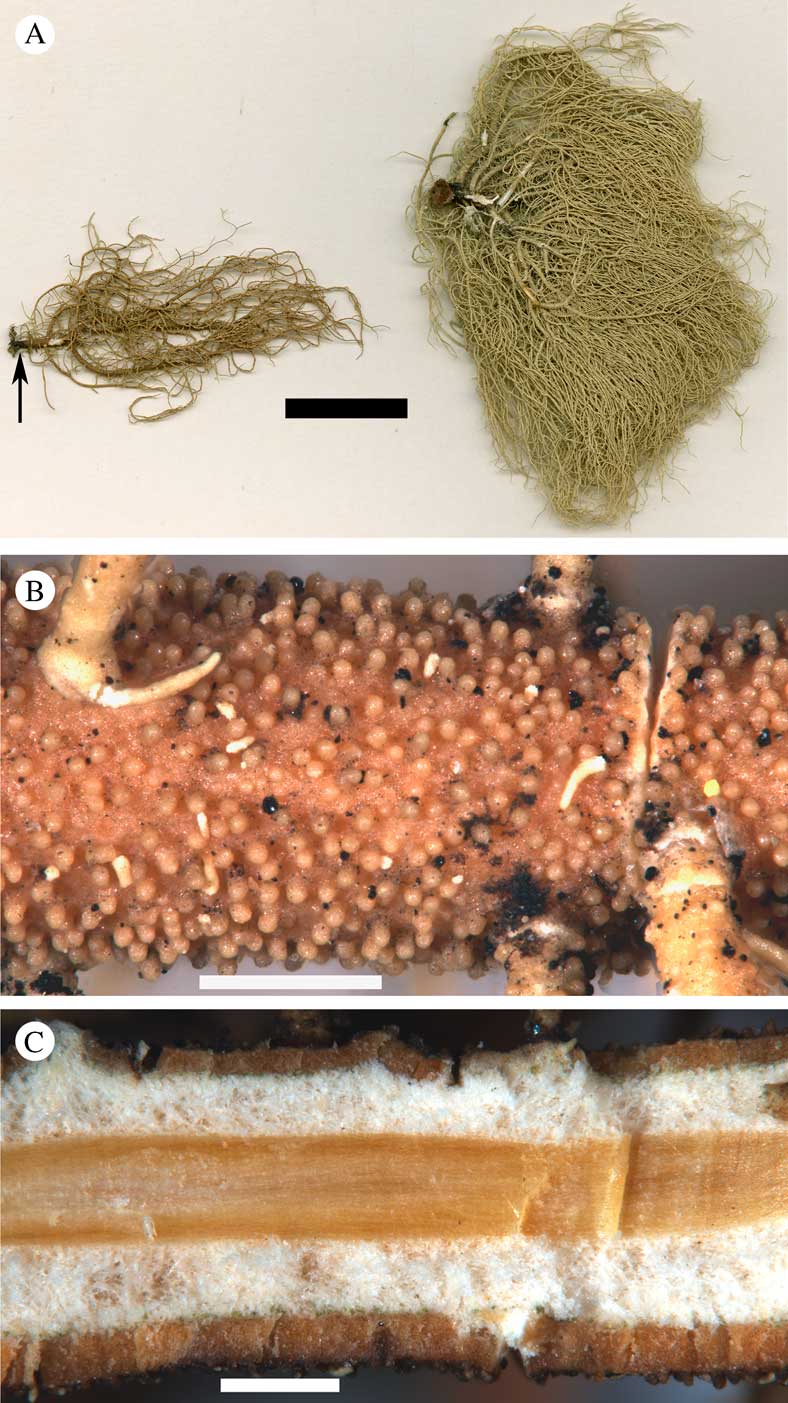
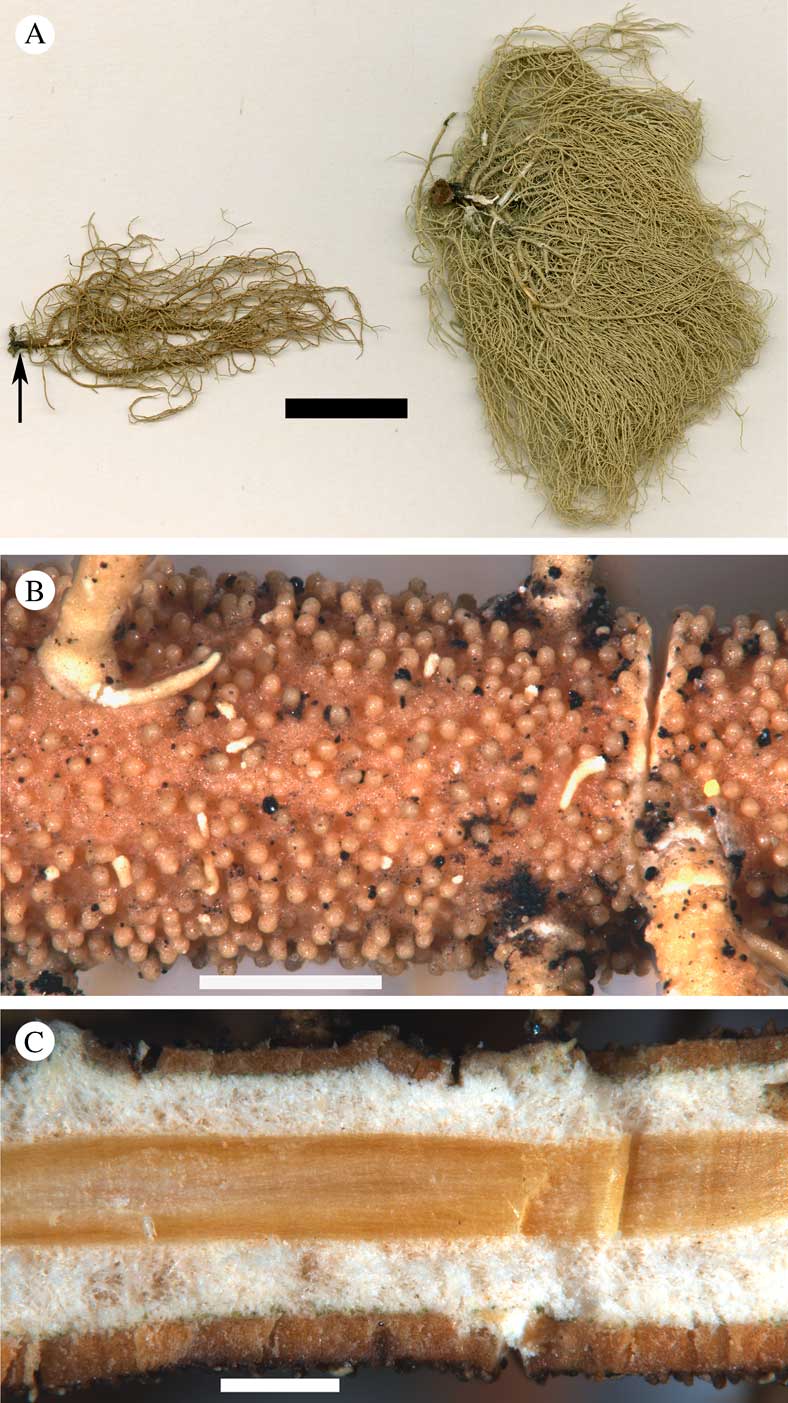
Usnea viktoriana. A, left, thallus with few ramifications, arrow pointing at the black base (G68362) and right, densely ramified thallus (holotype); B, papillae on main branch (G58839); C, section of branch (G68651). Scales: A=2 cm; B & C=500 µm. In colour online.
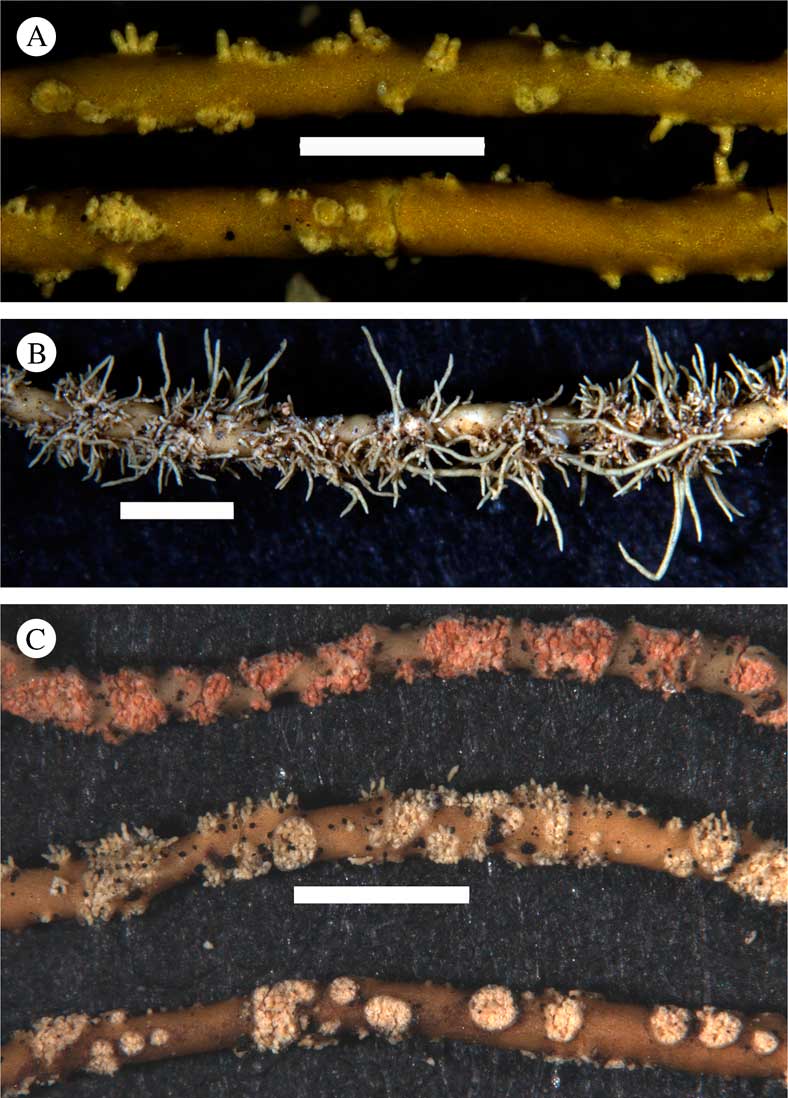
Usnea viktoriana. A, young soralia with short isidiomorphs (G60032); B, mature soralia with isidiomorphs and long isidiofibrils (G60032); C, overmature soralia (G68651). Scales: A=500 µm; B & C=1 mm. In colour online.
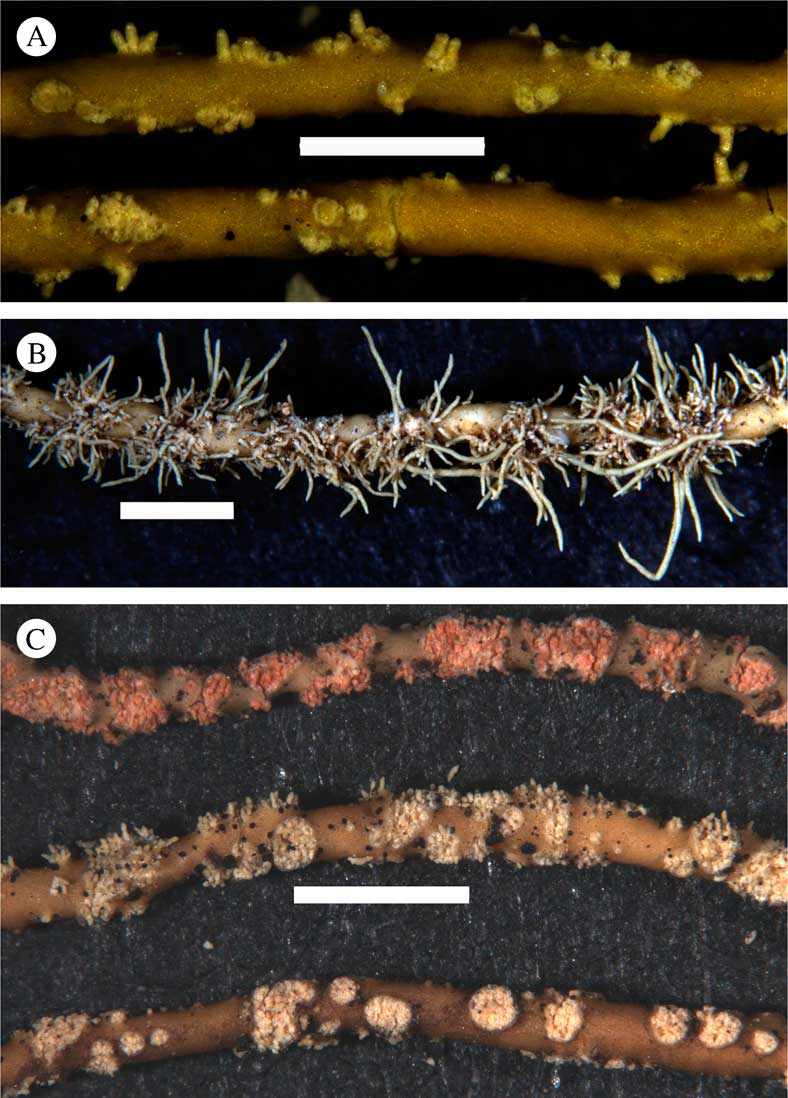
Thallus shrubby to subpendulous with basal branches distinctly spreading laterally, up to 15 cm (Fig. 1A); ramification anisotomic-dichotomous; trunk always black pigmented on 1–3 mm, usually thinner at the contact point with the bark and then slightly enlarging towards the main branches; main branches slightly irregular to cylindrical, sometimes short and dividing quickly into secondary branches (thallus shrubby), or remaining clearly visible (thallus subpendulous), segmentation inconspicuous with thin annulations, 0·6–2·0 mm thick (average 1·2 mm); segments cylindrical or slightly swollen; lateral branches not constricted at ramification point; foveolae, maculae and pseudocyphellae absent; papillae always present on main branches, numerous, short verrucose to almost cylindrical, 35–50× 50–90 µm (Fig. 1B); tubercles absent; fibrils few and scattered to rarely numerous on some young branches; fibercles absent to rare; soralia on apices and thin lateral branches, punctiform and circular when young (Fig. 2A), later fusing together and forming aggregates looking like large and irregularly shaped soralia, usually even with the cortex and efflorescent (due to the presence of numerous isidiomorphs and isidiofibrils), sometimes excavate on thin apices or larger branches when overmature (Fig. 2C), borne on the cortex ad initio; isidiomorphs numerous, usually covering young soralia (Fig. 2A), 50–150 µm long; isidiofibrils numerous, usually covering mature soralia aggregates, often fasciculate, fragile and irregularly shaped (Fig. 2B), 250–700 µm long; cortex matt, moderately thick, with ceratina-type plectenchyma (Fig. 1C); medulla dense, unpigmented, moderately thin to moderately thick (Fig. 1C); axis unpigmented, moderately thin to moderately thick (Fig. 1C). CMA: %C=(6·0–)7·0–8·5–10·0(–13·0); %M=(10·0–)18·0–22·5–27·0(–30·5); %A=(26·0–)30·5–38·0–45·5(–62·0) (n=100). A/M=(0·8–)1·0–1·9–2·8(–6·2) (n=100).
Apothecia rare, subterminal, small, up to 5 mm diam.; ascospores 8× 5 µm.
Pycnidia not seen.
Chemistry. Three chemotypes were found in U. viktoriana (n=100, 3 KC− specimens were not analyzed with TLC):
1) Soralia: K−, C+ pinkish-reddish, KC+ pinkish-reddish: alectorialic acid and 5,7-dihydroxy-6-methylphthalide (78% of the specimens studied)
2) Soralia: K+ orangish-reddish, KC−: salazinic±barbatic acids (11%)
3) Soralia: K−, KC−: no medullary compounds seen with TLC (9%)
Etymology. Named after Viktoria, the beloved granddaughter of the first author.
Distribution and ecology. Corticolous, exceptionally saxicolous. In many regions U. viktoriana occurs mainly in the mountains between (300–)1000–1900(–2000) m elevation, in forests dominated by Picea or in different kinds of mixed forest, more rarely in pastures or in peatlands. However, it is also common in those parts of the northern German lowlands with poor sandy soil, with high forest cover and less intensive agriculture. Usnea viktoriana grows mainly on Picea abies (35% of the specimens studied), Acer spp. (16%), Larix decidua (14%), Abies spp. (12%), Alnus spp. (6%), Pinus spp. (4%), Quercus spp. (3%) and other tree species (10%). It commonly grows with U. substerilis Motyka (25% of the specimens studied), U. perplexans Stirt. (18%), U. subfloridana Stirt. (15%), U. hirta (L.) Wigg. (14%), U. dasopoga (11%), U. barbata (9%) and other species (9%). This set of accompanying species, with U. substerilis and U. perplexans as the most frequent companion species, indicates a clear continental tendency in the distribution of U. viktoriana. In Europe, U. viktoriana is known to occur in Austria (Steiermark, Tirol), the Czech Republic (Ore Mts, SW Moravia), France, Germany (Allgäu, Böhmerwald, Ore Mts and northern German lowlands), Italy (Trentino, type locality), Liechtenstein, Poland (Sudetes Mts and in the lowlands), Romania (Carpathians), Russia and Switzerland (Jura Mts, Prealps and Alps). Most of the specimens identified as U. diplotypus in the Red List of Swiss lichens (Scheidegger & Clerc Reference Scheidegger and Clerc2002) have alectorialic acid and correspond to U. viktoriana. It is also known to occur in Turkey (Trabzon Province) and Russia (Northern Caucasus Mts). It is likely to be much more widespread. We have not been able to locate any specimens from Scandinavia. Additionally, Halonen et al. (Reference Halonen, Myllys and Petrova1999) mention the absence of alectorialic acid-containing “U. diplotypus” in eastern Fennoscandia, in contrast to the salazinic acid-containing “U. diplotypus” (= U. dasopoga in Scandinavia, see Clerc Reference Clerc2011).
Variability. In this species, life form and density of ramifications are highly variable (Fig. 1A). Some specimens are subpendulous with one or two distinct main branches displaying a small number of lateral branches and ramifications. Other specimens are shrubby and compact with numerous ramifications without distinct main branches. The density of isidiomorphs and isidiofibrils might vary too (Figs 2A–C), especially on overmature specimens where most of these structures are shed (Fig. 2C, uppermost branch).
Discussion. The type of U. viktoriana and two other specimens collected in Switzerland and identified as U. praetervisa were sequenced for six loci and analyzed in a phylogenetic Bayesian context by Mark et al. (Reference Mark, Saag, Leavitt, Will-Wolf, Nelsen, Tõrra, Saag, Randlane and Lumbsch2016). In the six concatenated loci tree, all three specimens clustered in a strongly supported monophyletic group called “praetervisa” (Mark et al. Reference Mark, Saag, Leavitt, Will-Wolf, Nelsen, Tõrra, Saag, Randlane and Lumbsch2016, Fig. 1) with a weak sister relationship with a “barbata-chaetophora-dasopoga-diplotypus” group. In the STACEY SMC-tree, the same three specimens formed a minimal distinct cluster with strong support (PP=1) (Mark et al. Reference Mark, Saag, Leavitt, Will-Wolf, Nelsen, Tõrra, Saag, Randlane and Lumbsch2016, Fig. 1). All three specimens were said to have norstictic acid as the major compound (Mark et al. Reference Mark, Saag, Leavitt, Will-Wolf, Nelsen, Tõrra, Saag, Randlane and Lumbsch2016) which most probably was responsible for their identification as U. praetervisa since this taxon effectively contains norstictic acid as the major compound (Clerc Reference Clerc2004). However, on repeating the TLC analysis of these specimens we found alectorialic acid in all three instead of norstictic or stictic acids. The distinct morphology of these three specimens, as well as the presence of alectorialic acid as the major compound, corresponded well to a distinct morphotype present in G under the herbarium name U. “alectorialica” ad int. (specimens mostly collected by E. Frey) or under “U. diplotypus” sensu P. Clerc (specimens from the Red List of threatened epiphytic lichens of Switzerland, see Scheidegger & Clerc Reference Scheidegger and Clerc2002). This morphotype was awaiting further study, in particular molecular studies. The strong support shown in the molecular tree of Mark et al. (Reference Mark, Saag, Leavitt, Will-Wolf, Nelsen, Tõrra, Saag, Randlane and Lumbsch2016) leads us to describe a new species based on morphological, anatomical, chemical and molecular data.
It might seem risky to describe a new species in this group of European Usnea species (the U. barbata-dasopoga group) in which so many taxa have already been named (see Motyka 1936–Reference Motyka1938). However, two arguments might speak in favour of a new taxon: 1) the C+red, KC+red soralia are not mentioned in any description of European species and none of the many types studied showed such reactions; 2) one could imagine that the salazinic acid chemotype, and not the alectorialic acid chemotype, was described in the past as a new species. However, the characteristic aggregated soralia with long, thin isidiofibrils could not be observed in any of the selected types of European species examined in this study.
For 78% of the more than 100 specimens studied, identification is unambiguous: the C+, KC+red reactions of the soralia indicating the presence of alectorialic acid is diagnostic. It is interesting to note here that when herbarium specimens are old enough, the paper of the specimen’s envelope turns reddish, further indicating the presence of alectorialic acid in the lichen. Alectorialic acid is not a common substance in European Usnea species. Except for the taxon described here, it is so far known only in the apothecia of the species pair Usnea florida-U. subfloridana (Clerc Reference Clerc1984). Clerc (Reference Clerc1987) mentioned this compound for a third species, as a chemotype of U. diplotypus Vain. which corresponds to U. viktoriana. Alectorialic acid is more common in Africa where it has been stated as present in U. exasperata (Müll. Arg.) Motyka (Swinscow & Krog Reference Swinscow and Krog1978), U. bicolorata Motyka, U. maculata Stirt., U. ruwenzoriana Motyka and U. submollis Steiner (Swinscow & Krog Reference Swinscow and Krog1979). In U. bicolorata and U. submollis, alectorialic acid might occur together with salazinic and/or barbatic acids (Swinscow & Krog Reference Swinscow and Krog1979). Interestingly, the presence of alectorialic acid seems to be linked to dispersal, both sexual (e.g. U. florida, see Clerc Reference Clerc1984) and asexual (e.g. U. bicolorata, see Swinscow & Krog Reference Swinscow and Krog1979). In U. viktoriana, alectorialic acid was found in high concentration in the soralia. Although the medulla usually reacts KC−, we were not able to test whether alectorialic acid was certainly absent.
The salazinic acid chemotype and chemotype 0 (20% of the specimens analyzed) are shared with other morphologically similar species producing isidiomorphs. Usnea barbata (L.) F. H. Wigg. is usually distinctly pendulous, with strongly irregular branches showing depressions in the cortex and with soralia that do not usually fuse together. The isidiomorphs are short and never numerous (one or two in each soralia) and isidiofibrils are absent. Usnea dasopoga (syn. U. diplotypus, see Clerc Reference Clerc2011) is usually distinctly pendulous with cylindrical, rarely slightly swollen segments. The soralia of this species usually do not fuse together in aggregates but remain isolated, arising on top of fibercles or on the cortex ad initio. When isidiofibrils are present, they are usually shorter, not so fragile and of irregular shape, as they are in U. viktoriana, but usually more robust and even in shape. Furthermore, the cortex of U. dasopoga is on average thicker (9–13%) and the medulla thinner (13–22%). Usnea glabrescens (Vain.) Vain. has tapering branches with cylindrical segments, large circular soralia that do not fuse together, with few short isidiomorphs and usually norstictic acid as the main substance and salazinic acid as an accessory substance. Usnea hirta (L.) F. H. Wigg. has no papillae, main branches with distinct foveoles or depressions in the cortex, a basal part that is never black pigmented and often fatty acids of the murolic group in the medulla. Usnea perplectans Stirt. (syn. U. lapponica Vain., see Clerc 2016) shares with U. viktoriana the presence of salazinic acid but has large and excavated soralia without isidiomorphs. Usnea substerilis Motyka has irregular branches and enlarging soralia that do not merge together, and rarely with short isidiomorphs not developing into isidiofibrils. Usnea wasmuthii Räsänen has larger, more or less concave soralia becoming oval longitudinally, isidiomorphs that are usually present only in young soralia, never developing into isidiofibrils, and a basal part usually with small longitudinal cracks; together with salazinic acid, U. wasmuthii often contains barbatic acid. Finally, U. subfloridana might be morphologically quite similar to U. viktoriana but the former species has tapering branches and short isidiomorphs, on average a thinner medulla (12–20%) and a larger central axis (41–57%). Furthermore U. subfloridana never produces alectorialic acid or salazinic acid in the medulla and soralia. However, since alectorialic acid is found in apothecia of U. florida and since U. subfloridana is its sorediate counterpart, alectorialic acid can sometimes be found in apotheciate individuals of U. subfloridana (Clerc Reference Clerc1984).
We were not able to find any morphological or anatomical correlations that would allow us to separate the alectorialic acid chemotype from the salazinic acid chemotype. However, further molecular studies with more material will be needed to see whether the salazinic acid chemotype deserves a taxonomic rank.
Selected specimens examined.
1. Usnic acid, alectorialic acid chemotype: Austria: Kärnten: Hermagor-Eggeralm, 1250 m, 1931, E. Frey 13396 (G-262432). Steiermark: Nördliche Kalkalpen, Mürzsteger Alpen, W der Schneealpe, NW von Neuberga an der Mürz, Hinteralm, W der Wiener-Lehrer-Hütte, 1380 m, 2004, P. Bilovitz 3579 & H. Mayrhofer (G-262408). Tirol: Osttirol, Ködnitztal am Grossglockner Rainer, 1600 m, 1931, E. Frey 6766 (G-262428).—Czech Republic: SW Moravia: Trebic District, Mikulovice, Mikulovicka hora hill, 570 m, 2014, J. Soun 1000 (hb. J. Soun). Ustecký kraj: Erzgebirge bei Český Jiřetín, östlich von Horný Ves (Oberdorf), 700 m, 22 vi 2011, V. Otte (GLM-L-29464).—France: Savoie: Bionnassay, Les Bettières, 1400 m, 20 viii 2011, V. Otte (GLM-L37303).—Germany: Bayern: Allgäu, Hotzen bei Unterjoch, 1200 m, 27 xii 1967, K. Kalb s. n. (G262434). Brandenburg: Niederlausitz, westlich von Schipkau, Kiefernforstkomplex auf der Hochkippe Schipkau, 150 m, 31 x 2016, V. Otte s. n. (G-262417). Sachsen: Rittersgrün, 14 v 2012, C. Päßler (GLM-L40000).—Italy: Trentino-Alto Adige: Via M. O. F. Seratini, 20 km SE von Bozen, 1625 m, 20 viii 2013, V. Herklotz (GLM-L-37502).—Liechtenstein: Mauren: Unteres Saminatal, Gemeindewald, 1300 m, 19 vi 1988, P. Clerc s. n. (G-00262430).—Poland: Województwo Dolnośląskie: Isergebirge, c. 750 m, 24 v 2015, V. Otte (GLM-L-39463).—Romania: Braşov: Abstieg von Culmea Tiganestilor nach Bran, 23 vii 1973, P. A. Schmidt (GLM-L-23525).—Russia: Adygheya: Kaukasus, Naturpark “Bol’šoj Thač”, am Wege unterhalb der Poljana Knjažeskaja, 1620 m, 27 viii 2003, V. Otte (GLM-L-23573).—Switzerland: Canton Bern: Gurnigel, 1568 m, 15 v 2011, T. Törra s. n. (TU-76469). Canton Fribourg: Cerniat, Le Frachy, 1180 m, 1995, U. Groner 1426 (G-60051). Canton Graubünden: S-Chanf, God Fullun, 1700 m, 1995, M. Frei 2585 (G-60061). Canton Luzern: Eigental, oberer Rand des Stösswaldes unterhalb Krähgütsch, 1020 m, 1956, E. Frey 18794 (G-68514). Canton Schwyz: Muotathal, Bödmerenwald, 1354 m, 5 ii 2011, T. Törra s. n. (TU-76470). Canton Vaud: Bassins, 1335 m, 1998, C. Keller 11302 (G-60068).—Turkey: Trabzon: Kayabasi, 1850 m, v 2005, K. Yazici s. n. (G-262435).
2. Usnic acid, salazinic acid (± barbatic acid) chemotype: Switzerland: Canton Graubünden: Lumbrein, route de Lumbrein à Vrin, 1400 m, 1975, F. Page 1534 (G-59098). Canton Vaud: Préalpes vaudoises, Bex, La Peufaire sous Frenières, 735 m, P. Clerc 2448 (G-57145).
3. Usnic acid only (chemotype 0): Germany: Brandenburg: Lärchenjungbestand beim Vorwerk Bärenklau, 15 iii 2007, G. Erdmann & V. Otte (GLM-L-29991).—Switzerland: Canton Ticino: Leventina, Conca di Dalpe Alpe Piumogna am Fuss des Bosco Grande, 1400 m, 1963, E. Frey 25916 (G-262429). Canton Valais: Binntal, NE de Im Feld, 1600 m, 1982, F. Page 1162 (G-262431).
Usnea praetervisa (Asahina) P. Clerc
MycoBank No.: MB 370247
Biblioth. Lichenol. 88: 85 (2004); Usnea comosa subsp. praetervisa Asahina, Lichens of Japan III. Genus Usnea: 95 (1956); type: Japan, Honshu, Prov. Kai, Asahigaoka, lakeside of Yamanaka, Nakano-mura, 30.vii.1954, S. Kurokawa 540328 (TNS—lectotype). Chemistry: usnic and norstictic acids. %CMA: 7·5/16/53, A/M=3·3.—Usnea subfloridana subsp. praetervisa (Asahina) P. Clerc, Lichenologist 32: 83 (2000).
Usnea parafloridana K. Mark, Will-Wolf & Randlane Org. Divers. Evol. 16: 497–524 (2016); type: USA, Wisconsin, Vilas Co., Trout Lake Conifer Swamp State Natural Area, 27.viii.2011, Susan Will-Wolf WW14807 (TU—holotype). Chemistry: usnic and norstictic acids. %CMA: 5·5/22/45, A/M=2·1 (syn. nov.).
Description. See Clerc (2004, Reference Clerc2007) for a detailed description. Usnea praetervisa is characterized by the jet black pigmented basal part, the tapering branches with lateral branches not constricted at their ramification point, punctiform soralia with isidiomorphs, a thin medulla (13–19%) and a thick central axis (45–57%), and by the presence of norstictic acid in the medulla.
Discussion. Usnea praetervisa is morphologically and anatomically difficult to separate from U. subfloridana (Clerc 2004, Reference Clerc2007; Ohmura Reference Ohmura2012) and the most straightforward differential diagnostic character is the presence of norstictic acid in U. praetervisa instead of thamnolic or squamatic acids in U. subfloridana. Clerc (Reference Clerc2004) raised this taxon to species rank on the basis of subtle morphological and anatomical characters correlated with the presence of norstictic acid, but the question of whether U. praetervisa is a chemotype of U. subfloridana awaited molecular analysis. In their study, Mark et al. (Reference Mark, Saag, Leavitt, Will-Wolf, Nelsen, Tõrra, Saag, Randlane and Lumbsch2016) described a new species, U. parafloridana, which appears closely related to, but distinct from, U. subfloridana (Mark et al. Reference Mark, Saag, Leavitt, Will-Wolf, Nelsen, Tõrra, Saag, Randlane and Lumbsch2016, Fig. 1). Interestingly, U. parafloridana is characterized chemically by the presence of norstictic acid in the medulla. The study of the holotype of U. parafloridana shows that this specimen is part of the morphological and anatomical variability of U. praetervisa. Thus U. parafloridana shares the same chemical, morphological and anatomical characters as U. praetervisa and is synonymized here with this species. Usnea praetervisa is therefore confirmed as being a good species chemically and molecularly well separated from U. subfloridana Stirt. Usnea praetervisa is so far known to occur in Japan and China (Ohmura Reference Ohmura2001), Taiwan (Ohmura Reference Ohmura2012), Russia (Ohmura et al. Reference Ohmura, Skirina and Skirin2017), western (Clerc Reference Clerc2007) and eastern United States (Clerc Reference Clerc2004), France and Portugal (Clerc Reference Clerc2004), Spain (Fos & Clerc Reference Fos and Clerc2000) and India (Awasthi Reference Awasthi1986; specimens not seen).

The first author thanks Yamama Naciri (CJB) and Alice Gerlach (CJB, ICN) for fruitful discussions. We are further indebted to the curators of the cited herbaria, especially to Ave Suija (TU) for sending us thetype of U. parafloridana and to Jaroslav Soun (Czech Republic) for sending us specimens of U. viktoriana.