Introduction
Traditional medicines are the foundations of global health care. The World Health Organization (WHO) estimated that 80% of the African and Asian populations use traditional medicine as the first source for their health care needs (Oyebode et al. Reference Oyebode, Kandala, Chilton and Lilford2016). Severe modifications of human lifestyle and food habits have led to the emergence of various chronic pathologies such as cardiac and gastrointestinal ailments. In spite of their immense efficacy, worldwide acceptance and applicability, the administration of several synthetic drugs has resulted in increased side effects which in some cases may be lethal (Altissimi et al. Reference Altissimi, Colizza, Cianfrone, Vincentiis, Greco, Taurone, Musacchio, Ciofalo, Turchetta, Angeletti and Ralli2020). Moreover, there has been failure in the treatments of several chronic diseases due to the development of microbial resistance against specific synthetic drugs (Udaondo & Huertas Reference Udaondo and Huertas2020).
In this context, medicinal plants have played a major part in traditional medicine and have served as rich source of therapeutic agents for the treatment and prevention of various diseases all over the world; they occupy an important place in the sociocultural, spiritual and medicinal fields (Luardini et al. Reference Luardini, Asi and Garner2019). Medicinal plants are the ‘backbone’ of traditional medicine; more than 3.3 billion people in the developing countries utilise medicinal plants on a regular basis (Davidson-Hunt Reference Davidson-Hunt2000). These medicinal plants have been a rich source of active ingredients, which can be used in the drug development and synthesis (Tiwari Reference Tiwari2008). The use of traditional medicine and medicinal plants in most developing countries, as a normative basis for the maintenance of good health, has been widely observed (UNESCO 1996). In recent times, there has been a resurgence use of herbal medicines as an alternative to the conventional ones as the phytochemicals active in herbal medicine are perceived to have little or no adverse effects on human health (Miraj et al. Reference Miraj, Parveen and Chaudhari2020). The herbal medicine industry is gaining momentum with a growth of 20% per annum (Khan & Ahmad Reference Khan and Ahmad2019). According to WHO, by 2050, the market is expected to reach around 3 trillion US$/year (Khan & Ahmad Reference Khan and Ahmad2019). In India, there is a steadily growing market of medicinal plant parts/product. For example, the annual trade of some medicinal plants such as Bacopa monnieri and Tribulus terrestris is 2000–5000 metric ton and for Rauvolfia serpentina is 200–500 metric ton (Goraya & Ved Reference Goraya and Ved2015). The cost of these plant parts/products may vary. The rate of Rauvolfia serpentina is approximately INR 800–850/kg, whereas the rates of Bacopa monnieri and Tribulus terrestris are approximately INR 50–100/kg (Goraya & Ved Reference Goraya and Ved2015).
India, being one of the 12 megadiverse countries of the world, harbours a great diversity of medicinal plants (belonging to various plant taxa) in a variety of habitats (Uniyal et al. Reference Uniyal, Awasthi and Rawat2002). However, studies on medicinal plants are limited to the characterisation of the active ingredients in most of the cases. The pollination biology of medicinal plants has received little attention in the scientific literatures.
Plant–pollinator interactions are directly or indirectly related to a number of floral traits such as floral colour, inflorescence, scent, corolla length, corolla opening diameter, etc. (Laha et al. Reference Laha, Chatterjee, Das, Smith and Basu2020; Laha et al. Reference Laha, Chatterjee, Das, Smith and Basu2019; Bauer et al. Reference Bauer, Clayton and Brunet2017; Schiestl & Johnson Reference Schiestl and Johnson2013). Pollinator-mediated floral evolution has resulted in complex plant–pollinator interactions based on floral traits and insect behaviour. Moreover, pollinator abundance and diversity have been shown to have a significant influence on successful pollination (Albrecht et al. Reference Albrecht, Schmid, Hautier and Müller2012; Rianti et al. Reference Rianti, Suryobroto and Atmowidi2010). It has also been shown that certain aspects of pollinator behaviour are also important for successful pollination events; for example, the structural morphology of flowers may influence pollinator’s flower handling time. The impact of floral traits in shaping its pollinator fauna may act solely or in a combination with other traits (Benitez-Vieyra et al. Reference Benitez-Vieyra, Perez-Alquicira, Sazatornil, Dominguez, Boege, Perez-Ishiwara and Fornoni2019), and different combinations of floral traits may also have differential impacts on the pollinator assemblages (Zhang et al. Reference Zhang, Onakpoya, Posadzki and Eddouks2015). So far, most of the studies exploring the effects of floral traits on pollinator fauna have involved wild and ornamental plants at the community level. However, for medicinal plants, such studies are rare.
Our study investigates the complex pattern of interactions between insect floral visitors and flowers of seven medicinal plant species in an urban garden situated in Narendrapur, Kolkata. To address the plant–pollinator interaction, a mutualistic bipartite network approach was followed in this study. This approach allows quantifying reciprocal interactions between partners and also illustrates the asymmetry and robustness of the mutual interaction (Bascompte & Jordano Reference Bascompte and Jordano2007). This study was conducted to enlighten the impacts of floral traits on the visitation rates and the flower handling time of the insect floral visitors of the selected medicinal plants against the backdrop of their plant-specific interactions and functional grouping. Therefore, in our study, we hypothesise that: 1) visitation rates of insect flower visitors will vary among different plant species; and floral traits (corolla length and corolla opening diameter) will have direct impacts on 2) flower handing time of insect visitors and on 3) visitation rates of insects.
Materials and methods
Study site
The study was conducted in a medicinal plant garden of Narendrapur Ramakrishna Mission (22.4379°N, 88.3992°E) situated in south Kolkata in West Bengal (eastern India). The garden is situated amidst a suburban landscape with a road and moderate market areas nearby. The whole Ramakrishna Mission Campus is spread over 0.73 km2 area which includes residential educational institutes, an administrative building, residences and meadows. The soil in the garden is mostly alluvial with a mixture of sand and small amount of (uncharacterised in the current work) laterite. The canopy of the garden is composed of Neem (Azadirachta indica), Saal (Shorea robusta), Teak (Tectona grandis), Mango (Mangifera indica), Jackfruit (Artocarpus heterophyllus), Arjun (Terminalia arjuna), Gamar (Gmelina arborea), Haritaki (Terminalia chebula), Bahera (Terminalia bellirica), with Saal, Teak and Neem being the dominant species. The semi-natural vegetation in thickets included many flowering plants (unidentified by the researcher) which may have presented additional floral resources to insects at the time of study. Following the non-pesticidal management practices, neem oil, neem cake, various plant extracts, mustard oil cakes and vermicompost are the chief inputs to the garden. A typical tropical climate prevails in the region with a hot and humid summer and dry winter. However, during the study period (April to July, 2019), summer was extended beyond the normal range with a delayed monsoon.
Focal medicinal plant species
The present study focused on selected medicinal plants which were available during the study period. The plant species were Sphagneticola calendulacea (L.) Pruski, Asteraceae (Common name: ‘Mahabhringraj’), Talinum portulacifolium (Forssk.) Asch. ex Schweinf., Talinaceae (Common name: ‘American Palang’), Tribulus terrestris L., Zygophyllaceae (Common name: ‘Gokhura’), Leucas aspera (Willd.) Link, Lamiaceae (Common name: ‘Shwet dron’), Rauvolfia serpentina (L.) Benth. ex Kurz; Apocynaceae (Common name: ‘Sarpgandha’), Ocimum americanum L., Lamiaceae (Common name: ‘Kalo tulsi’) and Bacopa monnieri (L.) Wettst. and Plantaginaceae (Common name: ‘Brahmi’). A table (Table S1) has been provided in the supplementary material highlighting the plant part used and the ailments for which these plants are used.
Focal observations
For each of the seven focal medicinal plant species, three 1m × 1m quadrats were laid randomly in the garden following Sutherland (2006). Focal observations in each quadrat were carried out for a 5-min time period and were repeated on each day of observation starting from 7:00 AM to 12:00 PM (n = 5 h). Data were collected once in a week over a total of 15 observation days, that is, 75 working hours (15 observation days × 5 working hours in each day).
Only the insect visitors touching reproductive parts of the flowers were recorded. Both the number of insect visitors and the time spent on flowers (hereafter referred to as ‘handling time’ or ‘HT’) were recorded in each 1m × 1m quadrat during focal observation. The insects that could not be identified in the field were collected by sweep net and taken to the laboratory for further processing. The specimens were preserved in dry conditions as per Gullan & Cranston (Reference Gullan and Cranston2014). Preserved specimens were identified to the highest possible taxonomic resolution with the help of the identification keys provided by Michener (Reference Michener2007) and from Johnson & Triplehorn (Reference Johnson and Triplehorn2005). Those insects which could not be identified to species level were categorised as morphospecies with respect to differences in their morphological characteristics.
Floral trait measurements
The corolla length (CL), that is, length of the petal from the base to the tip and floral display diameter or, opening diameter (OD), that is, the maximum length of the corolla opening, of five randomly selected flowers of each medicinal plant species were measured in the garden during the study period. All the measurements were taken using 150 × 0.02 mm handheld Vernier Calipers (Aerospace™). This was done at the same time of day for each plant species under study.
Data analyses
Visitation rates of insects (VR) were calculated as the number of insects visited per unit area (i.e., 1m × 1m) for each plant species. Handling time (HT) was estimated as the mean of all handling time values for each insect visitor throughout the study period.
To determine whether there were any differences in visitation rate and handling time of three groups (viz. all insects, bees, lepidopterans) among plant species, a Kruskal–Wallis test was performed.
A bipartite network was constructed using the insect visitation rate for respective flower species in which the higher nodes represented insect floral visitors and the lower nodes represented the plant species. The modularity of the network was analysed using 10,000 permutations after restricting the model tolerance to 1E-10 (Dormann et al. Reference Dormann, Fruend, Gruber and Dormann2019). The modularity analysis allows determining the ‘building blocks’ of the network based on highly and poorly interacting partners (Olesen et al. Reference Olesen, Bascompte, Dupont and Jordano2007) that help understand the existing functional groups of the system. Closeness centrality (CC) (measurement of how close a focal species is to all other species in the network) (Gonzalez et al. Reference Gonzalez, Dalsgaard and Olesen2010) and betweenness centrality (BC) (measurement of the fraction of shortest paths between all pairs of species in the network, which passed through a particular species) (Gonzalez et al. Reference Gonzalez, Dalsgaard and Olesen2010) of each member of the network were also calculated. The centrality indices allow to find out the more crucial interactions, that is, connected links indicating the ‘keystoneness’ of the species (Gonzalez et al. Reference Gonzalez, Dalsgaard and Olesen2010).
To determine the relationship between the visitation rate of three groups (all insects, bees and lepidopterans) with the corolla length and opening diameter, linear regressions (lm) were performed where opening diameter and corolla length were predictor variables and the visitation rate was response.
The floral handling time, a key behavioural aspect of pollinators, could be influenced by the floral traits under consideration and visitation rate. To address the effects of visitation rate, corolla length and opening diameter on mean handling time of insect visitors, linear regressions (lm) were performed where visitation rate, corolla length and opening diameter were predictor variables and the handling time was response.
All the subsets of predictor variable combinations (including the null model) were tested in the linear regression models. The best component models were selected by creating 95% confidence interval according to the ‘information-theoretic approaches’ (Burnham & Anderson Reference Burnham and Anderson2002). Model averaging was performed to find out relative importance of different predictor variables in the models (Burnham & Anderson Reference Burnham and Anderson2002). All models were ranked by their respective AICc values (Akaike’s information criterion corrected for small sample size) and AICc weights (wi). Usually, models with ‘ΔAICc < 2’ were selected as the more supportive models (Burnham & Anderson Reference Burnham and Anderson2002). Normality and heteroscedasticity were checked by inspecting the Normal Q–Q plots, standardised residuals against fitted value plots and also by Breush–Pagan test. Box–Cox power transformation of data was performed to meet the assumptions of linear regression. Wherever transformation of data did not achieve normality, non-parametric tests were performed. Multicollinearity between predictor variables was assessed by the variance inflation factor (VIF) test. VIF values >10 were considered as multicollinear (Dormann et al. Reference Dormann, Fruend, Gruber and Dormann2019; Kutner et al. Reference Kutner, Nachtsheim and Neter2004). All the analyses were done using ‘R’ statistical software (version 3.4.3) (R Core Team 2013) with ‘MASS’ package (Ripley et al. Reference Ripley, Bates, Hornik, Gebhardt and Firth2011) for Box–Cox power transformation, ‘lmtest’ package (Hothorn et al. Reference Hothorn, Zeileis, Farebrother, Cummins, Millo, Mitchell and Zeileis2019) for Breush–Pagan test, ‘MuMIn’ package (Barton and Barton Reference Barton and Barton2019) and ‘AICcmodavg’ package (Mazerolle and Mazerolle Reference Mazerolle and Mazerolle2019) for candidate model selection by setting 95% confidence intervals and computation of relative importance of predictor variables, and ‘fmsb’ package (Nakazawa and Nakazawa Reference Nakazawa and Nakazawa2019) for VIF test. For bipartite network analysis, ‘bipartite’ (Dormann et al. Reference Dormann, Fruend, Gruber and Dormann2019), ‘vegan’ (Oksanen et al. Reference Oksanen, Blanchet, Kindt, Legendre, Minchin, O’hara, Simpson, Solymos, Stevens, Wagner and Oksanen2013) and ‘sna’ (Butts and Butts Reference Butts and Butts2019) packages were used in ‘R’.
Results
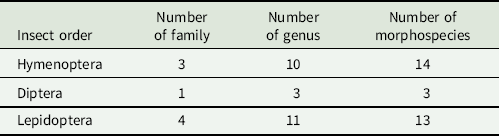
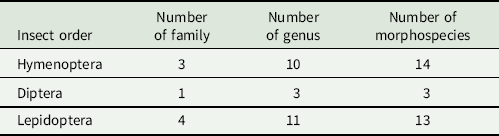
A total of 30 insect morphospecies belonging to three orders, viz. Hymenoptera, Diptera and Lepidoptera, were observed as visitors of focal flower species. The number of families, genera and morphospecies of insect visitors are listed in Table 1. The results showed that hymenopteran insect visitors belonged to three families: Apidae, Megachilidae and Halictidae, while Syrphidae was found to be the single representative family of order Diptera that visited the focal flowers. Lepidopteran flower visitors belonged to four families: Papilionidae, Nymphalidae, Pieridae and Lycaenidae. The flower visitation network is shown in the supplementary material provided.
Number of families, genera and morphospecies of insect floral visitors found on six observed medicinal plants during the study period.
Among the plants, Sphagneticola calendulacea and Talinum portulacifolium exhibited the highest BC and CC values, respectively. Among the floral visitors, Ceratina (Pithitis) sp.2 showed the highest BC and CC values.
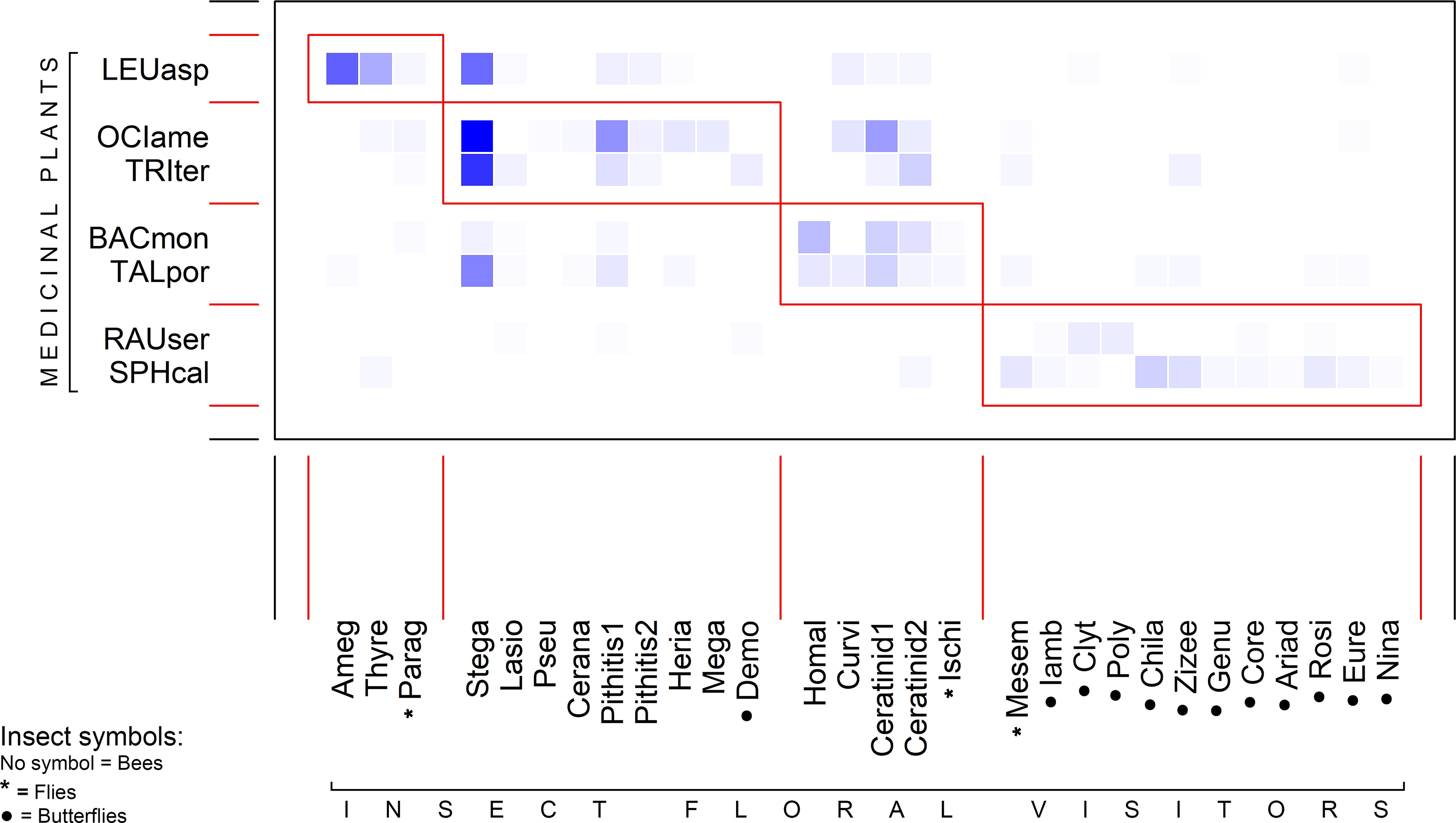
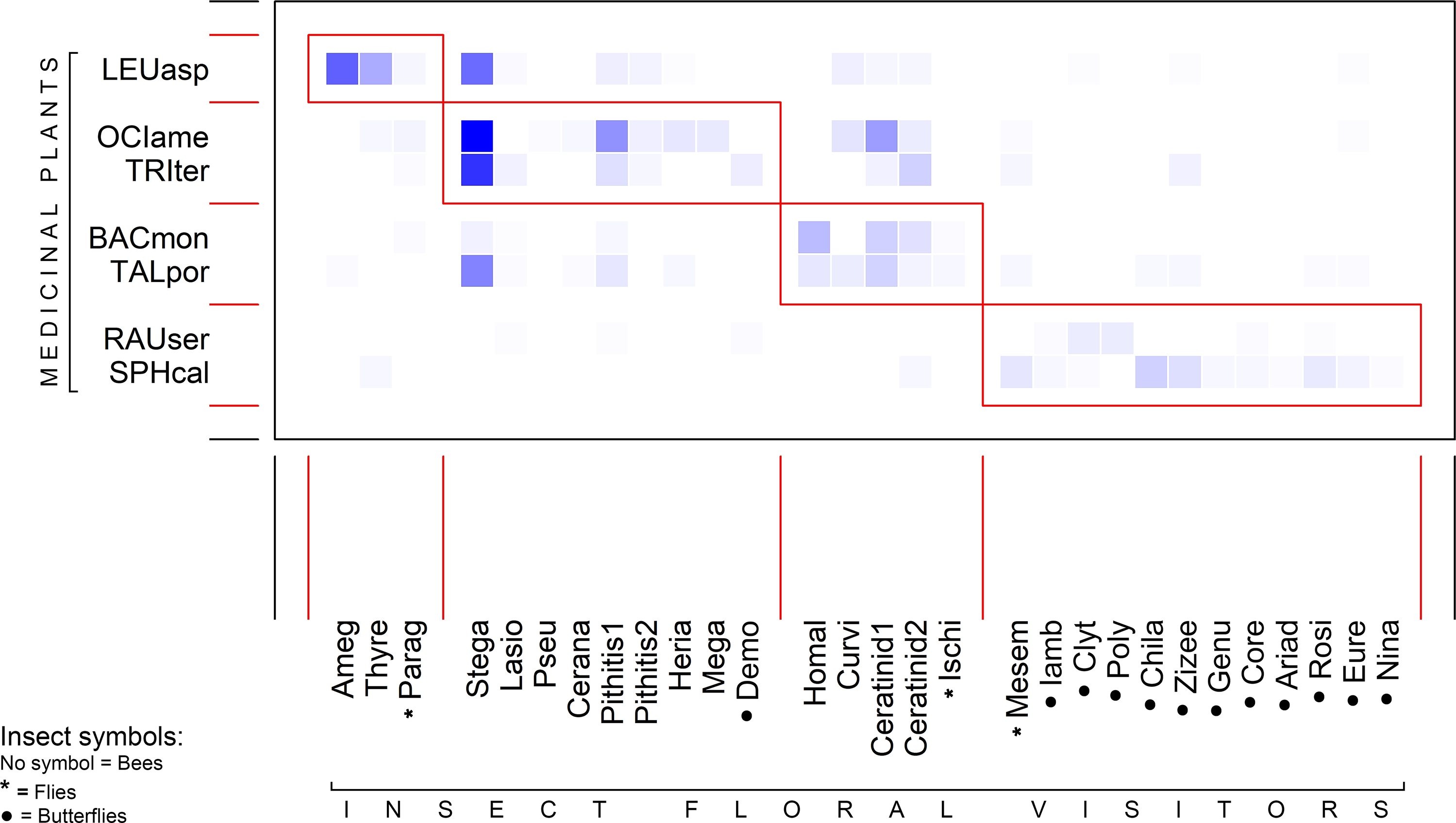
The modularity analysis resulted in four distinct modules (Figure 1) from the bipartite network between medicinal plant species and the insect floral visitors. Modules indicated that the insect visitors in Sphagneticola calendulacea and Rauvolfia serpentina were mostly comprised of lepidopterans; thus, they formed a separate module. In contrast, the remaining four plant species were mostly visited by bees and few other insects. Another distinct and important module was represented by a syrphid fly and two long-tongued bees (Amegilla sp. and Thyreus sp.) of which one is a buzz pollinator (Amegilla sp.) which visited Leucas aspera. Bacopa monnieri was frequently visited by bees. The largest module is constituted by Talinum portulacifolium, Tribulus terrestris, Ocimum americanum and many species of halictid, apid and megachilid bees.
Modularity plot showing different modules formed from the interactions among medicinal plants and insect floral visitors. Each module represents functional group consists of medicinal plant species and their corresponding interacting insect species having intense interaction frequencies. RAUser = Rauvolfia serpentina, SPHcal = Sphagneticola calendulacea, BACmon = Bacopa monnieri, OCIame = Ocimum americanum, TRIter = Tribulus terrestris, TALpor = Talinum portulacifolium, LEUasp = Leucas aspera, Stega = Steganomus sp., Lasio = Lasioglossum sp., Homal = Lasioglossum (Homalictus) sp., Curvi = Curvinomia sp., Pseu = Pseudapis sp., Cerana = Apis cerana, Ceratinid1 = Ceratina (Ceratinidia) sp.1, Ceratinid2 = Ceratina (Ceratinidia) sp.2, Pithitis1 = Ceratina (Pithitis) sp.1, Pithitis2 = Ceratina (Pithitis) sp.2, Ameg = Amegilla sp., Thyre = Thyreus sp., Heria = Heriades sp., Mega = Megachile sp., Parag = Paragus sp., Mesem = Mesembrius sp., Ischi = Ischiodon sp., Iamb = Iambrix salsala, Clyt = Papilio clytia, Poly = Papilio polytes, Chila = Chilades pandava, Zizee = Zizeeria karsandra, Demo = Papilio demoleus, Genu = Danaus genutia, Core = Euploea core, Ariad = Ariadne merione, Rosi = Castalius rosimon, Eure = Eurema hecabe, Nina = Leptosia nina
The overall visitation rate to the flowers did not differ significantly (Kruskal–Wallis test, df = 5, p > 0.05), but visitation rate of lepidopterans and hymenopterans (bees) differed significantly among plant species (Kruskal–Wallis test, df = 5, p < 0.005).
Similarly, the flower handling time of all insects across plant species did not differ significantly (Kruskal–Wallis test, df = 5, p > 0.05). But handling time of insect subgroups including lepidopterans and hymenopterans (bees) showed significant differences across plant species (Kruskal–Wallis test, df = 5, p < 0.005).
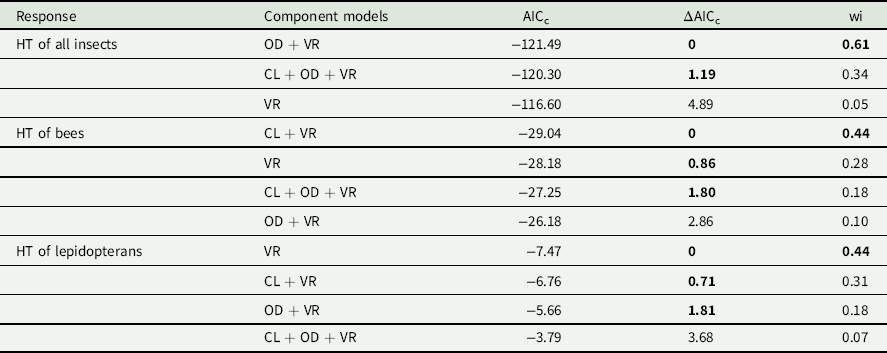
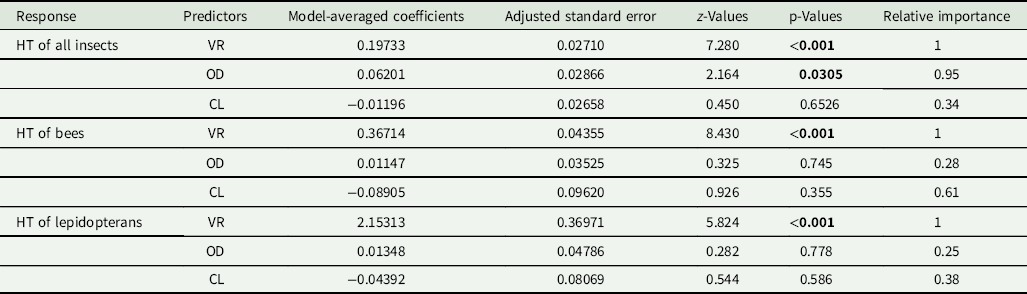
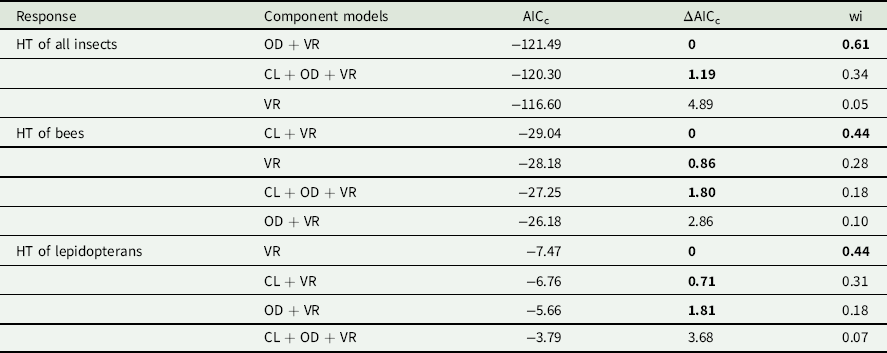
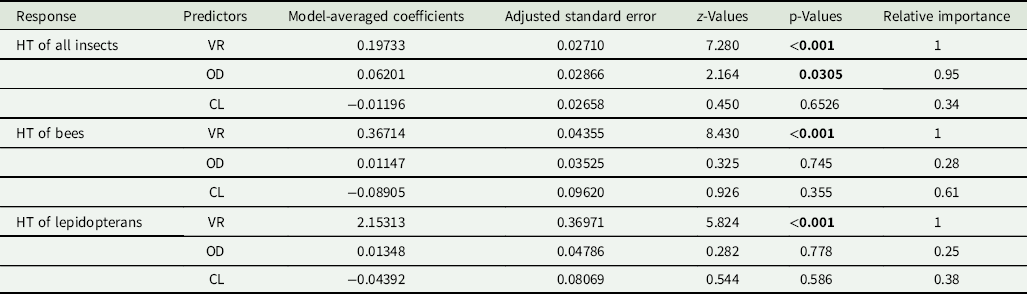
Results from regression analyses showed that the variation in flower handling time of all insect visitors was best explained by two combinations of predictors (‘Opening Diameter + Visitation Rate’ and ‘Corolla Length + Opening Diameter + Visitation Rate’; Table 2) having ΔAICc < 2; however, the combination of ‘Opening Diameter + Visitation Rate’ with ΔAICc = 0 and highest AICc weight (Table 2) was considered as the most important variable to explain the variation in response variable. According to the relative importance of individual predictor, Visitation Rate (p < 0.001) was the most important predictor followed by Opening Diameter (p < 0.05) (Table 3). When bees were considered separately, three component models (‘Corolla Length + Visitation Rate’, ‘Visitation Rate’ and ‘Corolla Length + Opening Diameter + Visitation Rate’) had ΔAICc < 2; the combination of ‘Corolla Length + Visitation Rate’ was the best model having ΔAICc = 0 and highest AICc weight (Table 2). Of this model, the predictor Visitation Rate (p < 0.001) was relatively more important predictor, whereas, Corolla Length (p > 0.05) was less so (Table 3). In case of lepidopterans, out of three combination models having ΔAICc < 2, the model ‘Visitation Rate’ was the best predictor with ΔAICc = 0 and the highest AICc weight (Table 2). In this case too, Visitation Rate (p < 0.001) was the most important predictor (Table 3).
The effects of different predictor variables (floral traits such as OD, CL and VR) on HT of floral visitors. Only the best component models (according to 95% confidence interval) are shown here. (OD = opening diameter; CL = corolla length; VR = visitation rate; HT = mean handling time; AICc = Akaike’s information criterion corrected for small sample size; wi = AICc weight). Models having ΔAICc < 2 have been presented in bold.
The summary of different model-averaging analyses and relative importance of each predictor variables (VR, OD and CL) for three different response variables, that is, HT of all insects, HT of bees only and HT of lepidopterans only. Significant predictors and respective p-values have been presented in bold. (VR = visitation rate, OD = flower opening diameter, CL = corolla length of flowers and HT = mean handling time).
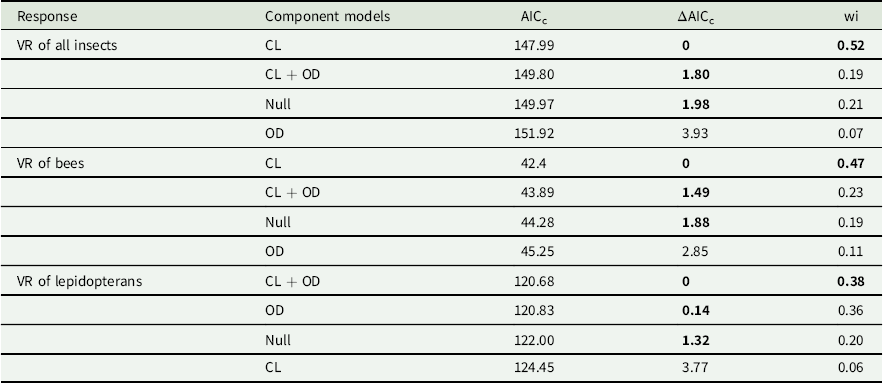
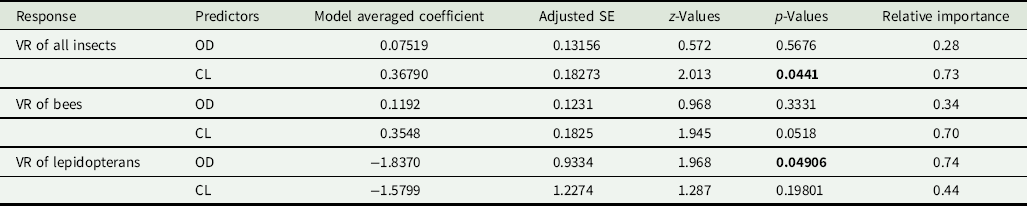
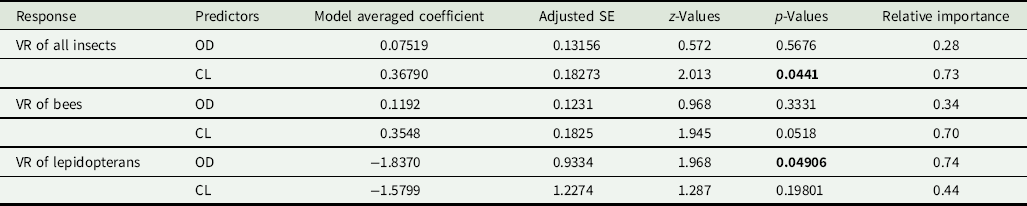
When Visitation Rate was taken as the response variable, results showed that visitation rate of all insect visitors was best influenced by three combinations of predictors (‘Corolla Length’, ‘Corolla Length + Opening Diameter’ and ‘Null’; Table 5) all having ΔAICc < 2; however, only ‘Corolla Length’ (p < 0.05) with ΔAICc = 0 and highest AICc weight (Table 4) seemed to be the most significant predictor of Visitation Rate. Among the predictors, ‘Corolla Length’ (p < 0.05) showed higher relative importance as compared to that of ‘Opening Diameter’ (p > 0.05) (Table 5). In case of the bee group, the same three combinations of predictors, that is, ‘Corolla Length’, ‘Corolla Length + Opening Diameter’ and ‘Null’ had ΔAICc < 2 (Table 4) and ‘Corolla Length’ had the lowest ΔAICc and highest AICc weight (Table 4). Therefore, ‘Corolla Length’ was turned out to be an important variable to explain variations in Visitation Rate of bees. In this case, Corolla Length was relatively more important than Opening Diameter (Table 5). However, both of their influences on Visitation Rate were statistically not significant (p > 0.05). In case of Lepidoptera, ‘Corolla Length + Opening Diameter’, ‘Opening Diameter’ and ‘Null’ (Table 4) had ΔAICc < 2; however, ‘Corolla Length + Opening Diameter’ combination had ΔAICc = 0 and highest AICc weight (Table 4) and hence, it was the best predictor to explain variations in Visitation Rate. In this case, Opening Diameter (p < 0.05) was relatively more important than Corolla Length (p > 0.05) (Table 5).
The effects of different predictor variables (floral traits such as OD and CL) on VR of floral visitors. Only the best component models (according to 95% confidence interval) were shown here. (OD = opening diameter, CL = corolla length, VR = visitation rate, AICc = Akaike’s information criterion corrected for small sample size, and wi = AICc weight). Models having ΔAICc
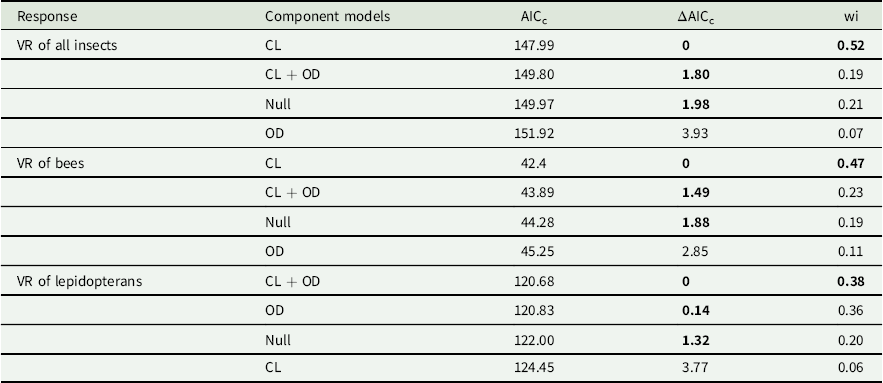
<2 have been presented in bold.
The summary of different model-averaging analyses and relative importance of each predictor variables (OD and CL) for three different response variables, that is, VR of all insects, VR of bees only and VR of lepidopterans only. Significant predictors and respective p-values have been presented in bold. (VR = visitation rate, OD = flower opening diameter and CL = corolla length of flower).
Discussion
The reproductive biology of medicinal plants has not received much attention in the scientific literature. The present study aimed to fill this knowledge gap by focusing on the pollination of some Indian medicinal plants which were valued in ancient Indian literature such as the ‘Veda’ (Dhiman et al. Reference Dhiman, Nanda and Ahmad2012). This study explored potential insect pollinators visiting selected medicinal plants during the course of our study and focused on the influence of selected floral traits on the visitation rate and flower handling time of insect floral visitors. Results showed that the visitation rate had a strong positive influence on the flower handling time, while, on the other hand, visitation rate was positively influenced by the corolla length of flowers.
The pollination efficiency or the pollen load carried by an insect can be predicted by the flower handling time (Murua Reference Murua2020). Consistent visitation to the same species of flower by an insect also suggests that the insect might be an efficient pollinator (Amaya-Marquez Reference Amaya-Márquez2009). Our study supports both these statements; visitation rate was a predictor of flower handling time in all three cases considered, that is, all insects, only bees and only lepidopterans. The literature also suggests that larger flowers (having larger opening diameter) would provide more space for insects to land on (Ushimaru & Hyodo Reference Ushimaru and Hyodo2005), be more visibly conspicuous to insect visitors (Worley et al. Reference Worley, Baker, Thompson and Barrett2000) and may also facilitate better dispersal of pollinator attracting volatiles (Ruiz-Ramon et al. Reference Ruíz-Ramón, Aguila, Egea-Cortines and Weiss2014). In our study, along with visitation rate, corolla opening diameter was also a significant predictor of flower handling time of all insects. Therefore, the combined effect of both corolla opening diameter and visitation rate was shown to be the factor which best predicted of flower handling time when all insects were taken as a group.
However, in case of bees, corolla opening diameter was not so important; corolla length was more influential in determining bees’ flower handling time. Studies have reported that there is a strong correlation between insect tongue length and depth of corolla tube (Klumpers et al. Reference Klumpers, Stang and Klinkhamer2019). Close size matching between insect tongue and corolla tube lengths reduces flower handling time and leads to efficient nectar extraction by the insects (Klumpers et al. Reference Klumpers, Stang and Klinkhamer2019). Thus, if an insect with a longer tongue visit flowers with shorter corolla, it might face difficulty to forage on nectar which may increase time spent on flowers and hence, higher handling time (Klumpers et al. Reference Klumpers, Stang and Klinkhamer2019). This may explain our results of negative relationship between flower handling time and corolla length. However, the results showed that insect visitation rate was more important predictor of the flower handling time compared to the corolla length irrespective of the floral traits. In this study, two plants (S. calendulacea and R. serpentina) were most frequently visited by lepidopterans (butterflies in this case). The mean corolla length of S. calendulacea was significantly shorter (Wilcoxon rank sum test, W = 0, p < 0.0005 at 95% confidence level) than R. serpentina. Most of the floral visitor on S. calendulacea had shorter proboscis (Sultana et al. Reference Sultana, Rahman, Akand, Hoque, Miah and Bashar2017) than those on R. serpentina indicating trait matching (Darwin Reference Darwin1877). But R. serpentina received fewer insect visits than S. calendulacea which might have resulted in the negative relationship between corolla length and visitation rate.
Just like butterflies, visitations by long-tongued bees (Thyreus sp. and Amegilla sp.) were largely restricted to L. aspera which had the longest corolla among other focal plant species. The corolla length of L. aspera was significantly longer than B. monnieri, O. americanum, T. portulacifolium and T. terrestris (Wilcoxon rank sum test, W = 0, p < 0.0005 at 95% confidence level). More frequent visits by these long-tongued bees to L. aspera tallied with the trait matching hypothesis (Darwin Reference Darwin1877) and explain the positive relationship between corolla length and visitation rate. However, there was a negative relation between corolla length and handling time for bees which is not easy to interpret. We suggest that deeper flowers may cause difficulty for the insects due to relatively narrower space as they have to go fully inside to get access to the nectar.
Along with flower size (as measured by corolla opening diameter) and depth (as measured by corolla length), flower colour and nectar production have also been identified as important traits influencing pollinator activity (Peach et al. Reference Peach, Liu, Klitgaard and Mazer2020). This work, however, focused on the relationships between visitation rate and flower handling time and flower corolla opening diameter and corolla length.
We applied a mutualistic network approach to evaluate the impact of specific partners on the plant–pollinator interaction. The bipartite network analysis allowed us to investigate the assumption of keystone species belonging to both plant and pollinator categories. Species with higher BC indicates a scenario where one species has an important role in connecting different species hubs of the network that would otherwise be less or not connected at all (Gonzalez et al. Reference Gonzalez, Dalsgaard and Olesen2010). Our analysis revealed that in our network, one insect species and two plant species were crucial. Ceratina (Pithitis) sp.2 showed highest CC and BC; therefore, we suggest that its removal from the network would affect connectivity between all other plants and insects in the network thereby making the system fragmented and thus more vulnerable (Jordan et al. Reference Jordan, Liu and Davis2006). The absence of T. portulacifolium, would negatively affect the network and this effect would be exacerbated in the absence of S. calendulacea as indicated by its higher BC value (Jordan et al. Reference Jordan, Liu and Davis2006).
Although our study was limited in some ways, for example, in the number and duration of observations, we have plans for future studies on the reproductive biology of medicinal plants. Nevertheless, the present study is a pioneering attempt which may encourage researchers to continue studying the pollination of tropical medicinal plants.
Supplementary material
To view supplementary material for this article, please visit https://doi.org/10.1017/S0266467421000341
Acknowledgement
The authors express their gratitude to the Secretary Maharaj, Ramakrishna Mission, Narendrapur for allowing fieldwork. The first author conveys special thanks to Mr Divyajyoti Ganguly and Mr Suman Pramanik for their kind co-operation. The authors also show their gratitude to the anonymous reviewer for the constructive suggestions to make the manuscript even better. Lastly, the authors express their heartfelt gratitude to Dr Barbara Smith (Centre for Agroecology, Water and Resilience, University of Coventry, UK) for her valuable comments and language scrutiny for the manuscript.
Conflict of interest
The authors have no conflict of interests.