Introduction
During the last years, mortality in children and adolescents with CHD has rapidly decreased. Reference Remmele, Schiele, Oberhoffer-Fritz, Ewert, Bauer and Helm1,Reference Marelli, Ionescu-Ittu, Mackie, Guo, Dendukuri and Kaouache2 Life expectancy is increasing due to the significant advances in paediatric cardiology, cardiac surgery, and aftercare in the last decades. Reference Kaltman, Burns and Pearson3–Reference Voss and Harris5 For this growing adult congenital heart disease population, it is a question of how to prevent, reduce, or delay them in terms of comorbidities, as they are known to have a generally increased risk of morbidities, including neurologically acquired diagnoses in particular. Reference Remmele, Schiele, Oberhoffer-Fritz, Ewert, Bauer and Helm1 Regarding the close interaction of the heart and the brain focus shifts on the heart–brain axis as an important neurodevelopmental factor in the CHD population. Reference Lanz, Brophy, Therrien, Kaouache, Guo and Marelli6 Some studies in neonates, infants, and children show structural brain abnormalities such as reduced brain volume, white matter, and grey matter lesions, and outer and inner liquor space enlargement. Reference Heye, Knirsch and Latal7–Reference Panigrahy, Schmithorst and Wisnowski12 All of these studies pointed out a significant association of these brain-related findings with developmental delay in young children with most of them having complex CHD.
That leads to the assumption patients with complex CHD do have lifelong problems due to their CHD. So far, most of the studies investigated children and fewer adolescents, which means right now there was not enough follow-up time for children with CHD to find out the relevance when they reach adulthood.
However, less is known about cognitive function assessed by standardised intelligence tests in adult CHD patients. Since cognitive function causes individual life perspectives and plans and their health-related quality of life, Reference Cohen and Earing13 this study aimed to assess and compare adult CHD patients with Fontan circulation and adult CHD patients with acyanotic CHD in terms of cognitive function and associations with health-related quality of life.
Patients and Methods
Study subjects
In 2018, patients with all kinds of CHD were routinely asked to complete an intelligence test and fill in the SF-36 questionnaire during their routine appointment at the German Heart Center Munich. Forty-four adult CHD patients (female n = 21 (47.7%); mean age at assessment 34.7 ± 11.9 years) were included in this subgroup analysis. Inclusion criteria were an age of at least 18 years and no interventional treatment or surgery during the past 6 months which potentially affects their cognition. Acyanotic CHD was defined based on the underlying leading CHD diagnosis, Reference Brickner, Hillis and Lange14 and none of the included patients had already developed a cyanotic condition (e.g., Eisenmenger syndrome). The severity class of CHD was categorised as simple, moderate, and complex based on the American College of Cardiology (ACC) definition. Reference Warnes, Williams and Bashore15 The variable cyanosis duration was defined from the day of birth to the day of completion of the Fontan circulation. The study was following the Declaration of Helsinki (revision 2013). Approval from the local ethics board was obtained (Project Number 350/18 S). Patients voluntarily agreed to participate and to the anonymous publication of their data by giving their written informed consent.
Cognitive function
Wechsler Adult Intelligence Scale-Fourth Edition (WAIS-IV) Reference Wechsler16 was administered to all patients. This worldwide established test was validated in 2013 for the German norm population of 1664 participants.17 These national test norms serve the comparison in this study. It is the most commonly used test to assess cognitive function in adolescents and adults from 16 to 90 years. It includes 10 core subtests to calculate the Full-Scale Intelligence Quotient (FSIQ) with four specific domains of intelligence; Verbal Comprehension (VC), Perceptual Reasoning (PR), Processing Speed (PS), and Working Memory (WM) each of them also calculated into IQ points. In this test, impairment is defined as an intelligence quotient (IQ) achieved which is below more than one standard deviation (SD) of the norm (100 IQ points ± 1SD). The versions for children and adolescents have been frequently used in paediatric cardiology populations as well. Reference Daseking and Petermann18
Health-related quality of life (SF-36)
The Medical Outcomes Study Questionnaire Short-Form 36 Health Survey (SF-36) is a set, subdivided into eight sections (vitality, physical function, bodily pain, general health perceptions, physical role functioning, emotional role function, social role function, and mental health) of generic health-related quality-of-life measures. Reference Cassidy, White, DeMaso, Newburger and Bellinger19 Out of each section scaled scores with a range from 0 (negative health) to 100 (positive health) represent the weighted sums of the Likert-scaled questions. The SF-36 relies upon patient self-reporting within a 4-week window. It is quite well established in various health care sections to assess or monitor adult patient outcomes. The German version was validated by Bullinger and Kirchberger Reference Cassidy, White, DeMaso, Newburger and Bellinger19 and was deployed in this study. The SF-36 is used to evaluate individual patients' health status and monitor and compare disease burden with an acceptable internal consistency Reference Bullinger and Kirchberger20 ; therefore, it is a worldwide used well-established questionnaire. It was used in this study as it was the most recent normal value for Germany taken from a 2013 survey. Reference Bullinger21 The norm data were assigned to our participants according to age and sex.
Data analyses
Descriptive statistics were calculated in absolute and relative frequencies (%) for categorical variables, and means and SD for numerical variables. Shapiro–Wilk test was performed to prove normal distribution. The Student’s t-test was used for group comparison as well as regression and correlation models to find associations between measurements and patients’ data. The analysis was made with adjustments for age and sex. All analyses were performed using the software SPSS V.20 (SPSS Inc., Chicago, Illinois, United States of America) or R software V. 3.3.1. Pirate plots were used for visualisation of the data which represent the mean, confidence interval, raw data, and density distribution. The level of statistical significance was determined two-sided and with a p-value < 0.05.
Results
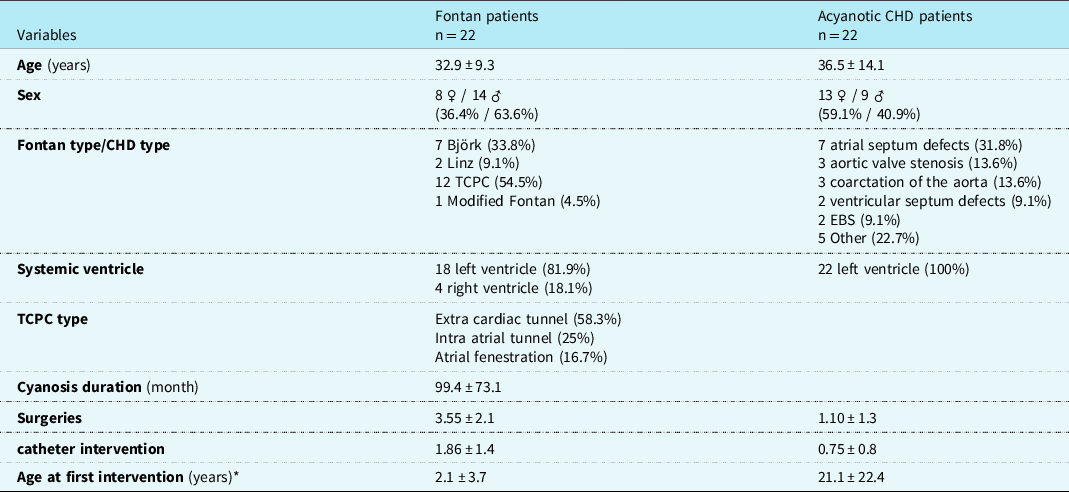
Both groups show the same number of patients with more male adult CHD (64%) in the Fontan group and more female adult CHD in the acyanotic group (59%). Most of the Fontan patients were palliated with total cavopulmonary connection with about 55% followed by the Fontan Björk procedure with about 34%. In four cases, the Fontan patients had the right ventricle as their systemic ventricle (Table 1).
Group characteristics.

* Surgery or catheter intervention.
Cn = number; TCPC = total cavopulmonary connection; EBS = Ebstein’s anomaly
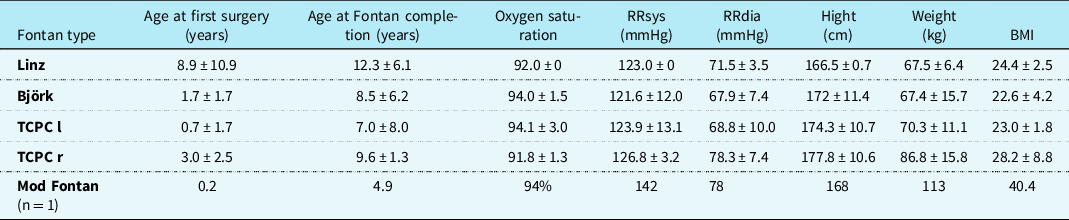
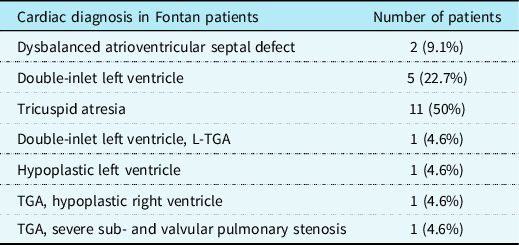
Fontan-specific data on oxygen saturation, blood pressure, and body composition at the date of the test are given in Table 2. Additionally, detailed information on the underlying cardiac diagnosis in Fontan patients is in Table 3.
Fontan patients.

RRsys = Riva-Rocci systolic blood pressure; RRdia = Riva-Rocci diastolic blood pressure; BMI = body mass index; TCPC l = total cavopulmonary connection with left systemic ventricle; TCPC r = total cavopulmonary connection with right systemic ventricle.
Detailed cardiac diagnosis in Fontan patients.

TGA = transposition of the great arteries; L-TGA = corrected transposition of the great arteries.
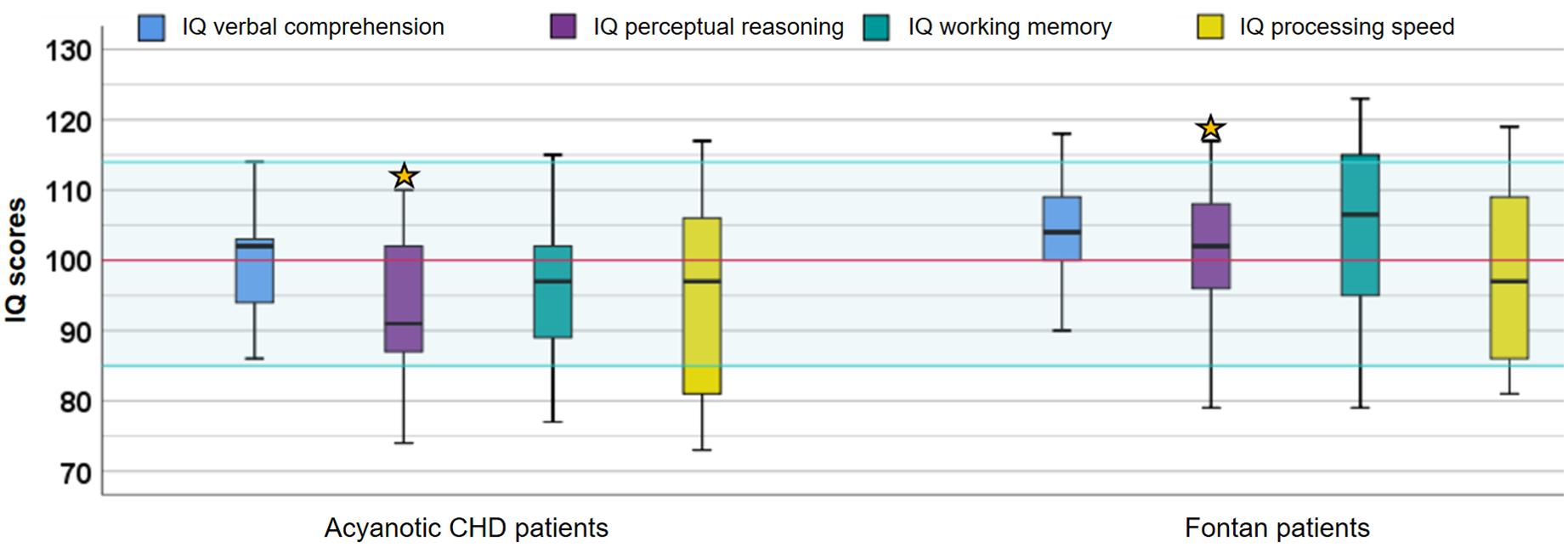
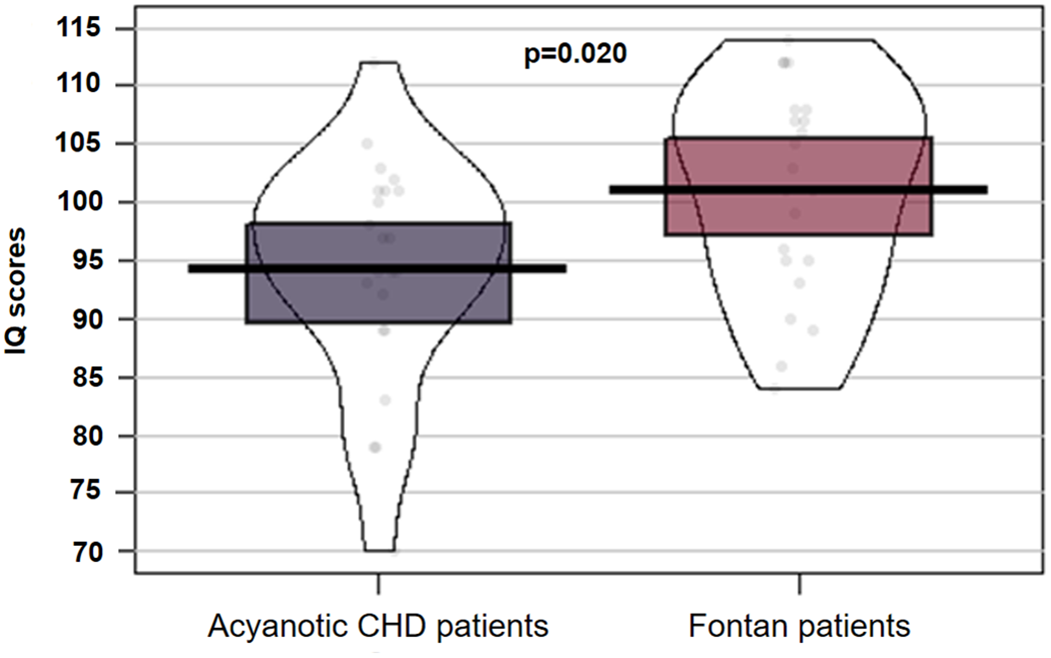
All adult CHD patients showed normal IQ scores in subscales and full-scale score. Fontan patients showed significantly better results in the full-scale IQ as well as in subscale perceptual reasoning in comparison with patients with acyanotic CHD. Figure 1 shows the IQ results of the subscales of both groups.
Subscale scores of the Wechsler Intelligence Test. IQ: Intelligence quotient; * significant difference between the groups with a level of significance p < 0.05.

The significant difference between groups in FSIQ is shown in Figure 2 by pirate plots serving detailed information on the results of each group. There were no significant associations found in terms of sex differences, number of surgeries or catheter interventions, or cyanosis duration with the IQ score.
The FSIQ in comparison depicted with pirate plots. IQ: Intelligence quotient; level of significance p < 0.05.

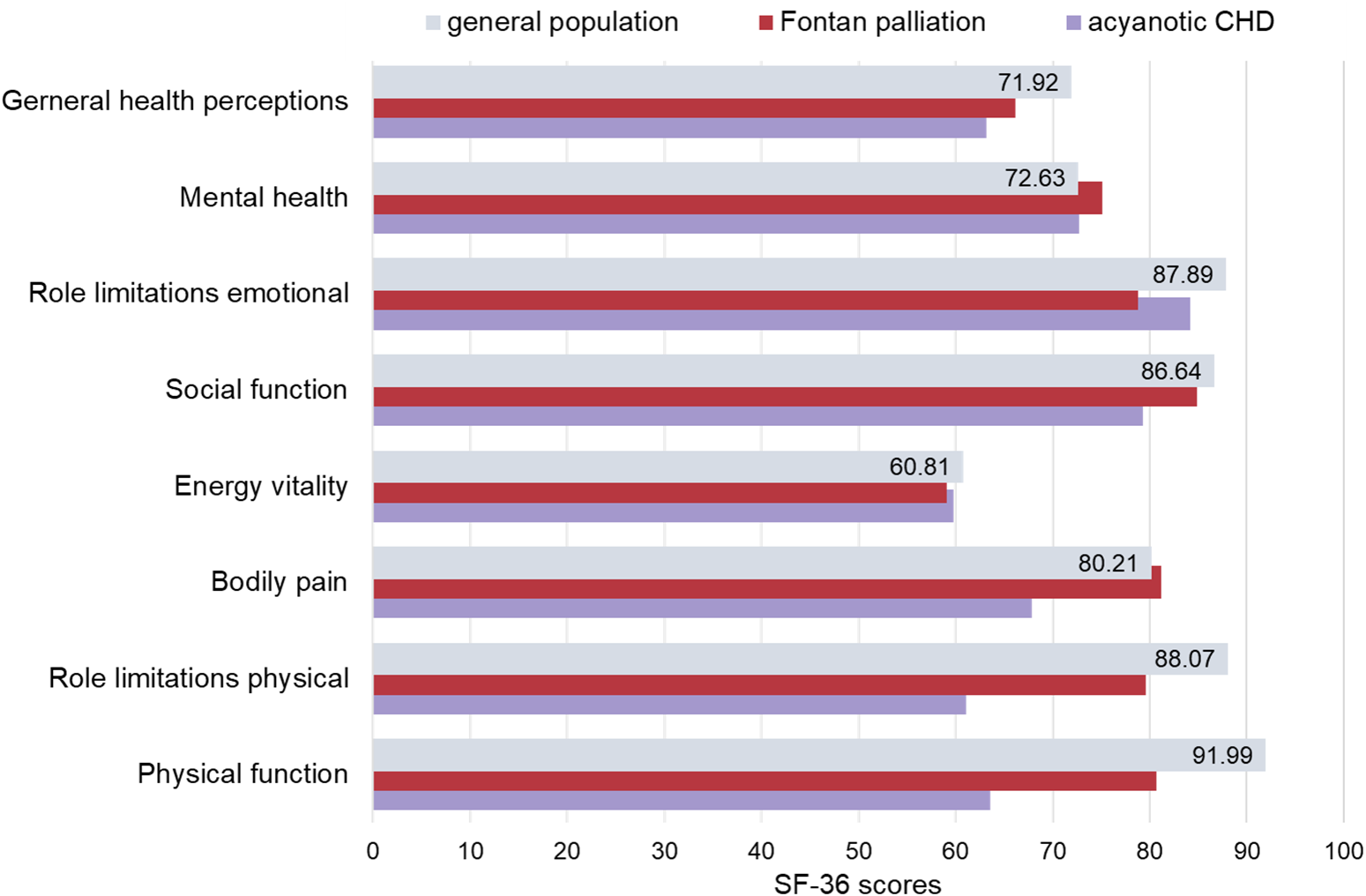
In terms of health-related quality of life, no significant difference was found between both CHD groups, but partly obviously trends to reduced values in the acyanotic CHD group (Fig 3). Furthermore, no significant association between IQ scores and health-related quality of life was found.
HrQoL scores in comparison.

Discussion
Cognitive function
Since there is a close connection of an abnormal cognitive function with overall quality of life, employment opportunities as well as educational attainments, it is important to follow this in patients with CHD into adulthood. Reference Cohen and Earing13 Neonates and infants are most often reported with neurodevelopmental delays, especially in patients with complex CHD. Reference Ellert and Kurth22–Reference Reich, Heye and Tuura25 Hypoxaemia during pregnancy, perioperative as well as postoperative, haemodynamic changes, and early surgeries are related to adverse effects on brain development and neurodevelopment. Reference Klaver, Knirsch, Wurmitzer and von Allmen26 For example, because of the enormous advantages in medicine and surgical procedures, surgeries with cardiopulmonary bypass have become a widespread, low-risk standard procedure; in Germany alone, around 3852 children (newborns up to the age <18 years) underwent heart surgery with cardiopulmonary bypass in 2019. Reference Wray27 In addition to the benefits, however, there are also side effects that can affect the lungs, kidneys, liver, or brain. Studies from the early 2000s reported neurological deficits in up to 80% of adults after heart surgery with cardiopulmonary bypass. 28–Reference Nathan, Wells, Munson and Wozny31 This does not seem to apply to children with CHD, Gunn et al. investigated the neurodevelopmental status after early heart surgery of 130 children at the age of 2 years in a direct comparison of CHD surgery with cardiopulmonary bypass and surgery without cardiopulmonary bypass. They found no significant differences in terms of the cardiopulmonary bypass use or aortic clamp on its own but reported repeated surgeries as a high-risk factor for neurodevelopment impairments. Reference Fearn, Pole, Wesnes, Faragher, Hooper and McCollum32 In our study, number of surgeries or interventions did not show a relation with cognitive function in adulthood. Our study population of adult CHD patients showed no impairment in cognitive function compared with the german norms. Interestingly, Fontan patients had partly significant higher scores than patients with acyanotic CHD, although the control group had the first intervention or surgery at a significantly later time, that is, after the critical developmental age. Our results are not in line with other studies, but since most of them focus on younger CHD patients it is hardly comparable. Based on advances, different technics came to use to get an improved knowledge of the developing brain and its relations to CHD. More recent studies focus on neurodevelopmental outcomes combined with brain imaging using MRI to identify differences that can explain the neurodevelopmental delay in neonates and young CHD patients. They reported a high incidence of white matter lesions. Reference Guo, Chau and Peyvandi9,Reference Gunn, Beca and Hunt33–Reference Desai, Hamrick, Strickland, Matthews, McMaster and Mahle36 Additionally, Claessens et al. reported impaired cortical volume and brain gyrification in patients with univentricular heart circulation and white matter development resembling premature birth Reference Claessens, Moeskops and Buchmann10,Reference Bertholdt, Latal and Liamlahi37 changes that can predict developmental problems. Most of the studies in adolescents with CHD reported on executive function problems with reduced working memory and additionally, Fontes et al. on volume changes of the hippocampus with a structure–function relation of hippocampal subfields in this context in adolescents with complex CHD. Reference Claessens, Kelly, Counsell and Benders38 In another study, functional MRI was used which brought out a reduced prefrontal inhibition in patients with CHD compared to a healthy control group and a correlation with executive functioning. Reference Fontes, Rohlicek and Saint-Martin39 However, besides all these advanced findings resulting from technical possibilities, it remains unclear what this means for our growing group of adult CHD. It remains unclear what impact the differences/abnormalities found will ultimately have on the function of the mature brain in adult CHD, due to the enormous neuroplasticity of the developing child’s brain. Reference King, Smith and Burns40
In our study cohort, there was no impairment in cognitive function, and one reason might be that none of the patients in this study had been diagnosed with neuro events like ischaemic stroke. Of course, that does not mean they do not exist but it seems the brain found adaption mechanisms to enable normal cognitive function. It would be most interesting to do MRI with our Fontan cohort to find out whether there are still existing changes or undiagnosed lesions. On the one hand, it can be discussed whether MRI findings in neonates and young children with CHD present some kind of pathophysiology due to less oxygen or changes in the blood flow. For example, reported in the literature is liquor space enlargements associated with neurodevelopmental delay, Reference Heye, Knirsch and Latal7,Reference Knirsch, Mayer and Scheer8 which may be due to a higher rate of ultrafiltration in the brain to prevent oxygen deficiency in the growing brain. On the other hand, a recently published work by Ehlert et al. reported reduced fractional anisotropy of the brain in both patients with cyanotic CHD and with acyanotic CHD as well in comparison with healthy controls in adolescents, especially in the frontal lobe which is associated with working memory. Reference Kolb and Gibb41 It would be interesting if these changes of the brain still exist in older ages of our adult survivors or what kind of adaption mechanism leads the brain to normal function. MRI studies on adult CHD survivors may promise an improvement in understanding brain adaptions due to the underlying CHD.
Health-related quality of life
The adult CHD patients of both groups showed normal to good self-reported health-related quality of life measured with the SF-36 in this study without significant differences between both groups. This is in line with a recent study reporting on a large cohort of about 4000 patients with all kinds of adult CHD. Reference Ehrler, Latal, Kretschmar, von Rhein and O'Gorman42 They also pointed out that health-related quality of life is not dependent on the complexity of the underlying CHD. With a closer look at the descriptive data (Fig 3), there were differences, without statistical significance but of interest, in the dimensions of physical role functioning, physical function, and bodily pain with worse results in patients with simple to moderate CHD, especially in comparison with normal data. Since patients with complex CHD usually have to be treated surgically postnatally and are now more often diagnosed during pregnancy than in previous decades, families have time to cope with the diagnosis. Furthermore, the need for repeated surgeries in the case of Fotan patients leads to those patients having to live with CHD from the beginning. They had to find coping strategies within their family as well as for their own, which leads to a higher sense of coherence with more mindfulness. Reference Andonian, Freilinger and Achenbach43 In a recently published study, Moons et al. reported on the positive association of sense of coherence with QoL in a large study with 15 enrolled countries and concluded strategies to improve SOC may improve QoL. Reference Muller, Hess and Hager44 However, the enhanced sense of coherence develops during childhood through the successful application of generalised resistance resources. Reference Moons, Apers and Kovacs45 This implies that when patients experience new, life-altering situations due to CHD later in life, we need to accompany them to help them develop their coping strategies and improve their health-related quality of life. Further studies on adult CHD patients, especially those underinvestigated with a simple CHD, should be invited to get more knowledge about their needs and worries since they do not have regular appointments like patients with moderate or complex CHD. Once this has been done, the next step is to develop programmes that support and strengthen patients in dealing with their CHD.
Conclusion
This study in adult Fontan patients showed that it is possible to live an adult life with normal cognitive function and good health-related quality of life with a univentricular heart. Thus, this study could be a guidepost for more in-depth studies on cognitive function in Fontan survivors. Since these results are not in line with other studies on Fontan patients at younger ages, further studies are needed on older Fontan survivors or long-term studies that follow the newborn patients into older ages. Additionally, various newer MRI or functional MRI techniques should be increasingly used in studies in adult CHD to understand the adaptive mechanisms that take place to allow the brain to function and to compare them with neonatal findings.
In addition, the focus should be on health-related quality of life of adult CHD with simple CHD in particular, since a reduced health-related quality of life is not only medically based. However, when the acyanotic group was compared with the norm values, the results were partly significant worse in the acyanotic CHD group, which necessitates further studies on the health-related quality of life of patients with acyanotic CHD.
Limitations
The significant differences between both groups must be interpreted with caution, since both groups showed normal results within the frame of normative data. The evaluation of the detailed surgery data is not feasible as complete data are not available for all patients, since not all of the surgeries were performed at the same hospital or in the same country. In addition, this is a single-centre experience; even though the sample size is small, it is a considerable sample of Fontan patients at this age.
Ethics and dissemination
Approval from the local ethics board of the Technical University of Munich was obtained (Project Number 350/18 S). The authors are accountable for all aspects of the work in ensuring that questions related to the accuracy or integrity of any part of the work are appropriately investigated and resolved.
Funding
No funding.
Contributors
Conception and design: JR, NN, and MP
Administrative support: ROF and PE
Provision of study materials or patients: JR, NN, and MP
Collection and assembly of data: JR, NN, and MP
Data analysis and interpretation: JR
Manuscript writing: All authors
Final approval of manuscript: All authors
Declaration of Conflicting Interests
The authors have no conflicts of interest to declare.