Introduction
The vine mealybug, Planococcus ficus (Signoret) (Hemiptera: Pseudococcidae), is found throughout Central and South America, California, the Mediterranean basin, South Africa and the Middle East. It completes a variable number of generations per year, depending on the climatic conditions. In the Mediterranean basin, the annual generations of P. ficus range from three to four in Italy (Duso, Reference Duso1989; Lentini et al., Reference Lentini, Serra, Ortu and Delrio2008) to six in Tunisia (Mansour et al., Reference Mansour, Grissa Lebdi, La Torre, Zappalà and Russo2009). In contrast, four to six generations per year have been reported in California (Millar et al., Reference Millar, Daane, McElfresh, Moreira, Malakar-Kuenen, Guillén and Bentley2002) and five to six generations in South Africa (Walton & Pringle, Reference Walton and Pringle2004).
This pest causes increasing yield losses in wine and table grape vineyards (Daane et al., Reference Daane, Almeida, Bell, Walker, Botton, Fallahzadeh, Mani, Miano, Sforza, Walton, Zaviezo, Bostanian, Vincent and Isaacs2012). The conventional control strategy against P. ficus consists of multiple applications of insecticides in spring–summer, in order to reduce the population density and avoid fruit damage. However, the chemical control of P. ficus is often of limited effectiveness, as mealybugs reside above all underneath leaves, under bark and in roots, being thus protected from contact insecticides (Walton et al., Reference Walton, Daane and Pringle2004).
The identification and synthesis of the P. ficus sex pheromone (Hinkens et al., Reference Hinkens, McElfresh and Millar2001) have facilitated the development of monitoring (Millar et al., Reference Millar, Daane, McElfresh, Moreira, Malakar-Kuenen, Guillén and Bentley2002; Walton et al., Reference Walton, Daane and Pringle2004) and mating disruption control strategies. The pheromone-mediated control of P. ficus has been successfully applied in California and the Mediterranean basin using a microencapsulated formulation and reservoir dispensers (Walton et al., Reference Walton, Daane, Walter, Bentley, Millar, Larsen and Malakar-Kuenen2006; Cocco et al., Reference Cocco, Lentini and Serra2014; Sharon et al., Reference Sharon, Zahavi, Sokolsky, Sofer-Arad, Tomer, Kedoshim and Harari2016).
High sex pheromone concentrations influence insect mating behaviour in several ways, including the reduced responsiveness of males to pheromone stimuli due to adaptation or habituation, the delayed or diminished response of males due to the continuous presence of pheromones, false trails by synthetic pheromone sources that divert males from calling females, and modifications in the ratios of components of the natural sex pheromone blend, which lead to a sensory imbalance effect (Bartell, Reference Bartell1982; Barclay & Judd, Reference Barclay and Judd1995; Cardè & Minks, Reference Cardé and Minks1995). Irrespective of the modes of action, the effectiveness of mating disruption can be evaluated by assessing damage reduction or variations in the reproductive and demographic parameters of natural pest populations or sentinel females artificially deployed in the field (Baker & Heath, Reference Baker, Heath, Gilbert, Iatro and Gill2005). Studies on insect demography show that the rate of population increase is affected not only by fecundity and fertility but also by the age at first mating (Carey, Reference Carey1993). Therefore, any factor causing a delay in mating has a significant influence on population dynamics.
The effects of delayed mating on the reproductive output have been studied in several lepidopteran species, generally highlighting a higher longevity and pre-oviposition period and a lower fecundity and fertility with increasing female age at mating (Proshold, Reference Proshold1996; Fadamiro & Baker, Reference Fadamiro and Baker1999; Jones & Aihara-Sasaki, Reference Jones and Aihara-Sasaki2001; Torres-Vila et al., Reference Torres-Vila, Rodriguez-Molina and Stockel2002; Jiao et al., Reference Jiao, Xuan and Sheng2006). However, the delay of mating differentially affects the biological parameters of the investigated species, thereby altering their fitness (Mori & Evenden, Reference Mori and Evenden2013). The decrease of the target pest population density can also be due to a delay of mating encounters rather than the suppression of matings, as observed in the European corn borer, Ostrinia nubilalis (Hübner) (Lepidoptera: Crambidae), subjected to mating disruption (Fadamiro et al., Reference Fadamiro, Cossé and Baker1999).
Delayed mating has also been reported to affect the reproductive output of females in other orders of insects. In the oriental beetle, Anomala orientalis (Waterhouse) (Coleoptera: Scarabaeidae), the fecundity gradually decreased with increasing female age at mating (Wenninger & Averill, Reference Wenninger and Averill2006). Similarly, the solenopsis mealybug, Phenacoccus solenopsis Tinsley (Hemiptera: Pseudococcidae), mated 30 days after emergence, exhibited a decreased fecundity and pre-oviposition period compared with females mated at the age of 2 days (Huang et al., Reference Huang, Zhang, Zhang and Lu2013).
The influence of delayed mating on the reproductive biology of P. ficus has not previously been explored. In the congeneric citrus mealybug, Planococcus citri (Risso) (Hemiptera: Pseudococcidae), delayed mating and high temperature modified the sex ratio and fecundity (Nelson-Rees, Reference Nelson-Rees1961; Ross et al., Reference Ross, Langenhof, Pen, Beukeboom, West and Shuker2010). To our knowledge, no specific studies have been carried out on the factors influencing the P. ficus sex ratio. On the other hand, the reproductive biology of P. ficus has been studied in detail by Waterworth et al. (Reference Waterworth, Wright and Millar2011), who demonstrated that it cannot reproduce parthenogenetically, even though virgin females are capable of laying unviable eggs. The same authors also reported a very long lifespan of unmated females (94 days), whereas males lived approximately 4.5 days and mated multiple times per day.
A deeper understanding of the reproductive biology of P. ficus is required in order to evaluate the influence of mating disruption on its populations. Laboratory and field experiments were thus carried out to investigate the effects of increasing delays in mating on reproductive and demographic parameters of P. ficus.
Materials and methods
Insect rearing and source of adults
The stock colony of P. ficus originated from ovipositing females collected in infested vineyards in north-western Sardinia (Italy). It was maintained on sprouted potato tubers (cv. Spunta) in constant darkness at 22–25 °C and 60–70% RH. Species-specific identification was initially confirmed by molecular analysis (Demontis et al., Reference Demontis, Ortu, Cocco, Lentini and Migheli2007) and is routinely tested approximately every 6 months to rule out the potential contamination of P. citri, which is morphologically very similar to P. ficus.
Males and females used in the experiments were obtained from eggs of the same age. Thus, approximately 80 mated females at the onset of oviposition were isolated in plastic cylinders (8 cm tall, 6 cm in diameter) sealed with a double layer of paper napkins and a rubber band. At daily intervals, the oviposited eggs were gently moved with a soft sable-hair brush to sprouted potatoes placed inside Tupperware containers (13.5 × 13.5 × 6.5 cm3) covered with ventilated lids. Containers were marked with the date of egg collection and stored in a growth chamber kept at 25 °C, 50% RH, 12L:12D photoperiod. Since the preimaginal development time was approximately 30 days (see the ‘Results’ section), mealybugs were observed daily after 20 days under a dissecting microscope equipped with an ocular micrometer in order to separate immature males and females. Mature third-instar nymphs, approximately 1.2 mm long, were isolated on a sprouted potato (weight range 25–60 g) inside a plastic cylinder (8 cm tall, 6 cm in diameter), whereas male prepupae were moved to paper towel strips and placed in plastic vials (5.5 cm tall, 1.2 cm in diameter). Vials and cylinders were kept in the growth chamber and checked daily until male and female emergence, the dates of which were recorded. Adult mealybugs from each stock colony were randomly assigned to the different treatments.
Delayed mating experiment
In order to evaluate the influence of delayed mating on the reproductive output of P. ficus, the following reproductive parameters were investigated: (i) length of the pre-oviposition period, from mating to the onset of oviposition; (ii) length of the pre-reproductive period, from adult emergence to the onset of oviposition, which also corresponds to the sum of the female age at mating and the pre-oviposition period; (iii) length of the oviposition period; and (iv) total longevity of females. In addition, the following were also recorded: daily fecundity, i.e. the number of eggs oviposited by each female; fertility, calculated as the percentage of viable eggs over the total oviposited eggs; sex ratio of offspring, calculated as the percentage of female offspring; and survival. Experiments were carried out in the above-described growth chamber at 25 °C, which is the optimal developmental temperature of P. ficus (Walton & Pringle, Reference Walton and Pringle2005).
In order to allow mating, virgin females at ages 1, 3, 5, 7, 14, 21 and 28 days were individually paired at the beginning of the photophase with two 3-day-old virgin males inside the plastic cylinders and were observed until mating occurred. At least 25 females were tested for each age at mating. After mating, females were checked daily until the onset of oviposition, after which eggs were collected daily with a sable-hair brush until female death and were gently placed inside plastic cylinders (4.0 tall, 3.5 cm in diameter). Dates of mating, beginning and end of oviposition and death of each female were recorded.
The offspring sex ratio was preliminarily determined in ten females mated 1, 7 and 28 days after emergence following the method described by Ross et al. (Reference Ross, Langenhof, Pen, Beukeboom, West and Shuker2010) for P. citri eggs. Since there was no significant difference in the sex ratio among the tested treatments (see the ‘Results’ section), the sex ratio of other treatments was not evaluated. Therefore, the mean value (59% female offspring) was used in the calculation of the life table parameters.
Fertility was assessed in ten females mated 1, 7, 14, 21 and 28 days after emergence by collecting the oviposited eggs with a sable-hair brush every 2 days. Eggs were placed in cardboards inside sealed plastic cylinders (4.5 tall, 3.5 cm in diameter) and stored for 2 months under natural laboratory conditions. Fertility was determined as the percentage of egg eclosion, calculated as [first-instar nymphs /(first-instar nymphs + unhatched eggs)] × 100.
The ability of P. ficus females of different ages to attract and mate with wild males was investigated in field observations. Thus, 20 females at ages 1, 7 and 28 days were reared in the laboratory as described previously, and released in a naturally-infested vineyard. Females were placed individually on a sprouted potato inside a plastic cylinder (8 cm tall, 6 cm in diameter), which had four holes on the upper part of the wall (1.5 cm in diameter) to allow male access. The positions of the three treatments were alternated in the central five rows of a 0.5-ha plot in a commercial vineyard (18 years old, cv. Carignano) (for further details about the experimental vineyard, see Muscas et al., Reference Muscas, Cocco, Mercenaro, Cabras, Lentini, Porqueddu and Nieddu2017) and spaced approximately 3 m along and within rows. Cylinders were sheltered from direct sunlight and rain by laminated cardboard, and hung from trellis wires inside the canopy. In order to prevent ants and wild females from entering the cylinders, the support wires were coated with insect trapping glue. Each female was checked daily in order to estimate the length of the pre-oviposition period, given by the time interval from the field release to the beginning of oviposition. Mating was assumed to occur on the same day as the release. Females accidentally injured during the daily checks were excluded from the analysis.
Data analysis
Reproductive parameters (fecundity, fertility, sex ratio, pre-oviposition period, pre-reproductive period and oviposition period) and female longevity were compared among treatments by a generalized linear mixed model, setting normal and binominal distributions for numerical and percentage data, respectively. Significantly different means were separated by Tukey's multiple comparison test (P < 0.05) (PROC GLMM, SAS Institute, 2008).
Life tables for females mated at different ages were built from age-specific fecundity (m x ) and survival (l x ) rates, which were calculated from reproductive and survivorship data. The following population growth parameters were estimated (Carey, Reference Carey1993; Maia et al., Reference Maia, Luiz and Campanhola2000):
-
Net reproductive rate, R 0 = ∑(l x mx );
-
Intrinsic rate of increase (r m), obtained by the iterative solution of the equation
 $\sum e^{{ - r}_{{{\rm m}^x}}} l_xm_x = 1;$
-
Finite rate of increase,
$\lambda = e^{r_{\rm m}};$
-
Mean generation time, T G = lnR 0/r m;
-
Population doubling time, DT = ln2/r m.


The mean values of the life table parameters were estimated with the jackknife method using a Microsoft Excel 2007 spreadsheet (Microsoft, Redmond, WA, USA), which generates pseudo-values of the investigated parameter through a subsampling replication technique (Meyer et al., Reference Meyer, Ingersoll, McDonald and Boyce1986). Jackknife pseudo-values were compared using analyses of variance (Bari et al., Reference Bari, Jahan and Islam2015), followed by Tukey's tests to separate means (P < 0.05) (PROC GLMM, SAS Institute, 2008).
Results
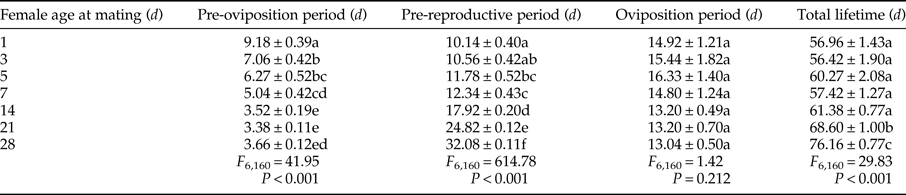
The preimaginal development time did not vary significantly among female groups (F 6,160 = 1.88, P = 0.189), ranging from 29.36 ± 0.41 to 30.71 ± 0.35 days (mean ± SE, data not shown). The duration of the pre-oviposition period decreased significantly in females mated within 7 days, whereas 14-, 21- and 28-day-old mated females exhibited a non-significantly different pre-oviposition period (<4 days) (F 6,160 = 41.95, P < 0.001) (table 1). The pre-reproductive period, also on account of being the female age at mating plus the pre-oviposition period, showed a significantly increasing pattern with increased mating delay (F 6,160 = 614.78, P < 0.001) (table 1). The length of the pre-reproductive period increased by about 2 days from 1- to 7-day-old females, and then increased proportionally by about 14 days in females mated from 14 to 28 days. The oviposition period ranged from 13.04 to 16.33 days revealing a slight, yet not significant, decrease in females mated 14, 21 and 28 days after emergence (F 6,160 = 1.42, P = 0.212). Females mated at 21 and 28 days lived significantly longer than those mated at younger ages (F 6,160 = 29.83, P < 0.001), with the total lifetime being modified above all by differences in the pre-reproductive period among treatments (table 1).
Effect of delayed mating on oviposition behaviour and lifetime (mean ± SE) of Planococcus ficus females.

Means within columns followed by the same letter are not significantly different by Tukey's test (P < 0.05).
Females mated within 7 days showed similar daily oviposition patterns, as peaks were reached 5–7 days after the beginning of oviposition and ranged from 27.54 to 33.78 eggs day−1 (fig. 1). In contrast, females mated at older ages reached higher peaks (range 50.08–63.68 eggs day−1) in a shorter time (4–5 days). Only 1-day-old females laid fewer than 300 eggs, whereas the mean fecundity ranged from 302.5 to 355.6 eggs in females mated at older ages. However, no significant difference was revealed among groups (F 6,160 = 1.41, P = 0.212).
Daily oviposition patterns of Planococcus ficus females mated at increasing ages (1, 3, 5, 7, 14, 21 and 28 days after emergence).

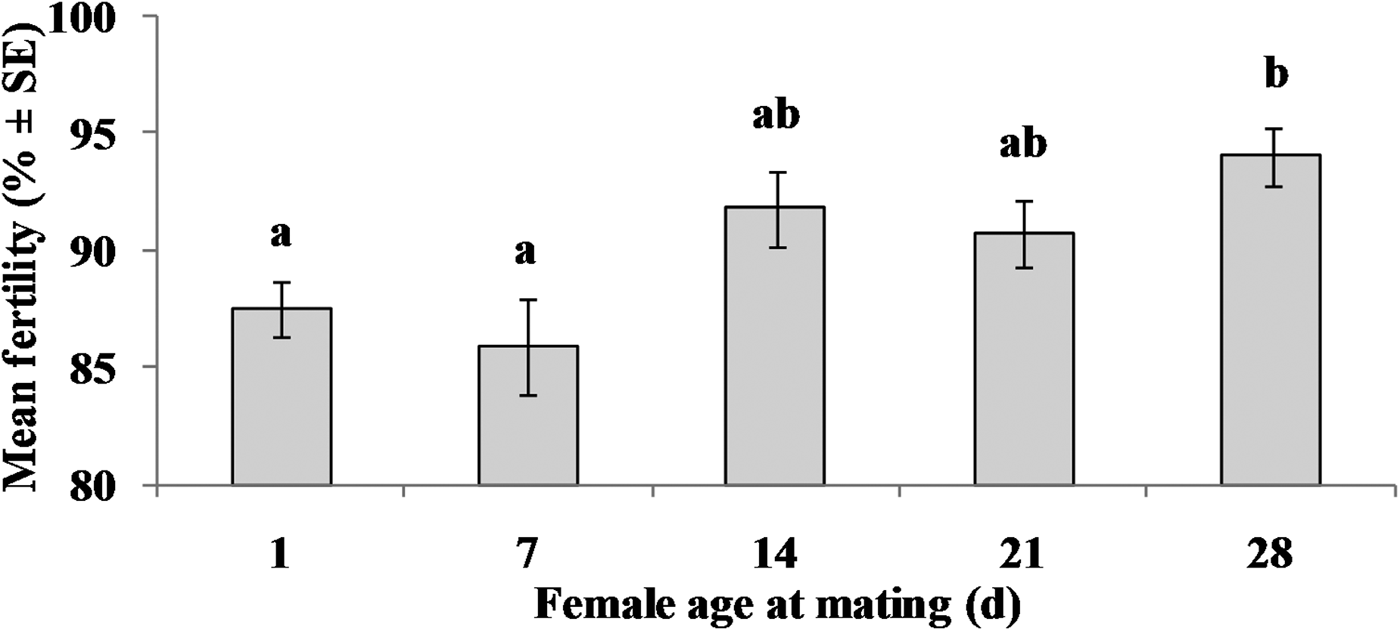
The fertility of the investigated groups (females mated at 1, 7, 14, 21 and 28 days) was 87.51 and 85.86% in females mated at 1 and 7 days of age, respectively, whereas it was above 90% in the other groups (range 90.74–94.00%) (fig. 2). However, a significant difference appeared only between females mated at 1 and 7 days compared with those mated at 28 days (F 4,45 = 4.60, P = 0.010), suggesting that older females had higher reproductive performance than young-mated females. The percentage of female offspring did not vary significantly among the investigated ages at mating, showing a predominance of female offspring (range = 57.3–62.6%) (F 2,27 = 0.90, P = 0.419).
Fertility (mean ± SE) of Planococcus ficus females for different ages at mating. Different letters above columns indicate significant differences (Tukey's test, P < 0.05). Note that the y-axis starts at 80%.

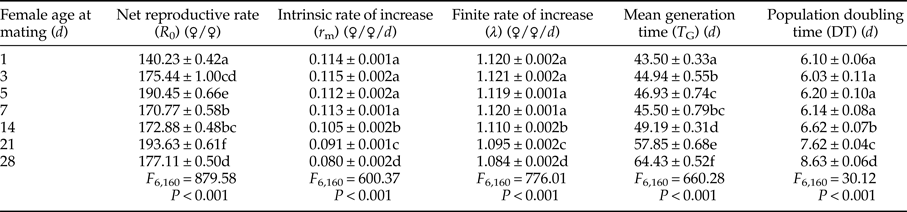
The effects of the delayed mating on reproductive traits of P. ficus also affected the life table parameters of cohorts originating from females mated at different ages. The net reproductive rate was significantly higher in females mated at 5 and 21 days post-emergence, whereas those mated at 1 day showed the lowest rate (F 6,160 = 879.58; P < 0.001) (table 2). The intrinsic and finite rates of increase did not differ significantly among 1- to 7-day-old groups, whereas it decreased significantly in the other treatments (r m: F 6,160 = 600.37; P < 0.001; λ: F 6,160 = 776.01; P < 0.001). The mean generation time ranged from 43.50 to 46.93 days in females mated at 1–7 days, showing a significant increase in females mated at older ages (14–28 days) (F 6,160 = 660.28; P < 0.001). The doubling time exhibited a pattern similar to T G, with values of the same magnitude in females mated at 1–7 days and significantly higher values in females mated 14–28 days after emergence (F 6,160 = 30.12; P < 0.001).
Life table parameters (mean ± SE) of Planococcus ficus in relation to female age at mating.

Means within columns followed by the same letter are not significantly different by Tukey's test (P < 0.05).
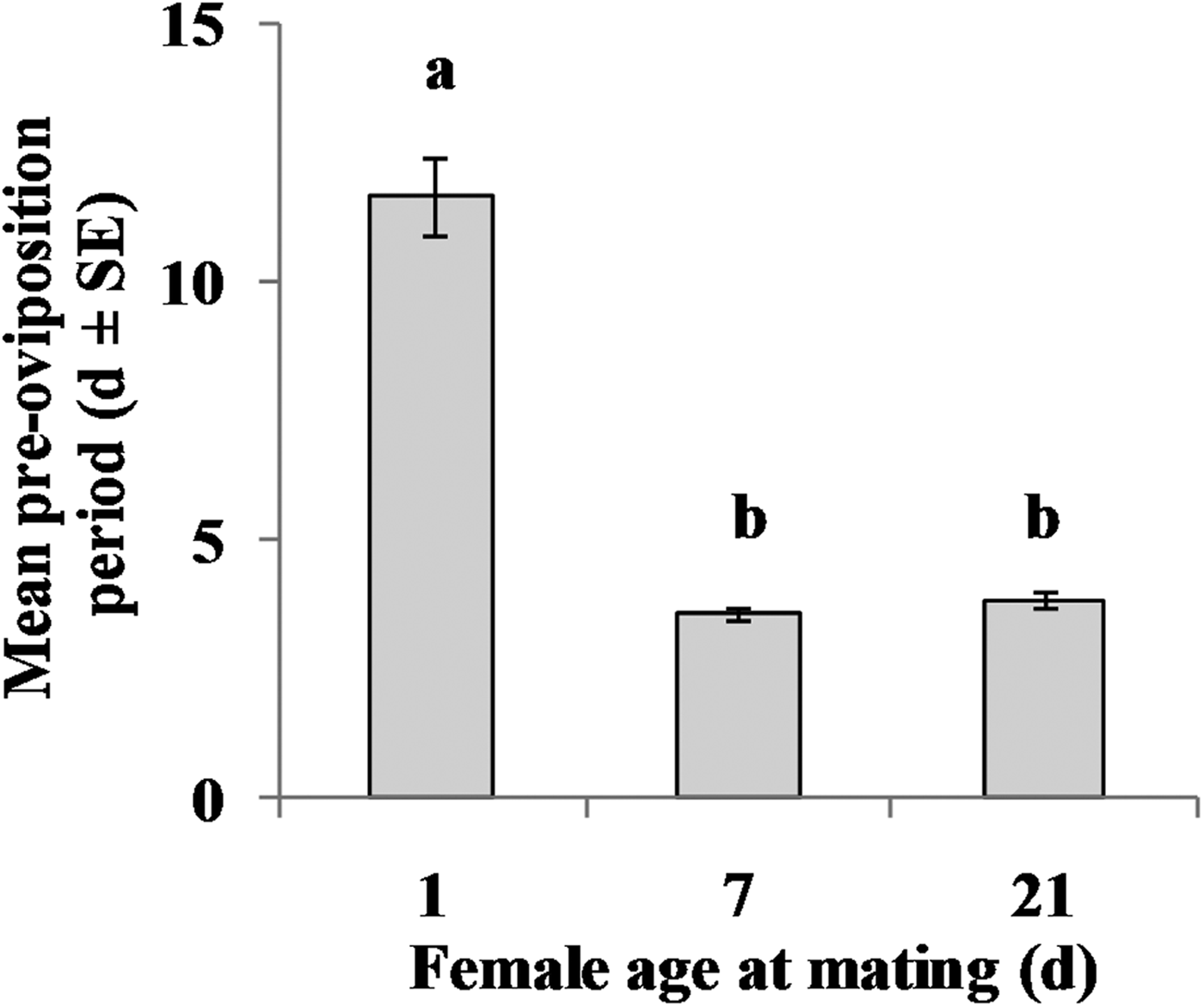
Females released in the field 1 day after emergence showed a pre-oviposition period of 11.67 days, which was significantly longer than that of 7- and 28-day-old females (3.60 and 3.84 days, respectively) (F 2,54 = 112.24; P < 0.001) (fig. 3). The lengths of pre-oviposition periods confirmed the laboratory findings, showing that females of different ages equally attracted males and mated on the same day as the field release.
Length of the pre-oviposition period of Planococcus ficus females released in the field at different ages.

Discussion
The present study illustrates the reproductive traits of P. ficus females mated at increasing ages and indicates the influence of delayed mating on the population growth potential of this pest. The preimaginal development time of mealybugs reared on sprouted potatoes was about 30.5 days at 25 °C, similarly to the findings of Walton & Pringle (Reference Walton and Pringle2005) in mealybugs reared on fresh grapevine leaves. The significantly longer development time observed by Varikou et al. (Reference Varikou, Birouraki, Bagis and Kontodimas2010) in P. ficus immatures developed on grape leaf discs (43.3 days at 25 °C) is likely due to the different rearing substrate. Because the development times of P. ficus on sprouted tubers and fresh grape leaves were similar, it is likely that phloem-sap feeders, such as mealybugs, have a feeding preference for fresh substrate over excised plant organs. In addition, the grape cultivar and possible genetic differences among the mealybug populations has been shown to affect the preimaginal development time (Varikou et al., Reference Varikou, Birouraki, Bagis and Kontodimas2010).
P. ficus females can mate shortly after emergence (Waterworth et al., Reference Waterworth, Wright and Millar2011), although a variable time interval before the beginning of oviposition is required for ovarian maturation. Time intervals between mating and the beginning of oviposition (pre-oviposition period) decreased in females mated within 7 days and were almost equivalent in older females. This trend has also been observed in Ph. solenopsis: females mated at 30 days showed a significantly shorter pre-oviposition period than that of females mated 2 days after emergence (Huang et al., Reference Huang, Zhang, Zhang and Lu2013), thus suggesting that newly-emerged females have a longer pre-oviposition period than older females. This phenomenon can be explained by the egg production and oviposition within the female reproductive tract (Bloch Qazi et al., Reference Bloch Qazi, Heifetz and Wolfner2003). Oocytes are firstly generated within the ovaries (oogenesis) and then released in the oviducts (ovulation), through which eggs move down into the common oviduct, where they are fertilized and finally laid. Virgin females retain oocytes in the ovaries and ovulation starts after mating. In P. citri, meiotic ovarioles become visible 6 days after female emergence (Nelson-Rees, Reference Nelson-Rees1961), which means that meiosis initiates after at least 6 days even if females mate on emergence. Subsequent ovulation, fertilization and oviposition may require a fairly constant period of time (about 3–4 days). Therefore, in our opinion, P. ficus virgin females mated at age ≥7 days have almost completed the oogenesis of a portion of eggs, and exhibit a nearly constant and slightly longer pre-oviposition period than 3 days.
The progressive decrease of the pre-oviposition period in females mated within 7 days affected the length of the pre-reproductive period. In fact, in our study, the pre-reproductive period increased slightly in females mated within 7 days, whereas, in contrast, it increased proportionally with the mating delay in females mated at 14, 21 and 28 days. A pre-reproductive period similar to P. ficus females mated at 1 day has been found in both the passionvine mealybug, Planococcus minor (Maskell) (Hemiptera: Pseudococcidae) and P. citri. These species showed a pre-reproductive period of 10.2 and 12.3 days when reared at 25 °C on sprouted potato and grapevine, respectively (Francis et al., Reference Francis, Kairo and Roda2012; da Silva et al., Reference da Silva, de Morais Oliveira, Silva, da Silva, de Souza and Oliveira2014). However, no information is available on the pre-reproductive period in mealybugs mated at older ages.
The reproductive performance of P. ficus females mated at increasing ages differed considerably from that of other insects. A delayed mating of 4–6 days in some lepidopteran species has led to a significant reduction of fecundity and fertility (Vickers, Reference Vickers1997; Jones & Aihara-Sasaki, Reference Jones and Aihara-Sasaki2001; Walker & Allen, Reference Walker and Allen2011), whereas P. ficus has not been found to be negatively affected by the age at mating. In fact, in our experiment, P. ficus fecundity was 267.4 eggs in 1-day-old females, ranging instead from 302.5 to 355.6 eggs in females mated at older ages. No studies have been carried out on P. ficus egg production. However, it is reasonable to assume that P. ficus oogenesis is similar to P. citri, for which Nelson-Rees (Reference Nelson-Rees1961) observed the highest fecundity in 10–20-day-old females and the decay of ovarioles and egg resorption in 30-day-old virgin females. The same author demonstrated that P. citri is a capital breeder, as starved newly-emerged females had a reduced body size and undeveloped ovarioles.
The different performance of mealybugs relative to other systematic groups could be due to their different evolution. In fact, many lepidopteran species enter in diapause during the winter months and have a short adult lifespan and reproductive period. For instance, the autumn gum moth, Mnesampela privata (Guenée) (Lepidoptera: Geometridae), exhibits continuous ovulation after adult emergence and both fecundity and fertility are linearly related to longevity (Walker & Allen, Reference Walker and Allen2010). Unmated M. privata females live about 10 days; therefore, a mating delay of 7 days reduces the time available for oviposition by 70% (Walker & Allen, Reference Walker and Allen2011). In contrast, P. ficus does not enter into diapause but slows down its life cycle, overwintering mainly as mated adult females and preserving the reproductive potential for several months (Lentini et al., Reference Lentini, Serra, Ortu and Delrio2008). In fact, overwintering females are usually larger and have higher fecundity than summer females (A. Lentini, personal observation). The minimum development threshold temperature of insects is lower than the reproductive threshold (Gilbert & Raworth, Reference Gilbert and Raworth1996). Therefore, mealybug adult females at low temperatures can feed and increase their ‘energy reserve’ in order to produce a high number of eggs under favourable climatic conditions.
Contrary to findings in Lepidoptera, the fertility of P. ficus females did not decrease with age, in fact females mated at 28 days showed the highest fertility values. Similarly, the fertility of A. orientalis was not affected by the age at mating, although about 50% of females mated at older ages did not lay fertile eggs (Wenninger & Averill, Reference Wenninger and Averill2006).
Age of mating did not affect the offspring sex ratio, which was about 59% female regardless of the mating delay. The mean sex ratio observed is in accordance with our previous observations carried out in over 11,000 P. ficus eggs (female percentage = 60.3%) (Cocco et al., Reference Cocco, Marras, Muscas, Mura and Lentini2015). To date, no studies have reported variations in the P. ficus sex ratio due to the age of females at mating, whereas research carried out on P. citri provided contrasting results. Ross et al. (Reference Ross, Dealey, Beukeboom and Shuker2011) observed nearly 50% of female eggs in young-mated females and about 60% in females mated after 30 days. On the other hand, Nelson-Rees (Reference Nelson-Rees1961) found a prevalence of female offspring among females mated within 20 days and a majority of male offspring among 30-day-old females. Sex ratio in P. citri and, by extension, in P. ficus is likely influenced not only by female age, but also by environmental factors such as food quality, feeding frequency and population density (Ross et al., Reference Ross, Langenhof, Pen, Beukeboom, West and Shuker2010, Reference Ross, Dealey, Beukeboom and Shuker2011). In addition, climatic conditions may play a role in biasing the sex ratio, as Walton & Pringle (Reference Walton and Pringle2005) observed a lower proportion of females at 18 and 30 °C under laboratory conditions. This could be an adaptive response to adverse environmental conditions in order to ensure higher genetic variability, as reported in some mite species (Margolies & Wrensch, Reference Margolies and Wrensch1996; Rencken & Pringle, Reference Rencken and Pringle1998).
The findings of our field experiment were in accordance with our laboratory results. In fact, mating delay did not impair the calling behaviour of P. ficus females and their mating ability, as females of different ages mated on the same day as the field release. Similarly, the female age at mating in the European grapevine moth, Lobesia botrana Den. & Schiff. (Lepidoptera: Tortricidae) did not alter the calling activity of females and their receptivity (Torres-Vila et al., Reference Torres-Vila, Rodriguez-Molina and Stockel2002).
Female mating at different ages affected all the investigated demographic parameters. The intrinsic and the finite rates of increase showed a decreasing pattern in females mated at 14–28 days, whereas the population doubling time increased when mating was delayed for more than 14 days. These patterns indicate a lower growth potential of P. ficus populations at increasing ages at mating. Increasing mating delay also led to a lengthening of the mean time required to complete a generation. The net reproductive rate did not show a clear pattern and it is not clear why females mated at 5 and 21 days exhibited the highest values. However, overall the demographic parameters showed a consistent pattern with the finding that a mating delay >7 days reduces the population growth potential.
Biological and reproductive parameters of P. ficus are affected by several factors, including the host species (Ahmed & Abd-Rabou, Reference Ahmed and Abd-Rabou2010), grapevine cultivar (Morandi Filho et al., Reference Morandi Filho, Grützmacher, Botton and Bertin2008; Gonzalez Luna & La Rossa, Reference Gonzalez Luna and La Rossa2016), climatic conditions (Cocco et al., Reference Cocco, Mura, Muscas and Lentini2017), nitrogen fertilization (Cocco et al., Reference Cocco, Marras, Muscas, Mura and Lentini2015) and vineyard floor management (Muscas et al., Reference Muscas, Cocco, Mercenaro, Cabras, Lentini, Porqueddu and Nieddu2017). The main aim of this study was to highlight differences in the reproductive output of P. ficus females mated at increasing ages. Therefore, life table values may vary under different conditions, but nonetheless they provide an insight into the influence of the female age at mating on the reproductive output and indicate the distinct response of P. ficus females to delayed mating. The demographic parameters observed by Gonzalez Luna & La Rossa (Reference Gonzalez Luna and La Rossa2016) on P. ficus reared in 2-year-old grapevines were comparable with those observed during our experiment in females mated at 1–3 days, which are the natural mating conditions in the field.
Changes in the reproductive output of P. ficus due to delayed mating could affect pheromone-mediated pest control strategies, such as mating disruption. Mating disruption against P. ficus would be effective if mating is suppressed or delayed for more than 7 days. In fact, delayed mating did not reduce mealybug fecundity, but increased the development time of P. ficus populations, thereby reducing the number of generations per year. The effectiveness of mating disruption is influenced by the persistence of the synthetic pheromone in the vineyard. Our ongoing studies investigating the influence of mating disruption on the reproductive traits of P. ficus in the field have indicated a significant reduction of ovipositing females as well as the lengthening of the pre-oviposition period in the pheromone-treated plots throughout the season (A. Cocco, unpublished results). The mating disruption control technique applied to lepidopteran pests is potentially more effective, because a simple mating delay of a few days, even without mating suppression, greatly affects female fecundity, thus reducing the population growth potential (Vickers, Reference Vickers1997; Jones & Aihara-Sasaki, Reference Jones and Aihara-Sasaki2001; Walker & Allen, Reference Walker and Allen2011). For instance in the koa seedworm, Cryptophlebia illepida (Butler) (Lepidoptera: Tortricidae), a mating delay of 6 days reduced the population growth rate by about 20% (Jones & Aihara-Sasaki, Reference Jones and Aihara-Sasaki2001), whereas in P. ficus a similar growth rate reduction was obtained with a mating delay ≥3 weeks. In vineyards protected by mating disruption, a higher percentage of unmated P. ficus females, a lower percentage of ovipositing females and a lower fecundity were observed, although the contribution of mating delay on the reduction of the pest population density was not estimated (Walton et al., Reference Walton, Daane, Walter, Bentley, Millar, Larsen and Malakar-Kuenen2006; Cocco et al., Reference Cocco, Lentini and Serra2014). In order to better understand the influence of the reproductive traits on the effectiveness of mating disruption to control P. ficus, further field studies are ongoing to quantify the length of the mating delay caused by the control method adopted.
Acknowledgements
The authors wish to thank two anonymous reviewers for detailed and constructive comments that significantly improved the quality of the manuscript.