Introduction
Nasal obstruction caused by turbinate hypertrophy significantly impairs patients’ quality of life. The inferior turbinate derives its arterial blood supply from the posterior lateral nasal artery, which, together with the septal artery, comprises the major branches of the sphenopalatine artery. As such, approaches for turbinate reduction should not only reliably reduce nasal obstruction while maintaining normal mucosal function, but also limit bleeding, the most severe complication of such surgery.Reference Mori, Fujieda, Igarashi, Fan and Saito1
Although numerous surgical techniques exist, including turbinectomy, turbinoplasty, extramucosal or submucosal electrocautery, radiofrequency ablation, laser-assisted resection or ablation, and cryosurgery,Reference Brunworth, Holmes and Sindwani2 there is currently no clear consensus in the literature indicating the optimal technique for turbinate reduction.Reference Eliashar3–Reference Barham, Thornton, Knisely, Marcells, Harvey and Sacks7 Partial resection was developed to avoid damaging the vascular pedicle and the bleeding that might be associated with total turbinate resection.Reference Elwany and Harrison4,Reference Fradis, Danino, Gaitini, Gershinski, Malatskey and Golz8 Still, the rich blood supply of the nasal turbinates means that post-operative bleeding remains one of the most common and severe complications of this surgery type. The literature reports variable post-operative bleeding rates, ranging between 2.6 and 20 per cent, and there are few studies comparing the rates of bleeding between the different approaches.Reference Fradis, Danino, Gaitini, Gershinski, Malatskey and Golz8–Reference Gupta, Mercurio and Bielamowicz11
In order to support informed surgical choice, we conducted a retrospective study comparing the post-operative bleeding following three turbinate surgical approaches: partial turbinectomy, anterior rhinoscopy submucosal turbinate reduction and endoscopic turbinoplasty. We hypothesised that the improved visibility of the nasal cavity in the endoscopic turbinoplasty technique would result in a lower post-operative bleeding rate compared with the other techniques.
Materials and methods
Patients who underwent surgical inferior turbinate intervention in the Galilee Medical Center between January 2016 and November 2017, and who had completed at least one month of follow up, were included. Patients who underwent other inferior turbinate surgical techniques, have a history of clotting disorder, or who received preventive treatment with tranexamic acid or any other medication affecting the clotting system in the 7–10 days before surgery were excluded from the main study. We performed an additional analysis of the bleeding rates of patients who received treatment with tranexamic acid.
Patients were divided into three groups as follows: partial turbinectomy, medial flap turbinoplasty performed by anterior rhinoscopy (submucosal turbinate reduction), or endoscopic turbinoplasty. The procedures were performed by three senior surgeons, with each surgeon performing their technique of expertise. We compared post-operative bleeding (the primary outcome), as well as timing, severity and treatment of the bleeding (secondary outcomes).
Surgical approaches
All procedures were performed by an expert otolaryngologist under general anaesthesia and transoral intubation.
Preparation
In the endoscopic turbinoplasty technique, patients were prepared topically with 2 per cent lidocaine (Esracain), and 1:1000 adrenaline-soaked cottonoids placed within the inferior meatus and over the anterior head of the inferior turbinate.
In the partial turbinectomy and submucosal turbinate reduction techniques, patients were prepared topically with xylometazoline hydrochloride 0.1 per cent (Novartis, Basel, Switzerland).
For all surgical approaches, the mucosa was injected with lidocaine hydrochloride 2 per cent and 1:100 000 adrenaline (Lidocadren; Teva, Petah Tikva, Israel) along the inferior border and anterior head of the inferior turbinate. The patient's head was placed in the neutral anatomical position, and the operative bed was placed in a 15–20° reverse Trendelenburg position.Reference Barham, Knisely, Harvey and Sacks10
Techniques
The partial turbinectomy technique included removal of the inferior turbinate bone, along with its mucosa (Figure 1 – ‘A’). Submucosal turbinate reduction was carried out through a small incision at the anterior projection of the inferior turbinate, after which the remaining mucosal flap was elevated in a subperiosteal plane using a Cottle dissector. The turbinate bone and lateral mucosa were then removed along the vertex of the inferior meatus, leaving the medial flap intact in the nasal cavity (Figure 1 – ‘B’). Both approaches were performed by anterior rhinoscopy. Electrical cautery was applied using bayonet bipolar forceps to the inferior turbinate stump. Merocel (Medtronic, Minneapolis, Minnesota, USA) or Telfa (Medtronic) tampons were used for nasal dressing (Figure 2 – ‘A’ and ‘B’).
Illustrations of the three surgical techniques. Partial turbinectomy and submucosal turbinoplasty were performed by anterior rhinoscopy. The partial turbinectomy technique included removal of inferior turbinate bone along with its mucosa (‘A’). Submucosal turbinectomy was performed through a small incision at the anterior projection of the inferior turbinate, after which the remaining mucosal flap was elevated in a subperiosteal plane. The turbinate bone and lateral mucosa were then removed along the vertex of the inferior meatus, with the medial flap remaining intact in the nasal cavity (‘B’). Endoscopic inferior turbinoplasty was performed using a microdebrider. A medial flap was created by removing the inferior border of the inferior turbinate mucosa, exposing the turbinate bone. The turbinate bone and lateral mucosa were then removed along the vertex of the inferior meatus (‘C’).

Bleeding homeostasis achieved with electric cautery in the three surgical techniques. The illustration shows electrical cautery of the inferior turbinate stump in partial turbinectomy and submucosal turbinoplasty (‘A’ and ‘B’), and electrical cautery of the arterial supply of the inferior turbinate artery in the endoscopic turbinoplasty approach (‘C’).

Endoscopic turbinoplasty was performed using a microdebrider (Medtronic) with a 4.3 mm or 4 mm blade. A medial flap was created by removing the inferior border of the inferior turbinate mucosa, exposing the bone of the turbinate. The remaining mucosal flap was elevated in a subperiosteal plane using a Cottle dissector. The turbinate bone and lateral mucosa were then removed along the vertex of the inferior meatus (Figure 1 – ‘C’). The arterial supply of the inferior turbinate artery was identified and cauterised using bayonet bipolar forceps (Figure 2 – ‘C’). The remaining medial flap mucosa was folded and attached to the lateral nasal wall using a Surgicel Snow dressing (Ethicon, Somerville, New Jersey, USA).
Most of the inferior turbinate surgical procedures were performed together with other sinonasal procedures; however, cases such as septal haematoma were excluded.
Data, including patient demographics, nasal packing details and medications, along with post-operative bleeding rates, severity, timing and treatment, were collected through review of patient charts or by telephone contact with the patient. Bleeding severity was classified as requiring intervention (including treatment with a nasal tamponade, or cauterization with or without general anaesthesia) or only conservative treatment (monitoring and discharge within 24 hours). Early bleeding was defined as occurring during hospitalisation and late bleeding as occurring after discharge.
Statistical analysis
Chi-square and Fisher exact tests were used for categorical variables, and t-tests or Wilcoxon rank-sum tests were used for normally distributed continuous variables. A two-sided p-value of less than 0.05 was considered significant. Multivariate logistic regression analysis was used to evaluate the association of the incidence of post-operative bleeding with each operative method and other potential confounding factors, such as post-operative dressing type and the requirement for bilateral or unilateral intervention.
Results
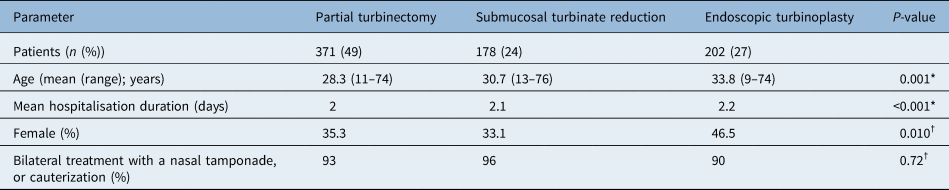
During the study period, 1035 patients underwent inferior turbinate surgery. Twenty patients were lost to follow up, 10 patients underwent other surgical techniques, and 254 patients were excluded because of preventive treatment with tranexamic acid. Overall, 751 patients were included in the study analysis: 371 patients (49 per cent) underwent partial turbinectomy, 178 (24 per cent) underwent submucosal turbinate reduction and 202 (27 per cent) underwent endoscopic turbinoplasty. The demographics of the three groups were similar, as shown in Table 1.
Patient demographics for the three inferior turbinate surgical techniques

*Kruskal–Wallis test; †chi-square test
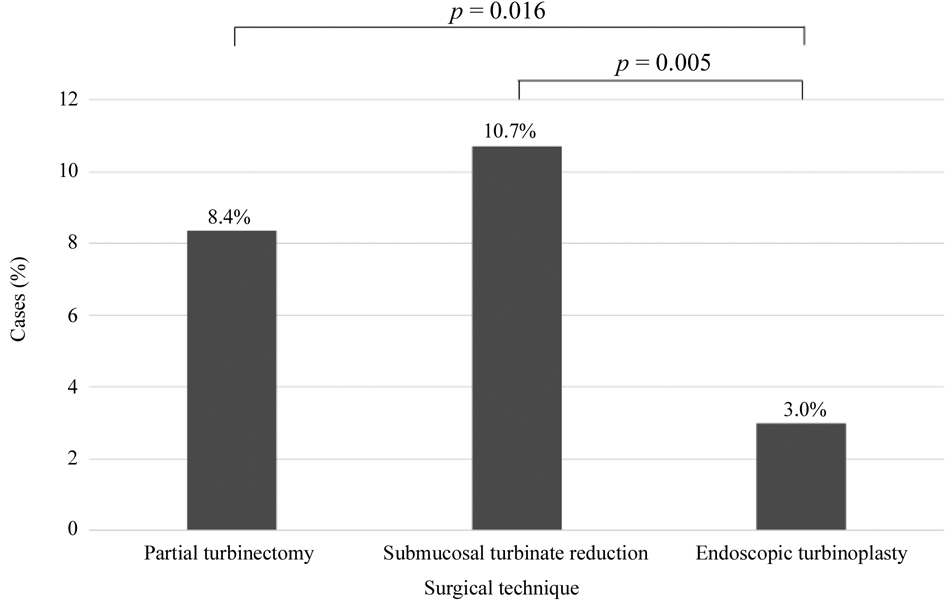
Of the 751 patients included in the study, 56 (7.5 per cent) presented to the emergency room with post-operative bleeding: 31 patients (8.4 per cent) had undergone partial turbinectomy, 19 (10.7 per cent) had undergone submucosal turbinate reduction and 6 (3.0 per cent) had undergone endoscopic turbinoplasty.
The logistic regression analysis revealed a higher odds ratio for post-operative bleeding in the partial turbinectomy and submucosal turbinate reduction groups than in the endoscopic turbinoplasty group (partial turbinectomy vs endoscopic turbinoplasty: odds ratio = 2.46, 95 per cent confidence interval (CI) = 0.99–6.08; submucosal turbinate reduction vs endoscopic turbinoplasty: odds ratio = 2.79, 95 per cent CI = 1.05–7.42), as shown in Figure 3.
Post-operative bleeding rates for the three surgical approaches.

In the partial turbinectomy group, the early and late bleeding rates were 1.3 per cent and 7.0 per cent, respectively. In the submucosal turbinate reduction group, the early and late bleeding rates were 2.8 per cent and 7.9 per cent, respectively. Patients in the endoscopic turbinoplasty group only experienced late bleeding (3.0 per cent).
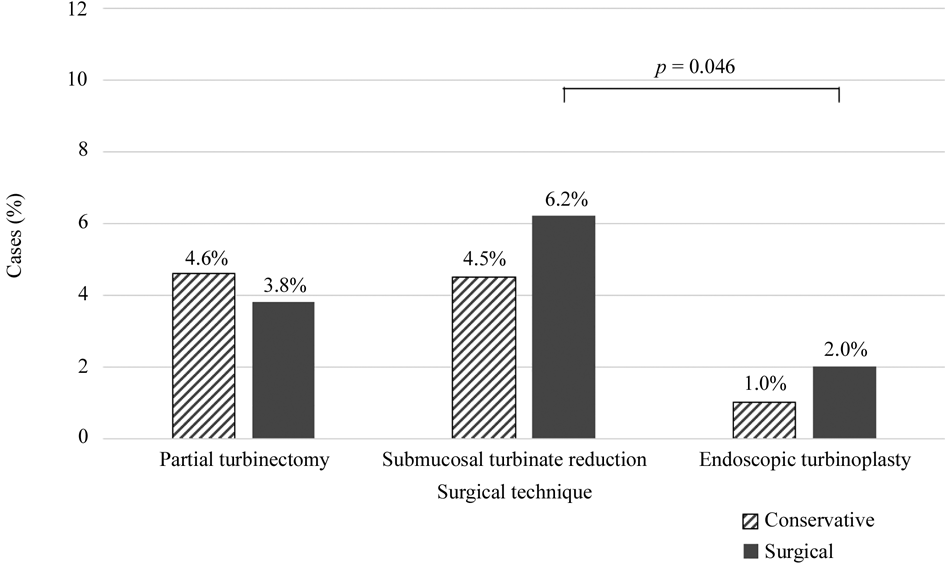
Post-operative bleeding was treated conservatively in: 3.8 per cent of partial turbinectomy patients, 6.2 per cent of submucosal turbinate reduction patients and 2.0 per cent of endoscopic turbinoplasty patients. According to the logistic regression analysis, the odds ratio for requiring an intervention to control bleeding was significantly lower in the endoscopic turbinoplasty group than in the submucosal turbinate reduction group (odds ratio = 3.26, 95 per cent CI = 1.02–10.43) (Figure 4).
Intervention type (conservative vs surgical) required to treat post-operative bleeding following the three surgical approaches.

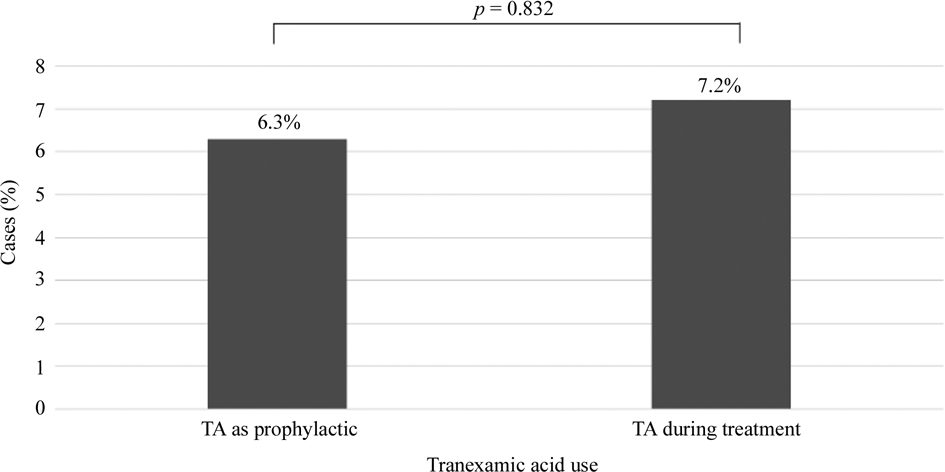
As one of the surgeons performing submucosal turbinate reduction routinely used tranexamic acid as a prophylactic treatment, a large group were excluded from the main analysis (254 patients). An additional comparison showed that the bleeding rate for patients who received tranexamic acid as a prophylactic (6.3 per cent; 16 out of 254 patients) was similar to that for patients who were not treated with Tranexamic Acid prophylactic (7.2 per cent; 11 out of 151 patients). This difference was not statistically significant (p = 0.832) (Figure 5).
Post-operative bleeding rates in patients who underwent submucosal turbinate reduction and received tranexamic acid (TA) either as a prophylactic measure or as part of treatment for post-operative bleeding.

Discussion
Turbinate surgery for nasal obstruction generally involves reducing the size of the inferior turbinate. After turbinate surgery became common in the late 1800s,Reference Nurse and Duncavage12 total inferior turbinectomy was advocated. This technique involves fracture of the turbinate bone toward the midline and cutting along its lateral attachment using a nasal speculum and headlight or by endoscopic visualisation.Reference Bergmark and Gray13 Disadvantages of the approach include post-operative complications, such as bleeding and scar formation, and presumed loss of physiological function leading to atrophic mucosal changes, nasal crusting and dryness.Reference Hong and Jang14
Submucosal resection of the turbinate, involving removal of the inferior turbinate bone while leaving the overlying medial mucosa intact, was first described by Spielberg in 1924,Reference Spielberg15 and further elaborated on by House in 1951.Reference House16 By maintaining the mucosal flaps, normal mucosal function is preserved, reducing the likelihood of complications such as crusting (minimal crusting is typically observed along the incision site) and atrophic rhinitis, and resulting in a lower incidence of post-operative bleeding.Reference House16,Reference Jackson and Koch17 The primary disadvantages of traditional submucous resection are the potential for mucosal shredding in inexperienced hands and the need for nasal packing post-operatively.Reference Gupta, Mercurio and Bielamowicz11
More recently, microdebrider-assisted submucosal resection of the inferior turbinate has proved successful, with even fewer complications of crusting and with long-term favourable outcomes.Reference Barham, Thornton, Knisely, Marcells, Harvey and Sacks7,Reference Chen, Tan and Huang18 An Allergic Rhinitis and its Impact on Asthma guideline update includes a recommendation for performing endoscopic turbinoplasty for inferior turbinate reduction as a more precise and less traumatic surgery.Reference Bousquet, Khaltaev, Cruz, Denburg, Fokkens and Togias19
Although a large number of published articles exist on turbinate reduction or resection, we found few comparative studies on the bleeding rates of different surgical approaches. A minority of them include a reference to post-operative haemorrhage and its treatment.Reference Sinno, Mehta, Lee, Kidwai, Saadeh and Lee6–Reference Batra, Seiden and Smith9
Our retrospective study comparing the post-operative bleeding rates of three surgical turbinate reduction approaches showed an overall bleeding rate of 7.5 per cent, which is comparable to the rates previously reported in the literature. The bleeding rate in patients who underwent endoscopic resection was statistically significantly lower than that in patients who underwent traditional anterior rhinoscopy (partial turbinectomy or submucosal turbinate reduction). Furthermore, the number of patients requiring intervention to stop post-operative bleeding was substantially lower after endoscopic surgery compared with non-endoscopic approaches.
ENT surgeons will continue using the anterior rhinoscopy approach, as it is inexpensive, quick to perform and effective. Yet, studies such as ours contribute to a base for informed surgical choice, and we anticipate that this will help promote the use of an endoscope for turbinate surgery. We believe that surgeons using non-endoscopic turbinate surgery perform ‘blind’ cautery of the concealed stump; by contrast, in endoscopic surgery the artery is exposed, visualised and cauterised, whether it is bleeding or not (Figure 2 – ‘C’). Hence, it is likely that the precise identification of the posterior lateral nasal branch (of the sphenopalatine artery) and its prophylactic cautery are the reason for the lower rate and severity of bleeding in the endoscopic group.
In addition, Surgicel® absorbable dressing was used to attach the medial flap to the remaining bone in endoscopic turbinate surgery, while nasal packing was used in anterior rhinoscopy and removed after 2 days. Withdrawal of the nasal packing is traumatic and irritates the mucosa lining, which could also contribute to the difference in bleeding rates. Another possible factor contributing to the lower bleeding rate in the endoscopic turbinoplasty group is that the preparative procedure for this technique includes more rigorous decongestion.
Tranexamic acid is used in several clinical settings to stop bleeding by preventing clot breakdown (fibrinolysis). It has a role in the management of epistaxis as an adjunct to standard treatments, and it prevents blood loss after surgery in emergency procedures and other disciplines such as orthopaedics.Reference Zhang, He, Fang, Chen, Liang and Wang20,Reference Perel, Ker, Morales Uribe and Roberts21 However, we found no studies in which the drug was prophylactically given to prevent bleeding after nasal surgery. A recent Cochrane review shows a reduction in the risk of re-bleeding with the use of either oral or topical tranexamic acid in addition to the usual care of adult patients with epistaxis.Reference Joseph, Martinez-Devesa, Bellorini and Burton22 Based on this analysis, it is reasonable to conclude that the prophylactic administration of tranexamic acid may prevent bleeding after surgery. Here we compared, for the first time, the bleeding rates following nasal surgery with and without the use of tranexamic acid as a pre-operative preventive measure. We found that prophylactic treatment with tranexamic acid did not reduce post-operative bleeding. Based on this finding, and given that such prophylactic treatment is associated with higher rates of mild (nausea and diarrhoea) or severe (seizures, thromboembolic events) side effects, the use of tranexamic acid as a prophylactic should be carefully considered.
Among the strengths of this study are: the inclusion of a large number of patients (over 700); the low rate of exclusion because of lack of follow up (2 per cent); and the objective nature of the primary outcome. In this study, details on bleeding and its treatment – data that cannot be biased over time – were extracted from patient files.
• Inferior turbinate surgery is a common procedure performed using long-established techniques and newer endoscopic approaches
• Post-operative bleeding is the most important complication; however, there is no consensus on post-operative bleeding rates for any of these techniques
• This study compared post-operative bleeding rates between the inferior turbinate surgical techniques of: partial turbinectomy, submucosal turbinate reduction and endoscopic turbinoplasty
• This study has the advantages of objective outcome measures and a large cohort
• The endoscopic technique had the lowest post-operative bleeding rates
• Use of endoscopy is encouraged for inferior turbinate surgery
The limitations of our study include its retrospective nature, meaning we cannot conclude the direct influence of the surgical technique on the bleeding rate. In addition, each type of turbinate procedure was performed by a different senior surgeon, and therefore the outcome may in part be caused by differences between surgeons. Furthermore, many of the turbinate surgical procedures were carried out alongside other procedures, most commonly endoscopic sinus surgery and septoplasty. This means that the bleeding source may not have been the inferior turbinate. As we counted all instances of bleeding in the endoscopic turbinoplasty group, it is reasonable to assume that the true rate of turbinate bleeding is even lower than our results suggest. Finally, the overall bleeding rate was low, making it difficult to demonstrate statistical significance between the groups. A further prospective study should be performed to strengthen and validate our results.
Conclusion
Endoscopic inferior turbinoplasty had the lowest overall rate of post-operative bleeding and the lowest rate of patients requiring intervention. This information supports use of the endoscopic approach for inferior turbinate reduction. This approach allows better control of bleeding during the initial procedure and should be considered for every patient scheduled to undergo turbinoplasty. Furthermore, avoiding the use of nasal packing may lower the early bleeding rate in patients undergoing turbinoplasty using an endoscopic approach, allowing a shorter post-operative hospital stay and a more comfortable recovery.
Acknowledgement
We wish to thank Orly Yakir for the statistical analysis.
Competing interests
None declared