Implications
The study identifies the key components of the measures being assessed by the member states (MSs) in regard to the Broiler Directive, and the methodologies used for assessment. The study identifies that there is significant variability in the stage of implementation between MSs, and indicates that shared guidance and technical information may be of value in the set-up process for those MS engaged in implementation of the Directive.
Introduction
Poultry is the second most important meat in the European Union (EU) in terms of mass of meat consumed per capita. The European annual production is approximately six billion birds, with an average consumption of poultry meat of about 23 kg per capita/year (European Commission, Agriculture and Rural Development, 2015). The European poultry industry employs 300,000 people across Europe and has an annual turnover of 30 billion Euros (AVEC, Association of Poultry Producers and Poultry Trade in the EU, 2014). From 1 July 2010, new welfare rules for meat chickens came into effect across the EU through Directive 2007/43/EC (EU, 2007). For the first time in the construction of animal focussed legislation, Directive 2007/43/EC prescribes welfare rules for meat chickens and provides for variable levels of stocking density dependent on the performance of the farm. The key clauses in this legislation are as follows:
-
1. Member states (MSs) shall ensure that the maximum stocking density in a holding or a house of a holding does not at any time exceed 33 kg/m2.
-
2. By way of derogation from paragraph 2, MSs may provide that chickens be kept at a higher stocking density, provided that the owner or keeper complies with the requirements set out in Annex II, in addition to the requirements set out in Annex I.
-
3. MSs shall ensure that, when a derogation is granted under paragraph 3, the maximum stocking density in a holding or a house of a holding does not at any time exceed 39 kg/m2.
-
4. When the criteria set out in Annex V are fulfilled, MSs may allow that the maximum stocking density referred to in paragraph 3 be increased by a maximum of 3 kg/m2. (This last clause effectively permits a maximum stocking density in the EU of 42 kg/m2).
The Broiler Directive is unique in that it uses data collected at abattoirs and on farm to monitor on-farm welfare to vary permitted stocking rates. The Directive sets a maximum stocking density of 33 kg/m2, except where the keeper complies with certain extra requirements (providing the capacity to stock at up to 42 kg/m2). Stocking density is a key determinant of the potential productivity of a farm. The co-relation between the quality of management and stockmanship, and the impact of stocking density on welfare outcomes and behavioural opportunities of broiler birds is the subject of a number of studies (Dawkins et al., Reference de Jong, Berg, Butterworth and Estevez2004; Jones et al., Reference Haslam, Knowles, Brown, Wilkins, Kestin, Warriss and Nicol2005; Villagrá et al., Reference Villagrá, Ruiz de la Torre, Chacon, Lainez, Torres and Manteca2009; Bokkers et al., Reference Bokkers and Koene2011; Buijs et al., Reference Buijs, Keeling and Tuyttens2011). The introduction of this Directive has a number of practical implications for the poultry production industry, the enforcement bodies and the consumer, including requirements for keeper training in physiology, feeding needs, animal behaviour, the concept of stress, practical aspects of poultry handling, catching, loading and transport, emergency care, emergency killing and culling, and biosecurity measures. In addition, the requirements of the Directive require links to record keeping, statutory inspections and provision of codes of management practice.
There are a number of common disease conditions, which affect both broiler welfare and productivity through morbidity, poor growth, and/or culling and mortality (EU, 2000; Bessei, Reference Bessei2006; de Jong et al., Reference Dawkins, Donnelly and Jones2012). Some of the well-recognised clinical conditions affecting broiler birds, and which are the basis for the measures used in the MSs include the following:
Foot pad dermatitis: a condition that causes lesions on the plantar surface of the foot, the most severe of which may become deeply ulcerated (EU, 2000; Haslam et al., 2007; Shepherd and Fairchild, Reference Shepherd and Fairchild2010).
Ascites: a condition that is caused by failure of fluid homoeostasis associated with cardiovascular pathology, resulting in accumulation of fluid in body tissues and the peritoneum.
Joint lesions/Lameness: some degree of lameness can be seen in many flocks, with a proportion of birds progressing to severe lameness. Joint pathologies may be detected at slaughter, but lameness scoring of live birds on-farm is not yet a common feature of assessment as it is potentially time consuming (Kestin et al., Reference Jones, Donnelly and Stamp Dawkins1992; Sørensen et al., Reference Sørensen, Su and Kestin2000; Sanotra et al., Reference Saif, Fadly and Glisson2003; Bokkers and Koene, Reference Bokkers, de Boer and Koene2004; Kristensen et al., Reference Knowles, Kestin, Haslam, Brown, Green, Butterworth, Pope, Pfeiffer and Nicol2006; Knowles et al., Reference Kestin, Knowles, Tinch and Gregory2008).
Hock burn: lesions on the tibiotarsal skin surface caused predominantly by contact with litter that is in poor condition (Haslam et al., 2007; Meluzzi et al., Reference Kristensen, Perry, Prescott, Ladewing, Ersboll and Wathes2008a).
Cellulitis: skin lesions caused by localised skin infection and inflammation occurring in the skin and connective tissue on the abdomen or leg skin. Small skin lesions caused by scratching by other birds can predispose to cellulitis (Saif et al., Reference Meluzzi, Fabbri, Folegatti and Sirri2008), cellulitis of the breast skin is known as a breast blister (Haslam et al., 2007; Meluzzi et al., Reference Meluzzi, Fabbri, Folegatti and Sirri2008b).
Respiratory disease: a range of disease conditions caused by bacterial, viral, fungal and dust associated pathogenic processes can result in morbidity and mortality in production birds (Saif et al., Reference Meluzzi, Fabbri, Folegatti and Sirri2008).
The competent authority (CA) in each MS, which may be the local state veterinary agency or may be a government department, is directed to provide trigger levels based on postmortem inspection to identify possible indications of poor welfare. In line with the requirements of the Directive, each country has initiated the use of a set of measure, these being made at the slaughterhouse or at the farm. Annex II of the Directive permits the CAs to increase the stocking density on farms that comply with these specific ‘outcome’ measure results, which are monitored and enforced by the CA.
The aims of this study were as follows:
To determine which technical data (measures of poor welfare) the MSs collect in line with the Directive.
To ascertain how the different MS use the data collected to make decisions on compliance with the Directive and on the use of variable stocking densities (33, 39 and 42 kg/m2) as permitted by the Broiler Directive.
Material and methods
CA staff who had responsibility for implementation of the Broiler Directive in the MSs were invited to workshops, and to contribute to web-based questionnaires. The personnel from the MSs (state veterinarians or local animal policy team personnel) liaised with the project, used the online questionnaires, attended workshops and helped to design the webtool, to share their experiences in the following: (a) the measures used in their own countries, (b) the methods and reference material used to assess these measures in each country, (c) the methods for collating the measure information and how this is turned into enforcement action decisions and (d) the mechanisms for enforcement action and the way that each country has chosen to work with the broiler producers to rectify cases where problems are identified.
A total of 13 MSs provided full information, and partial information was provided by a further nine MSs, giving information in full or part from 22 MSs. The personnel who attended the workshops engaged with a range of information exchange activities, and this allowed significant exchange of technical knowledge and also allowed data on the different approaches adopted by the MSs to be collected. Although actual ‘trigger level’ (the thresholds for decisionmaking) were discussed at the workshops, and provided by some MS, these are not reproduced in this paper as many of the MSs were, at the time of the workshop activity, refining the threshold values as a result of their early experience in use of the measures, and so were unable to provide ‘fixed’ and publishable threshold values at the time of the study. The MSs did provide information on what measures were being assessed as part of their individual country local implementation of the Directive.
The measures used by each country were determined and then questions were asked on the methodology used to make the measures, including the use (or not) of reference material such as photographic scales and by whom the measures were made (state veterinary organisations, other government agencies or third-party inspectors). Questions included were as follows:
How is the mortality and postmortem data being collected by the MS, are reference or scoring scales used?
Who resources (pays for staffing of) the data collection?
What recording formats and datasheets are used to collate the information collected?
How is the data used and interpreted to result in adjustment of the permitted stocking density?
How are the ‘thresholds’ for trigger levels set?
Is reference material or guidance being used by the MS to make decisions on both compliance and on subsequent action?
Data were collected on these questions through the workshop activities and through the use of a project webtool. Verbal information was transcribed and summarised to inform discussions on perceived priorities for harmonisation of use of the measures by the CA personnel.
Results
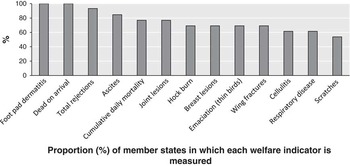
The common measures used as reported by the CA personnel were, in decreasing order of use, foot pad dermatitis, dead on arrival, total rejections, ascites, cumulative daily mortality, joint lesions, hock burn, breast lesions, emaciation (thin birds), wing fractures, cellulitis, respiratory disease and scratches.
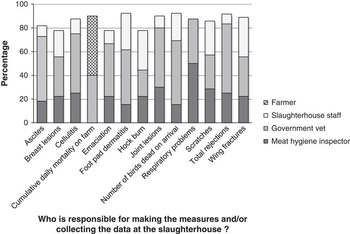
In Figure 1, the proportion of the respondent MSs that opt to use each animal measures under the requirements of the Broiler Directive 2007/43/EC is shown. The breakdown of ‘who’ makes the measures at the slaughterhouse (or sometimes at the farm) is shown in Figure 2. The majority of the measures are made by state officials – either the government employed vet (51.4% of total) or the meat hygiene inspector (27.8%). A smaller proportion of measures are made by the slaughterhouse staff who are privately employed (not government officials) (20.8%). In the case of cumulative daily mortality, which is logically an ‘on-farm measure’, the farmer/producer records this measure in 50% of the MSs, and the government vet in the other 50% of cases (where it is recorded).
The proportion (%) of member states that have opted to use the following animal measures under the requirements of the Broiler Directive 2007/43/EC: foot pad dermatitis, dead on arrival, total rejections, ascites, cumulative daily mortality, joint lesions, hock burn, breast lesions, emaciation (thin birds), wing fractures, cellulitis, respiratory disease and scratches. A total of 13 member states provided full information and nine provided partial information – this data represents combined results from 22 member states.

Who is responsible for making the measures at the slaughterhouse and/or collating information provided from the farm in the member states in relation to the Broiler Directive 2007/43/EC? For the following measures: foot pad dermatitis, dead on arrival, total rejections, ascites, cumulative daily mortality, joint lesions, hock burn, breast lesions, emaciation (thin birds), wing fractures, cellulitis, respiratory disease and scratches. A total of 13 member states provided full information and nine provided partial information – this data represents combined results from 22 member states.

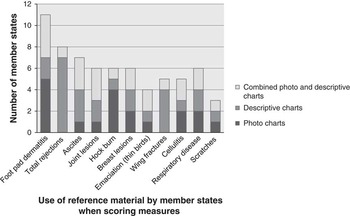
To make the animal-based measures, reference scoring charts or comparison with photographic reference scales may be used. Many of the MS had derived scoring scales or reference material from the Welfare Quality information on poultry assessment (Welfare Quality Consortium, 2009). Figure 3 shows the common types of reference material used by the CA staff. Some measures do not need scoring scales – for example, mortality rates. For some MSs, it is not apparent what reference material is used or provided, and in some MSs the score is determined by the experience of staff working in the slaughterhouses based on local rules for what constitutes a ‘positive score’. Some MSs collect data on the environmental conditions in the poultry house. The information on house environment is commonly collected from farm records, particularly so in the case of temperature, humidity and ventilation (use of fans and number of fans operating), and water usage. Litter quality is assessed by the state inspector in many MSs, and examination of medicine use records are included by one MS as a requirement of the monitoring of the Broiler Directive 2007/43/EC.
The types of reference material (photo reference charts, descriptive material, or combined photographic and descriptive material) used across the 13 member states who provided, in relation to data that they collect for the Broiler Directive 2007/43/EC, for the following measures: foot pad dermatitis, dead on arrival, total rejections, ascites, joint lesions, hock burn, breast lesions, emaciation (thin birds), wing fractures, cellulitis, respiratory disease and scratches.

The workshop activities allowed the CA staff to indicate areas where they felt that sharing of information or resources could lead to benefits. A wide range of comments on practical implementation issues regarding the Directive were collected from the MS personnel. Some examples of comments from the MSs include:
‘It is difficult to get data at the individual flock (house) level as several flocks may be sent together’.
‘Food chain information is not always available at the stable (house) level’.
‘There is variability between slaughterhouses in the way this is collected even within a MS’ – regarding differences in foot pad dermatitis scores (FPD).
‘There is low affinity from the producers with the “book keeping” approach for the records required by the Directive’.
‘Slaughterhouse personnel are a priority area for local training’.
‘There are limited resources – our MS has the equivalent of 2 full time inspectors to oversee the whole Broiler production’.
The potential for sharing information and group training was explored in the workshops, and comments from the MSs were collated. Some example comments include:
‘It would be good to share instructions for inspectors and veterinarians on-farm between MSs’.
‘It would be of real value to make agreement between MSs on the number of birds to be sampled for each welfare measure’.
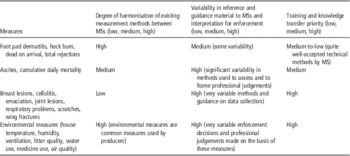
The MS personnel stated that there already existed a high degree of agreement (high degree of harmonisation) on the methodology by which some of the measures were made, and this was the case for foot pad dermatitis, hock burn, dead on arrival and total rejections.
For other measures, the MSs personnel indicated that there was some variability in the use of methodologies (medium degree of harmonisation), this being the case for ascites and cumulative daily mortality.
For the measures such as cellulitis, emaciation, joint lesions, respiratory problems, scratches, wing fractures, breast lesions and environmental measures, the MS personnel indicated that there was a low degree of agreement (low degree of harmonisation) between MSs regarding how these measures were made.
The MSs personnel commented on the degree of variability in the type, and application, of reference material used to assess the measures. The MSs indicated that the best agreement (medium variability) was for reference materials for foot pad dermatitis and hock burn, dead on arrival and total rejections. The MS personnel indicated that there was a low degree of agreement (high variability) regarding the reference scoring scales used for all other measures.
The MS personnel indicated that knowledge transfer (KT) or training was identified as most highly prioritised (high priority) for the measures used for breast lesions, cellulitis, emaciation, joint lesions, respiratory problems, scratches and wing fractures.
The measures indicted as of ‘medium’ priority for KT and training activity were ascites and cumulative daily mortality. ‘Low priority’ was given to training for foot pad dermatitis, hock burn, dead on arrival and total rejections, as it was perceived that there already existed well-established methodologies for scoring and recording these measures.
The results of these workshop-based activities regarding how the measures are assessed, the use of reference and guidance material, and the priority weightings for KT and training are shown in Table 1.
Priority areas for ongoing training and technical exchange between member states (MSs) based on similarities and variation in MSs approaches to measures used in enforcement of Broiler Directive 2007/43/EC

Discussion
The sampling and data collection requirements of the Directive offer the potential to promote improved welfare conditions and to provide information of management value to farmers. However, there are potential costs in terms of time and resource allocation for assessment, enforcement and rectification. The Directive creates the requirement for assessment tools, which can be used to target underperforming producers, and may allow CAs in the EU to target their inspection and enforcement resources. The use of agreed assessment methods may result in the public feeling reassured that welfare standards are being applied (Veissier et al., Reference Veissier, Butterworth, Bock and Roe2008), and this could result in increased confidence in the welfare gain from improvements in broiler welfare. There is potential for improvements in the quality of management of meat chickens through the implementation of the postmortem pathology measures, through training and KT, and through increased attention to lighting, ventilation, record keeping and the management practices promoted in the Directive. In addition, through application of the same standards for all producers (nationally and within EU), there may be greater consumer reassurance as to the overall welfare standards of meat chicken (Butterworth, Reference Butterworth2009; Butterworth et al., Reference Butterworth, Blokhuis, Jones and Veissier2013). The collation of the data show that there is general agreement within MSs of a ‘common range’ of measures, which can be practically assessed to fulfil the requirements of the Broiler Directive. However, the data collected from the participating MSs shows quite significant variation in both the combinations of ‘common measures’ that are collected, and also in the scoring and reference material used. For some MSs it is not very clear what reference material is used or provided, and it is apparent that in some MSs, scores are determined by the experience of staff working in the slaughterhouses and that scores are ascribed based on local rules. The degree to which the variable stocking rate prescribed in the Directive is relevant to each country will depend on its commercial stocking rate practices. The reasons for the different approaches to the monitoring of the Directive seen between MSs were noted by the MSs personnel as being due to a variety of factors, including:
Different MSs are at different stages of implementation of the Directive.
Different MS have focussed different levels of resourcing and personnel on the activities required by the Directive.
The structure of the poultry industry differs between MSs, and some of the EU countries already specify stocking densities below those described in the Directive (<33 kgm2), whilst others stock commercial broilers at the upper end of the range permitted in the Directive (42 kgm2).
It was not possible within this workshop-based study to determine the long-term effects of broiler welfare in the EU flock of the use of the different scoring or reference scales used by the different MSs. It is suggested that further study in this area would be of interest in helping to answer the question ‘does the use of the measures adopted by the MSs result in improved welfare condition for broiler chickens in the EU?’. This study restricts itself to comparison of the methods used by voluntary sharing of information between MS, and does not extend to analysis of the long-term welfare impact.
The CA personnel who took part in the work showed a willingness to share data between MSs and also a willingness to work to harmonise country approaches to give the maximum potential for uniform application of the requirements of the Directive across the EU members. The MSs representatives clearly stated during workshop and group activities that the opportunity to share materials through a technical forum and to share and learn the technical and implementation details of what other MSs do was of value in raising and resolving technical issues, which each country had, so far, solved in isolation. The MS personnel also indicated that a process for sharing methods and reference material could potentially lead to increases in harmonisation of the implementation of the Broiler Directive across the EU, and perhaps to increases in animal welfare through increased consistency in application of welfare control measures.
Acknowledgements
The authors would like to thank the following contributors for the study: Francesca Neijenhuis, Frank Tuyttens, Ute Knierim, Lubor Kostal, Boris Bilcik, Knut Niebuhr and Ludovic Cziszter. This project was carried out within EUWelNet, a European networking project focussing on the integration of animal welfare. The project was co-financed by the European Commission. The text represents the authors’ views and does not necessarily represent a position of the Commission who will not be liable for the use made of such information.