Introduction
The 330 kDa fibrillar glycoprotein hyalin is a component of the sea urchin embryo extracellular hyaline layer. It serves as an adhesive substrate during early development (Herbst, Reference Herbst1900; Fink & McClay, 1982; McClay, Reference Fink and McClay1985; Wessel et al., Reference Wessel, Berg, Adelson, Cannon and McClay1998) and consists of repeated regions (called hyalin repeats) averaging 84 amino acids (Wessel et al., Reference Wessel, Berg, Adelson, Cannon and McClay1998; Callebaut et al., Reference Callebout, Gilges, Vignon and Mornon2000) and non-repeated regions (Wessel et al., Reference Wessel, Berg, Adelson, Cannon and McClay1998). The GenBank database suggests that the hyalin repeat is a unique sequence that shows slight similarity to mucoid protein sequences (Callebaut et al., Reference Callebout, Gilges, Vignon and Mornon2000) and appears to be related to the immunoglobulin-like fold (Callebaut et al., Reference Callebout, Gilges, Vignon and Mornon2000). Because hyalin consists of only 2–3% carbohydrate (Stephens & Kane, Reference Stephens and Kane1970; Citkowitz, Reference Citkowitz1971), it is not very similar to mucins that contain more carbohydrate (Wessel et al., Reference Wessel, Berg, Adelson, Cannon and McClay1998). The hyalin repeat has been identified in bacterial, murine, Caenorhabditis elegans and Drosophila melanogaster proteins, as well as in a human protein (Callebaut et al., Reference Callebout, Gilges, Vignon and Mornon2000). Because of the widespread occurrence of the hyalin repeat sequence, its function is garnering a great deal of interest and hyalin research may yield new information about functions that apply to a wide variety of organisms.
Hyalin and the hyalin repeat appear to function in adhesive interactions, but very little work has been done to explore its function. Edelman's group has shown that the chick neural cell adhesion molecule is related to the immunoglobulin superfamily (Edelman, Reference Edelman1987). Given the relationship of the hyalin repeat to immunoglobulins, we now hypothesize that hyalin may have important specific functions in sea urchin cell adhesion heretofore underappreciated. Even in sea urchins little more is known other than that antibody against hyalin can block development and sea urchin embryo cells adhere to hyalin (Fink & McClay, 1982; McClay, Reference Fink and McClay1985; Wessel et al., Reference Wessel, Berg, Adelson, Cannon and McClay1998). We have shown that hyalin purified from S. purpuratus embryos blocked a specific adhesive interaction in living S. purpuratus embryos, extension/attachment of the archenteron to the blastocoel roof (Razinia et al., Reference Razinia, Carroll and Oppenheimer2007). We have selected this specific in vivo adhesive interaction to study because past work only focused on single cells disaggregated from whole embryos and on general adhesive characteristics occurring during development (Herbst, 1990; Fink & McClay, 1982; McClay, Reference Fink and McClay1985; Wessel et al., Reference Wessel, Berg, Adelson, Cannon and McClay1998).
Here we extend these studies to learn if hyalin purified from S. purpuratus embryos can block this interaction in another sea urchin species L. pictus. This is one important next step in exploring the specificity of hyalin-mediated interactions across species and genera. It is a good starting point because it is already known that a monoclonal antibody against S. purpuratus hyalin cross-reacts with L. pictus hyalin (Vater & Jackson, Reference Vater and Jackson1990).
Material and methods
Solutions
Artificial seawater (ASW; 423 mM NaCl, 9 mM KCl, 9.3 mM CaCl2, 22.9 mM MgCl2, 25.5 mM MgSO4, 2.1 mM NaHCO3, pH 8.0) was prepared by using the Marine Biological Laboratory (Woods Hole, MA) formula. Low calcium artificial seawater (LCASW) was prepared by reducing the calcium concentration to 1.5 mM (Bidwell & Spotte, Reference B Tidwell and Spotte1985; Razinia et al., Reference Razinia, Carroll and Oppenheimer2007).
Preparation of hyalin
Adult S. purpuratus sea urchins were obtained from Marinus Scientific. Gametes were obtained by intracoelomic injection of 0.55 M KCl. Eggs were collected by inverting the female over a beaker of artificial seawater at 11 °C. Sperm were collected ‘dry’ in 100 × 15 mm plastic Petri plates and held on ice. Eggs were rinsed through 202 μm Nitex mesh and washed three times with large volumes of artificial seawater prior to acid dejellying. The dejellying procedure involved bringing a suspension of 0.5% eggs rapidly to pH 5.5–5.7 with 1 N HCl, letting the suspension incubate for 2 min without stirring and then returning the suspension to pH 8.0 with 2 M Tris base. The dejellied eggs were washed three times with large volumes of artificial seawater and their vitelline envelopes were disrupted with 0.01 M dithiothreitol (DTT), 0.1 M Tris base, pH 9.2 for 3 min. Eggs were then washed extensively with 0.01 M Tris seawater, pH 8.0. Four volumes of eggs were inseminated with one volume of dilute sperm (1 ml sperm/25 ml 0.01 M Tris seawater, pH 8.0). At 45–90 s postinsemination, the suspension was diluted into eight volumes of artificial seawater and the hyaline layers were allowed to develop for 45 min while the eggs settled. Hyalin protein was isolated and purified by the method described by Gray et al. (Reference Gray, Justice, Nagel and Carroll1986) with the following variations. The supernatant seawater containing embryos with fully formed hyaline layers was aspirated leaving a mat of loosely adherent cells. The hyaline layers were dissolved from the egg surfaces by the addition of 50 ml of 0.475 M NaCl, 0.025 M KCl. Embryos were stirred in this medium for 15 min until the hyaline layers appeared to be substantially reduced. Embryos were allowed to settle down and the supernatant solution containing crude hyalin proteins was collected. Crude hyalin proteins were centrifuged at 15 000 rpm for 15 min at 4 °C using a Sorvall SA 600 rotor to remove residual sperm and contaminants. The supernatant contained purified hyalin that was used in 1:10 NaCl–KCl low calcium seawater for both the microassay and gels (Razinia et al., Reference Razinia, Carroll and Oppenheimer2007).
Electrophoresis
Electrophoresis was performed under non-denaturing conditions using Native Next Gel Agarose Electrophoresis Kit (Amresco, Solon, OH) on horizontal submarine slabs of 2% agarose. The gels were fixed with 40% methanol, 10% acetic acid and 50% water and stained in 50 ml of Coomassie Brilliant Blue G250 (Sigma) (Razinia et al., Reference Razinia, Carroll and Oppenheimer2007).
Concentration measurements
Protein concentration was determined by UV absorbance as described by Warburg & Christian (Reference Warburg and Christian1941).
Embryo preparation and culture
Gametes of L. pictus sea urchins were collected as described above. Eggs were washed three times with 500 ml of artificial seawater, pH 8.0. Freshly diluted sperm (1.2 ml concentrated sperm/5 ml artificial seawater, pH 8.0) were added to 6 ml of eggs suspended in 500 ml of artificial seawater. The embryos were washed twice with 500 ml artificial seawater, pH 8.0 to remove excess sperm. The embryos were then transferred to a Pyrex tray and incubated at 15 °C for 24 h (Razinia et al., Reference Razinia, Carroll and Oppenheimer2007).
Microplate assay
Using wide-mouthed pipette tips, 25 μl of 24-hour-old hatched L. pictus embryos were transferred to 40 wells of a 96-well polystyrene flat-bottom microplate. On average, there were about 11–15 embryos per well. As the embryos had hatched and were swimming, a consistent sample size (number of embryos/well) could not be obtained. The embryos in each well were incubated at 15 °C with hyalin preparation diluted in low calcium artificial seawater or various control solutions (see Fig. 2). Final hyalin concentration was 57 μg/ml based on previous dose response results (Razinia et al., Reference Razinia, Carroll and Oppenheimer2007). The microplate assay was repeated two more times for each treatment. After an additional 24 h, the embryos were fixed by adding 5.5 μl of 10% formaldehyde. Embryos in each well were then observed using a Zeiss (Oberkochen, Germany) Axiolab photomicroscope and the archenteron morphologies (complete, unattached, no invagination and exogastrula) were tallied. For each treatment, the total sample size was obtained by combining the number of embryos in each well for the 30 replicates. The specific archenteron morphologies observed for the 30 replicates were also combined and recorded as mean percentages ± standard deviation. An unpooled two-sample t-test was used to analyse the significance of the observed differences in the complete archenterons versus unattached archenterons in the combined controls versus the hyalin-treated samples. In all cases the differences were highly significant (p < 0.001).
Results
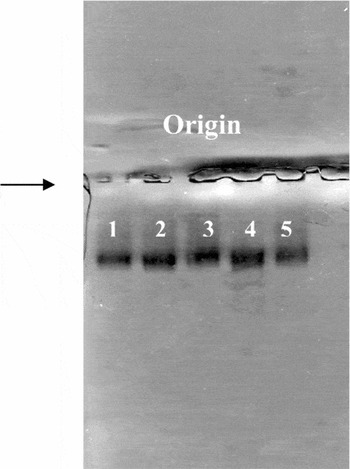
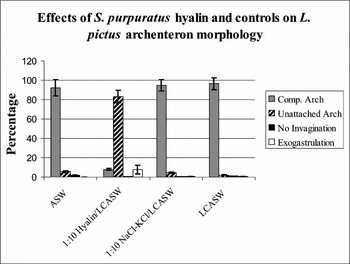
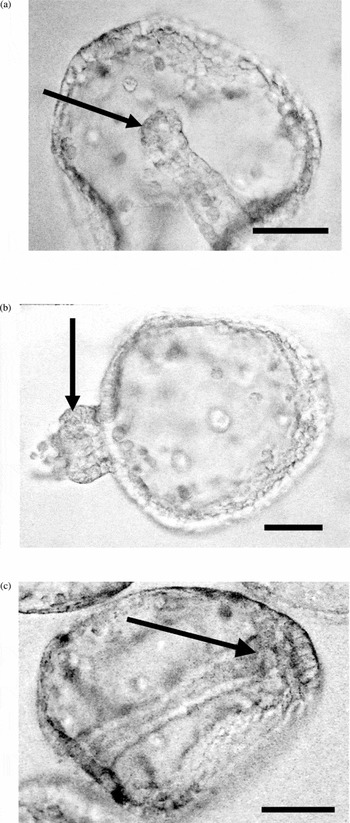
Figure 1 shows that the hyalin preparations used in this study, purified from S. purpuratus embryos, exhibited one major band on 2% agarose gels. This is a standard method of assessing hyalin purity (Gray et al., 1986). Figure 2 shows that hyalin 57 μg/ml prevented archenteron attachment to the blastocoel roof, while all control samples exhibited complete attached archenterons. The controls included: 1:10 NaCl–KCl in low calcium seawater (as used for the hyalin samples), low calcium seawater alone and artificial seawater. Figure 3 provides typical photographs of embryos in hyalin versus those in control solutions and shows the appearance of unattached versus attached archenterons. In some cases, in the hyalin samples, in which exogastrulation occurred, not only were the archenterons unattached to the blastocoel roof, but they everted out of the embryo proper. The results are dramatic. The archenteron morphologies displayed in the 30 replicates (×3 controls) were 94 ± 6% complete archenterons and 4 ± 0.7% unattached archenterons in the combined control samples and 8 ± 1% complete archenterons and 83 ± 6% unattached archenterons in the hyalin-treated samples (30 replicates). The small percentages of no invagination and exogastrulation morphologies bring the percentages to 100%. These differences were statistically highly significant (p <0.001).
A 2% agarose gel electrophoresis of S. purpuratus hyalin preparations (lanes 1–5). The origin is indicated by an arrow. The direction of migration, toward the positive pole, is from top to bottom (Razinia et al., Reference Razinia, Carroll and Oppenheimer2007).

Effects of S. purpuratus hyalin and controls on L. pictus archenteron morphology. Percentage is the percentage of embryos exhibiting complete archenterons (Comp. Arch), unattached archenterons (Unattached Arch), no invagination or epogastrulation in artificial seawater (ASW), 1:10 hyalin (final hyalin concentration 57 μg/ml) in low calcium seawater (LCASW), 1:10 NaCl–KCl in LCASW or LCASW alone. Error bars are ± standard deviations.

Photos of L. pictus embryos in S. purpuratus hyalin and control samples. (a) Embryo in hyalin sample showing unattached archenteron. (b) Embryo in hyalin sample showing exogastrulation. (c) Embryo in control sample showing complete, attached archenteron. Arrows denote archenterons. All scale bars = 30 μm.

Discussion
The hyalin repeat, so far, has been identified in echinoderms, streptococci, C. elegans, D. melanogaster, mouse protein and SRPX protein in humans (sushi-repeat-containing protein, X chromosome), a protein that is encoded by a gene that is deleted in patients with X-linked retinitis pigmentosa and believed to be present on photoreceptor cell surfaces (Callebaut et al., Reference Callebout, Gilges, Vignon and Mornon2000). The hyalin repeat domain is thought to be a distinct superfamily within the immunoglobulin-like fold and is believed to function in cell adhesion (Wessel et al., Reference Wessel, Berg, Adelson, Cannon and McClay1998; Callebaut et al., Reference Callebout, Gilges, Vignon and Mornon2000).
Our studies explore the relationship of hyalin to cell adhesion in a way not done previously. Instead of focusing on disaggregated single cells or general aspects of embryo development, we focus on a specific adhesive interaction in intact, living embryos, using an assay that allows precise quantitative determination of developmental effects. Large molecules can enter embryos if added exogenously (Latham et al., Reference Latham, Martinez, Cazares, Hamburger, Tully and Oppenheimer1998) and exert their effects internally as well as externally (Latham et al., Reference Latham, Tully and Oppenheimer1999).
In this study we carry the experiments of Razinia et al. (Reference Razinia, Carroll and Oppenheimer2007) one step further by showing that S. purpuratus hyalin blocks the archenteron elongation/attachment interaction in a different species of sea urchin L. pictus, just as it did in S. purpuratus from which the hyalin was obtained (Razinia et al., Reference Razinia, Carroll and Oppenheimer2007). We chose L. pictus because previous work indicated that a monoclonal antibody against S. purpuratus hyalin cross-reacted with L. pictus hyalin (Vater & Jackson, Reference Vater and Jackson1990). This work is a first approach to investigate hyalin function in the varied organisms that possess the hyalin repeat domain (Callebaut et al., Reference Callebout, Gilges, Vignon and Mornon2000). We suggest that exogenously added hyalin binds to a hyalin receptor or hyalin-binding ligand and in this way blocks the cellular interaction that in vivo is mediated by hyalin–hyalin receptor binding. We are using anti-hyalin antibody to determine if hyalin is located on the structural components of the adhesive interaction and to investigate if it blocks the adhesive interaction in vivo by the use of our novel dissected components of this cellular interaction (Coyle–Thompson & Oppenheimer, Reference Coyle-Thompson and Oppenheimer2005).
The quantitative microplate assay could facilitate purification of hyalin-binding receptors by preincubating hyalin with putative receptor-containing preparations and determining if the hyalin activity of blocking the cellular interaction is reduced. Hyalin-derivatized microbeads could be used in the purification. In addition, no past work has explored the non-repeat region of hyalin or the role of carbohydrate in hyalin function. We are using the microplate assay to compare the effects of native hyalin, carbohydrate-free native hyalin and carbohydrate-free recombinant hyalin on the cellular interaction being studied.
Of all the systems in which the hyalin repeat has been identified, the sea urchin is probably the most accessible, most easily probed and most likely to reveal new information about hyalin function. The sea urchin embryo is a National Institutes of Health designated model system because at least 25 basic physiological processes were discovered or developed in sea urchins that were later found to be of general importance across taxonomic groups including humans (Davidson, Reference Davidson and Cameron2002; Davidson & Cameron, Reference Davidson2006).
We have previously made some advances in identifying molecular mechanisms of the archenteron blastocoel roof interaction, a model specific interaction in this NIH designated model system. We have provided evidence that glucose/mannose groups are involved in this adhesive interaction. Glucose/mannose-binding lectin, Lens culinaris agglutinin, was found to enter the sea urchin embryo and be bound to the lining of the archenteron and blastocoel (Latham et al., Reference Latham, Martinez, Cazares, Hamburger, Tully and Oppenheimer1998) and to prevent attachment of the archenteron to the blastocoel roof (Latham et al., Reference Latham, Tully and Oppenheimer1999). Enzymes that cleave glucose/mannose from oligosaccharides and glycoprotein synthesis inhibitors blocked the interaction (Khurrum et al., Reference Khurrum, Hernandez, Eskalaei, Badali, Coyle-Thompson and Oppenheimer2004) as did a glucose-containing polysaccharide (Sajadi et al., Reference Sajadi, Rojas and Oppenheimer2007). Single cells disaggregated from sea urchin gastrula stage embryos bound to beads derivatized with glucose/mannose-binding lectins (Khurrum et al., Reference Khurrum, Hernandez, Eskalaei, Badali, Coyle-Thompson and Oppenheimer2004).
We developed a novel approach to study this cellular interaction by dissecting the blastocoel roof and archenteron away from the remainder of the embryo and studying the adhesive interaction in a pristine environment unaffected by possible confounding factors in whole embryos (Coyle-Thompson & Oppenheimer, Reference Coyle-Thompson and Oppenheimer2005). The isolated archenteron and blastocoel roof bound to FITC-coupled Lens culinaris agglutinin (glucose/mannose specificity) that was inhibited by alpha-methylmannose (Coyle-Thompson & Oppenheimer, Reference Coyle-Thompson and Oppenheimer2005). The lectin-bound isolated pieces were less adhesive to each other than when the lectin was blocked by alpha-methylmannose, suggesting that Lens culinaris agglutinin binds to ligands that mediate this adhesive interaction (Coyle-Thompson & Oppenheimer, Reference Coyle-Thompson and Oppenheimer2005). The hyalin studies presented here and in Razinia et al. (Reference Razinia, Carroll and Oppenheimer2007) suggest that we have an easily purified component of this adhesive interaction. How hyalin relates to the glucose/mannose results just cited will be an exciting avenue for further study.
Acknowledgements
This work was supported by NIH NIGMS, SCORE (S0648680), MARC, RISE and the Joseph Drown Foundation.