Introduction
The comprehension of Relative Clauses (RCs) has been widely studied in children with Specific Language Impairment (SLI) speaking a variety of languages. It is well acknowledged that children with SLI perform better on subject RCs than on object RCs (e.g., Friedmann & Novogrodsky, Reference Friedmann and Novogrodsky2004; Håkansson & Hansson, Reference Håkansson and Hansson2000; Jensen de López, Olsen & Chondrogianni, Reference Jensen de López, Olsen and Chondrogianni2014). It is, however, vital to note that the results of previous studies on comprehension of Mandarin RCs in Typically Developing (TD) children do not converge, with some pointing to a subject RC preference (Hu, Gavarró, Vernice & Guasti, Reference Hu, Gavarró, Vernice and Guasti2016; Lee, Reference Lee and Lee1992) and others pointing to symmetric performance (e.g., Chang, Reference Chang1984). Furthermore, as Hu et al. (Reference Hu, Gavarró, Vernice and Guasti2016) noticed, subject RCs were difficult for Mandarin monolinguals up to the age of 6, whereas this has never been reported in languages with head initial RCs. As a result, it is challenging to predict whether subject RCs will elicit better performance than object RCs in Mandarin children with suspected SLI (SLI for short).
Children with SLI encounter more difficulties comprehending RCs than their TD peers, and similarly to young TD children before the age of 6, subject RCs are reported to be better understood than object RCs in this group speaking a language with head initial RCs (e.g., Jensen de López et al., Reference Jensen de López, Olsen and Chondrogianni2014). Many theories have been proposed to account for the underlying factors of the problems, which have been quite successful in explaining the nature of the grammatical impairment prevalent in children with SLI. These accounts are known as the Linear Order Analysis (Cromer, Reference Cromer1978), the Representational Deficit for Dependent Relationship Theory (van der Lely, Reference van der Lely1996; van der Lely & Battell, Reference van der Lely and Battell2003), the Thematic Role Assignment Deficit Theory (Friedmann & Novogrodsky, Reference Friedmann and Novogrodsky2004), the Relativized Minimality account (Jensen de López et al., Reference Jensen de López, Olsen and Chondrogianni2014) and the Externalization Deficit Hypothesis (Lorenzo & Vares, Reference Lorenzo and Vares2017, Reference Lorenzo and Vares2019). However, the hypotheses are far from perfect because none of them can accommodate all the linguistic characteristics of children with SLI exhibited in the acquisition of RCs.
The aim of this paper is two-fold. First, in order to overcome the methodological flaws, we used a new version of the character-picture matching task (Adani, Reference Adani2011) to assess the comprehension of RCs with the purpose of establishing whether subject or object RC priority holds in Mandarin children with SLI. The second goal of this paper is to propose a novel representational account in order to provide a better explanation of the grammatical deficit in children with SLI. In particular, we suggest that the deficit in children with SLI results from the underspecification of Edge Features, which leads to poor performance in the comprehension of RCs.
This paper is structured as follows. We will first review previous studies on TD children’s comprehension of RCs, with a focus on studies of Mandarin-speaking children, followed by a review of theories on the comprehension of RCs in children with SLI. We will then elaborate on the new hypothesis and subsequently present the results of the character-picture matching task. Finally, we will discuss the theoretical implications of our results.
Tasks used in studies on children’s comprehension of Mandarin RCs
Researchers have extensively investigated the comprehension of RCs in TD children acquiring a variety of languages, including English (Booth, Mac Whinney & Harasaki, Reference Booth, Mac Whinney and Harasaki2000; de Villiers, Tager Flusberg, Hakuta & Cohen, Reference de Villiers, Tager Flusberg, Hakuta and Cohen1979); Italian (Adani, Reference Adani2011; Adani, van der Lely, Forgiarini & Guasti, Reference Adani, van der Lely, Forgiarini and Guasti2010); Hebrew (Friedmann, Belletti & Rizzi, Reference Friedmann, Belletti and Rizzi2009); German (Arosio, Yatsushiro, Forgiarini & Guasti, Reference Arosio, Yatsushiro, Forgiarini and Guasti2012) and Mandarin (Chang, Reference Chang1984; Hu et al., Reference Hu, Gavarró, Vernice and Guasti2016). It has been shown that TD children under the age of 6, across typologically different languages, have greater difficulties comprehending object RCs than subject RCs (Friedmann et al., Reference Friedmann, Belletti and Rizzi2009; a.o.). However, studies on Mandarin TD children reported discordant outcomes. Some studies pointed out a subject RC priority; whereas others showed that there was no asymmetry between the two RCs.
According to previous studies, the experimental method is classified into three categories: the Acting out task, the Sentence-picture matching task and the Character-picture matching task. In early studies, the acting out task was extensively used to assess RC comprehension in TD children (e.g., de Villiers et al., Reference de Villiers, Tager Flusberg, Hakuta and Cohen1979). In the task, RCs were presented to children and they were required to act out the sentences by manipulating a set of toys, which map onto NPs in RCs. This task has also been adopted to study the comprehension of Mandarin RCs in TD children, but has mixed results.
Chang (Reference Chang1984) tested the comprehension of SS, SO, OS, and OO RCsFootnote 1 in 48 school-aged Mandarin children and observed no significant difference in the accuracy between SS and SO RCs, and between OS and OO RCs, suggesting that there was no preference for subject or object RCs. However, as Su (Reference Su2006) noted, object RCs used in the study should be better categorized as subject RCs (one example object RC in the study: bei gongche zhuang de qiche, ‘the car that was bumped into by the bus’). Given the problematic stimuli used in the experiment, it is difficult to interpret the results.
Other studies indicated that subject RCs were easier to comprehend in Mandarin TD children. Lee (Reference Lee and Lee1992) used the acting out task to assess 61 children’s (aged 4;0-8;0) comprehension of SS, SO, OS, OO, SIO and OIO RCsFootnote 2 and pointed to a subject RCs advantage across all age groups (e.g., at age four: SS 41.7%, SO 25%, OS 14.6%, OO 2.1%; at age eight: SS 93.8%, SO 72.9%, OS 93.8%, OO 45.8%). Cheng (Reference Cheng1995) also found a primacy for subject RCs in a study using the acting out task to examine the comprehension of SS, SO, OS, and OO RCs in 36 preschool children.
However, criticism has been levied at the acting out task. The first shortcoming is that the experimental setting was not pragmatically appropriate for the use of RCs. The function of RCs is to individuate the referent of the RCs’ head, but the acting out task fails to provide a set of referents from which a subset can be picked out (Hamburger & Crain, Reference Hamburger, Crain and Kuczaj1982). Secondly, this task may underestimate children’s knowledge of RCs because children are more likely to focus on playing with the toys than on following instructions (McDaniel, McKee & Cairns, Reference McDaniel, McKee and Cairns1998).
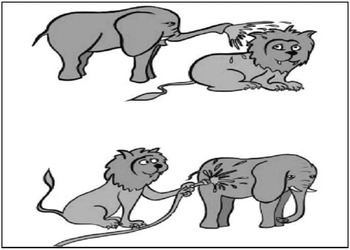
To eliminate the limitations of the acting out task, Friedmann and Novogrodsky, (Reference Friedmann and Novogrodsky2004) investigated children’s comprehension of RCs by using the sentence-picture matching task. In this task, children were asked to choose one of the two pictures, one of which matched the sentence they heard and the other depicted the reverse action. For the Hebrew object RC (e.g., Tare li et ha-pil she-ha-arie martiv. ‘Show me the elephant that the lion is wetting.’), the children were required to select one picture from those shown in Figure 1 based on what they heard.
A set of pictures used in sentence-picture matching tasks (Friedmann et al., Reference Friedmann, Belletti and Rizzi 2009).

However, as pointed out by Arnon (Reference Arnon2005) and Adani (Reference Adani2011), the aforementioned methodological problem was still at play in this task. More specifically, the task was not pragmatically appropriate because the semantic function of RCs is to individuate the referent of the RC head, but in this task, children were required to select a picture rather than a character in the picture. Therefore, even when a correct picture was chosen, it was unclear whether the child was indeed pointing to the correct or wrong referent. The second flaw is that even though children chose the correct picture matching the RC ‘the elephant that the lion is wetting’, we do not know whether they can interpret RCs, as Hu et al. (Reference Hu, Gavarró, Vernice and Guasti2016) noted, because the children might choose a picture depicting ‘a lion is wetting’ by simply interpreting the embedded clause ‘the lion is wetting’, which happens to be the correct picture.
In order to improve the method further, Arnon (Reference Arnon2005) developed the character picture matching task, in which children were explicitly asked to point to a referent rather than a picture. In this task, it is possible to pinpoint which character children choose. Using this task, Hu et al. (Reference Hu, Gavarró, Vernice and Guasti2016) tested the comprehension of subject and object RCs in 120 Mandarin (age range 3; 0-8;11). The stimuli used in the experiment are illustrated in (1).

All matrix sentences start with na yi-ge ‘which one’ to ensure that the participants single out a character instead of a picture. Each experimental sentence is paired with two experimental pictures, one of which corresponded to the RC and the other was with opposite thematic roles, as shown in Figure 1. Mandarin children showed a subject RC preference up to the age of 7 according to the findings (e.g., 3-year-olds: Subject RCs 47.8%, Object RCs 24.8%; 7-year-olds: Subject RCs 99.4%, Object RCs 45.6%). However, there are still some methodological shortcomings afflicting the study of Hu et al. (Reference Hu, Gavarró, Vernice and Guasti2016). According to Adani (Reference Adani2011), we hold that the experimental setting in Hu et al. (Reference Hu, Gavarró, Vernice and Guasti2016) does not satisfy Hamburger & Crain’s felicity requirements for the use of RCs because no other possible referent is to be presented (e.g., an extra cat or child) within one picture.
As pointed out by an autonomous reviewer, Friedmann and Novogrodsky (Reference Friedmann and Novogrodsky2011) adopted both the picture matching task and character picture matching task in a study examining the comprehension of Hebrew Wh questions and found that children with SLI scored similarly on both tasks. It seems that the felicity condition has little effect on children’s performance. However, several other studies have revealed that once the experiment is conducted in a more pragmatically appropriate context, the performance of children improves significantly (Crain & Thornton, Reference Crain and Thornton1998, p.70; Crain, Thornton & Murasugi, Reference Crain, Thornton and Murasugi2009; Hamburger & Crain, Reference Hamburger, Crain and Kuczaj1982; O’Brien, Grolla & Lillo-Martin, Reference O’Brien, Grolla, Lillo-Martin, Bamman, Magnitskaia and Saller2006, among many others). Furthermore, despite the fact that the two tasks yielded the same results in that study, we prefer the character picture matching task in this paper. One reason for this is that the character picture matching task allows us to observe more possible errors compared to the sentence picture matching task. Second, the character picture matching task prevents children from only interpreting the embedded clause of RCs to choose a picture, as noted by Hu et al. (Reference Hu, Gavarró, Vernice and Guasti2016).
Recently, several studies have found that the selection of language tasks had a significant impact on the outcome of the experiment. Shetreet and Novogrodsky (Reference Shetreet and Novogrodsky2019) have revealed that adults displayed a clear response pattern in all tasks assessing the interpretation of Hebrew quantifiers, while children were affected by the tasks, showing an adult-like performance pattern in only one task. According to Pinto and Zuckerman (Reference Pinto and Zuckerman2018), in the picture-selection task, children are asked to choose between several pictures representing a variety of possible interpretations, which may result in the explicit presence of alternative problems, and thus underestimating the children’s knowledge.
It is well acknowledged that the character picture matching task developed by Adani (Reference Adani2011) is exempt from methodological shortcomings. Although the character picture matching task is a picture-selection task, it is, to the best of our knowledge, the ideal task for assessing children’s knowledge of RCs. First, unlike the previously mentioned tasks, the character picture matching task satisfies Hamburger & Crain’s felicity requirements for the use of RCs. Second, all options are included in a single event in this task, which might alleviate the explicit presence of alternatives problem to some extent (Pinto & Zuckerman, Reference Pinto and Zuckerman2018, p.4).
The act out task and the character picture matching task have been used to investigate the acquisition of RCs in Mandarin TD children, but the studies yielded mixed results. Considering the methodological problems mentioned previously, it therefore must be the case that the methodological faults are responsible for the conflicting results. In this paper, we will adopt the character picture matching task to test the comprehension of RCs in Mandarin children with and without SLI, which will help us to establish whether Mandarin children perform better on subject RCs than on object RCs.
Theories of SLI and the acquisition of Relative Clauses
RCs are often poorly understood by children with SLI speaking typologically different languages, such as English (Adams, Reference Adams1990), Swedish (Håkansson & Hansson, Reference Håkansson and Hansson2000), Greek (Stavrakaki, Reference Stavrakaki2001), Hebrew (Friedmann & Novogrodsky, Reference Friedmann and Novogrodsky2004) and Danish (Jensen de López et al., Reference Jensen de López, Olsen and Chondrogianni2014). Additionally, it has been reported that there is a subject over object RC advantage in this population speaking languages with head-initial RCs, which is similar to young TD children. For instance, the English Subject RC (2a) has been found to be more easily comprehended than the Object RC (2b).

Many hypotheses have been proposed to account for the language deficit and the subject over object RCs asymmetry seen in children with SLI. The Linear order analysis approach was based on the assumption that children with SLI do not have an intact representation of RCs and that thematic roles of arguments in RCs are solely determined by the linear order of the sentential constituents (Cromer, Reference Cromer1978). The first noun phrase is interpreted as the agent and the second noun phrase as the patient. This approach predicts that the comprehension of English subject RCs such as (2a) is always unproblematic because the first noun phrase in (2a) happens to be the agent and the second is the patient. However, children with SLI will always encounter difficulties with the comprehension of object RCs (2b) because such a strategy always leads to a reversed interpretation of the sentence. When children with SLI are presented with the object RC (2b), they will recognize ‘the boy’ as the agent and ‘the mother’ as the patient according to the linear order of the NPs. As such, they will constantly choose the wrong picture depicting ‘a boy kissing a mother’.
Previous studies, however, do not endorse the above-mentioned analysis. Friedmann and Novogrodsky (Reference Friedmann and Novogrodsky2004) found that children with SLI chose one of the pictures randomly and performed at a chance level when they were required to interpret a Hebrew object RC. The analysis predicts that children with SLI will consistently commit thematic role reversal errors, resulting in a below-chance performance in the binary sentence-picture matching task.
Furthermore, we predict that Mandarin children with SLI will be more accurate at interpreting object RCs than subject RCs based on the Linear order analysis. Mandarin is a language with head-final RCs, as illustrated in (3). According to the analysis, when children are asked to interpret a Mandarin object RC, such as (3b), they will interpret the first noun phrase as the agent and the second as the patient, which happens to be correct. However, if they use the same strategy when interpreting a Mandarin subject RC, such as (3a), they will obtain the reversed interpretation of the sentence because the first noun phrase is the patient and the second is the agent in (3a).

Hu et al. (Reference Hu, Gavarró, Vernice and Guasti2016), on the other hand, found that the accuracy of the subject RC comprehension was significantly higher than that of the object RC comprehension in Mandarin TD children. It is reasonable to expect that the acquisition of RCs in Mandarin children with SLI will resemble that seen in younger TD children. If this is the case, the Linear order analysis fails to account for the acquisition of RCs in Mandarin children with SLI.
The Representational Deficit for Dependent Relationship Theory (RDDR) was initially proposed by van der Lely (Reference van der Lely1996) and developed by van der Lely and Battell (Reference van der Lely and Battell2003). The theory assumes that the underlying deficit in children with SLI is located in the syntactic computational system. The deficit is defined as impaired knowledge concerning syntactic movement, which makes them treat the obligatory movement as optional. The theory predicts that children with SLI will be susceptible to errors in interpreting RCs, but it does not predict their exact performance.
To make up for the gap, Friedmann and Novogrodsky (Reference Friedmann and Novogrodsky2004) presented a detailed prediction of the exact performance in children with SLI by adopting Grodzinsky’s (Reference Grodzinsky1990) theory of agrammatic aphasia. They claimed that the deficit in SLI lies in the inability to assign thematic roles to noun phrases (NPs) that have been replaced from their original sentential positions. When interpreting an NP lacking a thematic role due to a syntactic deficit, children with SLI will adopt a non-syntactic strategy. The first NP in the sentence is understood as the agent, while the NP that does not move retains its thematic role.
In the English subject RC (2a), the moved NP the boy cannot be assigned a thematic role. Since it is the first NP in the RC, it will be interpreted as the agent, which happens to be correct. As a result, children with SLI will always choose the correct picture in the binary sentence-picture matching task. However, trouble arises when the NP without the thematic role is not the agent but rather the patient, as in the case of the English object RC (2b). In this case, the first NP is recognized as the agent if the non-syntactic strategy is adopted. If the unmoved NP retains its thematic role in (2b), the second NP is also interpreted as the agent. Under the circumstances, children with SLI cannot deduce the thematic roles of NPs because the clues are contradictory, leading to a guessing strategy and chance-level performance in object RCs comprehension (Friedmann & Novogrodsky, Reference Friedmann and Novogrodsky2004).
This theory also yields the prediction that Mandarin children with SLI interpret object RCs better than subject RCs. Children with SLI cannot identify the thematic role of moved object NP xiaopengyou ‘the kid’ in Mandarin object RC (3b) using normal syntactic knowledge. However, according to the linear order, the moved object NP might be interpreted as the patient, which happens to be correct. Children with SLI will, therefore, always choose the correct picture in the binary sentence-picture matching task in such a condition. The challenge arises when the moved NP is the agent, as in the case of the subject RC (3b). Since the moved subject NP is the second NP in the sentence, it will be mistakenly interpreted as the patient according to its linear position. If the unmoved NP (mama ‘the mother’) retains its thematic role, it will also be interpreted as the patient, forcing the children with SLI to guess which is the patient and consequently choose the picture randomly. Similarly, this prediction runs counter to the results reported in Hu et al. (Reference Hu, Gavarró, Vernice and Guasti2016).
The commonly observed subject RC preference in children with SLI, according to a third account, is due to the Relativized Minimality (RM) effect. The comprehension of object RCs involves RM violation, but that of subject RCs does not. RM was first postulated as a theory of syntactic locality on constraints governing the extraction of wh-elements from syntactic islands (Rizzi, Reference Rizzi1990, Reference Rizzi and Belletti2004). This account rests on the assumption that a local relation between X and Y cannot hold if the intervener Z is similar in structure to X, as shown in the configuration of (4).

In (4), X is the moved element, Y is the copy of X and Z is the potential intervener. Friedmann et al. (Reference Friedmann, Belletti and Rizzi2009) proposed that for young TD children, dependency between the relative head and the copy is hard to establish if the moved element and the intervener share structural similarity. In the object RC example, the boy that the mother kissed, the intervener is the subject (the mother) of the embedded clause because it c-commands the copy of the relative head but not the relative head itself. Furthermore, the moved element and the intervener have one feature in common, i.e., [+NP]. In this way, an RM violation will occur. However, there is no intervener between the relative head and its copy in English subject RC example the boy that kissed the mother because the potential intervener, the object NP (the mother) in the embedded clause, does not c-command the copy of the moved element. The intervention effect, according to Friedmann et al. (Reference Friedmann, Belletti and Rizzi2009), renders the comprehension of object RCs more difficult than subject RCs for young TD children.
Jensen de López et al. (Reference Jensen de López, Olsen and Chondrogianni2014) extended this theory to the acquisition of RCs in children with SLI. They explored the comprehension of subject and object RCs in Danish-speaking children with SLI by adopting the sentence-picture matching task and discovered that children with SLI performed significantly better on the subject than the object RC, corroborating the prediction of RM. Arosio, Panzeri, Molteni, Magazù and Guasti (Reference Arosio, Panzeri, Molteni, Magazù and Guasti2017) tested the comprehension of Italian RCs in children with SLI by using a sentence-picture matching task. The results revealed that the comprehension of subject RCs is unproblematic for children with SLI, but the comprehension of object RCs is challenging for them. In a similar vein, they addressed the subject-object RCs asymmetry in terms of RM effect and further held that children with SLI have a deficit in transferring thematic roles to moved elements.
However, RM is far from being perfect because it is unable to account for deficits in children with SLI concerning functional categories, such as the complementizer omission, which is very prevalent in preschool children with SLI (Håkansson & Hansson, Reference Håkansson and Hansson2000). Additionally, this approach cannot give a possible congruous interpretation of the non-target responses of children with SLI in the comprehension task used in this study.
Another hypothesis is the Externalization Deficit Hypothesis, which has been proposed by Corver, Southwood and Van Hout, (Reference Corver, Southwood and Van Hout2012) and Lorenzo and Vares (Reference Lorenzo and Vares2017, Reference Lorenzo and Vares2019). Chomsky has lately divided the Faculty of Language into a (core) thought-related part – a Language of Thought (LOT) and a (peripheral) externalization channel (Berwick & Chomsky, Reference Berwick and Chomsky2016; Chomsky, Reference Chomsky2013, Reference Chomsky2016). According to this hypothesis, the syntax-phonology interface, specifically the externalization channel, was pinpointed as the primary locus of affectation of SLI. Lorenzo and Vares (Reference Lorenzo and Vares2017) argue that children with SLI may have more difficulty interpreting object RCs than subject RCs because of the externalization deficit. Specifically, the relative head (in Spec CP) and the subject (in Spec TP) are in the same phase in object RCs, whereas the relative head and object are located in the CP and vP respectively in subject RCs. The two NPs, the relative head and the subject, are to be linearized relatively to each other at the same phase in object RCs, which will cause comprehension problems. These researchers further attributed the difficulty of externalizing object RCs to the limited working memory resources of children with SLI. They also addressed the asymmetry of RC comprehension in terms of Richards’ (Reference Richards2010) distinctness framework, indicating that children with SLI may find object RCs more challenging because they must linearize two insufficiently distinct nominal constituents within the same phase (Lorenzo & Vares, Reference Lorenzo and Vares2019).
This hypothesis is also problematic. First, as pointed out previously, this hypothesis fails to account for deficits in children with SLI concerning functional categories. Second, it is difficult for us to deduce the exact performance of children with SLI when interpreting challenging object RCs. Lorenzo and Vares (Reference Lorenzo and Vares2017) have implied that children with SLI will resort to the ‘agent-first’ strategy to interpret object RCs, but this strategy will lead to good performance in interpreting Mandarin object RC, which contradicts the findings of previous studies.
To summarize, we hold that although all the representational theories presented in this section are certainly insightful, none of them can accommodate all the linguistic features displayed by children with SLI in the acquisition of RCs. In the following section, this paper will present a novel representational account that attempts to cover a wider range of problems seen in children with SLI when acquiring RCs.
Edge feature underspecification hypothesis
As discussed in the previous section, the hypotheses previously reviewed are not flawless, although some of them are quite successful in explaining some facets of the grammatical impairment in children with SLI, such as subject RC advantage in children speaking languages with head-first RCs. The Linear order analysis and RDDR approaches fail to explain the possible subject RC preference in children speaking Mandarin, a language with head-final RCs. The RM and the Externalization Deficit Hypothesis can account for the subject-object RC asymmetry cross-linguistically, whereas they cannot elucidate why this population with SLI has impaired knowledge of functional categories. In a nutshell, few of the hypotheses can account for the full range of linguistic deficits exhibited in RC acquisition, resulting in substantial disagreement about the nature and locus of the representational impairment in children with SLI. It is for this reason that we propose a novel account aimed at providing a better explanation of the grammatical deficit in children with SLI. The hypothesis is dubbed the Edge Feature Underspecification Hypothesis (EFUH), as formulated below in (5).

The leading idea of the hypothesis is that the deficit in children with SLI results from the underspecification of EFs and that there is substantial variation in the underspecification.
Edge features (EF) in this paper refer to features at the edge of the clausal domain. Chomsky (Reference Chomsky, Freidin, Otero and Zubzarreta2008) has suggested that wh-movement is driven by an Edge Feature on C, which attracts a wh-expression to move to the edge of CP to become the specifier of C. It is worthy of note that the EFs in C are also known as syntactic-discourse features located in the left periphery of clauses, i.e., on the edge of CP (Rizzi, Reference Rizzi, Cheng and Corver2006). Rizzi (Reference Rizzi, Cheng and Corver2006) argued A’ movement takes place to satisfy the external interface with semantics. Firstly, wh-elements are merged in a semantically selected position, where they are assigned thematic properties. They can then be remerged in a position dedicated to scope-discourse semantics, from which they obtain the semantic interpretation. The positions require Spec-head agreement with respect to scope-discourse features, such as Q, Top, Foc, R, etc. for Questions, Topic, Focus, Relatives, etc.
The Minimalist Program (Chomsky, Reference Chomsky, Freidin, Otero and Zubzarreta2008) defines the movement operation in three parts: Agree, elements to be moved, and Merge. In Mandarin RCs, the EF (R) attached to C is uninterpretable and unvalued, whereas the EF on the relative head is interpretable and valued. The relative head that bears the valued EF will provide the EF attached to C with value through Agree. In a raising analysis of RCs, C endowed with the uninterpretable EF searches through the smallest domain and attracts the closest element (the subject of the embedded clause) bearing an interpretable EF, as illustrated in (6).

At this juncture, it is true that the EF of C is responsible for the syntactic movement involved in the derivation of RCs. It is in line with this that we venture to propose that all the errors in the acquisition of RCs in children with SLI are caused by the defective EF.
EFUH is modeled on the Feature Underspecification Hypothesis (FUH), which was put forward by Grillo (Reference Grillo2008, p.49; Reference Grillo2009) to explain deficits seen in non-canonical sentence comprehension in aphasics. Grillo claims that this population’s comprehension problems stem from their inability to represent scope-discourse features at the edge of the nominal, verbal, and clausal domains. Many theories of SLI have been borrowed from aphasic studies (e.g., Friedmann & Novogrodsky, Reference Friedmann and Novogrodsky2004)Footnote 3 , and we thus establish our hypothesis tentatively based on FUH.
One of the greatest challenges for children with SLI is the acquisition of structures involving syntactic-discourse features, also known as EFs, which naturally leads to the conclusion that the locus of the deficit in children with SLI is in EFs. There is substantial evidence that children with SLI exhibit difficulties with sentences involving EFs, such as Relatives (Håkansson & Hansson, Reference Håkansson and Hansson2000), Wh-questions (van der Lely & Battell, Reference van der Lely and Battell2003), Topicalization (van der Lely & Harris, Reference van der Lely and Harris1990) and Passives (van der Lely, Reference van der Lely1996)Footnote 4 . Existing studies point to the generalization that features associated with the left periphery of the clause (the edge) are problematic for children with SLI. We therefore argue that the problems observed in children with SLI in acquiring all of the above constructions should be reduced to a single underlying deficit because it would be more advantageous to account for a set of seemingly unrelated issues with a unified explanation.
We propose that the grammar of children with SLI operates on the basis of defective EFs for two reasons. First, EFs are positioned at the highest level of the clause (see Belletti, Reference Belletti2004; Cinque, Reference Cinque1999, Reference Cinque2002; Pollock, Reference Pollock1989), which is vulnerable to impairment. It is hypothesized that the representation of the higher functional field in the syntactic tree is hard to access for aphasic speakers, in line with the Tree Pruning Hypothesis (Friedmann & Grodzinsky, Reference Friedmann and Grodzinsky1997). Many subsequent studies have shown that the highest nodes of the syntactic tree are impaired or inaccessible in agrammatism (Friedmann, Reference Friedmann, Grodzinsky and Amunts2006 etc.). It can therefore be expected that EFs will also be compromised in children with SLI. In effect, the acquisition of the syntax-discourse interface features (EFs) is claimed to be problematic even for normal language learning, such as advanced Second Language Acquisition (cf. Sorace & Filiaci’s Interface Hypothesis, Reference Sorace and Filiaci2006), and bilingual First Language Acquisition (Sorace, Reference Sorace2011). Given this, we have reason to expect that such interface features will be problematic for children with SLI as well. The more fundamental reason for this assumption is that children with SLI have shown severe weakness in the area of syntax. It stands to reason that underdeveloped syntactic capacity will result in difficulties coping with the syntax-discourse interface, which necessitates the integration of components of syntax and pragmatics.
Second, limitations in internal syntactic processing capacities are supposed to underlie the underspecified EFs in children with SLI. The less efficient processing of syntactic information will result in the desynchronization of parts of the syntactic tree (cf. Grillo, Reference Grillo2008; Kolk, Reference Kolk, Stemmer and Whitaker1998). Based on the evidence that children with SLI exhibit a slow processing rate in a wide range of linguistic and nonlinguistic tasks, Kail and Salthouse (Reference Kail and Salthouse1994) proposed the Generalized Slowing Hypothesis, which maintains that children with SLI respond more slowly than TD children of the same age across all processing tasks. It is, therefore, not a large leap in logic to assume that they will have trouble processing syntactic information accessed later, e.g., the EFs. We hypothesize that there is a selective impoverishment of the featural make-up of syntactic elements in children with SLI, as suggested by Grillo (Reference Grillo2008) and Kolk (Reference Kolk, Stemmer and Whitaker1998) among others, since different types of features are accessed at different times during sentence processing (Grillo, Reference Grillo2008, p.53). EFs are located on the highest position of clauses and are thus accessed later in representation, and it follows naturally that the slowed-down syntactic processing capacity of children with SLI will have more severe effects on the representation of EFs.
Desynchronization of parts of the syntactic tree will occur as a result of the problematic representation of syntactic information (cf. Grillo, Reference Grillo2008; Kolk, Reference Kolk, Stemmer and Whitaker1998). To be more specific, the integration of EFs into constructed syntactic constituents will be slowed. In other words, if the cost of activating higher-level features exceeds the system’s processing capabilities, the features will not be activated in time for successful integration into the syntactic structure. Leonard (Reference Leonard2014, p. 271) also suggested that the information will be susceptible to faster decay or interference from the subsequent information, if it is not processed quickly enough.
It is in line with the above that we assume that children with SLI will have a harder time synchronizing EFs in well-formed syntactic constituents while processing complex structures, and thus will not be able to represent the full range of EFs. In a nutshell, we maintain that because EFs are accessed later during complex structure processing, they are more likely to be compromised as a result of an impaired syntactic system. We argue that SLI is better understood as a representational deficit caused by the processing deficit (cf. Grillo, Reference Grillo2008; Piñango, Reference Piñango, Grodzinsky and Bastiaanse1999). This approach is particularly promising in the context of SLI theories, as it not only avoids some of the issues raised by other processing-based accounts, but also provides a plausible explanation for the representational deficit.
The advantages of this hypothesis are twofold. First, the hypothesis may provide a unified explanation for a set of seemingly unrelated issues, such as the subject RCs preference and errors about the functional category. The first question addressed in this paper is whether Mandarin children with SLI differ in their acquisition of subject and object RCs. Regarding this question, our prediction is consistent with that of RM. Hu et al. (Reference Hu, Gavarró, Vernice and Guasti2016) are the first to apply the RM framework to the acquisition of Mandarin RCs in TD children, discovering that Mandarin TD children up to the age of 7 exhibit a preference for subject RCs in comprehension. If EFUH is on the right track, SLI children’s grammar cannot fully specify the [R] feature of the relative head (xiaopengyou ‘kid’) in (7). As a result, the intervener (baba ‘father’) and the relative head share the same feature set, i.e., [N], and hence the dependency between the relative head and the copy cannot be established in object RC (7b), while there is no intervention between the relative head and the copy in subject RC (7a). In summary, there will be an intervention effect in object RCs for children with SLI, and this effect will lead to better interpretation of subject RCs than that of object RCs.

Furthermore, according to the EFUH, children with SLI might be insensitive to the semantic function of RCs. As pointed out by Quine (quoted in Heim & Kratzer, Reference Heim and Kratzer1998), restrictive RCs are noun modifiers, and they have the same function as adjectival phrases and prepositional phrases. The restrictive RC functions to restrict the referent set given in the context. For instance, to interpret the RC in (8), the listener must understand that the embedded clause is a noun modifier and that the noun being modified is the NP ‘the boy’. Kuno (Reference Kuno and Li1976) also assumed that RCs must be about the referent of their head noun. Cinque (Reference Cinque2020, p. 5) proposed that restrictive RCs are standardly assumed to denote sets that combine with the sets denoted by the Head through set intersection. To conclude, the RC describes the property of the head of the RC and attributes a particular property to the head noun.

If children with SLI are insensitive to the EF on C – namely, [Rel] – they will encounter trouble recognizing the fact that restrictive RCs are noun modifiers. One of the possible consequences is that they may possibly point to the picture corresponding to the NP in the embedded clause in the character-picture matching task adopted in this paper, in which they are obliged to point to the picture corresponding to the relative head.
Both EFUH and standard RM account predict a subject RC preference in children with SLI. However, the key distinction between them can be summed up in two points. First, EFUH stated unequivocally that the RM effect in object RCs is caused by the underspecification of EFs in children with SLI. The normal RM account attributes the RM effect to limited computational resources for computing a subset-superset relation in young children and children with SLI. (Friedmann et al., Reference Friedmann, Belletti and Rizzi2009; Jensen de López et al., Reference Jensen de López, Olsen and Chondrogianni2014). Second, RM cannot explain the errors concerning the functional categories of RCs in children with SLI, known as Middle errors. Each test sentence in this paper was paired with one set of colored pictures with the same structure: person (animal) X on the left, person (animal) Y in the center, and person (animal) X on the right, as shown in Figure 2, which is present in the Method section. When children pointed to the character in the middle, we coded the response as a Middle error. For instance, the child pointed to the sister in the middle rather than the boy on the left in Figure 2 after hearing the object RC (Zhiyixia xiaojiejie qin de xiaogege, ‘Point to the boy that the sister kissed.’). According to EFUH, Middle errors are due to their insensitivity to the semantic function of RCs.
A sample of the experimental picture

Secondly, variation in severity of grammatical impairment in children with SLI can be accounted for by EFUH. One assumption of EFUH is that the underspecification of features does not necessarily mean the absence of the grammatical rules governing feature marking. We argue that the underspecification of edge features will result in poor performance in the acquisition of the relevant constructions but not a complete impairment of grammatical knowledge because the underspecification of features is not equal to being absent and null.
We contend that if the EF is underspecified, it is difficult for children with SLI to activate it during RC comprehension, which might result in Thematic role reversal errors and Middle errors. We cannot claim that the underspecification of EFs in children with SLI is optional because this implies that children with SLI will show a chance level performance both in comprehension of subject and object RCs, which contradicts the findings of many studies (e.g., Adani, Stegenwallner-Schütz, Haendler & Zukowski, Reference Adani, Stegenwallner-Schütz, Haendler and Zukowski2016; Jensen de López et al., Reference Jensen de López, Olsen and Chondrogianni 2014). EFUH holds that the underspecification of EFs is a processing derived deficit, resulting from limited processing capacity. It happens when the discourse/contextual features can not be integrated into constructed syntactic constituents, which gives rise to the variation in severity of the grammatical impairment in children with SLI. To wrap up, we predict that the comprehension of RCs will be difficult but not impossible for children with SLI and that varying degrees of underspecification could give rise to different patterns of disruption and impairment.
The main reason for proposing EFUH is that it enables a natural explanation for virtually all aspects of the representational deficit with RC acquisition in children with SLI. This hypothesis is intended to replace more problematic generalizations like the ones discussed above.
Present study
To the best of our knowledge, no other studies have examined the comprehension of RCs in Mandarin children with SLI using a character-picture matching task, which would allow us to ascertain the deficit seen in children with SLI more deeply by teasing apart the factors influencing experiment results. We will address the following three specific questions in this paper: I) Do Mandarin children with SLI differ in the comprehension of subject and object RCs? II) Do Mandarin children with SLI differ from Typically Developing Age matched children and Typically Developing Younger children in their comprehension of RCs? III) Do children with SLI commit the same errors as TD children?
Method
Participants
Forty-four monolingual Mandarin-speaking children aged 3;2 to 5;11 participated in the current study. Children with suspected SLI (SLI for short) (N = 15) and TD children (N = 29) were recruited from normal kindergartens. The children at risk of language impairment in this paper are defined as having suspected SLI because they did not have a previous independent diagnosis of SLI. As the participants in this study are preschoolers, it is extremely difficult to find groups of previously diagnosed SLI children at this age. We asked all the children’s parents to give their consent for participation.
The children with SLI were 11 males and 4 females, ranging in age from 4;5 to 6;0 months (Mean = 62.83 months; SD = 5.56 months). The recruitment of children with SLI consisted of the screening phase and the testing phase. During the screening phase, the parents and kindergarten teachers were required to complete a questionnaire to identify subjects and exclude those children who did not meet the criteria for SLI as described in Leonard (Reference Leonard2014, pp. 14-15). As determined by the written questionnaire, all children with SLI in this study had normal hearing ability, no otitis media with effusion, no neurological dysfunction history, no structural anomalies, no oral motor dysfunction, and no symptoms of impaired reciprocal social interaction. The Wechsler Preschool and Primary Scale of Intelligence-Fourth Edition (WPPSI-IV CN) was used to assess the children’s performance IQ, which was developed by King-May Psychology Assessment, Ltd. and licensed by NCS Person, Inc. The results revealed that all children with SLI have a non-verbal IQ in the normal range.
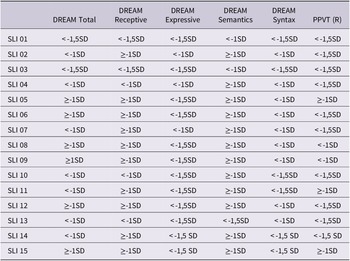
During the testing stage, the language ability of potential children with SLI was assessed using two standardized tests. The first test is the Peabody Picture Vocabulary Test–Revised Chinese Version 1990 (PPVT-R), which can be used to test the receptive vocabulary of Mandarin-speaking children with considerable validity and high reliability (Sang & Miao, Reference Sang and Miao1990). The second one is the Diagnostic Receptive and Expressive Assessment of Mandarin (DREAM) (Ning, Liu & de Villiers, Reference Ning, Liu and de Villiers2014), which is thought to hold promise as a diagnostic tool of Mandarin language impairment for children aged 2;6 to 7;11(Liu, de Villiers, Ning, Rolfhus, Hutchings, Lee, Jiang & Zhang, Reference Liu, de Villiers, Ning, Rolfhus, Hutchings, Lee, Jiang and Zhang2017). All children with SLI have at least two of the six scores in the language tests (DREAM and PPVT-R) 1 SD below the mean score for their age. Furthermore, the scores on the syntax in DREAM are at least 1 SD lower than the mean standardized score for their age, implying that all of the children with SLI in the current study have poor syntactic ability. Table 1 provides the test scores for children with SLI.
Test scores of the children with SLI

The rationale of choosing preschool children with SLI is that we want to observe a wider range of errors exhibited in their comprehension of RCs. Many studies examining RCs in school children with SLI found that they made thematic role reversal errors but no errors in functional category C in RCs (Friedmann & Novogrodsky, Reference Friedmann and Novogrodsky2004; Jensen de López et al., Reference Jensen de López, Olsen and Chondrogianni2014, among many others). The difficulty in producing RCs in preschool children with SLI, on the other hand, was attributed to impaired knowledge of C. It has been shown that children with SLI tend to omit the obligatory complementizer and there is a 2-year delay in the onset of RC production in this population (Håkansson & Hansson, Reference Håkansson and Hansson2000; Schuele & Dykes, Reference Schuele and Dykes2005). We, therefore, intend to probe whether the errors in functional category C can be found in the comprehension of RCs in preschool children with SLI.
To address the second question, we recruited two groups of TD children to participate in the experiment, allowing us to ascertain the possible discrepancy between the children with and without SLI. One control group of fourteen children (Age range: 4;3-5;8; Mean: 62.27 months, SD: 4.96 months) was selected to serve as Typically Developing Age matched (TDA) children. The remaining fifteen children were Typically Developing Younger (TDY) children (Age range: 3;2-4;2; Mean: 45.01 months, SD: 4.35 months). The one-way ANOVA test showed that there is a significant difference between the three groups in terms of age (F (2; 46) = 55.4, p<.01) and the post-hoc comparisons with Bonferroni correction revealed that the TDA and SLI groups do not differ in age (MD = 0.91, p = 0.88>0.05). On the other hand, there is a significant difference in age between TDY and SLI group (MD = 17.82, p<0.01).
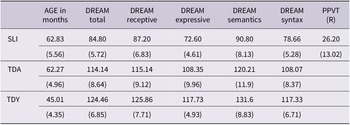
The TDA and TDY groups also took a standardized language test (DREAM), and their scores are within the normal range. All the TDA and TDY children are mentally and physically healthy and have normal language proficiency. Table 2 presents the age and the scores on PPVT(R) and DREAM of children with SLI and TD children.
Detailed profiles of the three groups of children (Mean and SD)

Note. The scores obtained from DREAM are standard scores, whereas the scores of PPVT(R) are raw scores.
We examined whether there are differences between three groups of children in terms of the language proficiency based on data from DREAM. A number of one-way ANOVAs revealed that children with SLI performed significantly worse than both TDA and TDY children in terms of DREAM total, receptive, expressive, semantics and syntax (all ps<.001).
Experimental task
The task is a binary character-picture matching task with 10 sets of different colored pictures (Adani, Reference Adani2011). The examples of stimuli under investigation were given in (9). There were 10 subject RCs and 10 object RCs, yielding 20 sentences in total. To build up our stimuli, we used the same transitive verbs for the two RC types, which included tui ‘push’, ti ‘kick’, qin ‘kiss’, zhuang ‘bump’, pai ‘beat’, yao ‘bite’ , mo ‘touch’, ca ‘wipe’, xi ‘wet’, zhui ‘chase’. A total of eight nouns were employed to depict the animate characters: gege ‘brother’, jiejie ‘sister’, xiaomao ‘cat’, xiaogou ‘dog’, xiaoyang ‘sheep’, xiaoniu ‘calf’, laohu ‘tiger’, shizi ‘lion’. All sentences were semantically reversible and ranged in length from nine to eleven words.

Each sentence was matched with one set of colored pictures with the same structure: person (animal) X on the left, person (animal) Y in the center, and person (animal) X on the right. For example, a boy is kissing a girl and the girl is kissing another boy, as shown in Figure 2. The action in the experimental trial pictures was directed to the left in 5 pictures and to the right in 5 pictures.
Procedure
Participants were examined individually in a quiet room of the kindergarten and the experimental sentences were presented to them in pseudo-random order. The children were instructed to listen carefully to the experimenter and point to the character that best matched what they heard. When the experimenter gave the instructions, he or she pointed to the two X persons or animals to ensure that the children would point to the character in the picture rather than the whole picture. For example, the experimenter pointed to the two boys in figure 2 one after the other, saying simultaneously: zheli you liang ge xiaogege, zhiyixia qin xiaojiejie de xiaogege (There are two brothers, show me the brother that the sister is kissing.).
Data coding and scoring
We coded a response as correct when a participant accurately identified the correct character (out of the two), while incorrect responses were coded as errors. These errors were labeled as Thematic role reversal errors (TRREs) or Middle errors. We coded the response as a TRRE when the children chose the other character corresponding to the head NP. For example, when children heard an object RC (Zhiyixia xiaojiejie qin de xiaogege, ‘Point to the boy that the sister is kissing.’), they pointed to the boy on the right rather than the one on the left in Figure 2. It seems that the children misinterpreted theta-roles of the NP of RCs because the head NP of the object RC is a Patient, but the child interpreted it as an Agent. We coded the response as a Middle error when children pointed to the character in the middle. For instance, the child pointed to the sister in the middle after hearing the object RC (Zhiyixia xiaojiejie qin de xiaogege, ‘Point to the boy that the sister kissed.’).
Results
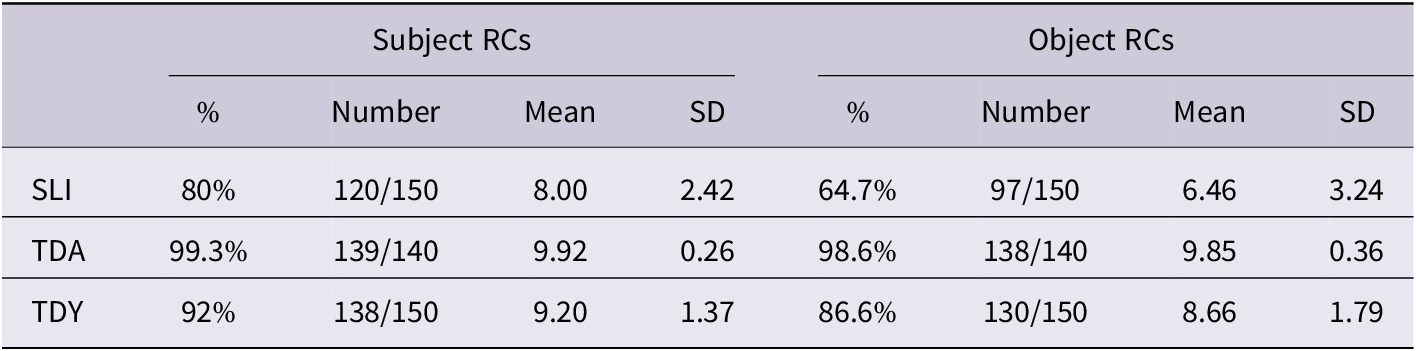
First, we calculated the accuracy of children's comprehension of subject and object RCs. Table 3 summarizes the descriptive results, which shows that children performed better with subject RCs than with object RCs, and that children with SLI lagged behind both TDA and TDY children. We used R (version 4.0.3, R Core Team, 2019) to perform linear mixed-effects analysis of the relationship between various fixed factors in this paper. First, we used a mixed-effects model with sentence type and group as fixed factors and subjects and items as random factors to analyze correct responses and found a significant effect of group (x2 = 24.67, p<.001; Wald Z = 12.33, p<.001) and a significant effect of sentence type (x2 = 9.34, p = 0.01; Wald Z = 8.96, p<.001).
Percentage (%) and raw scores of correct responses in the comprehension of subject RCs and object RCs in each group

According to the statistics shown in Table 4, children with SLI performed worse than both TDA and TDY children in RC comprehension, while there was no significant difference between the two groups of TD children. It should be noted that the lack of difference between TDA and TDY children could be due to their similar language proficiency, as evidenced by the fact that all of the mean scores obtained in DREAM were higher for the TDY group than for the TDA group.
Summary of the simple effects of children in the generalized mixed Model (N=880, log-likelihood = –186.102) for RC comprehension

To further examine whether there was any difference in the comprehension of subject and object RCs for each group separately, we ran a mixed-effects model with sentence type as a fixed factor and subjects and items as random factors. Table 5 shows that children with SLI performed better in the comprehension of subject RCs compared to object RCs, whereas there was no significant difference between the two RCs in both TDA and TDY children.
Summary of the simple effects of the sentence in the generalized mixed Model (N = 880, log-likelihood = –262.35) for RC comprehension

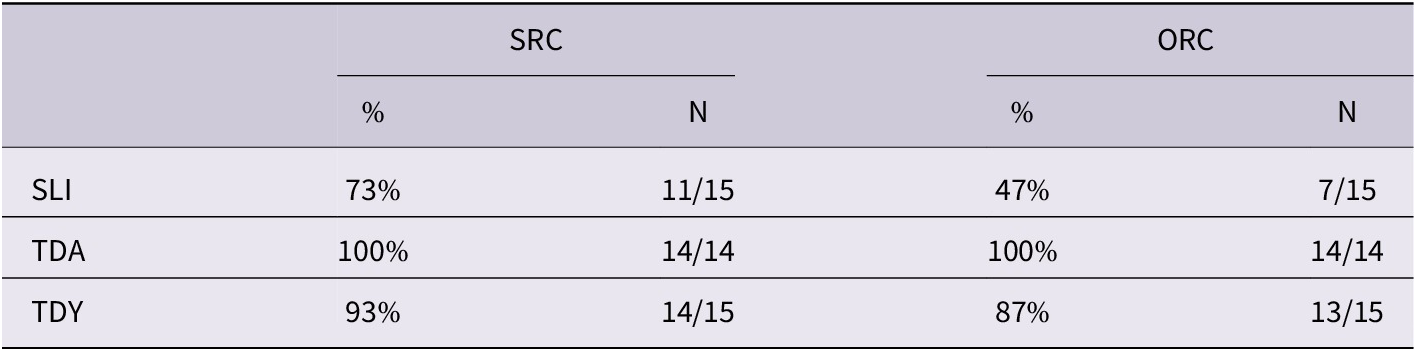
This pattern also remains true for individual children within each group. Table 6 reports the percentages and numbers of the three groups of children performing above chanceFootnote 5 in each condition. Descriptively, more children with SLI performed above chance in the subject RCs condition as compared to the object RCs condition. TDY children, on the other hand, showed only a marginal difference between the two conditions, whereas TDA children reached the ceiling level in both conditions.
Percentages (%) and number (N) of participants who performed above chance in the RC comprehension task

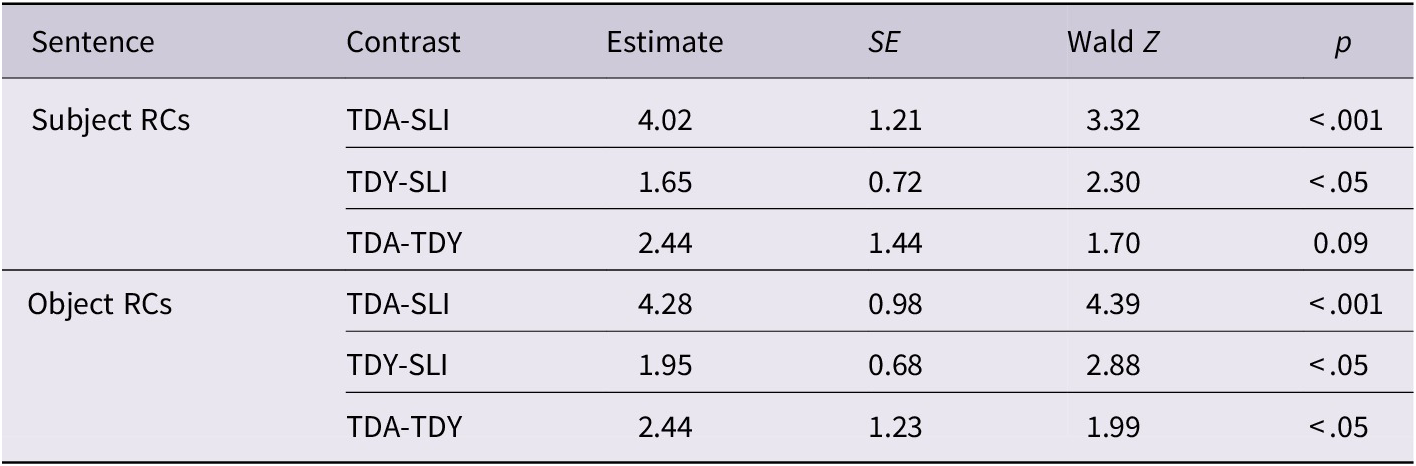
Then we examined whether the three groups of children differed in the two RCs separately. Table 7 summarizes the results of the statistical analysis of the group effect on the accuracy of the two RCs respectively. There was a significant difference between the children in terms of accuracy in subject RCs (x2 = 6.86, p<0.05; Wald Z = 3.106, p<0.01). To be more specific, there was a significant difference between the SLI and TDA children and between the SLI and TDY children, but there was no difference between TDA and TDY children. For the accuracy of the object RCs condition, there was a significant difference among the children (x2 = 12.24, p<.001; Wald Z = 3.781, p<.001). There was a significant difference in accuracy between the TDA and SLI children, between the SLI and TDY children, and between TDA and TDY children.
Summary of the simple effects of children in the generalized mixed model (N=880, log-likelihood=-262.35) for RCs comprehension

To wrap up, children with SLI showed a subject over object RC advantage in the comprehension task, whereas TD children performed equally well in both conditions. Children with SLI comprehended the RCs significantly worse than their TD peers, and they even fell behind TDY children, who are 17 months younger on average.
Error analysis
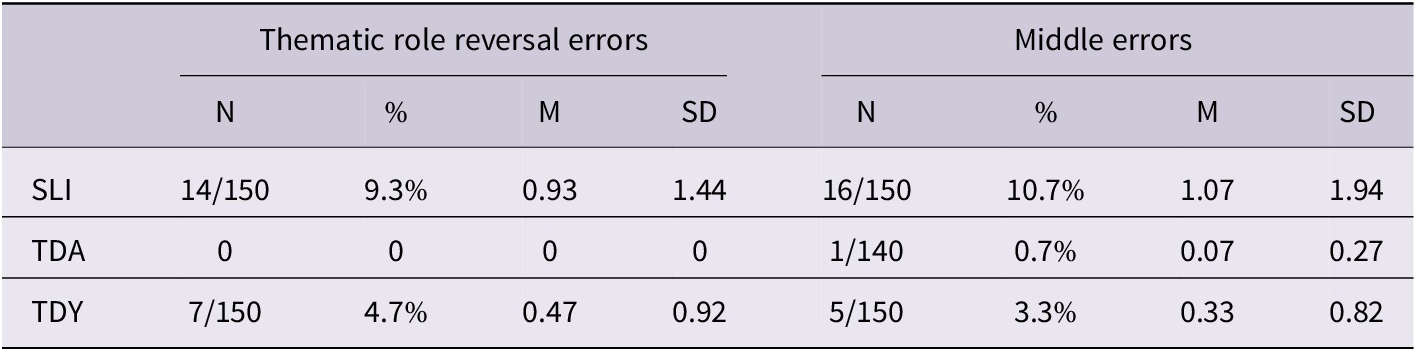
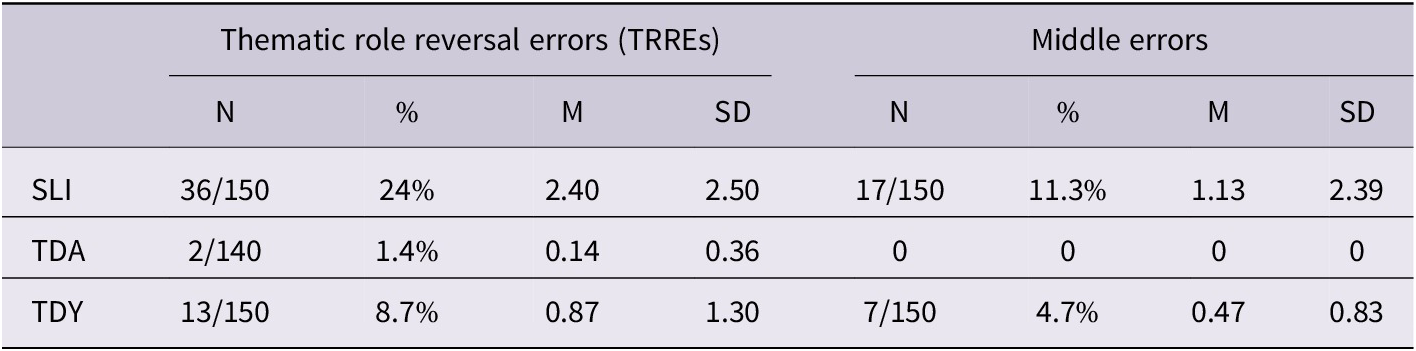
We further performed the error analysis because untargeted responses are very informative about the syntactic deficit seen in children with SLI. As shown in Table 8 and 9, Middle Errors were almost exclusively found in children with SLI and TDY children, and the two types of errors were equally distributed in the subject RCs condition, but TRREs were more common in the object RCs condition.
Percentage (%) and raw scores of wrong responses in the comprehension of Subject RCs in each group

Percentage (%) and raw scores of wrong responses in the comprehension of Object RCs in each group

We ran a Poisson regression model to deal with the count variable, i.e., the number of errors. We limit the factor of group to children with SLI and TDY children, since TRREs were not observed in TDA children’s comprehension of subject RCs, and Middle errors were not observed in their comprehension of object RCs. For children with SLI, there was no difference between the two errors in the subject RCs condition (β = 0.13, Wald Z = 0.36, p = 0.71), whereas they were more likely to make TRREs as opposed to Middle errors (β = –0.75, Wald Z = –2.54, p = 0.01<0.05) in the object RCs condition. The two errors did not differ in TDY children’s comprehension of subject RCs (β = –0.34, Wald Z = –0.57, p = 0.56) or in the comprehension of object RCs (β = –0.62, Wald Z = –1.32, p = 0.19).
To evaluate the effect of group on the tendency to make a particular error, we conducted a series of mixed-effects models with group as a fixed factor and subjects and items as random factors. In terms of TRREs, there was no significant difference between children with SLI and TDY children in subject RCs condition (Wald Z = –1.50, p = 0.13>0.05), whereas in object RCs condition, children with SLI had a higher tendency to make this error than TDY children (Wald Z = –2.53, p = 0.01<0.05). In terms of Middle errors, there was no difference between the two groups in any of the conditions (both ps > .14).
To conclude, when children with SLI failed to choose the correct response in object RCs condition, they were more likely to commit TRREs than Middle errors and they committed more TRREs compared to TDY children in the same condition.
General discussion
This is the first study to investigate the comprehension of RCs in Mandarin children with SLI by using the character-picture matching task. One of the key findings of this paper is that children with SLI had greater accuracy in comprehension of subject as compared to object RCs, whereas the same pattern did not hold for both TDA and TDY children.
Theories capitalizing on the linear order as the interpretation strategy predict that the comprehension of object RCs is better than subject RCs in Mandarin children with SLI. In line with the linear order analysis (Cromer, Reference Cromer1978), the assignment of thematic roles of arguments in RCs is solely dependent on the linear order of the sentential constituents for children with SLI. The first noun phrase is interpreted as the agent and the second noun phrase as the patient. Since the first NP (xiaojiejie ‘sister’) happens to be the agent in Mandarin object RC (10b), this analysis predicts that Mandarin children with SLI will interpret object RCs better than subject RCs. Similarly, the Externalization Deficit Hypothesis (Lorenzo & Vares, Reference Lorenzo and Vares2017) claims that children with SLI would use a first-agent strategy in interpreting RCs, predicting that Mandarin children with SLI will perform well in the object RC condition and thus will exhibit no advantage for either type of RC. Our findings show that Mandarin children with SLI performed better in the subject RC condition, contradicting these theories.

As discussed previously, according to RDDR and subsequent research, children with SLI will adopt a non-syntactic strategy to interpret an NP lacking a thematic role in RCs (Friedmann & Novogrodsky, Reference Friedmann and Novogrodsky2004; van der Lely & Battell, Reference van der Lely and Battell2003). To be more precise, the theory argues that the first NP in the RCs will be understood as the agent and NPs that do not move retain their thematic roles. If this is the case, children with SLI will perform well when comprehending Mandarin object RCs (10b) because the first NP (xiaojiejie ‘sister’) will be interpreted as the agent, which is correct by chance. However, when interpreting subject RC (10a), they can only achieve chance level performance because the first NP (xiaojiejie ‘sister’) has not undergone movement and therefore will maintain its thematic role as the patient, while the second NP (xiaogege ‘brother’), as a moved NP, will not be able to do so. Children with SLI will interpret it as the patient according to the linear order. If so, in (10a) there are two patients, which is contrary to grammatical rules, and children with SLI will be forced to guess the thematic roles of the NPs involved in (10a), resulting in a chance level performance in the subject RCs condition. The findings of this study are not in line with this prediction.
The subject over object RCs advantage observed in Mandarin children with SLI in this paper is consistent with RM (Jensen de López et al., Reference Jensen de López, Olsen and Chondrogianni2014; Rizzi, Reference Rizzi1990, Reference Rizzi and Belletti2004) and EFUH proposed in this study. In the configuration of Mandarin object RC (10b), the dependency between the relative head (xiaojiejie ‘sister’) and the copy is hard to establish for children with SLI because there is a qualified element (xiaogege ‘brother’) intervening between them. Due to the insensitivity to the EF of the relative head in the impaired language system, children with SLI will assume that the relative head and the intervener share the same feature, leading to intervention effects. There is no such intervener between the relative head and the copy in subject RC (10a), and hence no RM violation arises.
According to the findings of this study, the RM effect did not manifest itself in TDA and TDY children’s comprehension of object RCs. TDA children’s RC knowledge was nearly adult-like because they had almost reached the ceiling level in interpreting the two RCs, whereas TDY children’s comprehension of subject RCs did not differ significantly from that of object RCs. The current study’s findings differ from those of Hu et al. (Reference Hu, Gavarró, Vernice and Guasti2016), who found that even seven-year-old Mandarin-speaking children could not correctly interpret object RCs. We propose that the disparity between their findings and the current study’s findings is due to the different research designs. Hu et al. conducted a character-picture matching task by using two pictures with two characters each, and children’s responses were categorized as correct responses, Embedded NP Errors, Reversal Errors, and Other Errors. However, in this study, there were only three characters to be chosen. In their study, children were required to consider four possible referents, which may impose a greater processing load on participants than the tasks used in this study. Tentatively, we hold that the study using two pictures may have underestimated the RC knowledge of the children. Furthermore, according to Adani (Reference Adani2011), the experimental setting in Hu et al. did not create felicitous conditions for target-like RC comprehension, which may have contributed to the disparities between their and our results.
This paper also discovered that when children with SLI failed to interpret RCs, they tended to make Middle errors and TRREs. Non-target responses may be more informative to the nature of the deficit in this population.
In terms of the Middle error, RM cannot provide a satisfactory explanation, whereas EFUH maintains that it is caused by the underspecified Edge Feature on C in RCs. More specifically, we contend that the Middle error is caused by the impairment of knowledge of the functional category C. According to Chomsky (Reference Chomsky, Freidin, Otero and Zubzarreta2008), wh-movement is driven by an Edge Feature on C, which attracts an appropriate type of constituent (Relative head) to move to the edge of CP to become the specifier of C. Both C and the relative head bear the Edge feature. EFUH assumes that children with SLI have EFs that are underspecified, and thus are insensitive to the EFs of both C and the relative head. The RM effect is caused by insensitivity to EFs of relative head, while the underspecification of EFs of C causes errors concerning functional category C, specifically the Middle Error.
The occurrence of the Middle error, according to Adani (Reference Adani2011), indicates a genuine problem in deriving the correct representation of RCs. To put it another way, committing the Middle error is equivalent to interpreting only the embedded IP. Children with SLI made Middle errors in their interpretation of both RCs, lending credence to the argument that SLI children have a significant problem projecting the representation of RCs.
In this paper, we further propose that the difficulty in projecting the representation stemmed from the impairment of knowledge of the functional category of C, which leads to their insensitivity to the semantic role of RCs. The restrictive RC functions as reviewed previously, to restrict the set of references in the context. We maintain that when children with SLI come across an RC (e.g., qin xiaojiejie de xiaogege ‘the brother that kissed the sister’), probably they cannot recognize that the RC is about the referent of the head noun (xiaogege ‘the brother’). They can simply process the embedded part of the RC in this case, resulting in Middle errors.
In previous studies examining the modality of production, researchers found that children with SLI opted for declarative sentences and sentence fragments instead of target RCs (e.g., Novogrodsky & Friedmann, Reference Friedmann, Grodzinsky and Amunts2006), which may also be attributed to the insensitivity of the semantic function. In addition, it has been shown that preschool children with SLI tend to omit the obligatory complementizer (Håkansson & Hansson, Reference Håkansson and Hansson2000; Schuele & Dykes, Reference Schuele and Dykes2005). We suggest that Middle errors in comprehension are analogous to omitting the obligatory complementizer in production, both of which are caused by deficiency of the functional category C.
Notably, TDY children also made some Middle Errors in the task (3.3 % on the condition of Subject RCs and 4.7 % on the condition of object RCs), although these errors were less frequent in TDY children than in SLI children. We assert that the findings indicate that younger TD children cannot avoid the difficulty of representing RCs.
Next, we proceed to discuss the reasons for TRREs. According to RDDR, this error is caused by the inability to assign the thematic role to the noun phrase that has been replaced from its original position. As previously discussed, this analysis failed to account for the findings of this study, so we propose another explanation for this error. The reason for the TRRE, according to EFUH and RM, is that the local dependency is blocked by an intervener in the object RC. When children with SLI discovered that it was difficult to establish the local relationship between the head and the copy, they most likely treated the object RC (e.g., xiaojieie qin de xiaogege ‘the brother that the sister kissed’) as a corresponding subject RC (qin xiaojiejie de xiaogege ‘the brother that kissed the sister’). This strategy would result in TRREs because xiaogege ‘the brother’ is the agent and xiaojiejie ‘the girl’ is the patient in the corresponding subject RC, which is the opposite of the thematic roles in the target sentence.
Cross-linguistic studies may provide additional evidence supporting our proposal. Adani et al. (Reference Adani, van der Lely, Forgiarini and Guasti2010) found that the majority of the non-target responses that children adopt at all ages result from interpreting an object RC as a subject RC, in a study of TD (aged 5;0-9:0) Italian children’s comprehension of object RCs. They attributed the results to the intervention effect in object RCs, along the lines proposed by Friedmann et al. (Reference Friedmann, Belletti and Rizzi2009).
Note that in the subject RC condition, we also observed TRREs. We consider that the linear blocking effect is at play in Mandarin subject RCs (cf. Hu et al., Reference Hu, Gavarró, Vernice and Guasti2016). Recall that Mandarin is an SVO language with head-final RCs: the intervention effect is more complex. Structurally, the intervention happens in object RCs, and linearly there is a blocking effect in subject RCs. It is worth noting that while linear intervention effects are at play, structural intervention effects have a greater impact on the comprehension of RCs, as evidenced by the fact that children with SLI made more TRREs in object RCs (24%) than in subject RCs (9.3%).
As suggested by an anonymous reviewer, if we accept that linear intervention effects play a role in the comprehension of Mandarin subject RCs, it follows naturally that comprehension of Mandarin object RCs would be easier than comprehension of head initial object RCs, such as Italian object RCs. There is no linear intervention in Mandarin object RCs, whereas in the case of Italian object RCs, both the structural and linear intervention effects disfavor the expected answer. This prediction has been confirmed by this study. In this research, we discovered that Mandarin TD children performed significantly better in the case of object RCs than Italian children of similar age (Arosio et al., Reference Arosio, Panzeri, Molteni, Magazù and Guasti2017). The disparity is likely due to the fact that linear intervention does not play a role in the comprehension of Mandarin Object RCs.
As pointed out by one anonymous reviewer, Hu, Costa and Guasti (Reference Hu, Costa and Guasti2020) found that when bilingual children did not comprehend object RCs, they were more likely to make embedded Errors (Middle errors in this paper) in Mandarin; whereas, in this paper, children with SLI were prone to making reversal errors when they had trouble interpreting Mandarin object RCs. This discrepancy will be investigated further in the future. The possible explanation is that the bilingual children may have been influenced by Italian because they were more likely to make reversal errors in Italian.
In summary, this paper found that children with SLI have a subject over object RC advantage in comprehension and their knowledge of RCs is severely impaired. The errors committed by children with SLI suggest that there is a genuine problem in deriving the correct representation of object RCs in this population. Additionally, we hold that children with SLI tend to interpret object RCs as subject RCs owing to structural intervention. The EFUH will account for the subject-object RCs asymmetry as well as the nature of errors. The EFUH captures more characteristics of children with SLI in acquiring RCs compared to previous theories. This paper also established that RCs can serve as clinical markers of linguistic impairment, allowing children with SLI to be distinguished from their TD peers.