Carbapenem-resistant Pseudomonas aeruginosa (CRPA) and Klebsiella pneumoniae carbapenemase (KPC)–producing bacterial infections are rapidly emerging in the United States. Reference Magiorakos, Burns and Rodríguez Baño1,Reference Won, Munoz-Price and Lolans2 Outbreaks of KPC-producing organisms are challenging to control and often spread in acute-care and long-term care facilities. Reference Won, Munoz-Price and Lolans2,Reference Endimiani, Depasquale and Forero3 KPC-producing organisms are associated with high mortality, and they contribute to both higher all-cause in-hospital and infection-related mortality. Reference Chen, Yang and Tan4,Reference Ben-David, Kordevani and Keller5 Infections caused by KPC-CRPA are extensively resistant to multiple antibiotics, Reference Villegas, Lolans and Correa6 difficult to treat, and complicate the clinical management of patients. 7,Reference Walters, Grass and Bulens8 KPC-producing CRPA is rare in the United States. Reference Walters, Grass and Bulens8 In May and June 2018, cases of KPC-CRPA involving multiple counties in the Houston region of Texas were identified. Due to the unusual nature of such infections, an outbreak investigation was conducted.
Methods
The study utilized surveillance data from health departments in the Houston region and was approved by the Institutional Review Board of the University of Texas Health Science Center, Houston, Texas. The Houston Health Department and Texas Department of State Health Services laboratories perform resistance-mechanism testing on carbapenemase-producing organisms, including P. aeruginosa, as part of the Centers for Disease Control and Prevention (CDC) antibiotic resistance laboratory network. CRPA clinical isolates showing unusual resistance are voluntarily submitted to the laboratories by providers or commercial laboratories in the region.
From May 2018 to May 2019, KPC-CRPA outbreak investigation was conducted in the Houston region. Cases were defined as patients or residents with KPC-CRPA from surveillance or clinical cultures. Point prevalence studies (PPSs) were conducted at the healthcare facilities where the initial cases had overlapping stays in the previous 6 months. PPSs, contact tracing, and admission screening were conducted using rectal swabs collected daily. Repeated PPSs were conducted at the facilities until 2 rounds of negative KPC results were obtained. The CRPA isolates were initially analyzed using a modified carbapenemase inactivation method for carbapenemase identification followed by polymerase chain reaction (PCR) and pulsed-field gel electrophoresis (PFGE), including similarity check by dice comparison. In addition, core-genome multilocus sequence typing (cgMLST) was performed on the KPC-CRPA isolates at the CDC laboratory in Atlanta, Georgia. The clinical data, demographics, and prior laboratory tests were abstracted from medical records. In addition, multiple onsite infection control assessments were conducted at the facilities that had overlapping patient stays.
Results
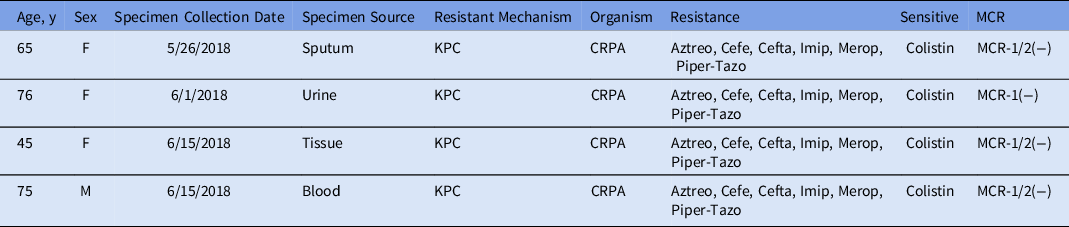
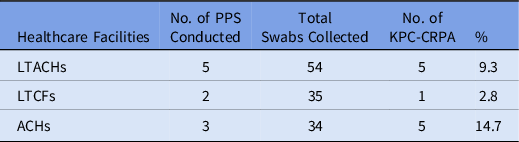
Four KPC-CRPA cases were identified from different healthcare facilities across the region in May and June 2018. In total, 10 facilities were identified to have been potentially exposed, including 2 long-term acute-care hospitals (LTACHs), 2 long-term care facilities (LTCFs), 3 acute-care hospitals (ACHs), an outpatient wound care center, and 2 physician’s offices. However, 3 facilities where the initial cases had overlapping admission in the 6 months preceding their KPC-CRPA diagnosis were prioritized. Information about the 4 initial KPC-CRPA cases is presented in Table 1. None of these patients had a history of international travel in the previous 12 months. The first case was identified from the sputum culture of a 65-year-old woman with previous history of admissions to an LTACH, LTCF, and ACH. The patient died during the study period. The second patient was a current nurse who had sought care at an outpatient clinic for skin lesions. This patient declined to provide recent admission history or visit to healthcare facilities in the region. The third case was a 75-year-old man receiving wound care at home and multiple admissions to the LTACH. The fourth case was identified at an ACH from urine culture and had had admissions to an LTACH and LTCF. Overall, the patients were mostly older, had multiple comorbidities, and most had wound care or debridement and endotracheal tubes at the healthcare facilities. Table 2 shows the number of swabs collected and KPC-CRPA cases identified during the PPSs at the LTACH, LTCF, and ACH. Overall, 13 additional cases were identified during PPSs and admission screenings at the 3 facilities. Furthermore, 3 KPC-positive patients died during the study period, and 5 more died following discharge.
Characteristics of the Initial Cases of KPC-CRPA, May–June 2018, in Texas

Note. KPC, Klebsiella pneumonia carbapenemase; CRPA, carbapenem-resistant Pseudomonas aeruginosa; MCR, mobile colistin resistance gene; Aztreo, aztreonam; Cefe, cefepime; Cefta, ceftazidime; Imip, imipenem; Merop, meropenem; Piper-Tazo, piperacillin-tazobactam.
Summary of the Findings From Point Prevalence Studies and Admission Screenings

Note. KPC, Klebsiella pneumonia carbapenemase; CRPA, carbapenem-resistant Pseudomonas aeruginosa; LTACH, long-term acute-care hospital; LTCF, long-term care facility; ACH, acute-care hospital.
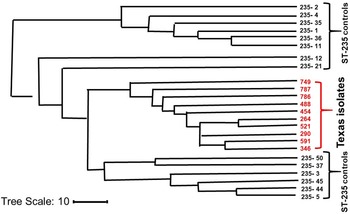
The KPC-CRPA isolates identified showed resistance to aztreonam, cefepime, ceftazidime, imipenem, meropenem, and piperacillin-tazobactam (Table 1). Further analysis at the CDC showed that the CRPA isolates exhibited panresistance. PFGE analysis showed distinct patterns with 90% relatedness, and the isolates from all of the cases showed 100% similarity by dice comparison. Also, PFGE patterns of the KPC-CRPA isolates identified from the PPS also matched that of the isolates collected from the initial cases. cgMLST analysis revealed that the isolates were genetically related and clustered with the emerging clonally related epidemic multilocus sequence type 235 (ST235) (Fig. 1). Core-genome single-nucleotide variant phylogenomic analysis indicated that the identified KPC-CRPA isolates were 89.95% related to each other. Interestingly, a unique strain of KPC-CRPA recovered from one of the patients matched the emerging sequence type (ST 298) lineage.
Phylogenetic tree of healthcare-associated KPC-producing Pseudomonas aeruginosa ST-235 isolates collected from the patients. Core-genome multilocus sequence typing was performed on the KPC-CRPA isolates at the CDC laboratory in Atlanta, Georgia.

Infection control assessments at the LTACH and LTCF identified lapses in infection prevention and environmental cleaning, but the sink hygiene assessments revealed no significant shortcomings. At the ACH, serious infection control breaches were identified: not appropriately donning and doffing personal protective equipment like gloves, not performing proper hand hygiene when entering and exiting patient rooms, poor wound care practices, inappropriately touching patient environment while changing dressing during wound care, and inadequate high-touch surface cleaning in daily and terminal cleaning.
Discussion
We described an emerging threat and regional spread of KPC-CRPA, a rare occurrence in the United States. Four initial cases of KPC-CRPA were identified from different healthcare facilities through surveillance of clinical isolates. Further investigation uncovered 13 additional cases at 3 healthcare facilities. The study also revealed the emergence of clonally related KPC-producing Pseudomonas aeruginosa ST235, the first cluster associated with KPC-CRPA in the United States. A unique case of KPC-CRPA isolates with ST298 was identified. Molecular and genetic analysis of the isolates revealed that the KPC-CRPA were genetically related, suggesting the potential transmission of CRPA within and between the healthcare facilities in the region. Most of the patients had overlapping stays at an LTACH, LTCF, and ACH. However, one of the cases could not be epidemiologically linked to any of the other cases or healthcare facilities. Although, the emergence of carbapenemase-producing Pseudomonas aeruginosa was first reported in Texas in 20019 and in Florida in 2010, Reference Poirel, Nordmann, Lagrutta, Cleary and Munoz-Price10 the incidence of KPC-CRPA has generally remained rare in the United States. Reference Walters, Grass and Bulens8
Lapses in infection control practices at each facility were noted, suggesting that indirect patient-to-patient transmission through contaminated healthcare workers or medical equipment may have played a role in the outbreak. The genetic relatedness of the isolates also suggests communal exposure and transmission networks. One limitation of this study is that we did not attempt to identify close contacts of the initial cases who were no longer hospitalized or residing at the facilities, and this may have resulted in underestimation of the total number of cases of KPC-CRPA and perhaps the number of potentially exposed facilities. Strengthening implementation of best practices of infection prevention and control in healthcare facilities is critical in containing emerging multidrug-resistant organisms. In addition, we suggest increased surveillance targeting CRPA strains. Lastly, our findings demonstrate the utility of regional laboratories in identifying rare and unusual outbreaks of highly resistant pathogens that individual facilities may not be able to detect using single facility-based surveillance.
Acknowledgments
We greatly appreciate the cooperation of the healthcare facilities during the outbreak investigation. We acknowledge Bobbiejean Garcia, an epidemiologist at the Texas DSHS, for reviewing this manuscript and for her contribution during the outbreak investigation. The study finding and conclusions are those of the authors only and do not necessarily represent the official position of either the author’s workplace institution or health departments or the centers that performed the laboratory tests.
Financial support
No funding was received for this study. C.D. was supported by National Institutes of Health (NIH)/National Institute of Allergy and Infectious Diseases (NIAID) (grant nos. R01AI116914 and R01AI150685).
Conflicts of interest
All authors report no conflicts of interest relevant to this article.