Implications
Colostrum plays an essential role in piglet survival and growth, providing the piglets with a vital source of immunoglobulins (Ig) and energy. Despite this, both colostrum yield (CY) and quality vary considerably among sows. Therefore, feeding sows with alternative additives or compounds is common practice to improve colostrum quality and production. Resin acid-enriched composition (RAC) contains free fatty acid, resin acids (RA) and improves performance in species other than the pig. This study demonstrated that RAC supplementation in the sow diet increases CY, colostrum IgG, acute phase protein (APP) and abundance of beneficial gut microbiota and subsequent litter performance.
Introduction
Colostrum plays an essential role in piglet survival and growth, providing a source of Ig (mainly class IgG) and energy (Rooke and Bland, Reference Rooke and Bland2002). Piglets are born with a limited energy reserve and are devoid of immune protection due to the epitheliochorial structure of the placenta (Rooke and Bland, Reference Rooke and Bland2002; Salmon et al., Reference Salmon, Berri, Gerdts and Meurens2009). Therefore, colostrum is the sole external source of a piglet’s nutrients and maternal immunity. Inadequate colostrum intake (CI) by the piglet is a major direct and subjacent cause of mortality during the initial days after birth (Decaluwé et al., Reference Decaluwé, Maes, Wuyts, Cools, Piepers and Janssens2014). In addition, insufficient intake of maternally derived Igs has a negative effect on piglet health, and thus also influences weight gain and survival at later stages in life (Rooke and Bland, Reference Rooke and Bland2002). Both the CY and colostrum quality vary considerably among sows (Devillers et al., Reference Devillers, Farmer, Le Dividich and Prunier2007). This variation can be attributed to sow, piglet and environmental traits (Devillers et al., Reference Devillers, Farmer, Le Dividich and Prunier2007; Quesnel, Reference Quesnel2011). Therefore, an improvement in CY and its composition, especially Ig of class G, A and M, benefits piglets. Thus, feeding sows with alternative additives to improve colostrum is common practice in modern pig production. Resin acid-enriched composition has been used in feed as a novel additive to improve performance in broilers (Vienola et al., Reference Vienola, Jurgens, Vuorenmaa and Apajalahti2018). Resin acid-enriched composition improved the microbial population in the small intestine of broilers and changed the microbial fermentation as well as improving the feed conversion ratio and gut microbiota (Kettunen et al., Reference Kettunen, van Eerden, Lipiński, Rinttilä, Valkonen and Vuorenmaa2017; Vienola et al., Reference Vienola, Jurgens, Vuorenmaa and Apajalahti2018). Resin acid-enriched composition, a novel dietary product, typically comprises RA (~8%) and free fatty acids (~90%), and 2% to 3% neutral components, such as those occurring naturally in trees, including alcohols and terpenic hydrocarbons such as squalene. Resin acid of RAC has been used to enhance immunity and regulate inflammation and wound healing (Kang et al., Reference Kang, Hirai, Goto, Kuroyanagi, Lee, Uemura, Ezaki, Takahashi and Kawada2008; Park et al., Reference Park, Lee, Lee, Yoo, Shin, Yamabe, Kim, Lee, Kim and Lee2017). However, CLA, pinolenic and oleic acids are characteristic fatty acid components of RAC and the effects of their supplementation in gestating and lactating diets have been well studied (Bontempo et al., Reference Bontempo, Sciannimanico, Pastorelli, Rossi, Rosi and Corino2004; Corino et al., Reference Corino, Pastorelli, Rosi, Bontempo and Rossi2009; Yao et al., Reference Yao, Li, Jun Wang, Zhou, Wang, Zhu, Wang and Thacker2012). Studies indicated that dietary supplementation of essential fatty acids improved sow colostrum Igs, piglet performance, average daily gain (ADG) and weaning weight. However, the peculiar fatty acid composition of RAC, and its content of RA, may suppress the pathogenic bacteria and influence the growth of beneficial microbiota (Dorman and Deans, Reference Dorman and Deans2000; Vienola et al., Reference Vienola, Jurgens, Vuorenmaa and Apajalahti2018).
Our hypothesis was that using RAC in the sow late gestating diet might induce stimulation of the mucosal immune system, improve beneficial gut microbiota and result in higher levels of CY, colostrum Ig and better colostrum composition. The RAC diet may therefore improve colostrum availability and immune protection of sucking piglets. We aimed to explore the role of RAC on sow CY, colostrum Ig levels, colostrum composition and litter performance. We studied the sows’ APPs, in sow colostrum and plasma. The acute phase response in sows can appear as non-specific to disturbances in homeostasis due to inflammation, tissue injury during gestation and farrowing (Sorrells et al., Reference Sorrells, Eicher, Harris, Pajor and Richert2007). However, Larson et al. (Reference Larson, Wei, Weber, Mack and McDonald2003) suggested that a specific APP, serum amyloid A (SAA), in colostrum has local beneficial effects on the neonatal gut development. We also aimed to demonstrate the influence of RAC feeding on gut microbiota profile of sows by high-throughput sequencing analysis. In one of our recent studies we found that piglets having higher abundances of Lactobacillus, Roseburia, Flaonifractor, Barnesiella grew faster (Hasan et al., Reference Hasan, Junnikkala, Peltoniemi, Paulin, Lyyski, Vorenmaa and Oliviero2018). In the same study it was shown that bacterial families, for example, Lactobacillaceae, Ruminococcaceae, Pervotellaceae, were positively correlated with sow high CY and better colostrum quality.
Material and methods
The experiment was carried out in three trials (herds 1 to 3) in commercial pig farms in Finland (two herds) and in the Netherlands (one herd) during January 2016 to April 2016, December 2016 to March 2017 and June 2017 to August 2017, respectively. The experiment was carried out in different batches of sows that farrowed in that period.
Study population and experimental design
A total of 44 multiparous sows (Yorkshire × Norwegian Landrace) of mixed parities (from 1 to 7, 3.8±0.2, mean±SE) in herd 1, 47 multiparous sows (Yorkshire × Norwegian Landrace) of mixed parities (from 1 to 7, 3.6±0.2) in herd 2, and 30 multiparous sows (Topigs 20) of mixed parities (from 1 to 6, 3.1±0.2) in herd 3, were allocated to two dietary treatment groups. During pregnancy sows were loose housed and feed was served in individual feeding cages. One week before expected farrowing the sows were transferred to the farrowing department, where they were housed in individual farrowing crates (200×80 cm). Upon arrival at the farrowing rooms, sows were fed a standard herd specific diet (2.9 kg/day), according to the national standards for lactating sows (CON; n=21, n=23, n=15 for herd 1, 2, 3, respectively) (Supplementary Table S1) or the same standard diet supplemented with 5 g RAC/day per sow in feed (Progres®; Hankkija Oy/Suomen Rehu, Hyvinkää, Finland, patent no. FI124918, Supplementary Table S2) (RAC; n=23, n=24, n=15 for herds 1, 2 and 3, respectively). The dosage of RAC was chosen according to previous results in vitro and in vivo in chicken (Kettunen et al., Reference Kettunen, van Eerden, Lipiński, Rinttilä, Valkonen and Vuorenmaa2017; Vienola et al., Reference Vienola, Jurgens, Vuorenmaa and Apajalahti2018). Sows with clear evidence of inappetence (feed left in the feeding trough) or with clinical signs of health problems, were not included in the study. The supplementation of RAC was continued until the start of farrowing. All the parturitions were supervised during the farrowing 24 h a day, birth times of individually weighed piglets were recorded, the backs of the piglets were dried with paper towels and marked with a thick pen, and the birth weights were measured. Piglets were again individually weighed at 24 h after the birth of the first piglets. Ear-tagging was done only for six selected piglets based on BW at birth (BWB) in a block of three categories: two piglets of <1 kg, two piglets of 1.4 to 1.8 kg and two of piglets >1.8 kg, respectively, representing small, normal and large piglets (Hasan et al., Reference Hasan, Junnikkala, Peltoniemi, Paulin, Lyyski, Vorenmaa and Oliviero2018). Piglets were allowed to drink a milk supplement only after 24 h weighing. The same sampling protocol was used by Hasan et al. (Reference Hasan, Junnikkala, Peltoniemi, Paulin, Lyyski, Vorenmaa and Oliviero2018). The CON diet litters included 126, 138, 90 piglets and 138, 144, 90 piglets in the RAC diet in herds 1, 2 and 3, respectively. Litters were standardized to 14 piglets per sow at 24 h after birth and cross-fostering was done only among the litters of the same treatment group, and those six ear-tagged piglets per litter that remained with their original mothers until weaning (Hasan et al., Reference Hasan, Junnikkala, Peltoniemi, Paulin, Lyyski, Vorenmaa and Oliviero2018). All the six ear-tagged piglets were followed until weaning at 3 to 4 weeks of age and were weighed again (3 weeks in herds 1 and 2, 4 weeks in herd 3). No additional care was given to the piglets by the researchers and farm workers unless there was a clear risk of them becoming crushed by the sow (Hasan et al., Reference Hasan, Junnikkala, Peltoniemi, Paulin, Lyyski, Vorenmaa and Oliviero2018).
Observed parameters and colostrum yield calculation
Individual piglets’ CI within a litter was summed to calculate a sow’s CY. Colostrum intake was estimated by the regression equation as described by Devillers et al. (Reference Devillers, Van Milgen, Prunier and Le Dividich2004), based on the variables: BWB (kg), weight at 17 to 24 h of age (BW24, kg), duration of CI (t in min and 17 h⩽t⩽25 h), and time between birth and first suckling (t FS, min). The equation is as follows: CI = −217.4+0.217×t+1 861 019×BW24/t+BWB×(54.80−1 861 019/t)×(0.9985–3.7×10−4×t FS+6.1×10⁻⁷×t 2 FS). The t FS was estimated to be 35 min, which was based on our observations from a previous study (Hasan et al., Reference Hasan, Junnikkala, Valros, Peltoniemi and Oliviero2016). A 6 g/kg BWB miscalculation of CI for piglets or less than 2% error with an error of 15 min in t FS generates a 6 g/kg BWB miscalculation of CI for piglets or less than 2% error (Devillers et al., Reference Devillers, Van Milgen, Prunier and Le Dividich2004). The following sow parameters were assessed: parity, gestation length, farrowing duration, and numbers of live born and stillborn piglets. Farrowing duration was calculated based on the time from the first to the last piglet born. The following piglet parameters were recorded: BWB, BW24, birth interval, BW at weaning, pre-weaning mortality and ADG as described in Hasan et al. (Reference Hasan, Junnikkala, Peltoniemi, Paulin, Lyyski, Vorenmaa and Oliviero2018).
Sample collection
Colostrum samples (20 ml) were obtained within the first 2 h after birth of the first piglet. Colostrum sample was collected from the same side of the anterior udder across the first three teats (Hasan et al., Reference Hasan, Junnikkala, Peltoniemi, Paulin, Lyyski, Vorenmaa and Oliviero2018). At the beginning of farrowing 5 ml blood samples were collected from sows’ vena saphena using lithium heparin tubes (Hasan et al., Reference Hasan, Junnikkala, Peltoniemi, Paulin, Lyyski, Vorenmaa and Oliviero2018). Samples were kept in an icebox and heparinized tubes were centrifuged for 10 min at 2000 rpm/min, separated plasma being stored at −20°C until analysis. Blood samples were collected only from pigs in herds 1 and 2. Faeces were collected in sterile 50 ml tubes directly from the rectum of sows (n=21 CON; n=23, RAC) from only herd 1. Samples were immediately cooled, wrapped in an icebox and stored at −80°C after shipment to the laboratory for total genomic DNA extraction (Hasan et al., Reference Hasan, Junnikkala, Peltoniemi, Paulin, Lyyski, Vorenmaa and Oliviero2018).
Sample analysis
Colostrum concentrations of Igs (IgG, IgA and IgM) were analysed using swine IgG, IgA and IgM ELISA quantification Kits (Bethyl Laboratories, Montgomery, TX, USA) as described in Hasan et al. (Reference Hasan, Junnikkala, Peltoniemi, Paulin, Lyyski, Vorenmaa and Oliviero2018). The sensitivity of the kits were 1.37 to 1000 ng/ml, with a linearity of dilution 90% to 100%. The ELISA kit from Bethyl Laboratories is designed to react specifically with Pig Ig, and not with other Igs or other pig serum proteins. The intra- and inter-assay coefficients of variation were 4.8%, 3.3%, 1.3% and 6.7%, 5.3%, 6.8% for IgG, IgA and IgM, respectively. The colostrum total solid, fat, protein and lactose contents were analysed using MolkoScanTM FT+(Foss, Hillerød, Denmark), according to a validated method described in Hasan et al. (Reference Hasan, Junnikkala, Valros, Peltoniemi and Oliviero2016). Colostrum and plasma SAA were analysed with commercial multispecies indirect ELISA (PhaseTM SAA Assay; Tridelta Development Ltd, Kildare, Ireland) according to the manufacturer’s instructions for swine. A monoclonal antibody for SAA used in this kit is specific to SAA (McDonald et al., Reference McDonald, Weber and Smith1991) and has been used before for SAA quantification in sow colostrum (McDonald et al., Reference McDonald, Larson, Mack and Weber2001). Initial samples dilutions were 1 : 500 for plasma and 1 : 1000 for colostrum. The variation of coefficients of intra- and inter-assays were, respectively, 12% and 12%. Plasma and colostrum haptoglobin (HP) concentrations were analysed with a haemoglobin-binding assay developed for cows (Makimura and Suzuki, Reference Makimura and Suzuki1982) with modifications, in which tetramethylbenzidine was used as a substrate and 5 µl of sample volume. Pooled and lyophilized aliquots of porcine acute phase serum were used as standards. The assay was calibrated using a porcine serum sample of known HP concentration provided by the European Commission Concerted Action Project (number QLK5-CT-1999-0153). The intra- and inter-assay coefficients of variation were, respectively, 8% and 11%.
Microbial composition and bioinformatics analysis
DNA was extracted from sow faeces (250 mg) using a QIAamp DNA Stool DNA kit (Quagen, catalogue no. 51504), following the manufacturers’ instructions. The quality and concentration of DNA were assessed by a Nanodrop 2000 (Thermo Fisher Scientific, Waltham, MA, USA). Deoxyribonucleic acid was stored at −20°C until sequencing (Hasan et al., Reference Hasan, Junnikkala, Peltoniemi, Paulin, Lyyski, Vorenmaa and Oliviero2018). The 16s hypervariable region V3 to V4 and mixed primers 341F_1-4 (CCTACGGGNGGCWGCAG) and 785R_1-4 (GACTACHVGGGTATCTAATCC), were amplified with partial Illumina TruSeq adapter sequences added to the 5’ ends as reported by Hasan et al. (Reference Hasan, Junnikkala, Peltoniemi, Paulin, Lyyski, Vorenmaa and Oliviero2018) (F_1; ATCTACACTCTTTCCCTACACGACGCTCTTCCGATCT, F_2; ATCTACACTCTTTCCCTACACGACGCTCTTCCGATCTgt, F_3; ATCTACACTCTTTCCCTACACGACGCTCTTCCGATCTagag, F_4; ATCTACACTCTTTCCCTACACGACGCTCTTCCGATCTtagtgt, R_1; GTGACTGGAGTTCAGACGTGTGCTCTTCCGATCTGACT, R_2; GTGACTGGAGTTCAGACGTGTGCTCTTCCGATCTa, R_3; GTGACTGGAGTTCAGACGTGTGCTCTTCCGATCTtct, R_4; GTGACTGGAGTTCAGACGTGTGCTCTTCCGATCTctgagtg). Similarly as reported by Hasan et al. (Reference Hasan, Junnikkala, Peltoniemi, Paulin, Lyyski, Vorenmaa and Oliviero2018), the DNA sequencing was done by the DNA Sequencing and Genomics Laboratory, Institute of Biotechnology, University of Helsinki, Finland, according to Pereira et al. (Reference Pereira, Aho, Paulin, Pekkonen, Auvinen and Scheperjans2017). The software package MOTHUR (v 1.39.5) was used to process the 16S ribosomal RNA gene amplicons (Schloss et al., Reference Schloss, Westcott, Ryabin, Hall, Hartmann, Hollister, Lesniewski, Oakley, Parks and Robinson2009). Sequences were assigned to ⩾97% ID operational taxonomic units (OTUs) by similarity with chimera filtering using the USEARCH algorithm (Edgar, Reference Edgar2013). As in our previous work (Hasan et al., Reference Hasan, Junnikkala, Peltoniemi, Paulin, Lyyski, Vorenmaa and Oliviero2018) the annotation of the representative OTU and taxonomic information for each OTU was obtained from the Ribosomal Database Project classifier (Cole et al., Reference Cole, Wang, Fish, Chai, McGarrell, Sun, Brown, Porras-Alfaro, Kuske and Tiedje2013). Data visualization and further analysis were done using Calypso (Zakrzewski et al., Reference Zakrzewski, Proietti, Ellis, Hasan, Brion, Berger and Krause2016).
Statistical analysis
Data analyses were done in SPSS 24.0 (IBM Company Headquarters, Chicago, IL, USA). Data are expressed as Least-Squares mean±SEM unless otherwise indicated. Significance is reported at a P value of <0.05 and <0.1 tended to significance (Hasan et al., Reference Hasan, Junnikkala, Peltoniemi, Paulin, Lyyski, Vorenmaa and Oliviero2018). Before analysis, the data were tested for normality and homogeneity with the Kolmogorov–Smirnov test and the Levene’s test. All the models are based on univariate analysis and tested the association of CY and IgG (dependent variables) with other explanatory variables. Models generated from univariate analysis were included in the final models if P<0.25, and biologically meaningful interactions were checked (the specific inclusion value of P was chosen to allow a multivariate stepwise backward model with not too limited number of variables). Stepwise backward elimination procedure was performed for final models. General linear model with treatment (RAC and CON) as a fixed factor and herd as a random factor, and parity and farrowing duration as covariates were used for analysing sow level data. For piglet data, all the colostrum variables were tested with univariate analysis with ADG as the dependent variable: only lactose and CI were found to be significant. We analysed ADG with a mixed model where feed was a fixed factor and herd was a random factor, lactose and CI covariates, and sows a random factor nested within herd. Microbiota statistical analysis was done with Calypso (Zakrzewski et al., Reference Zakrzewski, Proietti, Ellis, Hasan, Brion, Berger and Krause2016) for Shannon Index, Simpson’s Index, ANOVA and correlations.
Results
Sow reproductive performances
The effects of the dietary RAC supplementation on the performance of sows are presented in Table 1. Sow dietary RAC had no significant effect on the gestation length, farrowing duration, litter size and birth interval (P>0.05). However, there was a tendency for fewer stillborn and live-born piglets in herds 1 and 2 between RAC and control treatments (P=0.10; P=0.10, respectively).
Effect of dietary supplementation of resin acid-enriched composition on sow farrowing characteristics

RAC=resin acid-enriched composition; CON=control.
The mean value of each treatment and SEM are given.
Piglet growth performance
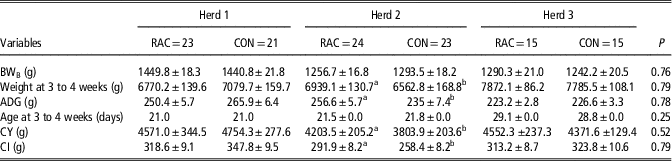
Piglet growth performance is shown in Table 2. Dietary supplementation of RAC had no effect on BWB. Piglets from RAC-fed sows were significantly heavier (P=0.04) at 3 to 4 weeks of age in herd 2, and there was a tendency towards this in herd 3 (P=0.07). We did not establish a similar trend in herd 1, but the overall differences among herds were significant. After univariate analysis, in a linear mixed model, herd and CI significantly increased ADG (P=0.001), whereas feed and lactose did not.
Effect of dietary supplementation of resin acid-enriched composition (RAC) on sow colostrum yield, piglet colostrum intake and piglet growth performance

CON=control; BWB=BW at birth; ADG=average daily gain; CY=colostrum yield; CI=colostrum intake.
The mean value of each treatment and SEM are given.
a,bMeans in the same row with different superscript differ (P<0.05) between the same dietary treatment in same herd.
Colostrum yield, colostrum quality and composition
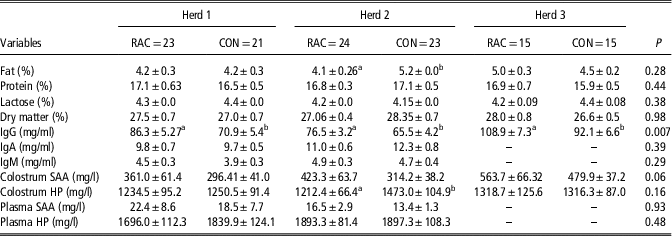
There was a higher CY in herd 2 (P=0.03) and tendency towards this in herd 3 (P=0.09) for RAC-fed sows (Table 2). The RAC-fed sows had significantly higher IgG levels (P=0.007) in all three herds, although the treatment did not influence colostrum IgA and IgM concentration. However, the RAC supplementation of sow diets did not have any effect on the CY in herd 1. In addition, colostrum dry matter, lactose and protein percentages were unaffected by the dietary treatment (Table 3). Moreover, feeding sows with RAC significantly reduced colostrum fat content only in herd 1. When all three herds were analysed together in a regression model, neither treatment nor herd had significant effects on CY. In a regression model, colostrum IgG was significantly influenced by the treatment and herd (P=0.001), but farrowing duration and parity did not have any effect on colostrum IgG.
Effect of dietary supplementation of resin acid-enriched composition (RAC) on colostrum composition, colostrum quality, colostrum and blood acute phase proteins in sow

CON =control; Ig=immunoglobulin; SAA =serum amyloid A; HP =haptoglobin.
The mean value of each treatment and SEM are given.
a,bMeans in the same row with different superscript differ (P<0.05) between the same dietary treatment in same herd.
Colostrum and plasma concentration of acute phase proteins
The effect of the sow dietary RAC supplementation on colostrum and plasma concentration of SAA and HP are presented in Table 3. The RAC-supplemented sows tended to have increased colostrum SAA (P=0.09, P=0.07 and P=0.09 for herd 1, 2 and 3, respectively) and a similar tendency was also observed for plasma SAA. On the other hand, RAC-supplemented sows had significantly lower HP in colostrum in herd 2, but the changes were not similar in other herds or for plasma.
Microbial composition after resin acid-enriched composition supplementation
A total of 90 434 DNA sequence reads were generated from sow faecal samples after quality filtering as described. Shannon and Simpson’s indices were used to gauge diversity of the microbial communities in the different treatment groups. The diversity of the microbial community can be predicted by the diversity indices, where higher the indices indicate greater diversity. The Shannon indices were 3.3±0.07 and 3.5±0.07 for sows fed RAC and CON, respectively. The Simpson’s indices were 0.09 v. 0.07 for sows fed RAC and CON, respectively. The differences between Shannon and Simpson’s indices were not significant.
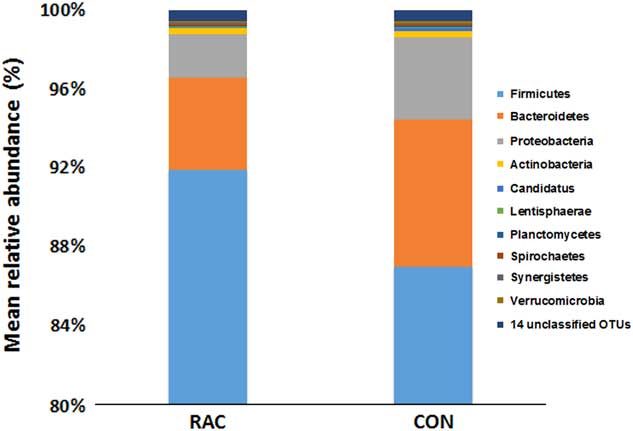
Collectively, 11 bacterial phyla, 141 genera and 430 species (OTU) were identified in the faecal samples of sows. At phylum level, Firmicutes, Bacteroidetes and Proteobacteria were the three predominant phyla, representing 91.90% v. 86.97%, 4.67% v. 7.45% and 2.19% v. 4.16% of all the sequences in RAC and CON-fed sows, respectively (Figure 1). There was a significant difference in the relative proportions between the treatment and control groups. The abundance of Firmicutes significantly increased (P=0.01) in RAC-fed sows. A contrary trend was observed for Bacteroidetes and Proteobacteria, where feeding sows with RAC significantly reduced their presence (P=0.01).
The distribution of bacterial phyla in faecal samples under conditions of dietary treatment during late gestation in sow. Values represent the mean proportions of the phylum. RAC=resin acid-enriched composition; CON=control.

The distribution of the 16S sequences that were assigned to the genus level was analysed and is represented in Supplementary Table S3 (only genera with ⩾0.1% of the total sequences are displayed). The following 10 genera were defined as the most abundant, with more than 1% of total DNA sequences: Romboutsia, Clostridium sensu stricto, Oscillibacter, Acidaminobacter, Christensenella, Sporobacter, Intestinimonas, Flavonifractor, Thermotalea, Barnesiella and Ruminococcus. A total of 19 differentially abundant genera were identified among the dietary treatments at the genus level, which included the five most abundant and fourteen least abundant genera (Supplementary Table S3). Resin acid-enriched composition treatment resulted in significant increases in the abundances of Romboutsia and C. sensu stricto (P=0.045; P=0.011, respectively) and significant decreases in the abundances of Barnesiella, Sporobacter, Intestinimonas, Campylobacter and some other genera presented in the Supplementary Table S3 (P=0.016; P=0.048; P=0.009; P=0.007, respectively).
Discussion
This experiment showed that dietary supplementation of RAC increased CY of gestating sows (in two herds) and colostrum IgG content. In herds 2 and 3, a sow diet supplemented with RAC increased the weight of piglets at 3 to 4 weeks of age. The experiments were conducted consecutively in three different trials in commercial settings with the agreement of the farmer not to use any medication without researcher consent. However, due to farm policy, all piglets of herd 1 received intramuscular antibiotic treatment at day 1. The three farms had also herd-specific standard diets, two different genetic lines, and were located in two different countries. These factors could have explained some of the differences found in the performances of the sows among the three herds. However, we always had a control in each farm and accounted for the different herd diets in the statistical analysis. In the sows, RAC supplementation in a late gestation diet increased abundance of beneficial bacteria and decreased numbers of opportunistic pathogens. The supplemented RAC consisted of RA (mostly abietic, dehydroabietic and pimaric acids) and free fatty acids (mostly linoleic, oleic and pinolenic acids and CLA). Fractional distillation of crude tall oil, obtained as a by-product of the Kraft process in wood pulp manufacture, produces distilled tall oil and further refinement of distilled tall oil produces RAC. Previous studies reported that supplementing a gestating sow diet with a fatty acid such as CLA affects piglet performance. If the sow diet contains 0.5% CLA in the last week of gestation and 1st week of lactation, piglets are significantly heavier at weaning (Bontempo et al., Reference Bontempo, Sciannimanico, Pastorelli, Rossi, Rosi and Corino2004; Corino et al., Reference Corino, Pastorelli, Rosi, Bontempo and Rossi2009). Although the results reported here agree with others on the effects of feeding sows free fatty acid it is difficult to compare the various studies on CLA because of differences in methodologies and the specific composition of this novel RAC.
Colostrum is characterized by the high concentration of IgG and relatively low concentration of IgA and IgM (Klobasa and Butler, Reference Klobasa and Butler1987). Passive immunity or sufficient intake of colostral Igs by piglets is important during the piglet’s early life (Rooke and Bland, Reference Rooke and Bland2002). In the present study, IgG concentration was significantly higher in the sow fed with RAC in all three herds. Rooke and Bland (Reference Rooke and Bland2002) reported that IgG synthesis by piglets is positively correlated with the amount of maternal IgG absorbed, and early life maternal IgG has a significant influence on later immune development, thus reinforcing the need for an adequate IgG intake from colostrum.
The colostrum concentration of IgG is highly variable and can be affected by many factors, such as parity, season, genotype, farrowing duration and teat location (Klobasa and Butler, Reference Klobasa and Butler1987; Rooke and Bland, Reference Rooke and Bland2002; Quesnel, Reference Quesnel2011). In our study, the concentration of IgG was not influenced by sow parity or farrowing duration, and a similar result was obtained in our previous study (Hasan et al., Reference Hasan, Junnikkala, Valros, Peltoniemi and Oliviero2016) and in those of Quesnel (Reference Quesnel2011). To minimize the effect of teat location in the concentration of IgG, the colostrum samples were collected only from the three anterior teats from the same side of the udder.
All IgG in colostrum is derived directly from the plasma of the sow. Variation in IgG concentration in colostrum is very high among sows (Klobasa and Butler, Reference Klobasa and Butler1987) and so is individual variation of IgG concentration in the serum of a sow (Quesnel, Reference Quesnel2011). Supplementing a diet of a gestating sow with immunomodulating and bioactive compounds increases colostrum IgG concentration. For example, CLA, non-specific immunostimulating products, shark liver oil, fish oil, sources of essential oils, fermented liquid feed, polyunsaturated fatty acid (PUFA), seaweed extract and mannan oligosaccharides have all been tested and found to have effect (Bontempo et al., Reference Bontempo, Sciannimanico, Pastorelli, Rossi, Rosi and Corino2004; Yao et al., Reference Yao, Li, Jun Wang, Zhou, Wang, Zhu, Wang and Thacker2012).
Literature on the use of RAC in animal feed is scarce. To date, no studies have been done on supplementing gestating sow diets with RAC and subsequent effects on sow performance. The mechanism of performance improvement may also lie in systemic effects of the RAC, but investigation of such effects was beyond the scope of this work, although the mechanisms of some RAC components, for example, CLA, pinolenic and abietic acids, have shown anti-inflammatory and immunomodulatory effects in humans and animals (Takahashi et al., Reference Takahashi, Kawada, Goto, Kim, Taimatsu, Egawa, Yamamoto, Jisaka, Nishimura and Yokota2003; Bontempo et al., Reference Bontempo, Sciannimanico, Pastorelli, Rossi, Rosi and Corino2004; Kang et al., Reference Kang, Hirai, Goto, Kuroyanagi, Lee, Uemura, Ezaki, Takahashi and Kawada2008; Corino et al., Reference Corino, Pastorelli, Rosi, Bontempo and Rossi2009; Yao et al., Reference Yao, Li, Jun Wang, Zhou, Wang, Zhu, Wang and Thacker2012). The novel feed additives of RA (abietic and dehydrobietic acids) were reported to inhibit prostaglandin E2 (PGE2) production by activation of peroxisome proliferator-activated receptors (PPARs), especially PPARγ (Takahashi et al., Reference Takahashi, Kawada, Goto, Kim, Taimatsu, Egawa, Yamamoto, Jisaka, Nishimura and Yokota2003; Kang et al., Reference Kang, Hirai, Goto, Kuroyanagi, Lee, Uemura, Ezaki, Takahashi and Kawada2008). Decreases in PGE2 have direct effect on production of IgG (Calder, Reference Calder1996). Studies also indicated that dietary CLA increases plasma IgG and colostrum IgG in pigs (Bontempo et al., Reference Bontempo, Sciannimanico, Pastorelli, Rossi, Rosi and Corino2004; Corino et al., Reference Corino, Pastorelli, Rosi, Bontempo and Rossi2009; Yao et al., Reference Yao, Li, Jun Wang, Zhou, Wang, Zhu, Wang and Thacker2012). This is also possible via the pathway of cyclooxygenase and lipoxygenase by decreasing the PGE2 production (Calder, Reference Calder1996). In addition, dietary PUFA is involved in interleukin production, which, in addition to isotype-specific lymphokines, plays an important role in regulating Ig synthesis (Coffman et al., Reference Coffman, Ohara, Bond, Carty, Zlotnik and Paul1986). Although dietary PUFA, especially CLA, has an effect in the IgG increase, the doses were very low in our study compared to others. In our opinion, the novel RA has a potential role in the increase of IgG based on the current research of anti-inflammatory, immunomodulatory and inhibitory effect on pathogenic bacteria (Takahashi et al., Reference Takahashi, Kawada, Goto, Kim, Taimatsu, Egawa, Yamamoto, Jisaka, Nishimura and Yokota2003; Kang et al., Reference Kang, Hirai, Goto, Kuroyanagi, Lee, Uemura, Ezaki, Takahashi and Kawada2008; Park et al., Reference Park, Lee, Lee, Yoo, Shin, Yamabe, Kim, Lee, Kim and Lee2017; Vienola et al., Reference Vienola, Jurgens, Vuorenmaa and Apajalahti2018).
Colostrum SAA tended to be higher in all three trials in RAC-fed sows. Age-dependent studies showed that SAA concentration was highest in neonate piglets (Moya et al., Reference Moya, Boyle, Lynch and Arkins2007) and calves (Orro et al., Reference Orro, Jacobsen, LePage, Niewold, Alasuutari and Soveri2008). However, Larson et al. (Reference Larson, Wei, Weber, Mack and McDonald2003) suggested that SAA in colostrum has local beneficial effects on the neonatal gut. Research has also found that colostrum-associated SAA peptide enhanced innate protection by stimulating intestinal epithelial cells and mucous production and thereby prevented binding of enteropathogenic bacteria (Larson et al., Reference Larson, Wei, Weber, Mack and McDonald2003). Therefore, the tendency to have higher colostrum SAA content, for the sow whose diet has been supplemented with RAC, might positively affect piglet growth.
The beneficial effects of certain gut microorganisms are well known: boosting the production performance of the animal being one (Hasan et al., Reference Hasan, Junnikkala, Peltoniemi, Paulin, Lyyski, Vorenmaa and Oliviero2018). Therefore, we investigated the RAC effect on faecal microbiota of sows and showed that it did not induce changes in microbiota diversity. Firmicutes was the most prevalent phylum, particularly in the RAC fed sows, compared with the control group. Bacteroidetes represented another dominant phylum and their numbers were significantly lower in RAC-fed sows. However, sows from the RAC group also had a relatively lower abundance of Proteobacteria. This can be considered beneficial for the sow because high prevalence of Proteobacteria represents a marker for an unstable microbial community (dysbiosis), a potential diagnostic criterion for diseases in humans (Shin et al., Reference Shin, Whon and Bae2015). However, Proteobacteria are also linked with intestinal inflammation (Mukhopadhya et al., Reference Mukhopadhya, Hansen, El-Omar and Hold2012). Bacteria belonging to the Proteobacteria are also known to cause intestinal diseases in humans and animals (Salyers and Whitt, Reference Salyers and Whitt2002). Such a result indicated that the RAC might contribute to the balance of the intestinal microbiota at phylum level. Other studies conducted in the chicken showed that most of the components of RAC, especially the RA, inhibited the growth of pathogenic bacteria (Kettunen et al., Reference Kettunen, van Eerden, Lipiński, Rinttilä, Valkonen and Vuorenmaa2017; Vienola et al., Reference Vienola, Jurgens, Vuorenmaa and Apajalahti2018). We found that the RAC used in this study stabilized gut microbiota and reduced the risk of pathogen colonization. Barnesiella, Sporobacter, Intestinimonas and Campylobacter in the RAC group decreased, whereas Romboutsia and C. sensu stricto significantly increased. Barnesiella, Sporobacter, Intestinimonas and Campylobacter are well-known initiators of inflammatory diseases and gastrointestinal disorders in humans and animals (Weijtens et al., Reference Weijtens, Reinders, Urlings and Van der Plas1999; Zhang et al., Reference Zhang, Zhu, Zhou, Wu, Song, Dicksved and Wang2017); Romboutsia and C. sensu stricto produce short-chain fatty acids by anaerobic fermentation of dietary components, the main energy source for the colonocytes, and protect from inflammation (Lopetuso et al., Reference Lopetuso, Scaldaferri, Petito and Gasbarrini2013). Clostridium sensu stricto is reported to promote the intestinal mucus barrier and thus be able to inhibit adherence of pathogenic microbes (Wlodarska et al., Reference Wlodarska, Willing, Bravo and Finlay2015).
Overall, this study demonstrated that addition of RAC to the late gestation diet of sows enhanced colostrum production (in two farms out of three), colostrum SAA, and especially colostrum IgG concentration, ensuring availability of more energy and sustained piglet immunity. Supplementation of RAC in late gestation diets may change the gut microbiota and improve sow physiology, but we did not establish significant correlation with production parameters. Further studies should be directed at unveiling the exact cellular mechanism of RAC in farrowing sows and the anti-inflammatory and possible immunomodulatory effects via colostrum in weaned piglets.
Acknowledgements
The authors wish to acknowledge Merja Pöytäkangas for providing expert technical assistance in laboratory analysis and all pig farmers, for their support during the feeding trials.
Declaration of interest
The authors declare that they have no conflicts of interest.
Ethics statement
The study was approved by the Animal Experiment Board in Finland (permission ESAVI/333/04.10.03/2011) and by the Dutch authority CCD (The study does not require a special license under the Dutch Animal Procedures Act, decision 26.04.2017).
Software and data repository resources
None of the data were deposited in an official repository.
Supplementary material
To view supplementary material for this article, please visit https://doi.org/10.1017/S1751731118003518