INTRODUCTION
Antiblack police violence—and resistance to it—fuels a legitimacy crisis for U.S. police. Heightened scrutiny of police post-Ferguson has renewed conversations about “police-minority relations,” with police departments across the country adopting reforms that purport to improve relationships with minority communities (Reference LimLim, 2017; Reference StuartStuart, 2016). One reform involves hiring historically underrepresented officers—including people of color, LGBTQ people, and white women—as police officers (Advancing Diversity in Law Enforcement, 2016; Reference Alcindor and PenzenstadlerAlcindor & Penzenstadler, 2015; Reference CohenCohen, 2016; Final Report of the President's Task Force on 21st Century Policing, 2015; Policing Project at NYU School of Law, 2021).
The push to diversify the police is not new (Reference Ray, Ortiz and NashRay et al., 2017). Yet, little research investigates how this effort is discussed and understood by police officers and black civilians—two groups routinely invoked in discourse on “police-minority relations.” We explore how police and black civilians understand the significance of race and racism in policing by analyzing their discourse on police officers of color, and particularly black officers. Using 40 interviews with a race-diverse, primarily male sample of police officers and 60 interviews with black women civilians (who are not police), we ask: how do police and black women civilians, respectively, frame the relationship between race and racism with policing? How do they understand racial integration as addressing the issue of racism in policing?
By comparing their discourse on these topics, we find that black women civilians and police use divergent epistemologies to conceptualize race and racism in policing. Police rely on an epistemology of white ignorance (Reference MillsMills, 1997, Reference Mills, Sullivan and Tuana2007, Reference Mills, Gross and McGoey2015) to reconfigure the problem of police racism as an issue of misplaced racial bias against police and identify diversifying police as a remedy to address this bias. Alternatively, black women use a standpoint epistemology (Reference CollinsCollins, 1986, Reference Collins2009) to frame the problem of police violence as a structural relationship produced through a history of racism and identify police diversity initiatives as incapable of addressing this institutionalized racism. This frame positions race as an outcome of historical and structural racism, while police describe race as a static identity and source of inhered cultural difference.
We conclude with an analysis of how police engage diversity discourse as a form of racecraft (Reference Fields and FieldsFields & Fields, 2014), focusing the conversation on individual attitudes toward police to avoid institutional accountability for police racism. Black women express a competing epistemology for understanding police racism; however, this epistemology is not disseminated, legitimated, and enforced through state power. We thus theorize state-sponsored discourse on diversity and “police-minority relations” as a mechanism of white ignorance that works to systematically undermine lived experiences and collective memories of police racism and reinforce the state's monopoly on violence (Reference DavisDavis, 2015; Reference WeberWeber, 1965).
LITERATURE REVIEW
Police diversity programs
Policing is a historically white, working-class, male-dominated, and masculinized occupation in the United States. For decades, the police only considered white men appropriate candidates for the job—a homogeneity maintained through exclusionary physical and educational credentials (Reference MartinMartin, 1982)—producing the police as a gendered (Reference AckerAcker, 1990) and racialized organization (Reference RayRay, 2019). After the 1960s racial uprisings, the Kerner Commission Report identified police brutality as a key source of frustration in black communities, writing that “police have come to symbolize white power, white racism, and white repression” (Report of the National Advisory Commission on Civil Disorders, 1968). The Report called on policing agencies to diversify their forces with the goal to symbolically dispel the image of a majority-white police force, seen as an “occupying army” exerting control over black communities (Reference Bloom and MartinBloom & Martin, 2013; Reference NelsonNelson, 2013). A similar push for police diversity followed the 2014 uprising in Ferguson, Missouri, championed by President Obama's Task Force on 21st Century Policing (2015). This push called for diversifying police forces through targeted efforts to hire white women and people of color.
Yet, research on police diversity initiatives paints an inconsistent picture of their efficacy in reducing police violence (Reference Ba, Knox, Mummolo and RiveraBa et al., 2020; Reference Brown and FrankBrown & Frank, 2006; Reference DeJongDeJong, 2005; Reference Frydl and SkoganFrydl & Skogan, 2004; Reference Johnson, Tress, Burkel, Taylor and CesarioJohnson et al., 2019; Reference Lonsway, Wood, Fickling, de Leon, Moore, Harrington, Smeal and SpillarLonsway et al., 2002; Reference McElvain and KposowaMcElvain & Kposowa, 2008; Reference SmithSmith, 2003; Reference Sun and PayneSun & Payne, 2004). One rationale for diversification frames the incorporation of a critical mass of black police into a department as reducing the number of black citizens killed by police. Some research indicates that black and Hispanic officers do use force less often, particularly against black civilians (Reference Ba, Knox, Mummolo and RiveraBa et al., 2020). However, other research shows that increasing the proportion of the force that is black is not effective in reducing police-involved homicides of black citizens in large U.S. cities (Reference Nicholson-Crotty, Nicholson-Crotty and FernandezNicholson-Crotty et al., 2017), that there is no direct link between an officer's gender and race and the outcome of a civilian encounter (Reference Frydl and SkoganFrydl & Skogan, 2004), and that more gender and race-diverse departments do not have significantly lower rates of police-caused homicides (Reference SmithSmith, 2003). Underlying the push for diversifying policing is the belief that “damaged police-minority relations” is central to the problem with U.S. policing, and consequently, racial-minority officers can help in “building bridges between police and communities” to address the unrest (U.S. Department of Justice Community Relations Services, 2015; LEAP, 2020; RAND, 2020; Vera Institute of Justice, 2020). However, some black civilians see black cops as more like white cops than themselves—that is, as more in solidarity with police than “representatives” of black interests and community (Reference BentonBenton, 2020).
Police join a wave of U.S. institutions and organizations in valorizing “diversity.” Diversity and inclusion programs symbolically affirm inclusiveness within organizations (Reference BerreyBerrey, 2015) and allow them to celebrate difference without addressing structural injustices that produce and reproduce difference (Reference Bell and HartmannBell & Hartmann, 2007). Often, such programs pay lip service to race and gender inequality but fail to redistribute power, resources, and opportunities along these lines (Reference AhmedAhmed, 2012; Reference BerreyBerrey, 2015; Reference hookshooks, 1992; Reference Williams, Kilanski and MullerWilliams et al., 2014). Diversity efforts can thus obscure, entrench, and in some cases intensify existing racial inequities within the organization (Reference Moore and BellMoore & Bell, 2011; Reference ThomasThomas, 2020), mobilizing symbols, discourses, and practices associated with “diversity” as a form of public relations (Reference AhmedAhmed, 2012). This process enables organizations to cyclically dilute and co-opt antiracist critique from people of color (Reference Lerma, Hamilton and NielsenLerma et al., 2020); as well as deflect scrutiny from racist organizational structures and practices (Reference Castilla and BenardCastilla & Benard, 2010; Reference EmbrickEmbrick, 2011; Reference Kaiser, Major, Jurcevic, Dover, Brady and ShapiroKaiser et al., 2013). In this study, we examine police and black women civilians' discourses on police diversity initiatives as a way to address police violence and the relationship between police and minority communities.
Epistemologies of racial ignorance, racecraft, and the police
Discourses, ideas, and understandings about race and racism are grounded in epistemologies, or belief systems, about what race and racism are and how they operate in the social world. Conflicting epistemologies of racism produce divergent ways of seeing the world as “racial” or “about race.” The epistemology of racial ignorance (Reference MillsMills, 1997, Reference Mills, Sullivan and Tuana2007, Reference Mills, Gross and McGoey2015) works to rationalize white supremacy by “evad[ing] and distort[ing] social realties of racism to produce (mis)understandings useful for domination” (Reference MuellerMueller, 2020, p. 147). Within this epistemology, “white people evade and distort the perspectives of people of color and empirical facts of racism (p. 155).” As a hegemonic racial paradigm, an epistemology of racial ignorance both rationalizes and obscures white peoples' position of power in the racial hierarchy, through a widely held and legitimated set of (mis)perceptions, stereotypes, ideologies, logics, and narratives (Reference MuellerMueller, 2020). An epistemology of racial ignorance is supported by a linguistic blueprint—or discursive “toolkit” (Reference SwidlerSwidler, 1986)—that disavows white accountability for racist practices and structures while simultaneously rationalizing the very practices and structures that maintain the racial hierarchy (Reference FosterFoster, 2009; Reference PiercePierce, 2003). In this way, epistemologies of racial ignorance preserve both white privilege and the appearance of white innocence (Reference PiercePierce, 2003) by blaming racialized Others for racial tension, thus cultivating “a ‘selective racial consciousness’ rooted in recognition of positive portrayals of whiteness” (Reference FosterFoster, 2009, p. 686).
White ignorance also facilitates white (mis)understanding and rewriting of U.S. history in ways that legitimize racist policing. Police practices, such as slave patrols and Jim Crow law enforcement, were justified at the time as necessary measures to defend the safety and livelihood of white property owners and their families (Reference AlexanderAlexander, 2012; Reference HaddenHadden, 2003; Reference HintonHinton, 2017; Steinmetz et al., 2017). Colonial militias commit mass acts of violence, including genocide, against indigenous people in the name of “civilizing” (Reference AhramAhram, 2014; Reference Fenelon and TrafzerFenelon & Trafzer, 2014). U.S. Immigration and Customs Enforcement racially profiles and criminalizes immigrants, imprisoning them, forcibly removing them, and separating them from their children, all allegedly to bolster national security (Reference Aranda and VaqueraAranda & Vaquera, 2015; Reference DickersonDickerson, 2020). These state practices all allow the police to serve as “frontline enforcers of laws that represent the interests of the dominant classes” (Steinmetz et al., 2017, p. 70).
However, contemporary America's view of itself as a harmonious racial “melting pot” precludes an understanding of its police force as an extension of racial surveillance and control (Reference AlexanderAlexander, 2012; Reference Bonilla-SilvaBonilla-Silva, 2018). As the white middle class came to view these expressions of racism as socially unacceptable, it forced a transformation of the rationalizing logics that had previously sufficed to maintain white ignorance of white racist ideologies and actions. As such, an epistemology of white ignorance, and the hegemonic frames it produces, shift and morph to incorporate criticism and deflect critical attacks, maintaining dominance through subtle transformations across time and space (Reference MillsMills, 1997, Reference Mills, Sullivan and Tuana2007, Reference Mills, Gross and McGoey2015; Reference MuellerMueller, 2020).
One mechanism of white ignorance is racecraft, a discursive maneuver that blames outcomes of racism (e.g., poverty, violence, health disparities, exploitation, discrimination) on power-neutral notions of “race” or “racial difference” (Reference Fields and FieldsFields & Fields, 2014). Racecraft acts as a mechanism of white ignorance, deflecting focus away from white racism as the producer of racial inequities through incomplete explanatory formulas such as “killed because of their skin color,” (p. 27), which avoid naming racism itself as the root of the problem. As such, racecraft is a “sleight of hand” that “transforms racism, something an aggressor does, into race, something the target is,” (2014, p. 17).
Finally, as a discourse that reflects and reproduces an epistemology of white ignorance, racecraft enables the (mis)understanding that “race”—defined through inhered traits and individual attitudes—is to blame for racialized patterns in police arrests, harassment, and violence, rather than structural racism (Reference Schaefer and KraskaSchaefer & Kraska, 2012). This equips some white people to defend police as well-intended and virtuous (Lee & Gibbs, 2015) in the face of widespread police brutality, and construct criminality and violence as outcomes of “race” (i.e., blackness), and not racist policing (Reference AlexanderAlexander, 2012). Through racecraft, “‘race’ [is] taken, before the fact, to ‘explain’ whatever is found after the fact,” blaming black people for the racism they experience at the hands of police and eliding the fact that police, not “race,” are responsible for the persistent racism at work in policing (Reference Fields and FieldsFields and Fields, 2014, p. 6). This article builds on this work by analyzing police officers' discourses on diversity and police-community relations as a form of racecraft.
Standpoint epistemology, black feminist thought, and the police
Black communities continually challenge white ignorance by drawing on standpoint epistemology, a way of knowing and understanding reality that privileges the analysis of lived experiences, history, power relations, and structures (Reference CollinsCollins, 1986, Reference Collins2009; Reference HardingHarding, 1992; Reference SmithSmith, 1987). Marginalized groups' standpoints on institutions and systems produce specific insights about the social world. Reference CollinsPatricia Hill Collins (1986, Reference Collins2009) argues that black women's standpoint—at the intersection of patriarchy and white supremacy—enables them to create and elucidate knowledge about how institutional processes, actions, and structures reproduce social hierarchies. Movements like Black Lives Matter (BLM) and Say Her Name (SHN) draw from standpoint epistemology to provide alternate frameworks to conceptualize policing and challenge white ignorance that sees police as presumptively race-neutral, well-intended, virtuous, and innocent (Reference Khan-Cullors and BandeleKhan-Cullors & Bandele, 2018; Reference RitchieRitchie, 2017; Reference SmithSmith, 2016). Through continual documentation of police violence, activists and researchers amplify the lived realities of black communities in a country that disproportionately subjects them to police profiling, harassment, surveillance, and force (e.g., Reference AlexanderAlexander, 2012; Reference Barlow and BarlowBarlow & Barlow, 2002; Reference BrowneBrowne, 2015; Reference BrunsonBrunson, 2007; Reference BuehlerBuehler, 2016; Reference Crenshaw, Ritchie, Anspach, Gilmer and HarrisCrenshaw et al., 2015; Reference Hickman, Piquero and GarnerHickman et al., 2008; Reference RitchieRitchie, 2017), and construct a powerful counter-frame that questions hegemonic ideologies about the role of the police. These efforts highlight the power disparity between police and black communities, and challenge epistemologies of white ignorance that prioritize the vulnerability of state-armed police over the vulnerability of the black citizens.
Although multiple racialized and gendered communities have fraught relationships with police (Reference RiosRios, 2017; Reference RobinsonRobinson, 2020; Reference Schroedel and ChinSchroedel & Chin, 2020), we focus on black women's views for two primary reasons. First, black women are positioned at the intersection of antiblack racism and patriarchy. Through self-definition (Reference CollinsCollins, 2009) and intersectional counter-frames (Reference CombsCombs, 2016; Reference Wingfield and TaylorWingfield & Taylor, 2016), black women can challenge epistemologies of white ignorance by highlighting how race intertwines with class, gender, and other systems to assess policies, institutions, and behaviors that maintain inequality. Second, we focus on black women because of their specific relationship to policing. Black women experience excessive lethal, physical, verbal, and sexual violence at the hands of police (Reference Crenshaw, Ritchie, Anspach, Gilmer and HarrisCrenshaw et al., 2015; Reference JonesJones, 2009; Reference RichieRichie, 2012; Reference RitchieRitchie, 2017). Black women founded the antiracist movements BLM and SHN (Reference Crenshaw, Ritchie, Anspach, Gilmer and HarrisCrenshaw et al., 2015; Reference Khan-Cullors and BandeleKhan-Cullors & Bandele, 2018; Reference RitchieRitchie, 2017; Reference SmithSmith, 2016) and are often responsible for socializing black children to interact with white institutions, including the police (Reference DowDow, 2016; Reference Elliott and AseltineElliott & Aseltine, 2012; Reference Feagin and SikesFeagin & Sikes, 1994; Reference Malone GonzalezMalone Gonzalez, 2019; Reference HillHill, 2001). Black women are also called upon within their communities to address inequality (especially after state violence), navigating relationships with police and deploying various strategies to evaluate, on a case-by-case basis, whether involving police will make the situation safer or more dangerous (Reference Aniefuna, Amari Aniefuna and WilliamsAniefuna et al., 2020; Reference BellBell, 2016; Reference BurrowesBurrowes, 2019; Reference SmithSmith, 2016). For these reasons, we foreground black women's standpoint in exploring how black civilians understand the function and utility of police diversity initiatives and the relationship between black communities and the police.
METHODS
Using a methodologically innovative approach, we analyze data from two separate projects that both explore how participants understand the role of race and gender in policing. In discussing this research, we identified diversity and police-minority relations as salient themes in both sets of interviews. This article examines how these respondents drew on divergent epistemologies of race and racism to frame relations between police and black communities, and how these epistemologies facilitate incompatible approaches to “problems” and “solutions” associated with police violence.
Interviews reveal how respondents understand, experience, and navigate their lives and social worlds. We analyze the interpretive frames (Reference PughPugh, 2013) and “mental maps” (Reference LukerLuker, 2008) our respondents carry with them, to show how their social position within race and gender systems, as well as vis-à-vis policing institutions (i.e., within/outside), shape their understandings of diversity, policing, and power. Mapping the interplay between hegemonic racial frames and resisting counter-frames, or racial dialectic (Reference Wingfield and FeaginWingfield & Feagin, 2012), reveals how discursive frameworks shape our understandings of the relationship between white institutions, like the police, and the differently racialized groups they purport to “serve,” such as black communities. Reference Wingfield and FeaginWingfield and Feagin (2012) use the concept of the racial dialectic to describe the dialogic interplay between dominant and counter-frames on race in public discourse. The racial dialectic is comprised of competing ways of discussing and interpreting racial issues.
We attempt to explore and explain some of the racial commentaries, discourses, and ideologies about U.S. policing as they are circulating in the present moment. Frames are key to how we understand the social world, guiding how individuals make sense of social behavior, events, situations, processes, and conditions (Reference GoffmanGoffman, 1974). Among many other things, frames inform how society evaluates and discusses events and/or encounters deemed “racial,” articulated and contested through racial frames (Reference FeaginFeagin, 2006, Reference Feagin2013; Reference Wingfield and FeaginWingfield & Feagin, 2012). Racial framing refers to the racial perceptions, stereotypes, images, ideologies, narratives, and emotive reactions used to make sense of a given situation, experience, or issue involving race (Reference FeaginFeagin, 2006). Divergencies in racial frames help account for how “two racial groups, armed with the same objective facts and conditions, may interpret the causation” of a racialized conflict “in diametrically opposed ways” (Messner et al., 2013). By juxtaposing police narratives with narratives of black women civilians who are not police, we identify divergent racial epistemologies undergirding U.S. discourse on “police-minority relations.” Analyzing discrepancies in these belief systems illuminates discursive maneuvers the police use to downplay, discount, and distract from lived experiences of police racism.
Study #1: Police diversity and training
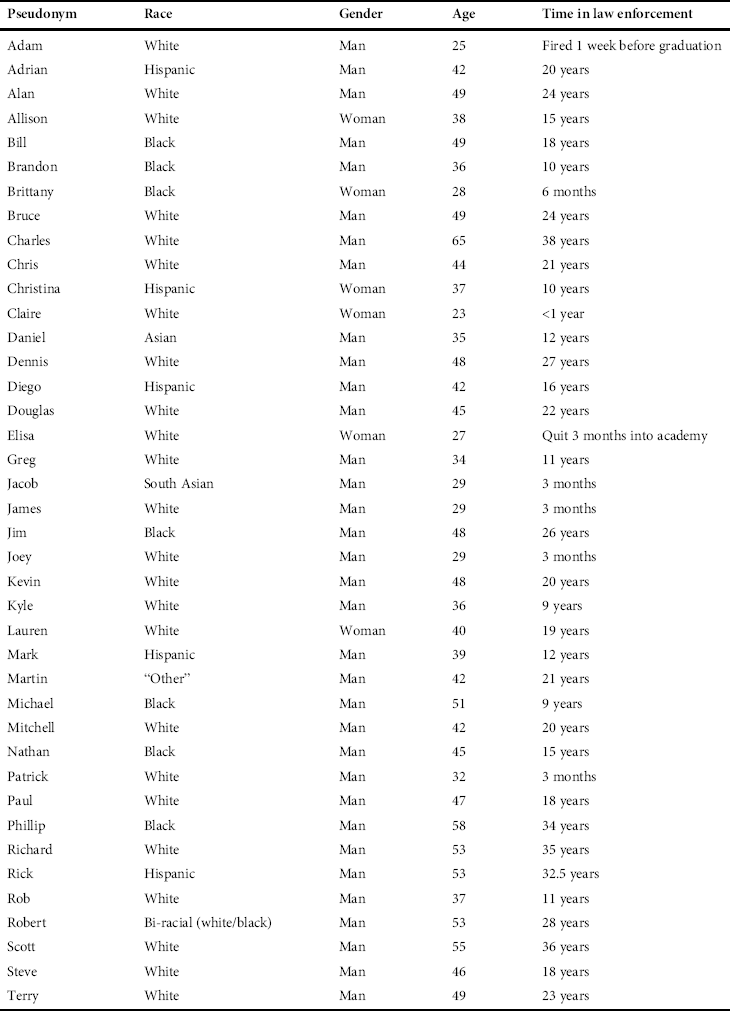
The first data set comes from an ethnography of police recruiting, hiring, and training. Between 2018 and 2019, Author 2 spent roughly 600 hours participating in and observing operations at four police academies in urban areas of a southern state. She interviewed 40 police across nine departments ranging in size from a dozen to several thousand officers. Interviewees were asked about their motivations for pursuing careers in law enforcement, impressions of policing before entering the field, career trajectories, feelings about the political climate around policing, and thoughts about diversity in policing. Law enforcement experience and specialty areas (i.e., recruiting/hiring, training, or patrol) varied. Of the 40 police interviewed, five are women, reflecting the broader gender makeup of U.S. police, where women comprise roughly 12% (“Table 74: Full-Time Law Enforcement Employees by Population Group, Percent Male, and Female, 2017” 2017, p. 74). Most respondents are white, but the sample includes a larger percentage of non-white officers than are represented in U.S. police forces generally. Respondents were given a demographic form after the interview and were asked to write in their gender, racial and/or ethnic identity, age, and time working in law enforcement. Table 1 presents this demographic information for the sample of police officers interviewed.
Demographic information of police officers

Interviews with police lasted between 30 min and 2 h. Most (31) were conducted in person, and nine were conducted via phone.
Study #2: Police and black women and girls
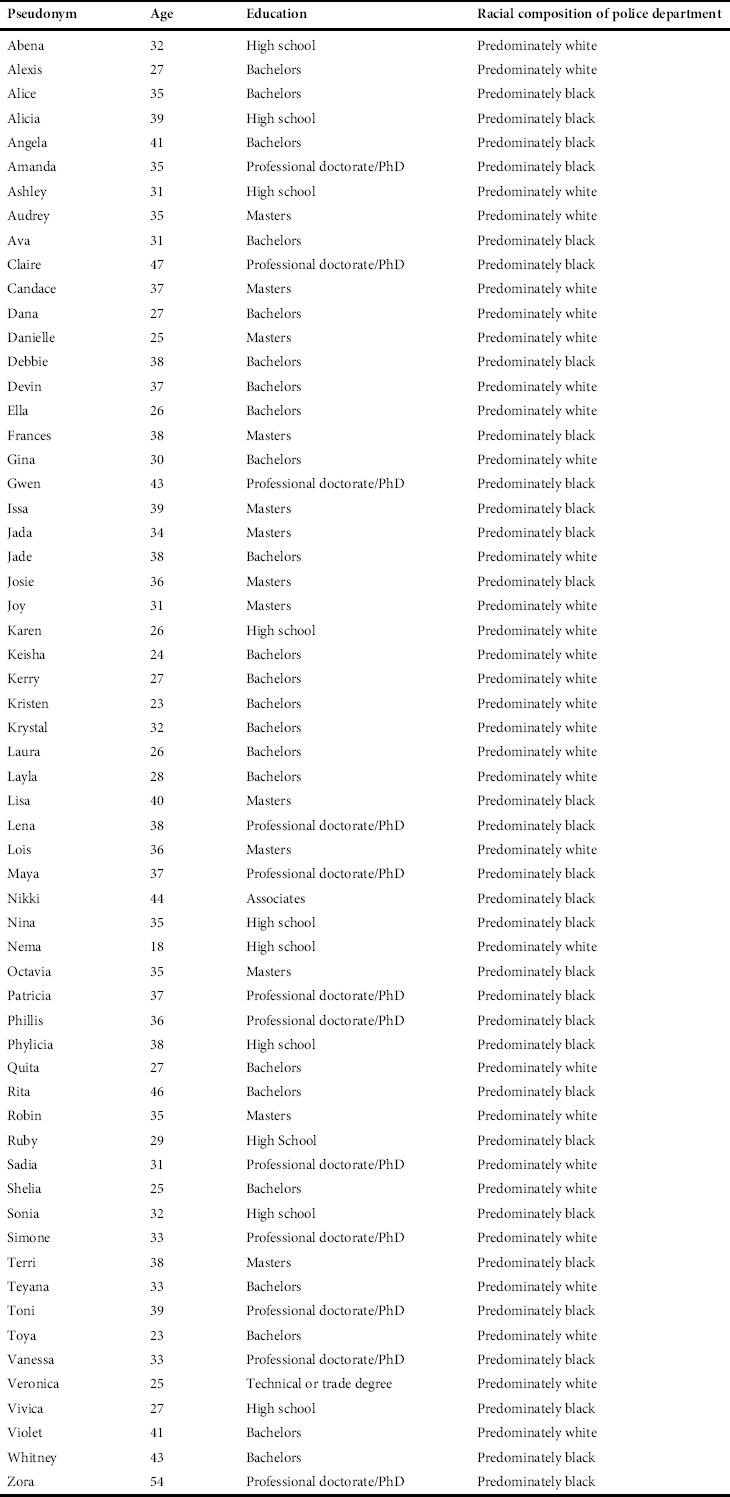
The second data set comes from a mixed-methods study of black women's socialization practices and experiences with police. Author 1 interviewed 30 black women with a focus on policing and parenting, and 32 black women with a focus on police violence. Interviewees were recruited through social clubs, nonprofits, and educational institutions; community events focused on black women and/or about policing; organizational and residents' social media accounts; black women's personal and professional networks; and direct contact with black women in Author 1's field site. Additional participants were recruited via snowball sampling in both field sites. In the policing and parenting interviews, Author 1 asked about participants' general views on police, personal experiences with police, how participants' families discussed police with them, and how participants discussed or planned to discuss police with their children. In the police violence interviews, Author 1 asked black women about their views on police, childhood, and adulthood experiences with police and conversations around policing, how they cope with police violence, police violence on social media, and police reform. This article draws primarily from black women's responses to questions about their general views on police and police reform, specifically how they conceptualize race and gender in their interactions with police, how race and gender shape their views of police, and the relationship between police and black communities. Table 2 presents black women civilians' demographic information.
Demographic information of black women

Interviews lasted up to 2 h. Twenty-eight interviews were conducted in person and 34 via telephone. Given the sensitive topic, telephone interview methods were valuable, allowing participants to choose the place and time they found most comfortable and accessible. All respondents and departments are assigned pseudonyms.
This article excludes three interviews conducted with black women police officers (two by Author 2 and one by Author 1). These black women police officers shared some views in common with the police officers in this study and others with the black women civilians. One also experienced strain around her role of acting as a caregiver within the job of policing. Future research is needed that specifically explores how black women police officers conceptualize police racism from their unique position as “outsiders within” (Reference CollinsCollins, 1986, Reference Collins1999).
Positionalities
Each interviewer's social position shaped her project in terms of access, rapport, and power dynamics. Author 2 is an upper-middle class white woman who presents as feminine. Police in field sites were usually men, and often white men. Providing help to white women falls within the police lexicon of legible and legitimated job tasks, and often, police were eager to provide information and volunteer for interviews. The age gap between Author 2, who was 27 years old during data collection, and many police, often in their 40s or 50s, introduced a paternal dynamic, whereby respondents compared Author 2 to their daughters. Despite initial resistance and barriers to entry Author 2 faced at police departments, respondents seemed to interpret her age, race, and gender as signals that she was unlikely to pose a threat to the institution. As a result, police were quite candid, and openly discussed gender, race, diversity, and use of force.
Author 1 is a middle-class black woman. This facilitated access to middle- and upper-middle-class black women and created some challenges to recruiting working-class and working-poor black women. However, the snowball method, paired with an option to choose between in-person or telephone interviewing, facilitated more comfort among participants. Additionally, once they recognized that a black woman was conducting the research, many women, across social class, expressed relief and willingness to participate.
Collective analysis
We analyze data from two studies to understand police and black women's views on diversity as a way to reform police and improve police-minority relations. Most interviews were recorded and transcribed by a co-author or transcription company, and for unrecorded interviews, we took detailed notes. We coded transcripts separately, using a grounded theory approach, analyzing emerging patterns and meanings from participant's discourse (Reference CharmazCharmaz, 2014).
Codes for the police diversity/training project included the role of police, diversity, proportionality in race and gender, community trust, community policing/relations, public perception, and historically black colleges and universities (HBCUs)/Hispanic-serving institutions, among others. Codes for the black women and policing project included varying discourses around the gender and race of officers, frames used to understand policing institutions (collective memory, history, socialization, and lived experience), and descriptions of the relationship between police and black communities. Through this analysis, we were able to ascertain that black women understood race and racism in a way that drew on standpoint as their epistemology across these four domains. Black women drew on a standpoint epistemology to contextualize their discourse on race of individual police, frames used to understand policing institutions, and descriptions of the relationship between police and black communities. Discursive patterns were consistent across participants working or residing under predominately black and predominately white police departments.
We shared quotes from these projects and recoded based on themes throughout both studies, include diversity as an intervention to police interactions, violence, and relationship with minority communities. At each stage of the coding process, we met to discuss themes and divergent cases. While police and black women civilians use varying frames to understand race, racism, and diversity in policing, the frames theorized in this study represent the dominant frames used by both groups. We analyze the dialectic between the two epistemologies to examine discourses on diversity as an intervention to police racism.
FINDINGS
Racially integrating police is a reform proposed to improve “police-minority relations” and address antiblack police violence. We analyze the logics that support, question, and critique the function of this reform through interviews with police and black women civilians. We theorize the divergent epistemologies they use to construct either race or racism as the policing “problem,” and correspondingly frame diversity as an effective or ineffective “solution.” We close with an analysis of how power relations between these groups produce conflicting epistemologies of race and racism. For police, this power dynamic enables a process of racecraft (Reference Fields and FieldsFields & Fields, 2014), whereby they mobilize a discourse on racial diversity and “police-minority relations” as a maneuver to evade institutional accountability for police racism.
Framing the problem: Hypotheticals and histories of policing
Hypothetical scenarios: Police and the epistemology of racial ignorance
Police officers in this study identified race and ethnicity as key sources of conflict in police-civilian encounters. One way they explained the source of this conflict was through hypothetical scenarios involving racialized police-civilian conflict. Robert, a multiracial (black, white) officer in his 50s, explains how race informs police-civilian relations, from his point of view:
If you have one race in a department, how does he [an officer] deal with when he comes across an African American or Asian American? You've got culture differences.… If, for instance, you've got a Haitian community, but you don't [have] any police officers who have any background from that culture. You may not have a bunch of police officers that have ever dealt with someone of Haitian descent…. so, their ideology wouldn't be the same. You would have no way of dealing with those people.
Robert sees race and ethnicity as a key source of conflict in police-civilian encounters. He explains how “culture differences” cause problems for police, making it difficult for them to “deal with” certain groups. Yet, Robert attributes the source of this conflict to racial and ethnic difference, and not racism. This way of limiting police-civilian conflict to a matter of “culture differences” deflects from how racial oppression by the department constructs the relationship and the conflict.
Instead, police blame irreconcilable “ideolog[ies]” and “background[s]” for conflict with non-white communities. A police department, for Robert, has “no way of dealing with” civilians racialized as “other” or outsiders to the institution, not because the police are a historically white supremacist institution, but because racial conflict occurs inevitably and universally across racial and ethnic categories, irrespective of context and power dynamics. Hypothetical examples like the scenario of a non-Haitian officer “dealing with” a “Haitian community” bolsters this foreclosing of the conflict to a clash of individualized racial and ethnic difference rather than a relational dialectic arising from systemic racism. Grounding the hypothetical in this frame produces white institutional ignorance about police racism: if racial animosity is a universal fact of life, divorced from context, then the police cannot be blamed for racialized patterns in police-civilian and community conflict.
In this way, police officers consistently construct race as a static category and a universally irreconcilable source of difference through hypothetical examples divorced from history and power dynamics. This allows officers to locate the source of racial animosity as inherent to individuals and their perceptions of difference and not institutional power. For example, Paul, a white, 47-year-old police officer, presented another hypothetical scenario:
Let's say you are living in a neighborhood and your neighborhood is just young, white females …. upper-middle class …. But every time something happens, every officer that comes to handle it is a black or Hispanic officer. And let's say some kids are going through the park after curfew or whatever and those officers stop them and one of the kids runs, so they chase him down and catch him. But when you go there to get your kid back, and it's just these black guys harassing my kids.
Paul gives a hypothetical in which “black or Hispanic” police patrol an imagined, homogenous community of upper-middle-class white women. He draws from ideologies of white feminine vulnerability (Reference CarlsonCarlson, 2014), and then juxtaposes this community of white women to an imagined black or Hispanic officer as the gendered racial Other that polices them. In this way, he both uses and downplays the history of white women civilians participating in state violence by weaponizing racial anxiety and stereotypes that construct black men and other men of color as aggressive and sexually predatory (Reference DavisDavis, 1981). He therefore produces an ahistorical scenario removed from power relations between minority communities and police departments, while also emphasizing an inherent racial difference as a source of conflict.
The actual work of policing does not change in Paul's example: police in both cases are surveilling youth in a neighborhood and using excessive force. What does change in the hypothetical is the race, gender, and class status of the person doing the policing—identities divorced from a broader relational context that empowers police to use surveillance and violence. Thus, in this scenario, the hypothetical officer's race and gender did not shape how they interacted with the child—they only informed how the parent made sense of the encounter. This discursive move removes the historical context and power dynamics from understanding the situation. This frames these scenarios as fundamentally equal and defines race as an inherent, static category that facilitates civilian misperceptions about policing. Analogizing a black officer harassing white children to a white officer harassing black children establishes a power-neutral “sameness” between the scenarios that acknowledges race in policing while (re)producing white ignorance of police racism. As such, he neutralizes the power dynamics of the encounter, flattening the very structural inequities that create “racial difference” between police and civilians. As a form of racecraft (Reference Fields and FieldsFields & Fields, 2014), this discourse rhetorically limits the scope of “the problem” with policing to a depoliticized, statically inhered “difference” in race, gender, and/or class, rather than historical and structural inequality, and reproduce white ignorance about racist police violence.
History and collective memory: Black women and standpoint epistemology
Like police, black women in this study acknowledge the relationship between race and policing. Yet, in contrast to police, black women rejected the narrative that inherent racial differences were the source of “the problem” with policing, and instead understood the structural, historical role of police in producing racism (and the category “race”). For example, when asked if the race of the officer mattered at all to her view of policing, Quita replied:
Not really. Not really, no…Because it's the institution. The whole ‘good cop’ thing don't really mean nothing to me because they don't run shit. They're not the problem.
Here, Quita rejects the narrative that individual “bad cops” are “the problem” with policing; instead saying “it's the institution.” She says a “good cop” cannot change the institution because “they don't run shit,” and resituates the institution of policing as “the problem.” Quita's pushback challenges the notion that a powerless “race” informs black women's experiences with police, rather than a history of racist oppression from the institution. By emphasizing this history, Quita challenges white ignorance about “the problem” of police violence.
A specific aspect of this history raised by black women was the connection of U.S. policing to colonialism. For example, when asked if the racial diversity of a police force has any bearing on her view of police, Devin said:
Mmm-hmm. [indicating no] I'm pretty sure the more diverse a police force is, the more violent they are… I feel like [police] are gentry for the colonial—I don't know. They're not—it's a weird thing. Yeah, I don't have great feelings about them, that's for sure.
Here, Devin identifies racism, not “race,” as the driving force behind police violence when she suggests that police exist to enforce a “colonial” process. Because Devin locates the root of “the problem” with policing in colonialism as an ongoing historical, structural process, she does not view the individual “race” of police or racial diversity of a police force as sufficient to ameliorate police violence (“I'm pretty sure the more diverse a police force is, the more violent they are”). Similarly, Sadia said:
Police were set up to criminalize, demonize, keep down, and oppress black people… Race don't mean shit… But the system [of] race matters. We live in a system that perpetuates race mattering… [Police] were a patrol people for slaves. That's how they started… Then you add on top of it living in a society that creates race, and then definitions for them, and then actions. How does this race manifest in action, thought, and words, and then in some white man's concepts of what it means to be these things, to be black, to be brown?
Here, Sadia distinguished “race” (i.e., racial identity, which “don't mean shit”) from a “system of race” (i.e., racism, which “matters”). As such, her response directly interrupts the process of racecraft, halting its “conjuror's trick of transforming racism into race” (Reference Fields and FieldsFields & Fields, 2014:26), by insisting on policing's institutional culpability in producing “race” through unequal power relations. By specifically identifying racism as the system and structure that produces “race” and racial difference, Sadia and other black women in this study pushed back on the epistemology of white ignorance, which supports police diversity initiatives.
Unlike police, who drew on hypothetical scenarios that obscured the role of history and power relations in policing (reflecting/reproducing an epistemology of white ignorance), black women in this study drew on their collective memories to reemphasize the role of history and power in policing (reflecting a standpoint epistemology). Black women emphasized racism over “race” in their narratives of police, which they connected to a history of antiblack violence. By specifically distinguishing “race” from racism, and naming racism as “the problem” they have with police, black women interrupt the process of racecraft (Reference Fields and FieldsFields & Fields, 2014).
Framing the solution: Mirroring and perception v. lived experience
Targeting perceptions, not practices: Police and epistemologies of racial ignorance
As examined in the previous section, police officers suggest an officer's racial identity becomes salient in a police-civilian encounter only insofar as it shapes the attitude or perceptions of the civilian involved in that encounter. This maneuver implicitly blames civilian attitudes for causing police-civilian conflict. In this section, we show how this maneuver further allows police to encapsulate the logical solution to this limited (mis)understanding of police-civilian conflict in a power-neutral, minimally transformative reform: “mirroring.”
Police in this study define police-force diversification through the rhetoric of racially “mirroring” local communities. They use the term “mirroring” to describe the goal of aligning police department demographics with the racial demographics of the cities they serve. Chris, a white lieutenant in his 40s who oversees hiring at a department, explains the goal of “mirroring”:
We really want to try to diversify the police department. That's our goal right now …. We're lagging behind on Hispanics and Asians, so we really want to try to target a lot of those groups. So, we look at the city population, and the general sense is that we want to mirror that or get pretty close to it.
Chris describes diversification as a central goal for his department, which aims to “mirror” the racial demographics of the city.
This goal of demographic “mirroring” was also raised by Jim, a 48-year-old black police officer with 26 years of law enforcement experience, and who currently works as a recruiter for his department:
We don't have any goals set number-wise. We just have a goal of trying to make the department more diverse to meet the image of the community. We're trying to get it to where it reflects the numbers of how the racial make-up is of our community. That's the goal ⋯ trying to fill the department to reflect the racial make-up of the community.
The language of “mirroring” used by Chris, Jim, and other officers suggests the goal of a police diversity initiative is primarily cosmetic, focused on reforming racial optics rather than the police hierarchies, structures, practices that actually produce racial disparities in policing.
Police officers in this study, across racial categorizations, suggest that black officers and other officers of color can serve as liaisons whose job it is to leverage a shared racial identity to cultivate police trust, deference, and reliance among community members. For example, Steve, a 46-year-old white officer, explained:
Oh, yeah. Your police department needs to reflect your community…. If you have a large Hispanic community, then your police department should reflect that. Same with any community …. I think it makes us probably easier to relate to if they see that it's not just a bunch of old white men, but there's women, there's African Americans, there's Hispanics. They see that diversity and think it maybe helps with our relationships with them.
Steve attributes police-civilian conflict to civilian attitudes, which he suggests affect police “relationships” with civilians from “any community.” He identifies the extent to which civilians “see” the police as racially diverse (or not) as a key factor in shaping the success or failure of police-civilian “relationships.” Focusing the diversity solution on optics disconnected from power relations, Steve suggests civilians distrust cops because they “see” police as segregated by race and gender; specifically, they find police “difficult to relate to” because they view them as “just a bunch of old white men.” Importantly, these hypothetical civilians distrust police because they cannot “relate” to “old white men” in an abstract, power-neutral way, not because of any legitimate experience of police racism. Tacitly blaming civilian attitudes for police-minority conflict (and by extension, civilians themselves), police deflect critical scrutiny away from the institutional racism of their own practices. This discourse allows police to craft a limited acknowledgement of “the racial” in policing, bounding the influence of “race” to individual misperception, and propose a correspondingly limited, optics-focused solution in racial diversity.
These police narratives not only work to depoliticize and discount civilians' lived experiences of police racism, but also implicitly blame them for bringing “race” into the encounter in the first place. For example, Paul, a white, 47-year-old police officer, says:
I think if it's a mixed group, regardless of anything happening, just the fact that, “Hey there's a white guy and maybe there's a brown or a yellow guy, and there's a white dude,” it feels like it's not an occupying force.
Paul explains that diversifying the force encourages black reliance on police by changing the racial optics of the department. Specifically, he said diversity mitigates the appearance of police as an “occupying force” (Reference Bloom and MartinBloom & Martin, 2013). As such, Paul frames the visual appearance of an integrated police as sufficient to change civilian perceptions of police, even if police practices do not change (“regardless of anything happening”). By reframing civilian distrust of police as vaguely “racial,” and not as a specific adaptive response to police racism, this hegemonic discourse engages a process of racecraft to (re)produce white ignorance of police racism.
Police in this study framed racially diversifying their departments as a reform that could improve their ability to engage local civilians. From these officers' points of view, hiring black police and other police of color helps improve black civilian perceptions of policing, and therefore improves “relations” between police and black communities. Framing civilian bias against “racial” difference—rather than police racism—as the source of black civilians' issues with police supports hiring black officers as a logical way to reform the institution. By restricting the site in need of reform to micro-level interactions and individual-level relations, police individualize police-civilian conflicts and outsource responsibility for managing these conflicts to individual officers of color, rather than institutional change.
Lived experiences: Black women and standpoint epistemology
Black women drew on their lived experiences as black women to challenge police justifications for diversity initiatives, which focus on changing civilian's “racial” perceptions of police. Instead, black women identified police as a racialized organization (Reference RayRay, 2019) that socializes its members into antiblack culture, ideology, and practices. For example, Alexis said:
I see the whole system as faulted… In fact, I feel like the race of the police officer makes me even more skeptical, almost… It takes a lot for me to really understand and see why a black person or a person of color would enter that space knowing it's really systemically trash. I don't see how you think you won't be policing as a unit… Because my black experience—I know how easy it is… in a corporate experience to get sucked up in it.
Here, Alexis points to the socialization of officers of color into the institution of policing, which she describes as “systemically trash” for black people. Drawing on her own experience as a black woman in predominately white institutions (i.e., her corporate experience), Alexis explains that police training makes it easy for black officers to “get sucked up in it,” referring to a culture that identifies racial minorities as targets of police surveillance and force. Black women in this study see their relationships with police as informed by their socialization into this white organization, noting that police training encourages new officers of all races to adopt white supremacist ideologies and practices.
Consequently, for these black women, the hiring of black officers as a “solution” does not address police violence because police violence is a result of racism. Instead, they see this reform effort as legitimizing and expanding the control police exert over black communities. Shelia said:
I feel like officers are socialized into this “code of blue” or whatever they call it. And then people that are minorities, they enter the force for whatever reasons they have, but they just learn to adapt and do the things the system already does. It doesn't really change anything.
Shelia describes a police socialization process that indoctrinates officers into the institution's practices and norms, or “code of blue.” For many black women in this study, learning the “code of blue” means adopting an antiblack paradigm that socializes officers of color into solidarity with a white institution and against the interests of racial justice advocates. Here, “blue” operates as a racial signifier that shifts allegiance to the institution and cultural practices of policing.
For these black women civilians, the diversity solution proposed by police only further implicates the racial politics entrenched in the institution of policing. Rita stated:
When they all stand together to us—they're all blue… I just think they're all blue, especially the black ones.…They [are] blue black! That's what they are! ⋯ Because the exterior of them shows the level of melanin that they have, so that lets me know that they're black. But they want to be a part of it [the police department] so bad that they're blue first. So, they're blue black.
Rita explains that black police officers learn to cultivate solidarity with police and view racial-minority communities as oppositional to their work. Black women in this sample invoke the “code of blue,” reasoning that by wearing the uniform, officers of color shift their allegiance to the police. Simone expresses a similar sentiment, explaining, “The uniform is all that matters. A certain part of you has to die to be a person of color and a police officer.” For these women, black officers' racial solidarity with black communities is shifted by their socialization into a white, racist institution.
According to these civilian women, police diversity initiatives are meant to advance the goals of the institution of policing, which includes trains all officers—including black officers—to develop solidarity with police and antagonism toward communities of color. This perspective sees diversifying the police force as stratifying black communities to serve the purposes of the institution, employing black persons to police and surveil other black persons.
When asked about black officers in police departments, Candace discusses mechanisms of community stratification and police surveillance:
I would hope that my people of color would address me differently with some understanding and empathy… I don't know nowadays… I don't know if it's an embedded culture that's being taught to see a person of color as a predator… I'm just gonna talk from our—as understanding of a slave mentality, of house negro versus a field negro. It's just still—I think it's the same mentality permeating these organizations, which were initially created to protect property. Which, at one point in time I was deemed—me being a person of color—was deemed as property. It's just always a reoccurring thought: How will you see me? What have you been taught, in a sense of approaching [me]?
Candace describes police officers, across racial categories, as products of an organization whose “imbedded culture” is antagonistic to people of color, specifically women of color. She notes similarities between slavery and policing, discussing how both institutions view black communities as requiring surveillance and control. She identifies the hiring of black officers as an extension of this institution, comparing black officers' social location to the higher-status location of an enslaved person working in “the house,” instead of performing manual labor outside in the “field.” From Candace's standpoint, police diversity initiatives further entrench structural racism by forcing black officers to uphold a system that favors the protection of white property over black lives.
Black women specifically referred to their lived experiences with black officers and other officers of color to support this view of police socialization and explain why they see police officers regardless of race as “all clumped together,” as Ashley put it. For example, when asked if the race of the police officer matters to her experience of police, Vanessa said no, explaining, “Um…no, cause like I said, when I was treated poorly, I was actually treated poorly by black officers.” Octavia also drew on black people's experiences with differently racialized officers in her response, saying: “You look at the footage on the news—there are black and white [police] that act the same way.” Similarly, Francis described an encounter she had in which she dealt with a black and a white cop:
[The black officer] actually had a little bit more to say than the actual white police officer, the white cop…. So, you know, it was a difference, kind of a difference, in between the two. Actually the—like I said, the black cop was more so talkative than the white cop… Whether it's a white cop or a black cop….I don't feel—I really don't feel a certain type of way, 'cause you know each one of them can act out of hand.
In recalling this encounter, Francis explained that the black officer “had a little bit more to say” than the white officer, indicating that in some cases, in her experience, black officers are just as hostile toward black women civilians as white officers, if not more so. She went on to say that she does not feel any differently about white versus black police, because “each one of them can act out of hand.” She also suggested that the practice of hiring black officers is not only insufficient to resolve police racism but can even exacerbate the issue.
Ella also suggested that while police diversity was “important,” it served mostly to stratify black communities, and make it easier for police to manage and control them:
I think that's important, to hire more of us… But even though they're black and they're female, they're still conditioned to have those views of regular black civilians. Sometimes they assume the roles of white people. They'll send a black officer to handle something. I've seen that on [a certain side of town] one time. They were arresting, actually, a black woman at [a park]. I saw them arrest a black woman, and I filmed it.
Ella draws on her lived experiences and observations of police to identify specialized duties, roles, and functions she sees as delegated to racial-minority officers. According to Ella, police departments hire black officers and other officers of color as liaisons whose job it is to leverage a shared racial identity to cultivate police trust, deference, and reliance among community members. She suggests that sometimes police “send a black officer to handle something” instead of a white officer (“they assume the roles of white people”), such as an experience in which Ella witnessed black police deployed to arrest a black woman.
Black women civilians in this study described hiring black police and other police of color as serving primarily to entrench a system of racist policing—that is, what black women identify as “the problem” with police-minority relations. According to these women, diversity initiatives advance the goals of the institution of policing, which trains all officers—including black officers—to develop solidarity with police and antagonism toward black communities and other communities of color. As such, black women, operating from standpoint epistemology, drew on their own lived experiences to reject framings of individual “difference” as the root of their issues with police, and frame policing as institutionally racist and sexist.
CONCLUSION
In this article, we ask: How do police and black women civilians understand racial integration as addressing the issue between police and minority communities? What do these understandings reveal about the belief systems they use to understand race, racism, and police-minority relations? Empirically building on a theory of racial ignorance (Reference MillsMills, 1997, Reference Mills, Sullivan and Tuana2007, Reference Mills, Gross and McGoey2015; Reference MuellerMueller, 2020), we identify epistemologies and discourses through which a white institution (in this case, police) evades and distorts the perspectives of people of color (in this case, black women) and their collective memories, history, and lived experiences of racism. By revealing discrepancies in how police officers and black women civilians describe the role of race and racism in policing, this study illustrates how the state reproduces white ignorance about police racism, as well as how black women civilians resist these narratives. We reveal conflicting epistemologies for understanding racism, which produce divergent frames for understanding race and its function for the institution of policing. By analyzing conflicting discourses on police diversity initiatives, we reveal ways that racecraft (Reference Fields and FieldsFields & Fields, 2014) operates through police narratives, and ultimately works to stall racial justice movements through the reproduction of white ignorance.
Police in this study relied on and reproduced an epistemology of racial ignorance to dismiss and discredit people of color's lived experiences of police racism. We argue police conceptualize racism using an epistemology of white ignorance, producing a frame that allows them to see race as a static identity based on inhered differences. This limits the issue of racism to an issue of “racial” perception, facilitating diversity initiatives as a solution to this limited (mis)understanding of the problem: police understand diversification as changing how people understand the police-minority interaction and the police as an institution, but that changes nothing about the policing institution or how police operate.
These police narratives evade and distort the social reality of racism to produce (mis)understandings useful for police domination, framing (1) policework as racial, but not racist; (2) police-minority conflict as resulting from racial misperception, rather than racism; and (3) police diversification as a reasonable intervention to address this misperception. For these officers, black officers and other officers of color as an asset to police departments because they can leverage their racial identity to shore up perceptions of police legitimacy among black civilians and other civilians of color. Officers of color are supposed to accomplish this by drawing on insider knowledge and rapport they are assumed to have with communities they racially and/or ethnically “mirror.” We argue these discursive maneuvers generate white ignorance about police racism, allowing police to acknowledge their work as selectively “racial” while also legitimizing police amidst growing calls for abolition.
Conversely, black women in this study drew on a standpoint epistemology grounded in lived experiences and history/collective memories of police violence to frame policing as racist; racialized distrust of police as relational; and the diversity solution as an unhelpful, and even harmful, intervention for black women. In other words, black women's standpoint allows them to see “race” as an output of racism, and racism as a function of unequal power relations that reflect their history and lived experiences of police violence. Because standpoint epistemology sees “race” as a product of racism, and racism as a social relation and product of socialization and institutional inequality, black women's narratives reveal why they see diversity as incapable of “fixing” the institution. Further, black women's reliance on history and lived experiences reject a framing of “the problem” that sees it as resulting from black women's misunderstanding and/or misperception of the situation. Instead, the problem is racist institutional practices of the police that reinforce unequal power relations, which police dismiss and downplay through this dialectic.
These epistemologies conceptualize racism in different ways, leading to different understandings of “race,” and producing supportive logics for divergent interventions to addressing police violence and racism. By juxtaposing the narratives of black women civilians with those of police officers, we show how police partly accommodate antiracist critique through a process of racecraft that maintains white ignorance about police racism by reproducing an ideology that sees “race” as a static, inhered identity differentiated by observable traits, but totally divorced from power relations. This limits the issue of racism to an issue of “racial” perception, facilitating diversity initiatives as a solution to this limited (mis)understanding of the problem: police understand diversification as changing how people understand the police-minority interaction and the police as an institution, but that changes nothing about the policing institution or how police operate.
Several implications emerge from these data. First, our findings cast doubt on potential efficacy of diversity-based police reforms. The black women in this study indicated they feel threatened by police officers across racialized and gendered categories. Given this, it seems unlikely that increased diversity in policing would improve “police-minority relations.” We foreground the voices of black women civilians, a population ostensibly meant to benefit from police reform. However, the black women in this study do not see officers of color as transformative or beneficial to their broader relationship with the police. Instead, this sample of black women and police officers operated from entirely different conceptualizations of what power and community mean within the context of racial and gendered systems. Further, for the police in this study, the epistemology and praxis of racial ignorance applies to officers across racial categorizations. For officers, their understanding of police racism is shaped by their participation in the institution of policing. This highlights that an individual's situatedness within an institution (e.g., a police department), not an “essential” racial identity, influences their relationship to racecraft.
Second, our findings suggest that police are adapting to increased public scrutiny of police by accommodating critique in a limited frame that acknowledges race, but not racism. We argue this racecraft (Reference Fields and FieldsFields & Fields, 2014) produces white ignorance that legitimizes oppression by obscuring the lived, material power disparities between police officers and civilians. As Reference Ray, Ortiz and NashRay et al. (2017) write, calls for hiring officers of color to reduce police violence assume that “the race of the officer, rather than racialized policing, is the cause of unrest.” This assumption implicitly blames “the community,” defined (by police) in racial terms, for failing to cooperate with police on the basis of racial difference. As a hegemonic discourse, the racial difference frame lays “the groundwork for handling difference as the real problem, instead of the power relations that construct difference” (Reference CollinsCollins, 1995, p. 493).
By selectively incorporating an acknowledgement of race into discourse on policing, these maneuvers work to neutralize discussion of power, history, and lived experiences in conversations of police racism. This explains why many of the police officers we interviewed said they supported police-force diversification—they believed hiring officers of color would improve community perceptions of police legitimacy, without necessitating major changes in police operations. This discursive move helps police defend police against charges of racism and shore up police legitimacy while also acknowledging that “race” shapes policework. By framing citizen attitudes as the ingredient that makes a police encounter “about race,” police officers can concede that “race” of officer, but not racism, shapes policing. In this way, police acknowledge that racial difference informs their interactions with civilians while denying that racism structurally informs their own practices or implicating themselves in (re)producing racial difference. This frame works to diminish the material issues black communities raise about police.
Finally, this study questions the logic of reforms seeking to “build bridges” and alleviate “tension” between police and black communities. This is the work of racecraft: the discourse bolsters police legitimacy by constructing black people's perceptions as a problematic Other (vis-à-vis the police), a static, racialized object that must be “dealt with.” Such a framework identifies the relationship between civilians and officers as a key site for police reform. The “police-minority relations” framework thus places the onus for reform on citizen attitudes toward police, rather than structural racism in policework. This allows departments to dismiss civilian interpretations of police encounters as racially biased and characterize this bias as the true cause of animosity, tension, and violence in the streets. Police can then outsource responsibility for fixing “police-minority relations” to individual black officers and other officers of color, who are seen as department liaisons for these communities. We conclude that diversity-based reforms primarily serve the institutional goals of police departments, because they allow them to elide their own power and skirt accountability for change.
More broadly, we suggest that rhetorically defining the social problem with policing as one of “police-minority relations” and/or “racial diversity” limits the scope of the conversation in a way that impedes the direct focus on eradicating police violence. Reducing the role of race in policing to individuals' identities and interpersonal dynamics defines the problem as about race, not racism, which distracts focus from racist systems and structures (Reference Fields and FieldsFields & Fields, 2014). This aligns with evidence that community policing programs reinforce rather than regulate police power (Reference Gascón and RoussellGascón & Roussell, 2019), obscuring punitive police practices with narratives about “building trust” and interacting “respectfully” with civilians (Reference Rios, Prieto and IbarraRios et al., 2020). As a mechanism of white ignorance (Reference MillsMills, 1997, Reference Mills, Sullivan and Tuana2007, Reference Mills, Gross and McGoey2015), this distraction forecloses discussion of more transformative models of justice. For police and police reformers, waning police legitimacy is cause for alarm (Reference ChapmanChapman, 2019; Reference Desmond, Papachristos and KirkDesmond et al., 2016). However, for some activists, delegitimizing the police is a necessary step toward the end goal of eradicating police and prisons. Future research on racism in the U.S. criminal punishment system, particularly on policing, must account for how “police-minority relations” are conceptualized differently across contexts, groups, and standpoints. Further, we suggest that work in this area critically examine how this concept of “police-minority relations” operates as a form of racecraft, a vector of power that legitimizes institutions of racial oppression.
Funding information
American Association for University Women; Horowitz Foundation for Social Policy; National Science Foundation, Grant/Award Numbers: 1904407, DGE-1610403; Osher Lifelong Learning Institute