I. INTRODUCTION
The family of mixed rare earth and alkali earth cobaltates Ln1−xSrxCoO3−δ attract significant attention as promising electrode materials for different electrochemical applications, such as cathode materials for solid oxide fuel cells, oxygen separation membranes.Reference Tsipis and Kharton1 All these applications require detailed description and analysis of synthesis methods, crystal structure, phase equilibria, and other properties. Important functional properties, e.g., electrical conductivity, ion mobility, chemical expansion, strongly depend on oxygen nonstoichiometry. Such kind of studies, performed in detail for Ln = La–Sm,Reference Kharton, Yaremchenko and Naumovich2 still lack for heavier rare earth containing systems, such as Ho.
Holmium cobaltate HoCoO3−δ can be prepared, e.g., by sol–gelReference Patil, Dash, Parida and Venugopal3 or solid-state reactionReference Kropanev, Petrov and Rabinovich4, Reference Kropanev and Petrov5 in air or at high oxygen pressureReference Demazeau, Pouchard and Hagenmuller6 and possesses an orthorhombically distorted perovskite structure with unit cell parameters: a = 5.147(2), b = 5.417(2), and c = 7.375(3) Å.Reference Demazeau, Pouchard and Hagenmuller6
Thermodynamic stability of HoCoO3−δ in air is limited to 1050 °C,Reference Kropanev and Petrov5 and above this temperature, it decomposes according to the reaction:

However, the decomposition temperature of HoCoO3−δ in air evaluated from the results reported in Ref. Reference Patil, Dash, Parida and Venugopal3 is approximately 1124 °C, which is higher than the temperature mentioned aboveReference Kropanev and Petrov5 and also contradictory to the synthesis temperature 1150 °C used in the latter work.Reference Patil, Dash, Parida and Venugopal3
Within the general formula of SrCoO3−δ, a number of oxides with different structures formed in air depending on temperature or oxygen content (2.29 ≤ 3−δ ≤ 2.80).Reference Takeda, Kanno, Takada and Yamamoto7 At temperatures around 1100 °C in air, a rhombohedral brownmillerite type structure (usually written as Sr2Co2O5 ± y) with oxygen content 2.42 < 3−δ < 2.52 is formed.Reference Grenier, Choldbane, Demaseau, Pouchard and Hagenmuller8, Reference Takeda, Yamaguchi and Watanabe9 An increase of oxygen partial pressure (1–103 atm) led to the formation of cubic SrCoO3−δ with 2.67 < 3−δ < 3.00.Reference Taguchi, Shimada and Koizumi10
Precise study of crystal structure of mixed holmium strontium cobaltates HoxSr1−xCoO3−δ and ordering effects of cations in A-position and oxygen vacancy ordering have been performed recently.Reference James, Avdeev, Barnes, Morales, Wallwork and Withers11–Reference Withers, James and Goossens13 Although the influence of oxygen nonstoichiometry on crystal structure and properties were shown elsewhere,Reference James, Avdeev, Barnes, Morales, Wallwork and Withers11–Reference Streule, Podlesnyak, Mesot, Conder, Golosova, Mitberg and Kazakov14 a systematic study of oxygen content versus temperature has not been performed yet. Only oxygen nonstoichiometries for some samples with the certain composition obtained at different conditions were determined. Information concerning the values of substitution limits reported by different authors also differs. For example, Istomin et al.Reference Istomin, Drozhzhin, Svensson and Antipov12 reported a homogeneity range of 0 < x ≤ 0.3, whereas Chiang et al.Reference Chiang, Khirnyi, Shevchenko, Kozlovskii, Semenov, Puzikov and Deineka15 studied samples with x = 0.45 and 0.55.
In the present study, the homogeneity range of HoxSr1−xCoO3−δ was studied at 1100 °C in air; oxygen nonstoichiometry and thermal expansion behavior versus temperature 25 ≤ T °C ≤ 1100 in air were measured.
II. EXPERIMENTAL
Polycrystalline samples of HoxSr1−xCoO3−δ were synthesized by a solid-state reaction using Ho2O3, SrCO3, and Co3O4 as starting materials. The stoichiometric mixtures of oxides and strontium carbonate were ground in an agate mortar. Two primary anneals were performed at 800 and 900 °C, and then, the samples were fired at 1100 °C for 120 h in air with intermediate grindings and slowly cooled to room temperature at the rate of about 100 °C/h.
Phase identification was performed by x-ray diffraction (XRD) analysis using a DRON-6,0 diffractometer with CuKα radiation. Unit cell parameters were refined using the Fullprof package. For high temperature XRD measurements (25–530 °C), a DRON-6,0 diffractometer was equipped with the special attachment HDK S1 (Edmund Buehler GmbH, Hechingen, Germany).
The change of oxygen nonstoichiometry was measured by thermogravimetric (TG) analysis within the temperature range 25 ≤ T (°C) ≤ 1100 in air using Simultaneous Thermal Analyzer STA 409 PC (Netzsch Gmbh, Selb, Germany). The measurements were performed in static conditions (8–10 h step at constant temperature).
The absolute value of oxygen nonstoichiometry was calculated from the electroneutrality condition for nonstoichiometric holmium strontium cobaltates HoxSr1−xCoO3−δ slowly cooled to room temperature. The mean oxidation state of cobalt ions was measured by chromatometric titration. The sample (∼0.2 g) was dissolved in 2 M hydrochloric acid in the presence of a known amount of Mohr salt Fe (NH4)2 (SO4)2 × 6H2O taken in excess. The amount of Fe2+ ions, left after reaction (2) was completed, were then titrated by 0.1 N solution of potassium dichromate (reaction 3):


The equivalent point was registered with the help of the automatic titrator, Akvilon ATP-02 (St. Petersburg, Russia).
Thermal expansion coefficients (TECs) of Ho1−xSrxCoO3−δ were measured using a Netzsch DIL 402C dilatometer within the temperature range 25 ≤ T (°C) ≤ 1100 in air. Bar-shaped samples (4 × 4 × 25 mm) for TEC measurements were obtained by pressing the powders mixed with 2–3 drops of polyvinyl alcohol water solution (10 wt%) using a manually operated press followed by sintering under slow heating conditions, holding at 1200 °C for 14 h, and slow cooling (the rate of heating and cooling was 80 K/h).
III. RESULTS AND DISCUSSION
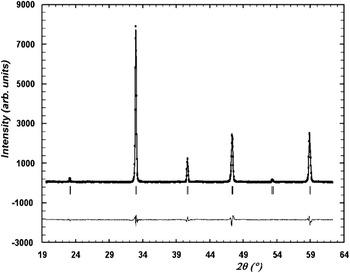
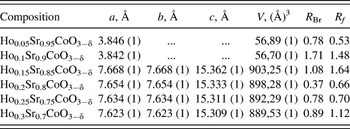
Samples with overall composition HoxSr1−xCoO3−δ within the range 0.05 ≤ x ≤ 0.4 with steps in x of 0.05 and within the range 0.4 ≤ x ≤ 0.9 with steps in x of 0.1 were treated according to the ceramic technique described in the Sec. II at 1100 °C. It was found that single-phase HoxSr1−xCoO3−δ samples were obtained within the range 0.05 ≤ x ≤ 0.30. Solid solution Ho0.05Sr0.95CoO3−δ and Ho0.1Sr0.9CoO3−δ were indexed in the cubic structure (Pm3m sp. gr.) with the unit cell parameters a = 3.846 Å (x = 0.05) and a = 3.842 Å (x = 0.1), in good agreement with those reported in Ref. Reference Istomin, Drozhzhin, Svensson and Antipov12. The XRD pattern for Ho0.1Sr0.9CoO3−δ is shown in Fig. 1, as an example.
XRD pattern for Ho0.1Sr0.9CoO3−δ refined by Rietveld analysis.

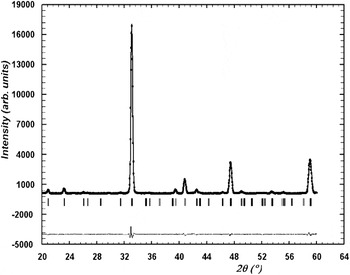
Further introduction of holmium leads to a change of crystal structure from cubic to tetragonal. Earlier,Reference James, Avdeev, Barnes, Morales, Wallwork and Withers11–Reference Withers, James and Goossens13 it was shown that HoxSr1−xCoO3−δ forms a 2ap × 2ap × 4ap superstructure as the result of a combination of A-site cation and oxygen vacancy ordering. Therefore, the samples within the range 0.15 ≤ x ≤ 0.30 were refined in the tetragonal 2ap × 2ap × 4ap superstructure. The XRD pattern for Ho0.2Sr0.8CoO3−δ is shown in Fig. 2, as an example. The values of unit cell parameters, unit cell volumes, and refinement parameters for single-phase samples are listed in Table I.
XRD pattern for Ho0.2Sr0.8CoO3−δ refined by Rietveld analysis.

Unit cell parameters of the HoxSr1−xCoO3−δ (0.05 ≤ x ≤ 0.30).

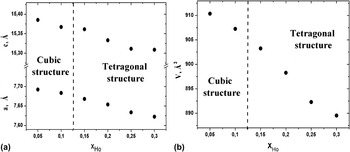
The decrease of unit cell parameters and unit cell volume with increase of holmium content (Fig. 3) can be explained by the relative cation sizes since the ionic radius of holmium is smaller than the ionic radius of strontium ( = 1.015 Å;
 = 1.26 Å; coordination number (CN) = VIII).Reference Shannon16 To illustrate the changes of unit cell parameter of all single phases (Fig. 3), those for the solid solutions with cubic structure were multiplied by 2 and 4, respectively.
The unit cell parameters (a) and unit cell volume (b) versus holmium content in HoxSr1−xCoO3−δ. The unit cell parameter of the solid solutions with cubic structure (x = 0.05 and 0.1) was multiplied by 2 (parameters a and b) and 4 (parameter c).

All samples with x > 0.3 were multiphase and consisted of saturated solid solution having an approximate composition Ho0.3Sr0.7CoO3−δ, Ho2O3, and CoO.
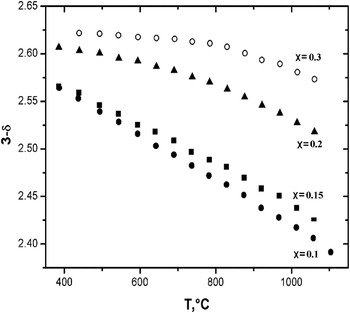
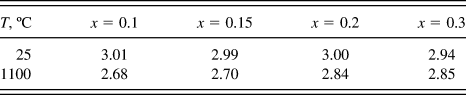
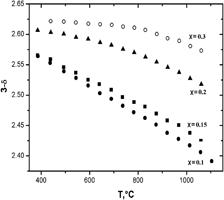
Combining the results of the chromatometric titration and TG measurements, the values of oxygen content versus temperature were obtained (Fig. 4). It is easy to see that within the entire temperature range, an increase of holmium content increases the value of oxygen index (3 − δ). Such a tendency is obvious since Sr2+ ions are substituted by Ho3+. As discussed below, it is also useful to analyze how oxidation state of cobalt varies with the changes of Ho/Sr ratio (Table II).
Oxygen content in HoxSr1−xCoO3−δ as a function of temperature in air.

Mean oxidation state of cobalt ions in the HoxSr1−xCoO3−δ.
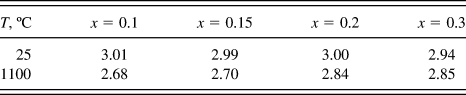
Introduction of holmium causes oxygen to be retained more strongly in the lattice (the variation of oxygen content with the temperature is smallest for the sample with x = 0.3), while oxidation state of cobalt varies in a more narrow range as compared to lower x. Since the oxidation states of strontium, holmium, and oxygen ions are considered to be unchanged, the formula of solid solution can be written as follows:  , where n means oxidation state of cobalt ions. Thus, electroneutrality equation can be represented as:

One can easily transform the above equation to the following form:

According to the Eq. (5), oxygen content and holmium content influence the value of mean oxidation state of cobalt in opposite directions. Obtained results (Table II) show that the values of holmium content (x) and mean oxidation state of cobalt ions (n) change in the same direction at 1100 °C. These lead to the conclusion that an increase of mean oxidation state of cobalt ions (n) with the increase of holmium content (x) is caused by higher rate of oxygen content gain in comparison to (x).
An increase of Ho/Sr ratio leads to a decrease of the mean radii of cations in A-positions, whereas oxidation state of cobalt ions (at 1100 °C) increases, and therefore, ionic radius of cobalt ions (in B-position) increases. Hereby, increase of holmium content leads to the decrease of rA/rB ratio that reduces the stability of the perovskite structure. These are in good agreement with the fact of instability of HoxSr1−xCoO3−δ (x > 0.3) at 1100 °C.
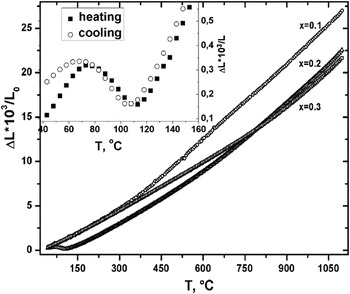
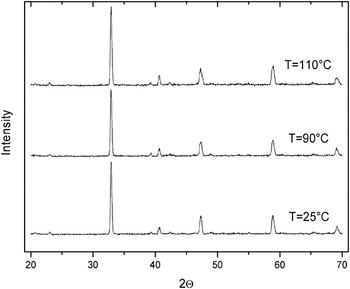
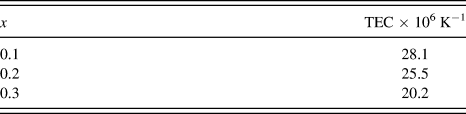
Relative densities of the samples for thermal expansion measurements were evaluated by comparison of measured values to those calculated from XRD data. Obtained values of relative densities of HoxSr1−xCoO3−δ were 86% for x = 0.1, 87% for x = 0.2, and 78% for x = 0.3. The thermal expansion behavior of HoxSr1−xCoO3−δ ceramics was reproducible while heating and cooling (Fig. 5). Peculiar character of dependency for the sample with x = 0.2 in the temperature range 25–110 °C (Fig. 5, inset) stimulated us to check the possibility of phase transition. Therefore, high temperature XRD measurements were performed for this sample. Figure 6 illustrates no visible phase transition within the studied temperature range. Thus, either such behavior corresponds to some other effects or the type of transformation cannot be detected by XRD technique, for instance, if it takes place due to oxygen order–disorder processes. The latter is unlikely since the temperature is too low. Table III lists the TECs calculated from the dilatometric data and averaged in the temperature range 530–900 °C.
Thermal expansion (ΔL/L 0) for HoxSr1−xCoO3−δ in air.

XRD pattern for Ho0.2Sr0.8CoO3−δ at different temperatures.

Average values of TECs of HoxSr1−xCoO3−δ within the temperature range 530–900 ºC.
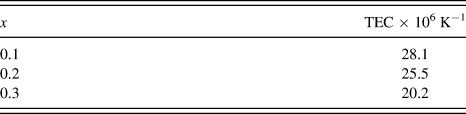
The decrease of average values of TEC with the increase of holmium content is probably related to the reduction of the unit cell volume and diminishing of oxygen exchange. It is worth to mention that thermal expansion consists of two constituents—one associated with atomic vibrations and the other related to changes in the chemical composition. The latter is known as “chemical expansion.”Reference Adler17
IV. CONCLUSION
It was shown that the homogeneity range of solid solutions of HoxSr1−xCoO3−δ is 0.05 ≤ x ≤ 0.3 in air at 1100 °C. An increase of holmium content leads to the transformation of HoxSr1−xCoO3−δ from a cubic to tetragonal structure. Oxygen content and thermal expansion of the HoxSr1−xCoO3−δ were also measured as a function of temperature in air.
ACKNOWLEDGMENTS
This work was financially supported in parts by the Ministry of Education and Science of Russian Federation within the Federal Target Program “Investigations and researchers on the priority directions of development for the scientific and technological complex of Russia in 2007–2013.”