Introduction
Hearing impairment (HI) is highly prevalent; it affects approximately 10% of the population (Stevens et al. Reference Stevens, Flaxman, Brunskill, Mascarenhas, Mathers and Finucane2013), making it the most common sensory deficit worldwide (Mathers et al. Reference Mathers, Fat and Boerma2008). HI is strongly associated with mental health problems (Fellinger et al. Reference Fellinger, Holzinger, Gerich and Goldberg2007) and projected to enter the top 10 in burden of disease in the coming decade (Mathers & Loncar, Reference Mathers and Loncar2006). People with HI more often have psychotic experiences (Stefanis et al. Reference Stefanis, Thewissen, Bakoula, van Os and Myin-Germeys2006; van der Werf et al. Reference Van der Werf, van Boxtel, Verhey, Jolles, Thewissen and van Os2007, Reference Van der Werf, Thewissen, Dominguez, Lieb, Wittchen and van Os2011) and more often develop psychotic disorders (Cooper, Reference Cooper1976; David et al. Reference David, Malmberg, Lewis, Brandt and Allebeck1995; Fors et al. Reference Fors, Abel, Wicks, Magnusson and Dalman2013). The aetiology and pathogenesis of this increased psychosis risk are uncertain, but evidence suggests that chronic social exclusion may be an important element of aetiology (Selten & Cantor-Graae, Reference Selten and Cantor-Graae2007; Selten et al. Reference Selten, van der Ven, Rutten and Cantor-Graae2013). As far as pathogenesis is concerned, an environmental risk factor such as HI may induce, through a process of ‘sensitization’, elevated dopamine neurotransmission and/or cognitive biases facilitating the onset of psychotic symptoms (Collip et al. Reference Collip, Myin-Germeys and Van Os2008).
Cognitive biases relevant to HI may consist of altered perceptions and responses in social situations, where people with hearing loss face more uncertainty than their normal-hearing peers. To identify the speaker and understand a degraded speech signal through visual and contextual inference requires great cognitive effort and includes the possibility of miscommunication, which is likely to cause stress. Minor stresses, including social stress, measured in daily life have repeatedly been associated with increases in momentary psychotic experiences (MPE), both in individuals with psychotic disorders and in persons who are genetically at an increased risk for such disorders (Myin-Germeys et al. Reference Myin-Germeys, van Os, Schwartz, Stone and Delespaul2001, Reference Myin-Germeys, Delespaul and Van Os2005a ). Increased levels of such stress reactivity may represent a vulnerability marker for psychotic disorder, with again elevated mesolimbic dopamine neurotransmission as a possible underlying mechanism (Myin-Germeys & van Os, Reference Myin-Germeys and van Os2007). This hypothesis has not yet been tested in persons who are at increased risk for psychosis due to an environmental risk factor. Social stress is of particular interest in relation to mesolimbic dopamine and psychosis since several experimental studies have reported increased striatal dopamine release in response to social stress in patients with schizophrenia and groups at clinical high risk (Soliman et al. Reference Soliman, O'Driscoll, Pruessner, Holahan, Boileau, Gagnon and Dagher2008; Mizrahi et al. Reference Mizrahi, Addington, Rusjan, Suridjan, Ng, Boileau, Pruessner, Remington, Houle and Wilson2012). A similar association was found between daily life stress measures and plasma elevations of homovanillic acid, a proxy measure of dopaminergic reactivity, in individuals genetically at high risk for schizophrenia, but not in controls (Myin-Germeys et al. Reference Myin-Germeys, Marcelis, Krabbendam, Delespaul and van Os2005b ). Recently, we showed greater striatal dopamine release in response to an amphetamine challenge in individuals with severe HI (SHI) compared with normal-hearing peers (Gevonden et al. Reference Gevonden, Booij, van den Brink, Heijtel, van Os and Selten2014a ).
The aim of the current study was to examine whether individuals with SHI are sensitized to daily life social stress and whether elevated striatal dopamine neurotransmission underlies this sensitization. It was predicted that (i) individuals with SHI react with more MPE to social stress in daily life than normal-hearing controls and (ii) that such reactivity to social stress is associated with decreased baseline dopamine D2/3 receptor availability and/or elevated amphetamine-induced dopamine release. Since affective dysregulation may contribute to the pathogenesis of psychotic symptoms (Myin-Germeys & van Os, Reference Myin-Germeys and van Os2007; Lataster et al. Reference Lataster, Valmaggia, Lardinois, van Os and Myin-Germeys2013), it was also predicted (iii) that individuals with SHI react with more negative affect (NA) to social stressors than normal-hearing controls.
Method
Participants
The sample consisted of young adults with SHI and normal-hearing healthy controls who had previously participated in a single photon emission computed tomography (SPECT) study (numbered NL24257.018.08) at the Academic Medical Center in Amsterdam. They had originally been recruited through local media, audiology services and patient organizations and had agreed to be contacted for further research. A total of 15 of the 19 participants with SHI and 18 of the 19 controls from the imaging study (Gevonden et al. Reference Gevonden, Booij, van den Brink, Heijtel, van Os and Selten2014a ) could be included in the experience sampling method (ESM) study. Reasons for not participating in the ESM study were lack of time or motivation. One control participant who was not included in the analysis of the imaging study because of technical problems did participate in the current ESM study. The interval between the measurement of dopamine release following the dexamphetamine challenge and the measurement of stress reactivity in the ESM study ranged from 1 day to 2 years (median = 143 days, interquartile range = 375 days). This time interval between SPECT and ESM assessment did not differ between groups [mean SHI = 189 days, mean control = 183 days, t(32) = −0.094, p = 0.93].
SHI was defined as having a Fletcher index (FI) >60 dB, i.e. an average pure-tone audiometry threshold over 500, 1000, 2000 and 4000 Hz in the best ear >60 dB for at least 3 years and normal hearing was defined as FI < 20 dB.
Other inclusion criteria for the SPECT study were: (1) age between 18 and 30 years old; (2) completed primary school; (3) born in the Netherlands to parents born in the Netherlands; and (4) white skin colour. Exclusion criteria were: (1) past or present history of neurological disorder (e.g. epilepsy, meningitis, structural brain damage); (2) abnormal electrocardiogram; (3) past or present history of substance abuse, psychosis, bipolar disorder or attention-deficit/hyperactivity disorder; (4) current major depression or use of antidepressant medication; (5) past or present use of medication known to affect dopamine D2/3 receptor binding (including all antipsychotics and methylphenidate); (6) history of use of any illicit drug other than cannabis; (7) past-year radiation exposure for research purposes; (8) family history (first-degree) of psychotic disorder; (9) positive urine drug screen prior to SPECT imaging; and (10) for females, a positive urine pregnancy test or breast feeding. Additionally, individuals with SHI were excluded if they had attended a primary or secondary school in which they actively learned or used Dutch Sign Language, because being part of a signing deaf community could be protective against social exclusion (Fellinger et al. Reference Fellinger, Holzinger, Gerich and Goldberg2007). Control participants were excluded if they had any form of impairment that could lead to social exclusion (e.g. wheelchair user).
Ethics
The study was approved by the local medical ethics committee of the Maastricht University Medical Center. All participants gave written informed consent and received remuneration of €50. The study protocol was registered prior to inclusion of the first participant in the Dutch Trial Registry under number NTR2973.
The authors assert that all procedures contributing to this work comply with the ethical standards of the relevant national and institutional committees on human experimentation and with the Helsinki Declaration of 1975, as revised in 2008.
Measures of intelligence, perceived discrimination and social exclusion
General intelligence was estimated using a short version of the Wechsler Adult Intelligence Scale (Velthorst et al. Reference Velthorst, Levine, Henquet, de Haan, van Os, Myin-Germeys and Reichenberg2013) and verbal intelligence using the Dutch version of the National Adult Reading Test (Schmand et al. Reference Schmand, Bakker, Saan and Louman1991). Perceived discrimination was measured by asking participants if they had ever experienced discrimination in any of 12 different domains, including education, the job market and health care and counting the number of domains in which participants responded ‘yes’. At the time of the SPECT study (Gevonden et al. Reference Gevonden, Booij, van den Brink, Heijtel, van Os and Selten2014a ), social exclusion was further measured with the Social Comparison Scale (Allan & Gilbert, Reference Allan and Gilbert1995), where lower scores mean that participants compare themselves less favourably with others, as well as with the Social Defeat Scale (Gilbert & Allan, Reference Gilbert and Allan1998), and the UCLA Loneliness Scale (Russell, Reference Russell1996), where higher scores indicate more feelings of defeat and loneliness.
SPECT acquisition and analysis
To measure baseline dopamine D2/3 receptor availability and the degree of amphetamine-induced dopamine release, participants underwent two [123I]iodobenzamide (IBZM) SPECT scans on the same day: the first before and the second after intravenous administration of dexamphetamine. Scans were made on a brain-dedicated scanner (Neurofocus 810, Inc.; USA) using a bolus/continuous infusion paradigm (Booij et al. Reference Booij, Korn, Linszen and van Royen1997). A region-of-interest (ROI) analysis was performed with a fixed ROI for the striatum and the occipital cortex as a reference region. The non-displaceable binding potential (BPND) was calculated at baseline and after amphetamine administration as the ratio of specific to free and non-specific binding. Dopamine release was then quantified as the percentage change in BPND from baseline. For full details of the scanning procedure and image analysis see Gevonden et al. (Reference Gevonden, Booij, van den Brink, Heijtel, van Os and Selten2014a ).
ESM
Participants received an e-diary, the PsyMate, which was programmed to emit a beep signal and vibrate at random moments in each of ten 90-min time blocks between 07.30 and 22.30 hours on eight consecutive days (Myin-Germeys et al. Reference Myin-Germeys, Oorschot, Collip, Lataster, Delespaul and van Os2009; Palmier-Claus et al. Reference Palmier-Claus, Myin-Germeys, Barkus, Bentley, Udachina, Delespaul, Lewis and Dunn2011). Participants were instructed to carry the PsyMate on their body at all times so the signal could be felt as well as heard. Many SHI participants were already accustomed to carrying their personal smartphone in this manner to attend to text messages, so bias due to not noticing the signal was expected to be minimal. The semi-random beep design prevents anticipatory behaviour of participants, and ensures that the full time window between 07.30 and 22.30 hours is covered for sampling of experience. After each beep, participants were asked to start the self-assessment promptly, thus collecting reports on the current context (activity, social context, location), appraisals of their current situation and affect and the presence of psychotic symptoms. Appraisals were measured with seven-point Likert scales. After 15 min the signal expired and participants could no longer start the assessment, as earlier work has shown that after this interval reports are less reliable and consequently less valid (Delespaul, Reference Delespaul1995). To ensure a representative sample of daily life at least 27 valid reports (out of 80) were required for a participant to be included in the analyses. No participants were excluded for this reason. For each subset of ESM items that was used as a scale, Cronbach's α was computed and a coefficient >0.7 was considered to reflect good internal consistency.
Social stress was measured only on beeps when the respondent indicated that (s)he was in the company of others using the ESM items ‘I like the present company’ (reverse-coded so that higher scores mean less pleasant company) and ‘I would rather be alone’ (Cronbach's α: 0.74) (Myin-Germeys et al. Reference Myin-Germeys, van Os, Schwartz, Stone and Delespaul2001).
As in earlier work (Myin-Germeys et al. Reference Myin-Germeys, Marcelis, Krabbendam, Delespaul and van Os2005b ), a scale representing MPE was constructed from the mean score of eight ESM items: ‘I feel suspicious’, ‘My thoughts are difficult to express’, ‘I can't let go of my thoughts’, ‘My thoughts are influenced by other people’, ‘I feel unreal’, ‘I see things that aren't really there’, ‘I hear voices’, ‘I am afraid of losing control’ (Cronbach's α: 0.73).
A NA scale was constructed based on the mean score of the mood items ‘down’, ‘guilty’, ‘insecure’, ‘lonely’ and ‘anxious’ (Cronbach's α: 0.79) (Myin-Germeys et al. Reference Myin-Germeys, van Os, Schwartz, Stone and Delespaul2001).
Statistical analyses
All analyses were carried out in Stata12 for Windows with the significance level set at 0.05 (two-tailed). ESM data have a hierarchical structure with multiple observations (level 1) nested within individuals (level 2) (Schwartz & Stone, Reference Schwartz and Stone1998). Given that hierarchical clustering induces violation of the assumption of independence of observations, standard errors were corrected for clustering of observations within persons by applying multilevel random regression models (Goldstein, Reference Goldstein and Goldstein2005).
Data were analysed using the XTMIXED multilevel linear regression routine. To account for possible bias inflating the type 1 error rate, models included a random intercept and random slope at the beep level and were assumed to have an unstructured covariance matrix.
To study the effect of HI on reactivity to social stress two separate regression models were tested with MPE and NA as the respective dependent variables and the interaction between group (SHI versus control) and social stress as the comparison of interest.
The relationship between striatal dopamine neurotransmission and reactivity to social stress was again studied with MPE and NA as dependent variables. Each was tested in two separate models, one with the interaction between social stress and dopamine receptor availability (BPND) and one with the interaction between social stress and dexamphetamine-induced dopamine release (ΔBPND). Age, sex and smoking status were included as person-level covariates as they are known to affect dopamine D2/3 receptor availability (Rinne et al. Reference Rinne, Hietala, Ruotsalainen, Säkö, Laihinen, Någren, Lehikoinen, Oikonen and Syvälahti1993; Pohjalainen et al. Reference Pohjalainen, Rinne, Någren, Syvälahti and Hietala1998; Fehr et al. Reference Fehr, Yakushev, Hohmann, Buchholz, Landvogt, Deckers, Eberhardt, Kläger, Smolka, Scheurich, Dielentheis, Schmidt, Rösch, Bartenstein, Gründer and Schreckenberger2008).
Group comparisons for background variables were performed with χ2 tests for categorical data and t tests for continuous data. To compare the group averages of ESM variables an individual mean was first calculated over all reports; these values were then aggregated to obtain the group mean and standard deviation.
Sensitivity analysis
The distribution of MPE in a healthy sample is generally strongly skewed. This was confirmed for the current sample by visual inspection of the data and therefore sensitivity analyses were conducted using the XTMELOGIT routine, with MPE dichotomized as ‘no current psychotic experience’ [score 1 on the continuous MPE scale; 1089 observations (55%)] and ‘at least one current psychotic experience’ [score >1 on the continuous MPE scale; 883 observations (45%)].
For further insight into the nature of the interaction effects in the analysis, odds ratios (ORs) for the presence of psychotic experiences given a situation of social stress were computed using the LINCOM routine. For this analysis, a social stress situation was defined as any situation where the social stress score exceeded the individual median.
Results
Sample characteristics
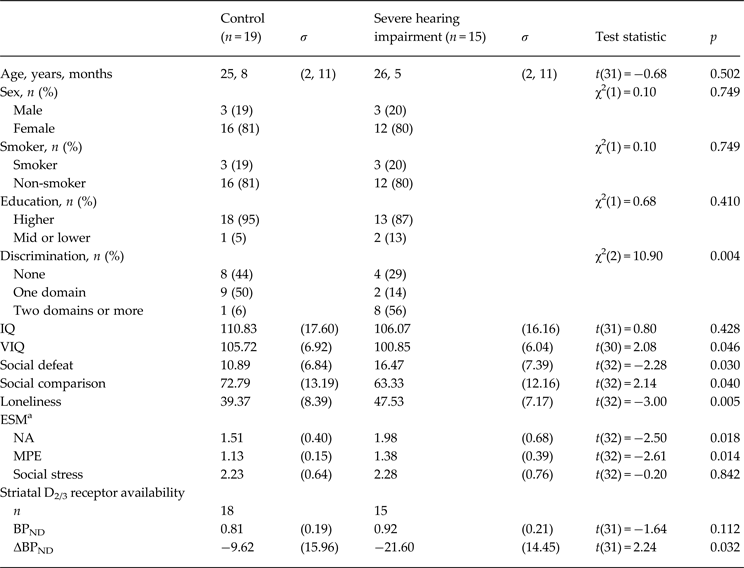
The data of one participant could not be analysed due to technical problems with the e-diary. The final sample thus included 34 participants: 15 (44%) people with SHI and 19 (56%) controls with normal hearing, who completed a total of 1972 valid ESM observations (mean = 58.00, s.d. = 9.48). The groups did not differ in mean number of ESM reports [SHI group: 58.20 (s.d. = 7.26), control group: 57.84 (s.d. = 11.12), t(32) = 0.11, p = 0.91]. Average hearing loss in the best ear was 9 (s.d. = 3) dB in the control group and 88 (s.d. = 16) dB in the SHI group. There were no differences between groups in education level or general intelligence, but the control group scored marginally better on the verbal intelligence quotient (IQ) test. There was a significant difference in perceived discrimination between the groups [χ2(2) = 10.90, p = 0.004]. Half of the SHI participants reported experiencing discrimination in multiple domains, whereas this applied to only one control participant. SHI participants had lower scores on the Social Comparison Scale (Allan & Gilbert, Reference Allan and Gilbert1995), and higher scores on the Social Defeat Scale (Gilbert & Allan, Reference Gilbert and Allan1998) and the UCLA Loneliness Scale (Russell, Reference Russell1996). This confirms that the SHI group experiences more social exclusion than the control group. Group means and standard deviations for background variables and ESM variables are summarized in Table 1.
Participant characteristics

Data are given as mean (standard deviation) unless otherwise indicated.
IQ, Intelligence quotient; VIQ, verbal intelligence quotient; ESM, experience sampling method; NA, negative affect; MPE, momentary psychotic experiences; BPND, non-displaceable binding potential; ΔBPND, percentage change in BPND after dexamphetamine administration.
a For the daily life, experience sampling variables, which included multiple observations over time from each participant, an individual mean was first calculated over all reports; these values were then aggregated to obtain the group mean and standard deviation.
Social stress
In 1234 observations (63%) the respondent was not alone. Control participants gave more responses in the presence of others (70%, s.d. = 13%) than SHI participants (55%, s.d. = 19%) [t(32) = 2.72, p = 0.01], but levels of social stress did not differ between SHI participants and controls (Table 1).
Stress reactivity
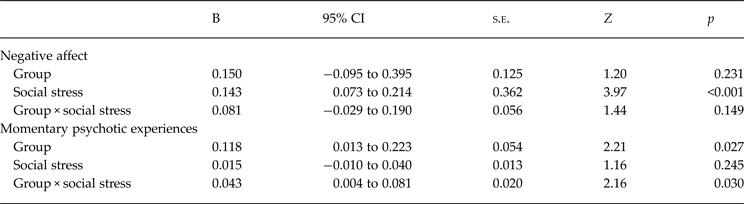
Mean levels of MPE and NA were higher in the SHI group compared with the control group (Table 1). In order to test for the presence of group differences in stress reactivity, the interaction effects between group (SHI versus control) and social stress on MPE and NA were examined. The interaction between group and social stress was not significant in the model of NA, but it was significant in the model of MPE: SHI participants showed a stronger positive association between social stress and MPE than normal-hearing controls (Table 2).
Main and interaction effects of group and social stress on negative affect and momentary psychotic experiences a

B, Standardized regression coefficient; CI, confidence interval, s.e., standard error.
a Multilevel linear regression results for the main effects of stress and group and the interaction effect of social stress × group (severe hearing impairment versus control) on negative affect and momentary psychotic experiences (n = 34, 1234 beeps).
Dopamine measures and stress reactivity
When adjusting for age, sex and smoking, the interaction between social stress and BPND was not associated with MPE [B = 0.01, 95% confidence interval (CI) −0.095 to 0.116, p = 0.84] or NA (B = 0.17, 95% CI −0.106 to 0.445, p = 0.23). Likewise, the interaction between social stress and ΔBPND was not associated with MPE (B < 0.001, 95% CI −0.001 to 0.001, p = 0.90) or NA (B < 0.001, 95% CI −0.003 to −0.004, p = 0.71). These analyses were repeated with the interval in days between SPECT and ESM as an additional covariate, but the results remained essentially unchanged.
Sensitivity analysis
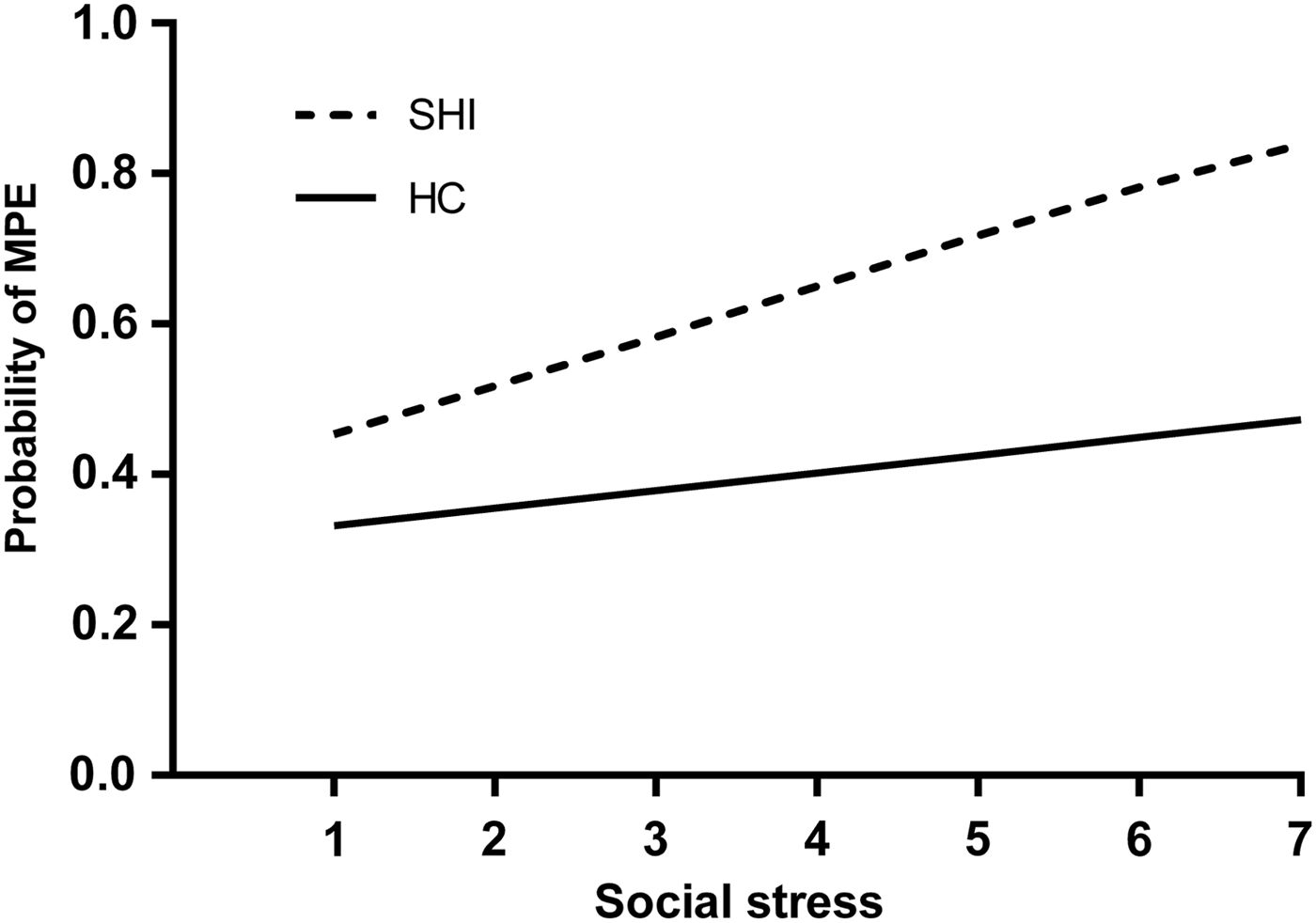
In 43% of the 1234 situations (beeps) where the respondent was not alone, at least one MPE was present according to the dichotomized measure. Using this alternative outcome measure, the interaction between group and social stress was not significant (B = 0.35, 95% CI −0.036 to 0.731, p = 0.08). Fig. 1 illustrates that when social stress ratings increase, the probability of the occurrence of at least one psychotic experience increases more in the SHI group than in the control group.
Probability of momentary psychotic experiences (MPE, dichotomous) as predicted by social stress rating, stratified by group: healthy controls (HC) and severe hearing impairment (SHI).

Using a within-person median split to dichotomize social stress, and computing the odds for any psychotic experience for low versus high social stress revealed that the OR was 1.80 (95% CI 1.12–2.90) in the control group and 2.81 (95% CI 1.48–5.32) in the SHI group.
Discussion
This study examined whether individuals with SHI, previously found to report more social exclusion and to exhibit increased amphetamine-induced dopamine release in comparison with controls, have more psychotic experiences in response to real-life social stressors, and, if so, whether this psychotic hyper-reactivity is associated with sensitivity of the dopamine system. The main result is that participants with SHI indeed report more psychotic experiences in response to social stress than normal-hearing control participants. However, we found no association between psychotic reactivity to social stress in daily life and baseline dopamine D2/3 receptor availability or amphetamine-induced dopamine release in the striatum.
Psychotic reactivity and social stress
The main result, increased psychotic reactivity to social stress in a SHI group, is in line with earlier ESM studies showing increased psychotic reactivity in siblings of patients, a group at genetic risk for psychotic disorder (Myin-Germeys et al. Reference Mizrahi, Addington, Rusjan, Suridjan, Ng, Boileau, Pruessner, Remington, Houle and Wilson2005a , Reference Myin-Germeys, Marcelis, Krabbendam, Delespaul and van Os b ). The current study extends these findings to a group selected for exposure to an environmental risk factor and provides preliminary evidence for behavioural sensitization in this group. This sensitization is possibly a result of negative day-to-day experiences related to their outsider status. In patients with psychosis, negative life events and traumatic childhood experiences are associated with increased stress reactivity (Myin-Germeys et al. Reference Myin-Germeys, Krabbendam, Delespaul and Van Os2003; Lardinois et al. Reference Lardinois, Lataster, Mengelers, Van Os and Myin-Germeys2011). In fact, SHI participants in this study report more discrimination, which previously has been found to mediate the risk for psychotic symptoms in a sexual minority population (Gevonden et al. Reference Gevonden, Selten, Myin-Germeys, de Graaf, Ten Have, van Dorsselaer, van Os and Veling2014b ), and probably signals a much wider range of major and minor negative social experiences which have been collectively termed minority stress (Meyer, Reference Meyer2003). Earlier studies have shown that hearing problems can manifest themselves in difficulties at school (Järvelin et al. Reference Järvelin, Mäki-Torkko, Sorri and Rantakallio1997; Sweeting & West, Reference Sweeting and West2001) and in the workplace (Hasson et al. Reference Hasson, Theorell, Wallén, Leineweber and Canlon2011), which are often not (sufficiently) adapted to the needs of people with HI, resulting in unemployment and lower social status (Järvelin et al. Reference Järvelin, Mäki-Torkko, Sorri and Rantakallio1997; Pierre et al. Reference Pierre, Fridberger, Wikman and Alexanderson2012; Stam et al. Reference Stam, Kostense, Festen and Kramer2013). Repeated negative social experiences could lead to the formation of cognitive biases, in effect internalizing the minority stress, for example by a growing expectation of rejection and increasingly negative self-image (Meyer, Reference Meyer2003). In turn, these cognitive biases could play an important role in the formation and exacerbation of psychotic symptoms (Garety et al. Reference Garety, Kuipers, Fowler, Freeman and Bebbington2001, Reference Garety, Bebbington, Fowler, Freeman and Kuipers2007), measured in this study as psychotic experiences in response to unpleasant company. An alternative explanation to consider is source-monitoring problems, which have been reported in schizophrenia patients and their siblings (Keefe et al. Reference Keefe, Arnold, Bayen and Harvey1999; Brunelin et al. Reference Brunelin, d’ Amato, Brun, Bediou, Kallel, Senn, Poulet and Saoud2007). While not measured in the current study, it is likely that people with SHI, who deal with degraded auditory signals and need to rely heavily on contextual and visual inference, will also show impairment on source-monitoring tasks. This impairment in turn could fuel the aforementioned cognitive biases and influence stress reactivity, for instance manifesting itself as increased paranoia. Finally, it should be noted that while recent work suggests a prominent role for affective stress reactivity in the development of positive symptoms (Lataster et al. Reference Lataster, Valmaggia, Lardinois, van Os and Myin-Germeys2013), no significant group effects on NA reactivity were found in this study. However, a significant affective response to social stress was measured across both groups (Table 2), and SHI participants did give higher average moment-to-moment NA ratings than controls irrespective of stress (Table 1), suggesting that a subtle between-group difference could be present that we are unable to detect with the current sample size.
Striatal dopamine and social stress
The absence in this sample of an association between striatal dopamine neurotransmission and reactivity to social stress raises the question whether dopamine alterations underlie the development of psychotic symptoms in individuals with SHI. The result may seem at odds with positron emission tomography (PET) studies using the Montreal Imaging Stress Task, which have shown that acute social stress causes measurable striatal and prefrontal dopamine release (Pruessner et al. Reference Pruessner, Champagne, Meaney and Dagher2004; Lataster et al. Reference Lataster, Collip, Ceccarini, Haas, Booij, van Os, Pruessner, Van Laere and Myin-Germeys2011) and that people at high risk for psychotic disorders display larger striatal dopamine release under stress than healthy controls (Mizrahi et al. Reference Mizrahi, Addington, Rusjan, Suridjan, Ng, Boileau, Pruessner, Remington, Houle and Wilson2012). However, in the preceding SPECT study in the same sample (Gevonden et al. Reference Gevonden, Booij, van den Brink, Heijtel, van Os and Selten2014a ) we found no association between dopamine release and increase in psychotic symptoms after amphetamine administration, or between dopamine release and direct measures of social exclusion. The absence of an association between striatal dopamine neurotransmission and psychotic reactivity in this ESM study mirrors that first result, but might also be related to the fact that dopaminergic activity was measured at a different time than stress reactivity, or be a matter of limited statistical power as further discussed under the limitations below. Nevertheless, on the basis of these data it can only be established that elevated striatal dopamine neurotransmission and elevated stress reactivity co-occur in the same environmental-risk population. While striatal dopamine release may be a valid biological vulnerability marker for psychosis, in a healthy population it has limited value, if any, to predict stress reactivity, a behavioural vulnerability marker for the disorder.
Strengths and limitations
This study has several strengths, but also a number of methodological issues to consider. It is the first study of symptomatic reactivity to daily life stress in a sample at increased risk for psychosis that was selected on the basis of an environmental risk factor instead of selection based on already existing psychotic symptoms (ultra-high risk) or genetic liability (relatives of psychotic patients). Moreover, it is the first ESM study in individuals with HI, a socially excluded but otherwise healthy population. Finally, the study offers a rare combination of high-quality dopamine imaging data and measurements of daily life experience suited to study the relationship between biological and psychological endophenotypes of psychosis risk. This is important, as extensive evidence (for a review, see Brunelin et al. Reference Brunelin, Fecteau and Suaud-Chagny2013), including a number of studies in individuals at risk for psychosis (Howes et al. Reference Howes, Montgomery, Asselin, Murray, Valli, Tabraham, Bramon-Bosch, Valmaggia, Johns, Broome, McGuire and Grasby2009; Mizrahi et al. Reference Mizrahi, Addington, Rusjan, Suridjan, Ng, Boileau, Pruessner, Remington, Houle and Wilson2012; Egerton et al. Reference Egerton, Chaddock, Winton-Brown, Bloomfield, Bhattacharyya, Allen, McGuire and Howes2013), suggests that excess striatal dopamine constitutes an endophenotype of psychosis. Nevertheless, little is known about the way these abnormalities relate to psychological vulnerability markers such as MPE.
The main limitation of this study is the small sample size. However, the unilevel equivalents for our multilevel sample size (Snijders & Bosker, Reference Snijders and Bosker1999) were 78 (psychosis) and 82 (NA), which should be adequate to find medium to large effects in tests of two-way interactions. Use of the appropriate statistical methods which take into account the multilevel structure of the data leads to conservative tests unlikely to yield false positives, and therefore the interaction effect between social stress and group can be interpreted with confidence. Even though this finding was no longer significant (p = 0.076) when subjected to a sensitivity analysis, Fig. 1 shows that the probability of the occurrence of at least one MPE seems to be influenced more by social stress in the SHI group than in the control group.
Second, dopamine release was measured up to 2 years before this ESM study, not in relation to daily life and not in response to a social stressor. While [123I]IBZM SPECT is an established and validated method to measure striatal dopamine neurotransmission, including amphetamine-induced dopamine release (Laruelle et al. Reference Laruelle, Abi-Dargham, van Dyck, Rosenblatt, Zea-Ponce, Zoghbi, Baldwin, Charney, Hoffer, Kung and Innis1995; Booij et al. Reference Booij, Korn, Linszen and van Royen1997), the timing of measurement matters. For example, while symptomatic schizophrenia patients differ from controls in amphetamine-induced dopamine release, patients who are in remission do not (Laruelle et al. Reference Laruelle, Abi-Dargham, Gil, Kegeles and Innis1999). Furthermore, it is possible that the dopaminergic response to a pharmacological challenge is qualitatively different from the dopaminergic response to a social stressor.
Third, while the SPECT scans were made with a brain-dedicated system with relatively high spatial resolution, we did not succeed in reliably identifying striatal subdivisions for analysis. Although we succeeded in measuring dopamine release in the entire striatum, PET brings greater possibilities to distinguish substriatal structures, zoom in on the area where dopaminergic alterations occur and obtain a better signal:noise ratio (Mawlawi et al. Reference Mawlawi, Martinez, Slifstein, Broft, Chatterjee, Hwang, Huang, Simpson, Ngo, Van Heertum and Laruelle2001; Martinez et al. Reference Martinez, Slifstein, Broft, Mawlawi, Hwang, Huang, Cooper, Kegeles, Zarahn, Abi-Dargham, Haber and Laruelle2003). For example, a dopamine depletion PET study in schizophrenia patients suggests that dopamine D2/3 receptor availability differs in the associative striatum and not in the limbic (ventral) or sensorimotor striatum (Kegeles et al. Reference Kegeles, Abi-Dargham, Frankle, Gil, Cooper, Slifstein, Hwang, Huang, Haber and Laruelle2010).
Fourth, selection bias may have affected the outcomes of this study. Volunteers for a demanding imaging study are probably higher-functioning individuals. Educational levels are high in both groups, while they were expected to be lower in the SHI population (Järvelin et al. Reference Järvelin, Mäki-Torkko, Sorri and Rantakallio1997). The high-functioning SHI population in this study is likely to receive relatively high levels of social support which may act as a buffer to the effects of social exclusion (Meyer, Reference Meyer2003) and they may therefore present with fewer psychotic symptoms than the average person with SHI. However, SHI participants did score significantly higher than controls on all social defeat measures, with large group differences of approximately one standard deviation. Finally, since stress reactivity is defined as the affective and psychotic response to subjective stress, and since the analyses in this study are cross-sectional and do not incorporate a time factor, the possibility of reverse causality cannot be ruled out. Higher levels of NA or MPE could possibly alter environmental appraisals. Regardless of directionality, however, a form of reactivity is measured which can be compared between individuals and groups.
Conclusion
To conclude, this study shows more psychotic reactivity to daily life stress in a healthy but socially excluded group of young adults with SHI compared with controls with normal hearing. An association between psychotic reactivity and striatal dopamine neurotransmission was also predicted but not detected. While both elevated striatal dopamine release and elevated psychotic stress reactivity have been found in the same population defined by an environmental risk factor, their inter-relationship cannot be established with the current data. The results of this study warrant further research to clarify the association between biological and psychological endophenotypes and psychosis risk.
Acknowledgements
This work was supported by a grant from the Stichting J.M.C. Kapteinfonds to J.P.S., and supported by the European Community's Seventh Framework Program under grant agreement no. HEALTH-F2-2009-241909 (project EU-GEI). We thank Y. Wurtz for collection of ESM data and D. op't Eijnde for data administration.
Declaration of Interest
None.