Voters’ electoral choices do not develop in a social vacuum. When making up their minds about which candidate or party to support at the ballot box, citizens refer to the members of their social networks. Disagreeing over electoral preferences with other people stimulates them to reconsider their decisions, and often leads voters to adapt their preferences to those of their discussants. As a consequence, voting behaviour appears contagious. This ‘social logic’ of votingFootnote 1 has been demonstrated by numerous studies.Footnote 2 While this thriving literature has made unequivocally clear that the phenomenon of discussant influence at elections is a substantive one, it is in various ways not yet well understood. This article addresses two questions that extant research has not yet solved: (1) how discussant influence works in the context of West European multiparty systems and (2) how social pressure and information sharing relate to one another as mechanisms of discussant influence.
Studies on discussant influence have rarely addressed issues of institutional context. Most analyses of voters’ electoral interdependence have focused on candidate voting in the American two-party system. Few studies have been conducted in countries with multiparty systems, and they have usually construed electoral influence in the same way as American studies. With few exceptions, this research thus failed to take into account the more complex conditions of party competition and choice in such systems.Footnote 3
In the two-party US system, political competition is dualistic and confrontational. Electoral disagreement between a voter and a discussant inevitably involves being on different sides of the fence, and therefore entails antagonism and discord.Footnote 4 In West European multiparty systems, party competition is more complex. Reflecting socio-political cleavages, these systems are structured in polar ideological campsFootnote 5 or directionsFootnote 6 that usually contain several different parties. Accordingly, voters can experience at least two different types of electoral disagreement with their discussants, depending on whether it concerns parties from the same or the opposing ideological camp. The latter type is dualistic and therefore resembles antagonistic disagreement in the American sense. But the former concerns ideologically adjacent parties that differ in details, but share fundamental political values and sometimes even form electoral alliances. In such cases, disagreement between voters and discussants can be assumed to be considerably less intense, and the resulting conflict (if any) to be less divisive. That disagreement in multiparty systems is thus a matter of degrees may have important implications for discussant influence that have not yet been addressed by extant research.
The second shortcoming addressed by our article concerns the mechanisms of discussant influence. While it is clear that voters often adapt their electoral preferences to those of their discussants, it is a matter of dispute why they do so. To explain the influence of social networks on voting behaviour, two competing lines of theories have been proposed. One emphasizes cognitive processes of information sharing between voters, while the other focuses on the affect-laden processes of social pressure and conformity.Footnote 7 The available evidence suggests that there is some truth to both the social pressure and the information-sharing perspectives. However, the relationship between them is unclear. While many studies have adopted one or the other perspective as an untested premise of their research,Footnote 8 attempts to identify which of them better describes the influence taking place in voters’ social networks have been rare,Footnote 9 and none has thus far investigated the conditions under which one or the other of the two mechanisms prevails.
With regard to both shortcomings of current research, we seek to break new ground by proposing a two-stage theory of discussant influence. For the specific context of West European multiparty systems, it states under which conditions the two approaches better capture the influence process taking place. It maintains that both mechanisms are important in these systems, although to varying degrees at different stages of layered decision-making processes that begin long before elections. We contend that in the long run, and mainly by means of continuous normative pressure, discussants restrict the party alternatives taken into account by voters to ideologically coherent ‘consideration sets’, whereas the ultimate choices of particular parties out of these pre-filtered sets at specific elections are more strongly guided by information obtained during campaigns through social communication. We test this theory using the case of the 2009 German federal election.
The following sections develop the two-stage theory of discussant influence in more detail and derive testable hypotheses. Then, we outline our research strategy, including technical information on the data used and the variables included in our models. The next section presents our results and interprets them in light of our hypotheses. In the final section we summarize our findings and discuss their implications.
DISCUSSANT INFLUENCE AT ELECTIONS
While scholars of electoral behaviour have long neglected voters’ interdependence at elections,Footnote 10 during the past two decades numerous studies have demonstrated its relevance beyond reasonable doubt. However, while it is clear that voters adjust their preferences to those of their discussants, it is less clear why they do so. Two competing explanations have been proposed to explain this phenomenon: information sharing and social pressure.Footnote 11
The first perspective is inspired by Downs’ view of voters as instrumental seekers of cost-efficient information on which they can base their electoral choices.Footnote 12 Here, discussant influence at elections is thought to come about as a consequence of voters’ search for electoral orientation, the provision of information by other persons and ensuing processes of learning on the part of voters. Social communication is believed to affect electoral decisions by providing voters with useful electoral guidance.Footnote 13 While this theory implies that discussant influence has essentially cognitive roots, the competing view emphasizes rather unpolitical affective processes relating to individuals’ interest in the stability of their social ties.Footnote 14 It dates back to the classic Columbia studiesFootnote 15 and conceives of voters as human beings who are inherently social and place a high value on maintaining harmonious relationships with their peers.Footnote 16 According to this perspective, normative group pressure leads to behavioural conformity on the part of individuals who adopt the preferences of others in order to avoid damaging their mutual relationship.Footnote 17
Many studies in the field have not bothered with theoretical reasoning on mechanisms by which discussant influence may come about, but have contented themselves with demonstrating its existence. Others have adopted either social pressureFootnote 18 or information sharingFootnote 19 as explicit, though untested, theoretical premises. Only recently have researchers, most notably Sinclair in her study of American elections,Footnote 20 started to investigate which of the competing views better describes the influence actually taking place in social networks.
How can one decide which of the two mechanisms better explains discussant influence? According to Sinclair, this requires understanding how the attributes of both the discussants and their relationships with voters moderate their influence.Footnote 21 Each of the two theories implies specific expectations with regard to factors that should facilitate or impede discussant influence. For instance, if it comes about as a result of social pressure, it should vary depending on the intimacy of the relationship between the voter and discussant.Footnote 22 More powerful influence in primary relationships that are characterized by a climate of confidence, emotional appreciation and mutual regard (as well as a high density of interaction) indicates the operation of social pressure and conformity. Some studies have indeed reported discussant influence on electoral preferences to be particularly intense between spouses, followed by other family bonds and friendships. Compared to these ‘strong’ ties, secondary relationships like neighbours and co-workers appear less conducive to discussant influence.Footnote 23
In contrast, from the point of view of the information-sharing model, ‘it is the message that has the potential to persuade, not the messenger’.Footnote 24 Whereas simple cues during everyday interactions should be sufficient to trigger the social pressure mechanism, information-sharing effects can only come about as a ‘consequence of explicit social communication’.Footnote 25 In line with this ‘conversion through conversation’ hypothesis,Footnote 26 a discussant’s influence on a voter should vary in accordance with certain characteristics of the communication that takes place between them. The available evidence indicates that there is some truth to this perspective. For instance, studies found discussants to be more influential when engaging in frequent political talks with votersFootnote 27 and when communicating their views effectively (that is, clearly enough that they are easily discernible by their addressees).Footnote 28 Other research suggests that network partners are more influential when voters perceive them to be knowledgeable about political matters and trustworthy in the sense of having basically similar political views.Footnote 29 These are exactly the attributes emphasized by Downs (and more recently by Lupia and McCubbins) as qualities that should make discussants particularly attractive to voters as sources of electoral advice.Footnote 30
Hence, there is evidence to support both the social pressure and information-sharing models of discussant influence. How these findings can be theoretically reconciled is unclear. In the following we propose an answer to this question in the context of West European multiparty systems. In contrast to previous studies, it construes the two perspectives as complementary, rather than competitive. Conceding that influence processes can be characterized by both mechanisms, it specifies the conditions under which each can be expected to dominate.
ELECTORAL CHOICES IN MULTIPARTY SYSTEMS
Compared to candidate elections in the American two-party system, parliamentary elections in West European multiparty systems are more complex, layered contests. Whereas in the United States each vote gained by one of the candidates is one lost for its (usually) sole competitor, elections in Western Europe are characterized by competition between two cleavage-based ideological camps at one level, and between parties of the same ideological direction within camps at another level.Footnote 31 In the former case, the contest is ‘between enemies on different sides of the cleavage boundary’, in the latter it is ‘between friends in the same cleavage block’.Footnote 32 According to the directional theory of voting, this contrast is reflected in the way voters look at elections. For them, it makes a fundamental difference whether the parties that compete for their votes belong to the same or opposing ideological camps.Footnote 33 Competition between parties of opposing ideological directions is antagonistic and resembles the dualism of American electoral contests. In contrast, competition between parties of the same ideological camp concerns alternatives that share important basic values and is thus rather a matter of degrees. In fact, such parties often campaign as proto-coalitions, coordinate their electioneering, and form governments together when they obtain a joint majority.
Some recent studies have sought to take these conditions into account by modelling electoral decision making in multiparty systems as a two-stage process of funnelling down alternatives to the eventual choice.Footnote 34 They start from the psychological premise that in choice situations with multiple alternatives, decision processes are more complex than under conditions of simple binary choices. Their inspiration comes from psychological social judgement theoryFootnote 35 and marketing research.Footnote 36 The studies assume that voters come to grips with this complexity by first forming a consideration set consisting of a limited number of parties that are deemed, in principle, electable. They further assume that the party that is eventually supported at the ballot box is chosen in a second step from this pre-filtered reservoir of alternatives.
Research on stepwise decision making generally suggests that in the first stage, non-compensatory, heuristics-based decision strategies are used to narrow down the range of alternatives. This implies that only alternatives that have certain characteristics are kept under consideration, whereas those lacking them are immediately excluded.Footnote 37 Regarding vote choices, this means that only parties sharing one, or at most a small number of, core characteristics have a chance to remain in the consideration set. Several studies of West European elections have shown that left-right ideology is crucially important for circumscribing individuals’ consideration sets.Footnote 38
When it comes to choosing a party out of this constrained set of alternatives, a different mechanism kicks in that appears to be more strongly guided by cognitive processes. Picking a party from a restricted range of alternatives that differ little in their basic directional orientation requires more careful and detailed scrutiny of the available options. The final choice is therefore assumed to be made more carefully by means of compensatory strategies for evaluating and ordering the remaining alternatives.Footnote 39 This requires more thorough and systematic thinking, which in turn presupposes a sufficient base of rather specific and detailed political information. This may concern short-term factors related to the current election like leaders’ personalities, recent political events or the issues of the day,Footnote 40 but also parties’ electoral prospects, programmatic platforms and coalition signals to which electors need to refer when aiming to cast their votes strategically.Footnote 41
The first step of decision making that leads to the exclusion of parties from consideration sets thus appears rather simple and refers mainly to the basic heuristic of ideological direction. In contrast, choosing a single party out of a limited set of alternatives that resemble each other in their fundamental political values and vary only in details implies more differentiated cognitive processes. It also requires rather specific electoral information. In the following, we propose that discussant influence plays a role in each of these stages of electoral decision making, although in different ways – primarily via social pressure at the first stage, and more strongly by means of information sharing at the second.
A TWO-STAGE THEORY OF DISCUSSANT INFLUENCE AT ELECTIONS IN MULTIPARTY SYSTEMS
It is commonly assumed that processes of discussant influence at elections are set in motion when voters experience disagreement over electoral preferences with members of their social networks. Interacting with a discussant supporting another candidate or party stimulates voters to reconsider and ultimately adapt their preferences.Footnote 42 In American research, disagreement over candidate preferences is typically equated with political discord and conflict.Footnote 43 Conversations with non-like-minded individuals have accordingly been characterized as ‘dangerous’, in contrast to interactions with like-minded persons, who are ‘safe’.Footnote 44 Obviously this understanding of electoral disagreement makes good sense in the context of an inherently dualistic two-party system like that of the United States, where most existing research on discussant influence at elections has been conducted. In American elections there are usually only two contenders, and the winner takes all. The essence of electoral disagreement can thus be efficiently expressed by the simple formula that whoever is not with me is against me.
In a multiparty system, however, being exposed to a discussant who supports another party can mean different things, depending on whether this party belongs to the same or the opposing ideological camp. For such contexts we therefore propose to distinguish between two types of electoral disagreement. The first concerns the ideological direction of parties: Does a discussant support a party from the same side or from across the ideological divide? The second type of disagreement is nested within the first one: If a discussant prefers a party from the same spectrum as a voter, is it the same party or a different one?
Most studies of discussant influence in European multiparty systems have ignored these complexities and simply adopted the American approach. They determined electoral disagreement by distinguishing whether voters supported the same or any other party than their discussants.Footnote 45 Some studies also chose to focus on party blocks instead of single parties for determining electoral agreement and disagreement. They referred to criteria such as incumbency and opposition,Footnote 46 electoral alliancesFootnote 47 or ideological camps.Footnote 48 These studies recognized that in West European party systems, party blocs are a functional equivalent to single parties in the American two-party system. However, they neglected the possibility that discussant influence might also play a role in choices between parties from the same bloc. Moving beyond this research, our theory of discussant influence in multiparty systems offers an approach to deal with the fact that under such conditions electoral disagreement is a matter of degrees.
At its core is the claim that both types of electoral disagreement – between party blocs and parties from the same bloc – trigger processes of discussant influence, although in different ways and at different stages of the funnel-shaped decision process outlined above. Whether the parties supported by voters’ discussants are ideologically congruent or incongruent to their own preferences can be assumed to be crucial for the formation and maintenance of ideologically coherent consideration sets. In contrast, whether a discussant prefers the same party as a voter or another party from the same ideological camp should make a difference for the ultimate selection of a particular party out of this choice set. Importantly, we further assume that different mechanisms of discussant influence characterize the two stages. We expect social pressure to be more important for filtering down electoral alternatives to ideologically consistent consideration sets. Information sharing should be especially relevant for making up one’s mind about which party ultimately to choose out of a consideration set. We see the first stage as a long-term process based on continuous social interaction and potentially spanning entire electoral cycles. The latter we assume to be rather short term and primarily driven by voters’ political conversations during campaigns.
Basic ideological leanings to the left or right are important elements of many West Europeans’ political identityFootnote 49 and thus carry a significant affective flavour.Footnote 50 We therefore assume that social pressure is a major reason for the ideologically uniform structure of consideration sets. Especially within their intimate relationships, discussants will tend not to take it lightly if a voter’s electoral behaviour deviates from their basic political value orientation. As a consequence, many individuals will find themselves confronted with external social norms signalling that persons they hold in high esteem are not inclined to tolerate them straying from the ‘fold to which they belong’.Footnote 51 By threatening them with withdrawal from a relationship that voters do not want to see damaged, spouses, relatives and friends can exert substantial influence on these persons’ decision making at elections.
Research into discussant influence on partisanship supports this argument. In one of the few studies that compared discussant influence on partisanship and candidate evaluations at an election, MacKuen and BrownFootnote 52 found American voters’ partisanship to be strongly constrained by their friends’ party identifications. They concluded from their research that a ‘political self-definition […] represents a […] serious matter. Conversational content is not sufficient to generate change; instead, individuals respond to their friends’ fundamental loyalties. This pattern suggests that self-identification depends on imitative rather than cognitive learning, with the citizen adopting friends’ characters rather than reacting to what friends say’.Footnote 53 In West European multiparty systems, cleavage-based ideological identities fulfil partly equivalent functions to partisanship in the United States.Footnote 54 It can thus be assumed that citizens similarly strongly care about their close associates’ fidelity to parties on either the ideological left or right. By means of affect-laden normative pressure, they consequentially constrain voters to parties from the same ideological spectrum.
Yet discussants can be assumed to take a more relaxed stance with regard to which party is eventually chosen from this limited set. This is no longer about a polar confrontation between contradictory worldviews, but about details and degrees on the basis of a fundamental correspondence with regard to basic political values. Therefore, at this stage the value of discussants as providers of cost-efficient information should come to the fore. When analysing discussant influence on voters’ candidate evaluations, MacKuen and Brown found that ‘[c]urrent, transitory, information plays the greatest part in influencing attitude change’.Footnote 55 According to their research, voters’ candidate attitudes were not responsive to their friends’ basic political loyalties, but rather to ‘hot communication – that is, the content of currently ongoing conversations, whether they reflect stable political biases or not’.Footnote 56 This suggests that in Western Europe, discussant influence with regard to choosing a party out of a consideration set occurs by way of information sharing rather than social pressure.
In sum, we assume that discussant influence at elections takes two different forms in West European multiparty systems, corresponding to successive stages of decision making. We expect social pressure to be more important with regard to the first stage, which limits voters to parties from the same ideological spectrum, as they will conform to the behavioural norms to which they are exposed by their discussants. We further expect information sharing to be relevant mainly at the ensuing stage, when voters make up their minds about which parties to choose out of their consideration sets.
HYPOTHESES
The remainder of this article aims to provide evidence for our contention that in ideologically structured multiparty systems like those of Western Europe, both social pressure and information sharing are important mechanisms of discussant influence, although to varying degrees at different stages of electoral decision processes. To gain leverage for substantiating this claim empirically, we refer to patterns of discussant influence that are characteristic of each of the two mechanisms.Footnote 57 If discussant influence comes about as a result of social pressure exerted by a discussant on a voter, it should vary by the intimacy of the relationship between these individuals.Footnote 58 Since we expect social pressure to be especially important as a mechanism of discussant influence at the first stage of decision making, when discussants constrain the range of alternatives considered for possible electoral support by voters, we propose the following testable hypothesis.
Hypothesis 1: Discussant influence is stronger for primary relationships (most notably for spouses, followed by relatives and friends) than for secondary relationships. These differences between relationships are more pronounced at the first than at the second stage of decision making.
If characteristics of the social communication between a discussant and a voter moderate the influence exerted by the discussant, information sharing is its likely explanation.Footnote 59 This may concern the frequency and clarity of such communication as well as how voters perceive their discussants with regard to their expertise and trustworthiness as political information sources. Since we assume that information sharing is especially important at the second stage of decision making, when discussants influence which parties voters choose from their ideologically coherent consideration sets, we hypothesize:
Hypothesis 2a: A discussant’s influence is higher the more often he or she discusses political matters with a voter. This effect is more pronounced at the second than at the first stage of decision making.
Hypothesis 2b: A discussant’s influence is higher the more effectively he or she communicates his or her electoral preference to a voter. This effect is more pronounced at the second than at the first stage of decision making.
Hypothesis 2c: A discussant’s influence is higher the more knowledgeable in political matters he or she is perceived to be by a voter. This effect is more pronounced at the second than at the first stage of decision making.
Hypothesis 2d: A discussant’s influence is higher the more trustworthy in political matters he or she is perceived to be by a voter. This effect is more pronounced at the second than at the first stage of decision making.
DATA AND METHODS
Data
An excellent case for testing our hypotheses is Germany. Its party system is rooted in socio-political cleavages and structured ideologically and by party size.Footnote 60 Parties have long traditions of representing the interests of particular social groups that are reflected in distinct positions on the left-right axis of ideological identities.Footnote 61 All five parties represented in the national legislature (Bundestag) can be located on the right or left of the ideological spectrum. Each direction is represented by one larger and one or two smaller parties. The system’s gravitation centres are the Christian Democrats (CDU/CSU) and the Social Democrats (SPD), two large parties of the centre-right and centre-left, respectively. They represent opposing sides of the two major historical cleavages of German society: religion and class. All federal governments since 1949 have been led by one of these two parties. Like the CDU/CSU, the market-liberal FDP is located on the right. The Greens and the Left are both located to the left of the SPD.
The parties’ left-right placements are reflected in their election manifestos,Footnote 62 and voters are well aware of them.Footnote 63 Ideological directions are also an important driving force behind the parties’ politics of coalition building,Footnote 64 both with regard to proto-coalitions during campaigns and government formation. Since the 1980s, the main confrontation has been between a ‘bourgeois’ or ‘black-yellow’ coalition of the FDP and a ‘red-green’ alliance of Social Democrats and Greens.Footnote 65 In recent decades, electoral competition in Germany has thus been strongly structured by ideological confrontations, pitting two camps – one left, one right – against each other.Footnote 66
Our analysis is based on a pre- and post-election panel survey conducted as part of the 2009 German Longitudinal Election Study (GLES). A random sample of 6,008 German citizens aged eighteen and above was interviewed by telephone during the 2009 German federal election campaign, of which about two-thirds were re-interviewed after the election (N=4,027).Footnote 67 The pre-election wave contained a sequence of questions developed to efficiently map respondents’ political core discussion networksFootnote 68 in the context of a national election study. It prompted respondents’ most important political discussion partners and elicited perceptional data for up to two discussants.Footnote 69
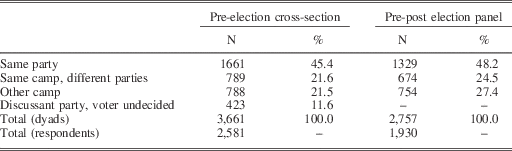
Our analysis applies a dyadic perspective. Its units of analysis are pairs of voters and discussants.Footnote 70 Our active dataset is restricted to cases for which our research question is substantially meaningful – that is, dyads in which the respondent in the pre-election wave (1) stated a preference for one of the five parties in the federal parliament on the part of his or her discussant and (2) stated an intention to vote for one of these parties or was undecided. Respondents who did not engage in any political conversations (and who thus had no one to influence them) could not be included in the analysis. For the same reason, dyads in which respondents did not receive partisan communications from discussants had to be excluded.Footnote 71 Dyads in which respondents were likely or certain non-voters also had to be excluded from the models. The resulting number of dyads available for the cross-sectional analyses was 3,661 and 2,757 for the panel analyses (corresponding number of respondents: 2,581 and 1,930).Footnote 72
Dependent Variables
Our analysis includes four dependent variables: two cross-sectional, based on pre-election data on vote intentions, and two with a pre- and post-election panel structure, which take into account respondents’ actual party choices. They are based on comparisons between discussants’ perceived pre-electoral party preferencesFootnote 73 and respondents’ own vote intentions (cross-section) or recalled vote choices (panel). One cross-sectional and one panel variable register whether or not a voter favoured a party of the same ideological direction as the one supported by his or her discussant.Footnote 74 The two ideological camps consist of parties situated to the right of centre (CDU/CSU and FDP) and left of centre (SPD, Greens and Left). The other two dependent variables refer only to dyads that are homogenous in terms of parties’ ideological direction and differentiate by whether or not voters supported the same party as their respective discussants.Footnote 75
Strategy of Analysis
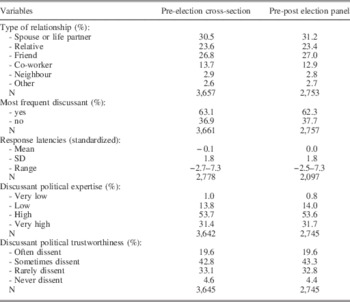
A survey-based study of discussant influence like ours has to deal with a number of methodological challenges. Following Fowler et al., establishing causality requires safeguards against several potential fallacies.Footnote 76 The first is unrepresentative egocentric network data. Smaller networks like those analysed in our study run the risk of unwarranted generalization to the entire universe of voters’ politically relevant associates. Information on discussants beyond the second one was not elicited in our study, and it is unclear whether the findings are generalizable beyond the first and second discussants. However, comparative studies suggest that German voters’ discussant networks are, on average, rather small.Footnote 77 Moreover, our data display substantial variation in all discussant attributes relevant for our study (Table 1), and the distributions largely conform to those registered on the basis of network generators allowing for more discussants.Footnote 78 We are therefore confident that the information loss caused by truncated networks does not significantly bias our findings.
Descriptives for Main Independent Variables

The second problem is misperception of discussant attributes. It concerns only those attributes for which, for theoretical reasons, true (rather than perceived) states are expected to be relevant for political behaviour,Footnote 79 in particular discussants’ party preferences.Footnote 80 Regarding discussants’ electoral preferences, American research based on snowball samples found some evidence of projection, leading to perceptions that are biased toward the respondents’ own preferences. But overall accuracy has nonetheless been found to be quite high.Footnote 81 Similar findings have been recorded by German snowball studies, with one important difference: German voters display a marked tendency to evade with ‘don’t know’ answers when in doubt about discussants’ true electoral preferences.Footnote 82 Dyads in which this is the case cannot be included in our analysis, which diminishes the risk that our findings are confounded by projection.
The third problem concerns the possibility of selection biasFootnote 83 as a consequence of the homophily principle, which predicts that similar individuals will seek each other out as interaction partners.Footnote 84 Either through politically motivated choices, or by accident as a by-product of selection on other attributes that are correlated with political affinities, this may lead to electoral agreement between voters and discussants. However, several recent long-term studies suggest that at least the amount of direct political selectivity reflected in dyadic similarities is rather small in comparison to influence. For most people, politics does not seem to be a major concern in discussant choice, but once connected members of social networks begin to converge in their party or candidate preferences.Footnote 85 In addition, it must be kept in mind that the availability of like-minded associates depends on supply. Many voters will not be able to construct congenial networks, despite trying, since selectivity is constrained by the composition of the contexts out of which discussants can be chosen.Footnote 86 Although not unequivocal, the state of research is thus encouraging with regard to our interpretation of electoral agreement as a result of influence rather than selection.
Nonetheless, our analysis needs to take precautions against the possibility of reciprocal causation in order to build a strong case for testing our theory of discussant influence. As McClurg recently pointed out, there is no single ideal solution to this problem; researchers can usually only resort to an approach ‘akin to building a circumstantial case’:Footnote 87 to use the available data in a way that rules out alternative interpretations as far as possible, even if some residual ambiguity remains. In particular, this requires controlling for demographic attributes and basic political orientations that may lead respondents to select people with similar attributes as interaction partners.Footnote 88 However, this strategy of course cannot be considered fully equivalent to randomization and experimental designs, since there is always the possibility of systematic confounders being excluded from the model because they are unmeasured or even unknown. As an additional safeguard to reduce the potential ambiguities of our findings, we therefore rely not only on cross-sectional but also on panel analysis with lagged dependent variables when modelling social influence. The panel approach is much less vulnerable to both reciprocal causation and projection problems, since it models change, rather than static relationships.Footnote 89 The panel models essentially tell us which factors strengthen or weaken the likelihood that voters will converge toward the preferences previously demonstrated by their discussants. Since there was rather little overall turnover during the campaign (11 per cent for the same camp condition, 8 per cent of which was convergent; 16 per cent for the same party condition, 10 per cent of which was convergent), these models pose a particularly tough test for our hypotheses (see Table 2 for marginals). Arguably, they underestimate the true amount of electoral influence, since they register only short-term movements during the last weeks of the campaign. This concerns in particular the hypothesized first stage of the decision process, which we see as a continuous long-term process of which our panel data can provide only a quick snapshot. In contrast, the cross-sectional analyses indicate upper bounds of effect sizes, albeit with less certainty, as they are possibly more strongly affected by selection and projection bias.
Party Preferences in Dyads

Our analysis proceeds in three steps. Using probit analysis, we first model whether voters supported parties from the same or the opposite ideological camp as their respective discussants. In the second step we model the probability of supporting the same or different parties, given the same ideological direction. Dyads in which voters and discussants favour parties from opposite ideological camps are excluded at this stage.Footnote 90 To assess the validity of our hypotheses we need to compare these two models with regard to the strength of the estimated effects – this is the third and most important step of the analysis. All effects should be statistically relevant, but some of them in the first model, and others in the second. In limited dependent variable models this is not as straightforward as in the linear model, because the regression slopes may be affected by unobserved heterogeneity.Footnote 91 Therefore we calculate population averaged marginal effects (AME) and discrete differences following the observed-value approach as recommended by Hanmer and Kalkan.Footnote 92 These quantities are not affected by unobserved heterogeneityFootnote 93 and offer an intuitive interpretation, indicating the average increase in the probability of Y=1 given a one-unit change in X. In addition, from generating the marginal effects via the simulation method we automatically get bounds of uncertainty not merely for these quantities but also for derived differences in effects between the two models (differences and corresponding 95 per cent confidence intervals are displayed in the last two columns of Tables 3 and 4). This allows us to test whether the impact of the various independent variables varies significantly between the models that represent the two stages of our process model.
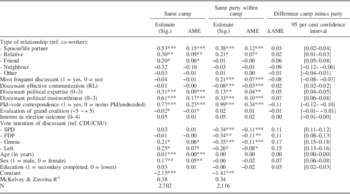
Moderators of Discussant Influence: Cross-Sectional Models (Probit Estimates for Dyads)

Note: The AME for dummy variables indicates the discrete change from the base level. ∆AME is the difference in AME between the camp and the party model; the 95 per cent confidence interval indicates whether this difference significantly differs from zero. *p<0.05; **p<0.01; ***p<0.001 (cluster-robust standard errors).
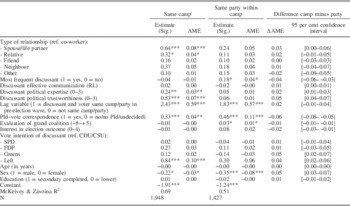
Moderators of Discussant Influence: Panel Models (Probit Estimates for Dyads)

Note: The AME for dummy variables indicates the discrete change from the base level. ∆AME is the difference in AME between the camp and the party model; the 95 per cent confidence interval indicates whether this difference significantly differs from zero. * p<0.05; ** p<0.01; *** p<0.001 (cluster-robust standard errors).
Independent Variables
To test our hypothesis about the relevance of different types of relationships, we include dummy variables in the models for the following relationships: spouses (including life partners), relatives and friends as primary relationships, and neighbours as well as the residual category of ‘other’ relationships as secondary relationships. Another secondary relationship, co-workers, serves as the implied reference category.Footnote 94 Our measure of the frequency of political conversations is a dummy variable indicating whether the respective discussant was the person to whom respondents talked most often about politics and thus was named first in the network (coded 1), or not (0).
To test the extent to which effective communication on the part of a discussant increases his or her electoral influence, we refer to response latencies with regard to respondents’ reports on discussants’ vote intentions – that is, the time it took respondents to reproduce these preferences during interviews. A swift response to this question indicates easy accessibility of the discussant’s vote intention in the respondent’s memory. This measurement is based on the assumption that the unambiguousness of the discussant’s electoral preference is reflected by the strength with which the mental concepts of a discussant and a party are associated in the long-term memory of a respondent. If a discussant expresses a party preference with great clarity, a strong mental association between person and party can be established that can be easily – and thus quickly – retrieved during an interview.Footnote 95
Discussants’ perceived political expertise is measured by a question asking how well the respective discussant was versed with regard to political matters (0=not at all, 1=not so well, 2=well, 3=very well). In line with Downs’ and Lupia and McCubbins’ claim that voters assess discussants as politically trustworthy if they share their general political worldviews, we refer to respondents’ overall assessments of the frequency of opinion differences during political conversations (0=often, 1=sometimes, 2=rarely, 3=never) to measure discussants’ perceived political trustworthiness. Dissent during political talks signals to a voter that this discussant is not on the same political wavelength and therefore should not be listened to, whereas its absence indicates that he or she is a political soulmate whose electoral advice can be confidently followed.Footnote 96 Table 1 provides descriptives for all independent variables, based on the dyads available for the cross-sectional and panel analyses, respectively. It shows that panel attrition has affected the distributions remarkably little.Footnote 97
Control Variables
In addition to discussant influence, electoral similarity between voters and their discussants can also be a consequence of actively seeking out like-minded discussants. Political predispositions in the sense of stable identities deeply rooted in voters’ personalities are the most important potential motivators of political selectivity. To the degree that associates are chosen on political terms, two types of identities can be expected to be of particular importance in Germany: partisanship and ideology.Footnote 98 To control for the potential impact of party attachment, we include in our models a dummy variable that indicates whether respondents supported a party at the ballots with which they identified (coded 1), or not (0=out-party voting, independent or undecided).Footnote 99 To assess the role of ideological identification with regard to selectivity, a standard left-right scale, folded at the midpoint, would be ideal. Unfortunately, this instrument is not available in our dataset. As a proxy we use a thermometer scale for respondents’ feelings regarding a grand coalition as a possible outcome of the upcoming election (scaled −5 to +5); using other data it can be shown that such an alliance between the parties dominating the two ideological camps is most popular among centrist voters.Footnote 100
Political interest (five-point scale from 0=‘outcome of election considered as personally not important at all’ to 4=‘very important’) is included to account for the reception and processing of campaign information from other sources than social communication. Moreover, the models contain a bloc of dummy variables indicating which party the respective discussant preferred (SPD, FDP, Greens, Left; implicit reference category: CDU/CSU). This accounts for differential opportunities to get in touch with supporters of parties in accordance with the parties’ varying sizes.Footnote 101 Furthermore, respondents’ demographic characteristics – age (in years), sex (1=male, 0=female) and education (1=secondary education completed, 0=lower education level) – are taken into account as control variables. Finally, the dependent variables of the cross-sectional models are added to the panel models as additional controls.Footnote 102
RESULTS
Discussant influence is highly conditional. Under some circumstances it becomes particularly pronounced, while under others it is attenuated.Footnote 103 From the specific patterns such conditionalities assume, we can infer the relevance of the two mechanisms of discussant influence at the various stages of the decision process.Footnote 104 Our expectation is that social pressure should be more evident at the first stage, when ideologically coherent consideration sets are formed, while patterns indicating the effects of shared information should more strongly characterize the second stage, when a particular party is chosen out of this limited set of alternatives. Table 3 shows the results of the cross-sectional models, and Table 4 the corresponding estimates from the panel models. Both tables contain the same two blocs of independent variables. Types of relationships are included to indicate the role of social pressure. The frequency of political conversations and the clarity of communicated messages as well as the perceived political expertise and trustworthiness of discussants indicate the importance of information sharing.
Before looking at our findings in detail, it is important to note that our analysis confirms all premises from which we developed our hypotheses. Discussant influence at elections does indeed vary by the type of relationship, but also by the frequency of political conversations and the clarity of communicated messages, as well as the perceived political expertise and trustworthiness of discussants. Hence, like previous studies we find evidence for both mechanisms of discussant influence. However, testing our hypotheses requires moving beyond these basic observations by inspecting the differences between the first and second stages of the decision process.
Larger AME estimates for primary than for secondary relationships suggest that social pressure is stimulating voters to bring their electoral preferences in line with those of their discussants. In contrast, if information sharing is the operating mechanism of discussant influence, ‘there should be no heterogeneous effects based on the intensity of personal relationships’.Footnote 105 However, both the cross-sectional and panel analyses find significant differences of that kind. In most analyses, voters’ preferences are much more likely to correspond to those of their spouses than to secondary relationships (which do not differ between themselves). Three out of four models also indicate the particularly influential role of relatives, although to a lesser degree than spouses. Friends differ from secondary relationships only in the cross-sectional model that predicts preferences for a party of the same ideological camp, and the effect is weaker again than for relatives.
Importantly, according to Table 4, the likelihood that voters will converge in their choices to the parties preferred by their discussants instead of sticking with another, ideologically adjacent party is not affected by the nature of relationships, whereas movements toward parties from the same ideological camp appear to be responsive to relationships. Coming from panel models, these observations are especially robust, and they are well in line with Hypothesis 1. But to test this expectation properly we need to compare the patterns of relationships across the two stages of the decision process. If Hypothesis 1 is correct, we should see significantly larger differences between primary and secondary relationships for the first stage than for the second stage. In other words, the difference between intimate and functional relationships with regard to voters’ likelihood to conform to their discussants should be more sizable for the distinction between voting for a party of the same and not the opposing ideological direction than for the distinction between voting for the same party and favouring another party from the same camp.
For both spouses and relatives such a pattern is indeed registered by the cross-sectional and in particular also the panel analysis. For friendships our finding is similarly clear-cut only in the cross-sectional model. While friends’ influence appears considerably stronger than that of co-workers at the first stage of the decision process, no such difference is found for the second stage. Correspondingly, the difference between the two models is even larger for friends than for spouses and relatives. However, friendship does not appear to spur short-term change toward parties of the same ideological leaning more strongly than workplace ties. Overall, Hypothesis 1 is thus clearly confirmed for two of the three types of primary relationships distinguished in our analysis, but less unambiguously so for friendship. That our short-term panel analysis supports our expectation of stronger effects in the first step of decision-making for spouses and relatives is particularly remarkable since our theory assumes this step to be rather long term in nature. Table 4 suggests that the mechanism of social pressure exerted within these relationships also works on the short run, although probably less massively than on the long run.
The other independent variables in the models concern aspects of information sharing between discussants and voters. These effects should be stronger for the second stage of the decision process, when voters make up their minds about which party to choose from those contained in their consideration sets. As Tables 3 and 4 show, the likelihood of voters adopting the preferences of their discussants indeed appears higher when politics is discussed more often, but only for voters’ decisions between the same party that their discussant supports and other parties from the same ideological camp. This suggests that information sharing and concomitant learning on the part of voters play not only a less important role, but are in fact irrelevant at the first stage of decision making, which is well in line with Hypothesis 2a. This result is clearly confirmed by the panel analysis and is thus particularly robust.
The expectation that effective communication on the part of discussants increases the likelihood of adopting their electoral preferences at the second stage of decision making is confirmed by the cross-sectional analysis. That the clarity of communication appears to be an important facilitator of electoral influence at that stage – but not at the previous one, when consideration sets are demarcated – is in accordance with Hypothesis 2b. It is another indication that in multiparty systems, discussant influence via information sharing is more characteristic of the second than the first stage of electoral decision making. However, this evidence is less robust, as it does not show up in the panel analysis.
Hypotheses 2c and 2d expect similar patterns with regard to discussants’ perceived political expertise and trustworthiness. In line with extant research, Tables 3 and 4 show that discussants who are endowed with substantial political knowledge exert considerably more influence than those with lower expertise. The degree to which discussants are deemed politically trustworthy appears to be an even more important condition for electoral influence. However, comparing models, we see that the pattern is opposite to the one expected by our hypotheses, which are thus disconfirmed. In both the cross-sectional and panel models, the effects of discussants’ political expertise and trustworthiness are stronger for the first than for the second stage of decision making. One possible reason for this unexpected outcome is that these two indicators might be less clearly related to information sharing as a mechanism of discussant influence than we assumed. To test for this possibility, we ran additional models (tables not shown) without these two indicators, which considerably strengthened the effects connected to types of relationships. While this cannot fully explain our unexpected findings, it suggests that as moderators of discussant influence, these variables are not sufficiently clearly indicative of processes of information transfer. They seem to confound the two mechanisms of discussant influence. Their operational utility for differentiating these mechanisms thus appears questionable.
In sum, when modelling German voters’ electoral decision making in two stages, one delimiting a range of electable parties that is constrained to the same ideological direction and the other determining which party from this restricted set is ultimately chosen, discussant influence appears relevant at both stages. However, different mechanisms of influence seem to characterize the two steps. Our evidence on these mechanisms is mostly, though not unequivocally, in line with our hypotheses. The expectation that social pressure is more important at the first stage is clearly confirmed, especially for spouses and relatives. Support for the proposition that information sharing is more important at the second stage is not quite as unambiguous. With regard to two of the relationships that indicate information sharing as a mechanism of influence – concerning the intensity and clarity of the discussants’ political communication – the expected patterns emerged. However, possibly at least in part due to an ambiguous quality of these two predictors as indicators for distinguishing the two mechanisms of discussant influence, our findings concerning discussants’ political expertise and trustworthiness are not in line with our expectations.
CONCLUSION
Extant research into discussant influence at elections has been dominated by studies from the United States in two ways. First, a large majority of existing analyses has focused on candidate elections in the American two-party system. More importantly, studies of elections in other countries have, with few exceptions, adopted this research as a model and conceptualized discussant influence in the same way. The specific institutional settings of these contexts have rarely been taken into account. With regard to West European democracies, it is therefore unclear how the specific conditions of cleavage-based and ideologically structured multiparty systems, which are characterized by typical patterns of opposition and affinity between parties, moderate discussant influence. Another shortcoming of the existing literature concerns the relationship between different mechanisms of discussant influence. Both cognitive and affective mechanisms appear important, but when (and under which conditions) is not clear.
We have sought to address both deficiencies by developing a two-stage theory of discussant influence in West European multiparty systems. In essence it is derived from two theoretical building blocs. The first is the idea that in multiparty systems voters decide in a stepwise fashion, first narrowing down the range of alternatives to a set of parties from one side of the ideological spectrum and then choosing a party out of this restricted set.Footnote 106 This construal of electoral decision making is linked to the two dominant views on the mechanisms of discussant influence at elections: that voters comply with social pressure exerted by significant others, and that they learn from information provided by persons with whom they interact.Footnote 107 Our theory of stepwise discussant influence maintains that social pressure and ensuing conformity are especially important at the first stage of the electoral decision process, when they lead voters to eliminate all parties from their consideration set that do not belong to the same ideological camp as the party supported by their discussants. It further contends that at the second stage, when a choice has to be made out of this restricted set of ideologically coherent parties, alternatives need to be weighed up more carefully and systematically so that useful information provided by discussants becomes more important as a basis for their influence at that stage. We construe the first stage as a process that is rather long term, potentially spanning entire electoral cycles and driven by the continuous interaction of voters with members of their social networks, whereas the latter is rather short term and is primarily fuelled by voters’ political conversations during campaigns.
Using the German federal election of 2009 as an example, we subjected this theory to an empirical test. To develop a test criterion for distinguishing between the two mechanisms of discussant influence, we adopted a logic proposed by SinclairFootnote 108 and referred to implied patterns of moderating factors that can be considered typical for each of them. Our findings were mostly in line with the expectations derived from our two-stage theory.
Primary relationships appeared as important facilitators of discussant influence, especially at the stage when consideration sets are formed by excluding parties from the ‘wrong’ ideological camp. This suggests that social pressure is more important at the first stage of electoral decision making than at the second. In multiparty systems, social pressure is of particular importance when voters narrow the range of electable alternatives down to ones that are ideologically acceptable to discussants. Importantly, these findings emerged even in our short-term panel analysis, although our theory assumes these processes to be predominantly long term in nature. Since we applied a fine-grained lens at differences between relationships, we were additionally able to show that the various types of primary relationships are not equivalent. Spouses appeared particularly important, followed by relatives, whereas findings were somewhat ambiguous for friends. At least in the short run, social pressure among friends does not seem to spur convergence to parties from the same ideological camp. Perhaps friendship, as an archetypical chosen relationship, is more strongly affected by selection bias. In any case, simply subsuming these three types of relationships to the global category of ‘strong ties’ would neglect important differences with regard to discussant influence.Footnote 109
Regarding influence via social information flows, on the other hand, strong moderating effects were expected for factors directly related to social communication. Frequent political talksFootnote 110 and the clarity of discussants’ political communicationsFootnote 111 indeed appeared to facilitate discussant influence at the stage of party choice, but not with regard to the formation of consideration sets. Voters also appeared particularly open to influence from discussants deemed particularly knowledgeable and trustworthy.Footnote 112 But here the observed patterns were contrary to our expectations, since they were more marked for the first than for the final stage of decision making. However, this may be due in part to ambiguities about the discriminative quality of these indicators with regard to the two mechanisms of discussant influence. Overall, our results provide strong (though not fully unequivocal) support for the assumption that information sharing is a particularly important mechanism of discussant influence when it comes to deciding which party to support at the ballots out of those contained in voters’ pre-filtered consideration sets.
Clearly, our study is not without limitations. Most notably, its evidence could not be derived from direct observation of the two processes of social influence, but from their implications. Our measures indicate qualities of relationships, interactions, and communications between respondents and discussants, but it would be desirable to also be able to register the specific content conveyed during political conversations. However, such data are difficult to come by, and large-scale surveys may be too crude for that purpose. In order to get more precise readings of what happens between citizens when they influence one another, it seems more promising to combine surveys with qualitative methods, such as focus groupsFootnote 113 or participant observation,Footnote 114 and with experimental evidence.Footnote 115 More direct evidence would also be welcome with regard to our contention that voters decide in stages with different temporal logics. Our results are suggestive, but in order to observe how voters’ decision processes evolve over time, data that combine short- and long-term panel waves would be necessary. In addition, more extensive measures for voters’ egocentric networks would be welcome, encompassing a larger number of discussants with more personal and relational attributes, ideally enriched with snowball surveys of discussants.Footnote 116
Arguably, the most serious limitation of our study is its restriction to one country. The scope of our theory extends to parliamentary elections in all multiparty systems in which parties are arrayed on the left-right continuum as the single-most important dimension of organizing political conflict. As soon as several electorally important parties can, with some constancy, be located on either side of the ideological spectrum (and provided left-right identities are a meaningful element of citizens’ political personalities), the sequential social influence processes outlined by our theory should be observable at elections. This clearly pertains to most West European democracies, where such systems grew out of socio-political cleavages dating back several centuries.Footnote 117 Whether other attributes of party systems also moderate these processes,Footnote 118 and whether similar processes can also be expected in multiparty systems in other parts of the world, is open to further theorizing and empirical inquiry.