Introduction
The effect of age on the way people deal with stress – their style of coping – is at the heart of a controversy. According to some authors, elders tend to adopt more passive forms of coping to deal with stress, avoiding aversive situations and distancing themselves from the problems they encounter (Diehl, Coyle, & Labouvie-Vief, Reference Diehl, Coyle and Labouvie-Vief1996; Folkman, Lazarus, Pimley, & Novacek, Reference Folkman, Lazarus, Pimley and Novacek1987). These authors suggest that such strategies are the most effective way to cope with stressors encountered in later life, including chronic stressors, such as medical problems and the loss of friends or relatives (Aldwin, Sutton, Chiara, & Spiro, Reference Aldwin, Sutton, Chiara and Spiro1996; Heckhausen, Dixon, & Baltes, Reference Heckhausen, Dixon and Baltes1989; Smith, Reference Smith2003). However, other researchers have argued that age itself does not necessarily influence a style of coping (Aldwin et al., Reference Aldwin, Sutton, Chiara and Spiro1996; McCrae, Reference McCrae1982) and that there are no normative changes in coping with age. This view regards changes in elders’ coping styles to be adaptive responses to age-related changes in self-beliefs and environmental pressures (Folkman et al., Reference Folkman, Lazarus, Pimley and Novacek1987). Hence, age would not directly predict coping; rather, it would constitute a risk factor for changes in self-referred beliefs and the nature of stressors, which in turn prompt changes in coping style.
This assumption is supported by studies that have shown a significant decrease in the effect of age on coping when the type of problems encountered by subjects was statistically controlled (Aldwin et al., Reference Aldwin, Sutton, Chiara and Spiro1996). In a more recent study, Trouillet, Gana, Lourel, and Fort (Reference Trouillet, Gana, Lourel and Fort2009) found that age only predicted changes in coping resources, including declines in social support satisfaction and increases in levels of perceived stress. Social support satisfaction and perceived stress predicted an increased use of emotion-focused coping, that is, attempts to control internal stress by avoiding stressful situations or by positively reappraising aversive situations. Self-efficacy was not affected by age, and it positively predicted the use of problem-focused coping – that is, efforts to actively reduce stress by collecting information, evaluating available means, and determining the ways – to solve problems (Trouillet et al., Reference Trouillet, Gana, Lourel and Fort2009). If age were a risk factor for the use of emotion-focused coping, elders’ abilities to shift from passive to more active forms of coping would ultimately depend on the make-up of their coping resources.
Although most previous studies explained changes in coping with age as reflecting a process of adaptation to changes in the nature of stressors, social relationships, or self-referred beliefs, they underestimated the role of cognitive resources. The present study tested the hypothesis that age, coping resources (i.e., perceived stress, self-efficacy) and cognitive resources (i.e., mental flexibility, working memory) are predictors of coping. In this study, coping resources refers to the participants’ perceptions of both the stressfulness of their life (i.e., perceived stress) and their ability to successfully solve problems (i.e., self-efficacy). Cognitive resources refer to the mental resources needed to achieve effortful mental tasks (discussed later), and coping is defined as the person’s cognitive and behavioral efforts to deal with current or anticipated negative, demanding, or challenging events (Lazarus & Folkman, Reference Lazarus and Folkman1984). We used structural equation modeling (SEM) to evaluate the fit between our data and this new theoretical model.
Our model combines elements of a recent theoretical model depicting the relationships between age, coping resources, and coping (Trouillet et al., Reference Trouillet, Gana, Lourel and Fort2009), and the information processing theory of cognitive resources (Park, Reference Park, Park and Schwarz2000). Trouillet et al. (Reference Trouillet, Gana, Lourel and Fort2009) proposed a model in which age positively predicted perceived stress but did not significantly predict problem-focused or emotion-focused coping. Self-efficacy was unrelated to age. Self-efficacy had been defined as a personal resource factor that may facilitate active and positive forms of coping when actions are pre-shaped and efforts are invested to solve problems (Schwarzer, Boehmer, Luszczynska, Mohamed, & Knoll, Reference Schwarzer, Boehmer, Luszczynska, Mohamed and Knoll2005). Self-efficacy predicted an increase in problem-focused coping (Luszczynska, Scholz, & Schwarzer, Reference Luszczynska, Scholz and Schwarzer2005; Trouillet et al., Reference Trouillet, Gana, Lourel and Fort2009). Perceived stress predicted an increase in emotion-focused coping but a decline in problem-focused coping (Cacioppo, Hughes, Waite, Hawkley, & Thisted, Reference Cacioppo, Hughes, Waite, Hawkley and Thisted2006; Rascle, Reference Rascle2000).
According to the information processing theory of cognitive resources (Park, Reference Park, Park and Schwarz2000), cognitive resources refer to the mental resources needed to carry out effortful mental tasks and everyday activities involving decision making, problem solving, or dealing with unfamiliar problems. Thus any age-related decline in cognitive performance is attributed to general processing inefficiencies (Salthouse, Reference Salthouse1988) that affect a number of cognitive resources, including processing speed, working-memory capacity, and inhibitory function.
Coping efforts are assumed to rely on two aspects of information processing – attentional resources and selectivity of attention – therefore, they would solicit the aforementioned types of cognitive resources (Matthews & Wells, Reference Matthews, Wells, Zeidner and Endler1996). Attentional resources and selectivity of attention enable people to retrieve relevant information from long-term memory and to maintain this information in the working memory, thereby allowing them to select the most suitable way to cope with stressors. Matthews and Wells (Reference Matthews, Wells, Zeidner and Endler1996) have argued that high levels of cognitive resources would predict the use of task-focused coping strategies (the most resource demanding) and that low levels of cognitive resources predict the use of avoidance strategies (the least resource demanding). Such assumptions are supported by studies of patients suffering from traumatic brain injury, in which the efficiency of executive functions (e.g., working memory) was found to predict the use of planful problem-solving coping strategies. A decline in the efficiency of executive functions (e.g., working memory, mental flexibility) predicted an increase in the use of emotion-focused coping (Krpan, Levine, Stuss, & Dawson, Reference Krpan, Levine, Stuss and Dawson2007). Similarly, the severity of executive (e.g., working memory) and mnemonic (e.g., recall and recognition performance on verbal memory tasks) deficits in schizophrenia were associated with a decline in the use of active forms of coping to adapt to mental illness (Wilder-Willis, Shear, Steffen, & Borkin, Reference Wilder-Willis, Shear, Steffen and Borkin2002).
A second study failed to show such links between executive functions and coping in schizophrenia patients, but this result had been attributed to methodological shortcomings (Bak et al., Reference Bak, Krabbendam, Delespaul, Huistra, Walraven and van Os2008). To date, the links between coping and cognitive resources have been empirically tested on clinical populations suffering from mental diseases or brain injuries, and it remains difficult to apply such results to other populations. Our study was designed to address this issue by exploring if age-sensitive cognitive resources depicted as determinants of coping (i.e., working memory and mental flexibility) would affect coping strategies in association with age.
The just-cited studies shed light on the predictive value of two main cognitive resources for coping: working memory efficiency (i.e., the ability to keep active and retrieve information in the long-term memory) and mental flexibility (i.e., the ability to switch from one set of active information to another). These two cognitive resources, which allow people to select the set of cognitions and behaviors needed to successfully cope with stressors, are age sensitive (Charlton et al., Reference Charlton, Landau, Schiavone, Barrick, Clark and Markus2008). A decline with age in working memory is caused by impairments to specific types of inhibitory processes, including a decline in elders’ abilities to suppress, during the recall phase, targets previously learnt in a memory task – as shown by the directed forgetting paradigm (Zacks, Radvansky, & Hasher, Reference Zacks, Radvansky and Hasher1996). Furthermore, age is associated with a decline in the ability to switch from one type of information to another, as has been shown using switching-tasks in which participants were presented with a list of numbers and asked to work through the list, switching between addition and subtraction. The cost of switching increased with age and was estimated by comparing response latencies for mixed addition and subtraction blocks with response latencies for pure blocks of addition or subtraction (for a review, see Verhaeghen & Cerella, Reference Verhaeghen and Cerella2002).
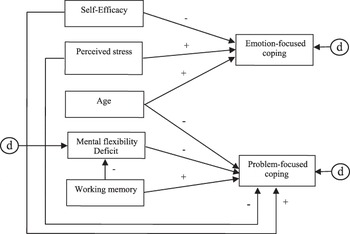
To study how age, coping resources, and cognitive resources predicted coping, we tested a structural model combining exogenous variables (i.e., age, self-efficacy, perceived stress, working memory, and mental flexibility) and endogenous variables (i.e., coping strategies). For the purpose of this study, an exogenous variable is conceived as a predictor explaining a part of the endogenous variable’s variance. Age was expected to predict a decline in problem-focused coping and an increase in emotion-focused coping (Brandstädter & Rothermund, Reference Brandtstädter and Rothermund2002; Diehl et al., Reference Diehl, Coyle and Labouvie-Vief1996; Folkman et al., Reference Folkman, Lazarus, Pimley and Novacek1987). Perceived stress was expected to predict an increase in emotion-focused coping but a decline in problem-focused coping (Yancura, Aldwin, Levenson, & Spiro, Reference Yancura, Aldwin, Levenson and Spiro2006). Self-efficacy was expected to positively predict problem-focused coping but negatively predict emotion-focused coping (Rascle, Reference Rascle2000). Problem-focused coping was expected to be negatively predicted by mental flexibility deficit but positively predicted by working-memory capacity (Krpan et al., Reference Krpan, Levine, Stuss and Dawson2007; Matthews & Wells, Reference Matthews, Wells, Zeidner and Endler1996; Wilder-Willis et al., Reference Wilder-Willis, Shear, Steffen and Borkin2002). Additionally, given the strength of the links between cognitive resources, working memory was expected to predict a decrease in the deficit of mental flexibility (Oosterman et al., Reference Oosterman, Vogels, van Harten, Gouw, Poggesi and Scheltens2010).
Method
Sample and procedure
Participants in the present study were 137 community-dwelling subjects (55 males and 82 females) with a median age of 44 years and a mean age of 46.16 years (SD = 20.55, age range 20–90). We recruited the youngest subjects from a population of French students. The older subjects were neighbors of the students or recruited from organizations for seniors. All participants lived independently in large cities in the south of France. Most were either students (23%) or workers (74%). Of the participants, 54 per cent lived as couples and 46 per cent were single. None of the participants reported having been diagnosed with any psychiatric disorders (e.g., depression), neurodegenerative diseases, or as taking any medical treatments for such disorders.
The changes with age in coping styles were expected to be a response to the changes in stressor prevalence and nature (Aldwin et al., Reference Aldwin, Sutton, Chiara and Spiro1996; Smith, Reference Smith2003). Heckhausen et al. (Reference Heckhausen, Dixon and Baltes1989) have described an age-related pattern involving expected gains (i.e., increase in cognitive efficiency) and expected losses (i.e., increase in health problems) across the adult life span. The expected losses increased from 20 to 60 years, remained quite stable from 60 to 69 years of age, and dramatically increased thereafter. Therefore, to study how changes in coping may be related to changes in age and related psychological resources, we needed to recruit participants from 20 to 60 years old and participants aged 70 and older. For this purpose, our sample comprised three subgroups including: (a) young adults (n = 58) from 20 to 38 years old (M = 26.10 years, SD = 5.67); (b) adults (n = 40) from 41 to 59 years old (M = 48.70 years; SD = 6.12); and (c) old adults (n = 39) from 70 to 87 years old (M = 73.38 years; SD = 6.58). Such categories of age were used only for recruitment purposes, and age was treated as a continuous variable in our statistical analyses.
The rating procedure took place during interviews where the participants were informed that the study was voluntary and anonymous.
Measures
Coping
We used the French version (Cousson, Bruchon-Schweitzer, Quintard, Nuissier, & Rascle, Reference Cousson, Bruchon-Schweitzer, Quintard, Nuissier and Rascle1996) of the Way of Coping Checklist (WCC) self-questionnaire (Vitaliano, Russo, Carr, Maurio, & Becker, Reference Vitaliano, Russo, Carr, Maurio and Becker1985), which uses 27 items to rate three dimensions of coping on 4-point Likert scales. Ten items rate problem-focused coping (e.g., “I planned actions and followed this plan”); nine items rate emotion-focused coping (e.g., “I tried to forget everything”); and eight items rate social-support seeking (e.g., “I tried to not isolate myself”). In the study by Cousson et al., internal consistency values were satisfactory for all three dimensions of the questionnaire (Cronbach α ≥ .70) (Nunnaly, Reference Nunnaly1978). We performed separate confirmatory factor analyses (CFA) for the problem-focused and emotion-focused scales. Our results showed a good fit between the data and both emotion-focused coping (Bentler Comparative Fit Index [CFI] = .98; root mean square of approximation [RMSEA] = .03) and problem-focused coping (CFI = .99; RMSEA = .01).
Self-efficacy
We used the French version of the General Self-Efficacy Scale (GSE), which comprises 10 items, rated on 4-point Likert scales ranging from “not at all true” to “completely true”. The psychometric qualities of this scale are satisfactory (Scholz, Guttiérez-Doña, Sud, & Schwarzer, Reference Scholz, Guttiérrez-Doña, Sud and Schwarzer2002). In this study, the corrected item-total correlations varied between .39 and .65 and the estimate of internal consistency was satisfactory (Cronbach α = .82) (Nunnaly, Reference Nunnaly1978). The one-dimensional structure of the scale was revealed by exploratory factor analyses and confirmed by confirmatory factor analyses. Our CFA analyses confirmed previous results showing the validity of the GSE (CFI = .99; RMSEA = .01).
Perceived Stress
The Perceived Stress Scale (PSS) was developed by Cohen, Kamarck, and Mermelstein (Reference Cohen, Kamarck and Mermelstein1983) and validated in French by Koleck, Quintard, and Tastet (Reference Koleck, Quintard and Tastet2002). The PSS scale provides a global measure of a person’s perception of the stressfulness of a number of events. It consists of a 14-item, 5-point Likert-type questionnaire. In the study by Koleck et al., the one-dimensional structure of the scale was revealed by the exploratory factorial analysis, and the estimate of internal consistency was satisfactory (Cronbach α = .89). In a study by Cohen et al., concurrent validity was verified by highlighting positive correlations between PSS score, depressive symptomatology (r = .76), and a global measure of physical symptoms traditionally viewed as psychosomatic (r = .65). Our CFA analysis confirmed the validity of this single-factor solution (CFI = .99; RMSEA = .01).
Mental Flexibility
The Trail Making Test (TMT) is a measure of attention, speed, and mental flexibility. It was originally part of the Army Individual Test Battery and was recently included in the French Groupe de Reflexion pour l’Evaluation des Fonctions Executives (GREFEX) executive functions battery (Godefroy & Le GREFEX, Reference Godefroy and Le2008). Participants are first asked to draw lines to connect 25 circled numbers in the correct order (Part A). Task requirements are similar for Part B of the test, except that the participants must alternately connect numbers and letters (e.g., 1-A-2-B). Because the executive component of the TMT is obtained by measuring the decline in performance between parts A and B of the test (Strauss, Sherman, & Spreen, Reference Strauss, Sherman and Spreen2006), we needed an index that estimates the cognitive cost of the flexibility instruction. We produced such an index of the mental-flexibility deficit by computing a T score from each participant’s completion time for each part of the TMT (TMTA * TMTB / TMTA + TMTB).
Working Memory
We used standardized scores for the Wechsler Adult Intelligence Scale (WAIS)-III digit-span subtest (Wechsler, Reference Wechsler2000) to assess the efficiency of the participants’ working memory. The task involves repeating sets of digits and is divided into two parts. Participants are first asked to repeat a sequence of numbers in the same order as presented (forward span), and then to repeat the same number sequence in reverse order (reversed span). Participants’ raw scores are obtained by summing the number of sets correctly repeated in the forward and reversed spans; standardized scores are obtained after controlling for the participant’s age.
Statistical Analyses
All SEM analyses were based on the maximum likelihood method and were carried out using AMOS software, version 6.0. Several fit-indexes were used to estimate the models’ adjustment to data. They include the χ2 statistic which is used as a test of significance of the difference between the measurement model and its just-identified version. If a non-significant value of the χ2 statistic is desired, it can be significant in the case of a large sample while the measurement model fits well to the data. For this purpose, we included the χ2/df statistic. In addition, we used the CFI to test the improvement of the adjustment to the data of the researcher’s model in comparison to a null model. A CFI value > .90 is indicative of a well-fitting model. Moreover, we used the RMSEA to evaluate the fit of the hypothesized model to sample data. An RMSEA value of less than .05 indicates a good fit, and values ranging from .05 to .08 represent reasonable errors of approximation (Byrne, Reference Byrne2010). The disturbance associated with observed variables represents error of the prediction of one variable from a second variable. The disturbance is noted as d in the figures.
Given our sample size, the measurement models and path analyses were evaluated separately. We first designed a measurement model for each variable included in the study in order to ensure the variable’s construct validity. In other words, we carried out several separate CFAs to check for links between each psychological construct (factor) and the multiple measures associated with it. Because of the small sample size and only for the purpose of the CFAs, we randomly aggregated the items of the PSS scales in agreement with previous studies (e.g., Trouillet et al., Reference Trouillet, Gana, Lourel and Fort2009). This way, the number of observed variables was adjusted to our sample number, and we obtained valid model identifications. For the PSS, we created seven groups of two items. The CFA results are summarized in Table 1. We then performed a path analysis for the model described above.
Confirmatory factorial analysis (CFA) results

CFI = comparative fit index
df = degree of freedom
GSE = self-efficacy
PSS = perceived-stress (the number of items reflects the number of item-groups comprising two original items each)
RMSEA = root mean square of approximation
WCC = way of coping
Results
Correlations of Model Variables
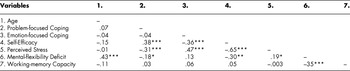
Most of the bivariate correlations were as expected (see Table 2). Age was positively associated with mental flexibility deficit. Problem-focused coping was positively associated with self-efficacy but negatively with perceived stress and mental-flexibility deficit. Emotion-focused coping was negatively associated with self-efficacy but positively with perceived stress. Self-efficacy was negatively associated with perceived stress and mental-flexibility deficit. Perceived stress was positively associated with mental-flexibility deficit. Finally, mental-flexibility deficit was negatively associated with working-memory capacity.
Correlations among variables included in the model (n = 137)

*p < .05; **p ≤ .001; ***p ≤ .0001
Path Analyses
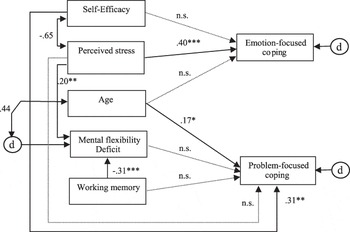
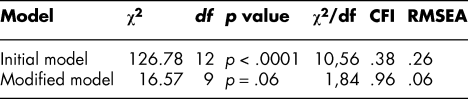
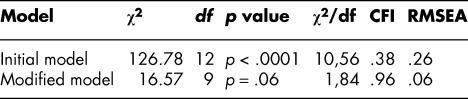
The fit between the initial model (Figure 1) and the sample data was poor (CFI = .38; RMSEA = .26) (see Table 3). To improve the fit, we modified the model in agreement with the modification indices (MI) provided by the software. We selected the following MIs because of their meaning and their values. We first looked at the co-variances to be added in the model. The co-variance between self-efficacy and perceived stress was associated with the highest decrease in the χ2 value and was supported by the postulated predictive value of self-efficacy for changes in stressor appraisal (Bandura, Reference Bandura2001). The co-variance between age and the error term associated with the mental-flexibility deficit was associated with the second highest decrease in the χ2 value. This co-variance was supported by the postulated effect of age on cognitive resources not measured in this study and predicting the mental-flexibility capacity (e.g., executive functions, speed processing) (Oosterman et al., Reference Oosterman, Vogels, van Harten, Gouw, Poggesi and Scheltens2010). Adding these two co-variances improved the model adjustment to the data but a few adjustment indices remained unsatisfactory (CFI = .92, RMSEA = .10). Second, we turned to the regression weights to be added in the model. We retained the path between mental-flexibility deficit and perceived stress because of the deleterious effect of perceived stress on mental flexibility (Renner & Beversdorf, Reference Renner and Beversdorf2010). This model (see Figure 2) exhibited satisfactory adjustment indices (CFI = .96, RMSEA = .06).
Hypothesized model of emotion- and problem-focused forms of coping

Revised model of emotion- and problem-focused forms of coping
*p ≤ .05; **p ≤ .01; ***p ≤ .001

Adjustment to data indicators from path analyses for the initial model and the modified model
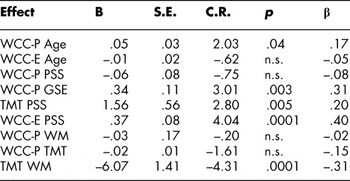
Analyses of the path coefficients (see Table 4) showed that age positively predicted problem-focused coping but did not significantly predict emotion-focused coping. Self-efficacy was found to positively predict problem-focused coping. In addition, perceived stress positively predicted emotion-focused coping and mental-flexibility deficit. Perceived stress did not significantly predict problem-focused coping. In terms of cognitive resources, working memory negatively predicted mental-flexibility deficit. Yet neither working-memory capacity nor mental-flexibility deficit significantly predicted problem-focused coping. The squared multiple correlations (R 2) showed that the predictors of each endogenous variable accounted for 22 per cent of the emotion-focused coping variance and 18 per cent of the problem-focused coping variance.
Relationships among age, cognitive resources, coping resources, and problem- and emotion-focused forms of coping from the modified model path analysis (as shown in Figure 2)

Key:
β = standardized regression coefficients
B = regression coefficients
C.R. = critical ratios
GSE = self-efficacy
n.s. = non-significant
p = p values
PSS = perceived stress
S.E. = standard errors
SSQ = social-support satisfaction
TMT = Mental-flexibility deficit
WCC-E = emotion-focused coping
WCC-P = problem-focused coping
WM = Working memory
Discussion
This research was designed to study the predictive value of age, as well as coping and cognitive resources, for emotion-focused and problem-focused coping. This project was prompted by the lack of knowledge about the role of cognitive resources in the changes experienced in older adults’ coping with age. First, we performed bivariate correlation analyses revealing that the use of problem-focused coping was associated with coping resources (i.e., a decline in perceived stress and an increase in self-efficacy) and a cognitive resource enabling the switch from one set of active information to another. Emotion-focused coping was related only to coping resources including a decrease in self-efficacy beliefs and an increase in perceived stress. Results from the SEM analyses confirmed that emotion-focused coping was predicted by perceived-stress level while problem-focused coping was predicted by age and self-efficacy. Cognitive resources did not significantly predict these two forms of coping.
The results from our study on the predictive value of coping resources for the two forms of coping are in line with the findings of previous studies. Each form of coping was predicted either by self-efficacy or by perceived stress (Cacioppo et al., Reference Cacioppo, Hughes, Waite, Hawkley and Thisted2006; Jopp & Rott, Reference Jopp and Rott2006; Rascle, Reference Rascle2000; Trouillet et al., Reference Trouillet, Gana, Lourel and Fort2009). Our results also confirm the direct relationship between a person’s ability to successfully solve a problem (i.e., self-efficacy) and the use of problem-focused coping (Bandura, Reference Bandura1977). However, the higher the person’s level of perceived stress (i.e., perceiving a problem and its context as a threat), the greater was their recourse to emotion-focused coping. We did not confirm the previously reported link between problem-focused coping and perceived stress (Yancura et al., Reference Yancura, Aldwin, Levenson and Spiro2006). However, we cannot compare these studies because in the present study we assessed the problem-focused coping dimension (i.e., efforts to actively reduce stress and determine the ways of solving problems). Yancura et al. focused on positive coping and negative coping, each method comprised of items with similar emotional valence but reflecting different forms of coping strategies (e.g., positive-action coping comprised problem-focused coping items such as “Focused on managing the problem” and emotion-focused items such as “Told myself to calm down”).
Our results indicated that the use of emotion-focused coping was not significantly predicted by age whereas problem-focused coping increased with age. This last effect highlights that people are not condemned to use only passive or emotion-focused coping strategies but that elders may keep the ability to actively solve stressful problems. Yet, determining the way that age would predict the use of coping implies the need to control several confounding variables including life events (Aldwin et al., Reference Aldwin, Sutton, Chiara and Spiro1996) and the nature of the problems to be solved (e.g., elders tended to use more-passive strategies when facing socioemotional problem situations in comparison to more instrumental strategies – for a review, see Blanchard-Fields, Reference Blanchard-Fields2010). It is possible that we failed to find a significant contribution of age to emotion-focused coping because our sample was too young. It has previously been argued that shifting towards a more emotion-focused coping profile would increase as people age beyond the 70-year mark (Rothermund & Brandtstädter, Reference Rothermund and Brandtstädter2003). In this period of life, they frequently face a significant decline in their physiological and psychological resource availability and need to rely on emotional forms of coping to confront uncontrollable problems. Consequently, the use of emotion-focused forms of coping would only increase when people age past 70 years in order to be more flexible in their goals and to more efficiently deal with daily strains (for a discussion, see Aldwin, Yancura, & Boeninger, Reference Aldwin, Yancura, Boeninger, Aldwin, Park and Spiro2007). Therefore, the effect of age on emotion-focused coping should increase as participants reach age 70 and beyond.
The present study did not confirm a predictive value of cognitive resources for the two forms of coping. Unlike previous studies on coping and cognitive resources, which have focused on subjects with clinical problems ranging from traumatic brain injury to schizophrenia (Krpan et al., Reference Krpan, Levine, Stuss and Dawson2007; Wilder-Willis et al., Reference Wilder-Willis, Shear, Steffen and Borkin2002), our study was based on community-dwelling people. Thus, our results show that the deleterious effects of age on cognitive resources (Charlton et al., Reference Charlton, Landau, Schiavone, Barrick, Clark and Markus2008; Verhaeghen & Salthouse, Reference Verhaeghen and Cerella1997; Zacks & Hasher, Reference Zacks and Hasher1997) are not strong enough to modify elders’ daily activities and coping capabilities. Psychiatric and neurological diseases are likely to significantly increase cognitive impairments, thereby promoting more-passive ways of coping and revealing the involvement of cognitive resources in the ability to cope with stressors. Such results could additionally highlight methodological limits concerning the assessment of coping by the use of questionnaires, which we will discuss.
Bivariate correlations revealed that problem-focused coping was negatively associated with deficits in mental flexibility, but this link was not significant in our multivariate analysis. Thus, it would be too simplistic to conceive of coping as unrelated to cognitive resources in a community-dwelling population, although the links between coping and mental flexibility may be explained by additional variables. In our model, age significantly predicted problem-focused coping and was a co-variate for the error term of mental-flexibility deficits. Therefore, we ask if the link between mental flexibility and problem-focused coping would be in part explained by age and additional age-sensitive cognitive resources not encompassed in this study but which predict mental-flexibility capacity (e.g., speed of processing). Moreover, our results highlight the limited predictive value of cognitive resources for coping. Blanchard-Fields (Reference Blanchard-Fields2010) reported that oldest people tend to more frequently use passive and emotional strategies when they must cope with interpersonal problems such as retirement, the deaths of friends, or nursing home placement decisions, and oldest people more frequently face such problems (Aldwin et al., Reference Aldwin, Yancura, Boeninger, Aldwin, Park and Spiro2007). We can hypothesize that changes with age in coping may be prompted by increases in the prevalence of such socioemotional problem situations. Therefore, our results argue in favor of a socio-cognitive approach to coping in aging.
One of the most important limitations of our current study is the ratio of sample size to the number of variables in the model. This ratio is satisfactory (Kline, Reference Kline1998), but increasing both the sample size and the power effect of the independent variables on the dependent variables in the model would give larger path coefficients. Furthermore, it would be necessary to increase the number of participants older than age 70 to reveal the effects of age and related cognitive resources on coping. In addition, although our results confirmed many of the results reported by Trouillet et al. (Reference Trouillet, Gana, Lourel and Fort2009), the present research can only be regarded as an exploratory study of how cognitive resources predict coping in association with age. Consequently, our results need to be confirmed by further studies to estimate the fit between the model and the data when age is treated as a categorical variable, and to examine changes in path coefficients across distinct age groups (from young people to older adults).
Moreover, an exploratory study by de Souza-Talarico, Chaves, Nitrini, and Caramelli (Reference de Souza-Talarico, Chaves, Nitrini and Caramelli2009) found that Alzheimer’s disease patients tend to select emotion-focused coping, whereas patients with better cognitive performance tend to select problem-focused coping. Hence, future studies should perform a cross-validation using two groups of participants (i.e., healthy elders vs. patients with Alzheimer’s disease) to determine if cognitive resources become significant predictors of coping with the deleterious effects of Alzheimer’s disease on high-level cognitive processes.
In this study, we used a self-report measure of coping (the Way of Coping Checklist or WCC) as this method is to date commonly used to measure coping and shows very satisfactory psychometric properties (for the French version of the WCC, see Cousson et al., Reference Cousson, Bruchon-Schweitzer, Quintard, Nuissier and Rascle1996). However, several results have shown that, when completing retrospective self-assessments of coping, people tend to over-report their behavioural responses but under-report their use of cognitive coping responses (for a review, see Robinson & Clore, Reference Robinson and Clore2002). Stone et al. (Reference Stone, Schwartz, Neale, Shiffman, Marco and Hickcox1998) argued that momentary assessment (e.g., ecological momentary assessment) of coping would be much more relevant as this permits participants to almost immediately report the way they deal with the events they are currently experiencing. By including such methods, future studies could explore how cognitive and coping resources differ in predicting how people believe they have coped with stress – as assessed by retrospective questionnaires – and how they effectively cope with stress – as assessed by momentary assessments. Finally, SEM cannot prove that a model is true; it can only be used to reject false models (Kline, Reference Kline1998). Consequently, SEM models, including ours, can only be viewed as simple approximations of reality.
In conclusion, our study confirms that the use of emotion-focused coping remains quite stable with age but the use of problem-focused coping tends to increase with age. We highlight the limits of the cognitive model to explain the changes with age in coping and argue in favor of a socio-cognitive approach. Finally, we suggest that age only impedes the ability to actively cope when the decline in cognitive resources reaches a clinical threshold, as is the case in patients suffering from neurodegenerative diseases, such as Alzheimer’s disease (de Souza-Talarico et al., 2009).