

Introduction
The progenitor of cultivated barley (Hordeum vulgare L.) is wild barley, H. vulgare L. ssp. spontaneum (C. Koch) Thell, which harbours large genetic variation (Gunaskera et al., Reference Gunaskera, Santakumari, Glinka and Berkowitz1994). Due to its rich adaptive diversity, wild barley has proven to be an important genetic resource for crop improvement (Ellis et al., Reference Ellis, Forster, Robinson, Handley, Gordon, Russell and Powell2000; Volis et al., Reference Volis, Mendlinger, Turuspekov and Esnazarov2002; Talamé et al., Reference Talamé, Sanguineti, Chiapparino, Bahri, Salem, Forster, Ellis, Rhouma, Zoumarou, Waugh and Tuberosa2004; Nevo and Chen, Reference Nevo and Chen2010). Plants with a vigorous root system are usually more robust in their growth, especially under suboptimal moisture conditions in the soil (Bengough et al., Reference Bengough, Gordon, Al-Menaie, Ellis, Allan, Keith, Thomas and Forster2004; Reference Bengough, McKenzie, Hallett and Valentine2011). Thus, roots are considered to be one key to overcome a major threshold in crop yield (Forster et al., Reference Forster, Thomas and Chloupek2005; Gregory et al., Reference Gregory, Bengough, Grinev, Schmidt, Thomas, Wojciechowski and Young2009; Gewin, Reference Gewin2010).
The manipulation of the root system has often been proposed as a possible avenue in breeding for tolerance to moisture stress (Passioura, Reference Passioura1972; Boyer and McPherson, Reference Boyer and McPherson1975). In barley, as in other cereals, seminal roots are responsible for the initial absorption of moisture. Grando and Ceccarelli (Reference Grando and Ceccarelli1995) reported a higher variation in maximum root length (RL) in wild barley than in modern barley cultivars. In barley landraces from Syria and Jordan, differences in the number of seminal roots have been reported in collections from different regions of these countries (Grando, Reference Grando1986). Other root traits that have been altered or been the targets of alteration to improve tolerance to water stresses include specific root weight (Kondo et al., Reference Kondo, Pablico, Aragones, Agbisit, Abe, Morita and Courtis2003) and specific root length (SRL; Løes and Gohoonia et al., Reference Løes and Gahoonia2004).
An understanding of the variation in various root traits and plant productivity is necessary to achieve improvement in the root traits of cultivated barley (Lynch, Reference Lynch1995; Bengough et al., Reference Bengough, Gordon, Al-Menaie, Ellis, Allan, Keith, Thomas and Forster2004; Gregory et al., Reference Gregory, Bengough, Grinev, Schmidt, Thomas, Wojciechowski and Young2009; Naz et al., Reference Naz, Ehl, Pillen and Leon2012). A comprehensive summary of root traits and their level of variation in Hordeum germplasm is currently lacking in the literature. Thus, the purpose of this study was to assess variation in root morphology characteristics among ecogeographically diverse collections of wild barley.
Materials and methods
A total of 315 accessions from the Wild Barley Diversity Collection (WBDC) were used in this study. The WBDC was originally assembled by Dr. Jan Valkoun (Barley Curator, ICARDA, Aleppo, Syria) and B. Steffenson (University of Minnesota, USA; Steffenson et al., Reference Steffenson, Olivera, Roy, Jin, Smith and Muehlbauer2007). The accessions were selected based on various ecogeographical characteristics (e.g. longitude/latitude, elevation, high/low temperature, rainfall and soil type) and were from 19 different countries, mostly from the Fertile Crescent (243/315 or 77.1%) and also from Central Asia (50/315 or 15.7%), North Africa (12/315 or 3.8%) and the Caucasus region (10/315 or 3.1%; Tyagi et al., Reference Tyagi, Park, Lee, Lee, Rehman, Steffenson and Yun2011). Ten seeds of each accession were placed on a layer of filter paper and were loosely covered with an additional layer of paper. The two layers of paper were then rolled together and placed upright inside a beaker containing distilled water in a germinator. A total of nine paper rolls were used for each accession in a completely randomized design with three replications. The germinator was set at a temperature of 4°C for 72 h under darkness and then at 20 ± 2°C with a photoperiod of 14 h. The intensity of lighting was 350 μmol PAR/m2s. On the 8th day after sowing, five uniform and representative seedlings were selected per paper roll, and observations and measurements were made on the following characteristics: seminal root number (SRN), root length (RL), root fresh weight (RFW), root dry weight (RDW), root water content (RWC, calculated as (RFW − RDW)/RDW), specific RFW (SRFW, calculated as RFW/RL), specific RDW (SRDW, calculated as RDW/RL) and SRL (calculated as RL/RDW). Principal component analysis (PCA) and data analysis were conducted using the SPSS (SPSS Inc., Chicago, IL, USA) software program.
Results and discussion
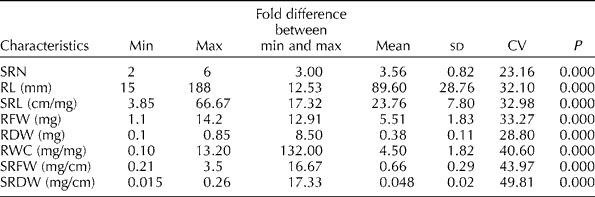
Significant differences were observed among the accessions for all the root traits examined. Passport data and the mean values of the ten examined seedling traits for all the 315 wild barley accessions are given in Table S1 (available online). The SRN varied significantly, ranging from 2 to 6 with a mean value of 3.5. In a previous study (Grando and Cecarelli, Reference Grando and Ceccarelli1995), wild barley has been reported to have 3–3.8 seminal root axes. The very low variation observed for this trait in that study may be due to the small number of accessions investigated. The morphology of the seminal root system in wild barley indicates that it might have a mechanism to judiciously regulate water use during early growth (Passioura, Reference Passioura1972). Fewer roots, especially in the upper part, may have a positive effect on water use efficiency in wheat (Ma et al., Reference Ma, Xu, Li, Liu and Huang2008). Accessions WBDC010, WBDC013, WBDC167, WBDC178, WBDC187, WBDC201 and WBDC289 had only two SRNs. These accessions may be useful for early drought tolerance in breeding programmes. The wide range of variations observed for RL and SRL in this study (Table 1) corroborated the previous results reported by Grando and Cecarelli (Reference Grando and Ceccarelli1995) and Romer and Schenk (Reference Romer and Schenk1998). Long seminal roots are important for protection against the effects of early summer drought (Grando and Ceccarelli, Reference Grando and Ceccarelli1995). Accessions WBDC266, WBDC067, WBDC072, WBDC173 and WBDC269 had long RL (Table S2, available online). A similar but non-significant trend in SRL was observed in barley by Løes and Gahoonia (Reference Løes and Gahoonia2004). In the present study, a significant variation was found for RFW and RDW. A similar result was reported for RFW and RDW in wild barley by Zhao et al. (Reference Zhao, Sun, Dai, Zhang and Wu2010). Accessions WBDC302, WBDC247, WBDC072, WBDC006 and WBDC254 had high RDW (Table S2, available online).
Range, fold difference between minimum (min) and maximum (max), mean, standard deviation (sd), coefficient of variation (CV) and probability (P) values for root characteristics of the 315 accessions from the Wild Barley Diversity Collection

SRN, Seminal root number; RL, root length; SRL, specific root length; RFW, root fresh weight; RDW, root dry weight; RWC, root water content; SRFW, specific root fresh weight; and SRDW, specific root dry weight.
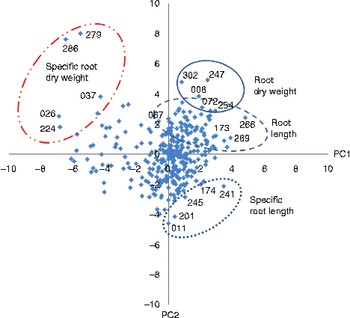
The PCA indicated that the first three principal components (PCs), with eigenvalues greater than unity, explained about 81% of the total variation among the accessions for the ten traits (Table S3, available online). In PC1, which explained about 38% of the total variation, the most prominent traits were RL, SRL, RWC, RFW, SRDW and SRFW, where SRDW and SRFW indicated a negative correlation. In PC2, which explained 30% of the total variation, the most predominant traits were RDW, SRN, RFW and SRFW. PC3 explained 13% of the total variation, with major contribution from the longitude and latitude of the collection sites. Accessions with prominent root traits clustered in distinct groups according to PC1 and PC2 (Fig. 1).
Principal component analysis plots for root traits of the 315 accessions from the Wild Barley Diversity Collection. Clustering of accessions ranking the top five accessions for root length, root dry weight, specific root dry weight and specific root length is shown. PC1, first principal component; PC2, second principal component.

Accessions having high values for various important traits are listed in Table S2 (available online). In previous studies, it has been shown that the WBDC is a rich source of resistance to biotic and abiotic stresses (Steffenson et al., Reference Steffenson, Olivera, Roy, Jin, Smith and Muehlbauer2007; Tyagi et al., Reference Tyagi, Park, Lee, Lee, Rehman, Steffenson and Yun2011; Roy et al., Reference Roy, Smith, Muehlbauer, Chao, Close and Steffenson2010; Naz et al., Reference Naz, Ehl, Pillen and Leon2012). Accessions WBDC266 and WBDC302 from Jordan and Syria had the greatest RL and RDW, respectively (Table S2, available online). Six barley cultivars with drought tolerance derived from wild barley have been released for use in Syria by the International Center for Agricultural Research in Dry Areas (Hajjar and Hodgkin, Reference Hajjar and Hodgkin2007). Similarly, accessions such as WBDC266, WBDC302, WBDC286 and WBDC011, which have the longest RL and the highest RDW, SDRW and SRL, respectively, would be useful for the improvement of these root traits in cultivated barley. As the WBDC has been extensively genotyped with more than 3000 molecular markers, it would be amenable to map quantitative trait loci for root traits by an association approach and subsequently introgress useful genes into cultivated barley to improve these root traits.
Supplementary material
To view supplementary material for this article, please visit http://dx.doi.org/10.1017/S1479262114000641
Acknowledgements
The present study was supported by a grant from the Regional Subgenebank Support Program of Rural Development Administration, Republic of Korea, to SJY and the Lieberman–Okinow Endowment at the University of Minnesota to BJS.