1. Introduction
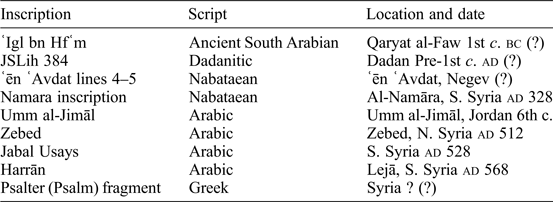
Old Arabic has been defined as the corpus of Arabic inscriptions produced in the pre-Islamic period. Like Old Aramaic, the Old Arabic corpus exhibits considerable internal diversity, and many features attested in these inscriptions preclude them from being the predecessors of Classical Arabic.Footnote 2 Macdonald (Reference Macdonald2000: 61) defined this corpus as consisting of the inscriptions shown in Table 1.
Traditional Corpus of Old Arabic texts (following Macdonald Reference Macdonald2000: 61)

The list in Table 1 includes all specimens that were composed fully in the Arabic language, in any script. Macdonald's original list was reduced in his (Reference Macdonald and Versteegh2008) contribution to the Encyclopedia of Arabic Language and Linguistics, in which he followed Mavroudi's (Reference Mavroudi, Grand'Henry and Lentin2008) dating of the Psalm fragment to the ninth century.Footnote 3 Hoyland (Reference Hoyland and Macdonald2010: 39–40) has recently been able to show that the Jabal Ramm inscriptionFootnote 4 should be omitted from the corpus of Old Arabic. It turns out that the text was composed in formulaic Nabataean.Footnote 5 The Umm al-Jimāl inscription is certainly pre-Islamic, as it is at the base of one end of an arch of a pre-Islamic church, but the stone is in such bad condition that it has so far been impossible to produce an accurate reading from the photographs alone.Footnote 6 In this article, I will discuss the language of the Rbbl bn Hfʿm epitaph and reassess its status as an example of Old Arabic.
2. How to determine genetic affiliation
Up to now all scholars have accepted the Rbbl grave inscription's place in the Old Arabic category, perhaps on account of the article ʾl and its assimilation to sibilants, along with a few other non-Sabaic features. M.C.A. Macdonald has already expressed doubts about the adequacy of the article as a diagnostic of genetic classification, and argued that other features should be taken into account.Footnote 7 Besides the article, it is clear that the remaining features of this text sufficiently distinguish it from ASA, but are they enough to call it Arabic? The uncritical identification of this inscription as Arabic seems to have been influenced by a belief that there were only two languages in Arabia in the pre-Islamic period – ASA and Arabic – and that any given inscription must be either one or the other.Footnote 8 Although our knowledge of pre-Islamic Arabia's linguistic diversity is still in its infancy, it is now clear that the Arabian Peninsula was home to a wide variety of non-Arabic Semitic languages. Thus the identification of the language of this epitaph as a variety of “Old Arabic” must rest on the identification of isoglosses unique to Arabic rather than features which are simply absent in ASA.Footnote 9
This brings us to the crux of linguistic classification: which features are relevant for linguistic diagnosis? Most of the grammatical features – the suffix conjugation, clitic pronouns, broken plurals, the preposition mn – are retentions from an earlier stage common to many Semitic languages, not just Arabic, and as such are irrelevant for classification. In the mid-1970s Hetzron re-examined the classification of the Semitic languages, giving priority to morphological innovations over phonological changes, vocabulary and typological similarities.Footnote 10 Hetzron emphasized the importance of morphological developments which appear in only a segment of a group of related languages. These languages are then assumed to have shared a common ancestor in which these innovations first occurred. Languages that do not exhibit these developments, then, could not have shared the same common ancestor, and are thus considered more remotely related. Moving forward in this way, linguists are able to determine the sub-grouping of a language family. This methodological approach is crucial when examining languages known only from the epigraphic record, as the data are never plentiful and almost always ambiguous.Footnote 11 Thus, a linguistic definition of “Arabic” is the sum of innovations that distinguish all varieties of Arabic from other sub-groupings of Semitic, including ASA and the languages of the epigraphic North Arabian scripts (ANA).Footnote 12
Before we approach the inscription itself, two caveats merit discussion: areal features and parallel developments. Areal features are linguistic traits that spread through contact and diffusion, rather than being inherited from a common ancestor. A good example is the conditioned sound change, s 1 > h, in CS.
Correspondences in the 3 ms clitic pronoun

This sound change did not operate in the same environments in Minaic, Qatabanic and Hadramitic, but was active in their closest relative, Sabaic. PS *s shifted to h in similar environments elsewhere in CS, in Arabic, Canaanite, Ugaritic, Aramaic, etc. Because this sound change was probably the result of a very early areal phenomenon, one cannot argue on this basis that Sabaic is more closely related to Aramaic than, for example, to Minaic.
Areal diffusion is not restricted to phonological phenomena, but can also spread to some classes of morphological features. A good illustrative example is the loss of the /t/ in the feminine ending *at in the CS languages. The shift of *at to ah or ā is relatively common in the CS languages, but it cannot be reconstructed for PCS. In most dialects of Arabic, *at goes to ah, including other later reflexes such as a, e, i, in nouns but not in the 3fs of the suffix conjugation, e.g. katabat, but in some Yemeni dialects, the sound change has spread to verbs as well.Footnote 15 In Hebrew, it affects both nouns and verbs, in Phoenician it applies to verbs only, and only nouns are affected in Aramaic. The sound change did not operate in Ugaritic, most ANA dialects (except for Dadanitic), the old Tayyi dialect of Arabic, and ASA. This distribution suggests that the sound change *at > ah is the result of diffusion and, as such, cannot be used as an indicator of genetic affiliation. In other words, languages which exhibit this change do not constitute a more closely related group to the exclusion of languages which preserve the final t.Footnote 16
The importance of distinguishing between innovations and retentions from the proto-language is clearly demonstrated by an example Huehnergard provides in his fundamental article “What is Aramaic?”.Footnote 17 He points out that Aramaic possesses a 1cs pronoun ʾanā, which more closely resembles Arabic and Ethiopic ʾanā than Hebrew ʾănî and ʾānôkî. On this basis one might argue that Aramaic was more closely related to Arabic, and one would, in fact, be wrong, as the form *ʾanā can be reconstructed to PS. The presence of the same form in Arabic and Aramaic simply reflects independent continuations of an original feature rather than an innovation of a common ancestor shared by Arabic, Aramaic and Ethiopic but not Hebrew. This example will bear on our interpretation of the features of this inscription, especially the status of the suffix pronouns -h and -hm.
2.1. The role of the article
Most scholars would not consider the article a feature of PS, or even of PCS for that matter.Footnote 18 The article is absent in Ugaritic, in the eighth century bce Deir ʿAllā and Zincirli inscriptions, in Hismaic, and is relatively rare in early Hebrew poetry and early Aramaic.Footnote 19 Where it is encountered, the article exhibits such a wide range of morpho-phonological forms that a straightforward reconstruction is unlikely. In Classical Arabic, language of the ANA inscriptions and the Canaanite languages, the article is a prefix, while in ASA and Aramaic it is a suffix. Just as the phonological form of the feminine ending is not suitable for genetic classification, the grammaticalized position of the article – whether a prefix or a suffix – cannot suggest a closer relationship between Aramaic and ASA on the one hand and Arabic, ANA and Canaanite on the other. Instead, these facts point towards the areal diffusion of the definite article following the diversification of PCS.Footnote 20 If the grammaticalized position of the article does not carry any classificatory weight, then can one really argue that the phonological shape of the article does?
Even if one wished to appeal to the peculiar assimilation rules of the article in Arabic, the next question must be: which Arabic? Almost all forms of the CS article exhibit some assimilation. The coda of the h- article assimilates in all environments in Canaanite and most ANA varieties; however, in Dadanitic, the final nasal remains unassimilated before laryngeals.Footnote 21 If Southern Thamudic in fact attests a hl article, then it would appear that the coda might have shifted to l.Footnote 22 Thus, it is difficult to consider the phenomenon of assimilation, in and of itself, significant. Within Arabic, there is considerable variation with regard to both the shape and the assimilatory patterns of the article. The Arabic of the grammatical tradition assimilates the coda of the article to coronals, and this became the standard in the imperial language; the ʾal article of the pre-Islamic northern dialects, on the other hand, does not seem to exhibit any assimilation.Footnote 23 The coda of the article assimilates to both /k/ and /g/ in Egyptian Arabic, to labials in Dhofar, and in all environments in some Yemeni dialects.Footnote 24 If one takes the ʾam and ʾan articles as reflexes of an original *ʾal, then one would have to propose two further ad hoc sound changes.Footnote 25 In no attested variety of Arabic are any such rules productive and therefore it would seem that they spread areally to Arabic with the article itself. Moreover, it is important to point out that the ʾl article is not restricted to Classical Arabic, but is also attested across the varieties written in the ANA scripts. Given the great diversity of article forms and assimilation patterns within Arabic itself, the fact that ʾl is not restricted to Arabic, and that the entire category is the result of areal diffusion, one is not on particularly strong grounds when using the phonological shape of the article as a diagnostic feature.Footnote 26
Based on these principles, Huehnergard (forthcoming) presented a list of morphological features that should be considered part of the package of innovations which characterize Proto-Arabic.Footnote 27 While the exact list is still being worked out, one important innovation relevant for our discussion of this inscription is the development of nunation on singular nouns. To this, I would also add the development of a new subordinating conjunction *tay and the form *ḥattay ‘until’ from *ḥadd ‘limit, edge’ + *tay ‘that’.Footnote 28 The presence or absence of these features can help us determine if the language in question is in fact a descendant of Proto-Arabic.Footnote 29
3. The inscriptionFootnote 30
1 ʿgl/bn/hfʿm/bn/l-ʾ
 h/rbbl/bn/h
ʿigl son of hfʿm built for his brother rbbl son of h-
2 fʿm/qbr/wlhw/wlwldhw/wm
fʿm a tomb: both for himself and his child and his w-
3 rʾth/wwldhw/wwld/wldhm
ife, and his children and their children's children
4 wnslyhm/hryr/ḏwʾl/ġlwn/f
and their women-folk, free members of the lineage of ġlwn so
5 ʾʿḏh/bkhl/wlh/wʿṯr
he has placed it under the protection of khl and lh and ʿṯr-
6 ʾs2rq/mn/ʿzzm/wwnym/w
ʾs2rq from strong and weak and
7 s2rym/wmrthnm/ʾbdm
purchase or pledge, for all time
8 bn/wkslm/ʿdky/tmṭ
without loss, so long as rains
9 r/ʾslmy/dm/wlʾr
the sky torrent and the earth
10 ḍ/s2ʿr
(produces) herbage

3.1. Features
a) Collapse of the triphthong in bn ‘he built’ < *banaya
III-w/y verbs did not exhibit exceptional behaviour in PS. In Gəʿəz, these forms inflect normally, banaya -ʾatawa, and Safaitic bny and s 2tw indicate that final triphthongs had not collapsed there either.Footnote 31 The spelling of etymological banaya as bn in this inscription, on the other hand, suggests that *aya contracted to ā, which remained unexpressed in the orthography. This common sound change is by no means restricted to Arabic. It operates regularly in Hebrew and Aramaic, and in both ASA and Ugaritic forms with and without the final triphthong occur. The earliest Phoenician inscriptions preserve triphthongs, but they have collapsed in the later inscriptions. More importantly, however, many older forms of Arabic do not seem to have experienced this change. Consider, for example, the spelling of etymological *banaya in the QCT as bny بنى, which must reflect either an underlying banē/banay or banaya, but not banā.Footnote 32 Indeed, the non-ā reflex is retained in some dialects well into the Umayyad period. One of the Muʿāwiyah dam inscriptions attests the form bny-h, for ‘he built it’, spelled unambiguously as بنيه.Footnote 33 Likewise, the spelling of the preposition ʿalā in the Jabal Says inscription as ʿly suggests that final tripthongs/diphthongs had not contracted.Footnote 34 The cognate of Classical Arabic suflā ‘lowest’ appears as σουϕλη /suflē/ in P. Petra 17 (Al-Jallad et al. forthcoming); the name Φασαιελη /phasaielē/ (PAES 792.1) attested in a Greek epitaph from southern Syria likewise indicates that these sequences did not contract to ā as in Classical Arabic.Footnote 35 There is other scattered evidence to suggest that triphthongs have not collapsed in other older forms of Arabic.Footnote 36
Huehnergard and Rubin have correctly argued that the reduction of triphthongs is an areal sound change or the result of parallel development.Footnote 37 Given the nature of this sound change and the fact that triphthongs occasionally collapse in ASA, this single attestation cannot stand as evidence for the genetic identification of this inscription.
b) The spelling of the 3 ms pronoun as -h against Sabaic -hw
This occurs in the forms l-ʾḫ-h, ʾʿḏ-h, and mrʾt-h. A final -h could suggest that the pronoun terminated with a final short vowel, -hu, or that it was in fact simply -vh; the latter solution, however, would require us to posit that final short vowels were lost in this dialect. Neither of these possibilities constitutes a suitable Arabic isogloss. In fact, the 3 ms clitic pronoun is represented as -h in nearly every consonantal Semitic script. The spelling hw in the same text may suggest the use of the Sabaic form as an ideogram, to be read in the local language.Footnote 38 The same can explain the occurrence of both hm and hmw.
c) The ʾ-causative
The PS causative can be reconstructed as *s1 aqtil-, the initial sibilant of which is preserved in Akkadian, Ugaritic and the non-Sabaic ASA languages. Sabaic, however, has undergone the sound change s1 > h, which operated in pronouns and other isolated situations, resulting in the form hqtl. H-forms also occur in Canaanite and sometimes in Dadanitic. A presumably secondary sound change h > ʾ occurred, which produced the form *ʾaqtvla from an earlier *haqtvla in the remainder of Ancient North Arabian, Arabic, Aramaic and Ethiopic. Dadanitic exhibits both, but the data are not plentiful enough to determine if these reflect different dialects of Dadanitic or if, indeed, h- and ʾ- forms were in free variation.Footnote 39 In any case, the appearance of an ʾ-form here distinguishes this dialect from any attested form of ASA, to be sure, but at the same time does not ally it more closely with Arabic or ANA, nor does it eliminate the possibility that it is simply a different language altogether.
The particular form of this verb, ʾʿḏ, appears to be a causative of a II-w verb (ʿwḏ). With only one example, it is impossible to draw any solid conclusions regarding the status of II-w/y verbs in this language. Huehnergard (Reference Huehnergard and Gianto2005, n. 75) argued convincingly that these have collapsed at the Proto-Semitic stage, which means their re-emergence in some varieties of Safaitic and Gəʿəz must be secondary. Since the absence of the medial vowel is an archaism, it cannot support a connection specifically with Arabic.
d) Mimation
Six words in this inscription terminate in non-etymological -m: ʿzzm; wnym; s 2rym; mrthnm; ʾbdm; wks lm. The first four words are syntactically in the genitive case. The word ʾbdm is an adverb, and wks 1m requires further discussion. Beeston (Reference Beeston1979, n. 1) has argued that the final -m's in this text should be connected with the so-called mā al-ʾibhāmiyyah, which is a post-positive indefinite relative particle mā, implying ‘any’ or ‘whatever’. This ingenious solution is challenged by the occurrence of a final m on the adverb ʾbdm, which Beeston himself had recognized as possibly problematic. He attempted to account for it by explaining the sense of ʾbdm as referring to ‘any stretch of time’. The problem with this interpretation is that the basic noun ʾabad- ‘time’ does not refer to a stretch of time itself but to time in an absolute sense, not only in Classical Arabic but in Sabaic and Safaitic as well.Footnote 40 For example, Lane quotes that one would say zamānu kaḏā for ‘the time of such a thing’ and not ʾabadu kaḏā, which refers to ‘time, duration, continuance, or existence without end’ or, in other words, ‘endless time’ (Lane 4b). In this case, it is unlikely that the -m termination should be identified as mā ʾal-ʾibhāmiyyah, which would render the translation: ‘any eternity’ or ‘whatever eternity’. Instead, the correct interpretation of the term is “forever” as an adverbial accusative, identical to what we encounter in Akkadian, e.g. ūmam < *yawmam ‘daily’, and indeed Arabic, ʾabadan. The difference between the Arabic form ʾabadan and the present form ʾbdm is in fact very important; however, to appreciate its significance, we must set mimation and nunation in their Proto-Semitic context.
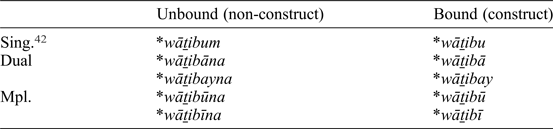
As I have discussed earlier, Proto-Semitic did not possess a formal means of nominal definition; rather, nouns came in two forms, unbound and bound (construct). Unbound forms terminated in -m in the singular and -n in the duals and plurals, as seen in Table 2.Footnote 41
Mimation and nunation in Proto-Semitic
Hebrew, for example, levelled the m termination from the singular to the dual and plural as well, producing -āyîm < *-ayna (dual) and -îm < *īna (masculine plural). Conversely, Arabic levelled the n endings of the plural to the singular.
The levelling of one of two values across a paradigm is not, in and of itself, a strong isogloss, but given that it occurs so widely among the known varieties of Arabic, I believe Huehnergard is correct to reconstruct the change for Proto-Arabic.Footnote 43 Its appearance in this text can be interpreted in two ways: (1) the language of the inscription did not participate in a Proto-Arabic innovation, ruling out the possibility that it is a descendant of Proto-Arabic; or (2) that it reflects the influence of a non-Arabic substratum. A comparable situation is the appearance of -k endings on the 1st and 2nd persons of the suffix conjugation in several Yemeni dialects of Arabic.Footnote 44 It is probably the case that Proto-Arabic levelled the -t endings, as only -t endings are encountered in all of the non-Yemeni attestations, both ancient and modern. In this case, the -k endings in the Yemeni dialects must be due to substrate influence. An argument against substrate influence in the case of mimation, however, is that this inscription was not produced in the ASA heartland, so one would have to assume the existence of yet another substrate language which preserved mimation in order to maintain the Arabic-ness of the current inscription. The simpler solution is to consider mimation part of the language itself. This hypothesis is also supported by the fact that the Sabaic cognate construction would not have carried mimation, k- ʾbd, making it unlikely that ʾbdm was an artificial form. If mimation was indeed part of the language of this inscription, then it would suggest that it did not participate in an important Proto-Arabic innovation, the levelling of nunation to singular nouns.
The absence of mimation on the word ḥryr requires further discussion. It is possible that the language of this inscription had a diptotic declension, marked by the absence of mimation on unbound forms, as in Arabic, and possibly in the pre-history of Ugaritic.Footnote 45 On the other hand, the word could be interpreted as in construct with a lexicalized ḏwʾl. In the same way that the ʾ- causative indicates that the language under investigation is not ASA, the presence of mimation also makes it highly unlikely that we are dealing with a variety of Arabic.Footnote 46
e) The words ḥryr, ns 1y, and s 1my
Mascitelli (Reference Mascitelli2006: 104) suggests that the y in the word s 1my, ns 1y and ḥryr acts mater lectionis for /ā/, but this explanation does not account for the absence of final y on the verb bn in the first line.Footnote 47 In the word ḥryr, it is relatively clear that the y signals a glide in the underlying form *ḥarāyir, which would correspond to ḥarāʾir in Classical Arabic. The comparative evidence favours the reconstruction of a glide in this position, and therefore the Classical Arabic reflex, with a glottal stop, must be considered innovative.Footnote 48 One cannot propose a general sound change of y/w > ʾfollowing a long ā, as glides obtain in this environment in several forms, e.g. ḥikāyat- and the L-stem, qāwala-yuqāwilu. Instead, the shift of the glide to a glottal stop could have been a dissimilatory change before high vowels, thus āy > āʾ / _i.Footnote 49 In the prefix conjugation of the L-stem, the glide was restored through paradigmatic levelling with the suffix conjugation.
The reconstruction of the PS word for “sky, heaven” is unclear. Kogan (Reference Kogan and Weninger2011: 192) gives *šam y, with the second syllable as anceps, while Fox argues for *šamaʾ (Reference Fox2003: 83), and Fronzaroli (Reference Fronzaroli1965: 144) maintains a reconstruction nearly identical to Gəʿəz, *šamāy. Whatever the proto-form must have been, it is clear that the form ancestral to the Classical Arabic reflex was *samāy. Arabic samāʾ must have arisen through paradigmatic levelling of the aforementioned dissimilation rule, which would have applied to the genitive, and perhaps nominative, case thus: *samāʾu, *samaʾi vs. *samāya. While the presence of the archaic form samāy is not significant for genetic classification, it nevertheless sets this language apart from the Classical and post-Classical varieties of Arabic, and again reduces the value of the collapse of the triphthongs (a) as a connection with Classical Arabic.
f) Negation with bn
The first word of the curious phrase bn wks 1m was originally translated by al-Ansāri as “from”, but as Beeston correctly points out, the non-Sabaic mn is used only two lines earlier, making this interpretation unlikely. However, if -hw in this text is in fact a Sabaism, one cannot rule out this possibility completely. Beeston suggested that bn should rather be read as the preposition bayn and the phrase made the equivalent of the Classical Arabic phrase bi-dūni nuqṣān, “without loss”. He suggests that we must appeal to the basic sense of bayn meaning separation. While certainly an attractive solution, this sense of the preposition is unattested in Semitic. On the other hand, Kropp (Reference Kropp1990) equated the line to a Sabaic expression bn mhbʾs 1tm, which is taken to mean “free of any damage”. This interpretation would again appeal to a Sabaic understanding of bn.
The term waks in Classical Arabic is used after the negative particle lā in the following phrase from the Lisān (s.v.): lahā mahru miṯli-hā lā waksa wa-lā šaṭaṭa “She shall have the dowry of her like: there shall be no falling short nor exceeding” (trans. E.W. Lane). This sense seems to fit the current context, and if indeed the same syntax is employed, we must interpret bn as a negative particle. Whether it is related etymologically to Arabic bayn is unclear, but there are no instances of the use of bayn in this sense in Arabic. Nominal negation is so far unattested in ANA, so it is impossible to compare the two. Its particular form invites comparison with Northwest Semitic *bal, but the irregular correspondence of n with *l makes such a connection tentative.Footnote 50
g) The particle ʿdky
The conjunction ʿdky is composed of the preposition ʿd and the subordinating particle ky. The first element, ʿd, is attested in Sabaic, as ʿd and ʿdy, which presumably correspond to Hebrew ʿād and ʿāday.Footnote 51 This preposition is unattested in Arabic, and thus appears to have been lost at the Proto-Arabic stage. Rabin speculates that the Huḏaylite pronunciation of ḥattā as ʿattā, may reflect “a compromise” between ḥattā and ʿad, but this is hardly convincing.Footnote 52
The second element, ky, is a common subordinating particle in Semitic. The particular construction ʿdky is unattested in Sabaic and Arabic, but is found in Dadanitic.Footnote 53 Beeston (Reference Beeston1979) interprets Namāra ʿkdy as a metathesized form of ʿdky. This explanation is unlikely for two reasons: (1) it occurs twice in that inscription and both times it is clearly written ʿkdy, which precludes a writing error; and (2) the form ʿkdy has been identified with a similar meaning in Safaitic (Al-Jallad, forthcoming). No convincing etymology of this form has yet been identified.Footnote 54
h) The case of the article ʾl-/ʾ-
We can now address the primary reason scholars have identified the language of this inscription as Arabic – the article ʾl-/ʾ-. As I stated earlier, the article is an areal feature of CS, meaning that it spread among the daughter languages through contact rather than being inherited from the proto-language. This also includes its form. The occurrence of an ʾl-/ʾ- article in this inscription carries as much classificatory weight as, say, the occurrence of an h- article in other Semitic languages. But first to illustrate the type of variation with which we are dealing, let us consider the various forms of articles attested in the ANA epigraphy:
• Dadanitic: h-, hn, ʾl Footnote 55
• Taymanitic: h-
• Safaitic: h-, ʾ-, ʾl
• Hismaic: zero
• Thamudic: h-, ʾl, Footnote 56hl (southern)
Macdonald (Reference Macdonald and Versteegh2008: 470–71) provisionally established a category of “Old Arabic mixed texts” to encompass inscriptions written in the ANA scripts which exhibit the ʾl-article. The only thing to support their mixed character, however, is the assumption that the ʾl-article is unique to Arabic. One can also interpret these texts as examples of non-Arabic varieties which make use of this form of the article. The ʾl-article appears several times in Dadanitic texts which are identical in all other respects to those with the h(n)- article: blḥgr ‘in Hegra’; hlgbl ‘this mountain’; ʾs¹fr ‘the writing’; ʾẓll ‘the sacrifice’.Footnote 57
Conversely, the Safaitic corpus, which I have recently identified as part of the Old Arabic dialect continuum based on the presence of the isoglosses listed in Huehnergard (forthcoming) and Al-Jallad (forthcoming), exhibits four different forms of the definite article. Alongside h-, one occasionally encounters ʾ(l):
SIJ 37: s¹lm w-fṣyt m- bʾs¹ ʾ- s¹nt “security and deliverance from the misfortune of the year”
KRS 125: ʿwr l-m yʿwr ʾ- s¹fr “blindness to whosoever would efface the writing”
C 5137: w- ḥll ʾl- dr “and he camped in this place” [lit. in the place]
There is evidence of yet another article in Safaitic, an invariable ʾ-, Footnote 58 which would seem to be related to the article ʾan, attested in later forms of Arabic, and hn.Footnote 59 This evidence, combined with the evidence from later stages of Arabic, indicate that there must have been significant dialectal variation in the shape of the article in early Arabic.
In terms of the form attested in the present inscription, not much weight can be given to the assimilation of the l, as there is no way to know its extent, but only that it assimilated to sibilants. Moreover, the elision of the onset following the conjunction w in line 9–10 is probably also not very significant. The change happens in Dadanitic as well, and would seem to be related to the elision of the glottal stop in the causative stem (see Table 3). Although the exact conditioning environment is hard to recover, this change would seem to operate in the following environment: #Cv_vCC ˊ.Footnote 60
The intervocalic loss of the glottal stop

This new perspective suggests that there was a series of definite article forms hn, hl(?), h, ʾn,ʾm, ʾl, and ʾ distributed across languages and families, from the fertile crescent to the borders of the Yemen, but not restricted to any of them. In other words, a language which is genetically Arabic can exhibit a h- article while one that is not can exhibit the ʾl-article. In this light, the presence of an ʾl article in this inscription is then not genetically significant.
i) Treatment of the indefinite direct object
Indefinite direct objects in this inscription do not appear with mimation, which is in a way reminiscent of the Classical Arabic pausal termination, ā. On the other hand, the preservation of mimation in the adverbial direct object ʾbdm, could suggest that this was not a global change, but perhaps only affected the indefinite accusative. The separate treatment of the direct object from the adverbial is not uncommon. The opposite is attested in most contemporary dialects of Arabic, which have neutralized case in the nominal system but continue to inflect adverbs with either -an or -ā. Given the ambiguities in the script, and the loss of mimation almost everywhere else, it is impossible to say if a similar development occurred elsewhere in CS. Thus, the separate treatment of the indefinite direct object might be a local innovation.
j) The lexicon
The lexicon does not usually play an important role in genetic classification.Footnote 61 Unlike morphology, lexical items can be borrowed rather easily, even in situations of light contact. This is especially true of languages sharing a relatively small geographic area. Moreover, it is often difficult to trace the semantic history of a word or root, and it is rarely clear if the sense encountered in a certain language is archaic or innovative. In addition to these methodological difficulties, one should not forget that our knowledge of the vocabulary of epigraphic languages, such as ASA and the inscription under question, is fragmentary. Thus, arguments based on the absence of a single vocabulary item in a poorly documented language are necessary ex silentio, as it is impossible to determine whether the word under examination existed in the mental lexicon of the speaker, but only that it was not preferred in inscriptional formulae. Let us, nevertheless, cast comparative light on the vocabulary of this inscription which is not indisputably PS.
• mrʾt ‘wife’: The feminine form of PS *mar ʾ ‘man’ has become the primary term for “woman”/“wife” in Arabic, replacing earlier *ʾanṯat-. The same word occurs in Safaitic C 4768: w wgm ʿl- gḥm bnt ʾnʿm mrʾt-h “and he grieved for Gḥm daughter of ʾnʿm, his wife”, and in the Amiritic dialect of Sabaic, e.g. Haram 40.
• ʾl ‘lineage group’: This word occurs frequently in the Ancient North Arabian inscriptions and is known from later Arabic sources. While it is tempting to connect this term to *ʾahl- ‘family’, no evidence for h- syncope in this position occurs in the languages in which it is attested, and, perhaps more importantly, it occurs alongside ʾahl in both Classical Arabic and Safaitic. Rather, the term should instead be connected with Akkadian ʾawīl- ‘freeman’,Footnote 62 but perhaps as a collective noun, CaCaC, ʾāl < *ʾawal. Thus, ʾāl would have originally had the same signification as ḥryr in this inscription. Since its semantics go back to PS, it is difficult to consider this an isogloss of any particular branch.
• ʾʿḏ ‘to put under protection’: This is the C-stem of the root ʿwḏ ‘to seek refuge’, which also occurs in Safaitic, WH 390: ʿwḏ b- Rḍy “he sought refuge in Rḍy”. The C-stem of this verb, e.g., Is. 10:31 hē ʿîzû, is attested in Hebrew, with the meaning of ‘to bring into safety’ (see Koehler and Baumgartner Reference Koehler and Baumgartner2001–12, #6849).
• wny ‘weak’: This root is attested widely with various senses.Footnote 63 In Safaitic, the root seems to have the same sense as in Arabic and the language of this inscription: C 3752 f wny f h b ʿls¹mn rwḥ ‘and he has become weak so, O Bʿls1mn, grant ease!’, as it does in the C-stem in Hebrew, hônâ,’ ‘to oppress’, from ‘to make weak’ (see Baumgartner and Koehler Reference Koehler and Baumgartner2001–12, #3792).
• s 2ry ‘purchase’: This root also occurs in Safaitic C 2832: w s²ry m- ʾḫ -h ʿḏ h- bkrt b- mʾt “and he purchased from his brother ʿḏ the she-camel for one hundred”. This sense is unknown in other Semitic languages, although it appears to be cognate with the name of the Antelebanon range, *śaryānu (del Olmo Lete and Sanmartín Reference Del Olmo Lete, Sanmartín and Watson2004: 847), and the range north of Petra connected with the deity ḏū s 2aray. Its Hebrew cognate, śārâ ‘to struggle, contend with’, probably reflects the original sense; the origin of the meaning ‘to buy’ is unclear.Footnote 64
• ʾbd-m ‘forever’: A similar expression is used in Sabaic k- ʾbd (Beeston et al. Reference Beeston, Ghul, Müller and Ryckmans1982: 1), and in Safaitic, C 2530: w wlh ʿl- {b}hln l- ʾ{b}d “and he grieved for Bhln forever”. The opposite sense is attested in Arabic as well as in Northwest Semitic.Footnote 65
• wks 1 loss: In addition to Classical Arabic, this word is attested in Safaitic: C 1186: w lt l ʾḫl w wk{s¹} w ḫrs¹ w ʿrg w ʿwr l- mn ḫbl “And Lt …loss (?) and mutism and lameness and blindness to whoever would defile [this inscription]”. The exact sense of Safaitic wks 1 is not entirely clear, but that it appears in curse formula surely indicates that it was something negative.
• dm “continuous rain”: This sense is only known in the Classical Arabic lexicons, and has not appeared, to my knowledge, in the ANA inscriptions.
4. Evaluation
Let us round up our evidence. There are five classes of features in this text:
1. Inherited Proto-Semitic forms that have been lost in Late and Middle Sabaic:
a. The 3mp suffix pronoun -hm;
b. The 3 ms suffix pronoun -h.
2. Inherited Proto-Semitic features that have been lost or replaced in Arabic:
a. Mimation;
b. The preposition ʿd;
c. No dissimilation of āy to āʾ before i; the preservation of the form s 1my (in Classical and Post-Classical Arabic).
3. Areal developments shared with other Semitic languages and not exclusively Arabic:
a. Collapse of triphthongs (NWS, some dialects of Arabic, Mehri, Tigre, Phoenician and occasionally in ASA and Ugaritic);
b. ʾ- Causative prefix (Aramaic, Ethiopic, Arabic, ANA, except in some cases for Dadanitic);
c. The prefixed article (ʾ/h)l- (Dadanitic, Thamudic and Southern Thamudic).
4. Features shared with other CS languages which are absent in Arabic and which are not clearly reconstructable to Proto-Semitic:
a. The compound preposition ʿdky.
5. Innovations found in the language of this text alone:
a. The special treatment of the indefinite accusative;
b. Possible negation with bn.
There are no innovations that connect the language of this inscription specifically with Arabic. On the contrary, the language exhibits many features that are not attested in any other varieties of Arabic, such as the preposition ʿd and mimation, which indicates that this language did not participate in an important Proto-Arabic innovation, the spread of nunation to singular nouns. The absence of the special dissimilation of āy to āʾ clearly distinguishes this text from Classical Arabic. The compound preposition ʿdky is not attested in Arabic or in ASA, but is found in Dadanitic once, and is attested in Hebrew. One might explain the absence of these features by appealing to the antiquity of the inscription, which, while undated, many have assumed is older than the remaining Old Arabic inscriptions.Footnote 66 While it is not possible to determine the exact chronological moment at which isoglosses characteristic of Arabic emerged, certain innovations in this text, such as the collapse of triphthongs and the possible reflex of *bal > bn, preclude it from being a kind of “pre-Arabic”, since these features obtain in the earliest stages of Arabic. To maintain such a view, one would have to imagine an ancestor more progressive than its descendant forms. On the other hand, the language of this inscription shares two interesting areal features with Classical Arabic, the ʾl article with assimilation, even though the extent of assimilation here is unclear, and the collapse of the *aya triphthong to ā. More generally, three vocabulary items, wks 1, s 2ry, mrʾt, found in this inscription are also attested in Classical Arabic and Safaitic but the significance of this is hard to assess considering our fragmentary knowledge of the lexica of other ancient Semitic languages.
When evaluated in a dispassionate manner, it is rather unlikely that we are dealing with a variety of Arabic at all, but whether the language should be connected with any of the various ANA languages is also unclear. More work on the linguistic subdivisions of ANA is required before an answer can be given. As a working hypothesis, the language of this inscription could reflect a transitional dialect between the southern ANA varieties and ASA, perhaps related to the substratum of the ʾAmīritic dialect of Sabaic. Until more evidence from this region of the Peninsula emerges, one must admit the possibility that we are dealing with a language which has, as of yet, only emerged once in the epigraphic record.