The present study was motivated by two concerns. First, we were interested in whether exposure to instruction in a classroom context could enable learners to acquire a grammatical feature when their primary attention was directed toward other features (i.e., whether incidental acquisition could take place). Interest in this issue derived from the assumption that much of the acquisition that takes place in a language classroom is of an incidental nature. Second, we wanted to examine the relative efficacy of two very different approaches to teaching—namely, comprehension-based and production-based language teaching—in promoting incidental acquisition.
Incidental acquisition will first be defined and its importance for both theories of SLA and language pedagogy discussed. Next, a number of studies that have investigated the incidental acquisition of grammatical features will be reviewed. The claims that have been made for comprehension- and production-based language teaching will then be considered, followed by a report of the present study.
INCIDENTAL ACQUISITION
Hulstijn (Reference Hulstijn, Doughty and Long2003), drawing on Schmidt (Reference Schmidt1994), gave three definitions of incidental acquisition in the second-language (L2) learning literature:Footnote 1
i The most general meaning is couched in negative terms as learning without the intention to learn.
ii Another interpretation is that it refers to the learning of one stimulus aspect while paying attention to another stimulus aspect.
iii A slightly more specific interpretation of incidental learning is that it refers to the learning of formal features through a focus of attention on semantic features. (pp. 357–358)
These definitions are not incompatible and can be incorporated into a single definition, provided in (1).
(1) Incidental acquisition is the learning of one L2 feature without intention while attention is focused on some other aspect of the L2 such as semantic meaning.
It was this definition that informed the present study. It should be noted that this definition of incidental acquisition does not preclude the possibility that learners manifest awareness of forms acquired incidentally. As Schmidt pointed out, incidental acquisition may require conscious attention to linguistic form. What distinguishes incidental from intentional language learning is the lack of any intention to learn, not the lack of awareness. Thus, incidental learning can be distinguished from implicit learning, which is defined in terms of a lack of awareness.
Incidental acquisition is of both theoretical and pedagogical significance. On a theoretical level, incidental acquisition is important because, in many learning contexts, learners develop their grammatical competence primarily by way of incidental acquisition. Cognitive theories of SLA are premised on the assumption that learning occurs when learners are exposed to input and have opportunities to produce the language during communication and that such learning does not require the learners to make a conscious effort to acquire specific grammatical features. Researchers who work within this paradigm have sought to investigate the conditions that facilitate such incidental learning. Research based on the input hypothesis (Krashen, Reference Krashen1985) has examined how modified input that learners can comprehend assists learning. Other research based on the interaction hypothesis (Mackey, Reference Mackey1999; Pica, Reference Pica1994) has investigated how comprehensible input, feedback, and modified output promote learning when learners attempt to negotiate meaning in order to address a problem that has arisen in communication. N. C. Ellis (Reference Ellis2002) has argued that a primary determinant of acquisition is the frequency of exposure to grammatical forms in input and interaction. Schmidt (Reference Schmidt1994, Reference Schmidt and Robinson2001) has proposed that the conscious noticing of exemplars of specific grammatical features in communicative input and interaction constitutes a key condition for the acquisition of those features. Although these theories differ in the importance that they attach to input or output as factors, they share a concern for incidental rather than intentional learning. The study reported here addresses a key issue within this theoretical paradigm—namely, whether exposure to communicative input that contains a specific grammatical feature and opportunities to produce this feature promote incidental acquisition of the feature and whether there is any difference in the effects of the input-based and production-based conditions.
Incidental acquisition is important in language pedagogy given that there are limits on a learner’s capacity to learn the grammar of a language intentionally and thus limits on the extent to which grammatical competence can be directly taught. Krashen (Reference Krashen1982) rightly pointed out that even the best students will only be able to learn (by which he meant intentionally learn) “a small part of the grammar as a language” (p. 93) and thus must rely predominantly on acquisition (by which he meant incidental learning). Although Krashen’s distinction between acquisition and learning has been challenged (in particular, his claim that acquisition is a subconscious process), his point remains valid. As already noted, incidental acquisition involves an absence of intention to learn, not an absence of awareness. Thus, because learners cannot hope to intentionally learn all of the grammar of a language, they must necessarily rely to a considerable extent on incidental learning—picking up grammar from the input and interactions that occur in their instructional context. This type of learning is, in fact, acknowledged in a number of well-established instructional practices—for example, in the importance attached to extensive reading and the use of tasks that aim to develop grammatical competence through the attention to meaning and the focus on form (Long, Reference Long, de Bot, Ginsberg and Kramsch1991) that arises incidentally when learners perform communicative tasks. However, it is quite surprising that there have been very few classroom studies on the incidental acquisition of grammar—of the studies reviewed next, only Loewen, Erlam, and Ellis’s (Reference Loewen, Erlam and Ellis2009) study took place in a classroom. Language pedagogy could benefit from research that focuses on incidental acquisition and on the conditions that promote it in a classroom context.
STUDIES OF L2 INCIDENTAL ACQUISITION
Hulstijn (Reference Hulstijn, Doughty and Long2003) observed that most studies of incidental SLA have examined the acquisition of vocabulary through reading (i.e., whether and to what extent learners acquire new words when reading for meaning). Krashen (Reference Krashen1989), in particular, has argued that acquisition in his terminology (i.e., incidental acquisition) is fostered by extensive reading. Krashen and colleagues conducted a number of studies to demonstrate that such acquisition does take place (e.g., Dupuy & Krashen, Reference Dupuy and Krashen1993). In contrast, there have been very few studies that have examined the incidental acquisition of L2 grammar—the focus of this study. Hulstijn (Reference Hulstijn, Doughty and Long2003) identified only three studies of grammar learning (Hulstijn, Reference Hulstijn, Dechert and Raupach1989; Robinson, Reference Robinson1996, Reference Robinson1997) that have explicitly used the term incidental. Two additional studies will be considered: Robinson (Reference Robinson2005) and Loewen et al. (Reference Loewen, Erlam and Ellis2009).
Hulstijn (Reference Hulstijn, Dechert and Raupach1989) conducted two studies that involved a natural language (L2 Dutch) and an artificial language. Learners were presented with word-order structures implicitly (i.e., the structures were not explained) and incidentally (i.e., learners did not know they would be tested for recall of the structures). Participants were assigned to one of three treatments that involved exposure to sentences containing the target structures. One group (the form-focused group) had to perform an anagram task that directed their attention to the structure without any need to consider its meaning. The second group (the meaning-focused group) was shown the same sentences on a computer screen and asked to provide a response based on the meaning of the sentences. The third group (the form- and meaning-focused group) was simply told to pay attention to both form and meaning but were given no special task to perform. The results showed that the form-focused group outperformed the other two groups in terms of gains in scores on a sentence-copying task and a task that required cued recall of the sentences used in the learning tasks. Hulstijn interpreted the results as showing that attention to form when encoding input is a sufficient condition for implicit and incidental learning. However, given that the meaning-focused group also produced significant gains, the hypothesis that exclusive attention to meaning will inhibit acquisition was not supported. Hulstijn suggested that even if meaning is the learner’s first priority, attention to form can occur as a backup procedure when meaning fails to provide an adequate interpretation.
Robinson (Reference Robinson1996) investigated 104 predominantly intermediate-level Japanese English-as-a-second-language (ESL) learners’ acquisition of two grammatical features: pseudoclefts of location (considered a hard rule) and subject-verb inversion following an adverbial fronting (considered an easy rule). There were four instructional conditions in this study: (a) an implicit condition (learners were asked to remember sentences), (b) an incidental condition (learners were asked to read the sentences that contained the target structure to understand their meaning), (c) a rule-search condition (learners were asked to identify rules), and (d) an instructed condition (learners were asked to write explanations of the rules). Learning was measured by means of a grammaticality-judgment test that measured correctness of judgments and response times. There was also a debriefing questionnaire to measure learners’ awareness of the target structures. Robinson found no significant differences in either accuracy or speed of response in judging sentences between the implicit and incidental conditions, which suggests that these conditions functioned similarly. The instructed (i.e., intentional) learners, however, were significantly more accurate than the incidental learners on the easy rule but not on the difficult rule. The learners in the incidental (and the implicit) condition were more likely to report awareness of the hard rule than of the easy rule.
Robinson’s (Reference Robinson2005) study was a replication of the study by Knowlton and Squire (Reference Knowlton and Squire1996). The latter study involved an artificial language, but Robinson investigated a natural language, Samoan. Another interesting feature of Robinson’s study was that it involved complete beginners. The learners (Japanese university students) were first asked to memorize the meanings of a number of Samoan words. They were then exposed to 150 tokens each of three Samoan grammatical rules, two of which involved the use of particles and the third rule targeted the incorporation of the direct object into verbs. The participants were asked to try as hard as possible to understand the meaning of each sentence. They were asked to respond to yes/no comprehension questions and received feedback on the correctness of their responses. Results showed clear evidence of learning of all three target structures on old items (i.e., in the same sentences as in the training materials) in a grammaticality-judgment test but only for one of the structures (the locative particle) on new items.
Loewen et al.’s (Reference Loewen, Erlam and Ellis2009) study investigated the incidental acquisition of third-person –s. The learners’ attention was directed at a different grammatical feature (the use of the indefinite article to express generic reference), but the input also contained a high frequency of third-person –s in sentences like A cheetah runs fast and Cheap transport makes life easy. This study differs from the other studies, therefore, in that learners were focused on grammar but not on the target feature under investigation. Acquisition was measured by means of an elicited oral-imitation test and an untimed grammaticality-judgment test, designed to measure implicit and explicit knowledge, respectively (see R. Ellis, Reference Ellis2005). The learners failed to demonstrate any gains in implicit knowledge as a result of the intensive exposure to third-person –s. Loewen et al. explained this finding by suggesting that the learners were unable to dual task (i.e., attend to third-person –s as well as the indefinite article, the explicit focus of the instruction) and also by pointing out the low saliency of third-person –s and possible blocking (i.e., learned inattention). Scores on the untimed grammaticality-judgment test actually declined (by 17%), probably because the instruction directed at the indefinite article caused the learners to focus their attention on this structure and distracted them from attending consciously to third-person –s errors in the ungrammatical sentences of the test. In short, this study failed to demonstrate that any incidental acquisition of third-person –s had taken place.
These studies reveal several crucial aspects of the incidental language learning of grammar. First, these studies show that incidental learning can take place sometimes, even for difficult rules—although not for nonsalient morphological features like third-person –s. Second, incidental acquisition may simply involve item learning (i.e., learners remember the specific items they have been exposed to), not system learning (i.e., learners internalize a rule that can be successfully applied to new exemplars of the target feature). Third, attention is involved. Learners’ capacity to learn grammatical features incidentally may depend on whether they are able to dual task successfully. In other words, if they are able to attend to both meaning and form (or to two different grammatical forms), then incidental learning becomes possible. However, if learners experience difficulty in attending to both meaning and form, incidental learning may be impossible or very limited.
COMPREHENSION-BASED AND PRODUCTION-BASED INSTRUCTION
Comprehension-based instruction (CBI) is input-based; that is, it exposes learners to oral or written input in activities that require them to demonstrate comprehension. The assumption is that while comprehending the input, learners will process it in ways that foster acquisition. Early studies that investigated comprehension-based language instruction include Asher’s (Reference Asher1977) experiments with total-physical response (TPR). These experiments showed that learners exposed to instructions they were to act out outperformed those who experienced a more traditional, production-based instruction (PBI). However, it can be claimed that TPR encourages intentional rather than incidental language learning because the instructions that constitute the input are designed to teach specific grammatical structures and explicit grammar instruction is not entirely ruled out. In this respect, Asher’s experiments resemble more recent studies based on VanPatten’s (Reference VanPatten1996) input-processing instruction. Like Asher’s experiments, these studies were designed to investigate the effect of input activities on learners’ ability to both comprehend and produce sentences that contained specific structures. In some of these studies (e.g., VanPatten & Cadierno, Reference VanPatten and Cadierno1993), explicit instruction was also provided, but even in those that relied entirely on structured input (e.g., VanPatten & Oikkenon, Reference VanPatten and Oikkenon1996), the nature of the activities was such that they invited intentional learning of the target structures.
Studies that have investigated the effects of enriched input on SLA are of greater interest, because these are more likely to reveal incidental language acquisition. R. Ellis (Reference Ellis1999a) identified three main goals of such studies: (a) to investigate whether the forms targeted in enriched input are noticed by learners (Jourdenais, Ota, Stauffer, Boyson, & Doughty, Reference Jourdenais, Ota, Stauffer, Boyson, Doughty and Schmidt1995), (b) to investigate whether enriched input promotes acquisition (e.g., Trahey & White, Reference Trahey and White1993), and (c) to compare the effects of enriched input with some other instructional option (e.g., White, Reference White, Doughty and Williams1998). In all of these studies, learners were exposed to large amounts of input that they processed for comprehension. Although the findings are somewhat mixed, Ellis concluded that these studies show that enriched input can promote noticing of specific forms, can lead to acquisition, and, in some cases, works as effectively as (or more effectively than) other instructional techniques that involve more traditional, explicit instruction.
Production-based language instruction can also cater to incidental language acquisition. A good example of research that has investigated this can be found in studies that have sought to demonstrate that awareness of form generated by output tasks can lead to learning (e.g., Kowal & Swain, Reference Kowal and Swain1994, Reference Kowal, Swain, Johnson and Swain1997; LaPierre, Reference LaPierre1994). In LaPierre’s (Reference LaPierre1994) study, Grade 8 French immersion students completed a dictogloss task (Wajnryb, Reference Wajnryb1990), which required them to take notes while listening to a text and then to reproduce this text in groups. LaPierre identified 250 language-related episodes—that is, occasions where students attended to and talked about some aspect of the language they were producing or attempting to produce. It is important to recognize that these episodes arose incidentally as the learners endeavored to complete the task at hand. In other words, although these language-related episodes clearly involved awareness, they did not constitute attempts at intentional language learning. To establish the effect that such episodes had on acquisition, LaPierre designed tailor-made tests, which were administered to individual learners unexpectedly 1 week later. The learners’ responses in these tests showed a 70–80% correspondence with the solutions (right or wrong) they had reached during the text reconstruction task. In other words, these results suggested that incidental acquisition had taken place.
A crucial question is which type of instruction—CBI or PBI—is the most effective in fostering incidental acquisition. One possibility is that CBI is more effective on the grounds that interlanguage development takes place when a learner processes input and that processing precedes the ability to produce the L2. This position is adopted by both Krashen (Reference Krashen1985) and VanPatten (Reference VanPatten1996). A second view is that a learner’s production of a specific feature constitutes an external stage in its acquisition. This position is held by sociocultural theorists (e.g., Lantolf, Reference Lantolf2000), who argue that scaffolded production initiates learning. It might then be expected that PBI is better equipped to foster incidental acquisition, especially for a completely new grammatical feature. A third view is that there is an “asymmetry in the use of knowledge” (Anderson, Reference Anderson1993, p. 38) and that practice in a particular skill will result in development of that skill only. According to this view, CBI would promote learners’ ability to comprehend the meaning of grammatical items, whereas PBI would promote their ability to produce them. This position has been advanced by DeKeyser and Sokalski (Reference DeKeyser and Sokalski1996).
To the best of our knowledge, the only studies that have investigated incidental acquisition in relation to CBI and PBI are those conducted by Izumi and colleagues (e.g., Izumi & Bigelow, Reference Izumi and Bigelow2000; Izumi, Bigelow, Fujiwara, & Fearnow, Reference Izumi, Bigelow, Fujiwara and Fearnow1999). The aim of these studies was to compare the relative effects of enhanced input and output on both comprehension and acquisition. In Izumi et al. (Reference Izumi, Bigelow, Fujiwara and Fearnow1999), output was elicited by means of a text reconstruction task. Enhanced input consisted of a reading text in which the target structure (relative clauses) was highlighted. Five groups were compared: (a) enhanced input with output, (b) baseline input (i.e., not enhanced) with output, (c) enhanced input without output, (d) baseline input without output, and (e) a control group that just completed the pretest and posttest. The groups with output did not differ from one another and outperformed the groups with input only. In other words, the visual input enhancement had no measurable effect on learning. Izumi et al. interpreted these results as evidence that output caused the learners to undertake a cognitive comparison between the target language form and their interlanguage form, which led them to the eradication of the interlanguage form. These studies indicate that PBI was more effective in promoting incidental acquisition of relative clauses than CBI.
It should be noted, however, that the studies that showed a positive effect for PBI on incidental acquisition all investigated learners at the intermediate level or beyond. It is possible that CBI will prove more effective with beginning learners. An argument in favor of such a position is that the ability to comprehend form-meaning mappings precedes the ability to demonstrate the same mappings in production (see VanPatten, Reference VanPatten1996). However, from the perspective of sociocultural theory, it can also be argued that PBI would be more effective.
METHOD
Research Questions
The first three research questions focus on the product of the instruction (i.e., the extent to which CBI and PBI resulted in learning of the target feature). The fourth research question concerns the instructional processes that occurred in the interactions that took place during the two types of instruction. In this way, the intention is to examine to what extent any differences in learning outcomes are traceable to differences in instructional processes.
1. Does incidental acquisition of plural –s occur when young Japanese learners of English participate in comprehension-based lessons?
2. Does incidental acquisition of plural –s occur when young Japanese learners of English participate in production-based lessons?
3. Do comprehension-based and production-based lessons differ in the extent to which they promote the acquisition of plural –s by young Japanese learners?
4. To what extent do the instructional processes that arise in the comprehension-based and production-based interactions differ?
The Target Feature: Plural –s
The marking of number on count nouns in English is obligatory in contexts of multiple referents. Most nouns are pluralized by adding –s (e.g., beds, animals), but nouns ending in a fricative or affricate add –es (e.g., buses, churches). There are also a number of irregular nouns (e.g., child vs. children). The acquisition of plural –s thus involves (a) identifying that number marking is obligatory, (b) determining whether the noun is count or mass, and (c) locating the appropriate morphological marker of plurality for each noun.
Plural –s, unlike third-person –s but like possessive –s, carries meaning; plural –s designates more than one. For this reason, it can be hypothesized that plural –s is likely to be acquired earlier than third-person –s, which carries no semantic meaning. However, a number of factors weigh against its acquisition. In many contexts, the plural –s marker is redundant because plurality is encoded lexically (e.g., He bought two beds.), and, on many nouns, it is not phonologically salient (e.g., when it results in a consonant cluster). If the learners’ first language (L1) lacks obligatory plural marking, they may not expect this feature in English.
The morpheme studies showed that plural –s was one of the first morphemes to be acquired. Krashen (Reference Krashen, Brown, Yurio and Crymes1977), for example, grouped plural –s along with the –ing verb forms and copula in the group of morphemes acquired first. Makino (Reference Makino1993), in a study of Japanese middle schoolers, also found that plural was acquired early: It ranked third out of nine morphemes, with a higher accuracy only on the –ing verb forms and on the articles. However, the morpheme studies were cross-sectional and relied primarily on elicited data (e.g., using the bilingual syntax measure; Burt, Dulay, & Hernandez, Reference Burt, Dulay and Hernandez1973). Other studies have shown that learners whose L1 does not include obligatory plural marking (as in Japanese) can experience considerable difficulty in learning the English plural. Wakabayashi (Reference Wakabayashi1997; cited in Hawkins, Reference Hawkins2001) compared the performance of two groups of advanced learners of English—15 Japanese speakers and 15 Spanish speakers—on a computer-based grammaticality-judgment test. Wakabayashi found that the Japanese learners exhibited more difficulty with plural –s than the Spanish learners. Hakuta’s (Reference Hakuta and Hatch1978) longitudinal study of a 5-year-old Japanese girl’s naturalistic acquisition of a range of English morphemes found that plurals ranked only 10th out of the 14 features examined. He commented that overall “performance on plurals was very poor” (p. 143). Jia (Reference Jia2003), in a longitudinal study of Chinese children’s and adults’ acquisition of plural –s in the United States, also found that this morpheme was acquired very slowly, with some of the learners falling short of the 80% criterion level for acquisition even after 5 years.
Plural –s, then, would appear to be problematic for Japanese and Chinese speakers of English who learn English naturalistically. It is possible that the inhibitory role played by the L1 not only is the result of negative linguistic transfer but is also reinforced by deeper crosslinguistic conceptual differences. Athanasopoulos and Kasai (Reference Athanasopoulos and Kasai2008) reported a correlation between Japanese learners’ propensity to view English nouns in terms of their material qualities rather than in terms of their shape (as native speakers of English do) and their ability to mark number on nouns. The learners were shown to have shifted cognitively in the direction of the target language (English) as their L2 proficiency increased. This study suggests therefore that learning plural –s might also entail a readjustment of cognitive preferences.
In sum, despite the finding that plural –s constitutes a relatively easy target for many learners, there are reasons to believe that learners whose L1 lacks obligatory plural marking and who conceptualize nouns in terms of their material qualities will experience difficulty with this morpheme. The participants in the present study were young Japanese learners of English. For such learners, the incidental acquisition of plural –s is likely to be problematic.
Design
Using a pretest, immediate posttest, and delayed posttest design, this study compared the effectiveness of CBI and PBI on the acquisition of plural –s by young Japanese learners of English. Three groups were involved: a comprehension-based group, a production-based group, and a control group. In the CBI and the PBI groups, the instruction was focused on sets of lexical items, which constituted the linguistic targets. However, some of the items were introduced in both singular and plural forms, so the students were incidentally exposed to a mixture of singular and plural nouns. All lessons were video-recorded and audio-recorded; one lesson was analyzed qualitatively.
Instructional Context
Although formal instruction of English starts in secondary school, 93.6% of all elementary schools in Japan offered some English lessons in 2005 (Monbusho, 2006). The present study was conducted in a private language school in Toyota City in Japan, where public elementary schools provide between 7 and 36 hr of English classes a year to students in Grades 3 to 6. Because English is not used in daily discourse, younger children are usually not exposed to English. In contrast, the private language school that was the site for this research accepts first graders. Newly enrolled students usually have no or very limited English learning experience. In the present study, all of the treatment sessions were conducted by a Japanese teacher of English (one of the researchers) with 11 years of teaching experience.
Participants
Thirty-six Japanese learners of English between 6 and 8 years old participated in this study. They were in six intact classes in a private language school in Japan: Three classes consisted of students in the first year of elementary school (age = 6–7) with only 4 months prior experience of learning English (90 min a week), and the other three classes consisted of students in the second year of elementary school (age = 7–8) with 16 months experience of learning English. The classes were used to form three groups—namely, a CBI, a PBI, and a control group. Each group was further divided into one first-year class (labeled A) and one second-year class (labeled B). There were six students in the CBI-A group, seven students in the CBI-B group, three students in the PBI-A group, eight students in the PBI-B group, six students in the control-A group, and six students in the control-B group. The participants received two 30–40-min lessons per week and did not have any English instruction outside of the study.
Treatment Materials and Procedures
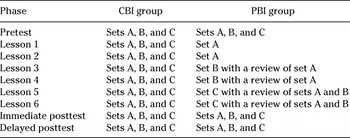
Twenty-four nouns were chosen as the target items for this study. The items were divided into three sets: eight items labeling animals for set A, eight items labeling home appliances for set B, and eight items labeling fruit and vegetables for set C. Two items from each set were in both singular and plural forms. Thus, there was a total of 10 words for each set (8 in singular form and 2 in plural form). In the CBI classes, learners were exposed to all three sets (i.e., all 30 words) in each lesson. However, in the PBI classes, the three sets were introduced separately: Set A was presented in lessons 1 and 2, set B was presented in lessons 3 and 4, and set C was presented in lessons 5 and 6. To ensure that the time between initial exposure to the target items and the posttests was the same for the CBI and PBI groups, the learners in the PBI class were given opportunities to review previous target items in the production phase as shown in Table 1.Footnote 2 Care was also taken to ensure that the actual time for each lesson was the same.
Overview of the design of the study

Note
Each set consisted of 10 vocabulary items and included two plural forms.
Treatment Materials and Procedures for the CBI Group. Three tasks were designed in accordance with R. Ellis’s (Reference Ellis2003) definition of tasks; that is, the tasks (a) included a gap, (b) required learners to focus primarily on meaning and to make use of their own linguistic resources, and (c) had a clearly defined outcome. These tasks constituted what Ellis called input tasks; that is, they were focused tasks designed in such a way that the outcome could only be achieved if the learners were successful in comprehending the input. Each task involved listening to the teacher’s commands and responding to them. The three tasks were performed in each lesson by one of the researchers who acted as the teacher and were repeated in each of the six lessons. At the beginning of each lesson, the goal and task procedures were explained to the participants, in the learners’ L1 (Japanese) if necessary. However, the teacher made every effort to use only English during the performance of the tasks.
Task 1: Help the zoo and the supermarket. Task 1 required the learners to listen to the teacher’s commands and find the cards with the target item or items. Thirty small flash cards for the 30 target items (including the 6 plural items), one three-sided board with 30 pockets to hold flash cards, and one small empty box to store the cards for which an incorrect answer was provided were prepared for each participant. The participants were informed that the purpose of this task was to help the zoo or the supermarket by finding the right cards and placing them in their holders. Participants listened to an instruction, found the card that matched the instruction, and then, when told to do so by the teacher, they all displayed the card they had chosen. The teacher then gave the correct answer. The participants who had chosen correctly placed the card in the pocket on the board, but the participants who had answered incorrectly put the card they had chosen back on the table and put the correct card in their box. After all 30 items had been completed, each student counted the number of cards in his or her incorrect box. The student with the fewest cards was the winner.
Task 2: Help the animals. The same 30 flash cards as in task 1 were used for this task. Each student received a set of these cards, and the teacher explained to the participants in their L1 that the goal of the task was to help the animals by finding certain cards. The participants were asked to find pairs of cards that corresponded to the teacher’s statements. For example, if the teacher said The polar bear needs the batteries, they had to find the card that depicted a single polar bear and the card that depicted two batteries. The students held up the pair of cards they had selected so that the teacher could indicate whether they had chosen the correct or incorrect cards. Participants were allowed to change their selections until they held up the correct cards. Altogether, each student was asked to identify 10 pairs of cards.
Task 3: Listening bingo game. This was a form of picture bingo. The participants began by choosing 9 of the 10 cards they were given and laid them out in a 3 × 3 formation in front of them. The cards were the same as those used in tasks 1 and 2 and included some plural cards in each set. The teacher then called out a word that described one of the pictures. If a student had a card with the picture of this word, he or she turned it face down. After six words were presented (some of which were singular and some plural), each participant’s bingo score (the number of turned-over cards) was checked by the teacher. Between one and three rounds were played depending on the available class time.
Instructional Materials and Procedures for the PBI Group. Prior to each PBI lesson, the goal of the activities—to learn new vocabulary—was made explicit to the students. Each lesson then consisted of five activities that represented the three phases of the PBI instruction (present, practice, produce). The first activity served as the present phase, which involved the participants’ repeating individual words. The second and the third activities, which served as the practice phase, required that the participants say the word shown on flash cards, both chorally and individually. The fourth and the fifth activities served as the produce (i.e., free production) phase. In both activities, participants named the items on the flash cards chorally while performing games that had their own, nonlinguistic outcomes. All five activities were carried out in each lesson and repeated six times with different sets of items. The researcher used English during the activities, but Japanese was used to explain the procedures whenever necessary. The teacher made every effort to provide corrective feedback using recasts because previous research (e.g., Seedhouse, Reference Seedhouse and Ellis2001) has shown this to be teachers’ favored corrective strategy for addressing errors. Corrective feedback was provided both when the learners chose the wrong word (e.g., banana instead of pear) and when they chose the wrong grammatical form (e.g., pear instead of pears) on the grounds that this constitutes standard practice in PBI lessons.
Activity 1: Listen and repeat. Ten flash cards that represented eight target items plus two plural items were presented one by one to the participants. The teacher presented each flash card, in turn, to the class, naming the item represented on the card. The participants were asked to repeat the word after the teacher chorally. Each flash card was presented twice. This activity was then repeated a second time.
Activity 2: Guess the hidden items. The teacher asked all of the participants, in English, to name each flash card as she displayed it face up in a holder. After nine cards were placed in the holder, the teacher placed the last card face down in the holder and asked the participants to try to name the hidden item. The teacher provided feedback, indicating whether a student was correct or incorrect and recasting wrong answers. This activity was repeated four times.
Activity 3: Throwing dice. All of the flash cards were placed on the holder face down. Each card was numbered. One of the participants threw a die. The teacher then picked up the card that corresponded to the number shown on the die and asked the participant to name the item. If the answer was wrong, the teacher provided a recast and turned the card face down again. If the answer was correct, the card was left face up. This was repeated until each participant had had two turns.
Activity 4: Production bingo game. The students were instructed to choose 9 cards from a set of 10 and to lay them out in a 3 × 3 formation; the teacher also had a set of cards. The teacher asked one of the participants to pick up one card from her set of cards and to show it to the other participants. Then all of the participants named the item chorally and turned over the same card from their own set. This was continued for six cards. Each participant’s bingo score (the number of cards turned over) was checked by the teacher. Two or three rounds were played depending on the available class time.
Activity 5: Kim’s game. This activity required the participants to produce all of the vocabulary items. The six sets of flash cards (a total of 60 cards) were spread randomly on the table face down. One by one, each participant turned over one of the cards, and then they all said aloud the word shown on the card. When a student turned a card over that matched one of the cards already face up, he or she was allowed to keep the pair of cards. If the participants could not name the item, or provided a wrong answer, the teacher provided feedback using recasts. After all of the cards had been turned over, the number of pairs collected by each participant was counted.
Control Group Materials. Each lesson in the control group consisted of three activities: practicing English songs, practicing verb phrases with TPR (Asher, Reference Asher1977), and tracing and copying the alphabet on worksheets. The songs were “London Bridge,” “Mulberry Bush,” and “Twinkle Twinkle Little Star.” These introduced the verb phrases get up, wash your face, get dressed, eat breakfast, go to school, go home, do your homework, eat dinner, watch TV, take a bath, go to bed, play soccer, play tag, sing a song, play tennis, and draw a picture. Care was taken to avoid using the target words in the classroom, but the students were exposed to some plural –s items from the teacher’s utterances and the songs. However, as the test results show, no incidental acquisition of plural –s took place in this group.
Testing Materials and Procedures
Three tests were designed to measure the participants’ receptive and productive knowledge of plural –s. The tests were administered as a pretest (1 week before the treatment session), an immediate posttest (1 week after the completion of the treatment session), and a delayed posttest (4 weeks after the immediate posttest).
Comprehension Test. This was a multiple-choice test, which included two of the words also included in the treatment and three new words. Each word was tested in singular and plural forms. The students were given a test sheet that consisted of 10 pairs of pictures. Each set had two pictures (one that represented the item in singular form and one in plural form). The test was administered to the participants in groups. The participants listened to an audio-recorded word and then indicated which picture in a pair corresponded to the word they had heard. They had 5 s to respond to each item in the test. Care was taken to ensure that the participants could not see other students’ test papers during the test.Footnote 3
Wug Test. This was adapted from Berko’s (Reference Berko1958) test for young L1 children. The test consisted of 10 items: There were five items that had been introduced in the treatment and five nonsense words. The test was administered to participants individually by the researcher. The researcher first provided the singular form orally while pointing to the single-item picture (e.g., This is a wug.) and then pointed to the plural-item picture and elicited a plural noun orally from the participant (e.g., There are two of them. There are two ...). The questions were provided in English first, but Japanese was used if a student did not understand the instructions. Ample time was given for the participants to answer. If a participant was unable to provide an answer or only said the singular form of a word for three consecutive items, the test was stopped.
Task-Based Production Test. This test was intended to provide evidence of the learners’ ability to produce plural –s in oral communication. A two-way information-gap task called “Same or Different” was employed for this test. The test was performed by the researcher working individually with each participant. Each participant had a sheet that showed 24 pictures of objects: There were 12 pictures of singular objects and 12 of plural objects. Five of the 12 plural objects represented items introduced during the treatment (i.e., crocodiles, batteries, mandarins, toothbrushes, squirrels); the other seven represented new items (i.e., camels, peacocks, green peppers, pans, seals, chestnuts, radishes). The students were asked to name each object, and the researcher then told the participant which picture she had. If the participants’ and the researcher’s pictures were the same, they put a tick in the square that showed the picture; if not, they put a cross. The participants were not always able to name the pictures. For this reason, an obligatory occasion analysis was used to compute scores for plural –s. An obligatory occasion was created whenever a participant demonstrated that he or she knew the word that corresponded to one of the plural pictures.
ANALYSIS
Descriptive statistics for the three groups were calculated for the comprehension, Wug, and task-based production tests. Additionally, a student’s score on each test was classified as acquired or not acquired, using 80% as the criterion level (Jia, Reference Jia2003). In each group, the number of participants who had acquired and those who had not acquired the structure based on this criterion was counted for each test and then compared by using the Fisher exact probability test.
The third CBI and the third PBI lessons were transcribed, and a number of analyses of the process features of the lesson conducted:
1. The total number of student and teacher utterances in the lessons was calculated.
2. The quality of the student utterances was examined by distinguishing whether the students’ utterances were teacher- or student-initiated. Teacher-initiated student utterances occurred typically in the form of students’ responses to teacher elicitations in initiate-respond-follow-up exchanges. Student-initiated utterances occurred when a student engaged in social or private speech.
3. The number of plural word tokens produced by the teacher in the CBI and PBI lessons was calculated.
4. A qualitative analysis of the nature of the comprehension and production errors the students made and of the teacher’s feedback on these errors was conducted.
RESULTS
The test results for product (i.e., the measures of acquisition of plural -s) will be reported first; the qualitative results for the process features of the CBI and PBI lessons will then be discussed.
Comprehension Test
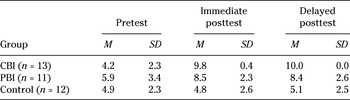
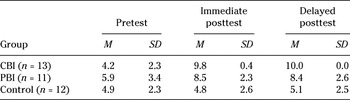
It should be noted that because this test required learners to choose between two pictures to demonstrate understanding of the plural, a score of 5 out of 10 could be achieved by chance. As shown in Table 2, in the pretest, all three groups scored more or less at chance. In the immediate posttest, the control group continued to perform at chance, but both the CBI and the PBI groups achieved the criterion level of 80%. By the delayed posttest, the learners in the CBI group demonstrated total comprehension of plural –s, whereas the PBI group maintained their immediate posttest scores. An ANOVA with a Bonferroni correction, F(2, 66) = 45.166, p < .016, followed by post hoc pairwise comparisons, also with Bonferroni corrections, showed that the differences between pretest and immediate posttest scores and between pretest and delayed posttest scores were statistically significant for both experimental groups at the .01 level. There were also significant group differences, F(2, 33) = 9.105, p < .016, and pairwise comparisons revealed that both the CBI and the PBI groups outscored the control group on both posttests at the .01 level but that there was no significant difference between the comprehension scores of the two experimental groups.Footnote 4
Descriptive statistics for the comprehension tests
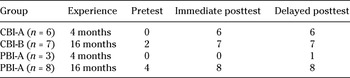
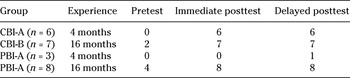
A further analysis, however, suggests that some of the CBI-group learners were indeed more successful than the PBI-group learners. Recall that each group actually consisted of two separate classes—one that had minimal prior classroom experience of English and the other had 16 months. Table 3 provides the number of students who had acquired plural –s in the comprehension tests in each class in the CBI and PBI groups using the 80% level as the criterion for accuracy (Jia, Reference Jia2003). There is a difference between the CBI- and PBI-group learners who had had only 4 months of experience. In the case of the CBI-A group, all six learners scored below 80% on the pretest but at or above 80% on both posttests. In contrast, none of the three learners in the PBI-A group achieved the 80% criterion level in the immediate posttest and only one did so in the delayed posttest. The Fisher probability exact test shows the difference between the learners in the CBI-A and the PBI-A groups to be statistically significant in the immediate posttest (p < .03) but not in the delayed posttest (possibly because of the very low N size in the PBI-A group). Thus, although all of the learners in both groups with 16 months of classroom experience (i.e., the CBI-B and PBI-B groups) were successful in acquiring an understanding of the meaning of plural –s incidentally, those with minimal prior experience with English benefited more from the comprehension-based lessons.
Number of students who acquired plural –s in the comprehension tests
Wug Test
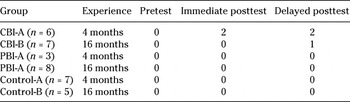
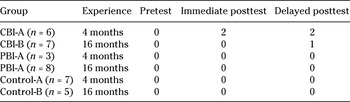
Table 4 provides the number of students who demonstrated some ability to produce plural –s in the Wug test. No student in the control group or in the PBI-A and PBI-B groups succeeded in producing plural –s in the pretest, immediate posttest, or delayed posttest. Although the students in the CBI-B group did a little better than the PBI groups (only one student in the CBI-B group achieved a score above 0% without reaching the 80% level), two of the students in the CBI-A group were able to achieve the 80% criterion level in both posttests. Overall, then, the Wug test provided little evidence of any incidental acquisition of productive ability, but the evidence that was found suggested an advantage for the CBI groups.
Number of students who produced plural –s in the Wug test
Note
At the immediate posttest, two students in the CBI-A group received a score of 10. In the delayed posttest, the same two students received a score of 8 and 9, respectively, and one student from the CBI-B group received a score of 2.
Task-Based Production Test
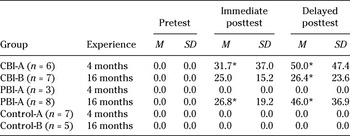
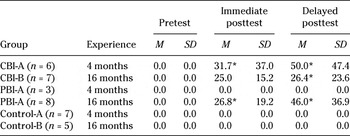
Statistically significant differences were found between the experimental groups and the control group, which demonstrated that incidental acquisition had taken place in both the CBI and PBI classes (see Table 5). Both the CBI-B and the PBI-B groups demonstrated that they could produce plural –s, with both groups outperforming the control group. The CBI-A group demonstrated the ability to produce plural –s, but the PBI-A group, like the control group, received a score of zero in the two posttests. Students in the PBI-B group demonstrated greater accuracy in the use of plural –s than students in the CBI-B group. However, on the new items, the CBI-B and the PBI-B groups performed similarly (e.g., in the immediate posttest, three of seven students in the CBI-B group produced –s on new nouns, and only two of eight students in the PBI-B group did so). None of the differences between the CBI and the PBI groups reached statistical significance, but only the CBI-A group scored significantly higher than the control group on both posttests.
Descriptive statistics for oral task-based production test
Note
The asterisk indicates a significant difference, p < .05, from the control group.
Process Features
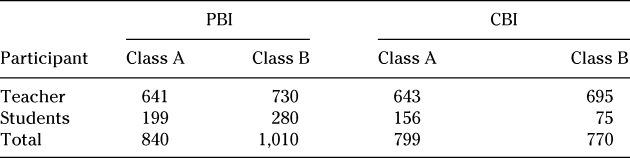
Table 6 shows the total number of students’ and teacher’s utterances in lesson 3 (the third of the six lessons) for the CBI and PBI groups.Footnote 5 There were 1,569 utterances in the CBI lesson and 1,850 in the PBI lesson. The number of teacher utterances was almost identical in the two groups (i.e., 1,338 for CBI and 1,371 for PBI) but, as might be expected, there was a difference in the number of student utterances (231 for CBI and 479 for PBI).
Number of student and teacher L2 utterances in lesson 3
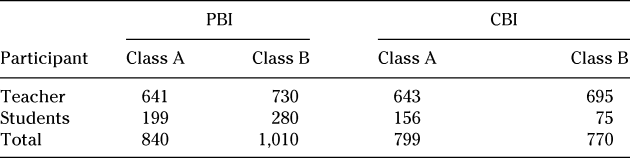
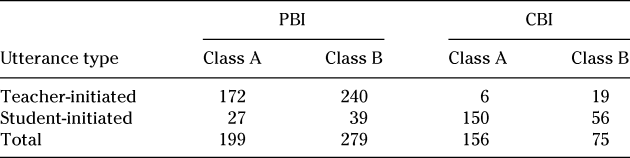
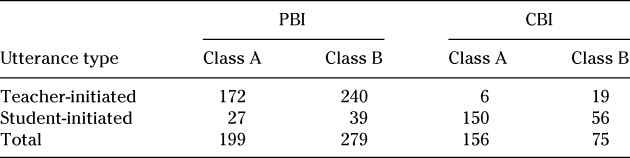
Table 7 provides the number of all the teacher- and student-initiated learner utterances in the CBI and PBI groups in lesson 3. The difference is substantial; whereas the vast majority of the student utterances in the PBI classes were teacher-initiated, which reflects the dominance of initiate-respond-follow-up exchanges in this instructional approach, the majority of the utterances in the CBI classes were student-initiated, which reflects the prevalence of these learners’ use of private speech. The number of plural word tokens produced by the teacher in the different classes are rather similar: Overall, there were 76 plural word tokens in the PBI classes (39 in PBI-A and 37 in PBI-B) and 88 in the CBI classes (34 in CBI-A and 54 in CBI-B).
Number of teacher- and student-initiated learner utterances in lesson 3
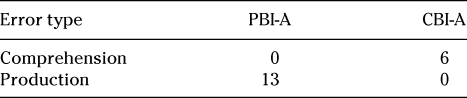
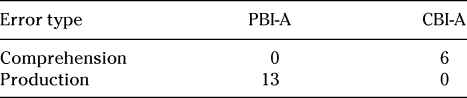
Finally, all instances in which the students in the CBI-A and the PBI-A groups demonstrated failure to comprehend a plural noun in the input or failure to produce a plural form in obligatory contexts were examined. Table 8 illustrates the results of this analysis. All of the errors in the PBI classes were errors of production, whereas all of the errors in the CBI classes involved a failure to comprehend the function of plural –s, which reflects the nature of the two different types of instruction. The teacher’s responses to these errors were then examined. In the PBI classes, the teacher corrected all but one of the students’ production errors. However, on only one occasion did the teacher explicitly require a student to repeat the correct form, which the student successfully did. On all other occasions, the corrections took the form of recasts, which failed to elicit any student uptake. The feedback in the CBI class centered on students’ failure to comprehend plurality, and it is noteworthy that students did not produce a plural noun in these corrective episodes.
Number of errors on plural – s by type
DISCUSSION
The first two research questions asked whether young Japanese learners of English were able to acquire plural –s incidentally in CBI and PBI lessons, respectively. The test results indicate that incidental acquisition of plural –s took place in both types of lessons. In the comprehension test, the CBI and PBI groups outperformed the control group on both posttests. In the task-based production test, the learners in both the CBI-B and the PBI-B groups outperformed the control group on the two posttests. In the case of the CBI group, the near-beginners (i.e., the CBI-A group) also outperformed the control group on both posttests. However, the results of the Wug test provided very little evidence of any incidental acquisition; only two of the learners in the CBI-A group were able to demonstrate productive knowledge of plural –s on this test, and no learners from the CBI-B, the PBI-A, or the PBI-B groups were able to do so. One explanation for the difference in the results for the comprehension test and the task-based production test, on the one hand, and the Wug test, on the other hand, may be transfer of learning. Whereas the comprehension test and the task-based production tests were similar to the kinds of activities the learners had experienced during instruction, which, in turn, enabled them to demonstrate learning, the Wug test was completely different in that it elicited a testlike rather than a communicative response.
The results of this study differ from those of Loewen et al. (Reference Loewen, Erlam and Ellis2009). Whereas evidence of incidental acquisition was found in the current study, this was not the case in Loewen et al.’s study. The most obvious explanation for this discrepancy lies in the target structures that the two studies investigated. Both studies investigated an –s morpheme; phonological saliency would thus not seem to be a factor. However, whereas third-person –s (the target structure of Loewen et al.) is functionally redundant (i.e., it adds no semantic meaning), plural –s is functionally salient (i.e., it conveys the meaning “more than one”), and in certain contexts, the meaning of an utterance depends on the decoding or encoding of the plural morpheme. Another possible explanation of the difference in the results of these two studies is the age of the participants. Whereas Loewen et al. investigated adult learners, this study investigated young children, who may be better equipped to learn incidentally.
The third research question addressed the differences in acquisition that result from the two types of instruction examined here. The differences between the CBI and PBI groups in all three tests were all statistically nonsignificant, with the exception of the difference between the CBI-A and the PBI-A groups in the comprehension test. The interactions in the comprehension-based lessons enabled the beginner learners to develop an understanding of the meaning of plural –s, whereas the interactions in the production-based lessons were not effective in achieving this understanding. There are other grounds for suggesting that CBI was more effective than PBI in the case of the learners with very little prior knowledge of English. The only learners to show any evidence of acquisition in the Wug test came from the CBI-A group. Additionally, whereas the learners in the CBI-A group demonstrated an ability to produce plural –s in the task-based production test, the learners in the PBI-A group, like the learners in the control group, did not demonstrate such an ability. Thus, the results show that although the two types of instructions equally benefited the learners with some prior knowledge of English, CBI was more effective in the case of the learners with very little prior knowledge of English. Furthermore, this advantage for CBI was evident in the near-beginner learners’ ability to both comprehend and produce plural –s. This conclusion, which is necessarily tentative, given the small size of the PBI-A group, suggests the importance of input rather than output for the incidental acquisition of a new morphological feature in learners with very little knowledge of the L2.
Why, then, was CBI more conducive to the incidental acquisition of plural –s by the near-beginner learners than PBI? To address this question, it is necessary to examine the process features of the CBI and PBI lessons. Table 6 reported the number of utterances produced by the teacher and the learners. It is clear that the sheer quantity of speech in the CBI and PBI lessons cannot explain the differences between the two groups, nor can the number of utterances produced by the teacher, which was almost identical in the two groups. There is, however, a difference in the number of student utterances, which reflects the methodological differences between the two instructional approaches at this beginner level. One possibility is that the students in the CBI-A group were better able to attend to the input (and, hence, better able to notice the plural –s morpheme and its function) than the students in the PBI-A group because they were not required to produce utterances in English so frequently, which, given their limited English proficiency, may have strained their processing capacity.
The difference between teacher- and student-initiated learner utterances in the CBI and PBI lessons is considerable (see Table 7); whereas the vast majority of the student utterances in the PBI classes were teacher-initiated, which reflects the dominance of initiate-respond-follow-up exchanges in this instructional approach, the majority of the utterances in the CBI classes were student-initiated, which reflects the prevalence of these learners’ use of private speech. An example of a typical exchange from the PBI lesson is provided in (2); the learner’s response follows the teacher elicitation.
(2) PBI-B lesson 3
Teacher: How many bingos have you got?
Student: Two bingo.
Teacher: Two bingos. No, you’ve got three bingos.
In contrast, in the CBI lessons, student-initiated utterances occurred when a student engaged in social or private speech, as illustrated in (3).
(3) CBI-A lesson 3
Teacher: Please take the battery to the supermarket.
Student 1: Ah, battery.
Student 2: One? One?
Teacher: Yes.
Student 2: One. One.
Teacher: Yes, battery.
Student 2: Battery. Battery. Battery.
Teacher: Battery, yes.
Student 3: bapori, bapori, bapori, bapori.
Student 2’s first utterance is social in nature, as it constitutes an attempt to clarify the number of batteries required from the teacher. His other two utterances are private in nature, as is student 3’s playful repetition of bapori. These utterances seem to be attempts on behalf of the learners to spontaneously rehearse the language associated with the performance of the task.
Various studies of L1 and L2 learners (e.g., R. Ellis, Reference Ellis1999b; Ernst, Reference Ernst1994; Johnson, Reference Johnson1995; Wells & Montgomery, Reference Wells, Montgomery, French and McLure1981) have found evidence to suggest that acquisition is more likely to occur when learners have the opportunity to exercise some degree of discourse control. It is not unreasonable to propose, therefore, that the CBI students benefited from the relative freedom they had to initiate utterances in English. Such freedom may have promoted greater attention to the function performed by plural –s.
Another possibility is that the lessons differed in the number of plural tokens produced by the teacher. As noted, there were 76 plural word tokens in the PBI classes and 88 in the CBI classes. However, the additional tokens in the CBI classes all occurred in the CBI-B group, but it was the students in the CBI-A group who demonstrated the highest level of incidental acquisition in both comprehension and production. It can be concluded, then, that the frequency of exposure to nouns with plural –s was sufficient in both classes to promote incidental acquisition but cannot account for the differences between the CBI-A and the PBI-A groups.
The nature of the feedback provided in the CBI and the PBI lessons was markedly different. It is possible, therefore, that feedback plays an important role in incidental acquisition and that feedback on comprehension errors is more facilitative than feedback on production errors. To explore this possibility, the teacher’s responses to learner errors were examined. In the PBI lesson, the teacher corrected all but one of the students’ production errors. However, only once did the teacher require a student to repeat the correct form, which the student successfully did. On all other occasions, the corrections took the form of recasts, which failed to elicit any student uptake. The exchange provided in (4) is typical of the type of correction that took place in the PBI classes.
(4) Teacher: What are they?
Student: Tooth. Toothbrushi.
Teacher: Yes, yes, toothbrushes. Okay, next.
It would appear, then, that the corrections were not salient to the students, perhaps because they were focused on the target vocabulary items.
The feedback exchanges in the CBI classes, which centered on the students’ failure to comprehend plurality, were very different from those in the PBI classes, as shown in (5) and (6).
(5) Teacher: Okay next one. A polar bear, the polar bear with the pears. He’s very hungry.
Student 1: (Showing a card with one pear)
Teacher: Not only one pear. Pears. Pears.
Student 1: (Showing polar bear with pears)
(6) Teacher: Okay, next one. Please take the toothbrush. Toothbrush.
Student 2: One?
Teacher: Toothbrush. One toothbrush, two toothbrushes.
Student 2: Two?
Teacher: No, no, no. Toothbrush, toothbrush.
Student 1: (Indicating two with fingers) two-thbrush?
Teacher: Not two. One toothbrush.
Student 2: Eh? One, two, brush?
Teacher: No, no (indicating one with fingers) toothbrush. One toothbrush. Ready, ready? Three, two, one. Go. One toothbrush.
All students: (Showing correct cards).
In (5), the student failed to understand the plural pears, which led the teacher to correct him explicitly and to repeat the plural noun twice. The student then recognized the need to show the card with two pears, which he selected. In (6), the students were at first unable to identify that toothbrush is singular, but after substantial assistance from the teacher, which included repeating the singular noun, contrasting the singular and plural forms, and gesturing the singular meaning, all of the students were able to select the correct card that showed a single toothbrush. These two examples illustrate the difficulty that the CBI students experienced in identifying number marked on nouns and also how the nature of the task itself forced them to attend closely to the form of the nouns in order to complete the task successfully. It is interesting to note, however, that on no occasion did any student produce a plural noun in the CBI corrective episodes.
In sum, although both types of instruction resulted in some incidental acquisition of plural –s, overall the CBI lessons appear to have been more effective in promoting incidental acquisition of this feature among students with little prior knowledge of English. To explain this finding, we undertook a detailed comparison of the PBI and CBI interactions that occurred in lesson 3. This comparison showed that the findings cannot be explained by the simple frequency of plural nouns in the teacher’s input. It was noted that there were fewer student utterances produced in the CBI classes but that notably more of these were student-initiated, which led to the speculation that this might have enabled the beginner learners to focus more closely on the input. However, the most likely explanation for the differences in incidental acquisition between the two groups lies in the exchanges that included student errors. In the PBI classes, only production errors occurred. These were corrected by means of recasts, but the corrections were not uptaken by the students and may not have been salient to them, as other classroom researchers have suggested (e.g., Sheen, Reference Sheen2006). In the CBI classes, only comprehension errors occurred. These were corrected by the teacher, which enabled the students to demonstrate understanding of the different meanings of singular and plural forms.
If acquisition of plural –s requires a degree of cognitive reorganization on the part of Japanese learners of English, as Athanasopoulos and Kasai’s (Reference Athanasopoulos and Kasai2008) study suggests, then this might best be achieved by pushing learners who have very limited knowledge of the L2 to notice the difference in meaning between singular and plural nouns in the context of a task where this difference is central to accomplishing the task and where the learners receive the necessary interactional support when they fail to comprehend. If incidental acquisition begins with comprehension, then CBI may be better able to facilitate this type of acquisition, at least with low-proficiency learners. For learners who already possess some proficiency in English, however, both CBI and PBI appear to be equally effective.
LIMITATIONS
We acknowledge a number of limitations of this study. First, this was a small-scale study. In particular, the number of learners in the CBI-A and PBI-A groups, who were absolute beginners, was very small. For this reason alone, we recognize that any conclusions must be tentative. Second, this study examined a very specific group of learners—young Japanese children—for whom the structure investigated—plural –s—constituted a particularly problematic structure, given that there is no L1 equivalent. Thus, it does not seem that the results of this study can be generalized to other learners.
Third, the learners had no prior knowledge of plural –s, as shown by the pretest scores. Thus, although the results reported here suggest that CBI is especially effective in promoting incidental acquisition in learners who were near-beginners, it remains possible that PBI may be more advantageous for learners who have already partially acquired the feature. As noted earlier, there is clear evidence that production can aid incidental acquisition. Additionally, in this study, the students in the PBI-B group, who had received more exposure to English, outscored the students in the CBI-B group in the task-based production test, although this difference was not statistically significant.
Fourth, it might be argued that PBI in the present study could have been more effectively implemented. For example, the teacher might have used a more explicit form of correction rather than recasts, and this might have led the learners to repair their errors. However, we maintain that the PBI classes were conducted in accordance with mainstream methodology as described, for example, in Hubbard, Jones, Thornton, and Wheeler (Reference Hubbard, Jones, Thornton and Wheeler1983), Gower and Walters (Reference Gower and Walters1983), and Ur (Reference Ur1996).
CONCLUSION
We elected to conduct a comparison of the incidental acquisition that took place in comprehension-based and production-based lessons. It is therefore clear that the current study has nothing to say about the relative effectiveness of these two approaches in enabling learners to acquire a linguistic feature that has been designated as the target for intentional learning. We believe, however, that it is important to examine incidental acquisition and we are puzzled why so few studies have pursued this line of research. It can be argued that no matter what the approach is, much of the learning that takes place in a classroom will be of the incidental kind. Slimani’s (Reference Slimani1989) research has shown that what students learn is often not what teachers topicalize.
This study has shown that incidental acquisition can take place in both comprehension-based and production-based lessons. Some evidence has been provided to suggest that, for young near-beginner learners, incidental acquisition is more likely to be fostered by CBI. A qualitative analysis of the interactions that took place in both types of lessons suggests that the advantage found for the near-beginners in the comprehension-based lessons may have originated in the teacher’s feedback, which enabled learners to make the form-function mapping for plural –s while engaged in the attempt to comprehend.
Further research is needed to probe the effects of CBI and PBI on incidental acquisition. We believe that it is important to undertake such research in real-life classrooms as opposed to laboratory contexts. Such research will need to examine a variety of linguistic features that differ in saliency and in learnability and to examine learners at different levels of proficiency. Additionally, such research ideally needs to be of the process-product kind, as in the study reported here; that is, in addition to investigating the learning that results from instruction, the contribution of instructional processes to incidental learning should be examined.