Introduction
Dementia is a major public health problem with significant physical and emotional consequences not only for care recipients but also for their caregivers (Vandepitte et al., Reference Vandepitte, Van Den Noortgate, Putman, Verhaeghe and Annemans2016a).
While caregiving may be a satisfying and rewarding activity (Ploeg et al., Reference Ploeg2017), providing continued support to relatives with dementia demands additional time in the caregiver’s daily living activities, due to the degenerative nature of the disease, and it may also result in poor physical and mental health (Vandepitte et al., Reference Vandepitte, Van Den Noortgate, Putman, Verhaeghe, Faes and Annemans2016b). According to Fusar-Poli et al. (Reference Fusar-Poli2020), mental health is “a state of well-being in which the individual realizes his or her own abilities, can cope with the normal stresses of life, can work productively and fruitfully, and is able to make a contribution to his or her community’’ (Fusar-Poli et al., Reference Fusar-Poli2020). Caregivers’ mental health may be compromised because caregiving may lead to subjective burden, depression, and a variety of psychological symptoms, such as anxiety (Delgado et al., Reference Delgado, Suárez, De Dios, Valdespino, Sousa and Braña2014; Haines et al., Reference Haines, Denehy, Skinner, Warrillow and Berney2015; Pérez-Fuentes et al., Reference Pérez-Fuentes, Gázquez, Ruiz and Molero2017). In addition, caregivers may also suffer from stress and emotional strain (Farran et al., Reference Farran2016b; Marquez-Gonzalez et al., Reference Marquez-Gonzalez, Losada-Baltar, Izal, Perez-Rojo and Montorio2007). High levels of hostility, aggression, somatization, irritability, hallucinations, delusions, restlessness, and disinhibition have also been reported by caregivers (Feast et al., Reference Feast, Orrell, Russell, Charlesworth and Moniz-Cook2017; Birkenhäger-Gillesse et al., Reference Birkenhäger-Gillesse, Kollen, Zuidema and Achterberg2018). This variety of symptoms may have a negative impact on caregivers’ health status (Del Rio Lozano et al., Reference Del Rio Lozano, Garcia-Calvente, Calle-Romero, Machon-Sobrado and Larranaga-Padilla2017). According to the World Health Organization (WHO), health is “a state of complete physical, mental and social well-being […]’’ (World Health Organization, 2004). Therefore, it is important to provide caregivers with supporting interventions, in order to prevent caregivers’ health problems, in general, and mental health, in particular, to be adversely affected by the fact of providing a relative with dementia with care (Vandepitte et al., Reference Vandepitte, Van Den Noortgate, Putman, Verhaeghe and Annemans2016a).
Over the last few decades, different supportive interventions for caregivers of relatives with dementia have been developed, including support groups, formal approaches to care, respite care, educational programs to perform daily caring tasks, combined interventions, and other multicomponent approaches (Alzheimer’s Disease International, 2016; Gaugler and Kane, Reference Gaugler and Kane2015; Sorensen et al., Reference Sorensen, Pinquart and Duberstein2002; Rodriguez-Sanchez et al., Reference Rodriguez-Sanchez2013; Prick et al., Reference Prick, De Lange, Twisk and Pot2015). However, these interventions usually show methodological difficulties, such as overlap among intervention types, lack of details of the interventions, lack of control groups, and insufficient clarity of outcome measures (Jackson and Browne, Reference Jackson and Browne2017). Moreover, these interventions usually report low rates of adherence, as they are carried out of home, requiring additional resources for the participants: leave the care recipient at home, the time needed to be invested to participate, attendance to the facilities, and time for trips to the facilities to participate in the intervention (Prick et al., Reference Prick, De Lange, Twisk and Pot2015). Additionally, physical and psychoeducational RCTs have been recently conducted with family caregivers (Gitlin et al., Reference Gitlin, Marx, Stanley and Hodgson2015; Vandepitte et al., Reference Vandepitte, Van Den Noortgate, Putman, Verhaeghe and Annemans2016a; Domingues et al., Reference Domingues, Verreault and Hudon2018). Interventions to increase physical activity levels in caregivers have also been designed (Hirano et al., Reference Hirano, Suzuki, Kuzuya, Onishi, Ban and Umegaki2011; Farran et al., Reference Farran2016b; Farran et al., Reference Farran2016a). These have been found to improve quality of life (physical and mental components) (Lee et al., Reference Lee, Ryoo, Crowder, Byon and Wiiliams2020), and fitness (Cuthbert et al., Reference Cuthbert2018), to reduce caregivers’ fatigue and burden (Hirano et al., Reference Hirano, Suzuki, Kuzuya, Onishi, Ban and Umegaki2011; Hill et al., Reference Hill, Smith, Fearn, Rydberg and Oliphant2007), and to improve the psychological status of caregivers (Chan et al., Reference Chan, Lautenschlager, Dow, Ma, Wong and Lam2016). However, these studies have used different methodologies, have been usually heterogeneous in their approaches and have reported different results, thus making it difficult to generalize conclusions. Additionally, there is evidence suggesting that exercise may reduce risk of depression and subjective burden, although the mechanisms by which physical exercise exerts this effect have not been extensively studied and thus are not well understood (Craft, Reference Craft2005). Moreover, some cohort studies have reported that mild-to-moderate levels of physical activity improve caregiver’s mental health (Farran et al., Reference Farran2016a; Hirano et al., Reference Hirano, Suzuki, Kuzuya, Onishi, Ban and Umegaki2011). In addition, physical exercise has been identified as an effective and feasible strategy to improve health-related quality of life at the physical and the psychological levels in caregivers (Cuthbert et al., Reference Cuthbert2018; King et al., Reference King, Baumann, O’sullivan, Wilcox and Castro2002; Stella et al., Reference Stella, Canonici, Gobbi, Galduroz, Cacao Jde and Gobbi2011). However, improving physical and mental health might only be effective if the physical exercises are of moderate intensity and are executed at caregivers’ homes taking into account caregivers’ personal preferences, for example, regarding the choice of hours (Prick et al., Reference Prick, De Lange, Twisk and Pot2015). In this sense, the interventions that are developed out of home may have high dropout rates, and the participants are more likely to discontinue participation in the intervention. This may limit the benefits from the intervention for caregivers (Rodriguez-Sanchez et al., Reference Rodriguez-Sanchez2013). Therefore, in order to compare different approaches to determine the most appropriate intervention for caregivers of relatives with dementia (minimum or optimal dose of physical exercise weekly, the type of exercises, the duration and settings of the interventions for these caregivers), additional RCTs and physical exercise-based interventions should be carried out (Lamotte et al., Reference Lamotte, Shah, Lazarov and Corcos2017).
It has been suggested that individual interventions tend to be more effective than group interventions, because they are usually tailored on the basis of the particular needs and contexts of caregivers. However, they require more resources from staff, that is, to develop or supervise each session and to generate the tailored intervention for each participant. In addition, the costs of staff are greater than interventions for groups (Goy et al., Reference Goy, Kansagara and Freeman2010; Lopez and Crespo, Reference Lopez and Crespo2008).
There are some published interventions that have been either supervised via telephone or by trained staff at the intervention center (Connell and Janevic, Reference Connell and Janevic2009; Farran et al., Reference Farran2016a; Hill et al., Reference Hill, Smith, Fearn, Rydberg and Oliphant2007). Regarding the last ones, involvement in outdoor health-promoting activities and face-to-face contact with a personal trainer at the intervention center may be difficult for caregivers for several reasons: caregivers might be unwilling to take a break from caregiving activities (Vandepitte et al., Reference Vandepitte, Van Den Noortgate, Putman, Verhaeghe and Annemans2016a), they could have difficulties to find alternative sources of care for the care recipients, and they could not have the time to participate in center- or community-based exercise interventions (Chan et al., Reference Chan, Lautenschlager, Dow, Ma, Wong and Lam2016). Therefore, individually tailored interventions that target the particular needs of caregivers are fundamental to improve their health status (Domingues et al., Reference Domingues, Verreault and Hudon2018), and home-based programs are essential to confirm the outcomes and to increase the adherence rates (Lamotte et al., Reference Lamotte, Shah, Lazarov and Corcos2017; Orgeta and Miranda-Castillo, Reference Orgeta and Miranda-Castillo2014).
In summary, previous research has suggested that more physical exercise-based supporting strategies should be implemented (Farran et al., Reference Farran2016a; Jackson and Browne, Reference Jackson and Browne2017). Therefore, this study sought to evaluate, whether an individual face-to-face home-based physical exercise program that is directed to informal female caregivers and supervised by a trained staff is feasible and effective, and to determine the potential positive impact of this intervention on mental health (Madruga et al., Reference Madruga, Prieto, Rohlfs and Gusi2020). In particular, we hypothesized that if such intervention is applied on female caregivers of relatives with dementia, the female caregivers will show a decrease in psychological symptomatology, risk of depression, and subjective burden.
Methods
Design
This study followed a between-subject experimental design on the basis of a RCT. The participants were randomly assigned to one of the two groups: the participants who were allocated to the intervention group (IG) and the participants who were allocated to the control group (CG).
Participants and setting
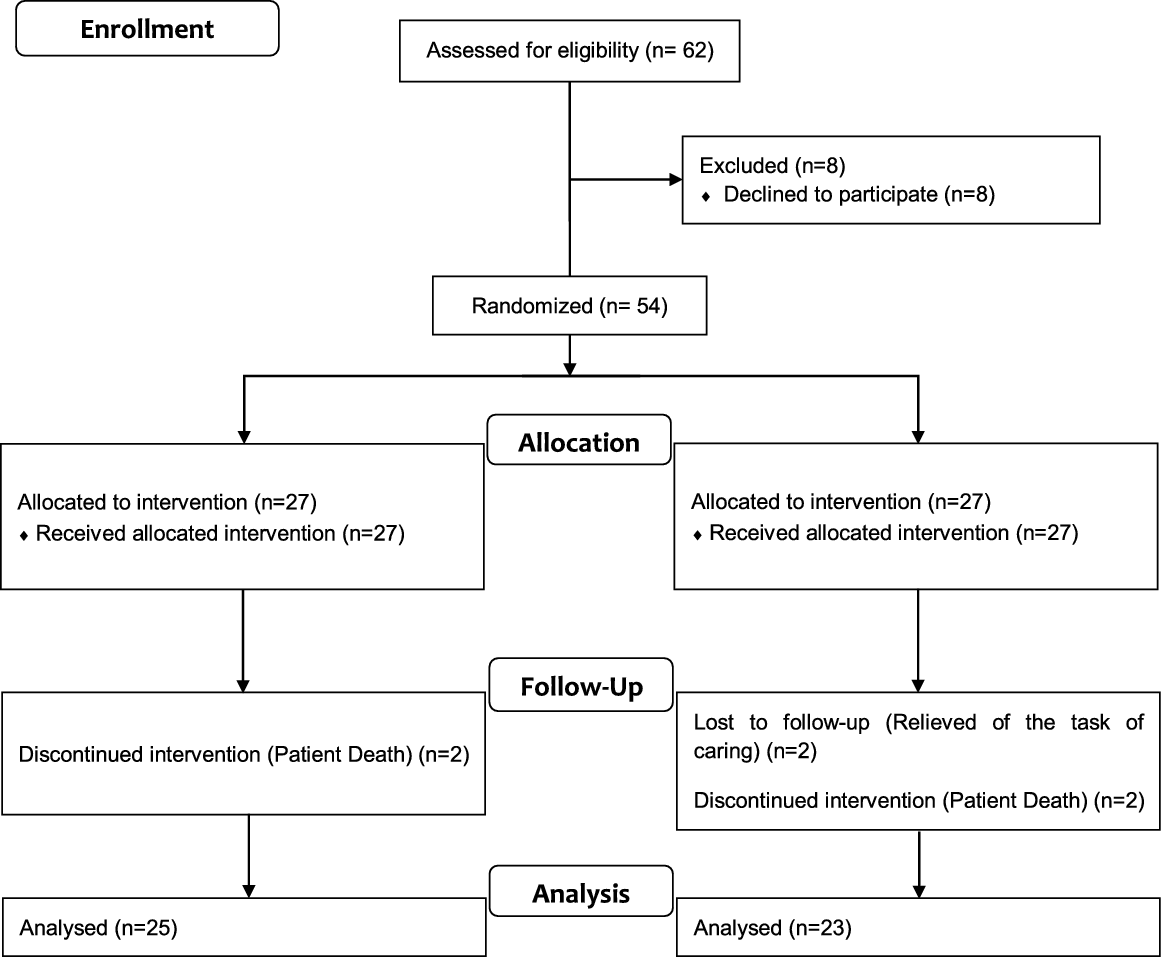
Participants were recruited in cooperation with the associations of relatives of patients with dementia from Extremadura (Spain). Then, potential participants were screened for eligibility in accordance with the study inclusion and exclusion criteria. The inclusion criteria were (1) being the primary informal caregiver of a relative with dementia of which diagnosis was done by a qualified physician. According to Badia et al. (Reference Badia, Lara and Roset2004), we defined the primary informal caregiver as providing the care recipient with at least 20 hours of care per week. (2) Being female. (3) Being 50-year-old or older. (4) Showing no medical condition that would prevent her from carrying out moderate-intensity physical exercise, as assessed by the Physical Activity Readiness Questionnaire (Thomas et al., Reference Thomas, Reading and Shephard1992). (5) Not being engaged in any regular physical exercise program, that is, more than two 20-minute-long sessions of exercise per week during the 6 months prior to the study. (6) In case of taking medication, absence of changes for at least 3 months prior to study entry. (7) No plans to move away from the area of residence in the following 12 months. The exclusion criteria were the opposite criteria plus being male. After sending per mail invitations to participate in the study to all potential participants, a total of 62 subjects accepted to participate in the study. After the screening, 8 female informal caregivers were excluded from the study. Moreover, data of six subjects were excluded from the statistical analyses for the following reasons: (1) death of the care recipient (n = 4). (2) Care recipients’ change of residence and subsequent changeover of the caregiver (n = 2). Therefore, a final total of 48 participants were randomly assigned to either the IG (n = 25) or to the CG (n = 23) (see Figure 1).
Outline of research process.

All participants signed a written informed consent before participating in the study. The study was conducted in accordance with the updates of the Declaration of Helsinki.
Sample size calculation
The current paper was developed in the framework of a large study to assess the cost utility of the intervention to the policy-makers of the healthcare system. Therefore, the required sample size was estimated using the Spanish version of the EQ-5D-3L questionnaire and taking into account the between-subject experimental design of the study. We assumed a significance level alpha of 0.05 and statistical power of 80%, which is required to detect a minimal clinically significant difference of 0.20 and SD of 0.12 (Zijlstra et al., Reference Zijlstra, Braakman-Jansen, Taal, Rasker and Van De Laar2007) to know if the intervention could be a cost-effective addition to usual care of the caregivers studied. More detailed information is described in the study protocol (Madruga et al., Reference Madruga, Prieto, Rohlfs and Gusi2020).
On the other hand, we have also to take into account the costs of the intervention that are added to the conventional care that is usually provided by the public health system, which will be 1,680€ per caregiver. This amount will include the personal trainer’s salary, insurance, and 2 hours/week travel-related costs.
A third aspect to take into account refers to the cost efficiency ratio, which is expressed as cost per quality-adjusted life-years (QUALYs) (Sacristan et al., Reference Sacristan, Oliva, Del Llano, Prieto and Pinto2002). This ranges between 10,000 and 50,000€ per QALYs, and we used a conservative estimated sum of 30,000 € per QALYs. A cost efficiency ratio of 0.21 corresponds to a 0.06 QALYs.
In view of the above, a sample size of 50 caregivers distributed into two groups – IG and CG – is required to achieve a statistical power of 80% with a 95% of confidence interval, using an analysis of variance in parallel to parametric testing and taking into account a potential dropout rate of 20%. In addition, in order to improve the confidence interval, a bootstrapping technique will also be used.
Intervention
A 9-month-long and home-based physical exercise intervention was carried out. Participants of the IG were subjected to the intervention twice a week for 1-hour session at their homes. This intervention was supervised by a qualified personal trainer. Therefore, these sessions were face-to-face ones. Each session consisted of the following activities: (1) 10-minute-long warm-up activities, in particular, slight movements of progressive intensity, and easy walks and steps; (2) 10-minute-long aerobic exercise at 60–65% of the maximal heart rate (HRmax); (3) 20-minute-long of overall mobility and strength exercises using the weight of one’s own body. (4) Additional 10-minute-long aerobic exercise at 60–65% HRmax. (5) 10-minute-long cool-down period of low-intensity exercises. During each session, participants wore a heart rate monitor to continuously monitor their heart rate to ensure that the caregivers were doing the appropriate intensity (Polar S625X, 1 Polar Electro Oy, 2 Kempele, Finland). As far as the heart rate was set by protocol, it was not recorded or used as outcome or variable. In order to enhance participants’ enjoyment of the exercises and fitness levels, materials such as weights, dumbbells, and elastics were included into the basic exercises.
Participants of the CG were not subjected to this intervention and thus continued their daily activities. They were also instructed not to start any new physical exercise program to avoid influencing the study. In addition, during the 9-month-long intervention period, participants of the CG were contacted once a month by telephone in order to conduct an ad-hoc-standardized, non-exercise-related conversation with a member of the researcher team, in order to remind them of the conditions of the study.
Participants of both groups were evaluated at home by qualified and trained members of the research team at baseline and at the end of the intervention (9 months after the intervention). Each of the two evaluations of each participant lasted about 45 minutes.
Prior to the baseline evaluation, and in order to apply a standardized evaluation protocol, the evaluators were given a testing manual that has been ad hoc written by the research team. This manual contains the description and particular instructions for all assessment procedures. They also participated in an assessment training workshop that consisted of three sessions, each 3–4-hours-long.
All evaluation tools have shown to have a moderate to high reliability and validity in samples of older people and caregivers.
Background characteristics of participants
Sociodemographic and other data from the caregivers were compiled using an ad-hoc-made questionnaire. The compiled demographic data included age, place of residence, marital status, number of co-residents, educational level, smoking and alcohol consumption habits, and level of physical activity. It also included questions regarding the nature of the relationship between the primary caregiver and the care recipient as well as the number of years that the caregiver spent caring the care recipient.
Regarding the care recipients, functional status was evaluated by trained members of the research team using the Barthel Index (Mahoney and Barthel, Reference Mahoney and Barthel1965). This 10-item tool assesses the care recipient’s capacity to perform 10 basic activities of daily life, such as the ability to dress or bathe. Numerical scores are assigned according to whether the individual requires assistance to perform the task or whether he/she is able to do the activity independently. The final score provides a quantitative estimation of the care recipient’s level of dependency, ranging from 0 to 100. Higher scores indicate a higher level of functional independence and the opposite pattern is indicated by lower scores. Cronbach’s α values range from 0.88 to 0.94. We have included this evaluation in order to provide readers with information on care recipients’ functional status, as it can act as a mediator of changes in mental health of caregivers (Viñas-Díez et al., Reference Viñas-Díez, Conde-Sala, Turró-Garriga, Gascón-Bayarri and Reñé-Ramírez2019; González-de Paz et al., Reference González-De Paz, Real, Borrás-Santos, Martínez-Sánchez, Rodrigo-Baños and Dolores Navarro-Rubio2016).
Exercise adherence
Participants of the IG were offered 72 sessions of exercise. Caregivers’ attendance to the sessions was monitored by the supervising personal trainer during the 9-month-long intervention. Exercise adherence rates were calculated on the basis of the percentage rate of completed sessions.
Outcome measures
Mental health
As we have indicated in the introduction of the present manuscript, caregivers of relatives with dementia usually show depression, psychological symptomatology, and subjective burden. For these reasons, we have measured participants’ mental health assessing participants’ risk of depression, psychological symptomatology, and subjective burden.
Risk of depression
Risk of depression was measured using the short form of the Geriatric Depression Scale (GDS) (Yesavage et al., Reference Yesavage, Brink, Rose and Lum1983). This 15-item self-administered questionnaire can detect major depression of older people in primary care settings. Scores range from 0 to 15. A cutoff of 5 or more symptoms is considered to indicate the presence of depression (Shua-Haim et al., Reference Shua-Haim, Haim, Shi, Kuo and Smith2001). The internal consistency Cronbach’s α is 0.80
Psychological symptomatology
Psychological symptomatology was measured using the Symptom Check List-90-Revised (SCL-90-R) (Derogatis, Reference Derogatis1977). This 90-item self-report questionnaire assesses the presence of psychological distress and a range of psychopathological symptoms. In particular, the SCL-90-R yields scores for nine primary symptom dimensions: somatization, obsessive-compulsive disorder, interpersonal sensitivity, depression, anxiety, hostility, phobic anxiety, paranoid ideation, and psychoticism as well as three indices of global distress. Each item is scored according to a five-point Likert scale, which ranges from 0 (not at all) to 4 (extremely). If the resulted Global Severity Index is greater than or equal to a T score of 63 or if any two primary dimension scores are greater than or equal to a T score of 63 or the 75th percentile, this means that the respondent experiences severe symptomatology (Derogatis, Reference Derogatis1977).
Subjective burden
Participants’ subjective burden was assessed using the Zarit Burden Interview (Zarit et al., Reference Zarit, Reever and Bach-Peterson1980). This 22-item self-report questionnaire examines the burden that is experienced by primary caregivers as a result of the functional, psychological, behavioral, and economic difficulties that are associated with being a caregiver. The resulted score ranges from 0 to 88, where 0 indicates no burden and 88 indicates severe burden.
Data analysis
All information were analyzed using SPSS 18.0 (SPSS Inc., Chicago, USA). Descriptive analyses were conducted to obtain means, standard deviations, frequencies, and percentages in the targeted variables. Student’s t-test for continuous variables and Pearson’s chi-squared test for categorical variables were used in order to evaluate between-group differences at baseline. In addition, the Kolmogorov–Smirnov with the correction of Lilliefors test was also used in order to test normal distribution of variables. Moreover, an analysis of variance was performed to evaluate between-subject differences at baseline and at the end of the 9-month-long intervention. This analysis was, additionally, adjusted for several factors that could be act as potential mediators of the changes in the mental health, essentially burden and depression (Viñas-Díez et al., Reference Viñas-Díez, Conde-Sala, Turró-Garriga, Gascón-Bayarri and Reñé-Ramírez2019; González-de Paz et al., Reference González-De Paz, Real, Borrás-Santos, Martínez-Sánchez, Rodrigo-Baños and Dolores Navarro-Rubio2016), such as caregiver’s age, subjective burden, time spent in the care for care recipients, and functional dependency of the care recipient (using the Barthel Index) at baseline. In addition, the effect sizes (Cohen’s d) for the standardized mean differences between the IG and the CG were also included: 0.20–0.49 for small effect; 0.50–0.79 for medium effect; and equal to or larger than 0.80 for large effect (Cohen, Reference Cohen1992). Finally, analysis of variance for repeated measures with Bonferroni adjustment was performed to evaluate potential differences between the IG and the CG as a result of the intervention. According to Hunter and Schmidt (2004), this analysis helps increase precision of resulting data.
Adjusted multiple regression analyses were conducted to elucidate which variables predicted the significant associations with the change in caregiver’s burden or risk of depression after 9-month study. Several variables related to caregiving duties (time spent in the care, to receive support, or help in caring and care recipients’ level of functional independence) and caregiver characteristics (group of participation, caregiver’s age, subjective burden at baseline, place of residence, and caregiver lives with the patient) were entered into the multiple regression analysis. For all tests, the significance level was defined as p < 0.05.
Results
Demographic and additional characteristics of caregivers
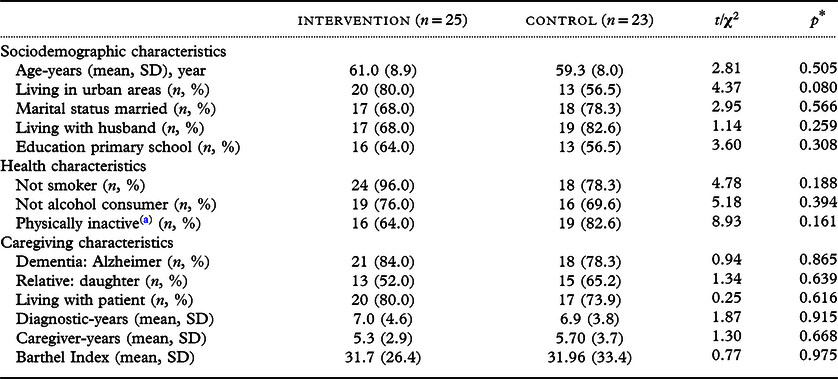
Demographic and additional characteristics of caregivers are shown in Table 1.
Sociodemographic, health, and additional characteristics of participants at baseline

* p-values of analysis of t or χ 2; p < 0.05
(a) Physical inactive includes respondents who never walk at least 30 minutes a day.
According to Table 1, no significant between-subject differences were observed in any of the demographic, health, and caregiving-related characteristics that were included in the analyses. The mean age of participants who were enrolled in the study was 60.2 years (SD = 8.5 years). A total of 81.3% (39/48) of the participants were caring for a relative with Alzheimer’s disease; 14.6% (7/48) were caring for a relative with stroke-related dementia, and 4.2% (2/48) were caring for a relative with another dementia. Moreover, all participants reported have been provided the care recipients with care for more than 5 years. A total of 75% of caregivers were living at home with the care recipient and 68.8% were living in an urban area. The participants reported to have been spending 42 to 168 hours per week providing the care recipient with care.
Intervention adherence
Eighty percent of participants of the IG (n = 22/25) completed up to 90% of the physical exercise sessions offered, and no one reported any health-related problem or secondary discomforts during the home-based intervention. In addition, these participants completed 62 to 72 sessions (69.7 ± 3.4), which means an intervention adherence up to 90%. Only a few sessions were missed by caregivers, and in all cases the reason was that they had to attend, together with the care recipient, an appointment with their healthcare provider.
Primary outcomes
Primary outcomes refer to risk of depression, subjective burden, and psychological symptoms, which are the variables that, on the basis of the WHO’s definition of mental health (World Health Organization, 2004), have been selected in this study to evaluate mental health. The results indicate that there were no between-subject differences in risk of depression (p = 0.333) or subjective burden (p = 0.998) at baseline. At the end of the 9-month intervention, however, there was a promising reduction of risk of depression in the IG in comparison with the CG effect size of −0.319. Moreover, the IG showed a significant decrease in subjective burden (47.80 ± 11.04) in comparison with the CG (56.13 ± 14.30). These results are shown in Table 2.
Effects on depression and subjective burden in caregivers stratified by group (intervention = 25, control = 23)

p < 0.05; p < 0.01
a Effect size (Cohen’s d).
Values are expressed as mean ± standard deviation.
* p-value of analysis of variance for repeated measures.
** p-value age-adjusted and Barthel Index of the care recipient-adjusted.
*** p-value caring time-adjusted and Barthel Index of the care recipient-adjusted.
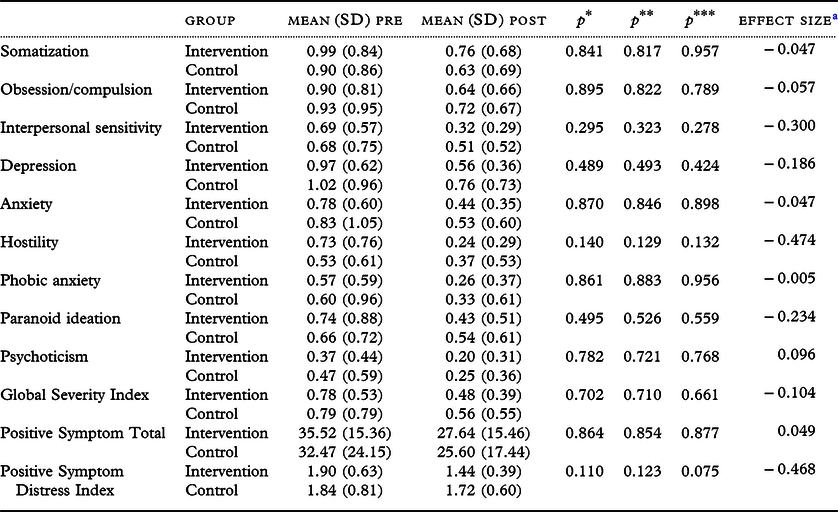
Regarding psychological symptoms, there were no significant between-group differences after the intervention, as shown in Table 3. At the end of the 9-month-long intervention, however, there was a promising reduction of hostility in the IG in comparison with the CG effect size of −0.474 and also a decrease in interpersonal sensitivity (d = −0.300) and Positive Symptom Distress Index (d = −0.468).
Effects on psychological symptoms in caregivers stratified by group (intervention = 25, control = 23)

p < 0.05; p < 0.01.
a Effect size (Cohen’s d).
Values are expressed as mean ± standard deviation.
* p-value of analysis of variance for repeated measures.
** p-value age-adjusted and Barthel Index of the care recipient-adjusted.
*** p-value caring time-adjusted and Barthel Index of the care recipient-adjusted.
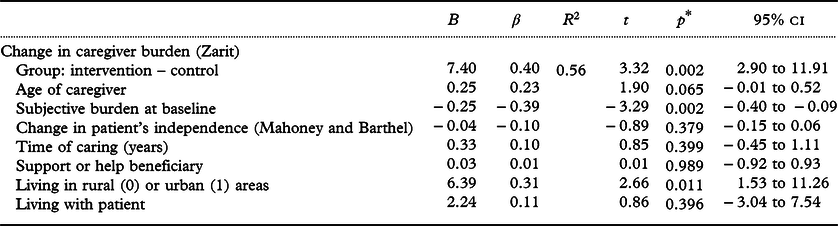
Results of multivariate regression analysis show that several variables were found to be significant predictors of the impact of the intervention on subjective burden, namely being allocated to the IG (β = 0.39, t = 3.18, p < 0.05), showing a high level of subjective burden at baseline (β = −0.37, t = −3.03, p < 0.05), and living in urban areas (β = 0.30, t = 2.5, p < 0.05) (Table 4).
Results of the multiple linear regression on the change in subjective burden for caregivers in the IG

p < 0.05; p < 0.01.
* p-value adjusted for baseline outcome of caregiver subjective burden and Barthel Index of the care recipient.
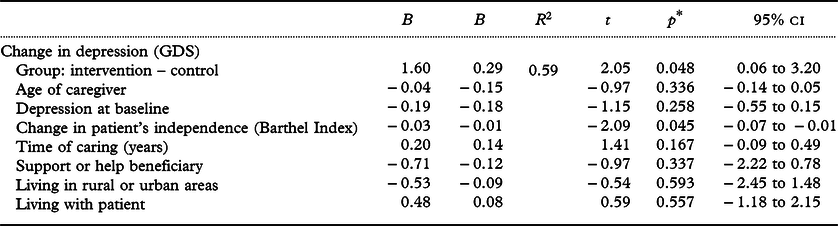
Finally, it was found that being in the IG (β = 0.33, t = 2.36, p < 0.05), changes in the care recipients’ level of functional independence (β = −0.31, t = −2.30, p < 0.05) predicted the impact of the intervention on risk of depression (Table 5).
Results of the multiple linear regression on the level of depression for caregivers in the IG

p < 0.05; p < 0.01.
* p-value adjusted for baseline outcome of caregiver subjective burden and Barthel Index of the care recipient.
Discussion
The increasing number of people with dementia worldwide and the high level of associated caregiver burden highlight the urgent needs to develop effective interventions that help primary informal caregivers of care recipients with dementia to ensure their health status, safety, and quality of life both at the physical and psychological levels. In this sense, interventions that are based on physical exercise programs have been shown to be useful and feasible nonpharmacological strategies that may improve mental health in caregivers (Orgeta and Miranda-Castillo, Reference Orgeta and Miranda-Castillo2014; Lamotte et al., Reference Lamotte, Shah, Lazarov and Corcos2017).
The present study aimed to elucidate whether a 2 per week home-based physical exercise intervention would reduce female caregivers’ risk of depression, subjective burden, and psychological symptoms, negative variables that are typically associated with being primary caregiver of a relative with dementia, and thus improve their mental health.
The present study found promising evidence suggesting that a 9-month-long home-based physical exercise intervention may reduce caregivers’ subjective burden and risk of depression. These results are consistent with those of previous research (King et al., Reference King, Baumann, O’sullivan, Wilcox and Castro2002; Connell and Janevic, Reference Connell and Janevic2009; Lowery et al., Reference Lowery2014) and are in contrast of the results found by Farran et al. (Reference Farran2016b), Hill et al. (Reference Hill, Smith, Fearn, Rydberg and Oliphant2007) and Prick et al. (Reference Prick, De Lange, Twisk and Pot2015). Moreover, the present intervention may also induce small effects on some caregivers’ psychological symptoms. The efficacy of this physical exercise intervention may stem from the fact that we used an individually tailored intervention being carried out at caregivers’ home (Goy et al., Reference Goy, Kansagara and Freeman2010).
Regarding the duration of the physical exercise sessions, it is worth noting that it was longer than that of the sessions that were designed by Hill et al. (Reference Hill, Smith, Fearn, Rydberg and Oliphant2007), Prick et al. (Reference Prick, De Lange, Scherder and Pot2011) and Lowery et al. (Reference Lowery2014), but it was similar to the total minutes of physical exercise done per week that were designed in previous studies (Hill et al., Reference Hill, Smith, Fearn, Rydberg and Oliphant2007; King et al., Reference King, Baumann, O’sullivan, Wilcox and Castro2002; Lowery et al., Reference Lowery2014).
With respect to the frequency of the targeted sessions, although it was lower in our study compared to some previous studies (Prick et al., Reference Prick, De Lange, Scherder and Pot2011; Chan et al., Reference Chan, Lautenschlager, Dow, Ma, Wong and Lam2016; King et al., Reference King, Baumann, O’sullivan, Wilcox and Castro2002), the two weekly sessions led to a promising reduction of subjective burden.
In relation to the types of activities, in the present study, each 60-minute-long session comprised combined exercises, including aerobic, mobility, and strength-endurance exercises, as in previous research (Connell and Janevic, Reference Connell and Janevic2009; Prick et al., Reference Prick, De Lange, Scherder and Pot2011), with a progressive intensity. However, those types of activities were different from those that have been used in previous studies, which only included brisk walking on a treadmill, tai chi or yoga (Hill et al., Reference Hill, Smith, Fearn, Rydberg and Oliphant2007; King et al., Reference King, Baumann, O’sullivan, Wilcox and Castro2002; Chan et al., Reference Chan, Lautenschlager, Dow, Ma, Wong and Lam2016).
Regarding the variables that could explain the resultant impact of the intervention on caregivers’ subjective burden, and in agreement with Chan et al. (Reference Chan, Lautenschlager, Dow, Ma, Wong and Lam2016), the present study found that the place of residence, in particular, urban area predicted that impact. This is inconsistent with previous studies (Pérez-Fuentes et al., Reference Pérez-Fuentes, Gázquez, Ruiz and Molero2017; Chiao et al., Reference Chiao, Wu and Hsiao2015; Shim et al., Reference Shim, Kang, Kim and Kim2016; Turró-Garriga et al., Reference Turró-Garriga, Soler-Cors, Garre-Olmo, López-Pousa, Vilalta-Franch and Monserrat-Vila2008), which found that a series of sociodemographical factors, such as sex, age, and cohabitation with the care recipient, psychological factors, such as neuropsychiatric symptoms, caregiving-related factors, such as duration of care, care recipients’ level of functional independence, and the fact of receiving help or support to care were associated with subjective burden. Indeed, and in agreement with Delgado et al. (Reference Delgado, Suárez, De Dios, Valdespino, Sousa and Braña2014), we did not find any association of subjective burden with these variables. However, being allocated to the IG and a high level of subjective burden at baseline (more potential range of improvement) were also found as positive predictors of that impact.
Other caregiver variables were also identified as significant predictors of changes in caregiver subjective burden after the 9-month-long intervention in this study, and caregiver burden scores at baseline indicated a moderate to severe burden (20 to 60) (Zarit et al., Reference Zarit, Reever and Bach-Peterson1980). After the 9-month-long intervention and despite the significant decrease in the caregiver burden in the exercise group, the burden scores remained at the same range of severity. Thus, additional interventions with higher frequency might be implemented to reduce caregiver burden more effectively.
A recent systematic review (Orgeta and Miranda-Castillo, Reference Orgeta and Miranda-Castillo2014) has reported that physical activity-based interventions result in a significant reduction in caregivers’ subjective burden. However, most of the initially identified studies were finally excluded because they did not meet the inclusion criteria – RCTs that included a CG. Indeed, the inclusion of a CG is essential to avoid possible bias and confounding factors that often occur in non-RCTs lacking a CG (Vandepitte et al., Reference Vandepitte, Van Den Noortgate, Putman, Verhaeghe and Annemans2016a), and the present study included a CG in the RCT.
In contrast with some other RCTs (Kuo et al., Reference Kuo2013), no significant within-group or between-group differences in depression were observed in caregivers after the intervention, but a small effect (d = −0.319) on caregivers’ risk of depression was found. In relation to the variables that could predict that small effect of the intervention on caregivers’ risk of depression, it was found, in agreement with Shua-Haim et al. (Reference Shua-Haim, Haim, Shi, Kuo and Smith2001), that participation in the IG as well as care recipients’ level of functional independence were, indeed, predictors of that effect. However, previous studies (Delgado et al., Reference Delgado, Suárez, De Dios, Valdespino, Sousa and Braña2014; Haines et al., Reference Haines, Denehy, Skinner, Warrillow and Berney2015; Alfakhri et al., Reference Alfakhri2018; Gitlin et al., Reference Gitlin, Marx, Stanley and Hodgson2015) have found that time spent in the care living together with the care recipient, low baseline scores of risk of depression, and receiving help in caring for the relative with dementia are, indeed, associated with risk of depression. Therefore, and in agreement with Orgeta and Miranda-Castillo (Reference Orgeta and Miranda-Castillo2014), additional randomized and tailored interventions should be carried out in the future in order to elucidate which particular variables may modulate the impact of the present intervention on caregivers’ risk of depression.
Regarding participants’ demographical data, their age, civil status, education level, caregiver living together with the care recipient, and time that has been spent as caregiver are consistent with those that have been described in previous reports (Alonso et al., Reference Alonso, Garrido, Díaz, Casquero and Riera2004; Badia et al., Reference Badia, Lara and Roset2004; Delgado et al., Reference Delgado, Suárez, De Dios, Valdespino, Sousa and Braña2014; Garzón-Maldonado et al., Reference Garzón-Maldonado, Gutiérrez-Bedmar, García-Casares, Pérez-Errázquin, Gallardo-Tur and Martínez-Valle2016). These reports also indicate that these characteristics usually lead to experiencing subjective burden as well as to negative impacts on caregivers’ health status and quality of life (Alonso et al., Reference Alonso, Garrido, Díaz, Casquero and Riera2004; Badia et al., Reference Badia, Lara and Roset2004; Delgado et al., Reference Delgado, Suárez, De Dios, Valdespino, Sousa and Braña2014).
To the best of our knowledge, the present study is the first one that has examined the effects of a physical exercise intervention on caregivers’ psychological symptoms using the SCL-90-R, which is a sensitive measure of that variable (Pot et al., Reference Pot, Deeg and Van Dyck1997; Burns et al., Reference Burns, Fleming, Wagstaff, Goodwin, Hirschman and Greenberg2002; Mitsonis et al., Reference Mitsonis, Voussoura, Dimopoulos, Psarra, Kararizou and Latzouraki2012). Regarding this variable, no statistical within-subject or between-subject differences were found after the intervention, even when adjusting for caregivers’ age and time spent in the care. This may be partial because the intervention did not apply the minimum dose of physical activity that is required to improve psychological symptoms, that is, either three 60-minute-long sessions per week of moderate physical exercise, as reported by previous authors (Farran et al., Reference Farran2016b; Jackson and Browne, Reference Jackson and Browne2017; Prick et al., Reference Prick, De Lange, Twisk and Pot2015), or because it did not develop additional ad hoc counseling sessions focused on caregivers’ individual needs, as Brodaty and Donkin (Reference Brodaty and Donkin2009) recommend. In addition, this lack of statistical significance could be also partially due to the small sample size to detect changes in this variable. Nevertheless, a tendency to reduce some of the nine measured psychological symptoms was found. Indeed, small and medium effect sizes were noticed in hostility (d = −0.474), interpersonal sensitivity (d = −0.300), and Positive Symptom Distress Index (d = −0.468) after the 9-long-intervention in the IG. Therefore, the present study found slight reductions and no increases in these psychological symptoms, which is a positive result (Goy et al., Reference Goy, Kansagara and Freeman2010). Future inclusion of additional strategies, such as psychological approaches, besides physical activity, might help caregivers of relatives with dementia reduce these psychological symptoms.
Up until now, some of the reports that have been published in the journal International Psychogeriatrics (IPG) have contributed to deal with one of the major challenges of the healthcare system: how to improve the well-being and quality of life at the physical and the psychological levels in caregivers of patients with dementia. For example, and in response to this question, Werner (Reference Werner2019) recommends the development of different approaches to be focused on these caregivers. Moreover, some of the studies that have been published in the IPG journal show the positive effects of different interventions on health status of both formal and informal caregivers. Among these studies, we outline the study by Mbakile-Mahlanza et al. (Reference Mbakile-Mahlanza, Van der Ploeg, Busija, Camp, Walker and O’Connor2020) which has found that Montessori system-based activities have positive effects on formal caregivers of nursing home residents with dementia. In addition, the study by Kaddour et al. (Reference Kaddour, Kishita and Schaller2019) has shown that cognitive behavioral therapies-based interventions are also positive for caregivers’ mental health. However, these studies have been developed out of caregivers’ homes, leading to high dropout rates, and to the fact that participants were more likely to discontinue their participation in the study. In addition, and according to Prick et al. (Reference Prick, De Lange, Twisk and Pot2015), improvements in caregivers’ physical and mental health are to see if the physical exercises are of moderate intensity and are executed at caregivers’ homes and taking into account caregivers’ personal preferences and needs regarding their timetables. Our study complies with this recommendation. Finally, Lamotte et al. (Reference Lamotte, Shah, Lazarov and Corcos2017) recommend to carry out additional RCTs and physical exercise-based interventions to determine what is the most appropriate intervention for caregivers of relatives with dementia. Our study is a RCT-based study. Therefore, the present RCT- and physical exercise-based intervention further helps the IPG journal deal with the above-mentioned challenge and thus contributes to enhance its leader role in the management of that challenge.
It is also important to highlight that the present study shows several limitations. First, although the characteristics of the caregivers who participated here were comparable to those described in previous studies (Badia et al., Reference Badia, Lara and Roset2004; Alonso et al., Reference Alonso, Garrido, Díaz, Casquero and Riera2004; Garzón-Maldonado et al., Reference Garzón-Maldonado, Gutiérrez-Bedmar, García-Casares, Pérez-Errázquin, Gallardo-Tur and Martínez-Valle2016), generalization of the present results to caregivers with other characteristics should be done with caution. Second, there was no follow-up evaluation to examine the generalization of the findings in the long term. Third, it is possible that a longer duration of the intervention or higher frequency could have led to a stronger positive impact of the intervention on the targeted outcomes. As previously stated, some variables could require a larger sample to reach significance. Finally, results from this study do not allow us to conclude that two 1-hour sessions per week during 9 months physical exercise is enough to significantly improve caregivers’ mental health, although the present study may serve as a recommendation. Future studies could compare with the current study to elucidate the particular dose of physical exercise as well as the particular duration of the intervention that is required to reduce caregivers’ subjective burden, risk of depression, and psychological symptoms and thus improve caregivers’ mental health.
Final remarks
To conclude, the present research work has produced promising evidence regarding the efficacy of physical activity-based interventions in preventing the reduction of psychological symptoms and improving the mental health of female caregivers of relatives with dementia. In particular, a home-based exercise intervention that is provided by a personal trainer may help to improve caregivers’ subjective burden and risk of depression. Given the worrying rise in the number of people with dementia and the crucial role that family caregivers play in taking care of them, together with physical activity, additional strategies such as more psychological approaches might help to improve caregivers’ mental health. In this regard, individualized interventions may be the most effective but require more resources and personnel. Future studies of cost-effectiveness of this home-based exercise intervention will enable us to provide scientific evidence for policy-makers to strengthen home-based interventions and health policies that might have positive implications, such as reduction of the investments of financial resources in hospitalizations, health services, and intake of medication. Studies that reduce costs and compare the efficacy and cost-effectiveness of several approaches, such as web-based exercise interventions, should be also designed in the future.
Conflict of interest declaration
None.
Description of authors’ role
Miguel Madruga designed the study, collected and analyzed the data, interpreted the results, and wrote the paper. Margarita Gozalo assisted with writing the paper. Josué Prieto participated in designing the study and collected the data, revised the writing of the paper. Paloma Rohlfs Domínguez supervised the development of the work and revised the writing of the paper. Narcís Gusi, PI, designed the study, analyzed the data, interpreted the results, and assisted to write and revised the paper.
Clinical trial registry identifier
ISCRCTN80414567
Ethical standards
The study was approved by the Committee on Biomedical Ethics of the University of Extremadura.
Acknowledgments
We would like to thank all Alzheimer’s Disease Family Associations of Extremadura (Spain). Moreover, we would like to thank all participants to let us visit their homes.