Marketisation and social enterprise
The reform of public services in the UK was one of the central themes of social policy development under the previous Labour governments, and has been taken up as a key priority by the Coalition government since 2010. Since the turn of the century, much of social policy in the UK has been devolved to the separate administrations in Scotland, Wales and Northern Ireland; however, this article focuses on developments in England only. This programme of reform is sometimes referred to as ‘modernisation’ (Margetts et al., Reference Margetts, Six and Hood2010) or ‘new localism’ (Milbourne, Reference Milbourne2009), but the policy agenda has in practice been based, too, on significant elements of ‘marketisation’. Marketisation refers to the adoption of market or quasi-market practices with the aim of generating greater efficiency, effectiveness and responsiveness of public services. At the core of this marketisation is the involvement of private and third sector providers in a mixed economy of welfare provision (Powell, Reference Powell2007).
Both Labour and now the Coalition have committed themselves to accelerating diversity of provision, and in particular to enhancing, and supporting, the role of third sector organisations (TSO) in playing a greater role in service delivery. TSOs have been encouraged in large part because of expectations that they can secure the engagement and trust of excluded or hard-to-reach groups due to their specialist knowledge, flexibility and independence from state structures (Haugh and Kitson, Reference Haugh and Kitson2007; Carmel and Harlock, Reference Carmel and Harlock2008), although what this has meant for these organisations in practice has been incorporation into the discourse and practices of marketisation (Salamon, Reference Salamon1993). There are two key dimensions to this.
The first implication of marketisation involves the way in which organisations are funded. TSOs have been opened up to a diversification of funding streams, with earned income becoming more important to many TSOs. According to the National Council for Voluntary Organisations (NCVO) Civil Society Almanac, earned income for charities in England and Wales almost doubled in the first decade of the new century from £10.6bn to £20.1bn (Clark et al., Reference Clark, Kane, Wilding and Bass2012: 40), and within this it is earned income from public sources that has grown the most. Income from public sources has been playing a greater and greater role in third sector funding, with public funding growing from £8.6bn in 2001 to £14.3bn in 2010, around 38 per cent of overall funding (Clark et al., Reference Clark, Kane, Wilding and Bass2012: 37). That increase is largely comprised of a reduction in the availability of grants and an increase in the use of contract funding for the provision of public services – with grant income declining from £4.4bn to £3bn and contracts increasing from £4.3bn to £10.9bn (Clark et al., Reference Clark, Kane, Wilding and Bass2012: 41).
Contracts to deliver public services have therefore become a much more important part of the earned income that have shifted TSOs towards marketisation, and public sector contracting has led to a significant shift in the way many TSOs engage with public bodies (SQW, 2007). The impact of this marketisation on the ways in which TSOs increase their share of commercial revenue through the adoption of market discipline strategies is explored by McKay et al. (Reference McKay, Moro, Teasdale and Clifford2011), who conclude that organisations are to some extent adopting the practices, structures and languages of the private sector and ‘succumbing to market forces’. There are interesting comparisons with the US here, where cutbacks in government funding for non-profits since the late 1970s and 1980s have been accompanied by encouragement to replace government in the provision of public services (Eikenberry, Reference Eikenberry2009), with the result that earned income now makes up the largest source of revenue for the third sector (Kerlin and Pollak, Reference Kerlin and Pollak2010).
The second consequence of marketisation is its impact on organisational structure, culture and practice. The process of securing and managing contracts has led to TSOs having to act more and more like commercial organisations. Macmillan (Reference Macmillan2010) describes this as ‘mission drift’ and Billis (Reference Billis and Billis2010) suggests that it means that TSOs have been increasingly ‘hybridised’. One particular dimension of this organisational change has been the trend for third sector activity to be labelled (or re-labelled) as social entrepreneurship. Social entrepreneurship is an activity, but it also can take an organisational form – social enterprise. Social enterprises have been promoted as being particularly capable of delivering the shift to earned income and marketisation within the third sector because they combine the market principles of business with the social values of charities and voluntary action (Peredo and McLean, Reference Peredo and McLean2006; Peattie and Morley, Reference Peattie and Morley2008).
Social enterprises have been described as ‘more market driven, client driven, self sufficient, commercial or business like’ than traditional voluntary organisations (Dart, Reference Dart2004: 414), and as occupying the increasingly blurred boundaries between non-profit and for-profit. They can encompass a range of overlapping organisations, objectives and values (Pharoah et al., Reference Pharoah, Scott and Fisher2004), and academic analysis has pointed out that both theoretically and empirically their form and scale are contested (Teasdale, Reference Teasdale2010). Despite this contestation, however, social enterprise comprises a discourse which addresses the impact of marketisation on the third sector, and social enterprises provide an organisational form which can embrace the pressures of mission drift and hybridisation. As a result, it is claimed that social enterprise has the potential to respond to the need for adaptable approaches to service provision in the context of potentially scarce public funding by providing more diverse and potentially more reliable income streams, thereby generating greater efficiency and accountability (Eikenberry and Kluver, Reference Eikenberry and Kluver2004), as well as providing the financial capacity to create sustainable improvements rather than short-term responses to social problems (Dees and Anderson, Reference Dees and Anderson2003).
Supporting public service markets: the social enterprise investment fund
Social enterprises have been attractive to politicians concerned with public service reform, and they have been an increasing focus of political and policy intervention over the last decade or so. In 2001, the Department of Trade and Industry (DTI) set up a Social Enterprise Unit to provide direct government support for social enterprises. This role was incorporated into the work of the Office for the Third Sector (OTS) in 2006, and has been continued in the Coalition's re-titled Office for Civil Society (OCS). The DTI unit developed a definition of social enterprises as: ‘business[es] with primarily social objectives whose surpluses are principally reinvested for that purpose in the business or in the community, rather than being driven by the need to maximise profit for shareholders and owners’ (DTI, 2002). It is this broad definition which has informed subsequent policy intervention and underpins the particular initiatives discussed in this article.
Social enterprises capture the shift towards earned income and contracting within the third sector, and they have been seen as particularly important in implementing a more diverse provider base within health and social care reform – and this has enjoyed cross-party support. However, combining social goals with business practices has also created some potentially significant problems for these organisations, especially within the context of the shift from grants to contracts in public funding. Questions have been raised over the extent to which social enterprises in practice have the capacity and skills needed to adapt to new financial and political environments of public sector contracting and business development (Dees and Anderson, Reference Dees and Anderson2003). Many social enterprises and TSOs are small community groups who have tended to rely on grant funding from public sources, even where they are engaged in service provision (Macmillan, Reference Macmillan2007; Sunley and Pinch, Reference Sunley and Pinch2011). Furthermore, third sector organisations encounter difficulties in negotiating commissioning and procurement processes as they tend to have less capacity and experience to tender successfully for contracts, especially when competing with large private providers (Addicott, Reference Addicott2011; Macmillan, Reference Macmillan2010; Packwood, Reference Packwood2007). As a result, commissioners may perceive such organisations as not business-like enough (Chapman et al., Reference Chapman, Brown and Crow2008).
Access to appropriate capital and skills is required to support the growth and sustainability of social enterprises, and enable them to bid for and deliver public services (OTS, 2006a; 2006b; Macmillan, Reference Macmillan2010; Wells et al., Reference Wells, Chadwick-Coule, Dayson and Morgan2010). However, the support provided to social enterprises in particular has been criticised as ‘fragmented and patchy’ with an emphasis on new start-ups rather than established organisations looking to reach financial sustainability (Lyon and Ramsden, Reference Lyon and Ramsden2006: 37). Income streams in the social care market in particular have been criticised as unpredictable, meaning that organisations live ‘hand to mouth’ in an ongoing search for funding (Alcock et al., Reference Alcock, Brannelly and Ross2004), limiting their capacity to grow and develop. Packwood (Reference Packwood2007: 36) argued that some TSOs ‘spend so much time struggling for survival that they have very little time or energy to develop leadership skills, or to undertake the research needed to gain a clear picture of what is coming around the corner’. Instead, their only concern is with delivering services rather than in developing and investing in the future sustainability of the organisation.
Access to finance and business support was recognised by Labour as being one of the biggest barriers facing the sector (SQW, 2007), and as a result the government committed the investment of significant resources to the direct provision of these. These social investment programmes were part of a wider process of ‘market making’ which is intended to support TSOs to develop their capacity to secure contracts to provide public sector services. The most significant of these was the Futurebuilders fund, which was established in 2005 (HM Treasury, Reference Treasury2002) as a ‘policy experiment’ to test how the third sector could be supported through loan funding and business support to improve its capacity to deliver public services and achieve social outcomes (Wells et al., Reference Wells, Chadwick-Coule, Dayson and Morgan2010). It provided £215m between 2005 and 2011 to support TSOs in bidding for public sector contracts. Formal evaluation of the fund indicated that whilst investment did appear to support third sector organisations to build organisational capacity and secure public service delivery contracts, some organisations found it difficult to make the strategic shift needed to generate income and actually deliver contracts (Wells et al., Reference Wells, Chadwick-Coule, Dayson and Morgan2010).
The Social Enterprise Investment Fund (SEIF) was another element in this support and investment strategy. It was established by the Department of Health (DH) in 2007 and was focused directly upon supporting social enterprises to improve their capacity to deliver health and social care services and to compete with other public and private providers for public sector contracts. Health and social care was one of the key areas where public service reform has sought to embrace a more plural and diverse provider market of private and third sector delivery, and where in particular the last Labour government felt that social enterprise could play a critical role. Although the SEIF was an English programme in the area of health and social care, it has implications for the implementation of marketisation across public services, and for other welfare regimes in Europe and beyond those where ‘modernisation’ programmes are underway.
The SEIF was initially delivered by Community Health Partnerships, an independent company wholly owned and controlled by DH, who administered the first two rounds (August 2007 to May 2009), and was then transferred to the Social Investment Business (SIB) in 2009 (in collaboration with Local Partnerships – formerly PUK). It began with a potential budget of £100m to be disbursed as a mixture of grants and loans, and continued after the change of government in 2010. The initial disbursement took place over the four-year period to March 2011, and a further year of funding was announced by the Coalition government for the financial year 2011/12. However, its longer-term future remains unknown. It provided advice and seed funding for social enterprises ‘starting up’, and investments to support the growth of ‘established businesses’ already delivering health and social care services. In addition, it offered business support, including advice on business plans and governance structures, to support social enterprises and help them bid for and win public service contracts and as a result become sustainable (DH, 2009).
The longer-term objectives for the SEIF included supporting the provision of high-quality services, improving health and social care for patients and service users and enabling better commissioning in line with the health and social care reform agenda. A further long-term aspiration for the SEIF was to itself become sustainable through the repayment of loan finance. This article draws on research to evaluate the SEIF, funded by the Department of Health (DH), and is focused in particular on the extent to which it was able to support and promote the role of social enterprises within the emerging market for health and social care delivery.
Methodology
The SEIF was a policy intervention that contained different aims and objectives, and which was also implemented in a number of different contexts. On this basis, the methodology for the research drew on ‘realistic’ evaluation and ‘theories of change’ (Connell and Kubisch, Reference Connell, Kubisch, Fulbright-Anderson, Kubsich and Connell1998) approaches developed for use in evaluating complex, multi-layered programmes to explain how programmes work – as well as whether they work (Birckmayer and Weiss, Reference Birckmayer and Weiss2000). This recognises the various difficulties in pinning down ‘policy success’ (Powell, Reference Powell2002), the problems of multiple objectives which are likely to entail trade-offs, and the challenges in attributing change to any particular policy or incentive given the complex interactions between potential causal and confounding variables (Powell et al., Reference Powell, Millar, Mulla, Brown, Fewtrell, McLeod, Goodwin, Dixon and Naylor2011). It is a conceptual framework which has gained particular prominence in health services research (Pawson et al., Reference Pawson, Greenhalgh, Harvey and Walshe2005; Greenhalgh et al., Reference Greenhalgh, Humphrey, Hughes, Macfarlane, Butler and Pawson2009).
To establish the programme theories underpinning the SEIF we undertook a detailed examination of its documentary history and used semi-structured interviews with key stakeholders to identify the mechanisms through which the SEIF was expected to achieve its outcomes. We asked interviewees about the desired outcomes of the SEIF, the types of activity associated with the SEIF and the measurement of these outcomes and activities, including unintended outcomes and impact of contextual factors. Analysis of this was used to generate a diagrammatic articulation of the short, medium and long-term steps involved in achieving SEIF outcomes (see Lyon et al., Reference Lyon, Gabriel and Millar2010). This programme theory provided the basis for the evaluation of the SEIF, with the different steps in the programme acting as research questions against which empirical data could be interrogated and the programme theory ‘tested’. These are examined in more depth in the full research report of the evaluation (see Alcock et al., forthcoming).
Key characteristics of marketisation underpinned the theories of change associated with the SEIF, and we focus primarily on these. We analyse the extent to which SEIF investments supported the start up and sustainability of social enterprises and helped to prepare them to secure service contracts within the developing commissioning environment in health and social care. We obtained this empirical material by employing a mixed methods approach, combining analysis of administrative data, a survey of investees and in-depth case studies with a selection of social enterprises. A database of all SEIF applicants (up to 31 March 2011) was also compiled, which included all investments and the amount and type of investment received by each investee.
The survey was administered online, with telephone back-up, and was undertaken with all SEIF investees who had received their investment decision by 31 March 2010. Organisations were classified into four key areas: health and wellbeing (53%), healthcare (17%), social care (16%) and social exclusion (14%). Out of the 285 investees, 172 completed the survey – a 60 per cent response rate. Non-respondents primarily included those organisations that had closed down or where email addresses had changed. The survey used a mixture of closed and open questions to gather information on applicant experiences and organisational outcomes of the SEIF, and was analysed in SPSS. Given the relatively volatile nature of the social enterprise field and the difficulty in contacting some organisations, this was a relatively high response rate and provided a reliable basis for assessing organisational experience of the programme.
The in-depth case study research comprised comprehensive documentary analysis and qualitative interviews with 16 social enterprise organisations during 2010/2011. The sample was purposive in its aim and included a diverse range of successful (n = 13) and unsuccessful applicants (n = 3) to the SEIF. Selected organisations ranged from large social enterprises delivering mainstream healthcare services to small organisations delivering wellbeing services to a local or socially excluded community. These social enterprises were therefore not representative of all English health and social care services, and instead included a significant number that worked with vulnerable groups. A total of thirty qualitative interviews were carried out with representatives from the selected social enterprises. The interviews gathered qualitative data on applicant experiences and organisational outcomes of the SEIF to build upon the data collected in the survey. A further twelve qualitative interviews were carried out with health and social care commissioners and social enterprise support agencies. Qualitative data from the interviews (and open survey questions) were coded and then thematically analysed using the NVivo software programme (Miles and Huberman, Reference Miles and Huberman1994).
Supporting social enterprises
Assisting start-ups
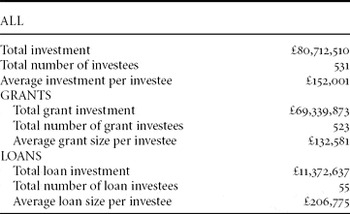
The SEIF supported 531 social enterprises by investing £80,712,510 up to 2011 into their start up or growth. The organisations received an average of £152,001 (see Table 1), although this ranged considerably from £546 up to £3,115,150. Central to the aim of the Fund was to provide a mixture of grant and loan funding, in order to help organisations to develop business plans and to challenge the potential for grant dependency identified by Macmillan (Reference Macmillan2007). Despite this, however, 86 per cent of investments (£69,339,872) were in the form of grants (with a further £3,086,430 of repayable grants), and only 14 per cent (£11,372,637) were loans. A total of fifty-five organisations (10%) received a loan; however the majority of these investees also received a grant and only eight investees (2%) received a loan only.
All SEIF Investments up to 31 March 2011 (Rounded to the nearest £)

Source: SEIF administrative data
Grant funding was especially prominent for social enterprises ‘starting up’, as they were often not in a position to make interest repayments. The survey of investees indicated that 52 per cent of SEIF funded organisations were new start-ups (including existing charities that were beginning to trade), and the case studies suggested that many organisations starting up may have been using the SEIF to obtain grant-based start-up funding, which was used to fund business support, legal and development expenses. Within this, external and specialised consultancy support was the key component, which enabled the development of marketing tools, a business plan, legal frameworks and accountancy systems.
There are some basic ingredients if you want to bake a cake, you need eggs, flour, milk, butter, well if you want to have a social enterprise, you need legal support, you need those pieces, and you need somebody to tell you how to do it. (Healthcare SE 1)
As far as we're concerned the impact [of SEIF] is very simple, it has made the difference between setting the company up and not . . . we'd have found it difficult to get investment from elsewhere. (Health and Wellbeing SE 3)
Grant support was particularly important for those fifty organisations that ‘spun out’ from NHS agencies under the Labour government's Right to Request initiative (Miller and Millar, Reference Miller and Millar2011). These comprised 10 per cent of all investees who received a total investment of £8,333,385. These ‘spin outs’ were often led by clinicians and for them SEIF was critical in providing business and management skills through funding consultancy costs, legal expenses and employing business support managers.
As a clinician, suddenly having to go from being, a dare I say it, a competent clinician and very comfortable in that to being pushed way out of my comfort zone to running a company and that's a huge transition. (Healthcare SE 3)
For these organisations in particular, the SEIF was also the only potential source of financial support.
[SEIF] was the only place we could go. I mean obviously with the Right to Request, whilst PCTs [Primary Care Trusts] have to offer support, support doesn't equate to money. (Healthcare SE 4)
The remainder of SEIF investments (48%) were used to develop and grow existing social enterprises. From the 48 per cent who were expanding within an existing social enterprise, most (44%) were already delivering health and/or social care services. Therefore, only 4 per cent of investees were using the SEIF investment to enable their social enterprise to break into the health/social care sector. Case study findings suggest that many of these organisations received a grant as well as some loan-based investments to make structural improvements, including purchasing and refurbishing buildings or equipment.
The organisations receiving SEIF investment were diverse, including ‘hybrids’ with multiple functions and specialties, but virtually all were operating with missions that we defined as ‘health inclusion’, responding to gaps within the health and social care system rather than replacing existing provision. They included in particular services that targeted disadvantaged or vulnerable groups, including those struggling with poverty, mental illness or the harm caused by alcohol, drugs or violence. The SEIF thus played an important role in helping the DH to meet health inequalities targets (DH, 2010; Marmot, Reference Marmot2010).
Investing in sustainability
The longer-term sustainability of social enterprises in health and social care depends critically on their ability to bid for and deliver public services, and SEIF investments also aspired to increase the capacity and skills of organisations to do this. This was inevitably a longer-term challenge, and it is an area where the evidence from the evaluation was more mixed. There was some evidence that social enterprises were already delivering health and/or social care services and were winning new contracts. Over half (52%) of the social enterprises in the survey reported that they had obtained new contracts to deliver public services since the SEIF investment (mainly funded by PCTs or Local Authorities), and nearly a quarter (23%) had won at least three new contracts since the SEIF investment. However, this left 48 per cent of investees that had won no new contracts at all. Over a quarter (29%) of these investees did however have contracts before the SEIF investment, indicating that, for some, the SEIF investment may have been used to support the delivery of an existing contract rather than to generate new ones. Nonetheless, our case study data indicated that some social enterprises were finding it hard to renew or replace existing contracts once they ended.
We talked to the PCT about our counselling service, and this was not the right time in the cycle. They had already just taken out a big contract with another counselling organisation. And so we have to wait, and I think probably its early next year when the PCTs will be thinking about a new contract for counselling services. (Health and Wellbeing SE 2)
Those targeting excluded groups or users with high needs were finding it especially hard, as these services were often expensive to run.
I mean who's going to be interested in services like this that are perceived as high-cost, and they are high-cost but that's because of the level of need. (Healthcare SE 4)
The case studies revealed that SEIF was essential in sustaining these organisations in the short term for a year or two, but beyond this the future remained uncertain.
I mean, it [SEIF] gives us a lifeline. We can manage comfortably for a year, but I really need, this year, to get some more money in. (Social Care SE 1)
The survey findings also indicated that some enterprises were struggling to survive, especially within a developing economic climate in which public services were being cut back. Thus 13 per cent of SEIF-funded organisations had closed down, primarily as a result of a lack of further funding. Although this figure is similar to the average closure rate of UK businesses, which stands at approximately 12 per cent (ONS, 2010), our figures are likely to understate the problem within social enterprises since those which have closed down would have been less likely to respond to the survey. In addition, the case studies revealed that many social enterprises were simply ‘getting by’ with support from any financial sources that were available to them. Many felt a lack of security or certainty for the future, especially during a time of economic instability and public sector reform.
ESF [European Social Fund] has now gone. The money's now going away . . . In that way, I mean, don't get me wrong, the organisation wouldn't go, but that's our last project at the moment. So things have been disappearing gradually through ESF going. (Social Exclusion SE 1)
Some social enterprises in our study were able to secure new contracts and generate their own commercial income, but many remained grant dependent. Survey data indicated that 51 per cent of respondents had recently received public sector grants in addition to any SEIF investments and 49 per cent intended to apply for a further public sector grants. Yet very few wanted to take on loans. As mentioned above, only 14 per cent of investments were loans, with only 2 per cent being exclusively loan-based, and only 18 per cent of survey respondents reported that they were considering applying for a public sector loan in the future.
The high reliance on grant funding in the SEIF was exaggerated by the requirement that organisations should only be funded if they were regarded as ‘unbankable’ by independent or commercial investors – however a small proportion (4%) of investments had in fact received bank loans in the previous year, although perhaps for different purposes. This was intended to ensure that SEIF loans did not unnecessarily distort the broader investment market for social enterprises, and indeed co-investment with other lenders was encouraged through a Funders’ Forum in which these were represented. Forty-five co-investment deals adding up to a total of £24,130,257 were made up to 2011, but the majority were co-investor grants and a large proportion (47%) came from public or EU sources, with only 22 per cent from high street banks. There was therefore considerable evidence of a reluctance to take on loan funding by the organisations applying for support from the SEIF and many of the survey respondents were only searching for grant funding. Many felt that they were not in a financially stable enough position to be able to take on a loan, as they may not be able to make repayments.
All of a sudden I've got to find about £7,000 a month [loan repayments] . . . I think it just would have been a lot happier and less of a risk for the organisation if we just got the full grant. (Social Exclusion SE 1)
This was linked to concerns about the business and management skills needed to run the organisations and secure new contracts, which was particularly acute for the ‘spin out’ organisations, led by clinicians who found they were often ‘muddling through’ and on a huge ‘learning curve’.
We're clinicians by background so one of the challenges is trying to grow business heads and to learn the skills that we need to run the business effectively . . . Nobody's taught me how to do PQQs and ITTs. That's something that I'm having to learn so again, I'm still doing some of the business as usual and trying to learn new skills and you've got to be really receptive to that. (Healthcare SE 4)
It would have been great just to have a little bit of breathing space to professionally develop as a business person . . . So tendering is very much my thing at the moment if we can try and source some support with that. (Healthcare SE 4)
SEIF investments did provide opportunities for social enterprise managers to develop business and professional skills through training, or alternatively to buy in the business support that was required. A significant amount of SEIF investment was used to fund business support from external and specialist sources, such as a business support manager or a consultant. The fund managers, SIB, did also provide business support as part of their investment package, although this was offered to only 33 per cent of investees surveyed, and some felt that it was not adequate or specialised enough for their needs.
[The investment officer] seemed not to understand the nature of the business we were establishing. (Survey respondent from Health and Wellbeing SE)
The commissioning environment
The ability of social enterprises to become sustainable through the securing of contracts to deliver health and social care services does not just depend upon their organisational development and preparedness. The value of social enterprises as providers also has to be recognised by those commissioning the services. Both the Labour and the Coalition governments have been keen to improve the commissioning environment, with the new government promoting their ‘any qualified provider’ strategy (DH, 2011). However, the SEIF research suggested that social enterprise delivery of health care services was still at an embryonic stage, especially in the minds of those commissioning services.
It requires resources, a lot of time and effort to make it work and I think generally with, particularly, clinical services, we haven't felt the push to get social enterprise involved. I don't sense buy in at management level, I don't sense buy in at any level above really front line delivery stuff. (SE Consultant 2)
Although some commissioners believed they had positive relationships with social enterprises and encouraged them to grow and develop, they continued to be concerned that these organisations were not quite investment ready or capable of taking on the requirements of the contracting process.
You realise actually that [social enterprises] aren't in a position to tender for business. Either they often know their stuff, but they're not good at writing business cases, or working out the financial aspects and the governance around those. (PCT Commissioner 3)
These risks meant that providing a contract to social enterprises to deliver public services was a gamble. Furthermore, for those social enterprises that were ‘investment ready’, commissioning structures and processes were not particularly amenable. Bureaucratised and formal procurement processes were often in tension with the relative fluidity of small community-based social enterprises.
Things have tightened up, certainly government-wise and in terms of how you have to account for how you spend the money, but particularly in terms of . . . the rules around procurement, making it much more difficult. You can't just go out to one organisation, to a local community group . . . so it's still relatively easy to contract with the big players in the voluntary sector, but not so easy to contract with the smaller ones . . . You have to be even more rigorous about who you're investing in. (PCT Commissioner 7)
The SEIF was not an intervention in commissioning practices, of course, but its aspiration of promoting sustainability of social enterprises delivering health and social care was inevitably compromised by the limitations that have been exposed by our research.
Towards marketisation
The development and operation of the SEIF must be seen within the context of marketisation and social enterprise outlined in the introduction to this article. As we argued, marketisation in the UK meant that TSOs, and social enterprises in particular, had to be willing and able to establish and survive within competitive markets, and the Labour governments were keen to do what they could to promote and support them in this. The SEIF was one such initiative that aimed to equip social enterprises with the capacity and skills to be able to compete with other public, private and third sector providers within an open market for health and social care. The research suggested that it has been largely successful in enabling the start up and growth of social enterprises, and expanding the range of providers. What is more, most of these organisations were outside of mainstream health and primary care services and were working with vulnerable and disadvantaged groups in the health inclusion field. A particularly important dimension of this were the ‘Right to Request’ organisations, most of whom felt that without SEIF investment they would not be able to exist. This tallies with the findings of a recent NAO study (2011) which reported that the majority of the thirty-seven Right to Request organisations, which had by then spun out of the NHS, had received SEIF support.
Here, the fund was a major new source of income for social enterprises and had significant effects in helping organisations to become established and to expand their capacity for competition and delivery. Furthermore, it focused investment especially in the health inclusion field, where public provision was generally weakest, helping the NHS to meet some of its equalities targets. However, despite initial intentions, the vast majority of SEIF investments took the form of grants, and even where loans were made these were often accompanied by grants or were on terms that were more favourable than those available in the external commercial markets or where commercial loans were not available. These investments supported the start up of social enterprises, but it less clear that they provided for their longer-term sustainability, with 13 per cent of organisations in our survey closing down within the funding period.
The high proportion of grant funding within the SEIF was primarily driven by demand from applicants. However, this was also compounded by administrative factors. These included the ‘bankability’ test for loan applications mentioned above, but this was also compounded by the impact of the ‘annuality’ rules on all applications. As the SEIF was a public sector fund, it required the fund managers to spend and account for funding within each financial year. This meant that administrators were under pressure to ‘get the money out quickly’ at the end of the year, and in this context grants were more attractive to them. This was recognised as a problem by the Department of Health, but it could not be avoided given the way the scheme was set up. Overall, therefore the management of the scheme operated to exclude many of those organisations which might be the most willing and able to take on loans.
As a result, whilst the SEIF had been largely successful in enabling the start up and growth of social enterprises, and expanding the range of providers, when it came to enabling the longer-term sustainability of social enterprises and their ability to secure and manage longer-term investment funding, the research suggests that the SEIF was less successful. It can take some time for organisations to reach this level of development, and this was particularly true for the ‘Right to Request’ agencies spinning out of the NHS, for whom previous research has suggested that the timescale required to establish a social enterprise is often underestimated (Tribal, 2009; Miller and Millar, Reference Miller and Millar2011). Many social enterprises were not therefore in a position to be able to compete with other public, private and third sector providers to secure contracts and, as explained, this was compounded by the limited understanding of social enterprises in a commissioning environment. Here the evidence supports previous research that social enterprises may struggle to secure new contracts or re-tender for existing ones (NAO, 2011; Addicott, Reference Addicott2011).
This means that the longer-term sustainability of social enterprises, and their ability to compete and survive within the developing market for health and social care, will require more than the short term grant support provided by the SEIF. The future of the fund is itself in doubt now in any case, in particular given the spending constraints imposed on the NHS, and this has been compounded, ironically, by the heavy reliance on grant funding through to 2011, which has not left a significant return on loan repayments into any future fund. An initial aspiration of the Department of Health was for the SEIF itself to become a sustainable source of funding for social enterprise. This may not now be realised in practice.
Concluding remarks
The SEIF provided an excellent example of the strengths and weaknesses of government investment to promote social enterprise in the context of public service delivery. Although this was an English initiative, its generic aims of supporting the start up and sustainability of social enterprises through grant funding and loan investment is a model which other governments may be seeking to replicate, and which policy makers and practitioners addressing these issues in different welfare regimes are likely to find instructive.
The SEIF had up to £100m to invest in social enterprises over four years from 2007 to 2011, and it promised to support the start up and sustainability of social enterprises and prepare them to become ‘investment ready’ providers in a marketised health and social care environment. However, our research, in evaluating the effectiveness of the SEIF in achieving these changes, in practice presents a rather mixed picture. There are some important – and to some extent contradictory – messages that emerge.
Introducing marketisation into public service delivery requires changes in both the supply of, and demand for, alternative providers. Supply is a problem, particularly in the third sector, if organisations are not prepared for and equipped to enter into the competitive market, and for many of the smaller and newer social enterprises encountered in our evaluation this was a problem. Governments can seek to address this problem by providing support to equip organisations and prepare them for the market, but access to and use of this investment will depend upon the demand for support and the ability of fund administrators to meet this. When this is translated into practice, it may lead to an over-reliance on short-term grant funding, focused on helping organisations to get established and enter the market, rather than the longer-term loan and investment funding which might enable them to secure a sustainable economic base for the future.
These supply-side problems are also compounded if the demand for social enterprise providers in health and social care is limited by the perceptions and activities of commissioners. Our research did not focus directly on the commissioning of health and social care services, but we did uncover evidence that some commissioners at least did not fully understand the circumstances and the potential of social enterprises and were cautious about extending market contracts to them. These problems do not mean that the marketisation of public services is flawed or unachievable. But simply wishing for a diverse market of alternative providers does not make one, and providing public investment to prepare organisations for this may not meet the long-term changes needed to create it.
Finally, there is another dimension to the SEIF investments and the promotion of social enterprises in providing alternative forms for the delivery of health and social care. The underlying policy goal here was to introduce more choice and diversity in health care provision, with the expectation that this would lead to improvements in service delivery – and ultimately health outcomes. Our evaluation of the SEIF did not seek to address these longer-term health policy goals, not the least because any assessment of their achievement would indeed need to be conducted over a longer term. Nevertheless these research challenges remain, and from them flow arguably the most important policy questions – to what extent does investment in alternative providers of service lead to diversity of health care services and improved outcomes for citizens?
Acknowledgements
This is article is based on independent research commissioned and funded by the Policy Research Programme in the Department of Health. However, the views expressed here are those of the authors only, not the Department.