





Highlights
-
• GLP-1RA (i.e. Exenatide, Liraglutide, Semaglutide, Dulaglutide) administration significantly attenuated substance and alcohol usage and preference, with its effect varying based on dosage and duration of treatment.
-
• GLP-1RAs reduced drug, alcohol, food, and sexual reward in preclinical models.
-
• Findings support GLP-1RAs as promising modulators of reward processing.
Significant outcomes
-
• GLP-1RAs modulate multiple reward processes, including reward anticipation, motivation, reinforcement, and consummatory behaviour.
-
• GLP-1-mediated reward modulation may have transdiagnostic relevance across disorders characterised by dysregulated reward processing.
Limitations
-
• Evidence is predominantly preclinical and heterogeneous, limiting translation to humans and conclusions regarding clinical efficacy.
Introduction
Glucagon-like-1 (GLP-1) is an incretin hormone commonly used in the management of type 2 diabetes mellitus (T2DM) (Andersen et al., Reference Andersen, Lund, Knop and Vilsbøll2018). Beyond its role in glucose homeostasis, GLP-1 is integral to metabolism and body weight regulation, with GLP-1 receptor (GLP-1R) activation improving glycaemic control, reducing body weight, and lowering blood pressure (Drucker, Reference Drucker2024). In addition to regulating metabolism and food satiety, accumulating evidence indicates that GLP-1 also plays a crucial role in modulating reward functioning (Alhadeff et al., Reference Alhadeff, Rupprecht and Hayes2012).
Reward processing comprises three interrelated and dissociable components: (1) reward responsiveness (i.e. liking, wanting), (2) reward salience, and (3) reinforcement learning (i.e. learning) (Cléry-Melin et al., Reference Cléry-Melin, Jollant and Gorwood2019). Disturbances across these reward domains are transdiagnostic features of psychiatric disorders, reflecting a broader shift advocated by the National Institute of Mental Health’s Research Domain Criteria (RDoC) (National Institute of Mental Health, 2024). Impairments in reward function (i.e. positive valence disturbances) are common, debilitating, and significantly associated with reduced health-related quality of life, psychosocial functioning, and increased suicide risk across disparate psychiatric disorders (McIntyre et al., Reference McIntyre, Woldeyohannes, Soczynska, Maruschak, Wium-Andersen, Vinberg, Cha, Lee, Xiao, Gallaugher, Dale, Alsuwaidan, Mansur, Muzina, Carvalho, Jerrell and Kennedy2016; Gillissie et al., Reference Gillissie, Le, Rhee, Cao, Rosenblat, Mansur, Ho and McIntyre2023; Wong et al., Reference Wong, Le, Phan, Rhee, Ho, Meshkat, Teopiz, Kwan, Mansur, Rosenblat and McIntyre2024).
Evidence further supports GLP-1R as a potential preventative and therapeutic target for mood, alcohol use, and substance use disorders (Abtahi et al., Reference Abtahi, Howell and Currie2018; Aranäs et al., Reference Aranäs, Edvardsson, Shevchouk, Zhang, Witley, Sköldheden, Zentveld, Vallöf, Tufvesson-Alm and Jerlhag2023; Cooper et al., Reference Cooper, Ramachandra, Ceban, Di Vincenzo, Rhee, Mansur, Teopiz, Gill, Ho, Cao, Lui, Jawad, Arsenault, Le, Ramachandra, Guo and McIntyre2023; Vallöf et al., Reference Vallöf, Maccioni, Colombo, Mandrapa, Jörnulf, Egecioglu, Engel and Jerlhag2016; Thomsen et al., Reference Thomsen, Holst, Molander, Linnet, Ptito and Fink-Jensen2019). Within the brain, GLP-1Rs are widely distributed in the mesolimbic reward-related regions, including nucleus accumbens (NAc), ventral tegmental area (VTA), lateral septum (LS), and nucleus tractus solitarius (NTS), where they can modulate neural circuits involved in reward processing (Cléry-Melin et al., Reference Cléry-Melin, Jollant and Gorwood2019). Furthermore, GLP-1-producing neurons located in the NTS project to multiple reward-related brain regions, suggesting a broader role for GLP-1 signalling in regulating reward and cognition.
Herein, we systematically synthesise the published preclinical literature evaluating the effects of GLP-1 and GLP-1RAs on reward-related behaviours, providing a rationale for interrogating these treatments as potential agents for psychiatric disorders, including alcohol use disorder (AUD) and substance use disorder (SUD) (Cléry-Melin et al., Reference Cléry-Melin, Jollant and Gorwood2019).
Methods
Search strategy
This systematic review was conducted in accordance with the 2020 Preferred Reporting Items for Systematic Reviews and Meta-Analyses (PRISMA) (Page et al., Reference Page, Moher, Bossuyt, Boutron, Hoffmann, Mulrow, Shamseer, Tetzlaff, Akl, Brennan, Chou, Glanville, Grimshaw, Hróbjartsson, Lalu, Li, Loder, Mayo-Wilson, McDonald, McGuinness, Stewart, Thomas, Tricco, Welch, Whiting and McKenzie2021). A comprehensive literature search was originally conducted from database inception through May 31, 2024, across PubMed, Ovid (MEDLINE, Embase, APA PsycINFO), and Web of Science Core Collection. Following peer review, the search was updated from June 1, 2024, through June 28, 2026. Database-specific search strategies, search dates, and number of records retrieved are provided in Supplementary Tables S2 and S3.
However, the review articles themselves were not eligible for inclusion.
Study selection and inclusion criteria
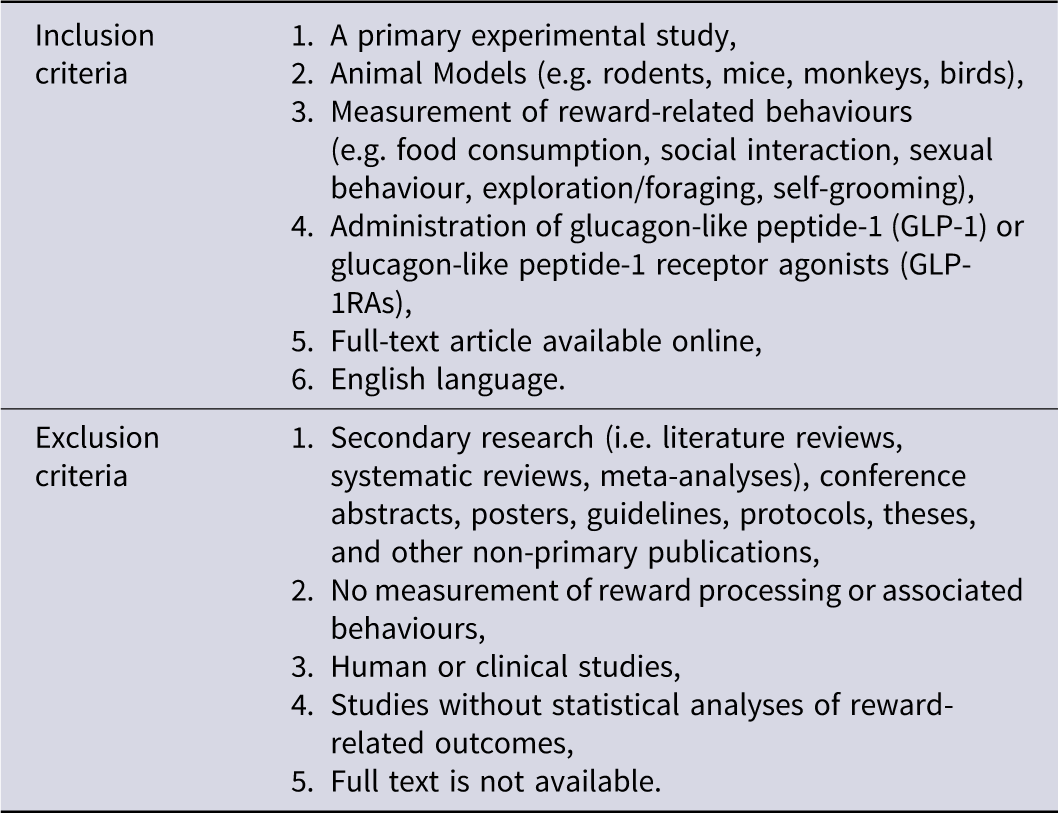
Article screening was conducted through Covidence wherein duplicated articles were excluded (Covidence, 2024). Two independent reviewers (H.A. and Y.J.Z.) reviewed the titles and abstracts according to the inclusion and exclusion guidelines (Table 1). Relevant primary experimental sources were then assessed through full-text screening and included for extraction if they reported on GLP-1RA-associated changes to reward functioning and associated behaviours. All discrepancies were discussed and resolved through several consensus discussions between the two independent reviewers (H.A. and Y.J.Z.), with consultation from a third reviewer when necessary.
Eligibility criteria

Table 1 Long description
A table with two sections: Inclusion criteria and Exclusion criteria. The Inclusion criteria section has six rows and one column. Row 1: A primary experimental study. Row 2: Animal Models (e.g. rodents, mice, monkeys, birds). Row 3: Measurement of reward-related behaviours (e.g. food consumption, social interaction, sexual behaviour, exploration/foraging, self-grooming). Row 4: Administration of glucagon-like peptide-1 (GLP-1) or glucagon-like peptide-1 receptor agonists (GLP-1RAs). Row 5: Full-text article available online. Row 6: English language. The Exclusion criteria section has five rows and one column. Row 1: Secondary research (i.e. literature reviews, systematic reviews, meta-analyses), conference abstracts, posters, guidelines, protocols, theses, and other non-primary publications. Row 2: No measurement of reward processing or associated behaviours. Row 3: Human or clinical studies. Row 4: Studies without statistical analyses of reward-related outcomes. Row 5: Full text is not available.
Data extraction
Literature applicable to reward functions and GLP-1RA administration was obtained and further organised using the piloted data extraction guideline. Extracted information was established a priori, involving (1) author(s), (2) study design, (3) animal model, (4) reward processing, (5) paradigm classification, (6) measurement tools, and (7) outcome of interest(s). Reward processing and outcome of interest(s) involved GLP-1 or GLP-1RA administration in the context of reward-related behaviours in preclinical literature. Two reviewers (H.A. and Y.J.Z.) extracted data from relevant literature, followed up with thorough discussion to resolve potential conflicts.
Included studies were further categorised as employing reward-specific paradigms (e.g. progressive ratio, conditioned place preference, operant self-administration) or proxy measures (e.g. locomotion, intake) to facilitate interpretative clarity. Paradigm classification differentiates reward-specific behavioural tasks from proxy measures of intake or locomotion, which may reflect non-specific effects. Studies incorporating both approaches were classified as mixed (Table 2).
Characteristics of studies examining the association between GLP-1 and reward processing in animal models

Table 2 Long description
A table categorizing studies on GLP-1 and reward processing in animal models. The table has 12 rows and 10 columns. Column headers are: Study, Species, GLP-1 analogue, Dose, Route, Reward, Paradigm, Outcome, Effect, Notes. Row 1: Did, 9; N 1, 28.221196; Bucket, bucket_2. Row 2: Did, 10; N 1, 28.221196; Bucket, bucket_2. Row 3: Did, 11; N 1, 28.221196; Bucket, bucket_2. Row 4: Did, 12; N 1, 28.221196; Bucket, bucket_2. Row 5: Did, 13; N 1, 28.221196; Bucket, bucket_2. Row 6: Did, 14; N 1, 28.221196; Bucket, bucket_2. Row 7: Did, 15; N 1, 28.221196; Bucket, bucket_2. Row 8: Did, 16; N 1, 28.221196; Bucket, bucket_2. Row 9: Did, 17; N 1, 28.221196; Bucket, bucket_2. Row 10: Did, 18; N 1, 28.221196; Bucket, bucket_2. Row 11: Did, 19; N 1, 28.221196; Bucket, bucket_2. Row 12: Did, 20; N 1, 28.221196; Bucket, bucket_2.
Note: Studies evaluating multiple GLP-1RAs were categorised according to the primary agonist investigated.
Quality assessments
Quality assessment was conducted using SYRCLE’s risk of bias analysis tool for animal studies (Hooijmans et al., Reference Hooijmans, Rovers, de Vries, Leenaars, Ritskes-Hoitinga and Langendam2014). Two independent reviewers (H.A. and Y.J.Z.) assessed risk of bias for each included study, with any disagreements resolved through discussion until consensus was reached.
Results
Search results
A systematic search of relevant literature yielded 3849 studies. Among these, 79 duplicates were identified manually, and 1789 were identified using Covidence, leaving 1981 records for title and abstract screening. Following screening according to the predefined inclusion and exclusion criteria (Table 1), 115 full-text articles were assessed for eligibility. Of these, 66 studies met the inclusion criteria and were incorporated into the systematic review (Table 2). Forty-nine studies were excluded because of incorrect study design (n = 25), unavailable full text (n = 15), wrong outcomes (n = 4), not being primary experimental studies (n = 3), or wrong intervention (n = 2) (Figure 1).
PRISMA flow diagram of literature searches relevant to GLP-1RAs, reward processing, reward behaviours (Covidence, 2024).

Figure 1. Long description
The flowchart begins with the identification phase, where studies are sourced from databases/ registers (3849 total) including MEDLINE (2331), Web of Science (851), and PubMed (667). References from other sources are not specified. A total of 1868 references are removed due to duplicates identified manually (79), by Covidence (1789), and other reasons. The screening phase follows, where 1981 studies are screened, and 1866 are excluded. 115 studies are sought for retrieval, with none not retrieved. These 115 studies are assessed for eligibility, and 49 are excluded for reasons including wrong outcomes (4), not being primary sources (3), wrong intervention (2), wrong study design (25), and full text not available (15). Finally, 66 studies are included in the review.
Methodological quality
Methodological quality was assessed using the SYRCLE Risk of Bias tool (Table S1). Across the included preclinical studies, most domains were judged to have a low or unclear risk of bias. Allocation concealment, incomplete outcome data, and selective outcome reporting were generally assessed as low risk across studies. Common methodological limitations included insufficient reporting of sequence generation, random housing, and blinding of caregivers/investigators, resulting in several domains being classified as having an unclear risk of bias.
Random outcome assessment and blinding of outcome assessment were frequently achieved through standardised or automated behavioural paradigms but were not consistently reported across all studies. Overall, only a small number of studies were judged to have a high risk of bias in individual domains, primarily due to inadequate control of potential confounding variables or incomplete reporting of experimental procedures. A detailed assessment of the methodological quality of each included study is provided in Supplementary Table S1.
Preclinical reward-associated behavioural paradigm considerations
Preclinical studies often assess feeding and reward-related behaviours under conditions of deprivation or heightened stress, and without full control for potential confounding variables such as anxiety and arousal. In addition, reward processing in animal models is often measured using heterogeneous paradigms, ranging from reward-specific tasks (e.g. drug administration) to general measures of consumption (e.g. chow intake) and locomotion (e.g. sexual and motor activity), which may reflect metabolic or nonspecific motivational effects rather than discrete reward processes. Furthermore, differences in dosing regimens, routes of administration, and exposure durations across animal studies limit direct correspondence with clinical treatment protocols. These methodological variations can further complicate efforts to map specific behavioural outcomes onto clinical constructs such as anhedonia, craving, reward learning, and relapse.
Notwithstanding these limitations, such paradigms remain widely used and accepted in preclinical research as indirect measures of reward-related processes, particularly when interpreted alongside complementary behavioural and neurobiological endpoints. When evaluated collectively, convergent preclinical findings across diverse paradigms and experimental protocols may nevertheless provide meaningful insight into underlying reward-related mechanisms.
GLP-1 and GLP-1RA effect on reward processing
Summary of findings
Cumulatively, the included studies demonstrated that GLP-1 and GLP-1RAs modulated multiple domains of reward-related behaviour across diverse animal models and behavioural paradigms. Across agonists, attenuation of food- and substance-associated reward was the most frequently reported finding, with reductions observed in reward-seeking, reinforcement, conditioned place preference, operant responding, and self-administration. Although the magnitude and consistency of these effects varied according to agonist, dose, administration site, and behavioural paradigm, the findings collectively suggest modulation of reward-related behaviours across the included preclinical studies.
Effect of GLP-1 on reward processing
We identified six studies evaluating the effect of GLP-1 on reward processing (Thiele et al., Reference Thiele, Van Dijk, Campfield, Smith, Burn, Woods, Bernstein and Seeley1997; Donahey et al., Reference Donahey, van Dijk, Woods and Seeley1998; Hwa et al., Reference Hwa, Ghibaudi, Williams, Witten, Tedesco and Strader1998; Shousha et al., Reference Shousha, Nakahara, Nasu, Sakamoto and Murakami2007; Failor et al., Reference Failor, Bohler, Cao, Gilbert and Cline2023; Xiao et al., Reference Xiao, Yap and Ong2025). Hwa et al. (Reference Hwa, Ghibaudi, Williams, Witten, Tedesco and Strader1998) reported a decrease in food consumption following GLP-1 administration, where the first two hours of food intake diminished by 73% (30 μg; p = 0.0001) and 48% (10 μg; p = 0.004). The effect of GLP-1 on food consummatory behaviour was notable in obese rather than lean rats. Donahey et al. (Reference Donahey, van Dijk, Woods and Seeley1998) replicated these findings, reporting a significant food intake reduction following treatment (P < 0.05). Likewise, Thiele et al. (Reference Thiele, Van Dijk, Campfield, Smith, Burn, Woods, Bernstein and Seeley1997) demonstrated that GLP-1 decreased latency to reject saccharin (P < 0.001) and reduced preference ratio (P < 0.05) following a conditioned taste aversion training test.
In addition to reduction in feeding behaviour, Shousha et al. (Reference Shousha, Nakahara, Nasu, Sakamoto and Murakami2007) reported decreased gross locomotor activity in GLP-1-treated quails compared to saline-treated quails (P < 0.05). Much like preceding studies, Failor et al. (Reference Failor, Bohler, Cao, Gilbert and Cline2023) reported a decline in food intake following GLP-1 infusion in quails (P < 0.05). More recent evidence further supports the role of endogenous GLP-1 signalling in alcohol-associated reward. For instance, Xiao et al. (Reference Xiao, Yap and Ong2025) demonstrated that activation of GLP-1R signalling within the dorsolateral septum significantly reduced ethanol operant self-administration, motivation for alcohol, along with reacquisition of alcohol seeking, supporting a role for central GLP-1 signalling in regulating alcohol reinforcement and relapse-like behaviours.
Effect of exenatide on reward processing
In addition to GLP-1, GLP-1RAs have been extensively investigated in preclinical models for their effects on food-associated, drug-related, and sexual behaviours, suggesting a robust and consistent influence on various reward-processing pathways. Firstly, we identified 41 studies that reported on the effect of exenatide on reward functions (Table 2). Twenty-two preclinical studies investigated exenatide, including exendin-4 (EX4), and its effects on substance use, whereas 15 studies examined food-associated reward, and 4 studies assessed sexual behaviours. Current literature indicates a potential reward-modulating effect with EX4 administration, wherein reward functions were attenuated following the agonist treatment.
Effect of exenatide on drug-associated reward
Alcohol, amphetamine, cocaine, nicotine, fentanyl, heroin, and oxycodone use were examined in response to EX4 administration. Twenty-two preclinical studies reported modulation of substance administration with EX4, with the majority corroborating their findings.
Alcohol administration
EX4 administration in selected brain regions, including nucleus accumbens core (NAcC) and shell (NAcS), hippocampus (HPC), lateral hypothalamus (LH), VTA, LS, and NTS has been extensively studied with respect to its role in alcohol self-administration.
Egecioglu et al. (Reference Egecioglu, Steensland, Fredriksson, Feltmann, Engel and Jerlhag2013) reported that high doses of EX4 (4.8 µg/kg) in the NAcC potentiated locomotor activity and reduced alcohol-induced locomotion activity (P < 0.001), while lower doses had no significant effect. EX4 also reduced alcohol-induced conditioned place preference (CPP) with a single dose (2.4 µg/kg) (P < 0.01) and blocked CPP with repeated doses during conditioning (P < 0.05). In an operant self-administration paradigm, EX4 (1.2 µg/kg) reduced active lever presses (P < 0.01) and decreased inactive lever presses (P < 0.05) following alcohol exposure. However, the treatment did not affect saccharin cue intake when paired with EX4 administration but rather increased saccharin cue acceptance during extinction trials. Like previous findings, EX4 amplified locomotor activity compared to vehicle treatment (P < 0.0001) (Egecioglu et al., Reference Egecioglu, Steensland, Fredriksson, Feltmann, Engel and Jerlhag2013; Vallöf et al., Reference Vallöf, Kalafateli and Jerlhag2019a). However, it is noteworthy that the increase in locomotor activity was blocked in mice injected with EX4 in the laterodorsal tegmental area (LDTg) (P < 0.001).
Vallöf et al. (Reference Vallöf, Kalafateli and Jerlhag2019a) observed that alcohol-associated CPP was attenuated by EX4 infusion in the NAcC (P = 0.0257). Following, EX4 administration in the NAcS of high alcohol-consuming rats exhibited decreased alcohol intake (P = 0.0319), with no notable difference in alcohol preference (P = 0.2615) and food intake (P = 0.4438). Contrarily, Abtahi et al. (Reference Abtahi, Howell and Currie2018) showed that NAcC EX4 infusion did not significantly impact alcohol intake two hours post-injection but demonstrated a reduction in food intake at 6 and 24 hours post-infusion (P < 0.05).
Notwithstanding, EX4 administration in both the NAcC and HPC was found to significantly reduce alcohol self-administration (Egecioglu et al., Reference Egecioglu, Steensland, Fredriksson, Feltmann, Engel and Jerlhag2013; Allingbjerg et al., Reference Allingbjerg, Hansen, Secher and Thomsen2023). EX4 infusion in the ventral HPC, NAcC, and LS demonstrated a significant decline in substance-related reward behaviours (P < 0.001) (Allingbjerg et al., Reference Allingbjerg, Hansen, Secher and Thomsen2023). At a higher dose, EX4 reduced alcohol intake when administered in the NAcC (P < 0.05), LS (P < 0.01), and ventral HPC (P < 0.001). Reinforcing these trends, Colvin et al. (Reference Colvin, Killen, Kanter, Halperin, Engel and Currie2020) reported inhibition of alcohol intake when administered in the VTA (P < 0.0001), NAcC and NAcS, dorsomedial HPC, and LH.
Shirazi et al. (Reference Shirazi, Dickson and Skibicka2013) substantiated these findings, where mesolimbic VTA EX4 infusion resulted in a decreased preference for alcohol-associated compartments relative to vehicle treatment (P < 0.05). EX4 injection reduced alcohol consumption at both 1 hour and 16 hours (P < 0.005). Additional studies reported that direct EX4 administration in the VTA significantly reduced alcohol self-administration and active nose pokes compared to vehicle treatment (P < 0.05), with no prominent distinctions between lower and higher doses (Dixon et al., Reference Dixon, McNally and Ong2020). The foregoing result was not replicated by Vallöf et al. (Reference Vallöf, Kalafateli and Jerlhag2019a), who reported that anterior VTA EX4 administration had no significant effect on alcohol intake (P = 0.7324) in comparison to the vehicle. No differences in alcohol preference (P = 0.9023) or food intake (P = 0.0722) were observed between both groups. Additionally, posterior VTA had no significant effect on alcohol intake (P = 0.9219) relative to the vehicle group.
Analysis of NTS EX4 administration indicated a decrease in alcohol intake and inhibition of memory consolidation for alcohol reward in mice (P = 0.015) (Vallöf et al., Reference Vallöf, Vestlund and Jerlhag2019b). Mice with extended alcohol consumption were treated with 0.05 μg EX4, resulting in a significant reduction in alcohol intake at 1-hour (P = 0.0101), 4-hour (P = 0.0017), and 24-hour (P = 0.0352) time points. Reduction in alcohol preference following 0.05 μg EX4 administration was observed at the 4-hour (P = 0.0639) and 24-hour (P = 0.0368) time points.
Daily EX4 administration significantly reduced alcohol intake and preference in mice during the post-deprivation period compared to saline-treated controls, with significant treatment effects on intake (P < 0.05) and preference (P < 0.05) (Thomsen et al., Reference Thomsen, Dencker, Wörtwein, Weikop, Egecioglu, Jerlhag, Fink-Jensen and Molander2017). EX4 also reduced the number of alcohol-drinking bouts (P < 0.01) and increased the latency to the first drink after deprivation (P < 0.05, Logrank test).
Sørensen et al. (Reference Sørensen, Caine and Thomsen2016) determined that EX4 (3.2 μg/kg) reduced (i.e. approximately 70%) ethanol intake (P < 0.01) without affecting food-maintained operant response. Intraperitoneal injection of 1.8 or 3.2 μg/kg EX4 slightly decreased responding rates and liquid food reinforcers earned, but these reductions were not statistically significant.
Sexual dimorphism was an additional factor that was suggested to affect the impact of EX4 on substance use behaviours. Díaz-Megido and Thomsen (Reference Díaz-Megido and Thomsen2023) demonstrated that EX4 administration at different doses suppressed alcohol-seeking behaviour in male mice but not in female mice. Female mice reinstated alcohol-seeking behaviour regardless of EX4 treatment (P > 0.4), whereas EX4 effectively inhibited reinstatement in male mice (P = 0.006). Although EX4 significantly reduced alcohol self-administration in both male and female mice, the effect was more pronounced in the male mice.
Overall, EX4 demonstrated the potential to reduce alcohol consumption and related behaviours across various brain regions, with some effects being dose-dependent and others showing significant interactions with sex and individual consumption patterns.
Cocaine administration
Five studies assessed the role of EX4 on cocaine self-administration and associated behaviours (Sørensen et al., Reference Sørensen, Reddy, Weikop, Graham, Stanwood, Wörtwein, Galli and Fink-Jensen2015; Schmidt et al., Reference Schmidt, Mietlicki-Baase, Ige, Maurer, Reiner, Zimmer, Van Nest, Guercio, Wimmer, Olivos, De Jonghe and Hayes2016; Hernandez et al., Reference Hernandez, Ige, Mietlicki-Baase, Molina-Castro, Turner, Hayes and Schmidt2018; Zhu et al., Reference Zhu, Hong, Li, Jiang, Guo, Wang, Ding, Gao, Sun, Sun, Wang, Wang and Wan2021; Zhu et al., Reference Zhu, Wang, Ding, Li, Wan, Sun, Guo, He, Ren, Jiang, Gao, Guo, Sun and Wang2022). Hernandez et al. (Reference Hernandez, Ige, Mietlicki-Baase, Molina-Castro, Turner, Hayes and Schmidt2018) demonstrated that a pretreatment with 0.2 µg/kg of EX4 significantly attenuated cocaine-seeking behaviour induced by re-exposure to cocaine-associated cues (P < 0.05), corroborating its effects on cocaine priming-induced reinstatement. Similarly, VTA EX4 administration significantly reduced cocaine self-administration but not sucrose self-administration in comparison to vehicle treatment (P < 0.05) (Schmidt et al., Reference Schmidt, Mietlicki-Baase, Ige, Maurer, Reiner, Zimmer, Van Nest, Guercio, Wimmer, Olivos, De Jonghe and Hayes2016). Further supporting these findings, Sørensen et al. (Reference Sørensen, Reddy, Weikop, Graham, Stanwood, Wörtwein, Galli and Fink-Jensen2015) observed that EX4 reduced both acute and chronic cocaine self-administration in mice. 30 and 100 μg/kg of EX4 diminished self-administration of the peak effective cocaine dose (0.03 mg/kg/infusion; P < 0.01, P < 0.05).
Conversely, Zhu et al. (Reference Zhu, Hong, Li, Jiang, Guo, Wang, Ding, Gao, Sun, Sun, Wang, Wang and Wan2021) reported that acute EX4 infusion did not enhance the extinction of cocaine-induced CPP, as evidenced by a lack of reduction in time spent in the cocaine-paired chamber (P = 0.2195). However, repeated EX4 administration significantly reduced CPP scores (P = 0.0047), indicating an enhancement in the extinction of cocaine-induced CPP following extinction training (P < 0.05). Extending further, Zhu et al. (Reference Zhu, Wang, Ding, Li, Wan, Sun, Guo, He, Ren, Jiang, Gao, Guo, Sun and Wang2022) reported that EX4 treatment significantly attenuated time spent in the cocaine-primed chamber compared to control during cocaine-primed reinstatement (P < 0.001), supporting EX4’s potential in inhibiting cocaine-primed reinstatement of cocaine-associated CPP during extinction training.
Amphetamine administration
We identified two studies that investigated EX4 administration and its effect on amphetamine-seeking behaviours (Egecioglu et al., Reference Egecioglu, Engel and Jerlhag2013b; Sirohi et al., Reference Sirohi, Schurdak, Seeley, Benoit and Davis2016). Following CPP testing, EX4 treatment impeded amphetamine-induced CPP in FLOX (control) mice but not in GLP-1R KDNestin mice. Similarly, EX4 inhibited alcohol consumption in control mice (P < 0.05) but not in GLP-1R KDNestin mice compared to saline treatment. Additionally, EX4 significantly reduced high-fat diet intake in both controls (P = 0.003) and GLP-1R KDNestin mice (P = 0.006) compared to saline treatment. High-fat diet intake was completely blocked in control mice and partially blocked in GLP-1R KDNestin mice.
With just amphetamine administration, Egecioglu et al. (Reference Egecioglu, Engel and Jerlhag2013b) reported that EX4 injection (2.4 µg/kg IP) significantly attenuated amphetamine-induced CPP in mice (n = 8 per group, P < 0.05, unpaired t-test). Additionally, EX4 significantly reduced CPP on post-conditioning compared to vehicle-treated rats (P = 0.025, n=8). Acute single injection of EX4 (2.4 µg/kg) also significantly reduced cocaine-induced (10 mg/kg) CPP on the post-conditioning day compared to vehicle injection (P = 0.031, n=8 per group).
Heroin administration
EX4 has been shown to significantly reduce drug-induced heroin-seeking behaviour following a one-hour pretreatment (Douton et al., Reference Douton, Augusto, Stoltzfus, Carkaci-Salli, Vrana and Grigson2021a). Saccharin cue intake significantly decreased in large suppressor (LS) groups compared to small suppressor (SS) and saccharin-saline groups. EX4 did not alter saccharin cue intake when paired with the drug but increased saccharin cue acceptance during extinction trials. EX4 tended to decrease drug-seeking behaviours in the SS group, but this trend was not statistically significant. In the drug-induced reinstatement test, EX4 administration one hour before drug priming significantly increased the latency to first contact with the active spout (P < 0.005) and reduced heroin-seeking across all groups (P < 0.05).
Oxycodone administration
EX4 infusion significantly reduced oxycodone self-administration and reinstatement, lowering oxycodone intake and active lever activity compared to vehicle treatment (P < 0.05) (Zhang et al., Reference Zhang, Kahng, Elkind, Weir, Hernandez, Stein and Schmidt2020). 0.3 and 3.0 µg/kg EX4 treatment reduced food intake at one and three hours post-session (P < 0.05) but not at six and 24 hours. Additionally, 3.0 µg/kg EX4 reduced cue-induced reinstatement of oxycodone-seeking without triggering reinstatement in the absence of cues, indicating its effectiveness in reducing oxycodone-seeking behaviour without negative effects on feeding or drinking.
Fentanyl administration
Following EX4 treatment, animals exhibited a significant reduction in active lever responses and fentanyl self-administration relative to controls (P < 0.05) (Zhang et al., Reference Zhang, Rahematpura, Ragnini, Moreno, Stecyk, Kahng, Milliken, Hayes, Doyle and Schmidt2021). Following the reinstatement of fentanyl-seeking behaviour, active lever responses and total infusions of fentanyl were significantly reduced in rats pretreated with 0.072 or 0.72 nmol/kg EX4 compared to controls (P < 0.05).
Nicotine administration
EX4 pretreatment (2.4 µg/kg) reduced nicotine-induced locomotor stimulation (nicotine administration: 0.5 mg/kg) (P < 0.01), although EX4 alone did not produce a significant reduction compared to the vehicle group (P > 0.05) (Egecioglu et al., Reference Egecioglu, Engel and Jerlhag2013a). EX4 also attenuated nicotine-induced dopamine release at various intervals compared to vehicle treatment: 60 minutes (P < 0.05), 120 minutes (P < 0.05), and 180 minutes (P < 0.001). Following conditioning, EX4 injection further attenuated nicotine-induced CPP in mice (P < 0.05, unpaired t-test).
Exenatide effect on food-associated reward
Administration of EX4 or exenatide has been widely studied for its influence on food and reward across various experimental setups and animal models. Alhadeff and Grill (Reference Alhadeff and Grill2014) demonstrated that EX4 administration in the medial NTS significantly reduced high-fat diet intake at both six hours (P < 0.05) and 24 hours (P < 0.001) post-injection. This trend was observed across all EX4 dosages. In progressive ratio (PR) operant experiments, EX4 also significantly decreased active lever presses (P < 0.05), and sucrose reinforcers obtained (P < 0.05). However, inactive lever presses were unaffected.
Furthermore, EX4 treatment significantly decreased CPP for food rewards compared to vehicle-treated groups (P < 0.05) without altering cumulative time active or distance travelled. EX4 administration in the paraventricular thalamic nucleus (PVT) significantly reduced both chow and high-fat diet (HFD) intake, showing main effects of treatment (P < 0.01), time (P < 0.001), and treatment × time interaction (P < 0.001) (Ong et al., Reference Ong, Liu, Pang and Grill2017). EX4 also decreased food-seeking and food-motivated behaviours, with treated rats showing no preference for the HFD-paired environment and reduced lever pressing during cue-induced reinstatement of sucrose-seeking (P < 0.05). EX4 decreased active lever presses (P < 0.01) and sucrose pellets earned (P < 0.01).
Bernosky-Smith et al. (Reference Bernosky-Smith, Stanger, Trujillo, Mitchell, España and Bass2016) found that EX4 significantly reduced responses for sweetened vegetable shortening (SVS) under fixed (FR) and progressive ratio (PR) reinforcement schedules. A 1.2 µg/kg EX4 injection reduced responses to SVS during PR sessions relative to saline control (P < 0.01), and a 2.4 µg/kg dose further reduced food-related reward responses (P < 0.0001). During FR sessions, EX4 at doses of 0.6 µg/kg (P ≤ 0.01), 1.2 µg/kg (P ≤ 0.001), and 2.4 µg/kg (P ≤ 0.0001) significantly inhibited responses for SVS relative to the saline-control group. On the contrary, Pierce-Messick and Pratt (Reference Pierce-Messick and Pratt2020) reported that EX4 alone did not significantly affect sweetened fat diet intake [Main effect of EX4: F(2,10) = 1.91, P = 0.20]. However, when combined with μ-opioid receptor stimulation, EX4 significantly attenuated the increased sweetened fat diet intake caused by μ-opioid receptor stimulation, as evidenced by a significant EX4 × time interaction (P < 0.001).
Brakey et al. (Reference Brakey, Schatz, Paul and Daniels2023) reported that lateral ventricle EX4 administration significantly reduced food intake in male and female rats (P < 0.05). Dickson et al. (Reference Dickson, Shirazi, Hansson, Bergquist, Nissbrandt and Skibicka2012) similarly noted that EX4 significantly reduced food-reward behaviour, as measured by sucrose motivation, across test periods (P < 0.0001). Rats administered EX4 (0.3 μg/kg) 10 minutes before the CPP test displayed a reduced preference for the chocolate-paired chamber compared to vehicle-treated groups (Student’s t-test, P < 0.05).
Douton et al. (Reference Douton, Norgren and Grigson2021b) observed a trend toward reducing tongue protrusions for sucrose with EX4 treatment, although this was not statistically significant (P > 0.05). However, paw licking tendency was significantly diminished (P < 0.05), and EX4 also reduced motivation to consume quinine, significantly increasing latency to initiate the first gape (P < 0.05) and further reducing the quantity of gapes caused by QHCl compared to vehicle-treated rats (P < 0.005). There was no significant difference in the latency to initiate the first lick of quinine between EX4 and vehicle-treated groups (P > 0.05). EX4 did not significantly affect motivation or affective responses during LiCl-conditioned taste aversion/avoidance tests.
In addition, Punjabi et al. (Reference Punjabi, Arnold, Rüttimann, Graber, Geary, Pacheco-López and Langhans2014) showed that intrameal HPV GLP-1 infusion (1 nmol/kg) significantly reduced the size of the first spontaneous dark-phase meal compared to vehicle combined with IC4V saline infusion (GLP-1/saline vs. vehicle/saline, P < 0.05). Hindbrain GLP-1 infusion inhibited eating behaviour without causing flavour avoidance (P > 0.05).
Qiao et al. (Reference Qiao, Ren, Li and Hou2019) reported that acute EX4 administration significantly inhibited chow intake at 1, 2, and 6 hours in both CeA lesion and sham-operated rat groups (P < 0.05). Similarly, EX4 treatment significantly suppressed high-sucrose food intake in sham-operated rats at 1 and 6 hours (P < 0.05) and at 2 hours in both sham-operated and CeA lesion rats, but only at the highest dose (P < 0.05).
Richard et al. (Reference Richard, Anderberg, Göteson, Gribble, Reimann and Skibicka2015) further established that EX4 infusion in the NTS suppressed palatable food intake but did not affect chow intake when both were offered simultaneously (1h: P < 0.005; 3h: P < 0.01; 6h: P < 0.05). When only chow was available, EX4 significantly reduced chow intake at one hour (P < 0.0001) and 22 hours (P < 0.005). In the sucrose PR operant conditioning task, EX4 significantly reduced sucrose rewards earned and the number of lever presses for sucrose (P < 0.005). Additionally, in CPP, EX4-treated rats spent significantly less time in the food-associated chamber compared to vehicle-treated rats (P < 0.05).
In the chick animal model, Tachibana et al. (Reference Tachibana, Sugahara, Ohgushi, Ando, Sashihara, Yoshimatsu and Furuse2001) reported a reduction in food intake in layer-type chicks by Exendin (5-39) infusion (P < 0.05), indicating a slight but notable change in feeding behaviour. However, in broiler chicks, Exendin (5-39) administration did not affect food intake. Terrill et al. (Reference Terrill, Jackson, Greene, Lilly, Maske, Vallejo and Williams2016) found that intra-LV injection of EX4 at 0.05 and 0.1 μg reduced chow intake at 20 hours post-dark onset (P < 0.01) but had no notable effects at earlier time points. EX4 also decreased high-fat diet intake at 9 hours into the dark phase (P < 0.05) and reduced body weight at 20 hours (P < 0.05).
Recent evidence further supports the effects of exenatide on food-associated reward. Knakker et al. (Reference Knakker, Inkeller, Kovacs, Lendvai and Hernadi2025) demonstrated that exenatide reduced food intake while dissociating hedonic and anticipatory regulation of feeding in non-human primates. These findings suggest that exenatide selectively suppresses food consumption while preserving aspects of reward discrimination.
Contrasting many of the findings, Treesukosol et al. (Reference Treesukosol and Moran2022) noted that EX4 treatment did not affect water or sucrose intake compared to controls. Higher doses of EX4 (1.0 and 3.0 µg/kg) decreased responses to sucrose and intralipid. Both doses showed significant concentration effects (P < 0.001) for sucrose but no group effects or interactions. 3.0 µg/kg dose showed significant group (P = 0.001), concentration (P < 0.001), and group × concentration interaction effects. This result calls for further research into the role of EX4 in food-related reward behaviours to ascertain its effects.
Wakabayashi et al. (Reference Wakabayashi, Baindur, Feja, Suarez, Chen, Bernosky-Smith and Bass2024) investigated the effects of EX4 on impulsive choice behaviour (ICs) and found significant, dose-dependent reductions in responses. EX4 administration led to increased latencies for nose-poke responses and reward cup entries following rewarded nose-pokes (P < 0.0001). EX4 also increased reward cup entry latencies from 0.52 ± 0.03 s (vehicle) to 0.64 ± 0.05 (0.6 μg/kg), 0.76 ± 0.05 (1.2 μg/kg), and 0.99 ± 0.08 s (2.4 μg/kg) (P < 0.0001). Although EX4 did not significantly change the sucrose reward volume dispensed after 2 minutes, it reduced the volume dispensed after 60 minutes (P < 0.0001).
Overall, these studies collectively indicate that EX4 effectively modulates food-associated reward behaviours, with dose-dependent effects on intake, motivation, and reinforcement. This supports its potential therapeutic application in conditions associated with impulsivity and maladaptive reward-seeking behaviours.
Effect of exenatide on sexual behaviours
Investigations conducted by Vestlund and Jerlhag (Reference Vestlund and Jerlhag2020a, Reference Vestlund and Jerlhag2020b) examined the role of exenatide on sexual behaviours, including sexual interaction, mounting, and self-grooming behaviours. In the first series of experiments, acute EX4 administration in the NTS resulted in a reduction of sexual interaction behaviours but did not alter preference for mates (EX4: n = 7; P = 0.9080) or female bedding in sexually naive male mice (Vestlund & Jerlhag, Reference Vestlund and Jerlhag2020b). However, repeated EX4 treatment (n = 10) did not display a significant effect on time spent on female bedding (P = 0.5899) or male bedding (P = 0.5862) compared to the vehicle group (n = 10). Moreover, repeated EX4 treatment did not alter the preference for female mice (P = 0.3995) or the total interaction time (P = 0.8735). Contrary to acute treatment, repeated EX4 administration did not influence sexual interaction behaviours.
Reflecting these observations, EX4 infusion into the LDTg, posterior VTA, and NAc elicited a reduction in sexual interaction and associated behaviours, but administration in the anterior VTA did not alter these behaviours (Vestlund & Jerlhag, Reference Vestlund and Jerlhag2020a). In sexually naïve male mice, EX4 in the LDTg decreased the frequency of social (P = 0.0346) and mounting behaviours (P = 0.0361, P = 0.0359) without significantly altering self-grooming. Similarly, EX4 infusion in the pVTA reduced social behaviour frequency (P = 0.0460), social behaviour latency (P = 0.0489), mounting frequency (P = 0.0481), and mounting latency (P = 0.0019) without impacting self-grooming behaviours. EX4 administration in the NAcS decreased social behaviour frequency (P = 0.0431) and duration (P = 0.0261) but did not affect sexual interaction or self-grooming behaviours.
In addition, in sexually experienced male mice, Ex4 significantly reduced intromissions and ejaculations without affecting mount latency or social behaviours (Shevchouk et al., Reference Shevchouk, Edvardsson, Ericson, Westberg and Jerlhag2026a). Similarly, EX4 reduced multiple indices of female sexual behaviour, including sexual interactions and lordosis responses, whereas longer-acting GLP-1RAs produced comparatively modest and species-dependent effects (Shevchouk et al., Reference Shevchouk, Edvardsson, Ericson, Zhang, Sköldheden, Nabinger, Snoeren, Westberg and Jerlhag2026b). These findings further support a role for EX4 in modulating natural reward beyond food- and drug-associated behaviours.
Effect of liraglutide on reward processing
Eleven studies investigating liraglutide’s effect on reward functions were identified (Raun et al., Reference Raun, von Voss and Knudsen2007; Vallöf et al., Reference Vallöf, Maccioni, Colombo, Mandrapa, Jörnulf, Egecioglu, Engel and Jerlhag2016; Jones et al., Reference Jones, Sample and Davidson2019; Evans et al., Reference Evans, Stoltzfus, Acharya, Nyland, Arnold, Freet, Bunce and Grigson2022; Douton et al., Reference Douton, Acharya, Stoltzfus, Sun, Grigson and Nyland2022a; Urbanik et al., Reference Urbanik, Acharya and Grigson2022; Douton et al., Reference Douton, Acharya, Stoltzfus, Sun, Grigson and Nyland2022b; Herman et al., Reference Herman, Hayes, Audrain-McGovern, Ashare and Schmidt2023; Liu et al., Reference Liu, Wang, Wang, Wang, Xing and Hölscher2024; Urbanik et al., Reference Urbanik, Booth, Acharya, Evans and Grigson2025; Hrickova et al., Reference Hrickova, Demirci, Amchova and Ruda-Kucerova2026). The findings suggest the potential of liraglutide in modulating substance and food-associated reward processing.
Effect of liraglutide on drug-associated reward
We identified nine animal studies that investigated the effects of liraglutide on drug-associated reward functions, particularly in heroin, alcohol, fentanyl, and nicotine self-administration. Of this literature, three studies investigated the role of liraglutide on heroin self-administration (Evans et al., Reference Evans, Stoltzfus, Acharya, Nyland, Arnold, Freet, Bunce and Grigson2022; Douton et al., Reference Douton, Acharya, Stoltzfus, Sun, Grigson and Nyland2022a, Reference Douton, Horvath, Mills-Huffnagle, Nyland, Hajnal and Grigson2022b).
Douton et al. (Reference Douton, Horvath, Mills-Huffnagle, Nyland, Hajnal and Grigson2022a) examined the impact of liraglutide on heroin-seeking behaviour in male Sprague Dawley rats (n = 24). In the cue-induced seeking and drug-induced reinstatement test, liraglutide significantly reduced heroin-seeking behaviour (P < 0.05), indicating greater drug-seeking behaviour in vehicle-treated rats. Liraglutide also significantly reduced stress-induced reinstatement (P < 0.05). In a follow-up study, Douton et al. (Reference Douton, Acharya, Stoltzfus, Sun, Grigson and Nyland2022b) (n = 95) demonstrated an increased latency for heroin self-administration and reduction in drug-induced reinstatement of drug-seeking behaviours (P < 0.05). Likewise, a study by Evans et al. (Reference Evans, Stoltzfus, Acharya, Nyland, Arnold, Freet, Bunce and Grigson2022) (n = 52) reported a reduction in cue-induced heroin-seeking, drug-induced, and stress-induced reinstatement of heroin-seeking for both high and low-drug takers. This study revealed a significant group × time interaction (F(6,48) = 4.52, p = 0.0011), with a significant drug × time interaction (F(3,48) =6.90, p = 0.0006) following three days of abstinence and treatment. Collectively, these findings indicate that liraglutide reduces cue-induced and stress-induced heroin-seeking behaviours in rats with a history of heroin self-administration.
Additionally, two studies examined the effects of liraglutide on alcohol self-administration (Vallöf et al., Reference Vallöf, Maccioni, Colombo, Mandrapa, Jörnulf, Egecioglu, Engel and Jerlhag2016; Liu et al., Reference Liu, Wang, Wang, Wang, Xing and Hölscher2024). Liu et al. (Reference Liu, Wang, Wang, Wang, Xing and Hölscher2024) reported a reduction in alcohol consumption and preference following liraglutide administration, with prevention of alcohol-seeking relapses in the animals (P < 0.05). There was also a reduction in alcohol-induced CPP following liraglutide treatment relative to vehicle treatment (P < 0.01) (Vallöf et al., Reference Vallöf, Maccioni, Colombo, Mandrapa, Jörnulf, Egecioglu, Engel and Jerlhag2016). Acute liraglutide administration decreased alcohol intake in outbred rats (n = 15), lowering alcohol intake (P < 0.01), alcohol preference (P < 0.05), and food intake (P < 0.001), with a tendency to increase water intake (P = 0.0936). In high alcohol-consuming rats, liraglutide (0.05 mg/kg) significantly reduced alcohol intake (P = 0.0056), whereas in low alcohol-consuming rats, liraglutide did not significantly impact alcohol intake (P = 0.1100). Following alcohol deprivation, there was a significant increase in alcohol intake from baseline in vehicle-treated rats (P < 0.05) but not in liraglutide-treated rats (P > 0.05). In accordance with these findings, Thomsen et al. (Reference Thomsen, Holst, Molander, Linnet, Ptito and Fink-Jensen2019) administered both exenatide (P < 0.05) and liraglutide treatment in naive adult male vervet monkeys, wherein alcohol intake was significantly reduced within the first week of treatment compared to vehicle treatment.
Urbanik et al. (Reference Urbanik, Acharya and Grigson2022) evaluated liraglutide effect on fentanyl administration. In the first hour, saline-treated rats exhibited more cue-induced fentanyl-seeking behaviour than those treated with liraglutide (P < 0.05), with no significant differences observed in hours 2 and 3 (P > 0.05). At hour 4, liraglutide-treated rats demonstrated a decline in drug-induced reinstatement of fentanyl-seeking behaviour. More recently, Urbanik et al. (Reference Urbanik, Booth, Acharya, Evans and Grigson2025) demonstrated that acute liraglutide significantly reduced cue-induced fentanyl seeking during the first hour of extinction testing (P < 0.05). In high drug-taking female rats, liraglutide also significantly attenuated drug-induced reinstatement of fentanyl seeking (P = 0.0001). Hrickova et al. (Reference Hrickova, Demirci, Amchova and Ruda-Kucerova2026) further demonstrated that liraglutide significantly reduced methamphetamine self-administration under short-access, but not extended-access, conditions, suggesting greater efficacy during earlier stages of drug use.
Lastly, Herman et al. (Reference Herman, Hayes, Audrain-McGovern, Ashare and Schmidt2023) investigated the influence of liraglutide on nicotine-taking and seeking behaviours in male (n = 63) and female (n = 58) Sprague-Dawley rats. Acute liraglutide administration attenuated voluntary nicotine taking in both sexes. Male rats exhibited fewer active lever responses (Bonferroni, P < 0.01) and reduced nicotine self-administration (P < 0.05), while female rats demonstrated significant effects of lever (P < 0.0001) and treatment (P < 0.05), with fewer active lever responses following liraglutide treatment (Bonferroni, P < 0.05). Repeated liraglutide administration during abstinence further attenuated nicotine seeking in both male (P < 0.05) and female (P < 0.05) rats and reduced the number of days required to reach extinction.
Collectively, liraglutide and related GLP-1RAs consistently reduced heroin-, alcohol-, methamphetamine-, fentanyl-, and nicotine-associated reward behaviours, including drug intake, cue-induced and drug-induced reinstatement, relapse-like drinking, and voluntary self-administration.
Effect of liraglutide on food-associated reward
Liraglutide administration inhibited the response to a target cue when an inhibitory stimulus was present compared to saline administration (P < 0.05), demonstrating its potential to enhance the suppression of responsiveness to reward cues in such contexts (Jones et al., Reference Jones, Sample and Davidson2019). Similarly, Raun et al. (Reference Raun, von Voss and Knudsen2007) investigated liraglutide’s impact on food intake in six female Göttingen minipigs. Liraglutide treatment significantly reduced food intake by over 60% across 4–7 weeks. Meal frequency decreased (P = 0.053), and both meal size (P = 0.0001) and meal duration (P = 0.0065) were significantly reduced compared to pre-and post-treatment levels. These findings indicate that liraglutide effectively reduces food-related reward processing by decreasing the quantity and frequency of food intake and attenuating responsiveness to food-related reward cues.
Effect of semaglutide on reward processing
Effect of semaglutide on drug-associated reward
Six preclinical studies examined the effects of semaglutide on reward functions (Aranäs et al., Reference Aranäs, Edvardsson, Shevchouk, Zhang, Witley, Sköldheden, Zentveld, Vallöf, Tufvesson-Alm and Jerlhag2023; Cawthon et al., Reference Cawthon, Blonde, Nisi, Bloomston, Krubitski, le Roux and Spector2023; Aranäs et al., Reference Aranäs, Caffrey, Edvardsson, Schmidt and Jerlhag2025; Fink-Jensen et al., Reference Fink-Jensen, Wortwein, Klausen, Holst, Hartmann, Thomsen, Ptito, Beierschmitt and Palmour2025; Chang et al., Reference Chang, Turner, Pagán, Pereira, Kleer and Flagel2026; Heslep et al., Reference Heslep, Marsh and Banks2026). Firstly, semaglutide treatment was found to reduce alcohol intake, relapse-like alcohol consumption, food intake, and dopamine-driven behaviours (Aranäs et al., Reference Aranäs, Edvardsson, Shevchouk, Zhang, Witley, Sköldheden, Zentveld, Vallöf, Tufvesson-Alm and Jerlhag2023). Both acute and repeated administration of semaglutide significantly reduced alcohol intake in female and male rats compared to vehicle-treated groups (P < 0.0001). Semaglutide further decreased relapse-like alcohol intake in male rats 4 hours post-infusion (P < 0.01), with more pronounced reductions at 24 and 48 hours (P < 0.001). Female rats exhibited similar reductions at 4 (P < 0.01), 24 (P < 0.001), and 48 hours (P < 0.01). In alcohol-related paradigms, Fink-Jensen et al. (Reference Fink-Jensen, Wortwein, Klausen, Holst, Hartmann, Thomsen, Ptito, Beierschmitt and Palmour2025) demonstrated that semaglutide significantly reduced voluntary alcohol consumption in alcohol-preferring male vervet monkeys, extending these findings to a non-human primate model.
Cocaine
In addition to alcohol use, Aranäs et al. (Reference Aranäs, Caffrey, Edvardsson, Schmidt and Jerlhag2025) demonstrated that semaglutide significantly reduced cocaine self-administration, cocaine seeking, and cocaine-evoked dopamine release within the NAc. Consistent with these findings, Heslep et al. (Reference Heslep, Marsh and Banks2026) reported that repeated semaglutide treatment significantly reduced cocaine-versus-food choice in both male and female rats, indicating reduced cocaine reinforcement.
Effect of semaglutide on food reward
Furthermore, semaglutide reduced food intake in alcohol-consuming rats (P < 0.0001). In alcohol-naive male rats, semaglutide decreased the 4-hour intake of peanut butter (P = 0.0009) and Nutella (P = 0.0090). There was an overall decrease in preference for rewarding foods with semaglutide treatment compared to vehicle treatment. Cawthon et al. (Reference Cawthon, Blonde, Nisi, Bloomston, Krubitski, le Roux and Spector2023) similarly reported that semaglutide reduced chow intake, sucrose intake, and sucrose preference in semaglutide-treated rats (P < 0.05). Chang et al. (Reference Chang, Turner, Pagán, Pereira, Kleer and Flagel2026) further demonstrated that chronic semaglutide treatment reduced free food consumption and home-cage chow intake while increasing responding for food-associated cues and progressive ratio performance, suggesting differential effects on consummatory behaviour and incentive motivation. These findings suggest that semaglutide effectively reduces alcohol and rewarding food intake and alters dopamine-related behaviours.
Effect of dulaglutide on reward processing
We identified one study investigating drug-associated reward processing in adult post-pubertal male and female outbred Rcc Han Wistar rats (Vallöf et al., Reference Vallöf, Kalafateli and Jerlhag2020). A nine-week dulaglutide treatment in male rats significantly reduced ethanol intake and preference compared to the vehicle group (P < 0.001, Bonferroni post-hoc analysis). This effect persisted after treatment. A nine-week dulaglutide treatment in female rats also resulted in a significant decline in ethanol intake and preference (P < 0.001). These conclusions propose that GLP-1RA administration can reduce ethanol preference and intake, with observed sex differences.
Discussion
Our review demonstrates convergence of findings across multiple animal models and experimental paradigms, suggesting that GLP-1RAs modulate several domains of reward-related behaviour. Although these preclinical findings cannot be directly extrapolated to humans, they provide biological plausibility for ongoing clinical investigations examining GLP-1RAs in disorders characterised by dysregulated reward processing. Emerging clinical studies have reported alterations in food cue reactivity, craving, and substance-related behaviours following GLP-1RA treatment. However, these observations were not systematically evaluated in the present review and should therefore be interpreted separately from the evidence synthesised herein (Merchenthaler et al., Reference Merchenthaler, Lane and Shughrue1999; Hayes & Schmidt, Reference Hayes and Schmidt2016; Eren-Yazicioglu et al., Reference Eren-Yazicioglu, Yigit, Dogruoz and Yapici-Eser2021; López-Ojeda & Hurley, Reference López-Ojeda and Hurley2024; McIntyre, Reference McIntyre2024).
Mechanistically, GLP-1 is postulated to modulate neural systems and neurotransmitters implicated across dimensions of hedonic tone (e.g. dopamine, glutamate). For instance, functional neuroimaging studies in individuals with obesity and T2DM have demonstrated that GLP-1RA administration attenuates activation in key reward-related regions, including the insula, orbitofrontal cortex, amygdala, caudate, putamen, and ventral striatum, particularly during exposure to high-calorie food cues and reward anticipation paradigms. These neural alterations have been accompanied by reductions in craving and improved eating control. Preliminary clinical evidence also suggests potential effects on substance-related reward, including reductions in cue reactivity, craving, as well as consumption among individuals with AUD and smoking behaviour, particularly among those with metabolic dysfunction (Badulescu et al., Reference Badulescu, Tabassum, Le, Wong, Phan, Gill, Llach, McIntyre, Rosenblat and Mansur2024).
Mechanistically, metabolic dysregulation and insulin resistance have been associated with altered dopaminergic signalling and reward sensitivity (Badulescu et al., Reference Badulescu, Tabassum, Le, Wong, Phan, Gill, Llach, McIntyre, Rosenblat and Mansur2024) (Figure S1). By improving glycaemic control and insulin signalling, GLP-1RAs may indirectly restore mesolimbic dopamine function, while preclinical findings further indicate modulation of VTA to NAc circuitry. Although these clinical findings are consistent with the preclinical evidence summarised in this review, they were not systematically evaluated and should be interpreted as supportive translational context rather than evidence synthesised by this review.
The effects of GLP-1 on reward modulation are likely mediated through both midbrain and hindbrain pathways (Eren-Yazicioglu et al., Reference Eren-Yazicioglu, Yigit, Dogruoz and Yapici-Eser2021; López-Ojeda & Hurley, Reference López-Ojeda and Hurley2024). Notably, preclinical studies have demonstrated that GLP-1Rs are localised in the NAc and VTA, regions implicated in motivation and reward processing (Egecioglu et al., Reference Egecioglu, Steensland, Fredriksson, Feltmann, Engel and Jerlhag2013; Alhadeff & Grill, Reference Alhadeff and Grill2014; Ong et al., Reference Ong, Liu, Pang and Grill2017; Allingbjerg et al., Reference Allingbjerg, Hansen, Secher and Thomsen2023). Furthermore, GLP-1 is synthesised within the NTS, with projections to multiple reward-related brain regions. Consequently, exogenous administration of GLP-1RAs may modulate both behavioural and neurochemical responses through actions on these interconnected reward circuits.
Extant preclinical studies further demonstrate that NAcC-administered GLP-1RAs, such as EX4, reduced substance self-administration, including alcohol, through modulation of the mesolimbic reward system (Egecioglu et al., Reference Egecioglu, Steensland, Fredriksson, Feltmann, Engel and Jerlhag2013; Vallöf et al., Reference Vallöf, Vestlund and Jerlhag2019a; Colvin et al., Reference Colvin, Killen, Kanter, Halperin, Engel and Currie2020; Allingbjerg et al., Reference Allingbjerg, Hansen, Secher and Thomsen2023). Contrarily, Abtahi et al. (Reference Abtahi, Howell and Currie2018) found that NAcC EX4 did not significantly change alcohol intake, emphasising the need for further investigation into this discrepancy. Nevertheless, the overall body of evidence suggests that GLP-1RAs are associated with significant reductions in substance self-administration, preference, and seeking behaviours when administered in different brain regions.
Beyond substance-related reward, GLP-1RAs demonstrated potential in reducing response and reinforcement for food reward while modulating locomotion, with effects varying based on the dose administered and duration following treatment. Sexual reward behaviours were also examined, with acute exenatide administration reducing sexual interactions and related behaviours (Vestlund & Jerlhag, Reference Vestlund and Jerlhag2020a, Reference Vestlund and Jerlhag2020b).
While included preclinical studies provide preliminary evidence supporting the potential of GLP-1RAs in modulating reward behaviours, several limitations must be considered. Although several included studies reported attenuation in reward-seeking and reward-related behaviours following GLP-1RA administration, findings were not entirely consistent across paradigms, brain regions, preclinical models, and dosing protocols. Notably, numerous studies reported null or context-dependent effects, particularly in relation to alcohol intake and food-related reward under specific experimental conditions. Future investigations should further explore the effects of GLP-1RAs in animal models representing states of metabolic surplus to better understand the respective responses to reward cues. This approach may provide additional mechanistic insights into the therapeutic potential of GLP-1RAs for conditions corresponding to maladaptive reward behaviours.
In addition, the predominance of positive findings in the published literature raises the possibility of publication bias, particularly in preclinical research. Studies reporting null or negative results may be underrepresented, limiting comprehensive assessment of treatment efficacy. Furthermore, many paradigms assess reward-related behaviours under conditions of deprivation or stress, which may confound interpretations related to hedonic processing. These limitations emphasise the need for standardised experimental designs and more thorough reporting in future studies.
Another notable consideration is the influence of environmental context, as the setting in which feeding occurs may further modulate reward responsiveness, motivation, and reinforcement learning behaviours. These limitations complicate the drawing of affirmative conclusions about feeding behaviours and rewards relative to GLP-1RA treatment.
Hence, conclusions should be drawn considering these limitations, wherein adequate experimental set-ups and behavioural paradigms (i.e. CPP and operant conditioning) are employed to measure reward. Notwithstanding, numerous preclinical studies have investigated various GLP-1RAs and observed reductions in reward-seeking behaviours across various experiments. Collectively, the preclinical findings summarised in this review provide a biological rationale for continued investigation of GLP-1RAs as modulators of reward-related neurocircuitry. Future clinical studies are required to determine whether these preclinical observations translate into therapeutic benefit in humans.
Conclusion
Extant preclinical evidence indicates that GLP-1RAs consistently attenuate reward-associated behaviours across multiple animal models and experimental paradigms. These findings provide a biological rationale for continued investigation of GLP-1RAs in disorders characterised by dysregulated reward processing. However, because this review synthesised exclusively preclinical evidence, no conclusions regarding clinical efficacy can be drawn. Well-designed clinical studies are required to determine whether these preclinical findings translate into therapeutic benefit in humans. Furthermore, variability observed across preclinical studies highlights the need for continued investigation to better elucidate the role of GLP-1RAs in reward processing and the factors contributing to differences in treatment response.
Supplementary material
The supplementary material for this article can be found at https://doi.org/10.1017/neu.2026.10097.
Acknowledgements
None.
Author contributions
Conceptualisation and Methodology: Yang Jing Zheng and Roger S McIntyre. Investigation: Yang Jing Zheng and Hezekiah Au. Formal analysis and Visualisation: Yang Jing Zheng. Writing - Original Draft: Yang Jing Zheng and Hezekiah Au. Writing - Review and Editing: All authors.
Funding statement
This paper was not funded by any entity.
Competing interests
Dr Roger S. McIntyre has received research grant support from CIHR/GACD/National Natural Science Foundation of China (NSFC) and the Milken Institute; speaker/consultation fees from Lundbeck, Janssen, Alkermes, Neumora Therapeutics, Boehringer Ingelheim, Sage, Biogen, Mitsubishi Tanabe, Purdue, Pfizer, Otsuka, Takeda, Neurocrine, Neurawell, Sunovion, Bausch Health, Axsome, Novo Nordisk, Kris, Sanofi, Eisai, Intra-Cellular, NewBridge Pharmaceuticals, Viatris, Abbvie and Atai Life Sciences. Dr Joshua D Rosenblat has received research grant support from the Canadian Institute of Health Research (CIHR), Physician Services Inc. (PSI) Foundation, Labatt Brain Health Network, Brain and Cognition Discovery Foundation (BCDF), Canadian Cancer Society, Canadian Psychiatric Association, Academic Scholars Award, American Psychiatric Association, American Society of Psychopharmacology, University of Toronto, University Health Network Centre for Mental Health, Joseph M. West Family Memorial Fund and Timeposters Fellowship and industry funding for speaker/consultation/research fees from iGan, Boehringer Ingelheim, Janssen, Allergan, Lundbeck, Sunovion and COMPASS. Yang Jing Zheng, Hezekiah Au, Gia Han Le, Sabrina Wong, Kayla M. Teopiz, Angela T.H. Kwan, have no conflicts to declare. Some authors have previously published manuscripts on GLP-1RAs. However, this review was conducted using predefined and protocol-driven methods to align with objective criteria and to minimise bias. Dr. Taeho Greg Rhee was supported in part by the National Institute on Aging (#R21AG070666; R21AG078972; R01AG088647), National Institute of Mental Health (#R01MH131528), National Institute on Drug Abuse (#R21DA057540), and Health Resources and Services Administration (#R42MC53154-01-00). Dr. Rhee serves as a review committee member for Patient-Centered Outcomes Research Institute (PCORI) and Substance Abuse and Mental Health Services Administration (SAMHSA) and has received honoraria payments from PCORI and SAMHSA. Dr. Rhee has also served as a stakeholder/consultant for PCORI and received consulting fees from PCORI. Dr. Rhee serves as an advisory committee member for International Alliance of Mental Health Research Funders (IAMHRF).


 Open access

