1. Introduction
According to mechanistic theories of explanation, the upper- (macro-) level behavior Ψ of a system S is explained by carving out the lower- (micro-) level mechanism constituting that behavior (Glennan Reference Glennan1996; Machamer, Darden, and Craver Reference Machamer, Darden and Craver2000; Craver Reference Craver2007). Hence, a theory of mechanistic explanation presupposes a theory of constitution providing criteria that identify those of S’s spatiotemporal parts whose activities are constitutively relevant to S’s Ψ-ing. The most popular theory of constitution, due to Craver (Reference Craver2007), purports to furnish such criteria by drawing on conceptual and methodological resources that have proven valuable in analyzing and discovering causation—notwithstanding the fact that constitution and causation are very different relations (Craver and Bechtel Reference Craver and Bechtel2007).
Since the time of Mill (Reference Mill1843), one of the dominant approaches to uncovering causation consists in intervening on causes (in controlled environments) to test whether they make a difference to their purported effects. As is well known, Woodward (Reference Woodward2003) has built his influential interventionist theory of causation on the fundament of this experimental protocol. While causation is a unidirectional difference-making relation—that is, causes change their effects but not vice versa—and holds among mereologically independent entities, Craver (Reference Craver2007) argues that constitution is a bidirectional or mutual difference-making relation among wholes and some of their spatiotemporal parts. Correspondingly, he proposes a theory of constitution that adds a parthood and a mutuality tweak to Woodward’s interventionist theory of causation. Subject to Craver’s mutual manipulability theory (MM), the behavior Φ of a spatiotemporal part X of S constitutes S’s Ψ-ing iff it is possible to (ideally) intervene (from the bottom up) on X’s Φ-ing such that S’s Ψ-ing changes and (from the top down) on S’s Ψ-ing such that X’s Φ-ing changes (Reference Craver2007, 153). Craver claims that MM provides an adequate analysis of constitution and that it furnishes a solid foundation for evidence-based constitutional discovery.
The first part of this article takes issue with both of these claims (sec. 2). MM is far from providing an adequate analysis of constitution, as it is in fact inapplicable to the very structures it is designed to account for. MM definitionally ties constitution to the feasibility of idealized experiments. Such experiments are, however, unrealizable in principle. Macro-level phenomena and their constituents are so tightly intertwined that they can be manipulated only via common causes (cf. Baumgartner and Gebharter Reference Baumgartner and Gebharter2015). Furthermore, less rigorous but feasible experimental setups inevitably generate confounded data that systematically underdetermine the inference to constitutive relations. Hence, MM cannot possibly ground a viable methodology for constitutional discovery.
Since constitution is a noncausal form of dependence—as commonly assumed in mechanistic theorizing—one cannot simply tweak a successful account of causation to obtain a successful account of constitution. Rather, constitution must be defined within a theoretical framework that reflects its distinctly noncausal nature. Furthermore, the inference to constitution can neither in theory nor in practice proceed along the lines of the inference to causation. The main reason is that, while there exist ideal experimental designs allowing for the generation of unconfounded data that conclusively establish the existence of causal relations, no such experimental designs exist for the inference to constitution. Even data generated under ideal discovery circumstances can always equivalently be accounted for in terms of a model that features constitutive dependencies and a model without any such dependencies. Hence, the inference to constitution is inherently underdetermined by experimental evidence (sec. 3).
As an alternative to MM, the second part of the article then develops an abductive theory of constitution, which exploits the fact that phenomena and their constituents are unbreakably coupled via common causes (sec. 4). The existence of an additional dependence relation, namely, constitution, is the best explanation for this unbreakable common-cause coupling. Hence, pace Craver, the defining feature of constitution is not the possibility of top-down and bottom-up interventions on a mechanism and the existence of corresponding (mutual) difference-making scenarios, but the impossibility of such interventions and the nonexistence of such difference-making scenarios.
Our abductive theory has important ramifications for the inference to constitution that any experimental method of constitutional discovery has to take into account (sec. 5). In particular, to establish constitutive dependencies, it does not suffice to wiggle the macro level of a mechanistic system such that the micro level changes and vice versa—as stipulated by MM. Rather, an extended series of experiments is needed that explore the whole space of possible ways of breaking the coupling of macro and micro levels. Only if all of these tests are unsuccessful is an inference to constitution warranted. Moreover, in light of its inherent empirical underdetermination, such an inference is ultimately grounded in pragmatic considerations concerning explanatory power and is not forced on the modeler by the evidence.
2. Inadequacy of MM
Before reviewing Craver’s MM, we must render transparent two crucial background assumptions of our argument and introduce our notation.
According to the first assumption, which is compellingly substantiated by Craver and Bechtel (Reference Craver and Bechtel2007), constitution must be sharply distinguished from causation. Causation holds among mereologically independent entities such that causes temporally precede their effects, and it is a unidirectional form of dependence in the sense that effects depend on their causes but not vice versa. By contrast, constitution holds among wholes and their parts, that is, among spatiotemporally overlapping entities, and it is bidirectional in the sense that parts depend on the wholes and vice versa.Footnote 1 Although some authors are skeptical of the distinction between causation and constitution (e.g., Ross and Ladyman Reference Ross, Ladyman and Menary2010; Leuridan Reference Leuridan2012), the distinction is standardly accepted by representatives of theories of mechanistic explanation. As this is the theoretical context of our article, we shall subsequently assume that constitution is a distinctly noncausal form of dependence.
The second assumption likewise belongs to the canon of mechanistic theorizing; it states that the relation between a mechanism’s upper and lower levels is to be analyzed in terms of nonreductive supervenience (Glennan Reference Glennan1996, 61–62; Eronen Reference Eronen2011, chap. 11). More specifically, relative to a given mechanistic organization of the constituents, phenomena supervene on their constituents, meaning that every change in a phenomenon is necessarily accompanied by a change in its constituents (Craver Reference Craver2007, 153). Moreover, phenomena are not reducible—in particular, not identical—to their constituents.
Phenomena and their constituents are types of behavior exhibited by specific entities on macro and micro levels, respectively. To represent such behaviors, we adopt the following notational conventions. Entities on macro levels are represented by individual constants S, S 1, S 2, … and macro behaviors by variables Ψ, Ψ1, Ψ2, …. Micro-level entities are symbolized by X, X 1, X 2, … and micro behaviors by variables Φ, Φ1, Φ2, … (Craver Reference Craver2007, 153–60). Moreover, we refer to the behaviors of specific entities—S’s Ψ-ing or X’s Φ-ing—by means of specific variables—Ψ(S) and Φ(X). Contrary to generic variables, which represent behaviors as exhibited by any entities, specific variables represent behaviors of specific entities (Spohn Reference Spohn2006). For instance, Φ(X) = ɸi means that entity X exhibits the behavior ɸi. As we—like Craver—are concerned only with behaviors of specific entities, we can dispense with generic behavioral variables altogether, which, in turn, allows us to treat the specificity of specific variables implicitly and to abbreviate our notation by simply writing Ψ for Ψ(S) and Φ for Φ(X).
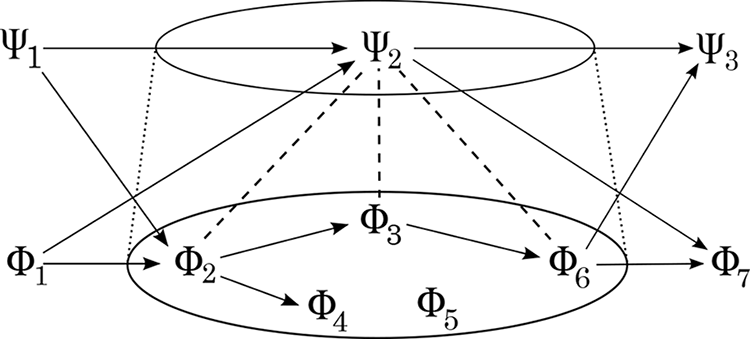
Phenomena typically have a multitude of spatiotemporal parts, only a proper subset of which are constitutively relevant to them. Likewise, they tend to be involved in manifold causal interactions with nonconstituents. Figure 1 provides an illustration: the phenomenon Ψ2 in the macro-level ellipse has five parts in the micro-level ellipse; only three of them, namely, Φ2, Φ3, and Φ6, are constituents of Ψ2; both the phenomenon and its constituents are involved in numerous inter- and intralevel causal relationships. That abstract structure can, for instance, be interpreted in terms of the mechanism underlying a cruising car, such that Ψ2 represents the phenomenon of the car’s movement, Φ2 the running engine, Φ3 the transmission of momentum to the axle, and Φ6 the turning wheels. Moreover, the car has two parts that are not constitutively relevant to its movement, namely, the air conditioning, Φ4, which is also operated by the engine, and the ashtray, Φ5, which is causally detached from the causal mechanism constituting the car’s movement. The purpose of a theory of constitution is to provide criteria that distinguish constituents from nonconstituting parts and from their causes and effects.
An example of a phenomenon Ψ2 with three constituents, Φ2, Φ3, and Φ6, and two nonconstituting parts, Φ4 and Φ5. Dashed lines represent constitution, directed edges symbolize causation, and the dotted lines stand for spatiotemporal overlap.

According to Craver’s (Reference Craver2007) MM, constitution is a difference-making relation that is adequately analyzed by suitably supplementing the resources of the currently most popular difference-making theory of causation: Woodward’s (Reference Woodward2003) interventionism. In a nutshell, interventionism stipulates that a variable  is a cause of another variable
 iff it is possible to (ideally) intervene on
 in such a way that
 changes, when all off-path causes of
 are fixed (cf. Woodward Reference Woodward2003, 59).Footnote 2 As constitution, contrary to causation, is a bidirectional dependence relation among parts and wholes, unidirectional manipulability as in interventionism does not suffice to establish constitutive relevance. Therefore, Craver adds a parthood and a mutuality constraint: constituents are spatiotemporal parts of phenomena and both are mutual difference-makers of each other. More explicitly: “to establish that X’s Φ-ing is relevant to S’s Ψ-ing [where X is a spatiotemporal part of S] it is sufficient that one be able to manipulate S’s Ψ-ing by intervening to change X’s Φ-ing (by stimulating or inhibiting) and that one be able to manipulate X’s Φ-ing by manipulating S’s Ψ-ing. To establish that a component is irrelevant, it is sufficient to show that one cannot manipulate S’s Ψ-ing by intervening to change X’s Φ-ing and that one cannot manipulate X’s Φ-ing by manipulating S’s Ψ-ing” (Craver Reference Craver2007, 159).
MM provides a sufficient condition for constitutive relevance and a sufficient condition for constitutive irrelevance, which jointly amount to a sufficient and necessary condition for constitutive relevance—that is, to a complete definition of constitution.Footnote 3 The core notion in its definiens is the modal notion of manipulability, which Craver (Reference Craver2007, sec. 4.8.3) cashes out in terms of the existence of a possible ideal intervention as defined by Woodward (Reference Woodward2003, 98). An ideal intervention on Ψ with respect to Φ is a variable  taking one of its values,
 , and thereby surgically fixing the value of Ψ without having an impact on Φ that is not mediated via Ψ and without being correlated with any other (off-path) causes of Φ. In sum, MM amounts to the following (where the specificity of the variables is made explicit):
(MM) Φ(X) is constitutively relevant to Ψ(S) iff (i) X (respectively, X’s Φ-ing) is a spatiotemporal part of S (respectively, S’s Ψ-ing); (ii) there exists a possible ideal intervention  on Φ(X) with respect to (w.r.t.) Ψ(S) that is associated with a change in Ψ(S); (iii) there exists a possible ideal intervention
 on Ψ(S) w.r.t. Φ(X) that is associated with a change in Φ(X).
One of the main selling points of MM is that it is directly operationalizable experimentally. The most straightforward way of establishing the possibility of mutually intervening on Φ and Ψ is to furnish actual bottom-up and top-down interventions of types  and
 . If, and only if, such experiments reveal mutual difference-making among wholes and parts, the latter are proven to be constituents of the former. To use figure 1 as an illustration, Φ2 (the car’s engine) is conclusively shown to be a constituent of Ψ2 (the car’s movement) by performing one intervention on Φ2 (e.g., taking one’s foot off the accelerator) that is associated with a change in Ψ2 (the car’s deceleration) as well as one intervention on Ψ2 (e.g., adding external friction) that is associated with a change in Φ2 (the engine working harder). By contrast, if it is established (inductively or otherwise) that there are no such mutual difference-making interventions on parts Φ4 (the air conditioning) and Φ5 (the ashtray) or on causes (Φ1, Ψ1) and effects (Φ7, Ψ3) of the mechanism, MM identifies these variables as nonconstituents of Ψ2.
Although MM has considerable intuitive appeal, the remainder of this section will show that it does not amount to an adequate theory of constitution—not because it merely fails in some intricate cases but because it fails in all cases. In short, the reason is that MM is unsatisfiable in principle, for there cannot exist ideal interventions on upper and lower levels of a mechanism that are associated with changes on the other level.
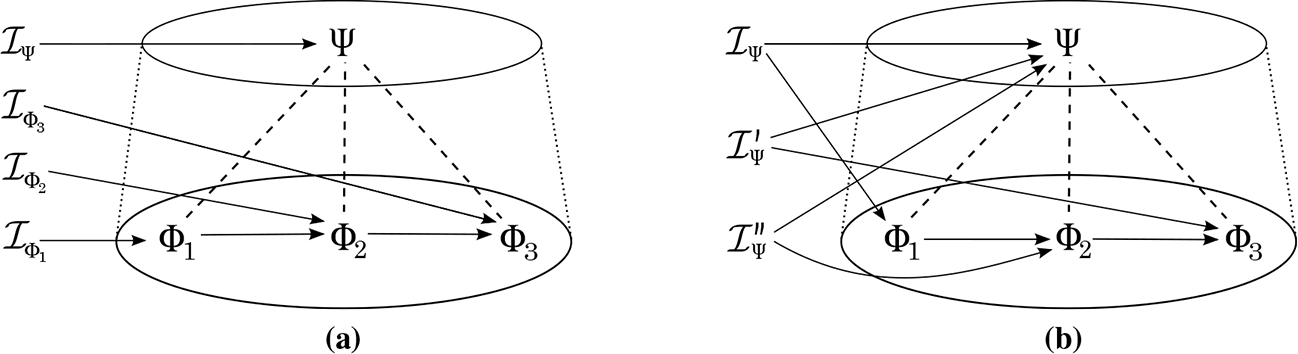
To see this, consider the simple mechanism in figure 2a: Ψ has the three constituents Φ1, Φ2, Φ3, which together form what we subsequently call a constituting set Φ = {Φ1, Φ2, Φ3}. MM entails that, for the elements of Φ to be constituents of Ψ, it is necessary that there exist intervention variables  ,
 ,
 , and
 as depicted in figure 2a that can induce changes on the system’s other level. Thus, assume (for reductio) that
 is an intervention variable for Ψ w.r.t. Φ1 such that changing Ψ via
 is associated with a change in Φ1 (when all off-path causes of Φ1 are held fixed). In that case, Woodward’s interventionism, which constitutes the theoretical background of MM, entails that
 is a cause of both Ψ and Φ1. This can be realized in one of two ways: either
 causes Ψ and Φ1 along one causal path, say,
 , or along two paths,
 . The former option is excluded since the instances of Ψ and Φ1 spatiotemporally overlap (i.e., the corresponding values of the variables represent spatiotemporally overlapping behaviors), which entails that their relationship is noncausal. Hence,
 causes Ψ and Φ1 along two different paths, meaning that
 is a common cause of Ψ and Φ1.Footnote 4 That, in turn, entails that
 does not surgically cause Ψ and is therefore not an intervention variable for Ψ w.r.t. Φ1, which contradicts our initial assumption, thereby reducing it to absurdity.Footnote 5
Model a depicts the impossible surgical interventions required by MM; model b, by contrast, features the possible fat-handed interventions.

This result can easily be generalized. Due to the noncausal nature of the relationship between phenomena and their parts, every cause of a mechanism’s upper or lower level that is associated with a change on the other level is a common cause of the corresponding occurrences on the two levels. In other words, whatever makes a difference on both levels of a mechanism does so along different causal paths and, hence, is not a surgical intervention.
Furthermore, as the constituents Φ of Ψ realize Ψ on the micro level, they form the supervenience base of Ψ in the mechanistic context of figure 2a, which entails that every change in Ψ (occurring in some spatiotemporal region) is necessarily accompanied by a change in Φ (i.e., in some Φi in Φ, occurring in the same spatiotemporal region). Every cause inducing a change in Ψ necessarily also brings about a change in at least one Φi in Φ and is thus a common cause of Ψ and Φi. More concretely, every cause of Ψ has the structural properties of either  ,
 , or
 in figure 2b. And more generally, every cause of a mechanism’s macro level is necessarily a common cause of the phenomenon and at least one of its constituents. Phenomena and their constituents can be manipulated only with a fat hand (cf. Baumgartner and Gebharter Reference Baumgartner and Gebharter2015).Footnote 6 Overall, the types of interventions required by MM cannot possibly exist for any mechanistic system. MM is hence unsatisfiable, which means that constitutive relations as defined by MM are inexistent, which again entails that friends of mechanistic explanations who rely on MM chase a chimera. This result reduces MM to absurdity.
3. Underdetermination of Constitutional Inference
The source of this fatal deficiency of MM is easily pinpointed: MM definitionally ties the notion of constitution to the possibility of surgical top-down and bottom-up interventions that target one level of a mechanism and thereby change the other level, where in fact it is possible to induce changes on upper and lower levels of a mechanism only by fat-handedly targeting both levels on different causal paths. Contrapositively put, whenever surgical interventions that target a first variable and induce changes in a second one are possible, these variables are not linked in terms of constitution but in terms of causation—as is duly entailed by the interventionist theory of causation (Woodward Reference Woodward2003). An obvious conclusion to draw is that constitution should not be analyzed in terms of surgical (or ideal) mutual manipulability. If the mutual manipulability idea is to get off the ground at all, it must be cashed out in terms of nonsurgical interventions of some sort.
Indeed, prompted by problems of the original version of interventionism with macro-to-micro causation, Woodward (Reference Woodward2015) has recently offered a modified variant of his theory, interventionism*, which comes with a correspondingly modified notion of an intervention.Footnote 7 He now (Reference Woodward2015, 334) defines an intervention on Ψ w.r.t. Φ to be a variable  taking one of its values,
 , and thereby fixing the value of Ψ without having an impact on Φ that is not mediated via Ψ or via a variable Γ, which is related in terms of supervenience to Ψ or Φ, and without being correlated with any other (off-path) cause Γ of Φ such that Γ is not related in terms of supervenience to Ψ or Φ. Against that background,
 can pass as an intervention variable for Ψ w.r.t. Φ even if
 is connected to Φ along causal paths that do not go through Ψ but through variables related to Ψ by supervenience. That is, according to interventionism*, common causes of macro and micro levels of mechanisms as in figure 2b count as interventions, because the macro level supervenes on the micro level. If such interventions are moreover associated with changes on both levels, which in light of the fat-handedness of these interventions will consistently be the case, MM turns out to be applicable to mechanistic systems and to entail that different levels of such systems are related in terms of constitution.
That is, giving up the surgicality requirement for interventions allows the mutual manipulability framework to steer clear of the reductio argument of the previous section. Nonetheless, the fact remains that all of the nonsurgical interventions on one level of a mechanism that are associated with changes on the other level are fat-handed, which, as this section will show, has far-reaching consequences for the inference to constitution and—a fortiori—for theories that analyze constitution in terms of the existence of (possible) manipulations of mechanisms.
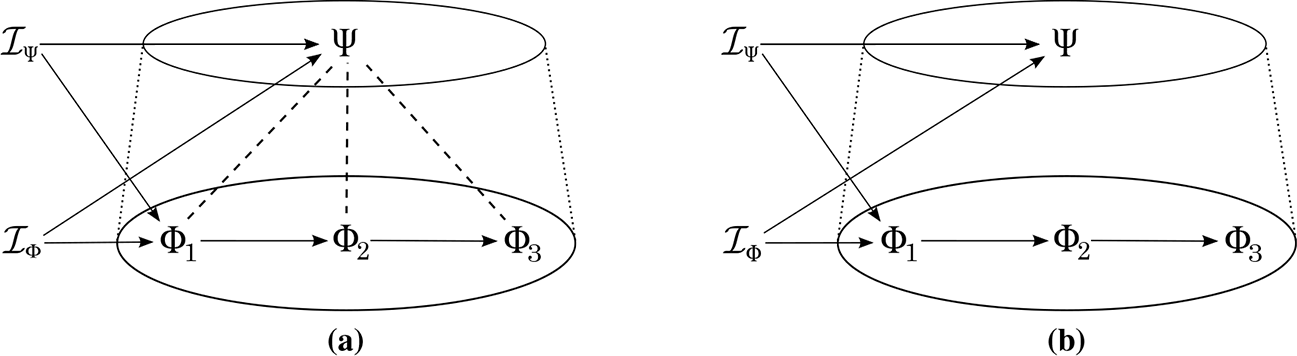
Fat-handed interventions generate confounded data, which, in turn, greatly diminishes the inferential leverage delivered by them (cf., e.g., Scheines Reference Scheines2005). Data produced by a common cause of two target variables are uninformative as regards the relationship between these variables. To see this, consider the fat-handed interventions depicted in figure 3a. If such interventions bring about correlations between the upper and lower levels, these correlations can be fully accounted for by the mere fact that the two levels are wiggled with a fat hand. Hence, there is no need at all to stipulate the existence of additional constitutive dependencies. Model 3a, which features constitutive dependencies, and model 3b, which does not, imply the very same correlations under manipulations via  and
 . As all manipulations that induce changes on both levels of a mechanistic system are fat-handed, this finding, again, can be generalized: relaxing the constraints imposed on interventions along the lines of interventionism* entails that the mutual manipulability of macro and micro levels can always be accounted for by the mere fat-handed nature of corresponding manipulations. Mutual manipulability via common causes does not provide a rationale for inferring constitutive relations.Footnote 8 For every model featuring constitution there exists a pure common-cause model that entails the very same correlations under manipulations and, hence, cannot be distinguished from the former model empirically.
Two empirically indistinguishable mechanistic models.

Nonetheless, if two common causes of Ψ and Φ1 (such as  and
 in fig. 3) that count as interventions by the standards of interventionism* yield changes on both levels of the system, MM—interpreted against the background of interventionism*—infers that Φ1 is constitutively relevant to Ψ. And Craver is not alone in contending that a few suitable experiments (in a controlled laboratory context) can afford conclusive experimental evidence for constitution. Harbecke (Reference Harbecke2015), for instance, proposes a variant of Mill’s (Reference Mill1843) method of difference that he claims to be apt for evidence-based constitutional discovery. In a nutshell, the idea is that if in one of two test situations, which are homogeneous with respect to instantiations of unmeasured constituents of a scrutinized phenomenon Ψ, a change is induced on a mereological part Φ of Ψ such that Ψ changes its value while both Φ and Ψ remain unchanged in the other of the two test situations, it can be inferred that Φ is a constituent of Ψ. However, the fat-handedness of all manipulations of different levels of mechanistic systems inevitably yields that no evidence for constitutive relations can be produced by those manipulations. Even in laboratory contexts that are perfectly homogeneous with respect to unmeasured factors that (causally or constitutively) determine a phenomenon Ψ, it is impossible to generate unconfounded data on constitutive relations. As a result, the inference to constitution is systematically underdetermined by evidence.
What is more, empirical underdetermination affecting constitutional inference differs from empirical underdetermination as is known from causal inference. Empirical data can often be accounted for in terms of different causal models that fare equally well with respect to all parameters of model fit (cf., e.g., Spirtes, Glymour, and Scheines Reference Spirtes, Glymour and Scheines2000, 59–72; Eberhardt Reference Eberhardt2013). Such underdetermination ultimately stems from the complexity of the causal structures in the world we live in and from our limited capacities for controlling background influences in ordinary discovery contexts. The resulting noise in typical real-life data yields that the latter, every so often, do not unambiguously reflect underlying causal structures. But this common form of empirical underdetermination can be resolved in ideal discovery contexts. Causes and effects are mereologically independent entities. It is possible to surgically intervene on a cause with respect to its effect. Moreover, since it takes time for causal influence to be transmitted from the cause to the effect, an effect can be suppressed via suitable interventions even after the cause has occurred; that is, causal interactions can be broken. As a result, cause-effect pairs can, at least in principle, be isolated from confounding background influences. It follows that contexts of causal discovery can be idealized to such a degree that crucial experiments become possible that produce unconfounded data providing conclusive evidence for causal dependencies. The paradigm example of such an ideal discovery context is the experimental setting envisaged in Mill’s method of difference, which also underlies interventionist approaches to causal inference. If a variable  is associated with changes in a (mereologically independent) variable
 , when all other causes of
 are fixed and all further required background assumptions are warranted (e.g., that
 does not change in an uncaused manner, i.e., miraculously), it conclusively follows that
 is causally relevant to
 (Hofmann and Baumgartner Reference Hofmann and Baumgartner2011). That is, there exist ideal discovery circumstances in which causal relations can receive unambiguous empirical support.
Such ideal discovery circumstances cannot possibly exist for constitutive relations. Since constituents realize phenomena on the micro level, manipulating phenomena is tantamount to manipulating their constituents. It is impossible to surgically intervene on phenomena, break constitutive dependencies, and isolate phenomenon-constituent pairs. As a result, even in ideal discovery contexts in which all unmeasured relevant factors for a scrutinized phenomenon Ψ are (assumed to be) fixed and all further required background assumptions are warranted (e.g., that the spatiotemporal parts of Ψ have been correctly identified), it is impossible to produce unconfounded evidence for constitutive relations. The reason is that in constitutional discovery—as opposed to causal discovery—data confounding is introduced by the very experimental manipulations intended to uncover constitution. Therefore, even data generated under ideal constitutional discovery circumstances can always be accounted for both by a model featuring constitutive dependencies and by a model without such dependencies. Or differently, even if the hypothesis “Φ is a constituent of Ψ” is experimentally tested in isolation (i.e., such that the whole theoretical background is taken to be beyond doubt), no evidence can be produced demonstrating that this hypothesis is true and its negation false. Contrary to the case of causation, there cannot exist an experimentum crucis for constitution. Being experimentally underdetermined is an inherent feature of constitutive relations.
This shows that analyses of constitution in terms of the existence of suitable experimental manipulations of mechanistic systems—be it of the surgical or nonsurgical type—are beyond repair. In particular, the basic idea behind Craver’s MM, namely, to account for constitution by supplementing the resources of the most popular difference-making theory of causation, interventionism, by a parthood and a mutuality tweak, is not just misguided because of unrealistic surgicality requirements but because phenomena and their constituents simply are not difference-makers of one another. Rather, they share common difference-makers in their mutual causal past; that is, they are unbreakably coupled via common causes. The fundamental differences between causation and constitution yield that these two relations must be theoretically accounted for in fundamentally different terms and uncovered by following fundamentally different methodological protocols.
4. An Abductive Alternative
In this section, we propose an alternative theory of constitutive relevance, which avoids MM’s problems by further developing the main finding of the previous sections: the characteristic feature of constitution is not the possibility of surgical top-down and bottom-up interventions on mechanisms, but the impossibility of such interventions. Whatever makes a difference on both levels of a mechanism necessarily does so along different causal paths, because constituents are spatiotemporal parts of phenomena and, hence, not themselves causally related to the latter. Therefore, while causal dependencies can be broken by means of suitable surgical interventions, there do not exist surgical interventions that could break constitutive dependencies. Rather, constitution relates macro and micro levels in such a way that they are unbreakably coupled via common causes.
To render this idea precise, it must first be emphasized that the common-cause coupling that marks constitution is characterized by an asymmetry between macro and micro levels, which stems from the fact that a phenomenon Ψ of a given mechanism supervenes on its constituents in a constituting set Φ = {Φ1, …, Φn}, but not vice versa. In consequence, every cause of Ψ is necessarily associated with a change in at least one element of Φ, and thus, it causes the latter change on a path that does not go through Ψ. That is, every cause of Ψ necessarily is a common cause of Ψ and at least one element of Φ. The same, however, does not hold for causes of the constituents in Φ. Supervenience does not exclude the possibility of causing changes in the supervenience base that are not associated with a change in the supervening property. For instance, if two values ɸn and ɸm of Φ1 realize the same value ψk of Ψ, causes that induce a change from Φ1 = ɸn to Φ1 = ɸm (or vice versa) are invariably associated with Ψ = ψk. Such causes can count as surgical, and hence, the micro level may be surgically manipulated. But since surgical micro-level causes are not associated with changes on the macro level, they are nonrevealing with respect to constitutive relations—and thus irrelevant for an analysis of constitution. The micro-level causes that are of relevance to account for constitution are the ones that are associated with changes on the macro level, and it does hold that these causes are common causes of the micro and macro levels.
The condition of common-cause coupling needs further refining, for, as stated, it may also be satisfied by variable sets containing parts of a phenomenon that do not constitute it. To illustrate, reconsider the mechanism in figure 1. The variable Φ4, which represents a car’s AC, is an effect of the constituent Φ2, the car’s running engine, but not itself a constituent of the phenomenon Ψ2, the car’s movement. In Craver’s (Reference Craver2007, 143) jargon, the AC is a “sterile effect” of the mechanism, that is, a constitutively irrelevant downstream effect of a constituent. Many common causes affect both the AC and the moving car. For instance, starting the engine initiates both the AC and the car’s movement, and, conversely, stopping the engine terminates both the AC and the movement. And yet, the AC is not a constituent, for an obvious reason: the influence of the common causes of the cruising car and its AC is always mediated via another spatiotemporal part of the car, namely its engine, which is a constituent of the movement. Or consider the causally and constitutionally isolated variable Φ5, which represents the behavior of the car’s ashtray. Many causes of Ψ2 will also cause changes in Φ5. For example, an accident can both warp the ashtray and stop the car. But that an accident can be a common cause of the deformed ashtray and the termination of a movement does not show that the ashtray is a constituent of the car’s movement. The reason is, again, obvious: the accident warps not only the ashtray but also the engine, which is a constituent of the car’s movement.
To ensure that a constituting set Φ exclusively contains constituents and, in particular, that it excludes nonconstituents such as sterile effects and isolated parts, we require that Φ be redundancy-free in the sense that no proper subset of Φ is common-cause coupled with the phenomenon. That is, for every proper subset Φ′ of Φ, some cause of the phenomenon exists that fails to be associated with a change in Φ′ and, instead, is associated with a change in an element of Φ outside of Φ′. Nonconstituents such as sterile effects or isolated parts can be eliminated from a set of parts of the phenomenon without breaking the common-cause coupling of the phenomenon and the remaining parts: any change in the phenomenon still is associated with a change in some element of the resulting subset. More concretely, Φ4 and Φ5 are not part of a constituting set Φ of the phenomenon Ψ2 in figure 1 because the set Φ″ = {Φ1, Φ2, Φ3, Φ4, Φ5} is not redundancy-free: it contains a proper subset, Φ = {Φ1, Φ2, Φ3}, that is common-cause coupled to Ψ2, meaning that every cause of Ψ2 is a common cause of Ψ2 and at least one element of Φ.
Overall, we contend that a first defining feature of a constituting set Φ of a phenomenon Ψ is that it is common-cause coupled with Ψ in a redundancy-free manner, meaning that both of the following two conditions are satisfied. First, every cause of Ψ is a common cause of Ψ and at least one Φi in Φ. Second, no proper subset Φ\{Φi} is common-cause coupled with Ψ; more precisely, for any Φi in Φ, there exists at least one cause of Ψ that is not a common cause of Ψ and any Φj in Φ\{Φi}.
However, many variable sets Vi including only causally related variables may comprise a variable V 1 and a subset  of Vi that does not include V 1, such that V 1 and
 are common-cause coupled (i.e., such that every cause of V 1 in Vi is a common cause of V 1 and some element of
 ) and
 is redundancy-free. Hence, the criterion of common-cause coupling needs to be supplemented by a further criterion, which discriminates between constitutional and nonconstitutional (i.e., coincidental) common-cause couplings. We contend that the identifying feature of constitutional common-cause couplings is their unbreakability. That is, if the set of analyzed variables is expanded, coincidental common-cause couplings may be broken whereas constitutional common-cause couplings will persist across all variable set expansions. More concretely, if a variable V 1 and a set
 coincidentally happen to be common-cause coupled within a set Vi, expansions of Vi by further causes of V 1 are bound to unveil, say, surgical causes of V 1 that do not induce changes in
 —to the effect that the common-cause coupling disappears. This is excluded in cases of constitution. The common-cause coupling of a phenomenon Ψ and a constituting set Φ is not a mere contingency of a modeled set V, which contains Ψ and Φ along with a given number of their common causes; rather, it is a structural necessity of the relationship between Ψ and Φ, which holds not only relative to V but also relative to every expansion of V.
That means that, even though the constitutional model 3a and the pure causal model 3b in figure 3 are indistinguishable relative to data on the variables in the set  , they are not equivalent in their implications for what happens under expansions of V3. Model 3a with its constitutive dependencies entails that the common-cause coupling of Ψ and its constituents cannot be broken by expanding V3, whereas model 3b does not have any such implications. Rather, according to model 3b, it is to be expected that, sooner or later, surgical causes of Ψ and Φ1 to Φ3 will be found that break their coupling.
These different implications render it possible to choose between constitutional and pure common-cause models. Gradually expanding V3 (in a series of follow-up studies) will yield one of two outcomes: (i) the common-cause coupling of Ψ and Φ = {Φ1, Φ2, Φ3} is broken or (ii) it is not broken. In case of outcome i, the attempt to model the relationship between Ψ and Φ constitutionally is empirically rejected. If, say, a follow-up study reveals a surgical cause of Ψ, Φ is shown not to be a constituting set of Ψ, meaning that the common-cause model prevails. By contrast, outcome ii gives preference to modeling Φ as a constituting set of Ψ, notwithstanding the fact that the correlations in every expansion of V3 can likewise be reproduced by a mere common-cause model. The reason is that a constitutional model not only reproduces the empirical correlations but also explains why the common-cause coupling of Ψ and Φ is not broken. That is, in case of outcome ii, a constitutional model is preferable over a pure common-cause model because it exceeds the latter in explanatory power. While it is a structural necessity of the constitutional model 3a that Ψ and Φ remain common-cause coupled in all expansions of V3, namely, that outcome ii obtains, the common-cause model 3b provides no reason whatsoever why surgical causes of Ψ cannot be found. The inference to constitution is thus inherently abductive: constitutional models are preferable over pure causal models because they explain both the highly correlated behavior of phenomena and their constituents as well as the impossibility of decoupling them.Footnote 9
By letting a complex instance of a variable set Φ designate the occurrence or process (in a particular spatiotemporal region) represented by a complex value assignment Φ1 = ɸ1, …, Φn = ɸn to all elements of Φ, we can now introduce the definitional details of our proposed No Decoupling (NDC) theory of constitutive relevance (where the specificity of the variables is again made explicit):
(NDC) Φ1(X 1) is constitutively relevant to Ψ(S) if, and only if, there exists a variable set V containing Ψ(S) and a proper subset Φ(X) = {Φ1(X 1), …, Φn(X n)}, such that all of the following conditions are satisfied:
1. Parthood. For every complex instance of Φ(X), there is an instance of Ψ(S) such that the former is part of the latter.
2. Coupling.
i. Every cause of Ψ(S) in V is a common cause of Ψ(S) and at least one Φi(X i) in Φ(X).
ii. For no Φi(X i) in Φ(X) does Φ(X)\{Φi(X i)} comply with part 2.i.
3. No decoupling. The coupling of Φ(X) and Ψ(S) cannot be broken (invalidated) by expanding V.
NDC differs in a number of crucial ways from MM. First, it replaces MM’s mutual manipulability conditions by Coupling and No Decoupling. This replacement ensures that NDC avoids the problems of MM: while MM defines constitution in terms of the possibility of top-down and bottom-up interventions, Coupling and No Decoupling essentially define it in terms of the impossibility of such interventions. Coupling and No Decoupling capture what we take to be the characteristic feature of constituents, namely, that they are unbreakably linked to their phenomenon via common causes.
Second, on a related note, while MM cashes out constitution broadly on a par with causation, NDC defines it in stark opposition to causation. More concretely, according to difference-making theories of causation, of which interventionism and interventionism* are popular instances, a causal relation among  and
 is analyzed in terms of the existence of (possible) probabilistic or counterfactual difference-making scenarios. As section 2 has shown, MM likewise renders constitution dependent on the existence of (possible) mutual difference-making scenarios. That is, both causation and constitution are rendered as existentially defined relations. In consequence, that some entities are related in terms of causation or constitution promises to be conclusively verifiable by exhibiting the existence of required difference-making scenarios. By contrast, NDC defines constitution in terms of the nonexistence of (possible) surgical causes. As a negative existential is the same as a universal negation, NDC renders constitution as a universally defined relation. According to NDC, it thus holds that a constitutive relation cannot be conclusively verified; rather, it can only be inductively corroborated.
In that light, NDC-defined constitution is much closer to noncausation or causal irrelevance than to causation. To establish that  is causally irrelevant to
 , according to difference-making theories, requires establishing the nonexistence of a (possible) scenario where
 makes a difference to
 . No (finite) data sample could ever conclusively establish this. Due to the fact that it is a universally defined relation, causal irrelevance—just as NDC-defined constitution—can only be inductively corroborated. Of course, NDC does not yield a notion of constitution that is coextensional with causal irrelevance. After all, constitution is a robust dependence relation, whereas the extension of causal irrelevance encompasses many independent entities. Still, the extension of the notion of NDC-constitution is a proper subset of the extension of the notion of causal irrelevance (as defined by difference-making theories). This squares nicely with our initial background assumption—taken from the canon of mechanistic theorizing—that constitution is a distinctly noncausal form of dependence (Craver and Bechtel Reference Craver and Bechtel2007).
A third manifest difference between NDC and MM is that the former defines constitutive relevance of Φi to Ψ with recourse to sets of variables, whereas according to the latter, that relation is defined in terms of the pair 〈Φi, Ψ〉 alone. That is, while MM renders constitutive relevance as an intrinsic property of the pair 〈Φi, Ψ〉, NDC renders it as an extrinsic property of that pair, which depends on whether Φi is contained in a constituting set of Ψ. This does justice to the fact that, contrary to causal dependencies, pairwise constitutive dependencies cannot be isolated from their context; rather, a constituent Φi is an indispensable element of a system that figures as supervenience base realizing Ψ in a given mechanistic context—to the effect that the phenomenon cannot exist without the constituents. At the same time, the set relativity of NDC-defined constitution does not turn it into a relativized notion. Whether Φi is a constituent of Ψ does not depend on the existence of a particular constituting set but on the existence of any such set. Moreover, No Decoupling ensures that constitutive relations are constant across variable set expansions. Either they hold relative to all expansions of a set that is common-cause coupled to a scrutinized phenomenon or they do not hold at all.
5. Constitutional Discovery in a New Light
As indicated in section 2, one of the most attractive features of MM is that it is straightforwardly operationalizable methodologically: to establish that a spatiotemporal part is a constituent of a phenomenon, it is sufficient to produce one successful top-down and one bottom-up intervention each. We have seen, however, that MM does not ground a viable method of constitutional discovery. For reasons of space, we must postpone a methodological operationalization of NDC to another occasion. Still, we want to emphasize that, against the background of NDC, constitutional discovery appears in a very different light than against the background of MM.
The role NDC attributes to experimental manipulations of mechanisms differs fundamentally from the role attributed to them by MM. MM calls for top-down and bottom-up manipulations whose intended purpose is to reveal mutual difference-making. By contrast, NDC—being formulated in terms of common-cause coupling instead of mutual difference-making—does justice to the fact that there cannot exist top-down and bottom-up manipulations in the first place, that is, manipulations that indirectly induce changes on one level of a mechanism by virtue of directly changing the other level. Rather than for mutual difference-making, NDC requires testing for unbreakable common-cause coupling, which is considerably more challenging than the simple test designs demanded by MM.
Whereas, according to MM, one successful top-down and one bottom-up manipulation warrant an inference to constitution, corroborating the unrestricted universal quantifiers in Coupling and the impossibility operator in No Decoupling calls for a whole battery of severe tests. In a nutshell, the ways of manipulating a phenomenon Ψ and the elements of a candidate constituting set Φ must be systematically altered while the baseline set of modeled variables V is gradually expanded, in order to check whether, outside of V, there exist surgical causes that break the common-cause coupling of Φ and Ψ.
That is, testing for the unbreakability of a common-cause coupling calls for maximally diverse manipulations in maximally diverse background conditions. Of course, it will often be infeasible to conduct experiments on the whole space of common causes of a system’s levels, and all variable set expansions are bound to be finite. Therefore, after a finite number of expansions and severe but unsuccessful attempts at breaking recovered common-cause couplings, the satisfaction of Coupling and No Decoupling by Φ and Ψ must be inductively inferred. This, in turn, licenses an abductive inference to the constitutive relevance of every Φi in Φ.Footnote 10 By contrast, if variable set expansions reveal a surgical cause of Ψ that does not target any element of Φ, the common-cause coupling of Φ and Ψ is falsified. Note, however, that this does not also falsify the constitutive relevance of a particular Φi in Φ for Ψ. Even if Φ is not a constituting set, Φi might still be contained in another set Φ′, which is unbreakably common-cause coupled to Ψ. That is, while the common-cause coupling of Φ and Ψ is conclusively falsifiable, constitutive relevance of one particular Φi in Φ is not; rather, that Φi fails to be constitutively relevant to Φ can be inductively corroborated only by means of an extended unsuccessful search for a constituting set comprising Φi. Overall, as to NDC, every constitutional inference—be it to constitution or to nonconstitution—inevitably involves an inductive leap.
Independently of what exactly the details of an experimental method of constitutional discovery will eventually turn out to be, we contend that the following methodological consequence of NDC must be respected by any such method. Even under ideal discovery circumstances, no finite number of experimental manipulations can be sufficient to conclusively warrant a constitutional inference. In particular, there does not exist a design for an experimentum crucis for constitution. Rather, establishing constitutive relations requires an extended test series exploring the whole space of possible ways of breaking the coupling of macro and micro levels. Only if these tests are unsuccessful, an inference to constitution is warranted. And since the evidence for the unbreakability of common-cause couplings is never conclusive, constitution can only be inductively corroborated.
6. Conclusion
If, as is standardly assumed in mechanistic theorizing, constitution is a noncausal form of dependence and phenomena are nonreductively supervening on their constituents, constitution cannot be adequately accounted for in terms of mutual difference-making relations, along the lines of Craver’s (Reference Craver2007) mutual manipulability theory (MM)—which likewise invalidates all accounts of mechanistic explanation based on MM. The reason is that different levels of a mechanism can only be manipulated simultaneously, on different causal paths. In other words, the top-down and bottom-up interventions required by MM are impossible, because phenomena and their constituents can be manipulated only with a fat hand. In light of the inevitable fat-handedness of interventions on mechanisms, the inference to constitution is inherently underdetermined by evidence: for every constitutional model there exists an empirically equivalent pure common-cause model.
In that light, this article developed an abductive theory of constitution (NDC), according to which constitution is a dependence relation that best explains why phenomena and some of their spatiotemporal parts are unbreakably coupled via common causes. Rather than in terms of the possibility of mutual difference-making scenarios, NDC spells out constitution in terms of the impossibility of such scenarios. Against that background, constitutional inference and discovery appear in a new light. Subject to NDC, establishing that Φ is a constituent of Ψ amounts to establishing that Φ is contained in a set Φ that is unbreakably common-cause coupled to Ψ; this, in turn, calls for a whole battery of experiments exploring the space of possible manipulations of the scrutinized system. The abductive inference to constitution is warranted only if all attempts to decouple Φ and Ψ have failed.
An obvious question remains: is it possible to faithfully reconstruct constitutional reasoning in science in terms of NDC? Craver (Reference Craver2007) contends that MM provides a faithful reconstruction of scientific practice, and he has undertaken considerable efforts to interpret real-life studies on the basis of MM. We have done none of that sort for NDC here. Still, our results demonstrate that MM cannot ground a viable experimental method of constitutional discovery. Hence, if we grant practicing scientists that they uncover constitutive relations based on some viable method—whichever this may be—MM cannot faithfully reconstruct their practice. How well NDC fares in this respect is thus the crucial follow-up question to be answered in future work.